About

ISSN 2036-6981 (online)

ISSN 1127-1124 (print)

Founded in 1998,"Studi sulla Formazione" aimed at those in the academic world who are dedicated to advancing the field of education through their research. "Studi sulla Formazione" provides a range of articles that speak to the major issues in education across all content areas and disciplines. The journal is published two times per year and edited through a rigorous double blind review process that utilizes a national and international editorial board and peer reviewers. SSF promotes to advance research in the field of education through a collection of quality, relevant, and advanced interdisciplinary articles.
 
Scientific Direction - Editor-in-Chief:
Alessandro Mariani, University of Florence, Italy
 
Studi sulla Formazione is a Diamond Open Access Journal 

 
Studi sulla Formazione is indexed in:

Call for Papers

Ernesto Codignola's Contribution to Interpreting the Challenges
of the 21st Century
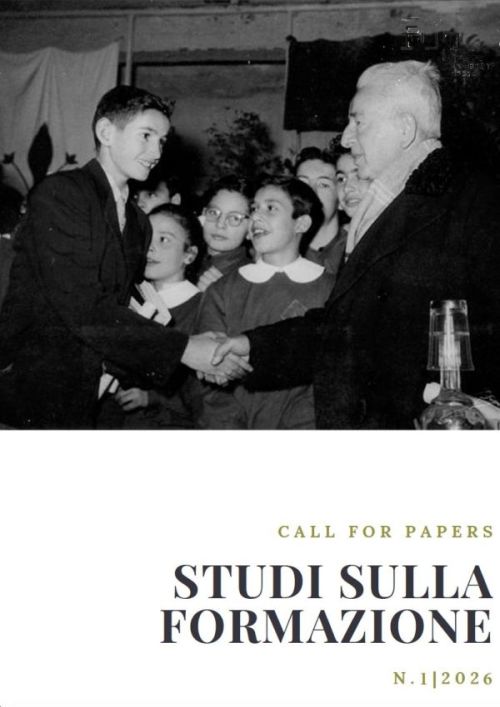
Ernesto Codignola was a follower and collaborator of Gentile and a central figure of pedagogical idealism in Italy.
Codignola's contribution to 20th-century Italian pedagogy and to the Florentine school constitutes a legacy that remains valuable and relevant for understanding and interpreting contemporary society and culture and for promoting a radical, critical, and secular-progressive pedagogy.
The dossier of the first edition of the journal “Studi sulla Formazione” in 2026 will develop this topic. We welcome contributions by Italian and foreign scholars, ware interested in the topic. The academic authors should communicate the title and the short abstract of the article and should send the final article (about 6.000-15.000 characters, spaces included) by May, 15th 2026 .

For further details please visit our CALL FOR PAPERS page.

Download the full call for paper in pdf (ita – eng)


Call for Papers

The European Union, a teacher of peace, can develop this vision globally!
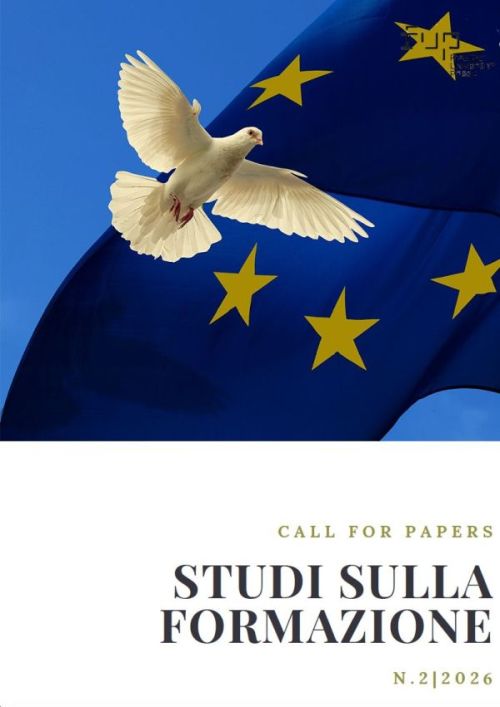
In our time (2020 and beyond), war has once again emerged as the preferred method for resolving conflicts between peoples, cultures, hegemonies... while a united Europe has forcefully reaffirmed its vocation to peace.
Europe is now becoming both the model and the goal of international politics and culture, capable of resolving conflicts through diplomacy and eliminating all armed means. Therefore, it is precisely from here that a Global Appeal for Peace and the Means to Achieve It must arise.
The dossier of the second edition of the journal “Studi sulla Formazione” in 2026 will develop this topic. We welcome contributions by Italian and foreign scholars, ware interested in the topic. The academic authors should communicate the title and the short abstract of the article and should send the final article (about 6.000-15.000 characters, spaces included) by September, 30th 2026 .


For further details please visit our CALL FOR PAPERS page.

Download the full call for paper in pdf (ita – eng)


Current IssueVol 29, No 1 (2026): Anno XXIX, 1-2026

Published June 30, 2026

##issue.tableOfContents##

Table of Contents

Editoriale

Editoriale
Franco Cambi
5
DOI: https://doi.org/10.36253/ssf-17523

Dossier - L'attualità di Ernesto Codignola per interpretare le sfide del XXI secolo

L'attualità di Ernesto Codignola per interpretare le sfide del XXI secolo
Cosimo Di Bari
7-16
DOI: https://doi.org/10.36253/ssf-17493
Ernesto Codignola: un pedagogista esemplare nell'Italia del Novecento
Franco Cambi
17-20
DOI: https://doi.org/10.36253/ssf-17494
“Bisogna lavorare a riaffiatare la scuola con la città”. Rileggendo il primo numero della rivista “Scuola e Città”
Rossella Certini
21-28
DOI: https://doi.org/10.36253/ssf-17495
Le scuole di domani: appunti per un dialogo Dewey-Codignola
Stefano Oliverio
29-36
DOI: https://doi.org/10.36253/ssf-17432
Sul filo della rete. Connessioni tra scuola e territorio nel pensiero di Ernesto Codignola e nell'eredità di Scuola-Città Pestalozzi
Valeria Angelini
37-43
DOI: https://doi.org/10.36253/ssf-17296
Scuola-Città Pestalozzi: un viaggio nella Didattica Attiva e nell’educazione democratica lungo 80 anni
Matteo Bianchini
45-53
DOI: https://doi.org/10.36253/ssf-17496
Ernesto Codignola e le origini di Scuola-città Pestalozzi: tra neoidealismo, attivismo e educazione del cuore
Tommaso Codignola
55-59
DOI: https://doi.org/10.36253/ssf-17497
Casa giocosa. L’antologia di Ernesto Codignola, Eurialo De Michelis e Raffaello Ramat
Maria Chiara Mattacchione
61-70
DOI: https://doi.org/10.36253/ssf-17397
Per una pedagogia della partecipazione: l'eredità critica del pragmatismo democratico nella scuola del XXI secolo
Antonio Sacristano
71-77
DOI: https://doi.org/10.36253/ssf-17359

Articles

L'algoritmo educativo e i suoi nemici. Strategie pedagogiche per orientarsi nella metamorfosi del mondo
Mario Caligiuri
79-87
DOI: https://doi.org/10.36253/ssf-15932
Due frontiere della filosofia educativa oggi: il compito plurale e il modello più critico. II. Mini.breviario di filosofia critica dell'educazione oggi. Nove noterelle
Franco Cambi
89-102
DOI: https://doi.org/10.36253/ssf-17498
L'ambiente educativo come infrastruttura sociale. Il Sistema Preventivo tra musicking, estetica dell’inclusione e contrasto alla povertà educativa
Valerio Ciarocchi
103-110
DOI: https://doi.org/10.36253/ssf-17348
I bambini e i loro spazi. Un dialogo tra Geografia dell'infanzia e Letteratura per l'infanzia
Giorgia Grilli
111-122
DOI: https://doi.org/10.36253/ssf-17234
Lo spazio del bianco: percorsi tra arte del Novecento e libri per l’infanzia
Valentina Valecchi
123-133
DOI: https://doi.org/10.36253/ssf-17180

Marginalia

Rileggendo “Il mio credo pedagogico di J.Dewey”, oggi
Franco Cambi
135-138
DOI: https://doi.org/10.36253/ssf-17521
Ricordo di Nicoletta Codignola
Daniela Sarsini
139-140
DOI: https://doi.org/10.36253/ssf-17522
View All Issues