


Published 2025-12-18
Keywords
- Early Modern Globalisation,
- Costume Books,
- Gender and Representation,
- Ethnography and Visual Knowledge,
- Cross-cultural Encounters
Copyright (c) 2025 Giovanni Tarantino

This work is licensed under a Creative Commons Attribution 4.0 International License.
Abstract
This article analyses Giulia Calvi’s Vestire il mondo as a major contribution to the visual history of early modern globalisation. Focusing on costume books from sixteenth–century Europe to Edo–period Japan, it explores how clothing functioned as a key medium for representing human difference and organising hierarchies of gender, religion, and civilisation. By tracing the transnational circulation of images, the essay highlights costume books as instruments of visual knowledge operating between art, ethnography, and power.
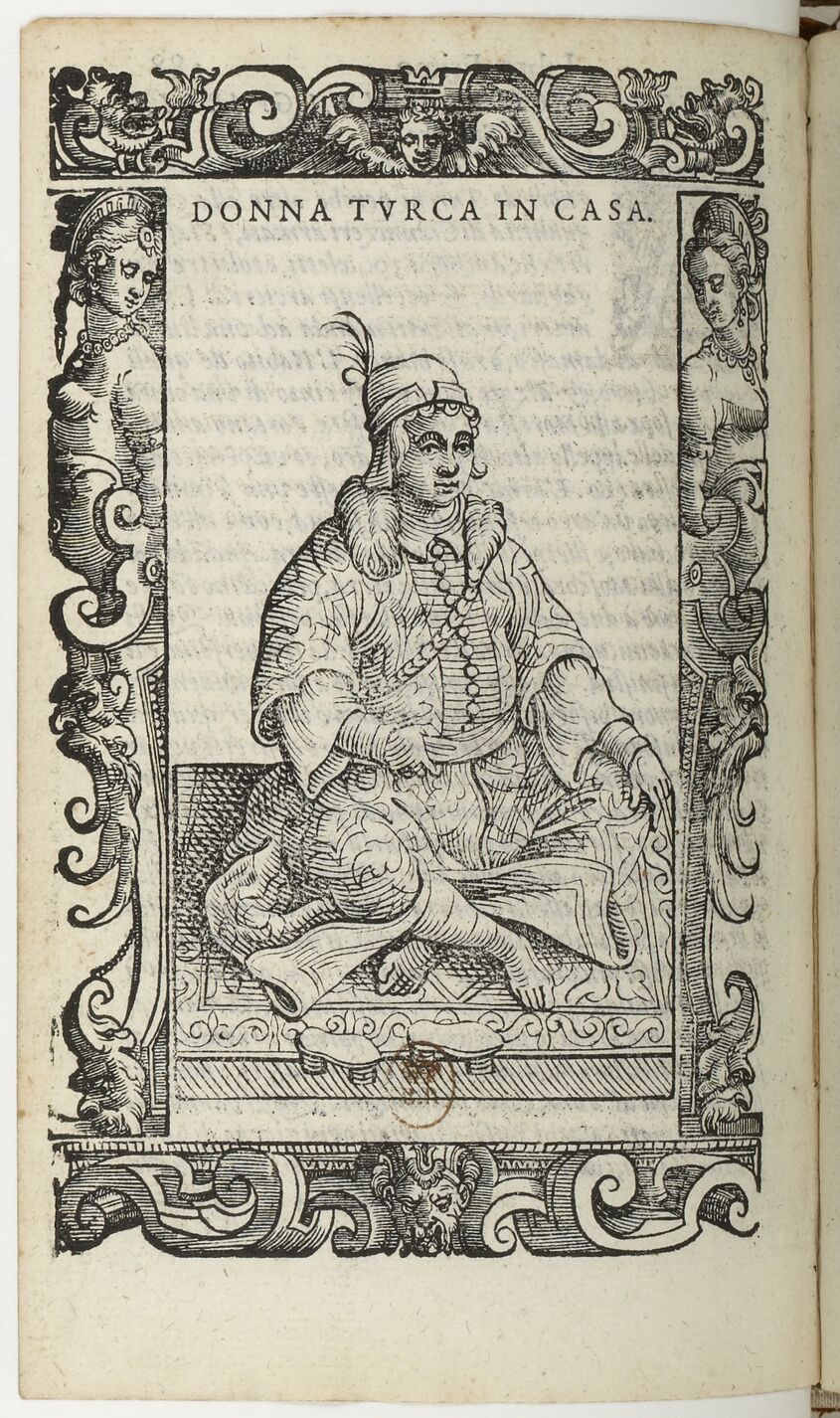
Image caption: Cesare Vecellio, Donna Turca in Casa, from De gli habiti antichi, e moderni di diverse parti del mondo libri due (Venice: presso Damian Zenaro, 1590), Bibliothèque nationale de France, RESERVE OB-12-4, 388v. Courtesy of the Bibliothèque nationale de France / Gallica. https://catalogue.bnf.fr/ark:/12148/cb403566709