

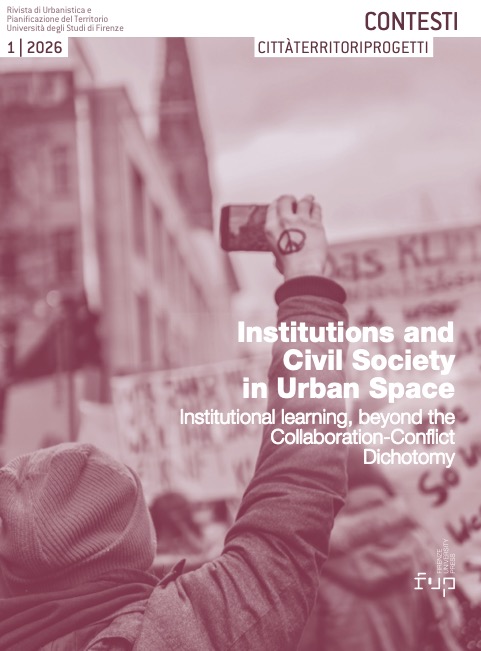
Istituzioni e società civile nello spazio urbano. : Apprendimento istituzionale, oltre la dicotomia tra collaborazione e conflitto
 Nadia Caruso
- Elena Ostanel
- Giulia Li Destri Nicosia
- Laura Saija
Published 2026-08-07
Keywords
- istituzioni,
- società civile,
- apprendimento istituzionale,
- co-produzione
How to Cite
Copyright (c) 2026 Nadia Caruso, Elena Ostanel, Giulia Li Destri Nicosia, Laura Saija

This work is licensed under a Creative Commons Attribution-NonCommercial 4.0 International License.
Abstract
This contribution examines how the relationship between public institutions and civil society has been conceptualized and operationalized in planning, outlining research directions that can advance the debate beyond the dichotomy between collaborative and conflictual approaches. On the one hand, it reviews dialogic-communicative and co-productive perspectives, which emphasize the role of civil society in governance processes and the co-production of urban commons. On the other hand, it discusses approaches that identify conflict as a constitutive dimension of democratic and transformative processes. The paper argues for moving beyond this dichotomy by recognizing that the relationship between the state and civil society is dynamic, context-dependent, and continuously reconfigured. From this perspective, the concept of institutional learning is reinterpreted by conceiving institutions as social practices that are continuously constructed and reconstructed through interactions between public and civic actors. This interpretation makes it possible to understand planning as a process of institutional transformation grounded in the shared production of rules, meanings, and collective practices.