


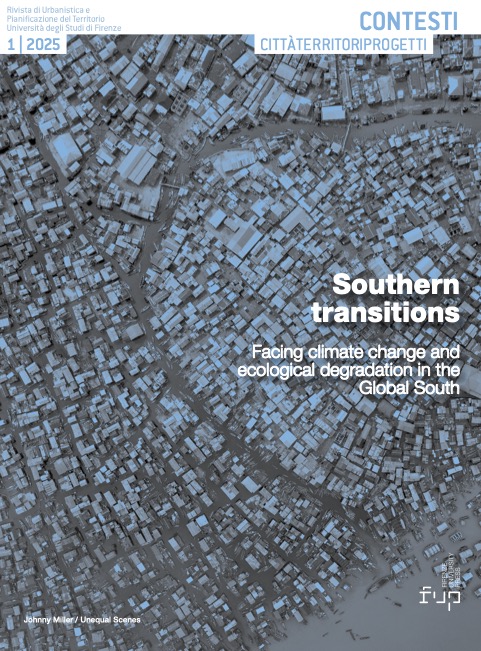
Published 2025-07-16
Keywords
- sustainability transitions,
- emerging economies,
- environmental justice ,
- circular economy ,
- climate change
How to Cite
Copyright (c) 2025 Irina Di Ruocco

This work is licensed under a Creative Commons Attribution-NonCommercial 4.0 International License.
Abstract
This study analyses one of the different dimensions of climate and ecological risk in the Global South, namely that of supply chains in these regions. The resilience of this economic-territorial tool is analysed through the lens of just transitions, reframing supply chains as socio-ecological systems. This perspective aligns with emerging interdisciplinary approaches while offering an original focus on territorial justice, informal economies, and participatory governance in urban logistics systems. The article innovatively proposes the integration of logistics and social resilience, and examines how decarbonisation, circular economy strategies and participatory governance shape sustainable supply chain transformations, highlighting the risk of reinforcing economic dependencies through sustainability policies centred on the global North that neglect local realities. Extending the discourse from urban planning and social justice to logistics, the research positions supply chains as critical elements of planetary justice. Through a comparative analysis of urban regions in the Global South, the study identifies best practices and obstacles to the sustainable adaptation of supply chains. The findings highlight the importance of participatory governance, regional supply networks and inclusive circular economy models to prevent new forms of economic subordination. By supporting place-based and justice-oriented approaches, this research contributes to strengthening spatial justice transferred to the logistics context, highlighting the central role of supply chains in promoting equitable and resilient ecological transitions for weaker countries.
Downloads
References
- Adelman S. 2018, The sustainable development goals, anthropocentrism and neoliberalism, in Hickel J., Lang M. (eds), Sustainable development goals, Edward Elgar Publishing, Cheltenham, pp. 15-40.
- Aguayo C., Eames C. 2017, Promoting community socio-ecological sustainability through technology: A case study from Chile, «International Review of Education», vol. 63, pp. 871-895.
- Anguelovski I., Alier J.M. 2014, The ‘Environmentalism of the Poor’ revisited: Territory and place in disconnected glocal struggles, «Ecological Economics», vol. 102, pp. 167-176.
- Baker J.L. (ed.) 2012, Climate change, disaster risk, and the urban poor: cities building resilience for a changing world, World Bank Publications, Washington D.C.
- Barbieri P., Boffelli A., Elia S., Fratocchi L., Kalchschmidt M., Samson D. 2020, What can we learn about reshoring after Covid-19?, «Operations Management Research», vol. 13, pp. 131-136.
- Braun B., Oßenbrügge J., Schulz C. 2018, Environmental economic geography and environmental inequality: challenges and new research prospects, «Zeitschrift für Wirtschaftsgeographie», vol. 62, n. 2, pp. 120-134.
- Bulkeley H. 2015, Can cities realise their climate potential? Reflections on COP21 Paris and beyond, «Local Environment», vol. 20, n. 11, pp. 1405-1409.
- Caniglia B.S., Vallée M., Frank B. (eds) 2016, Resilience, environmental justice and the city, Routledge, London.
- Cockburn J., Schoon M., Cundill G., Robinson C., Aburto J.A., Alexander S.M. et al. 2020, Understanding the context of multifaceted collaborations for social-ecological sustainability: a methodology for cross-case analysis, «Ecology and Society», vol. 25.
- Dhliwayo I. 2023, Emerging threats and the socio-ecological resilience of local communities, south-East Zimbabwe, Doctoral dissertation, Chinhoyi University of Technology, Chinhoyi, not published.
- Di Ruocco I., D'Auria A. 2024, Are the SEZs a place of social and urban conflicts? A look under the perspective of geographical social justice and inclusion, «Contesti. Città, territori, progetti», n. 1, pp. 192-211.
- Doorn N., Gardoni P., Murphy C. 2019, A multidisciplinary definition and evaluation of resilience: The role of social justice in defining resilience, «Sustainable and Resilient Infrastructure», vol. 4, n. 3, pp. 112-123.
- Douthwaite B., Hoffecker E. 2017, Towards a complexity-aware theory of change for participatory research programs working within agricultural innovation systems, «Agricultural Systems», vol. 155, pp. 88-102.
- Environmental Protection Agency (EPA) 2022, Health and Environmental Risk Assessment. Strategic Research Action Plan Fiscal Years 2023–2026, EPA, Washington D.C., https://www.epa.gov/system/files/documents/2022-10/HERA%20FY23-26%20StRAP_EPA-ORD_October%202022_508.pdf (03/25).
- Feola G. 2020, Capitalism in sustainability transitions research: Time for a critical turn?, «Environmental Innovation and Societal Transitions», vol. 35, pp. 241-250.
- Folke C., Haider L.J., Lade S.J., Norström A.V., Rocha J. 2021, Commentary: resilience and social-ecological systems: a handful of frontiers, «Global Environmental Change», vol. 71, art. 102400.
- Fraser N. 2008, Abnormal justice, «Critical Inquiry», vol. 34, n. 3, pp. 393-422.
- Fraser N. 2009, Scales of justice: Reimagining political space in a globalizing world, Columbia University Press, New York.
- Fuhr H. 2021, The rise of the Global South and the rise in carbon emissions, «Third World Quarterly», vol. 42, n. 11, pp. 2724-2746.
- Gereffi G., Humphrey J., Sturgeon T. 2005, The governance of global value chains, «Review of International Political Economy», vol. 12, n. 1, pp. 78-104.
- Herrera H., Bianchi C., Kopainsky B. 2018, Public policy planning to enhance the resilience of socio-ecological systems to climate change: operationalising resilience concepts from a dynamic perspective, Doctoral dissertation, University of Bergen, Bergen, not published.
- Hill R., Grant C., George M., Robinson C.J., Jackson S., Abel N. 2012, A typology of indigenous engagement in Australian environmental management: implications for knowledge integration and social-ecological system sustainability, «Ecology and Society», vol. 17, n. 1, art. 23, https://doi.org/10.5751/ES-04587-170123 (03/25).
- Hodson M., Marvin S. 2010a, Can cities shape socio-technical transitions and how would we know if they were?, «Research Policy», vol. 39, n. 4, pp. 477-485.
- Hodson M., Marvin S. 2010b, Urbanism in the anthropocene: Ecological urbanism or premium ecological enclaves?, «City», vol. 14, n. 3, pp. 298-313.
- Hofstetter J.S., De Marchi V., Sarkis J., Govindan K., Klassen R., Ometto A.R. et al. 2021, From sustainable global value chains to circular economy—different silos, different perspectives, but many opportunities to build bridges, «Circular Economy and Sustainability», vol. 1, n. 1, pp. 21-47. Jabareen Y. 2013, Planning the resilient city: Concepts and strategies for coping with climate change and environmental risk, «Cities», vol. 31, pp. 220-229.
- Kasperson R.E., Kasperson J.X. 2012, Climate change, vulnerability and social justice, in Id., Social Contours of Risk, Routledge, London, pp. 301-321.
- Leach, M., Rockström, J., Raskin, P., Scoones, I., Stirling, A. C., Smith, A., ... & Olsson, P. (2012). Transforming innovation for sustainability. Ecology and society, 17(2). https://www.jstor.org/stable/26269052
- Lintukangas K., Arminen H., Kähkönen A.K., Karttunen E. 2023, Determinants of supply chain engagement in carbon management, «Journal of Business Ethics», vol. 186, n. 1, pp. 87-104.
- Lozzi G., Iannaccone G., Maltese I., Gatta V., Marcucci E., Lozzi R. 2022, On-Demand Logistics: Solutions, Barriers, and Enablers, «Sustainability», vol. 14, n. 9465.
- Meerow S., Stults M. 2016, Comparing conceptualizations of urban climate resilience in theory and practice, «Sustainability», vol. 8, n. 7, art. 701.
- Mensah H., Nalumu D.J., Simpeh E.K., Mensah A.A. 2022, An overview of climate-sensitive sectors and its implications for future climate change risk and adaptation in sub-Saharan Africa, Ghana, «SN Social Sciences», vol. 2, n. 7, art. 90.
- Newell P., Mulvaney D. 2013, The political economy of the ‘just transition’, «The Geographical Journal», vol. 179, n. 2, pp. 132-140.
- Parnell S., Robinson J. 2012, (Re) theorizing cities from the Global South: Looking beyond neoliberalism, «Urban Geography», vol. 33, n. 4, pp. 593-617.
- Patel, S., Baptist, C., & d’Cruz, C. (2012). Knowledge is power–informal communities assert their right to the city through SDI and community-led enumerations. Environment and Urbanization, 24(1), 13-26. https://doi.org/10.1177/0956247812438366
- Pelling M., O’Brien K., Matyas D. 2015, Adaptation and transformation, «Climatic Change», vol. 133, pp. 113-127.
- Rademaker M.T.L. 2019, The Geopolitics of Materials: How Population Growth, Economic Development and Changing Consumption Patterns Fuel Geopolitics, in Tercero Espinoza L., Massari S. (eds), Critical Materials: Underlying Causes and Sustainable Mitigation Strategies, Springer, Cham, pp. 13-31.
- Raj S., Roodbar S., Brinkley C., Wolfe D.W. 2022, Food security and climate change: differences in impacts and adaptation strategies for rural communities in the global south and north, «Frontiers in Sustainable Food Systems», vol. 5, art. 691191.
- Revi A., Satterthwaite D., Aragón-Durand F., Corfee-Morlot J., Kiunsi R.B., Pelling M. et al. 2014, Towards transformative adaptation in cities: the IPCC’s Fifth Assessment, «Environment and Urbanization», vol. 26, n. 1, pp. 11-28.
- Rigon, A. (2022). Diversity, justice and slum upgrading: An intersectional approach to urban development. Habitat International, 130, 102691. https://doi.org/10.1016/j.habitatint.2022.102691
- Robinson D.F., Graham N. 2018, Legal pluralisms, justice and spatial conflicts: New directions in legal geography, «The Geographical Journal», vol. 184, n. 1, pp. 3-7.
- Sachs J.D. 2019, The ages of globalization: Geography, technology, and institutions, Columbia University Press, New York.
- Satterthwaite, D., Archer, D., Colenbrander, S., Dodman, D., Hardoy, J., & Patel, S. (2018). Responding to climate change in cities and in their informal settlements and economies. International Institute for Environment and Development, Edmonton, Canada, 61. https://www.iied.org/sites/default/files/pdfs/migrate/G04328.pdf
- Seto K.C., Ramankutty N. 2016, Hidden linkages between urbanization and food systems, «Science», vol. 352, n. 6288, pp. 943-945.
- Simon D., Leck H. 2014, Urban dynamics and the challenges of global environmental change in the South, in Parnell S., Oldfield S. (eds), The Routledge handbook on cities of the global South, Routledge, London, pp. 613-628.
- Sonwa D.J., Somorin O.A., Jum C., Bele M.Y., Nkem J.N. 2012, Vulnerability, forest-related sectors and climate change adaptation: The case of Cameroon, «Forest Policy and Economics», vol. 23, pp. 1-9.
- Swyngedouw E., Heynen N.C. 2003, Urban political ecology, justice and the politics of scale, «Antipode», vol. 35, n. 5, pp. 898-918.
- Tengö M., Brondizio E.S., Elmqvist T., Malmer P., Spierenburg M. 2014, Connecting diverse knowledge systems for enhanced ecosystem governance: the multiple evidence base approach, «AMBIO», vol. 43, n. 5, pp. 579-591, http://dx.doi.org/10.1007/s13280-014-0501-3 (03/25).
- Thondhlana G., Shackleton S., Blignaut J. 2015, Local institutions, actors, and natural resource governance in Kgalagadi Transfrontier Park and surrounds, South Africa, «Land Use Policy», vol. 47, pp. 121-129.
- Tofu D.A., Haile F., Tolossa T. 2023, Livelihood vulnerability and socio-economic determinants of households to climate change-induced recurrent drought in Ethiopia, «GeoJournal», vol. 88, n. 5, pp. 5043-5067.
- Tucker J., Daoud M., Oates N., Few R., Conway D., Mtisi S., Matheson S. 2015, Social vulnerability in three high-poverty climate change hot spots: What does the climate change literature tell us?, «Regional Environmental Change», vol. 15, pp. 783-800.
- UN-Habitat 2020, World Cities Report 2020: The Value of Sustainable Urbanization, United Nations Human Settlements Programme, Nairobi
- UN-Habitat 2024, World Cities Report 2024: Cities and Climate Action – Chapter 4: Urban Planning and Governance, United Nations Human Settlements Programme, Nairobi, https://unhabitat.org/sites/default/files/2024/11/wcr_2024_-_chapter_4.pdf (03/25).
- Wieland A. 2021, Dancing the supply chain: Toward transformative supply chain management, «Journal of Supply Chain Management», vol. 57, n. 1, pp. 58-73.
- Williams S., Doyon A. 2020, The Energy Futures Lab: A case study of justice in energy transitions, «Environmental Innovation and Societal Transitions», vol. 37, pp. 290-301. [Nota: già inserita anche alla voce 51, se vuoi puoi unificare o eliminare un doppione.]
- World Health Organization (WHO) 2021, WHO global air quality guidelines: particulate matter (PM2.5 and PM10), ozone, nitrogen dioxide, sulfur dioxide and carbon monoxide, WHO Environmental Health Report, Geneva, https://www.who.int/publications/i/item/9789240034228 (03/25).
- Yeung H.W.C., Coe N.M. 2015, Toward a dynamic theory of global production networks, «Economic Geography», vol. 91, n. 1, pp. 29-58.
- Yin R.K. 2017, Case study research and applications: Design and methods, Sage Publications, Thousand Oaks.