

Teaching methods for sustainable urban and territorial design: the case study of the Prato Ready Laboratories
 Carlo Pisano
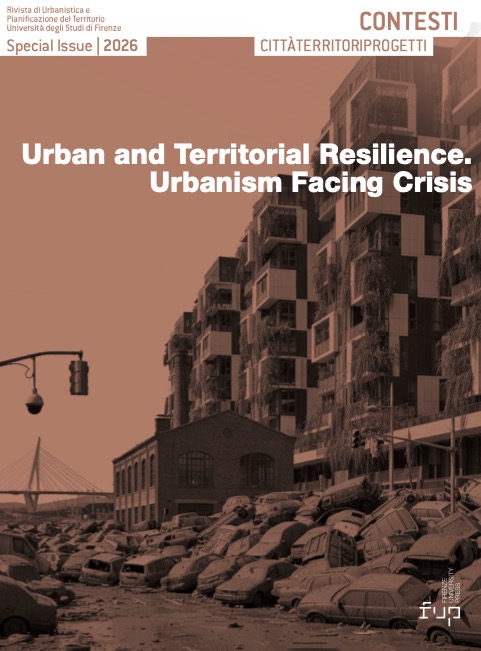
Published 2026-01-29
Keywords
- adaptation strategies,
- climate change,
- design thinking,
- resilience,
- urban design
How to Cite
Copyright (c) 2026 Carlo Pisano

This work is licensed under a Creative Commons Attribution-NonCommercial 4.0 International License.
Funding data
-
Ministero dell'Università e della Ricerca
Grant numbers PE0000005
Abstract
Designing is a complex, personal, creative, and open-ended process of exploring and deciding, often seen as implicit (Schön, 1985). In teaching urbanism, we frequently need to make this process explicit and transferable. To do so, this paper uses a conceptual framework based on Elise van Dooren’s model (2013, 2020), which identifies five key elements: (1) experimenting/exploring and deciding, (2) guiding theme or qualities, (3) domains, (4) frame of reference, and (5) laboratory or (visual) language. This paper evaluates the application of this framework in the Prato Ready Laboratories, a multidisciplinary program at the University of Florence (2024/25), involving nearly 150 students from four design labs in Architecture and Planning master courses. The program focuses on sustainable urban and territorial design, addressing climate change, disaster response, and energy resource challenges. Through comparative analysis, it aims to make explicit the teaching methodologies for resilient urban design in multi-hazard environments.
Downloads
References
- • Asimov, M. (1962). Introduction to Design. Englewood Cliffs: Prentice Hall.
- • Bloch, E. (1959). Das Prinzip Hoffnung [The Principle of Hope]. Frankfurt am Main: Suhrkamp.
- • Cross, N. (2001). Designerly ways of knowing: Design discipline versus design science. Design Issues, 17(3), 49–55.
- • Cross, N. (2007). Designerly Ways of Knowing. Basel: Birkhäuser.
- • Dorst, K. (2015). Frame Innovation: Create New Thinking by Design. Focuses on framing in complex problem situations, highly relevant to urbanism.
- • Gero, J. S. (1990). Design Prototypes: A Knowledge Representation Schema for Design. AI Magazine, 11(4), 26–36.
- • Jones, J. C. (1992). Design Methods (2nd ed.). New York: Van Nostrand Reinhold. (Originally published in 1970)
- • Lawson, B. (2004). What Designers Know. Oxford: Architectural Press.
- • Maldonado, T. (1970). La speranza progettuale. Milano: Feltrinelli.
- • Rittel, H. W. J., & Webber, M. M. (1973). Dilemmas in a General Theory of Planning. Policy Sciences, 4(2), 155–169.
- • Rowe, P. G. (1987). Design Thinking. Cambridge, MA: MIT Press.
- • Schön, D. A. (1985). The Design Studio: An Exploration of Its Traditions and Potentials. London: RIBA Publications.
- • Schön, D. A. (1987). Educating the Reflective Practitioner: Toward a New Design for Teaching and Learning in the Professions. San Francisco: Jossey-Bass.
- • Schön, D. A. (1993). The Reflective Practitioner: How Professionals Think in Action. Aldershot: Ashgate.
- • van Dooren, E. (2013). Designing with Precedents: Design Knowledge in the Design Studio. PhD Thesis, Delft University of Technology.
- • van Dooren, E. (2020). Making Design Processes Explicit: A Conceptual Framework for Design Education. International Journal of Technology and Design Education, 30(2), 391–406.
- • von Foerster, H. (2003). Understanding Understanding: Essays on Cybernetics and Cognition. New York: Springer.