


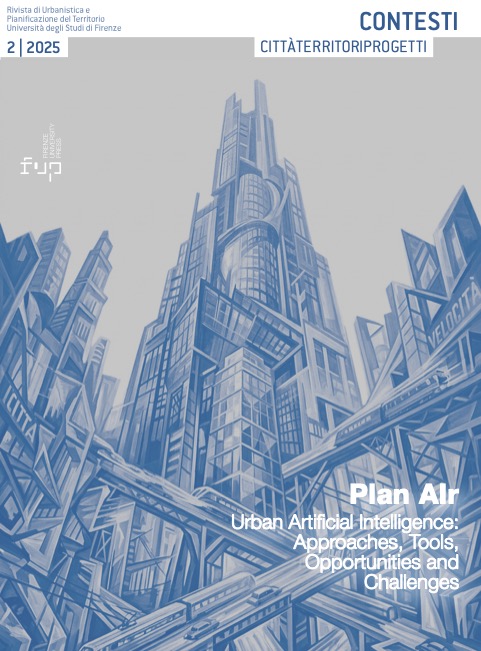
Published 2025-10-15
Keywords
- Artificial Intelligence,
- assisted design,
- generative design
How to Cite
Copyright (c) 2025 Iacopo Zetti, Biagio Martino

This work is licensed under a Creative Commons Attribution-NonCommercial 4.0 International License.
Abstract
The paper analyses the application of artificial intelligence in urban planning through a concrete case study. Using computational tools, the proposed test compares AI-generated solutions with a traditional design process. The analysis highlights the ability of the algorithms to generate layouts but reveals limitations in the integration with the urban context and in the management of qualitative aspects. The tools used prove to be effective in supporting design schemes and in allowing rapid environmental simulations, but require human guidance to interpret the spatial fabric and urban standards. The experiment confirms the role of the designer in mediating between calculation and creativity, integrating ethics, spatial narrative and contextual adaptation. AI emerges as a regulatory device but does not replace human vision in interpreting urban complexity and translating social values into design solutions.
Downloads
References
- Aggarwal, C. C. 2023, Neural Networks and Deep Learning: A Textbook, Springer, Cham.
- Alloghani, M., Al-Jumeily, D., Mustafina, J., Hussain, A., Aljaaf, A.J. 2020, A Systematic Review on Supervised and Unsupervised Machine Learning Algorithms for Data Science, in M.W. Berry, A. Mohamed, B.W. Yap (a cura di), Supervised and Unsupervised Learning for Data Science, Springer, Cham.
- Basu, P., Talwar, P., As, I. (a cura di) 2022, Artificial Intelligence in Urban Planning and Design: Technologies, Implementation, and Impacts, Elsevier, Amsterdam.
- Bateson, G. 1979, Mind and Nature: A Necessary Unity, Fontana/Collins, Glasgow.
- Carmona, M. (a cura di), 2010, Public Places, Urban Spaces: The Dimensions of Urban Design, Routledge, London.
- Dalton, C.M. 2015, For Fun and Profit: The Limits and Possibilities of Google-Maps-based Geoweb Applications, «Environment and Planning A», 47, 5, pp. 1029-1046, 10.1177/0308518X15592302.
- Dematteis, G. 1985, Le Metafore Della Terra: La Geografia Umana Tra Mito e Scienza, Feltrinelli, Milano.
- Dodge, M., Kitchin, R. 2012, Mapping Experience: Crowdsourced Cartography, «Environment and Planning A», 10.2139/SSRN.1921340.
- Farinelli, F. 2004, Sui Tipi Non Cartografabili, in: Atlante Dei Tipi Geografici, Istituto Geografico Militare, Firenze, pp. 77-79.
- Ferraro, G. 1996, Mappe e Sentieri. Una Introduzione Alle Teorie Della Pianificazione, «CRU - Critica della Razionalità Urbanistica», 6, pp. 52-63.
- Fogel, L. 1964, On the Organization of Intellect, University of California, Los Angeles.
- Fogel, L.J., Owens, A.J., Walsh, M.J. 1966, Artificial Intelligence through Simulated Evolution, J. Wiley, New York.
- Gehl, J. 2010, Cities for People, Island Press, Washington.
- Gill, P.E., Murray, W., Saunders, M.A., Tomlin, J.A., Wright, M.H. 2008, George B. Dantzig and Systems Optimization, «Discrete Optimization», 5, 2, pp. 151-158, 10.1016/j.disopt.2007.01.002.
- Harris, B., Batty, M. 1993, Locational Models, Geographic Information and Planning Support Systems, «Journal of Planning Education and Research», 12, 3, pp. 184-198, 10.1177/0739456X9301200302.
- IBM, Cosa Sono Le Reti Neurali Convoluzionali?, https://www.ibm.com/it-it/think/topics/convolutional-neural-networks> (2/25)
- Jiang, F., Ma, J., Webster, C.J., Li, X., Gan, V.J. 2023, Building Layout Generation Using Site-Embedded GAN Model, «Automation in Construction», 151, 10.1016/j.autcon.2023.104888.
- Langella, C., Scodeller, D., Dal Buono, V. 2017, Design Parametrico e Generativo: Nuove Prospettive Di Ricerca, «MD Journal», 3, pp. 6-13.
- LeCun, Y., Bengio, Y., Hinton, G. 2015, Deep Learning, «Nature», 521, 7553, pp. 436-444, 10.1038/nature14539.
- Mahes, B. 2020, Machine Learning Algorithms - A Review, «International Journal of Science and Research», 9, 1, pp. 381-386, 10.21275/ART20203995.
- McCarthy, J. 2008, What is Artificial Intelligence?, Computer Science Department Stanford University, Palo Alto, CA, (2/25)
- Minsky, M. 1961, Steps toward Artificial Intelligence, «Proceedings of the IRE», 49, 1, pp. 8-30, 10.1109/JRPROC.1961.287775.
- Minsky, M. 1988, The Society of Mind, Simon & Schuster., New York.
- Mitchel, T. 1997, Machine Learning, McGraw Hill, New York.
- Montjoy, V. 2023, What Is the Future Role of Architects in the Age of AI and Data?, «ArchDaily», https://www.archdaily.com/995781/what-is-the-future-role-of-architects-in-the-age-of-ai-and-data> (2/25).
- Nasteski, V. 2017, An Overview of the Supervised Machine Learning Methods, «Horizons», 4, pp. 51-62.
- Nebuloni, A., Rossi, A. 2017, Codice e progetto : il computational design tra architettura, design, territorio, rappresentazione, strumenti, materiali e nuove tecnologie, Mimesis, Milano.
- Newton, D. 2019, Deep Generative Learning for the Generation and Analysis of Architectural Plans with Small Datasets, «Proceedings of 37 eCAADe and XXIII SIGraDi Joint Conference», Blucher, Porto, 10.5151/proceedings-ecaadesigradi2019sdo5(1)35.
- Paba, G. 2012, Felicità e Territorio. Benessere e Qualità Della Vita Nella Città e Nell’ambiente, in A. Magnaghi (a cura di), Il Territorio Bene Comune, Florence University Press, Firenze.
- Plebe, A., Perconti, P. 2022, The Future of the Artificial Mind, CRC Press, Boca Raton.
- Rosenblatt, F. 1960, Perceptron Simulation Experiments, «Proceedings of the IRE», 48, 3, pp. 301-309, 10.1109/JRPROC.1960.287598.
- Rumelhart, D.E., Hinton, G.E., Williams, R.J. 1986, Learning Representations by Back-Propagating Errors, «Nature», 323, 6088, pp. 533-536, 10.1038/323533a0.
- Salingaros, N.A. 1999, Architecture, Patterns, and Mathematics, «Nexus network journal», 1, 1-2, pp. 75-86, 10.1007/s00004-998-0006-0.
- Söderström, O. 2000, Des Images Pour Agir. Le Visuel En Urbanisme, Payot, Lausanne.
- Turing, A.M. 1950, I.—Computing Machinery and Intelligence, Mind, LIX, 236, pp. 433-460 10.1093/mind/LIX.236.433.
- Waddington, C.H. 1977, Strumenti per pensare: un approccio globale ai sistemi complessi, Mondadori, Milano.
- Wan, L., Jin, Y., Echenique, M., Batty, M., Wegener, M. 2024, From Urban Modelling to City Digital Twins – Reflections from the Applied Urban Modelling (AUM) Symposia, «Environment and Planning B», 10.1177/23998083241279601.
- Wan, T., Ma, Y. 2022, Urban Planning and Design Layout Generation Based on Artificial Intelligence, «Mathematical Problems in Engineering», 2022, 1, 8976943, 10.1155/2022/8976943.
- Wiederhold, G., McCarthy, J., 1992, Arthur Samuel: Pioneer in Machine Learning, «IBM Journal of Research and Development», 36, 3, pp. 329-331, 10.1147/rd.363.0329.
- Xu, H., Omitaomu, F., Sabri, S., Zlatanova, S., Li, X., Song, Y., 2024, Leveraging Generative AI for Urban Digital Twins: A Scoping Review on the Autonomous Generation of Urban Data, Scenarios, Designs, and 3D City Models for Smart City Advancement, «Urban Informatics», 3, 1, 29, 10.1007/s44212-024-00060-w.
- Zhang, X-S., 2000, Introduction to Artificial Neural Network, in X-S. Zhang (a cura di), Neural Networks in Optimization, Springer US, Boston, MA.