A Philological Digital Platform to Experimental Preservation: Upcycling the Prefabricated School Buildings Heritage
1 Department of Civil Engineering and Computer Science Engineering, University of Rome Tor Vergata, Italy
2 Department of Architecture, University of Thessaly, Greece
3 Department of Civil, Environmental and Architectural Engineering, University of Padua, Italy
Email: ilaria.giannetti@uniroma2.it; fmicocci@uth.gr; angelo.bertolazzi@unipd.it
*Corresponding author
Abstract. In Europe, the increasing demand for public education between the 1950s and 1960s prompted extensive school-building programs. The design of these new schools was supported by updated pedagogical theories, which inspired a rethinking of building layouts. From a technological point of view, intensive experimentation with prefabricated construction systems was carried out to meet emerging design concepts for school buildings, as well as to accelerate construction and reduce costs. Nowadays, late 20th-century school buildings have emerged as fragile architectural heritage, characterized by experimental technological solutions that require the development of customized preservation approaches. This contribution presents a philological digital platform to document and analyze exemplary late 20th-century school buildings: this platform aims to support the conception of a novel preservation strategy driven by the principles of the circular economy. The analysis is framed within the broader scenario of participatory practices for the experimental preservation of late 20th-century public building heritage.
Keywords: BIM, GIS, Archival research, Selective dismantling, Reuse.
1. Introduction
In Europe, between the 1950s and 1960s, the increasing demand for public education prompted extensive school-building programs [1]. In Italy, a special program of ‘experimental school buildings’ was launched in 1961 and coordinated by the “Centro Studi per l’Edilizia Scolastica” of the Ministry of Public Education (Ministero della Pubblica Istruzione) [2]. The program supported the construction of a significant number of school buildings between 1961 and 1980. These schools featured prefabricated construction systems to speed up building and minimize expenses. At the same time, new pedagogical theories inspired a rethinking of school layouts, which became based on the modularity and flexibility of school spaces. This pushed the experimentation of easy-to-assemble and disassemble construction systems, mostly based on light prefabrication [3]. Over time, late 20th-century prefabricated school buildings have faced a generalized lack of acceptance from user communities. They have also aged poorly, requiring significant maintenance and upgrade interventions, and have emerged as a fragile and extensive building stock that urgently requires the development of customized preservation approaches [4].
According to the European Union Cohesion Policy (EUPC), improving school buildings is an opportunity to strengthen both the Integrated Territorial Investment (ITI) and the Community Led Local Development (CLLD) strategies in relation to the urban and social role of school buildings [5]. Within this framework, since the school system is increasingly perceived as a common good, the lack of acceptance of prefabricated school buildings by user communities represents a significant issue that often favors demolition over conservation. The implementation of participatory practices – involving end-users in the upgrade process of the school buildings – can be effectively exploited to broaden the field of their preservation, including through experimental approaches [6].
In this context, Construction History studies, based on the analysis of documentary sources, play a crucial role in increasing awareness within communities about the tangible and intangible values of the prefabricated school building heritage. This supports the classification of a specific cluster of 20th-century cultural and technological heritage. Digital approaches in Construction History – especially those related to philological BIM [7-10] – facilitate the extraction and organization of historical and technical data to be used in actual maintenance and preservation scenarios. This is achieved through the production of structured digital archives and data-analysis tools related to the history and technology of the buildings [11]. The current literature proposes a significant reference framework related to the use of BIM as a documentation tool to support the knowledge, preservation, and valorization of contemporary building heritage [12-14]. Nevertheless, the use of BIM for organizing archival document-based knowledge is still an emerging topic [15,16] that requires further insights.
Under these premises, on the one hand, the article presents the construction of a philological digital platform to document and analyse exemplary prefabricated school buildings of the late 20th Century, serving further as a data-analysis tool to support preservation strategies based on circular economy-driven practices within the recent literature and regulatory framework related to the application of the Minimum Environmental Criteria (CAM) [17-18]. On the other hand, the article presents the application of the digital platform to an Italian case study, testing the tools to support a specific preservation approach based on ‘selective dismantling’ and the reuse of building components. In this latter sense, the article aims to provide evidence for the use of the philological digital platform as a decision-making tool to broaden the practice of selective dismantling and the reuse of building elements within Italian professional communities.
The paper is structured as follows: Section 2 presents the methodology adopted for the construction of the philological digital platform, relying on the BIM approach; Section 3 presents the application of the digital platform considering a case study of 15 school buildings, functioning as kindergartens, which feature the patented ‘Benini’ construction system composed of precast concrete elements; Section 4 presents the results of four workshop experiences related to the participative implementation and testing of the philological digital platform with different users-clusters and stakeholders. Conclusions and future research perspectives are presented in Section 5.
2. The Construction of the Philological 3D Informative Model
The proposed methodology –as shown in Figure 1– relies on the extended use of a BIM-based web platform, designed and developed to meet the following key functionalities: i) digital archive of the historical and technical documents related to the design, construction and operational life of the single building; ii) information management tool for the organisation and the representation of the historical and technical data derived from the documentary analyses; iii) analytical tools to interrogate data related to the building, supporting the simulation of scenarios related to the potential disassembly and reuse of the building components; iv) production of interoperable dataset in user-friendly tabular format and integration of informative data in a webGIS platform.
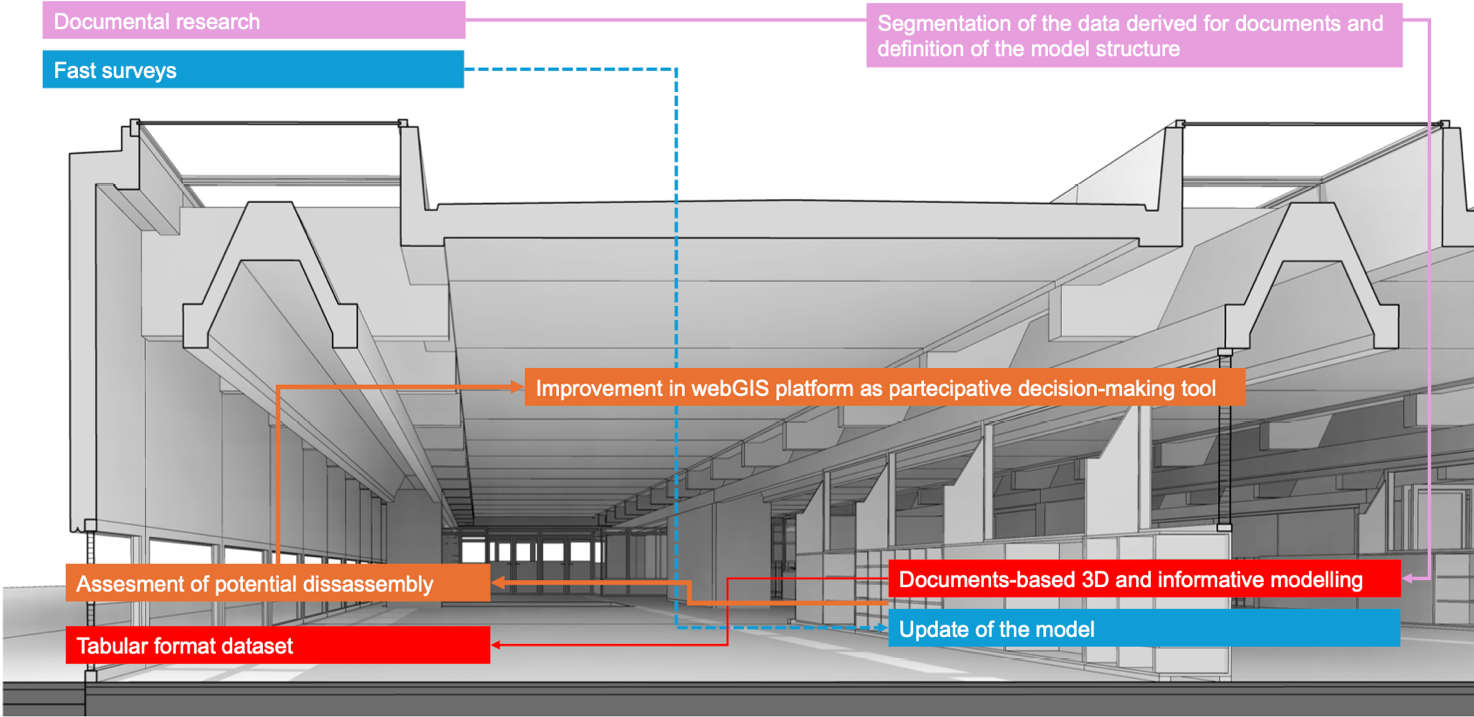
The construction of the BIM model develops into subsequent phases, leveraging a philological approach: 1) comparative analyses of the historical documents, overlapping and intersecting data derived from the different sources, and preparation of the model source data; 2) definition of the structure of the model and the naming scheme of the digital objects and related documentary sources; 3) geometric modelling and information enrichment of the model; 4) definition of a specific set of parameter dedicated to the assessment of the potential disassembly of the building elements; 5) production of interoperable dataset in tabular format and automatic generation of informative field, related to the single building, in GIS format.
To meet the design functionalities, the model refers to the “Level of Information Need” (LOIN) concept [19-20]. According to the purpose of the BIM and the limited dimensions of the school buildings, both the geometry and the informative parameters concern the single construction components. The granularity of the information supports the in-depth study of the connection, regarding both the structural and non-structural components of the buildings, to assess the disassembly potential of each building component. From the interoperability protocols, the methodology relies on the definitions defined by the Industry Foundation Standard (IFC) and on the use of datasets, using tabular data standards CSV. The Revit platform is utilised for geometric and informative modelling, leveraging the software’s native functionality to extract data in a tabular format. The webGIS platform’s informative enrichment, based on a tabular data frame, utilises a basic Python code executed on the QGIS console.
3. The Case Study
In 1971, the Italian Ministry of Education launched a tender for the design and construction of 15 single-storey prefabricated buildings for kindergartens in various municipalities across north-central Italy [21].
The Benini company was awarded the contract for 15 buildings, containing 3 or 6 classrooms each. They utilised a proprietary construction system, patented by Celestino Benini in 1975 (Italian patent n. 1036570), developed in collaboration with architect Luigi Pellegrin. This system comprises five prefabricated reinforced concrete elements: columns, beams, wall panels, and roof panels, which can be assembled in various configurations. Based on the ‘Gaburri-Structurapid’ system [22], the columns are hollow elements requiring on-site concrete casting. Patented in 1975, the system is adaptable to both single-storey and multi-story buildings. It relies on the assembly of precast elements, varying in shape according to three configurations (A, B, and C) detailed in the 1975 patent. For the kindergarten project, configuration C was selected; the first two configurations were used for two different types of multistorey school buildings, designed by Pellegrin between 1970 and 1975 [2, pp. 110-123]
The system allows the creation of modular spaces with custom-designed furnishings. The building plan is organised around a 7.20 × 14.40 m modular grid, resulting in overall dimensions of 27 × 25 m. An off-centre entrance hall leads to an open space featuring a lowered central area for everyday pedagogical activities. The three classrooms, each with expansive ribbon windows, are situated on the opposite side. The construction involves the straightforward assembly of the five structural elements, starting from the ground up. Columns are positioned at the modular grid intersections, supporting inverted V-shaped beams. Shaped wall panels, spaced 1.20 m apart, are then erected on the beams. Floor slabs rest on these panels, forming skylights where they align with the beams. The perimeter walls have a specialised design to accommodate the hanging of external wall panels, secured by mechanical joints.
Today, the 15 buildings are in different states of maintenance, ranging from fully functional to abandoned (Table 1). Those that are still in use suffer from significant issues with rainwater drainage and have been heavily modified by the addition of roofing structures or poorly executed maintenance interventions on the window systems, both of which disregard the original design constraints and technological solutions.
| Municipality | Location | Geographic Coordinates | Current Function |
|---|---|---|---|
| Alba | Strada Rorine | 44°41’24.6’N 8°01’24.13E | Primary school |
| Chivasso | Via Paleologi | 45011331.5” N7053’03 93E | Primary school |
| Rivoli | Via Antica Rivoli | 45°04’44.7’N 7030’53.3” E | Primary school |
| Lodi | Via Lago di Como | 45°18’40.2N 9030’42 1” E | Primary school |
| Morbegno | Via Prati Grassi | 46°08’19 3” N9034’04.7°E | Primary school |
| Spinea | Via Donizetti | 45°29’14.2’N 12°09’ 48 4” E | abandoned building |
| Arezzo | Via Carlo Pisacane | 43027’46 4’N 11°51” 35 9” 5 | Primary school |
| Prato | Via Galcianese | 43052’47.4’N 11°04’54.0’E | Primary school |
| Civita Castellana | Via Salvator Allende | 42°17’55.9’N 12°24’26.2E | Primary school |
| Lucca | Via Vecchi Pardini | 43050’47.7N 10028’51.0” E | Primary school |
| Latina | Via Milazzo | 45026’45.0’N 9°05’47.4” E | abandoned building |
| Cesano Boscone | Via XXV Aprile | 45026’45.0’N 9°05’47.4”E | Primary school |
3.1 The application of the philological 3D information model in selective dismantling and reuse scenarios
Following the proposed philological BIM methodology, a model of the 15 ‘Pellegrin-Benini’ prefabricated school building was developed utilizing the Revit platform and relying on interoperability protocols based on the combined use of IFC standards and tabular data standards CSV. The CSV data frame is used for the automatic informative enrichment of the Shape file via the QGIS Python console, facilitating subsequent webGIS integration.
The modelling process is divided into three main phases: 1) modelling of the ‘protype-building’: this involves creating a detailed digital model of a typical building based on the original design documents; 2) model update: updating the 15 individual building models to reflect their current state, based on fast surveys; 3) data export: extracting geometric and informative data using interoperability standards, such as IFC and CSV; 4) georeferencing of data: provide simplified and geo-localised 3D representation of the building featured by key informative field, automatically enriched from the parse of the CSV dataset.
The elaboration of the source data (Figure 2) of the ‘protype-building’ model develops via the iterative cross-reference information from three sets of key documents: technical and calculation reports submitted within the tender launched by the Ministry of Education, accompanied by executive drawings of the structural elements (conserved by Ministry of Education Archive, Experimental School Founds, Italian Central State Archive); the patent drawings for the Benini construction system (conserved by Italian Patent and Trademark Office Archive, Italian Central State Archive); and construction site photographs taken by the architect (conserved by Luigi Pellegrin Archive, CSAC Parma).
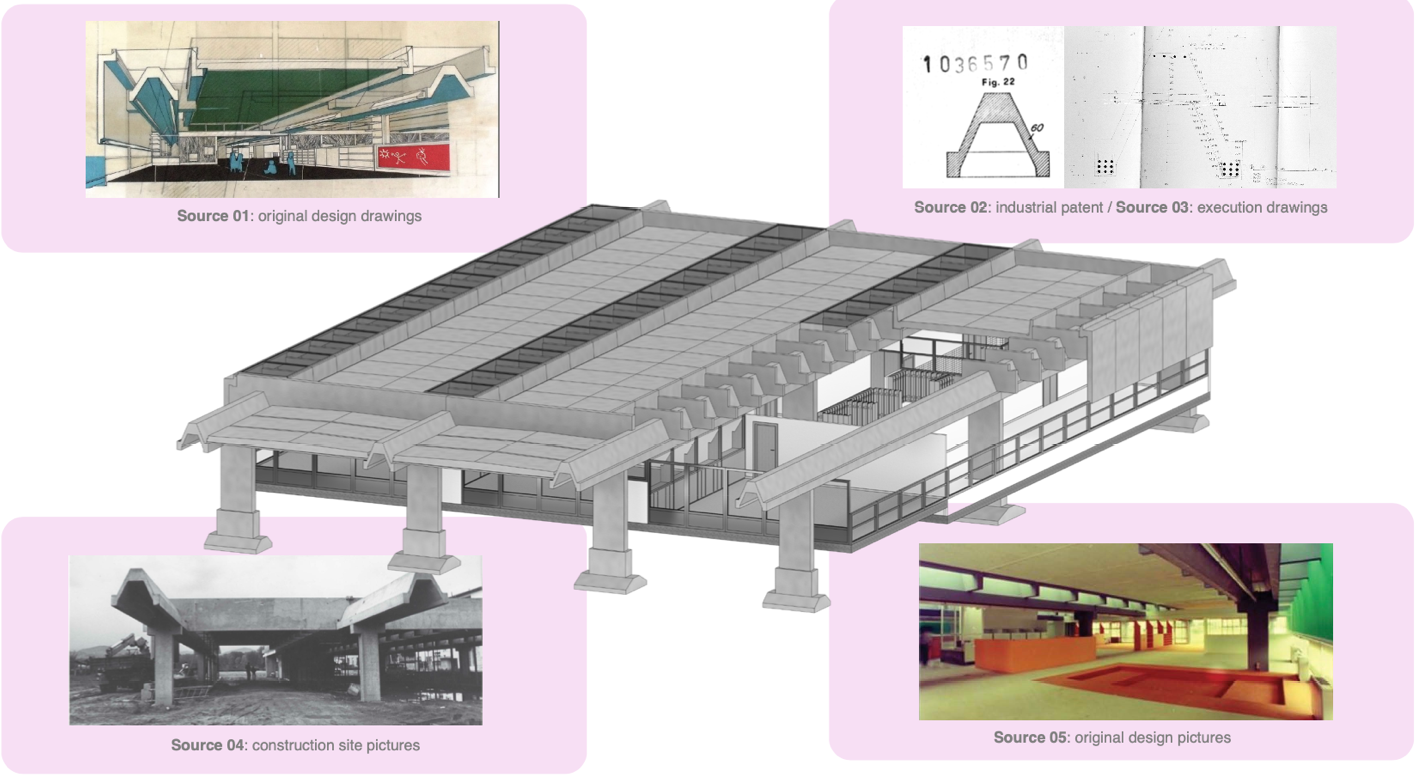
Geometric and informative data were extracted from these key documents, which were subsequently ordered and classified using unique alphanumeric codes (IDs) assigned accordingly to the defined relational structure of the digital model. In this specific case, the hierarchy of the elements composing the construction system – pillars, beams, walls, and the two types of panels – was translated into a definition of categories of the digital object composing the model, related through a three-level hierarchical structure. Within the relational scheme of the digital model, the category of beams (B), the one of the walls (W), and the one of the pillars (P) represent the first hierarchical level; the two types of panels (p), the second level, while the architectural elements such as the façade and the roof windows, the third. According to this hierarchical scheme, the nomenclature of all the digital objects of the model featured the assignment of IDs, ensuring the correlation between the individual digital object and the represented building component. Furthermore, the ID that identifies the single building component is assigned to the related set of documents, thereby ensuring a bilateral informative flow between the documentary sources related to the model and each digital object representing the building components.
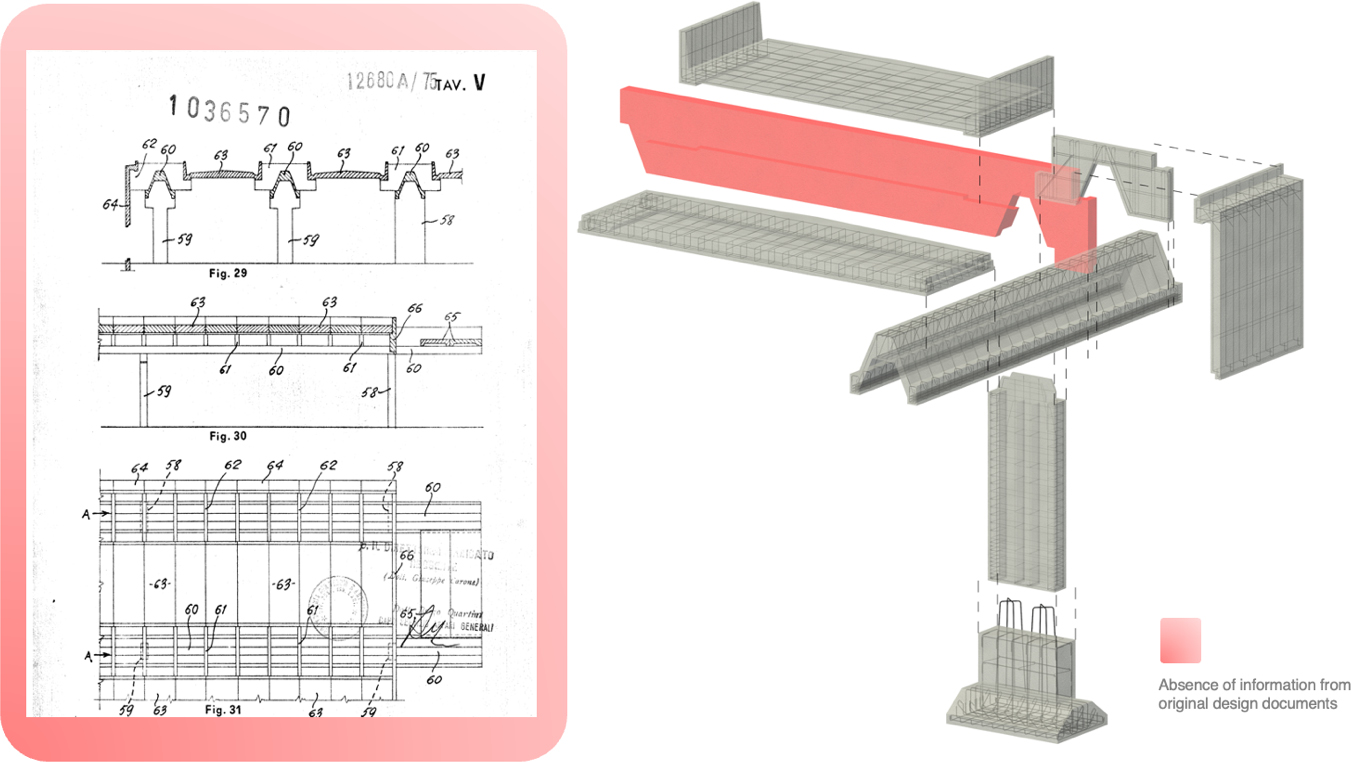
The geometric model was developed through the segmentation into nested objects, with increasing levels of detail. For instance, the digital objects representing the reinforcement of beams, pillars, and walls were developed, based on data from the original execution drawings and calculation reports, as “local models” correctly nested within the ‘B’, ‘P’, and ‘W’ general categories.
In this sense, each category of elements presents a detailed dataset regarding general geometric features, the data related to the history of the building, and the characteristics of the building material. Furthermore, the local models are exploited as an internal source to generalise and expand the related informative set to all the components of the building, exploiting standardisation. This procedure assures, on the one hand, the embedding of specific detailed information, guaranteeing, on the other hand, the fast usability of the model without informative data loss (Figure 3).
The “model update” phase focuses on the integration of the actual state of the 15 buildings, starting from the ‘Type-Building’ philological model. In particular, the update focuses on integrating novel geometries of roofing window systems, derived from fast photographic analyses or the analysis of documents concerning maintenance interventions stored in the technical office of individual school buildings. In this sense, the case of the school buildings of the Chivasso Municipality stood out for the construction of a superimposing steel structure without any relation to the original design of the school.
The “data extraction” phase relies on the creation of an interoperable data frame based on a standard tabular format (CSV). More specifically, by leveraging the IDs of the individual digital objects, the information content of the model can be easily represented in tabular format, without losing the semantic association with the related building components. Each element of the model, identified by its ID, corresponds to a comprehensive dataset, organised at multiple levels concerning history, geometry, construction details, material characteristics, and actual state. The datasets are extended to the documentary sources, integrating hyperlinks to the key documents, previously labelled by the corresponding IDs.
The final step of the workflow supports the management of the 15 school buildings at the territorial scale, processing data related to the single building in the urban context. The informative data extracted from the model in tabular format are processed to automatically enrich a webGIS platform, based on an SQL spatial database and directly connected to a web viewer. The 15 schools are localised and associated to simplified representation, embedding a set of informative parameters directly derived from the BIM – exploiting the Phyton code-based parse of the data frame in table format run by the QGIS console – including the set of main quantitative and qualitative data concerning each building components (ID, age, number, weight, state of decay, disassembly index).
The actual state of the 15 school buildings requires the development of specific strategies to manage their next future conditions, including experimental preservation actions. In this sense, discussing the future of the 15 school buildings in the broad framework of the optimisation of the resources in the construction sector, a possible path can be the assessment of the potential disassembly of the school building according to the selective dismantling procedures, traced by the regulatory framework of the Minimum Environmental Criteria (CAM) and the most affirmed manifestos on circularity in construction based on the threefold principle of “share knowledge”; “gathering data”; “valorise the existing building stock” [23-25].
In this sense, a specific set of ‘disassembly parameters’ was used to qualitatively assess all aspects related to the possibility of disassembling structural and non-structural components of the analysed buildings. As reported in the following Table 2, such parameters reflect the main principles of Design for Disassembly and the actual practices of ‘selective dismantling’, according to the actual regulatory framework (ISO 20887:2020) [26]. The main set comprises six parameters – Ease of access, Independence, Reversible connection, Weight, Obsolescence, Standardisation, named accordingly to the general principle of Design for Disassembly required by the ISO 20887:2020 [24]. The values of each parameter are classified in three base classes – low, medium, and high – and are assigned based on document-based knowledge, supported by on-site visual inspection. Each class of values – low, medium, high – corresponds, respectively, to a numerical score ranging from 0 to 2. The main set of 7 parameters is applied to each building element to assess its potential disassembly, evaluated through a numerical value, ranging from 0 to 12, considering the sum of the values assigned to each parameter. Furthermore, a corrective parameter is considered for the overall evaluation of the potential’ Disassembly Index’. As shown in Table 3, this parameter, named Safety of disassembly is evaluated, according the same classes of values – low, medium, high –, on documental basis and visual inspections: as it assesses the presence of potential hazardous substances, the low score (0) nullified the value of the potential ‘Disassembly Index’ obtained by the sum of the previous six parameters; the medium score (1) confirms the value of the potential ‘Disassembly Index’ requiring further on-site survey to confirm the values; the high score (2), confirms the value of the potential ‘Disassembly Index’.
| Name of the parameter | Description | Value of the parameter | ||
|---|---|---|---|---|
| Low (0) | Medium (1) | High (2) | ||
| 01_Ease of access | Ease of access to building components with minimal damage to and impact on them and adjacent assemblies (ISO20887) | exposed and accessible on one side | exposed and accessible on two sides | exposed and accessible on all sides |
| 02_Independence | Quality of the components to be removed without affecting the performance of connected or adjacent systems (ISO20887) | exposed and not accessible from the top | exposed and partially accessible from the top | exposed and accessible from the top |
| 03_Reversible connection | Connection that can be disconnected or disassembled (ISO20887) | Passing iron rebars | Concrete infill | geometric connection |
| 04_Weight | Weight of the structural component for construction site disassembly activities | >50 kg | 20-50 kg | <20 kg |
| 05_Obsolence | Express the % damage area/ total area of the element, considering visible damage. | >60% | 20-60% | 0-20% |
| 06_Standardization | Possibility to standardize the disassembly process using efficient and repetitive techniques measured via the % value expressing the quantity of the element/total of the structural elements (ISO20887) | 0-20% | 20-60% | >60% |
| Name of the parameter | Description | Value of the parameter | ||
|---|---|---|---|---|
| Low (0) | Medium (1) | High (2) | ||
| Safety of disassembly | Proven knowledge about the construction materials, identifying potential hazardous substances (ISO20887) | proven existence of hazardous substances (documentary basis) | assessment of hazardous substances (visual inspection) | proven absence of hazardous substances (documentary basis) |
According to the study of the historical and technological knowledge of the analysed building, previously obtained through the documentary sources, a further specific cluster of parameters is, thus, dedicated to the assessment of the ‘inherited identity’ [23] of each building element. As is shown in Table 4, this latter cluster includes the following three parameters: ‘Age of construction’, ‘Documental heritage’, and ‘Consistency of original design principle to DfD’. The latter three parameters are evaluated considering three base classes – low, medium, and high – corresponding to the numerical score ranging from 0 to 2, based on document-based information. ‘Age of construction’ refers, in this specific case, to the 70-year cut-off from construction date that, according to the constraints introduced by the Italian Law on Cultural Heritage, excludes selective dismantling from the possible scenarios. ‘Documental heritage’ refers to the cultural values of the building, inherited from the historical and technological background, that could be assessed on a documentary basis. Similarly, the ‘Consistency original design principle to DfD’ refers to the original design choice in terms of ease of access, independence, and reversible connections, according to documentary evidence. In this case, the latter two variables include, indeed, a tentative evaluation of the historical and technological value of the building, or better, of its construction system, supported by the documentary evidence of the original design drawings by Luigi Pellegrin, the literature of the time concerning the school building design, and the industrial patent describing the construction system.
| Name of the parameter | Description | Value of the parameter | ||
|---|---|---|---|---|
| Low (0) | Medium (1) | High (2) | ||
| Age of construction | Age of the building, referring to the construction period, considering cut-off of cultural heritage constraints (d. lgs. 22 gennaio 2004, n. 42) | <70 | 70 | >70 |
| Documentary heritage | Presence of documents proving links with historical and technological background ( d. lgs. 22 gennaio 2004, n. 42) | authorial design proven by original drawings | authorial design proven by original drawings, literature of the time | authorial design proven by original drawings, literature of the time, and industrial patents |
| Consistency of the original design principle with the DfD framework | Proven knowledge about the original design choice in terms of ease of access, independence, and reversible connections | visual assessment of construction details | knowledge about the historical-technical context (literature) | proven knowledge about the original design choice (documentary basis) |
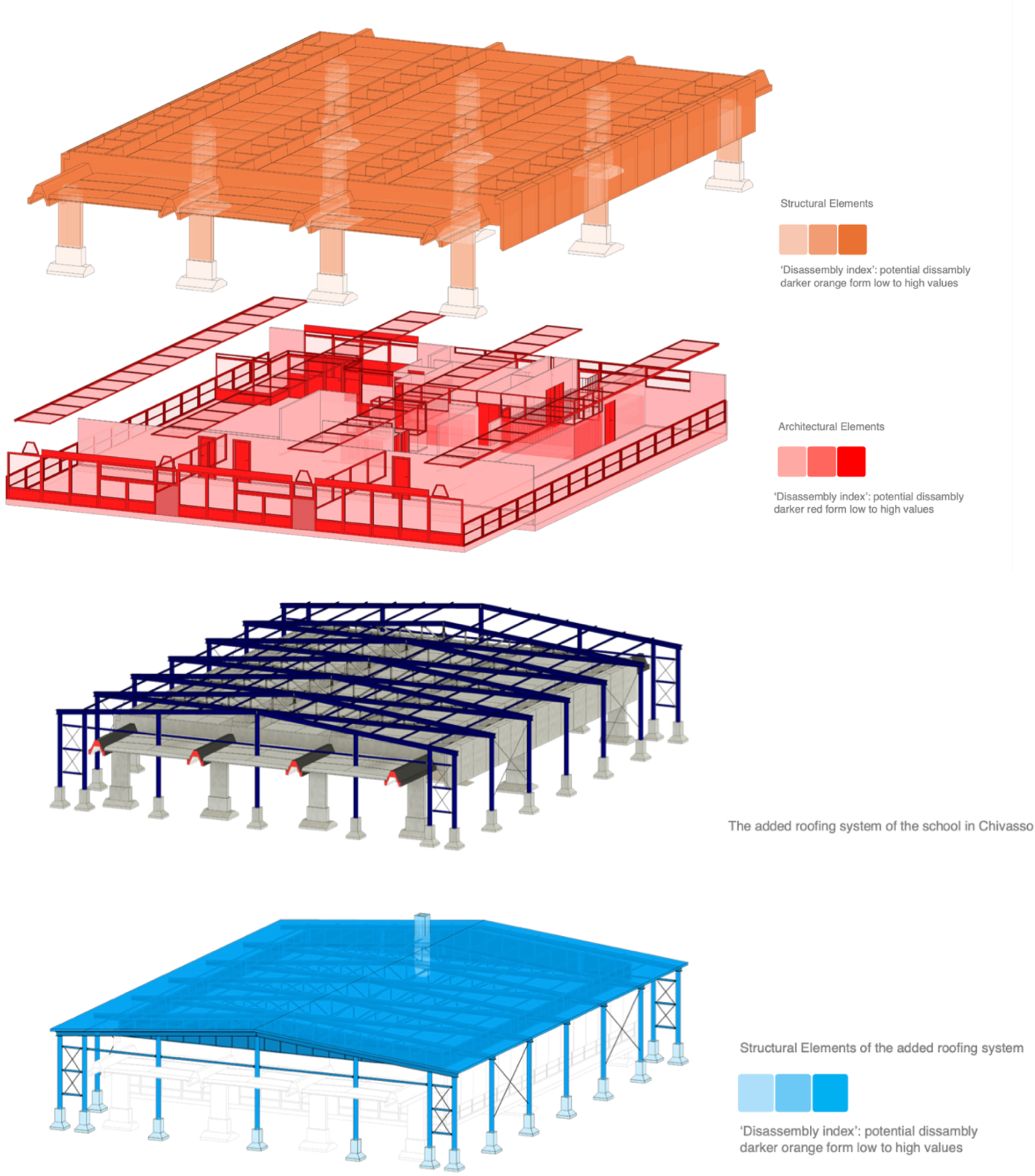
Combining the analytical definition of the ‘Disassembly index’ with the structured dataframe provided by the informative model of the building, a comprehensive measurement of the potential disassembly of each building component can be produced, supported by effective three-dimensional representations. Figure 4 shows the axonometric views of the school building, showing the graphic results of the value of the ‘Disassembly index’ assigned to each building component. In orange and red, the values of the ‘Disassembly index’ are shown for the structural and architectural elements of the type-building; in blue, the values of the same parameters are shown for the structural elements of the renewed roof of the specific case of the school building in Chivasso.
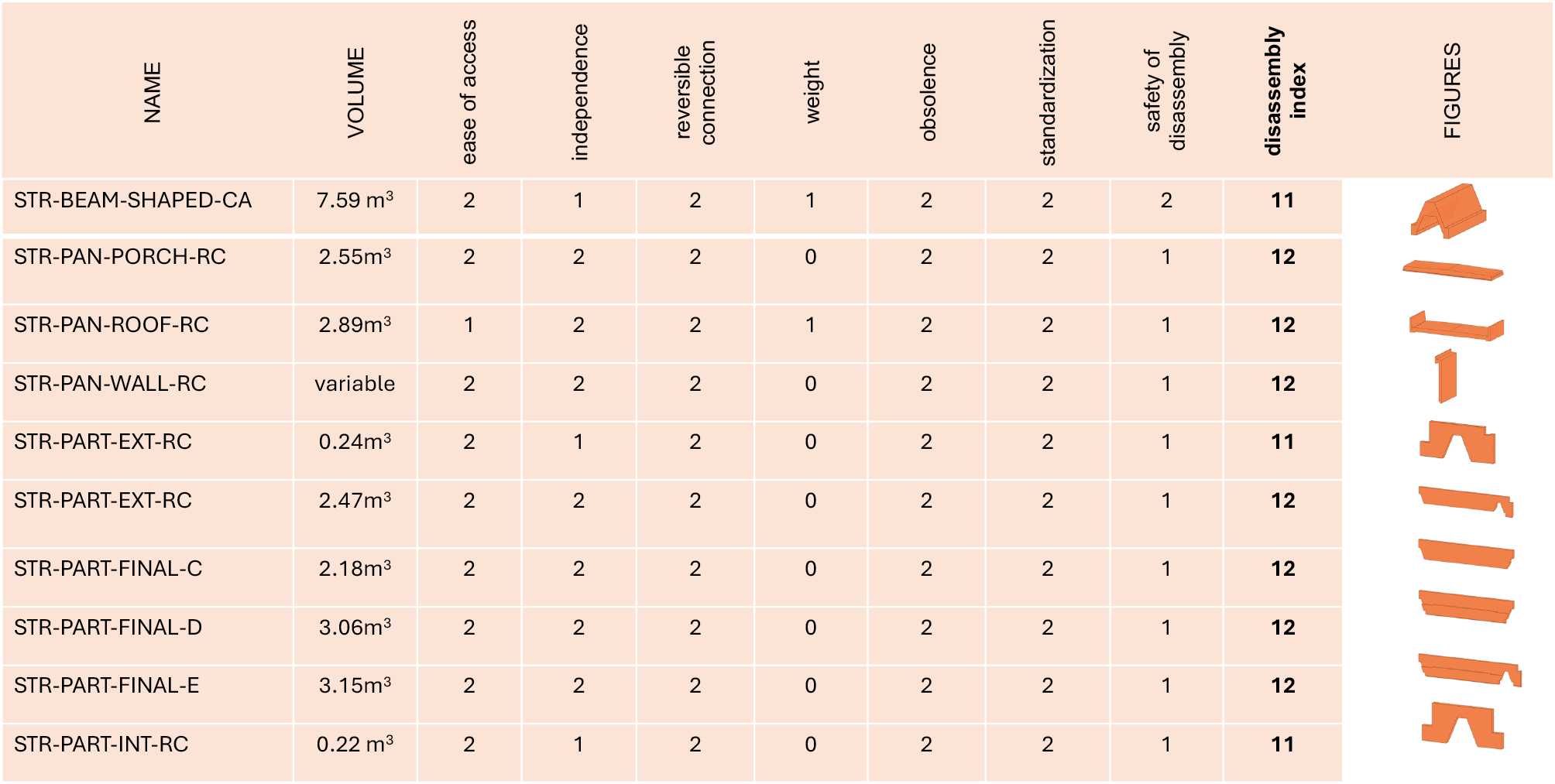
The list of values of the ‘Disassembly index’ corresponding to each building element is, thus, combined in a ‘Disassembly index’ at the building scale, corresponding to an average value, providing valuable data to support the decision-making process of the stakeholders involved in the school building maintenance and preservation.
4. About Participatory Practices to Design and Test the Philological Digital Platform
According to the application of participatory methods following what has been defined as the “shift from local government to local governance” [27], the use of integrated digital tools allows the construction of organised special database for the collection of information relating to the history of the building and its components, providing, at the same time, an easy-to-use tool to simulate the preservation scenarios, including the alternatives of selective dismantling and reuse. The possibility of collecting, connecting and display the historical and technical data allows to reconstruct the history of the building, from the project to the construction, to the subsequent interventions, contextualising it in the cultural and social horizon that led to the use of industrialised solutions and prefabrication in school buildings: this allows to bring the local communities closer to the material knowledge of the buildings, sharing the cultural values of the technological and the architectural solutions of the original design. Furthermore, the simulation of selective dismantling and reuse scenarios, supported by the virtual reconstructions, on the one hand, increases the awareness of the environmental criteria linked to the actual management of the existing buildings, and, on the other hand, can provide a useful tool to apply participative methods to the reuse design process.
A direct experience of the usefulness of the proposed digital-platform-aided participatory approach for the preservation of the 20th-century school buildings and the refinement of the methodology was investigated through four design workshops that were organised in different contexts. Three workshops were organised within the framework of the ESF project “SchoolNET. Innovative tools for the sustainable and inclusive refurbishment of school buildings and the management of urban mobility” [28], and they mainly focused on participatory consultation and discussion among different actors. At the same time, a fourth one, part of the PRIN 2022 PNRR “Upcycling Architecture in Italy” [29], was dedicated to exploring the methodology of DfD-Design for Disassembly and upcycling applied to a paradigmatic example of a prefabricated school building of the 1960s [4].
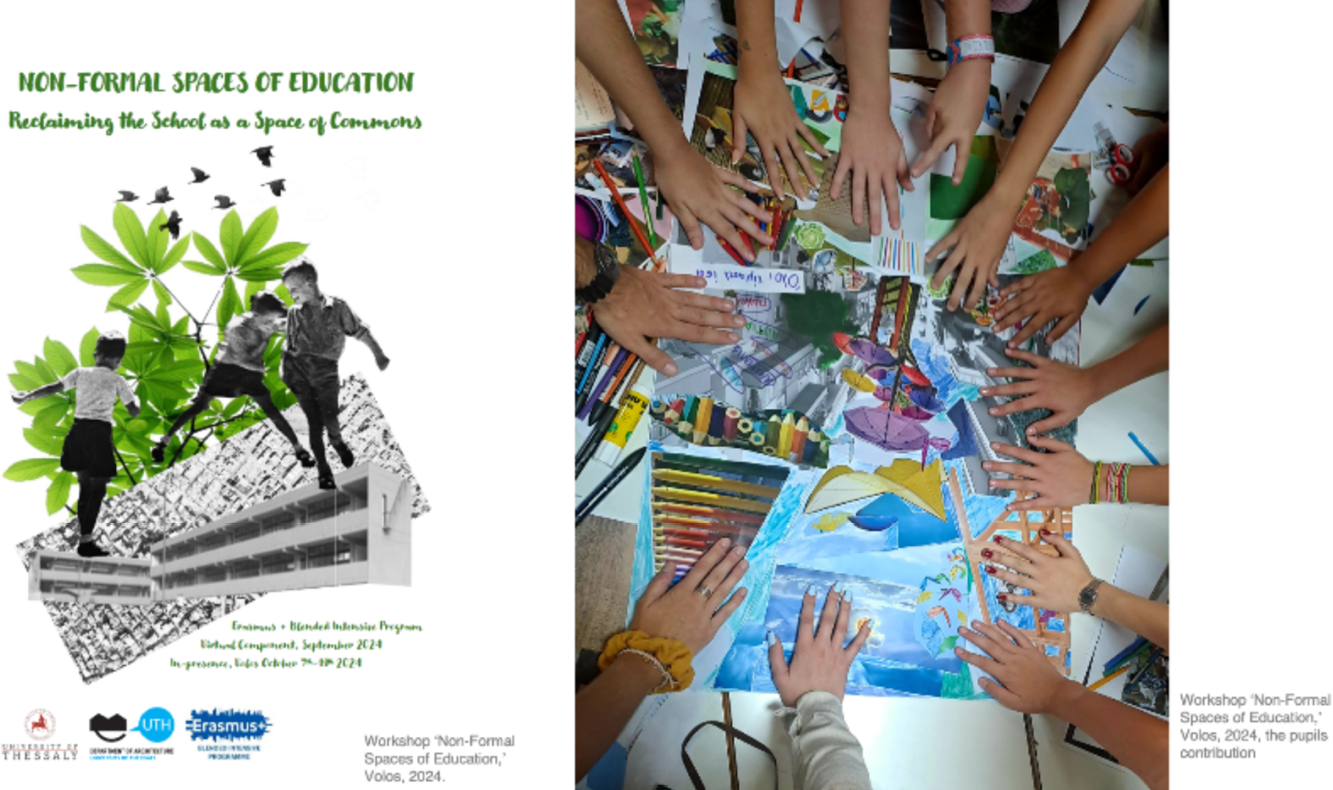
The first workshop “Science for All. Raggiungi, crea e costruisci la tua scuola ideale!” was organised in Padova with the participation of eight primary schools, organised in group work focusing on mobility – how they get to school -, structures – how they perceive the building where they are – and inclusion – provoking reaction of affection or disagreement of school places. The second one in Volos during the Erasmus+ Blended Intensive Program “Non-Formal Spaces of Education. Reclaiming the School as a Space of Commons” sought to investigate the possibility of creating new educational spaces in existing schools through the adaptation and transformation of an existing building and its surrounding space [30]. Both workshops had engaged teachers, students, and pupils in a participatory design using the tool of collage to inquire about expectations, desires, and daily practices of the pupils (Figure 6). The goal was to provide concrete indications for rethinking educational spaces, informing the development of the webGIS SchoolNET platform by shifting the point of view from developers to future users. The experiences highlighted how digital tools designed to facilitate decision-making processes for the transformation of the environment and school spaces should necessarily pass through a participatory process, respecting the value of social capital and cultural heritage represented by the school. The high social value of the school system and the possible repercussions on the urban communities of reference of the redevelopment and transformation actions require a precise participation activity with the users of the school network.
The third workshop, titled “Awareness on Schools” refurbishment and sustainable management, brought together assignees, corporate and network partners, professionals from the construction and plant engineering sector, and those involved in renewable energy production. It took place at the Fenice Academy in Venice. The focus was on raising awareness of the digitalisation and virtuous management of school buildings, and the design of systemic interventions at the building and urban scale. The intervention was a moment of confrontation between professionals from the fields of construction and plant engineering, renewable energy production, and public administration. In particular, the round table discussion focused on the use of BIM as a tool to guide the redevelopment and management of school buildings. On the one hand, the need to implement simplified and agile models, understood as databases with three-dimensional visualisation possibilities, was highlighted. In fact, this approach allows for easier data collection within the model and its use by managers (public administrations and municipal technical offices) of school buildings. On the other hand, the importance of a complete digital modelling leading to the implementation of a digital twin was emphasised, where the fidelity of the representation and computerisation of the data allows for greater efficiency in the management of the model and the building, despite requiring greater knowledge and commitment on the part of the managers (public administrations and municipal technical offices) of school buildings.
Eventually, an attempt to test the methodology, within a pedagogical approach for PhD students, has been investigated during a research-by-design workshop that was organised in June 2024 at Sapienza University of Rome, which involved 13 PhD students, from 5 different Italian universities, in the framework of the PRIN 2022 PNRR “Upcycling Architecture in Italy” [29]. In this case, the construction of the philological BIM, according to the presented methodology, focused on the experimental preservation of a prefabricated school building to explore ‘selective dismantling’ and potential reuse, and upcycling of its building elements. The model was tested involving the community of local stakeholders charged with the current maintenance of the school building, providing key data to develop the conception and the functioning of the digital platform: in particular, the need to provide easy-to-use viewers of the 3D-informative models, supported by an analytical dashboard for the assessment of the economic-financial impact of the selective dismantling processes, emerges. Furthermore, the heritage assessment issue was underlined, providing key data for the development of the digital platform as a ‘living archive’ [31] dedicated to preservation actions, exploiting the organisation of the historical and technical documentary framework.
5. Conclusions
The present paper addresses the construction and the use of an integrated digital platform to support knowledge and experimental preservation of the late 20th-century school building heritage. The methodology includes philological tridimensional and informative modelling approaches, exploiting documentary sources, and participatory practices in the development and testing phase of the digital platform. The study presents a twofold outcome: assessing the effectiveness of the proposed methodology for the construction of integrated digital platform dedicated to the actual actions of preservation of the late 20th Century school buildings, with specific reference to prefabricated school buildings and experimental preservation actions, including ‘selective dismantling’ and ‘reuse’; opening a further discussion on participatory practices for the actual preservation of the school buildings within the current socio-technical scenarios.
Regarding the first point, the study validates the proposed philological modelling approach, based on documentary sources, to provide a structured data frame concerning the history and the technological solutions of the buildings. In this sense, the proposed modelling approach allows the exploitation of a technical and data framework to produce an analytical tool to support the assessment of potential ‘disassembly’ and, then, reuse of the building elements, providing an easy-to-use interoperable data frame exploiting table style sheets and special representation of data. The procedure – based on the combined use of a philological BIM with the evaluation of the potential disassembly according to the current regulatory framework on DfD – is conceived as modular and replicable to different building typologies, particularly featured by the use of prefabricated systems. In this sense, the method can be considered effective to support decision-making within the challenging preservation of the broader prefabricated building heritage of the late 20th Century [32].
Regarding the second point, the study stresses the role of participatory design for the preservation and reuse of 20th-century school buildings using a digital tool to facilitate interaction among different stakeholders. To inform the construction of the digital tool, preliminary participatory design workshops engaging different potential stakeholders (pupils, professionals, researchers, and university students) may offer helpful information about how to transfer an easy-to-use interoperable data frame into a friendly and straightforward interface. Accordingly to the outcome of these workshops, the use of digital tools, may help to facilitate the employment of actual practices of Design for Disassembly to expand the potential reusability of the building components and transformative actions allowing to retrace and share the material history, through the documents of the original design and the construction process and share intangible values of the schools building provide by the action of ‘documenting’.
6. Acknowledgements
This article jointly presents the outcomes of the following research and pedagogical projects, developed within a research spin-off and through the international collaboration of the University of Padua, the University of Thessaly, and Tor Vergata University of Rome: Projects are: “SchoolNET. Innovative tools for the sustainable and inclusive refurbishment of school buildings and for the management of urban mobility”. Funding: European Social Fund [POR-FSE/2020-27|cod. 2105-0052-553-2023, lead University of Padua]; “Upcycling architecture in Italy. Forging and promoting a renewal building culture” [PRIN PNRR 2022, P2022KSYY9, Research Unit Tor Vergata University of Rome]; “Non-Formal Spaces of Education. Reclaiming the School as a Space of Commons” was organized as part of the Blended Intensive Program Erasmus+ [cod. 2023-1-EL01-KA131-HED-000129964-2, led by the University of Thessaly]
The authors would like to thank Eng. Cristian Tolù for his contributions to the Figures of this article, and all the participants in the workshop activities and the stakeholders involved in the participative design and test of the digital platform.
7. Authors Contributions
The Individual contributions of the authors are as follows. Ilaria Giannetti: Conceptualization, Data analysis, Writing of the original draft, Visualization, Editing and Supervision; Angelo Bertolazzi: Conceptualization, Data analysis, Writing of the original draft, Visualization, Editing and Supervision; Fabiano Micocci: Conceptualization, Writing of paragrah 4, Supervision. The authors would like to thank Eng. Cristian Tolù for his contributions to the Figures of this article.
8. Funding
“SchoolNET. Innovative tools for the sustainable and inclusive refurbishment of school buildings and for the management of urban mobility”. Funding: European Social Fund [POR-FSE/2020-27|cod. 2105-0052-553-2023, lead University of Padua]; “Upcycling architecture in Italy. Forging and promoting a renewal building culture” [PRIN PNRR 2022, P2022KSYY9, Research Unit Tor Vergata University of Rome]; “Non-Formal Spaces of Education. Reclaiming the School as a Space of Commons” was organized as part of the Blended Intensive Program Erasmus+ [cod. 2023-1-EL01-KA131-HED-000129964-2, led by the University of Thessaly]
9. References
[1] Ministry of Education (1957) The story of post-war school building. Her Majesty’s Stationery Office, London
[2] Giannetti I (2024) Esercizi di industrializzazione. Sperimentazione costruttiva per l’edilizia scolastica (1951-1979). Franco Angeli, Milano
[3] Tolù C, Mornati S, Giannetti I (2024) Valorizzare il patrimonio della prefabbricazione leggera in Italia: una piattaforma digitale a supporto della “decostruzione selettiva”. In: Cardaci A, Picchio F, Versaci A (eds) Reuso 2024: Documentazione, restauro e rigenerazione sostenibile del patrimonio costruito. Publica, Alghero, pp 1613–1621
[4] Bologna A, Giannetti I (2024) Introduzione: un’esperienza di research-by-design per il disassemblaggio e l’upcycling delle componenti di un edificio d’autore. In: Bologna A, Garcia-Fuentes JM, Giannetti I, Neri G, Germanò R (eds) Upcycling Architecture in Italy. Design Workshop. Risultati | Results. Politecnico di Torino, Torino, pp 7–15
[5] Savoldi P (2024) Starting with Schools: Proximity as a Space of Governance in Both Urban Planning and Educational Policies. In: Pucci P, Vecchio G (eds) Questioning Proximity – Opportunities and Challenges for Urban Planning and Mobility Policies. Springer, Cham, pp 81–89
[6] Lotz-Sisitka HB (2018) Education and the Common Good. In: Jickling B, Sterling S (eds) Post-Sustainability: Remaking Education. Palgrave MacMillan, Cham, pp 63–78
[7] Bruno S, De Fino M, Fatiguso F (2018) Historic Building Information Modelling: performance assessment for diagnosis-aided information modelling and management. Autom Constr 86:256–276. https://doi.org/10.1016/j.autcon.2017.11.009
[8] Achille C, Tommasi C, Rechichi F, Fassi F, De Filippis E (2019) Towards an Advanced Conservation strategy: a Structured Database for Sharing 3D documentation between Expert Users. Int Arch Photogramm Remote Sens Spatial Inf Sci XLII-2/W15:9–16. https://doi.org/10.5194/isprs-archives-XLII-2-W15-9-2019
[9] Bertolazzi A, Croatto G, Savinio M, Turrini U, Abazai A, Santi G (2019) The refurbishment of prefabricated residential buildings in socialist countries (1954-1970): methodological criteria and social perspectives. Tema 5(1):1–13. https://doi.org/10.30682/tema0501a
[10] D’Uffizi F, Vendetti E (2025) Philological HBIM for Knowledge, Management, and Valorisation of the Industrialized Building: The Case of Prefabricated Large Panels Systems (1950–80). In: Corrao R, Campisi T, Colajanni S, Saeli M, Vinci C (eds) Proceedings of the 11th International Conference of Ar.Tec. Colloqui.AT.e 2024. Lecture Notes in Civil Engineering, vol 610. Springer, Cham, pp 86–100
[11] Bertolazzi A, Giannetti I (2024) Il patrimonio dell’architettura industrializzata. In: Bertolazzi A, Giannetti I (eds) Architettura Industrializzata a Milano. Prototipi e modelli per l’edilizia residenziale pubblica (1945-1965). Franco Angeli, Milano, pp 135–153
[12] Pocobelli DP, Boehm J, Bryan P, Still J, Grau-Bové J (2018) BIM for heritage science: a review. Herit Sci 6(30). https://doi.org/10.1186/s40494-018-0191-4
[13] Yang X, Grussenmeyer P, Koehl M, Macher H, Murtiyoso A, Landes T (2020) Review of built heritage modelling: integration of HBIM and other information techniques. J Cult Herit 46:350–360. https://doi.org/10.1016/j.culher.2020.05.008
[14] Bastem SS, Cekmis A (2022) Development of historic building information modelling: a systematic literature review. Build Res Inf 50(5):527–558. https://doi.org/10.1080/09613218.2021.1983754
[15] Intrigila C, Giannetti I, Eramo E, Gabrielli R, Caruso G (2024) HBIM for conservation and valorisation of structural heritage: the Stylite Tower at Umm ar-Rasas, Jordan. J Cult Herit 70:397–407. https://doi.org/10.1016/j.culher.2024.10.010
[16] Russo M, Cocco PL, Giannetti I (2024) Analysis of the form, construction, and structural conception of Silberkuhl shells through construction history and advanced HBIM. Structures 68:107118. https://doi.org/10.1016/j.istruc.2024.107118
[17] Ente Nazionale Italiano di Unificazione (2020) UNI/PdR 75:2020. Decostruzione selettiva – Metodologia per la decostruzione selettiva e il recupero dei rifiuti in un’ottica di economia circolare. UNI, Milano
[18] Ministero della Transizione Ecologica (2022) Decreto Ministeriale 183/2022. Criteri ambientali minimi per l’affidamento del servizio di progettazione di interventi edilizi, per l’affidamento dei lavori per interventi edilizi e per l’affidamento congiunto di progettazione e lavori per interventi edilizi. Gazzetta Ufficiale della Repubblica Italiana, Roma
[19] UNI (2019) UNI 19650-1. Organization and digitisation of information about buildings and civil engineering works, including building information modelling (BIM) – Information management using building information modelling – Part 1: Concepts and principles. UNI, Milano
[20] CEN/TC 442 (2020) EN 17412 Building Information modelling. Level of Information need. Concepts and principles. CEN, Brussels
[21] Giannetti I (2020) Industrializzazione “su misura”: le scuole-pilota di Luigi Pellegrin (1967-1975). In: Cascone SM, Margani G, Sapienza V (eds) New Horizon of sustainable architecture. Colloqui.AT.e 2020. Edicom Edizioni, Gorizia, pp 35–48
[22] Gaburri LB (1968) Manuale structurapid ad uso del progettista e del calcolatore. Tib Abiati, Milano
[23] Circkla (2021) Manifest, Manifeste, Manifesto. https://cirkla.ch/it/verein/. Accessed 29 Nov 2024
[24] Stricker E, Brandi G, Sonderegger A (2022) Re-use in construction. A compendium on circular Architecture. Par Book, Zurich
[25] De Wolf C, Raghu S, Sentic A, Fivet C (2023) Innovations Practitioners Need for Circularity in the Swiss Architecture, Engineering, and Construction Sector. ETH, Zurich. https://doi.org/10.5281/zenodo.7520351
[26] ISO (2020) ISO 20887:2020 Sustainability in buildings and civil engineering works – Design for disassembly and adaptability – Principles, requirements and guidance. ISO, Geneva. https://www.iso.org/standard/69370.html. Accessed 29 Nov 2024
[27] Andrew C, Goldsmith M (1998) From Local Government to Local Governance: and Beyond? Int Polit Sci Rev 19(2):101–117. https://doi.org/10.1177/019251298019002002
[28] PRIN PNRR (2022) Upcycling architecture in Italy. Forging and promoting a renewal building culture. https://www.upcyclingarchitecture.it. Accessed 20 Jan 2025
[29] Valacchi F (2024) The Season of Living Archives: A Generative Provenance. JLIS.It 15(2):51–60. https://doi.org/10.36253/jlis.it-597
[30] Bertolazzi A, Giannetti I, Alonso Zúñiga PI (2025) Afterword: matter of fact and open issues on the industrialised buildings heritage. TeMa. https://doi.org/10.30682/tema110017