https://doi.org/10.36253/smp-17182
Victims of the Green Transition: Harm Narratives in AfD’s Climate Skepticism
Department of Sociology, University of Vienna, Austria
E-mail: till.hilmar@univie.ac.at
Abstract. This article examines how politicians from Germany’s main far right party, Alternative für Deutschland (AfD), delegitimize climate policies and climate action in their political communication. To this end, it analyzes more than 430.000 tweets posted between 2009 and 2023. Drawing on combination of computational and qualitative analysis, it investigates how the negative effects of climate action is framed through narratives. The findings reveal two major strategies: first, climate policies are portrayed as harming specific “deserving” groups – like citizens, taxpayers, commuters, and workers – whose livelihoods are said to be threatened by rising costs; second, pro-climate actors are vilified as “naïve”, “delusional”, and a threat to the moral order of society. Through these affective narrative configurations, AfD communication positions the party as the rational defender of the “middle of society”, effectively inverting the climate script by shifting attention from environmental catastrophe to alleged economic and social decline.
Keywords: climate skepticism, victimhood, Germany, AfD, narrative, LLM.
Contents
2. Climate skepticism in context
2.1 The far right and dimensions of climate skepticism
2.2 Delegitimizing climate policies: The role of narrative and victimhood constructions
3. Context, methods and analysis
3.1 AfD and the backlash to the green transition in the German context
3.2 Sampling, corpus construction and analysis
4.2 Policy instruments and climate measures (Energiewende, CO2-Steuer, Klimapaket)
4.3 Climate activists and movement actors (FridaysForFuture, Klimaaktivisten, Greta)
4.4 Rethorical labels (Klimahysterie, Klimawahn)
5. Discussion: strategies of delegitimzation in context
1. Introduction
European climate policy ambitions have undergone a dramatic development within the span of just a few years. Around 2019, the political momentum seemed to move decisively toward progressive legislation and a broad consensus on the need to decarbonize the economy. The passing of the European Green Deal, with its net-zero commitment, provided far-reaching legal frameworks for the corporate sector and ambitious national targets. Yet, following the Russian full-scale invasion of Ukraine in 2022, a growing backlash has taken shape. Persistently high energy prices have strained European economies and households. Today, worrying signs are emerging: European governments are considering relaxing prohibitions on oil and natural gas drilling; German conservatives are calling into question the 2035 ban on internal combustion engines. Europe faces mounting pressure from a climate-denialist Trump administration vested in fossil-fuel industry interests and from the ongoing challenge of reducing its dependence on Russian energy imports.
The populist radical right, rising across Europe, has singled out climate policies as a central target of attack (Dickson & Hobolt, 2025, Schwörer & Fernandez-Garcia 2024). Anti-climate rhetoric has become a winning card through which distrust in political institutions and anti-elite sentiment can be mobilized. Climate policies, it appears, increasingly function as a “wedge issue” (Dickson & Hobolt, 2025), that allows far-right actors to channel broader political discontent.
This development has been closely tracked by the social science literature. In particular, rich research on the populist radical right’s climate skepticism (Forchtner & Lubarda, 2023; Lockwood, 2018; McCright et al., 2016; Norgaard, 2011) and its various facets such as denialism, nationalism, distrust in science and political institutions, conservative ecologism, and Manichean worldviews has emerged. These ideological components can vary in their intensity and specific form of articulation across actors in the European landscape (Caiani & Lubarda, 2023); together, they constitute the ideational “mix” that fuels far-right backlash against the green transition.
In order to advance our understanding of how climate skepticism works in everyday political communication, this article argues that we need to look more systematically at the patterns through which climate policies are delegitimized. As Patterson (2023: 70) argues, examining delegitimation in this context “helps to bring together material and interpretive drivers of counteraction, with moral judgments made by involved actors that give backlash particular escalatory force and volatility”. Thus, in the following, I interrogate specific negative framings of concrete climate and environmental measures to identify recurring patterns in them.
The article examines the case of the German populist radical right party Alternative für Deutschland (AfD) (Arzheimer & Berning, 2019; Havertz, 2019). Germany provides a particularly instructive context, as it long positioned itself at the forefront of European climate politics, pursuing an ambitious program of renewable energy expansion, industrial decarbonization within its export-oriented economy, and the transformation of heating infrastructure. In recent years, however, these efforts have met a growing political backlash (Weisskircher & Volk, 2025). Using a large language model as part of a computational social science approach (Bonikowski & Nelson, 2022; Stuhler et al., 2025) in combination with qualitative analysis of narrative (Blum & Kuhlmann, 2019), I study a near-complete corpus of Twitter/X communication produced by AfD-affiliated accounts – comprising 434,772 tweets between 2009 and 2023 – to trace patters in how actors from this party sought to delegitimize climate action and climate policies.
The analysis reveals how the delegitimization of climate action in AfD communication operates through constructions of victimhood. A first strategy is to portray climate policies as harming specific social groups like citizens, taxpayers, commuters, and workers, whose everyday livelihoods are said to be threatened by rising costs. These narratives, it emerges, revolve around dramatizing the economic consequences of climate policies – an important finding given that the economic dimension of climate skepticism has so far received comparatively limited systematic attention (but see Bohr, 2016; Hilmar, 2025; Küppers, 2024). A second strategy is to cast pro-climate actors as villains who are a threat to the moral order of society. Overall, through narrative configurations of victims, villains, and threats, AfD politicians seek to present themselves as the rational defenders of the “middle of society” against policies portrayed as economically destructive and socially misguided. In doing so, they effectively invert the climate script: they shift the focus from environmental catastrophe to a different looming danger, namely, economic and social decline, to which this party presents itself as the only answer.
2. Climate skepticism in context
2.1 The far right and dimensions of climate skepticism
Climate skepticism constitutes an important ideological bedrock for the populist radical right (Lockwood 2018, McCright et al. 2016), hereafter referred to as the “far right” here as a shorthand. Still, as far as these parties’ positions on the environment, climate change, and climate policies are concerned, there is considerable variation across the European landscape. For example, Manuela Caiani and Balsa Lubarda (2023), in their study of political manifestos of Polish, Hungarian, and Italian populist radical right parties, demonstrate that positions on these issues are not homogenous and do not adhere to a simple “either-or” logic. These parties are not uniformly anti-environmentalist; indeed, many propose distinct environmental agendas that shape their proposals and policy frameworks. In the following, I provide a brief overview over the key themes that existing research has found to be associated with various forms of climate skepticism.
Denialism. Sometimes, far right parties outright deny climate change, arguing that while ecological changes are occurring, they are natural and cyclical, not human-caused (McCright et al., 2016). This stance is closely linked to disinformation and efforts to sow doubts about these phenomena. It is also known as “evidence skepticism” (Van Rensburg, 2015), contesting the veracity and truth-claims about climate science. However, recent literature suggests that outright denialism is just one approach among many and not always the most prominent. Forchtner and Lubarda (2023) for example note that while far right parties in the European Parliament may reject climate change, they sometimes acknowledge it but argue that the EU is not the main contributor to the problem, pointing instead to other countries like China or the US.
Distrust in science. This broader phenomenon typically manifests as a criticism of “expert culture”, where climate scientists are viewed as an illegitimate elite (Huber et al., 2022). These actors also often articulate their own version of “scientific” talk and evidence. To the extent that the legitimacy of those who design or promote climate measures is challenged, this can also be understood as “process skepticism”. It might also be articulated as a form of “response skepticism”, which questions the effectiveness of policy measures and points to their potential harm for society, the economy, or the environment (Van Rensburg, 2015).
Nationalism, national sovereignty discourse. Kulin et al. (2021) in a large European cross-country comparison, find that nationalist attitudes are a strong predictor for climate skepticism. They typically argue that climate laws and climate mitigation undermine national sovereignty. Yazar and Haarstad (2023) demonstrate the significance of regional identities that the far right successfully mobilizes in its efforts to undermine decarbonization, drawing on the cases of Germany and Poland.
Conservative ecologism. Another important source of skepticism stems from deep-seated value orientations and ideologies centered around particular notions of a moral order of nature and society. “Eco-fascism”, a particularly radical variant of such a strand, rooted in blood-and-soil ideology and 19th-century ideologies of Social Darwinism, inspires an eschatological strand within contemporary far-right environmentalism (Lubarda, 2024). As an intellectual tradition, it also surfaces in niche circles within these parties. Among the strands of conservative ecologism as alternative environmental belief systems, there are also spiritual and esoteric variants, depending on the national and regional context.
Manicheanism. Far-right climate discourse often employs antagonistic portrayals of the left, caricaturing its goals. Climate activists are regularly constructed as social figures associated with particular negative traits (Heide, 2025). It typically identities and labels its enemies as communists, internationalists, and greens in this way (Lubarda 2024: 61-66). Additionally, the far right engages in strategies of criminalizing climate activism, denouncing groups like Last Generation as “climate terrorists”.
These elements of climate skepticism are well documented. But are there recurring patterns that structure how they are communicated in relation to specific climate policies?
2.2 Delegitimizing climate policies: The role of narrative and victimhood constructions
The goal of the present analysis is to interrogate the strategies through which pro-climate action and policy measures are delegitimized (Patterson 2023). This starts from the recognition that, on the one hand, climate policy is not a singular object. It may refer to a range of instruments like environmental regulations, decarbonization and phase-out schemes, as well as tax and subsidy mechanisms designed to incentivize green and sustainable consumer behavior. Which of these policies become focal points of far-right contestation is an open, empirical question. On the other hand, the way far-right actors frame these policies must be understood as part of a broader space of policy communication. There is active meaning-making at work concerning the scope, effects, and efficiency of specific measures. Such processes of meaning-making affect how policies evolve and endure over time, as they shape the extent to which actors support these instruments. The far right may not be designing the policies in question, but it is actively participating in the public construction, and contestation, of climate policies’ meaning and legitimacy.
One strand of the public policy literature, the Narrative Policy Framework (NPF), makes an important contribution in this regard by proposing that policy communication operates through narratives (Blum & Kuhlmann, 2019; Habelitz et al., 2024; Somers 1994; Poletta et al. 2011). Political communication, in this view, is effective to the extent that it works through stories – in particular, accounts that link the effects of policies to specific outcomes for particular groups in society: Who benefits? Who loses? Narratives reduce complexity. Policies typically have a wide range of interconnected consequences, but policy narratives foreground selected effects, especially clear benefits or negative impacts on specific groups, or on the broader trajectory of society. In this way they associate a policy with a recognizable marker of identity. Blum and Kuhlmann (2019: 342), drawing on narrative theory, argue that meaning-making around involves the depiction of characters – “heroes”, “villains”, and innocent “victims” – as well as a plot and a moral (or resolution). These are affective forms of political messaging (Habelitz et al., 2024). By analyzing these elements and their interplay, we can systematically identify the actors constructed as enacting or supporting a policy, the target groups defined as beneficiaries or victims, and the causal linkages (construed as part of the suggested resolution of the story) that connect them.
Constructions of social groups reveal a great deal about those who put them into circulation – there are moments of social classification and evaluation at work in policy narratives. Through them, actors articulate visions of moral order and of the acceptable consequences of political intervention to this order; therefore, group construction itself becomes a site of legitimization and delegitimization. Here, I thus adopt the analysis of narrative elements found in the NPF with a particular focus on constructions of victimhood. Such constructions are particularly powerful because they raise the question of blame and guilt. It is through the portrayal of victims that the actions of the villains become intelligible and morally questionable; one must show who is suffering from specific policies and how. At the same time, these constructions offer empathetic points of identification, creating a space in which audiences can align themselves with those depicted as harmed.
A rich body of work demonstrates how the mechanism of constructing victimhood is central to far-right political rhetoric in other domains, such as nationalism and historical memory (Elgenius & Rydgren, 2022). Nationalist appeals rely on the invocation of social groups portrayed as having been “wronged”, casting them as victims of injustice and betrayal. Scholarship on the politics of memory demonstrates how historical narratives of victimhood and perceived injustice are central to nationalist mobilization and ethnic conflict (Malinova, 2021). There is also growing research demonstrating how emotions of victimization circulate in the public, fueled by mobilization strategies by the far right. As studies on resentment and grievance politics make evident (Betz, 2022; Damhuis & Rashkova, 2024), the construction of negatively affected groups and individuals is at the heart of far-right political appeals.
In the field of climate policy, narrative elements have largely been treated as secondary, if catchy, rhetorical features rather than as central mechanisms of climate skepticism. The underlying patterns of victimhood constructions have not yet been described in a systematic manner. Which negative outcomes are emphasized, and for which social groups? Who are cast as the bad guys within these accounts?
3. Context, methods and analysis
3.1 AfD and the backlash to the green transition in the German context
Germany constitutes a rich and instructive case for interrogating contemporary dynamics of climate skepticism in the European context. It has long assumed a leading role in ambitious decarbonization efforts such as the energy transition towards renewables (Energiewende), the coal phase-out, as well as the departure from nuclear energy. As Europe’s largest industrial economy and an export-oriented powerhouse, with a central role for the automotive sector, Germany’s decarbonization goals are connected to its industrial strategy. Berlin’s ambitious climate agenda has also been increasingly been contested. The country has witnessed strong civil society mobilization, including large-scale protests by groups like Fridays for Future. Yet in more recent times, it has experienced pronounced backlash, with polarization surrounding measures such as the heating law, carbon pricing, or renewables (Weisskircher & Volk, 2025). Rising energy prices following Russia’s full-scale invasion of Ukraine in 2022 have further amplified these tensions. Climate skepticism gains political salience in Germany precisely because it unfolds within the context of an ambitious pro-climate agenda.
AfD has been a key driver in this backlash, increasingly pulling conservative actors along in its wake. Founded only in 2013 (Arzheimer & Berning, 2019), initially by a group of economists advocating German monetary sovereignty and opposing EU bailouts, the party was first primarily anti-EU in orientation. After 2015, migration became one of its core mobilizing issue for the party. Economic themes remain crucial to the party’s self-understanding – AfD has never abandoned its ordoliberal beginnings, dynamically combining welfare chauvinism with a free-market stance (Havertz 2020). The attack on the energy transition increasingly became a core issue central to the party’s identity and mobilization. Growing polarization on climate among the German population in recent years has been linked to the AfD’s electorate, whose positions have moved further away from centrist attitudes on these issues (Coffé et al., 2026).
Like other far-right parties and actors in Europe, AfD maintains an ambivalent relationship to environmental concerns (Caiani & Lubarda, 2023). On the one hand, it invokes the goal of “protecting nature” and can be situated within a heterogeneous landscape of far-right environmentalism. On the other hand, climate denialism and skepticism toward scientific evidence are core elements of the party’s profile. The 2016 party program cast doubt on anthropogenic climate change, a position reiterated in the 2025 federal electoral program. Energy policy is a domain in which the party articulates a hard-nosed political economy stance. AfD campaigns against the energy transition, mobilizes against wind and solar expansion (Weisskircher & Volk, 2025), and opposes the coal phase-out, advocating a return to nuclear energy. It has also adopted Kremlin-friendly positions, calling for the restoration of Russian gas supplies after 2022 and, paradoxically, seeking to justify this position in terms of Germany’s “energy sovereignty”.
3.2 Sampling, corpus construction and analysis
The following analysis studies a large, novel dataset that comprises a near-complete Twitter/X communication of AfD-associated politicians between 2009 and 2023. Studying text data, I draw on a mixed-methods approach, but guided by a qualitative research interest (Bonikowksi and Nelson 2022): to identify recurring patterns of meaning in this communication, and understanding these patterns in context. The approach combines text-analytical tools for corpus construction, a large-language model for structured text extraction, and qualitative interpretation. Data for this article consists of 434,772 tweets posted by 230 AfD-affiliated accounts (see Appendix 2). The sample relies on a comprehensive and systematically compiled inventory of party-affiliated Twitter accounts developed by König et al. (2022), which records the set of identifiable AfD-affiliated accounts in 2021. Tweets posted by these accounts between 2009 and 2023 were subsequently collected and analyzed. Unlike studies that sample on specific climate policies like heating laws or wind energy, this corpus enables an inductive identification of recurring patterns of political rhetoric over time.
Studying text data, I draw on a mixed-methods approach, but guided by a qualitative research interest (Bonikowksi & Nelson 2022): identifying recurring patterns of meaning in this communication, and understanding these patterns in context. The approach combines text-analytical tools for corpus construction, a large-language model for structured text extraction, and qualitative interpretation.
To construct the subcorpus that contains tweets referencing climate or the environment, I adopt a keyword-based filtering strategy based on an externally validated reference corpus (see Appendix 2 for keywords and details). Keyword-based approaches are common computational text analysis, but this approach increases methodological rigor. It yields a subcorpus of 13,828 climate-related tweets.
For the analysis, I combine an automated procedure, employing a large language model (LLM), with qualitative analysis (Bonikowski & Nelson, 2022). The application of LLMs in qualitatively oriented research is developing rapidly, bringing many opportunities and challenges. This article follows state-of-the-art practices in sociological computational social science to identify and mitigate potential biases (Chae & Davidson, 2025; Stuhler et al., 2025; Than et al., 2025). A key advantage that closely aligns with the research interest of this article is that the use of a large language model enables a scaled implementation of what Stuhler (2022) describes as a relational approach to text in sociology. It entails understanding the roles of agency: actors who do something to others, expressed in grammatical relations in the text that can be identified as semantic relations. Information extraction from unstructured text, previously a domain that required fine-tuned approaches like word embeddings, becomes possible thanks to LLMs based on Generative AI (Stuhler et al., 2025; Than et al., 2025). Yet crucially, the information extraction task employed here is not equivalent to delegating annotation or interpretation to the model. The procedure serves a more limited purpose: identifying and extracting specific relational elements from the text according to predefined criteria. Thus, the goal is not to have the model replace interpretation, but to instruct it to systematize information that is already present in the material in a consistent and scalable manner to allow for targeted manual, in-depth reading and interpretation.
I choose the model LLama 3.1 8b Instruct, as it is an open-source model available to social science community via the Ollama platform and is the best fit for the article’s purposes (Chae & Davidson, 2025, see Appendix 2). I conduct the qualitative analysis based on the patterns extracted by the model. Specifically, I use the model’s results to identify families of meaning within different types of climate action extracted by the model (see Table 1 below) and generate segments of 50 randomly selected tweets for each cluster, which are then analyzed in depth using narrative analysis (Blum and Kuhlmann 2019).
| climate_action | count | responsible_actor | count | impacted_entity | count |
|---|---|---|---|---|---|
| klimaschutz | 528 | grüne | 202 | bürger | 259 |
| klimawandel | 330 | cdu | 107 | arbeitsplätze | 176 |
| energiewende | 291 | grünen | 107 | deutschland | 151 |
| fridaysforfuture | 275 | bundesregierung | 93 | umwelt | 126 |
| klima | 258 | spd | 87 | wirtschaft | 114 |
| klimahysterie | 188 | eu | 85 | menschenleben | 97 |
| klimapolitik | 184 | klimaterroristen | 81 | europa | 82 |
| klimawahn | 163 | afd-fraktion | 63 | natur | 73 |
| co2-steuer | 151 | klimaaktivisten | 59 | steuerzahler | 66 |
| umweltschutz | 128 | die grünen | 57 | klima | 64 |
| co2steuer | 119 | altparteien | 52 | sozialstaat | 59 |
| klimaaktivisten | 111 | habeck | 52 | kinder | 54 |
| klimanotstand | 109 | @die_gruenen | 50 | menschen | 51 |
| greta | 93 | merkel | 50 | industrie | 48 |
| klimapaket | 90 | fdp | 44 | deutsche | 46 |
4. Results
4.1 Descriptive patterns
A first look at the corpus reveals the evolution of AfD’s climate-related discourse on this platform over time (Figure 1). The trends show visible peaks around climate topics, with debate intensifying between 2017 and 2019 and reaching a major peak in 2019. This period coincided with key political developments, including the passage of the Bundes-Klimaschutzgesetz (also known as Klimapaket, climate law) by the German Bundestag at the end of 2019, as well as large-scale climate protests that year, when movements such as Fridays for Future became highly visible. Figure 1 also includes selected references to specific climate policies and action types that appear most frequently in the corpus, as identified by the LLM. Each is linked to the day on which it was mentioned most often. The figure shows that discourse around the Energiewende (energy transition) has been present for a longer period of time, while the introduction of the German carbon pricing scheme (CO2-Steuer) corresponds to the passage of the Klimaschutzgesetz. Debates around wind turbines (Windraeder) appear as a more recent issue.
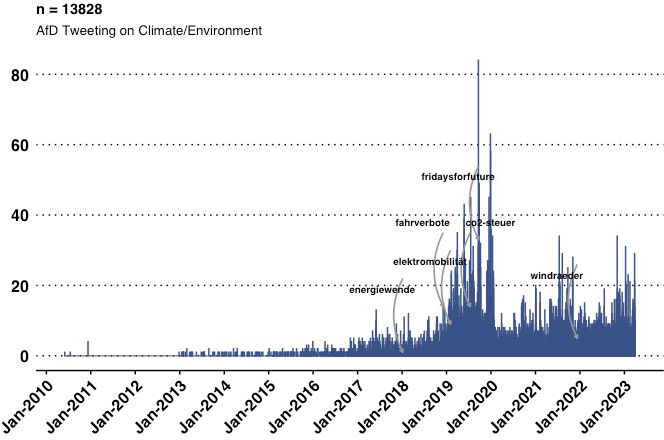
Table 1 should be regarded as an approximation of aggregate patterns rather than a precise ranking of frequencies (see Appendix). The model performed strongly in identifying climate-action references, but attributing responsible actors and affected entities proved more challenging. As the extraction of climate-action references achieved the highest validation scores, this category serves as the basis for the following qualitative analysis. Within the top results, I manually identified three particularly prominent semantic fields, or narrative families. They were generated through iterative reading of tweets associated with these climate-action references and served as heuristic entry points for the qualitative analysis. Within each family, I selected terms that were both prominent in the corpus and substantively specific, avoiding generic terms like “klima” or “klimawandel” that would dilute the analytical focus. They are as follows: (1) formal policy instruments and governance measures like Energiewende (energy transition), CO2-Steuer (carbon tax), or Klimapaket (climate law); (2) climate activism and movement actors like FridaysForFuture, Klimaaktivisten (climate activists), or Greta; and (3) explicitly delegitimizing counter-frames like Klimahysterie (climate hysteria) or Klimawahn (climate madness). These categories make evident that the AfD’s climate discourse references specific policies as well as activist actors and context-specific rhetorical labels, especially compounds with a negative attribution.
The selection of the keywords within the three narrative families was accompanied by a qualitative inspection of tweets associated with candidate terms, which confirmed that the selected references exhibited greater thematic variation and substantive specificity than more frequent but more diffuse alternatives. Based on the terms, for each narrative family, I drew a random sample of 50 tweets containing the corresponding references. By drawing tweets at random, the analysis was less dependent on a small number of especially visible or rhetorically striking examples. The aim was to capture different manifestations of the broader narrative family. The qualitative analysis nevertheless revealed substantial overlap between the families. They therefore do not constitute discrete narratives so much as they point to interconnected patterns of meaning that recur across different objects of climate-related discourse.
4.2 Policy instruments and climate measures (Energiewende, CO2-Steuer, Klimapaket)
A dominant pattern emerges in how AfD politicians narrate policy instruments such as the energy transition or carbon taxation: they are framed as threats to specific, deserving groups in society. The recurring core argument is that such policies make everyday life more expensive and thereby prevent certain groups from meeting their basic needs. Climate policies are thus typically narrated in terms of their economic consequences. As one tweet states, energy transition plans “come at immense cost to citizens. Especially drivers and homeowners are being squeezed” (2019-09-05). Another claims that the energy transition “means very concretely: driving more expensive – air travel more expensive – meat more expensive – rents rising – 100,000 jobs at risk” (2021-05-06).
In some instances, AfD actors go beyond monetary harm and invoke tangible physical danger. The group addressed is the “consumers” who, it is suggested, will “freeze” in winter, while “Germany is saving the world’s climate”, implying that their suffering is being justified in the name of a higher moral purpose (2021-09-17). The irony intends to underscore the claim that ordinary citizens are being sacrificed for abstract, global goals. Against these allegedly harmful and threatening effects, AfD actors portray themselves as the advocates of those affected. One account, speaking from the perspective of a landlord, states: “I have not increased the advance payments, but I have informed the tenants that, just as with gasoline, new taxes will also lead to higher heating bills. And that only one party, the AfD, has opposed this CO2-tax by all means” (2021-02-15). Here, the party presents itself as the sole defender of those burdened by rising prices.
At times, this framing is linked to broader socio-economic claims about poverty: “2 million Germans TOO POOR TO #HEAT… The so called #energy transition continues to drive up the costs of #driving, heating, and #housing” (2021-02-15). While invoking economic deprivation, these narratives do not speak on behalf of the poor. Instead, they allude to the risk of impoverishment for the middle class. That is how AfD actors carefully delineate the deserving social groups in their moral vocabulary. The recurring thread is the portrayal of basic needs under threat: heating, housing, and car use, framed as essential elements of everyday life. These narratives construct a “middle-of-society” form of economic victimhood, implying that basic economic rights are under threat.
The claim that climate policy makes life more expensive also plays a central role in constructing villains within the narrative. The argument is that rising costs could have been avoided – yet instead, this outcome was actively pursued. The burden is framed as the result of intentional action by political elites. As one tweet states: “The CO2 tax does not serve the environment, but green clientelism!” (2021-01-29). Here, pro-climate actors are introduced as pursuing particularistic interests rather than environmental goals. The Greens, it is argued, are in reality motivated by hidden agendas.
Another strand singles out economic mismanagement and waste, arguing that climate policy benefits the wrong groups while ordinary citizens and innocent families suffer: “I could burst with anger. Hundreds of millions of euros thrown out the window for nothing. In the name of the nonsensical #energy transition and climate hysteria. Wind farm operators rejoice - citizens and families in Germany must foot the bill” (2021-02-15). In some cases, this argument is linked to migration, suggesting that climate policy serves entirely different, and darker, purposes: “The CO2 tax merely serves to finance illegal migrants. Why should the climate change because of higher taxes?” (2019-07-05). In this logic, environmental policy is dismissed as a cover for redistribution toward undeserving outsiders. Similar narratives are directed at the EU. German “savers” and “renters” are portrayed as victims, with the German government adding further burdens through climate taxation: “After #Draghi and the #ECB, also on behalf of the federal government, expropriated German savers and destroyed their pensions and life insurance, the government is now collecting the rest through #wealth tax, #CO2 tax, and #property taxation” (2019-09-29).
Narratives that delegitimize specific policies and instruments also portray abstract, valued entities as under threat. A recurring theme defines the nation as a whole – Germany – as the victim. The argument is that green policies drive up prices, and Germany is being duped. Germans are made to pay, while other countries allegedly evade responsibility. A variation of this theme is the claim that historical or national achievements are under threat, often framed in economic terms. For example, German “prosperity” (Wohlstand) itself is depicted as being destroyed by the energy transition. As one tweet states: “In Germany, the federal governments of the past 17 years have squandered the postwar prosperity of the Federal Republic through the #energy transition, the #euro rescue, unqualified migration, #climate policy, #COVID-lockdowns, and the #sanctions against Russia. Now we are back where we were in 1949 + without hope” (2022-11-11). Prosperity, as a collective national achievement rooted in the postwar order, is invoked as being deliberately dismantled.
Economic frames are widespread in these narratives. But other abstract entities also appear threatened. For example, AfD politicians also argue that nature itself is suffering from climate policies. Instead of protecting the environment, it is suggested that climate policies damage it. Sometimes the claim is presented in general terms; in other cases, it is accompanied by references to supposed insider knowledge or technical intricacies that seem to substantiate it. As one tweet argues: “The next so-called #green technology massively subsidized by the state is turning out to be an environmental super-disaster. Rainwater can dissolve heavy metals from the building components. And it all ends up in groundwater and drinking water #Energiewende #Solar“ 2018-05-13).
Notably, AfD politicians frequently place climate policies alongside other measures that they take issue with, such as the wealth tax or sanctions against Russia. This work of cultural association is quite powerful: by grouping various policies together, climate action is embedded within a broader narrative of harmful government intervention. Such associations reduce complexity, presenting diverse policy domains as part of a single, coherent narrative pattern suggesting ignorance or bad faith.
4.3 Climate activists and movement actors (FridaysForFuture, Klimaaktivisten, Greta)
A second family of references emerges around attempts to portray climate activists and social movement actors in a negative light by emphasizing the alleged harm their actions cause to society. Here, the overarching thread is that climate activism is fundamentally misguided. Activists are depicted as irresponsible actors who engage in actions that are portrayed as potentially life-threatening. A particular focus in this regard is on activists who glued themselves to the streets and staged visible protests by blocking traffic. These actions occurred frequently in Germany in 2022 and 2023. The protests were unpopular among the general public, and AfD politicians draw on this sentiment to delegitimize the climate movement as a whole. One tweet, for example, claims that “climate activists carry out life-threatening interventions in road traffic, preventing emergency services from reaching accident victims or the sick”. The tweet further argues that these individuals should not be described as “activists” but rather as “terrorists” and that they should be “locked up” (2022-11-04). The “terrorism” charge, of course, is a particularly severe form of delegitimation.
The theme of “life-threatening” activism also relies on stories that are taken out of context or exaggerated. One prominent example concerns the widely circulated case of a cyclist in Berlin who was severely injured in an accident in the fall of 2022 and later died. A viral claim suggested that emergency responders had been unable to reach the scene because climate activists were blocking the road. The story spread on social media and was used to assign blame to climate activists. However, the claim later proved to be false: investigations by the Berlin General Prosecutor’s Office, reported in April 2023, found that the protest had not caused the delay (Berliner Berliner Morgenpost, 2023). By that time, AfD actors and others had already circulated the explanation widely. The case illustrates how victimhood narratives can be instrumentalized. Another line of argument focuses on claims of damage caused by climate activism to buildings, infrastructure and other valued public spaces. One tweet states: “The actions of the #climate activists are taking on ever greater proportions. The damage is considerable, for example at the #BER airport” (2022-11-28).
Charges of hypocrisy against climate activists are particularly widespread. This critique is directed strongly at the young activists who, in the general public, may appear as altruistic, genuinely concerned representatives of the climate movement. AfD politicians therefore subject their motives to especially intense questioning and discrediting. They accuse them, for example, of having different motives: “It is becoming increasingly clear: climate activists are not concerned with climate or environmental protection”, but instead seek to “abolish the system” (2022-11-02). Activists are also regularly portrayed as acting out of financial self-interest, sometimes with the claim that they are being paid to stage protests. The goal of these characterizations is to argue that pro-climate actors are a threat to the moral and social order.
Tweets target prominent figures of the climate movement, most notably Greta Thunberg. Her youth and public persona are mocked as naïve or juvenile. The aim is to suggest that the expectations and hopes invested in her are fundamentally misplaced. Such attacks are typically linked to claims about the real problems facing society, especially economic ones. In this way, materialist arguments are mobilized to dismiss climate activism as purely ideological. One tweet states: “Oh God… NO ONE could possibly have foreseen this… First the #car dies. Then the #jobs die. Then #regions die!!! But thanks to Saint #Greta, jobs and #money and #bread will rain down from the sky” (2019-10-03). Here, Thunberg is invoked ironically as a quasi-religious figure, while the alleged economic consequences of climate policy, in particular, the decline of industries, and regions, are foregrounded as the real stakes of the debate. The protests are placed within a broader narrative of national decline. Another example juxtaposes Fridays for Future demonstrations with claims that Germany is in “recession,” that “short-time work is at a high,” and that “insolvencies are increasing” concluding with the question: “When will the German Michel wake up?” (2019-09-27).
4.4 Rethorical labels (Klimahysterie, Klimawahn)
A third family uses rhetorical labels introduced to discredit pro-climate action. This line of attack revolves around charges of irrationality and emotional excess. As in the delegitimization of climate activists, the argument follows a now familiar pattern: an economic crisis is allegedly unfolding, but the actors in question seem to ignore this, and instead appear as distracted by climate politics. One tweet claims: “Climate hysteria will lead to much higher unemployment! Ignorance and stupidity have a price!” (2019-11-29). The supposed victims of climate hysteria are “hardworking commuters and workers” who are portrayed as bearing the real costs of climate policies (2019-05-27).
Here, climate policy is framed as irrational and destructive. This allows AfD representatives to position themselves as the voice of reason. A key narrative vehicle is the portrayal of the climate movement as a kind of religious cult or sect. As one tweet states: “Greta staged as a messiah: stop the climate cult and return to reason! The 16-year-old self-declared climate activist Greta Thunberg on the cover of the current issue of Time. No to climate madness! Yes to life!” (2019-05-21). In such narratives, a broader, arguably mythic storyline emerges. Society is portrayed as being governed by delusional elites who are accelerating national decline. Greta Thunberg appears in this story as a kind of false prophet, symbolizing a misguided movement that has captured, and inebriated, political and cultural institutions. Here, victimhood constructions take on an almost epic dimension: it is no longer merely particular social groups that are portrayed as threatened, but society, and Western civilization itself. The recurring motif of “climate hysteria” thus functions as a diagnosis of collective delusion: political elites – like the “green elite party” (2019-05-27) – and climate activists are depicted as part of the same irrational camp.
5. Discussion: strategies of delegitimzation in context
This article has examined the Twitter/X communication of politicians from Germany’s main far-right party, AfD, on climate issues. The main goal was to understand the specific strategies through which these actors seek to delegitimize pro-climate action. An important contextual factor is that, for a significant period of time, Germany stood at the forefront of progressive climate politics in Europe, not only at the level of consumption, but also in efforts to transform its economy, setting decarbonization targets for its industrial base and energy supply. AfD’s discourse is therefore best understood as a backlash against this progressive agenda.
As an analytical framework, the article has argued that examining narrative structures, with stereotypical character roles such as victims and villains, can reveal elementary dynamics of how policy communication and contestation unfold in the public sphere (Kuhlmann and Blum 2019). Based on the insight that victimhood constructions are critical to the far right’s political rhetoric in other domains (Betz 2022, Elgenius and Rydgren 2022), this article paid special attention to this element in climate discourse, asking specifically which groups, individuals, or entities are portrayed as negatively affected or suffering from climate action.
The patterns identified in the empirical material correspond closely to several strands of climate skepticism discussed in the literature (Lockwood 2018, Forchtner and Lubarda 2023, Caiani and Lubarda 2023), particularly response skepticism, process skepticism, and Manicheanism. Throughout the material, a strong focus on the perceived negative distributional and economic consequences of climate policies emerges. The patterns of harm and blame identified here can be classified as instances of response skepticism (Van Rensburg 2015), the form of skepticism that questions the effectiveness and efficiency of climate policies. Economic harm narratives portraying groups in the “middle of society” (like citizens, commuters, renters, and workers) as victims reflect response skepticism about the societal consequences of climate policy. Arguments that such policies make everyday life more expensive, and that they cause specific socially worthy groups to suffer, are employed to undermine confidence in these policies. AfD rhetoric conjures elements of class resentment here, but it also maintains a careful boundary: rather than speaking from the perspective of the economically marginalized, it speaks on behalf of those who are imagined as deserving, as entitled to fair treatment by political elites.
Accusations of elite manipulation and corruption arguably reflect process skepticism (Van Rensburg 2015) and distrust in governing institutions. Here, a recurring theme was the claim that elites act intentionally against the interests of citizens, frequently coupled with allegations of hidden monetary motives, as in the notion of “green clientelism” (see Bohr 2016). These arguments can, as we saw, also be linked to themes of nationalism and national decline, often articulated in conjunction with economic arguments and images.
The depiction of activists as dangerous or irrational actors who harm the social and moral order resonates with the Manichean logic identified in studies of far-right climate discourse. This is visible, for example, in portrayals of activists as “terrorists”, of the climate movement as a delusional cult, and of Greta Thunberg as a kind of false prophet. Such narratives mobilize the good-versus-evil binary opposition that is typical of populist discourse. Interestingly, direct distrust in climate science itself was less prominent in the material; it tended to appear more indirectly. Instead, political elites and activists were the primary targets of delegitimation. This may be because science skepticism lends itself less easily to the kinds of harm constructions foregrounded here. The hotly debated issue of the German heating law (Haas et al., 2025) exhibits a very similar grammar of moral conflict, structured around “trigger points” (Mau et al., 2026) and social figures constructed in public discourse (Heide, 2025). The AfD was very successful in capitalizing on this pivotal discussion around the energy transition. Since that debate only started in 2023, it is not covered in the dataset used here.
An important insight from this analysis is the salience and overall importance of economic references in delegitimizing climate policies (see also Hilmar, 2025). This dimension of climate-skeptical discourse currently remains somewhat underexplored in the existing literature. While some authors have identified elements of it (Bohr, 2016; Küppers, 2024), the findings here suggest that it plays such a central role that it warrants much more systematic study. To be sure, the AfD’s context may be specific in this regard. The party has deep roots in ordoliberal economic thought (Havertz, 2019). Still, this may not be limited to the German case. Further research should compare these patterns across cases and examine more closely how other far-right parties construct victimhood narratives in connection with economic arguments.
Overall, a key feature of AfD’s delegitimization discourse on Twitter/X is the attempt to position the party as the rational voice of the “middle” of society. Pro-climate actors are portrayed as irrational, “hysterical”, “naïve”, as part of a “sect” or “religion”. These labels function as a form of social mapping that, in turn, is meant to assign credibility to the AfD. By depicting its opponents as delusional, the party casts itself as the actor that protects what is truly valuable and that speaks with reason in the face of uncertainty. In the context of the looming climate crisis, uncertainty, and even catastrophe is acknowledged, but the source of danger is redefined. The imminent danger is not climate change itself. Instead, this rhetoric evokes a different apocalyptic horizon: social decline, demographic crisis, and economic collapse allegedly caused variously by a redistributionist, communist left, by Greens, or by a broad alliance of “irresponsible” pro-climate actors. Through such narratives, the party seeks to insert itself forcefully into the struggle over who can claim the position of the truly rational, judicious actor in the climate debate.
Funding
This project has received funding from the European Union’s Horizon Research and Innovation Action program under Grant Agreement no. 101132327. Views and opinions expressed are however those of the author(s) only and do not necessarily reflect those of the European Union. Neither the European Union nor the granting authority can be held responsible for them.”
References
Arzheimer K. and Berning C.C. (2019), «How the Alternative for Germany (AfD) and Their Voters Veered to the Radical Right, 2013-2017», in Electoral Studies, 60: 102040.
Berliner Morgenpost (2023), «Tote Radfahrerin – Ermittler entlasten Klimaaktivisten», 13 April, available at: https://www.morgenpost.de/bezirke/charlottenburg-wilmersdorf/article238131987/letzte-generation-betonmischer-unfall-toedlich-44-jaehrige-radfahrerin-keine-schuld-staatsanwaltschaft.html.
Betz H.-G. (2022), «Economic Resentment or Cultural Malaise: What Accounts for Nativist Sentiments in Contemporary Liberal Democracies», in Handbook on Migration and Welfare, Edward Elgar Publishing, Cheltenham, pp. 351-366.
Blum S. and Kuhlmann J. (2019), «Stories of How to Give or Take – Towards a Typology of Social Policy Reform Narratives», in Policy and Society, 38(3): 339-355.
Bohr J. (2016), «The ‘Climatism’ Cartel: Why Climate Change Deniers Oppose Market-Based Mitigation Policy», in Environmental Politics, 25(5): 812-830.
Bonikowski B. and Nelson L.K. (2022), «From Ends to Means: The Promise of Computational Text Analysis for Theoretically Driven Sociological Research», in Sociological Methods & Research, 51(4): 1469-1483.
Caiani M. and Lubarda B. (2023), «Conditional Environmentalism of Right-Wing Populism in Power: Ideology and/or Opportunities?», in Environmental Politics, 1-21.
Chae Y. and Davidson T. (2025), «Large Language Models for Text Classification: From Zero-Shot Learning to Instruction-Tuning», in Sociological Methods & Research, 55 (2): 501-567.
Coffé H., Crawley S. and Givens J. (2026), «Growing Polarisation: Ideology and Attitudes towards Climate Change», in West European Politics, 49(1): 1-29.
Damhuis K. and Rashkova E.R. (2024), «The Politics of Resentment: What Is It and How Is It Mobilized by Populist Radical Right-Wing Parties in Different Contexts?», in Frontiers in Political Science, 6: 1390228.
Dickson Z.P. and Hobolt S.B. (2025), «Going against the Grain: Climate Change as a Wedge Issue for the Radical Right», in Comparative Political Studies, 58(8): 1733-1759.
Elgenius G. and Rydgren J. (2022), «Nationalism and the Politics of Nostalgia», in Sociological Forum, 37: 1230-1243.
Forchtner B. and Lubarda B. (2023), «Scepticisms and Beyond? A Comprehensive Portrait of Climate Change Communication by the Far Right in the European Parliament», in Environmental Politics, 32(1): 43-68.
Haas, T., Sander, H., Fünfgeld, A., & Mey, F. (2025). «Climate obstruction at work: Right-wing populism and the German heating law», in Energy Research & Social Science, 123: 104034.
Habelitz N., Kuhlmann J. and Blum S. (2024), The Role of Emotions in (Climate) Policy Narratives: How Can It Be Analysed?, CIDAPE Working Paper.
Havertz R. (2019), «Right-Wing Populism and Neoliberalism in Germany: The AfD’s Embrace of Ordoliberalism», in New Political Economy, 24(3): 385-403.
Heide J. (2025), «Polarizing Social Figures? Climate Activists in German Media and Popular Discourse», in European Societies, 27(5): 959-991.
Hilmar, T. (2025), «Cassandra from the far right: how the German and Austrian populist radical right links climate skepticism with economic issues», in Environmental Politics, 1-30, https://doi.org/10.1080/09644016.2025.2560188
Huber R.A., Greussing E. and Eberl J.-M. (2022), «From Populism to Climate Scepticism: The Role of Institutional Trust and Attitudes towards Science», in Environmental Politics, 31(7): 1115-1138.
König T., Schünemann W.J., Brand A., Freyberg J. and Gertz M. (2022), «The EPINetz Twitter Politicians Dataset 2021: A New Resource for the Study of the German Twittersphere and Its Application for the 2021 Federal Elections», in Politische Vierteljahresschrift, 63(3): 529-547.
Kulin J., Johansson Sevä I. and Dunlap R.E. (2021), «Nationalist Ideology, Right-Wing Populism, and Public Views about Climate Change in Europe», in Environmental Politics, 30(7): 1111-1134.
Küppers A. (2024), «‘Climate-Soviets’, ‘Alarmism’, and ‘Eco-Dictatorship’: The Framing of Climate Change Scepticism by the Populist Radical Right Alternative for Germany», in German Politics, 33(1): 1-21.
Lockwood M. (2018), «Right-Wing Populism and the Climate Change Agenda: Exploring the Linkages», in Environmental Politics, 27(4): 712-732.
Lubarda B. (2024), Far-Right Ecologism: Environmental Politics and the Far Right in Hungary and Poland, Routledge, London.
Malinova O. (2021), «Politics of Memory and Nationalism», in Nationalities Papers, 49(6): 997-1007.
Mau S., Lux T. & Westheuser L. (2026), Trigger points. In Trigger Points, Bristol University Press.
McCright A.M., Dunlap R.E. and Marquart-Pyatt S.T. (2016), «Political Ideology and Views about Climate Change in the European Union», in Environmental Politics, 25(2): 338-358.
Norgaard K.M. (2011), Living in Denial: Climate Change, Emotions, and Everyday Life, MIT Press, Cambridge.
Patterson J.J. (2023), «Backlash to Climate Policy», in Global Environmental Politics, 23(1): 68-90.
Polletta F., Chen P.C.B., Gardner B.G. & Motes A. (2011), «The Sociology of Storytelling», in Annual Review of Sociology, 37(1): 109-130.
Schwörer J. & Fernández-García B. (2024), «Climate Sceptics or Climate Nationalists? Understanding and Explaining Populist Radical Right Parties’ Positions towards Climate Change (1990–2022)», in Political Studies, 72(3): 1178-1202.
Somers M.R. (1994), «The Narrative Constitution of Identity: A Relational and Network Approach», in Theory and Society, 23(5): 605-649.
Stuhler O. (2022), «Who Does What to Whom? Making Text Parsers Work for Sociological Inquiry», in Sociological Methods & Research, 51(4): 1580-1633.
Stuhler O., Ton C.D. and Ollion E. (2025), «From Codebooks to Promptbooks: Extracting Information from Text with Generative Large Language Models», in Sociological Methods & Research, 54(3): 794-848.
Than N., Fan L., Law T., Nelson L.K. and McCall L. (2025), «Updating “the Future of Coding”: Qualitative Coding with Generative Large Language Models», in Sociological Methods & Research, 54(3): 849-888.
Van Rensburg W. (2015), «Climate Change Scepticism: A Conceptual Re-Evaluation», in SAGE Open, 5(2), https://doi.org/10.1177/2158244015579723.
Weisskircher M. and Volk S. (2025), «The People against the Sun? Ideology and Strategy in Far-Right Parties’ Climate Obstruction of Solar Energy», in Environmental Politics, 1-32.
Yazar M. and Haarstad H. (2023), «Populist Far Right Discursive-Institutional Tactics in European Regional Decarbonization», Political Geography, 105: 102936.