https://doi.org/10.36253/smp-17135
Dwelling as a Wicked Problem: Housing, Inequality and Precarious Life Trajectories
Roma Tre University, Italy
E-mail: mariaalessandra.mole@uniroma3.it
Abstract. Over recent decades, dwelling has become one of the major social issues in Western societies, assuming a central role in both public and academic debate. Access to housing can no longer be understood solely in terms of the availability of dwellings, but rather as a multidimensional phenomenon intersecting transformations in the labour market, changes in family structures, and the widening of socio-economic inequalities. This contribution analyses dwelling as a social process, focusing on the tension between people’s rights and privileges which characterises contemporary societies. Through a theoretical framework drawing on the concept of wicked problems, this paper discusses the structural criticalities of housing, paying particular attention to its effects of the commodification. The theoretical reflection is then brought into dialogue with the findings of a qualitative study conducted in the city of Rome. It, therefore, aimed at exploring the symbolic, relational and identity-related meanings of dwelling for people who have experienced, and in many cases continue to experience, conditions of severe housing precariousness.
Keywords: dwelling, wicked problems, precariousness, inequalities.
Contents
1. Dwelling as an emerging social issue
2. Dwelling between use value and exchange value
3. Dwelling as a wicked problem of public policy
5.1 Dwelling on the street: between insecurity and symbolically valued objects
5.2 Dwelling and relational poverty
5.3 Housing and agency: dwelling as a precondition for action
5.6 Fragile social networks, shame and concealment strategies
1. Dwelling as an emerging social issue
Dwelling represents a fundamental dimension of human and social experience. As Palvarini emphasises (2010), it cannot be reduced to a merely material function or to a static possession, but must instead be understood as a relational and situated process which unfolds over time through adaptive everyday practices and processes of spatialisation. While the home has traditionally been associated with the provision of shelter and the satisfaction of basic needs, sociological research has progressively shown how dwelling also constitutes a space for the identity’s construction, the stabilisation of social relations and participation in collective life (Clapham 2005). From this perspective, housing functions as a social infrastructure, as it enables the exercise of rights, the construction of belonging and the possibility of planning relatively stable life trajectories (Saunders 1989; Somerville 1992; Padgett, Henwood and Tsemberis 2015).
Due to the fact that it operates as an infrastructure, the housing issue intersects multiple domains of social life, such as health conditions (Saegert and Evans 2003; Baker and Lester 2017), welfare and care arrangements (O’Malley and Croucher 2005; Bowlby and Jupp 2021), as well as other forms of social and economic inequality (Arundel 2017). Regarding this concept, dwelling can be adopted as an analytical lens through which to observe broader transformations. As Moos (2019) argues, housing is positioned “on the front line” of the processes of change which have shaped urban societies over the last two decades. Figure 1 summarises the main structural trends contributing to the redefinition of access to housing and forms of housing inequality.
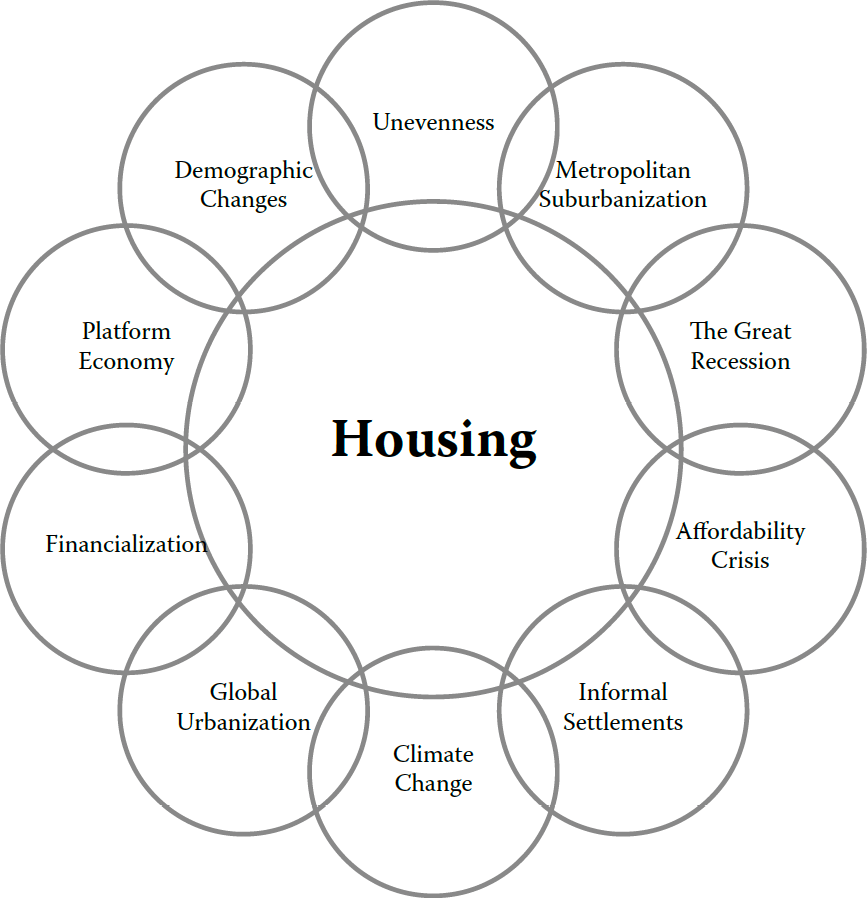
Economic, demographic, climatic and political changes tend to manifest themselves with particular intensity in the housing sphere, through rising housing costs, socio-spatial segregation, residential instability and the emergence of new forms of exclusion. Therefore, dwelling actively contributes to shaping inequalities, reinforcing or reorganising them spatially and affecting individuals’ life trajectories. Over recent decades, access to housing has indeed become increasingly problematic. Transformations in developed economies, labour market precarisation, the pluralisation of family structures and the intensification of mobility have altered housing demand, placing pressure on welfare systems which are often ill-equipped to respond to differentiated and intermittent needs. Within this framework, dwelling lies at the centre of a growing tension between right and privilege: while formally recognised as a fundamental right, in practice it increasingly takes the form of a selective and unequally accessible resource.
The aim of this contribution is to analyse dwelling as a complex social phenomenon, highlighting its material, relational and symbolic dimensions. This article particularly seeks to show how the housing issue can be interpreted as a wicked problem (Gallent 2019: 26), that is, a domain characterised by uncertain boundaries, sectoral interdependencies and the absence of unequivocal solutions (Rittel and Webber 1973). Thus, this phenomenon requires integrated policies capable of combining market regulation, social protection and the promotion of inclusion.
2. Dwelling between use value and exchange value
One of the most robust interpretative keys for understanding contemporary transformations in dwelling lies in the distinction between the use value and the exchange value of housing. Drawing from Marxian reflections on the commodity form, Lefebvre (2014 [1968]) shows how space – and housing in particular – is not a simple material container destined for biological and practical functions (shelter, rest, consumption), but rather a social product traversed by power relations and logics of appropriation.
From this perspective, housing tends to be transformed from a social good into a financial asset (Madden and Marcuse 2016), giving rise to what may be defined as a “housing question” which concerns not only the availability of dwellings, but also the structural mechanisms producing precariousness, displacement and inequality.
This shift cannot be interpreted as a process reducible to purely economic dynamics; but rather, it should be understood as a structural transformation of the social functions of dwelling. The growing centrality of exchange value alters the very way in which housing is conceived, regulated and lived: from a space oriented towards social reproduction, stability and the construction of social ties, housing increasingly comes to be treated as a patrimonial and financial asset. In this transition, the “rationality” governing housing is no longer primarily defined by residents’ housing needs, but by criteria such as economic return, investment liquidity and expectations of long-term appreciation. Hence, the housing question becomes a privileged lens through which to observe the evolution of contemporary urban capitalism: not only because real estate rent assumes a central role, but also because processes of social and territorial selection are intensified, redefining who can inhabit a certain housing space, where, under what conditions and with what degree of stability.
Over the last two decades, academic researches have described this process through concepts emphasising the growing integration between housing and financial markets. The financialisation of housing refers to the expansion of financial logics within the real estate sector, through the diffusion of mortgage credit, the transformation of dwellings into investment instruments, the centrality of large operators and the increasing disciplinary power of debt over life trajectories (Aalbers 2016; Fernàndez and Aalbers 2016). Even where housing formally remains “owner-occupied”, access and permanence are mediated by the ability to sustain its costs. This shift has fuelled new forms of housing vulnerability, often invisible in traditional homelessness indicators (Clapham 2002).
Alongside financialisation, gentrification and intensified urban competition have operated as territorial devices of social restructuring. Harvey (2008) links these phenomena to the neoliberal production of the city as a space of investment, while Smith (1996) explains gentrification as the outcome of a rent-gap logic which incentivises neighbourhood reconversion and valorisation, often at the cost of displacing working-class residents.
A further accelerator of these dynamics is represented by the growth of urban tourism and short-term rentals, which has rendered the boundaries between the city as a place to live and the city as a platform for an increasingly porous consumption. In environments where housing stock is captured by higher returns in the tourist market, dwellings lose their function of social stabilisation and become part of an economic chain oriented towards rotation and profit maximisation (Cocola-Gant 2016). This transformation, in addition to compressing supply for residents, contributes to rising rents and increasing contractual instability, with particularly severe effects on young people, migrants and low-income households.
Within this scenario, Rolnik (2019) explicitly speaks of a “war of places” to describe the growing conflict traversing housing space: dwelling becomes a terrain of struggle between social rights and extractive rent-seeking logics. Thus, the tension between use value and exchange value does not merely represent an analytical dichotomy, but a concrete social conflict, observable in difficulties of access to housing, displacement from central neighbourhoods, the growing weight of housing expenditure on household budgets and the production of new forms of urban marginality.
Within this framework, the growing prevalence of exchange value over the social use of housing has contributed to the emergence of an increasingly widespread condition of residential insecurity, which does not necessarily coincide with the absence of a dwelling, but rather with the instability, vulnerability and uncertainty characterising the housing trajectories of broad segments of the population. Recent researches have indeed challenged the equivalence between the housing issue and homelessness, highlighting how contemporary forms of housing exclusion are often less visible but not less pervasive (Clapham 2002).
The concept of precarious housing is located precisely within this intermediate analytical space, indicating unstable housing conditions marked by temporary contracts, unaffordable rents, overcrowding, threats of eviction or dependence on informal solutions (McKee 2012). In such contexts, housing ceases to function as an infrastructure of social security and instead becomes a source of stress, anxiety and vulnerability, with effects extending far beyond the housing sphere in the narrow sense.
Through the housing pathways approach, Clapham (2005) has shown how the experience of dwelling should be read as a dynamic process intertwined with individual biographies, life-course transitions and structural transformations of housing markets and welfare regimes. From this perspective, residential insecurity does not represent an exceptional or temporary condition, but an increasingly normalised dimension of housing trajectories, particularly for young people, single-parent households, migrants and workers in precarious employment.
Numerous studies have highlighted how housing precariousness is closely connected to labour market precarisation and welfare retrenchment, particularly in contexts characterised by a strong emphasis on private homeownership as a pillar of social security (Kemeny 1995; Ronald 2008; Arundel and Doling 2017). In such regimes, access to housing is increasingly mediated by the market and by debt, while public forms of protection are insufficient to compensate for the risks associated with income volatility and rising housing costs. Housing, far from being a stabilising factor, thus becomes a vector of risk exposure.
Academic researches on residential insecurity further emphasise the cumulative and intersectional effects of housing instability, disproportionately affecting individuals already exposed to other forms of inequality. Waldron (2022), for example, shows how the threat of eviction and contractual instability produce direct effects on mental health and long-term planning capacity, while Desmond (2016) demonstrates how evictions are not merely a consequence of poverty, but an active mechanism in its production and reproduction. Therefore, housing precariousness acts as a structuring factor of inequality.
Similarly, Coulter, van Ham and Findlay (2016) show how residential insecurity limits individuals’ ability to invest in social relationships, educational pathways and labour opportunities, reinforcing dynamics of social and territorial immobility. When housing is unstable, opportunities to exercise agency and to construct coherent life projects are significantly reduced.
In light of these contributions, the tension between use value and exchange value of housing acquires further relevance: it is not merely a theoretical contradiction, but a structural mechanism which produces residential insecurity as an ordinary condition.
In situtations which exchange value prevail, housing is primarily assessed in terms of its capacity to generate rent rather than its role as a space of life and social reproduction. This configuration produces a form of housing contingency in which permanence in domestic space is exposed to risks, negotiations and interruptions: sudden rent increases, contract termination, property sale, conversion to more profitable uses or income loss may trigger exit from housing even in the absence of exceptional biographical events. Hence, the researches on precarious housing broaden the analysis of housing inequality, shifting attention from extreme situations alone to a more articulated understanding of ordinary forms of vulnerability.
Housing, thus, tends to shift from a space of protection to a space of uncertainty, paradigmatically revealing the contradictions of urban capitalism and contemporary housing policies. These structural transformations find concrete expression in the life trajectories of individuals experiencing housing precariousness, as will become evident in the empirical findings presented below.
3. Dwelling as a wicked problem of public policy
Contemporary transformations of dwelling can be interpreted through the category of wicked problems, introduced by Rittel and Webber (1973) to describe public problems characterised by high causal complexity, sectoral interdependence, a plurality of actors holding conflicting values and the absence of definitive solutions. More recent literature has clarified that wickedness is not solely a technical property of problems, but also emerges from processes of framing, contestation and governance: wicked problems tend to generate persistent controversies over problem definition, responsibility, legitimate policy instruments and evaluation criteria (Head 2008; Termeer and Dewulf 2019; Head 2022). From this follows a crucial paradox: while defining housing as a wicked problem is analytically useful, there is also a risk that complexity may be invoked as an alibi for postponing structural interventions, producing forms of decision-making paralysis (Termeer and Dewulf 2019).
The housing issue exemplifies the characteristics of wicked problems for at least four reasons. First, dwelling is intrinsically multidimensional: it simultaneously concerns the availability and quality of housing supply, regulation of real estate markets, access to credit and rental housing, social and health policies, mobility and urban infrastructure, as well as demographic and migratory dynamics. It is therefore a “nested” problem in which sectoral interventions systematically generate externalities in other domains, making it difficult to isolate causes and effects and complicating any attempt at integrated governance (Adams 2011; Head 2022).
Secondly, housing governance is typically multi-level and polycentric. Responsibilities are fragmented across local, national and supranational levels and distributed among public authorities, real estate market actors, financial institutions and third-sector organisations. This configuration increases the risk of incoherence between objectives – such as urban attractiveness, property valorisation and tenant protection – and produces difficult trade-offs, particularly in the absence of binding coordination instruments (Thomann, Trein and Maggetti 2019). Third, housing is highly exposed to external shocks –economic crises, pandemics, energy inflation, rising interest rates which amplify instability and reduce the predictability of policy outcomes. Fourth, distributive conflicts are structural: depending on social and asset positions, the same intervention may be perceived either as the protection of a fundamental right or as a threat to property value and rent, making it difficult to build stable coalitions in support of long-term reforms (Head 2008).
This configuration helps explain why, in practice, housing policies tend to oscillate between emergency measures and partial interventions, often characterised by incremental adjustments that fail to address the root causes of inequality and sometimes merely displace problems across territories or social groups. The literature on the governance of wicked problems highlights that in such contexts there are no “solutions” in a strong sense, but rather strategies of management and mitigation requiring cross-sectoral coordination, iterative learning and adaptation over time (Head 2022). In particular, Termeer and Dewulf highlight the so-called evaluation paradox: when problems are complex and dynamic, it becomes difficult to determine “what has worked”, making approaches based on small wins and measurable intermediate objectives necessary, without abandoning a long-term transformative vision (Termeer and Dewulf 2019).
Applied to housing, this literature helps interpret the difficulty of combining supply-side policies, redistributive measures, market regulation and socio-health interventions without one domain neutralising or contradicting another.
4. Research methodology
The empirical research is based on a qualitative approach aimed at exploring the meanings attributed to dwelling by individuals living in conditions of urban marginality in the city of Rome. A total of 22 semi-structured interviews were conducted between April 2025 and July 2025 at two service centers: (1) Don Calabria Institute of Rome, a low-threshold service providing reception, meals and, in some cases, overnight accommodation; (2) the service “Assistance to the Person” promoted by Caritas Diocesana, oriented towards case management for situations of severe marginality and individualised support.
The sample consists of 22 individuals aged between 42 and 84 years old, with life histories marked by labour precariousness, housing loss, health problems, breakdown of family ties and, in some cases, addiction or experiences of detention. Five of the participants are women and seventeen are men. Among the women, two are foreigners and three are Italians, while among the men, six are foreigners and eleven are Italians. Interviews addressed common thematic areas – daily life, work, health, social networks, relations with services, dwelling and future aspirations – while leaving ample space for biographical narratives (Kvale 1996).
Access to the field was mediated by social workers employed in the services, whose presence played a crucial role in relational mediation and trust-building. For individuals who often experience ambivalent or conflictual relationships with institutions, such mediation proved decisive in facilitating authentic narratives of lived experience.
Interviews were transcribed and analysed through theoretically informed thematic coding, in dialogue with the literature on dwelling, housing precariousness and processes of social exclusion. The analysis does not aim at statistical representativeness, but rather at an in-depth understanding of vulnerability trajectories and practices of agency. This research design made it possible to explore dwelling not only as a material condition, but also as a lived and narrated experience, providing the empirical basis for the analysis of results that follows.
5. Research findings
This empirical evidence confirms and further articulates the theoretical reflections developed in the previous sections. It, therefore, shows how dwelling is configured, in the experiences of the interviewees, as a fundamental social infrastructure whose presence or absence cumulatively affects security, social relations, identity and capacity for action. Individuals attempt to “domesticate” urban space, rendering it experientially accessible as a place in which it is possible to feel at home. Dwelling can, in fact, be interpreted as a form of existential rootedness constitutive of human experience (Heidegger 1998 [1962]). The spaces where people seek to render familiar are not mere physical containers, but environments which are traversed, lived and continuously endowed with meaning, in which the world is experienced through repetitive and familiar actions, the use of objects, bodily postures and routines which enable symbolic appropriation. Practices such as habitually sleeping in the same place or regularly frequenting specific spaces contribute to the construction of a relatively stable everyday life. This routine is similar to what Giddens (1984) defines as “ontological security”, making the inhabited environment more predictable and therefore less threatening. However, this process of domestication is never fully accomplished nor guaranteed: it is fragile, reversible and constantly exposed to external disruptions, highlighting the structural tension between the need for rootedness and the precariousness of the material and social conditions of dwelling.
5.1 Dwelling on the street: between insecurity and symbolically valued objects
One of the most salient findings emerging from the interviews concerns the link between housing precariousness and everyday insecurity. Individuals living on the street, in cars or in informal arrangements describe their situation as one of permanent exposure to risk, in which the lack of a protected space amplifies their vulnerability. One interviewee recounts:
Now I’m on the street and I struggle even with the smallest things. For example, I had an umbrella –this morning I woke up and it was gone because it was stolen during the night. Then they stole my phone, my ID card. It’s mostly poor people who get targeted, the ones who have nothing (Male, Interviewee 1).
This account highlights how dwelling, understood as the construction of routines, repeated use of objects and stabilisation of everyday life, is continually interrupted and rendered precarious by external conditions. The absence of housing is presented as a radical rupture of a set of practices that enable existential rootedness. The loss of objects such as an umbrella, a mobile phone or an identity card directly contributes to the erosion of ontological security, making the environment not only unpredictable but constantly threatening (Giddens 1984). The episode of night-time theft illustrates how urban space, although lived and traversed daily, remains uncontrollable and radically unstable.
Other accounts further illustrate this condition:
Here, I charge my phone, have breakfast, take a shower, have lunch, and then I go around Rome until 8 p.m. I usually go to Via del Corso, Piazza di Spagna, because I sleep near the Ara Pacis. I stay there because there’s a lot of police. Rome has become dangerous; the more time goes by, the uglier things get to me. I was also robbed: I was looking at my phone and a kid grabbed it from behind and ran away (Male, Interviewee 2).
One day a friend told me he was sleeping outside under the canopy of an apartment building and invited me to stay with him for almost the whole summer. In October I stayed in a shelter near Piazza Venezia for eight months. Now I sleep in a friend’s car. During the day I move around to eat, fortunately food can be found all over Rome. I can have two lunches, three breakfasts, but places to sleep are hard to find. (Male, Interviewee 3).
These excerpts show how, in the absence of housing, everyday life is organised through a spatial ordering of the city, within which interviewees structure their time and movements. The typical day is marked by a relatively stable sequence of places and functions: the Don Calabria day centre represents a crucial anchoring space, where essential activities such as personal hygiene, food, phone charging and an initial form of social interaction are concentrated. This place takes on an almost domestic function during the first part of the day, enabling the construction of a routine which introduces a degree of predictability into everyday life.
Interviews reveal how respondents when occupying spaces select and render them functional. Central areas of Rome – Via del Corso and Piazza di Spagna – are not chosen randomly, but based on perceived safety, visibility and control. The explicit reference to police presence near the Ara Pacis, where the first interviewee sleeps, shows how security is sought through strategic use of public space. Thus, the city becomes both a resource to be tactically governed and a potentially hostile environment from which one must protect oneself.
These practices confirm that public spaces, temporary shelters and even a car can be transformed into spaces of everyday life. A condominium canopy, a dormitory or a friend’s car are not merely shelters, but become – albeit temporarily – inhabited places, that is, spaces marked by presence and repetition of actions. In line with Lefebvre’s reflections (1991), urban space appears in this situation its dual dimension: it is both the domain of action and the product of action itself. Interviewees shape urban space according to their needs, exercising a capacity to use it for their own purposes, rendering it familiar and, as far as possible, “homey”.
5.2 Dwelling and relational poverty
The analysis shows how dwelling is deeply intertwined with the relational dimension (Berti, Valzania and Molè 2025). The absence of stable housing not only fragments pre-existing family and friendship ties, but also makes it difficult to build sociality and sharing, fostering isolation and social withdrawal1. Some interviewees describe loneliness as a feeling of disconnection from the social world, accompanied by a perception of irrelevance: “Nobody looks at you here. You’re old, poor and useless. You disappear, it’s as if you don’t exist” (Female, Interviewee 4).
Conversely, reception services produce forms of proximity-based sociality which perform an important function of emotional and symbolic support. One woman describes the service as a place of everyday community:
In the morning I come here and stay with my friends. We’re together, we talk, we confide in each other. Everyone has their own problems, but among us we’re united. Those three hours pass in harmony, in community (Female, Interviewee 5).
Such ties perform a function of emotional containment and mutual recognition, particularly significant in trajectories marked by isolation, loss of social roles and relational fragility. The possibility of sharing time and words contributes to reconstructing a minimal sense of belonging and restoring dignity to everyday experience.
However, these ties are often narrated as ambivalent:
They care about me here, but they’re not real friends. They’re almost forced friendships, because we’re all in the same situation. Here it’s everyone for themselves, God for us all (Male, Interviewee 10).
In “our world” it’s hard to find someone who can really be a friend, there’s always some interest underneath (Male, Interviewee 7).
While such relationships provide immediate support and mitigate loneliness, they tend to be fragile, temporary and weakly convertible into resources useful for broader social inclusion.
Analytically, these are predominantly forms of bonding social capital (Putnam 2000), which strengthen internal cohesion and produce a sense of belonging and mutual support. However, they do not facilitate access to more heterogeneous networks with greater mediating capacity vis-à-vis the labour market, institutions and urban opportunities. As Portes (1998) observes, social capital is not intrinsically “positive”: in contexts marked by poverty and instability, it may generate ambivalent effects, contributing to group closure, mutual dependence and, in some cases, the reproduction of the very conditions of exclusion it seeks to mitigate.
The absence or weakness of bridging social capital significantly limits the possibility of transforming relationships into resources deployable beyond assistance circuits. In this perspective, Granovetter’s contribution (1973) on the role of weak ties is particularly relevant: it is precisely weak ties, rather than strongly cohesive ones, which enable access to information, opportunities and resources external to one’s immediate group. However, in contexts of housing precariousness, such connections are structurally reduced, both due to the spatial and symbolic segregation of services and to the instability of individuals’ life trajectories.
Dwelling, therefore, does not constitute a simple background to social relations, but a structuring condition of their quality, horizon and “social convertibility”. When housing experience is unstable or confined within circuits of marginality, relational networks also tend to remain closed and self-referential, offering short-term protection and support but rarely functioning as bridges towards autonomy and inclusion. As Woolcock emphasises (2001), the capacity of social capital to generate inclusive outcomes largely depends on the presence of connections between informal networks and formal institutions; in their absence, social relations risk unintentionally crystallising positions of disadvantage. From a more structural perspective, Bourdieu (1986) reminds us that the value of social networks is never neutral, but depends on their position within social space and their capacity to be converted into other forms of capital, highlighting how not all relationships offer the same opportunities for mobility and recognition.
5.3 Housing and agency: dwelling as a precondition for action
A central axis of the analysis concerns the relationship between dwelling and capacity for action. The absence of housing is associated with a reduction in autonomy, future planning and the ability to exercise agency. This condition is powerfully synthesised by one interviewee:
Without a home you’re mutilated. It’s a strong word, but it’s true. You can’t fully act, you’re limited. I lived in many houses; before I had a normal life, then I was on the street for quite some time, and this is the first home after that street life (Male, Interviewee 12).
The lack of stable space prevents the structuring of everyday time, self-care, sustained job searching and access to social rights. Conversely, access to housing – even temporary – produces an enabling effect. Another interviewee recounts:
When I entered this house, the feeling was that I suddenly came from nothing to having everything. The staff here tell us: this is your space which has value to you. So you have to be responsible and manage it (Male, Interviewee 6).
The possibility of having a space recognised as one’s own contributes to reconstructing a sense of responsibility, biographical continuity and social legitimacy – central elements for the exercise of agency. From this perspective, housing does not represent the final reward of an already accomplished pathway of inclusion, but rather a preliminary condition that makes the activation of individuals possible in the first place.
5.4 Residence and rights
A recurring thematic axis in the collected narratives concerns official residence registration (residenza anagrafica) as a crucial node for the effective exercise of social citizenship. The absence of residence emerges as a genuine form of institutional invisibility, placing individuals “outside the world” of rights, despite recognised needs and, in some cases, partial access to basic services. In this context, so-called “fictitious residence” (as in the case of Via Modesta Valenti in Rome) plays a central role as a minimal inclusion device, indispensable for avoiding total exclusion from welfare and legal protection circuits. This instrument is not perceived by interviewees as a definitive solution, but rather as an access threshold that allows one to “exist” for public administration. As one interviewee explains:
Yes, I have the fictitious one at Via Modesta Valenti… the people from Sant’Egidio helped me… sometimes people ask me where I got it… maybe I can help someone else (Male, Interviewee 14).
This excerpt highlights at least two relevant dimensions. On the one hand, the fundamental role of third-sector organisations as institutional mediators, capable of filling informational and procedural gaps within the public system. On the other, a “horizontal” dimension of knowledge emerges: obtaining residence transforms beneficiaries into informal resources for others, activating micro-practices of solidarity and information circulation that compensate for the opacity of official procedures.
Residence is also represented as a symbolic boundary between inclusion and exclusion. Even when primary needs are partially met (food, healthcare, shelter), the absence of residence continues to produce a condition of legal and social suspension:
I have everything: I eat, I get medical care, I sleep. But as long as I don’t have residence, I’m outside the world. The moment I get residence, everything will change (Male, Interviewee 16).
Here, residence is not merely a bureaucratic requirement, but assumes the meaning of an enabling device, capable of reactivating a future perspective and repositioning the individual within the social and normative order. Its absence produces a vicious circle of irregularity involving residence permits, access to rights and the very possibility of interacting with institutions:
I have to renew my residence permit, because I lost it. I lost my residence and now I’m doing everything with lawyers to get it back. […] I find it difficult because I’m not helped by the State. […] But it’s a right—we’re not protected, because you’re outside the world. But when I get residence, everything will change; what I’m missing is the bureaucratic and legal aspect (Male, Interviewee 9)
The analysis thus shows how official residence registration is not a mere administrative formality, but a key device of inclusion/exclusion, rendering individuals institutionally “visible” and entitled to rights.
5.5 Health and precariousness
Several narratives show how physical and mental health conditions are deeply intertwined with housing precariousness trajectories, configuring not as separate dimensions but as mutually constitutive elements of cumulative vulnerability. Many interviewees report chronic conditions–including cardiovascular diseases, diabetes, recognised disabilities and past physical trauma – which directly affect work capacity and the possibility of maintaining employment continuity. Health, for these specific group of people, is frequently described not as an episodic event, but as a permanent condition limiting opportunities for “starting over”, especially in the absence of stable housing capable of guaranteeing rest, regularity and access to services.
Most interviewees report inadequately monitored health problems due to interrupted care pathways, service fragmentation and logistical or financial difficulties related to purchasing medication or accessing specialist visits. As a 73-year-old man when renouncing treatment recounts: “I take the pills when I can afford them. Otherwise, I stay in bed and wait for it to pass” (Male, Interviewee 17).
Alongside physical conditions, psychological distress pervades narratives in a diffuse manner, often remaining in the background and rarely explicitly defined. In some cases, mental suffering is narrated through difficulties in maintaining stable relationships or being recognised in one’s complexity. One woman states:
I’ve always told people that I’m bipolar, but it always caused problems […]. It wasn’t an advantage to say it, because they took advantage of it. It’s something I have, it’s not who I am (Female, Interviewee 18).
This narrative highlights the weight of stigma associated with mental health and the risk that disclosure becomes an additional source of vulnerability, especially in relational and housing contexts marked by power asymmetries.
Other accounts emphasise how psychological distress often results from a stratification of critical events – bereavement, social isolation, difficult biographical transitions –rather than being a direct and immediate consequence of economic poverty. One man states: “It’s not even about money, it’s a deep crisis inside you”, (Male, Interviewee 8) underscoring how mental suffering is experienced as an intimate and totalising condition, difficult to translate into terms of assistential need.
5.6 Fragile social networks, shame and concealment strategies
Alongside material needs, interviewees’ narratives reveal a profound poverty of recognition, in which individuals struggle to be perceived – and to perceive themselves – as legitimate subjects within their affective and social networks.
Fear of being “seen” in their own vulnerability generates concealment strategies which manifest, first and foremost, in the construction of alternative narratives addressed to family members. As one interviewee recounts:
I’m ashamed to be seen like this, so I make up that I’m in Milan, Turin, Naples for work, that I’m travelling. Maybe they have doubts. I have a brother, but it’s as if I didn’t. I’m the one who keeps them at a distance. I also keep friends at a distance (Male, Interviewee 11).
In this situation, shame emerges as a central emotion, and lying is not aimed at deceiving others, but at protecting their own identity and preserving a symbolic distance which avoids judgement, pity or stigma.
When you live on the street and want to wash yourself, you can’t go to your friend’s house. I’ve never asked for it. I’d rather die than ask. (Female, Interviewee 13).
This statement shows how street homelessness produces a rupture of implicit norms of reciprocity regulating social relations. Asking for hospitality – or even access to basic hygiene facilities – is experienced as an unbearable violation of dignity, to the point that suffering becomes preferable to requesting help. In this sense, isolation appears not merely as a consequence of poverty, but as an active self-defensive mechanism against loss of status and recognition.
The construction of “protective lies” represents a further device for managing vulnerability, especially towards close family members:
I even lied to my brother; I didn’t tell him I’m on the street. I told him I’m in a shelter; it’s a white lie. Who knows what he would think, imagining me sleeping on the street (Male, Interviewee 15).
The lie is, therefore, as presented above, explicitly defined as “white”, underscoring its ethical and relational function: not deception, but damage limitation for both self and others. Fear of being imagined “sleeping on the street” refers to a socially stigmatised representation of marginality, from which the interviewee seeks to distance himself.
6. Conclusions
This analysis shows how dwelling is configured as a dynamic, relational and symbolic process, deeply intertwined with public policies, support networks and individuals’ biographical trajectories. The findings highlight how dwelling on the street or in informal arrangements produces a condition of permanent exposure to risk, in which insecurity is not episodic but structural. The recurrent loss of personal belongings, the need to select spaces based on criteria of protection and visibility, and the inability to control the surrounding environment progressively erode the possibility of constructing stable routines and “feeling at home” in urban space. Observed practices of spatial zoning reveal significant adaptive capacity on the part of these interviewees, but at the same time expose the limits of a domestication of space constantly threatened by external and unpredictable factors.
Secondly, this analysis presents how housing precariousness is deeply intertwined with forms of relational poverty. Moreover, proximity-based networks developing within services and reception contexts perform a fundamental function of emotional support and mutual recognition, but often remain fragile, temporary and weakly convertible into resources for broader inclusion processes.
A further contribution concerns the relationship between dwelling and agency. Collected narratives show how the absence of housing is experienced as a genuine mutilation of the capacity to act: without a stable space, it becomes difficult to organise time, care for oneself, plan for the future and claim rights. The administrative and legal dimension also emerges forcefully through the role of official residence registration. The absence of residence constitutes a form of institutional invisibility which suspends full access to social citizenship, even in the presence of recognised needs and partial service use. “Fictitious residence” devices represent minimal thresholds of inclusion, capable of reactivating rights and future perspectives, but also reveal the fragility of a system which delegates to exceptional solutions what should be structurally guaranteed.
Furthermore, difficulties in accessing continuous healthcare, the inability to sustain medication costs and fragmentation of healthcare provision exacerbate existing physical and psychological conditions. Mental distress – often not explicitly named – confirms that health cannot be addressed separately from the material and relational conditions of dwelling.
In light of the analysis presented above, these findings suggest that policies and interventions targeting individuals in conditions of housing precariousness are unlikely to be effective if confined to emergency or sectoral responses. Dwelling emerges as a transversal dimension, capable of profoundly shaping the quality of social relations, access to rights, health and individuals’ capacity to act.
References
Aalbers M. B. (2016), The Financialization of Housing: A Political Economy Approach, Routledge, London and New York.
Adams D. (2011), «The ‘wicked problem’ of planning for housing development in the UK», in Housing Studies, 26(6): 951-960.
Arundel R. (2017), «Equity Inequity: Housing Wealth Inequality, Inter and Intra-generational Divergences, and the Rise of Private Landlordism», in Housing, Theory and Society, 34(2): 176-200.
Arundel R. and Doling J. (2017), «The end of mass homeownership? Changes in labour markets and housing tenure opportunities across Europe», in Journal of Housing and the Built Environment, 32: 649-672
Baker E. and Lester L. (2017), «Multiple housing problems: A view through the housing niche lens», in Cities, 62: 146-151.
Berti F., Valzania A. and Molè A. (2025), «Se la povertà è relazionale: una ricerca nelle aree interne della Toscana», in Rivista Trimestrale di Scienza dell’Amministrazione, 1: 1-17.
Bourdieu P. (1986), «The Forms of Capital», in J. G. Richardson (Ed.), Handbook of Theory and Research for the Sociology of Education, Greenwood Press, New York, pp. 241-258.
Bowlby S. and Jupp E. (2021), «Home, inequalities and care: perspectives from within a pandemic», in International Journal of Housing Policy, 21(3): 423-432.
Clapham D. (2002), «Housing pathways: A postmodern analytical framework», in Housing, Theory and Society, 2: 57-68.
Clapham D. (2005), The Meaning of Housing: A Pathways Approach, Policy Press, Bristol.
Cocola-Gant A. (2016), «Holiday Rentals: The New Gentrification Battlefront», in Sociological Research Online, 21: 3.
Coulter R., van Ham M. and Findlay M. A. (2016), «Re-thinking residential mobility: Linking lives through time and space», in Progress in Human Geography, 40(3): 352-374.
Desmond M. (2016), Evicted: Poverty and Profit in the American City, Crown Publishers/Random House.
Fernàndez R. and Aalbers M.B. (2016), «Financialization and housing: Between globalization and varieties of capitalism», in Competition & change 20(2): 71-88.
Gallent N. (2019), Whose Housing Crisis? Assets and Homes in a Changing Economy, Policy Press, Bristol.
Giddens A. (1984), The Constitution of Society: Outline of the Theory of Structuration, Polity Press Cambridge.
Granovetter M. S. (1973), «The Strength of Weak Ties», in American Journal of Sociology, 78(6): 1360-1380.
Harvey D. (2008), «The Right to the City», in New Left Review, 53: 23-40.
Head B. W. (2008), «Wicked Problems in Public Policy», in Public Policy, 3 (2): 101-118.
Head B. W. (2022), Wicked Problems in Public Policy. Understanding and Responding to Complex Challenges, Palgrave Macmillan, London.
Heidegger M. (1998 [1962]), Tempo ed essere, Guida, Napoli.
Kemeny J. (1995), From Public Housing to the Social Market: Rental Policy Strategies in Comparative Perspective, Routledge, New York.
Kvale S. (1996), InterViews: An Introduction to Qualitative Research Interviewing, Sage Publications, Thousand Oaks.
Lefebvre H. (1991), The Production of Space, Basil Blackwell, Owford.
Lefebvre H. (2014 [1968]), Il diritto alla città, Ombre Corte, Bologna.
Madden D. and Marcuse P. (2016), In Defense of Housing: The Politics of Crisis, Verso, London/New York.
McKee K. (2012), «Young People, Homeownership and Future Welfare», in Housing Studies, 27(6): 853-862.
Moos M. (2019), A Research Agenda for Housing, Edward Elgar Publishing, Herndon.
O’Malley L. and Croucher K. (2005), «Housing and dementia care – A scoping review of the literature», in Health and Social Care in the Community, 13(6): 570-577.
Padgett D. K., Henwood B. F. and Tsemberis S. J. (2015), Housing First: Ending Homelessness, Transforming Systems, and Changing Lives, Oxford University Press, New York.
Palvarini P. (2010), «Qualità abitativa e vivibilità urbana», in Quaderni di Sociologia, 52: 31-51.
Portes A. (1998), «Social Capital: Its Origins and Applications in Modern Sociology», in Annual Review of Sociology, 24: 1-24.
Putnam R. D. (2000), Bowling Alone: The Collapse and Revival of American Community, Touchstone Books/Simon & Schuster, New York, London, Toronto, Sydney, Singapore.
Rittel H. W. J. and Webber M. M. (1973), «Dilemmas in a general theory of planning», in Policy Sciences, 4: 155-169.
Rolnik R. (2019), Urban Warfare: Housing under the Empire of Finance, Verso Books, London.
Ronald R. (2008), The Ideology of Home Ownership: Homeowner Societies and the Role of Housing, Palgrave Macmillan, New York.
Saegert S. and Evans G. W. (2003), «Poverty, Housing Niches, and Health in the United States», in Journal of Social Issues, 59(3): 569-589.
Saunders P. (1989), «The Meaning of “Home” in Contemporary English Culture», in Housing Studies, 4(3): 177-192.
Smith N. (1996), The New Urban Frontier. Gentrification and the Revanchist City, Routledge, New York.
Somerville P. (1992), «Homelessness and the Meaning of Home: Rooflessness or rootlessness?», in International Journal of Urban and Regional Research, 16(4): 529-539.
Termeer C. and Dewulf A. (2019), «A small wins framework to overcome the evaluation paradox of governing wicked problems», in Policy and Society, 38(2): 298-314.
Thomann E., Trein, P. and Maggetti M. (2019), «What’s the problem? Multilevel governance and problem-solving», in European Policy Analysis, 5(1): 37-57.
Waldron R. (2022), «Experiencing housing precarity in the provate rental sector during the covid-19 pandemic: the case of Ireland, in Housing Studies, 38(1): 84-106.
Woolcock M. (2001), «The place of social capital in understanding social and economic outcomes», in The Canadian Journal of Policy Research, 2(1): 11-17.
1 While this analysis addresses relational poverty and the consequences of marginality and housing precariousness without explicitly adopting a gender perspective, a more in-depth examination of similarities and differences between men and women will be the focus of future researches.