https://doi.org/10.36253/smp-17126
Collaborative Housing Strategies: The Case of “Widespread Reception” by Caritas Diocesana in Rome
Sapienza University of Rome, Italy
E-mail: carmelo.bruni@uniroma1.it; matteo.finco@uniroma1.it
*Corresponding author
Abstract. Homelessness is a long-standing issue, but only recently has it become relevant on the Italian and international political agenda. The latest data show that the phenomenon is growing and that policies to combat it have often proved ineffective. The traditional responses in our country have been limited to the provision and organisation of low-threshold reception services (staircase model). Only recently have some alternative services based on the “Housing First” model been trialled. The literature emphasises that the complexity of the homeless situation requires an integrated approach to the individual, which can create a stable network of multi-professional interventions. At the same time, interventions must promote the recovery or development of people’s skills and abilities when these are limited or compromised. In this context, in 2015, Caritas Rome launched the “Accoglienza diffusa” (Widespread Reception) project. The initiative is based on the principle that the path to inclusion involves building stable social networks that support personal empowerment. This contribution presents the initial results of this initiative. These show that the project is developing Welfare Communities in some areas of Rome, characterised by a stable local network of support and assistance for vulnerable individuals, involving public institutions, social enterprises, families and parishes.
Keywords: welfare communities, inclusion, homelessness.
Contents
3. The “accoglienza diffusa” [“widespread reception”] project
1. The homeless
The presence of homeless people1 in our urban contexts is not a recent phenomenon. In the 1980s, the attention to this issue began to grow, together with the crisis of modern Western welfare systems after the so-called Trente Glorieuses (Fourastié 1979). Since then, an extensive body of literature on this subject (e.g., Blau 1992; Kozol 1988; Rossi 1989; Shinn and Weitzman 1990; Stern 1984) has demonstrated the worsening presence of homeless people2, especially in wealthier urban contexts3.
In Italy, too, the interest for homelessness became significant during those years (Caritas Diocesana Roma 1987; Guidicini and Pieretti 1988; Negri and Saraceno 1996; Sarpellon 1991), although it only emerged as a factor in the political agenda at the beginning of this century. In fact, until 2011, there had never been a systematic survey on homelessness in the country4. Data show how it has become a growing problem, accompanied by urbanisation and migration, which have transformed it into a real social emergency.
It is hard to give a clear definition of homelessness, since it can be referred to different kind of people and situations. In literature, many terms are used to describe people without a home, since it is difficult to identify homogeneous characteristics in a wide and diverse range of situations and disadvantages (Lavanco and Santinello 2009: 19-20). In English, the range of terms used includes «tramps, hoboes, bums, idle and disorderly, poor and indigent, rogues and vagabonds, incorrigible rogues, vagrants, idle and dissolute, mendicants, beggars, casuals, dossers, of no fixed abode» (Gerrard 2017).
This explains why there is no shared definition at European level, since different countries use different criteria to describe the phenomenon. However, cross-sectional analyses carried out by international organisations such as FEANTSA (Fédération Européenne d’Associations Nationales Travaillant avec les Sans-Abri) show that, in general, the category of homelessness includes people without accommodation; in temporary accommodation (provided by the public services or NGOs), and those in marginal accommodation (well below standard) (Mauceri and Di Censi 2024: 20).
However, the proliferation of terminology and the difficulty in reaching a shared definition of homelessness is the consequence – and not the cause – of the difficulty to grasp its many facets. Historically, homelessness has been surrounded by prejudices and beliefs that are difficult to eradicate. For example, contrary to popular belief, some of the most recent studies on the relationship between homelessness and mental illness or drug addiction have concluded that it is not true that the latter are prevalent among the majority of homeless people (O’Sullivan et al. 2020).
Conversely, homelessness could typically take the form of a long-term, episodic or temporary condition. In fact, a research in the US in the 1990s shows that approximately 80% of shelter users are temporary, with very short stays or even a single one, while a further 10% are episodic users, and the remaining 10% are long-term users, who account for about half of all overnight stays (Kuhn and Culhane 1998). Substantially similar evidence, ceteris paribus, has been found in studies on other areas of the global North (Bairéad and Norris, 2022; Taylor and Johnson 2019; Waldron et al. 2019).
Furthermore, homeless families are not randomly distributed across the population (Bramley, Fitzpatrick 2018), but belong to a larger set of disadvantaged families (Batterham 2019; OECD 2024), for whom housing insecurity is a pervasive and semi-permanent dimension of existence (DeLuca and Rosen 2022). Therefore, the phenomenon takes different forms and characteristics depending on the territory (e.g., northern or southern Europe) and marital status (single or families). As a consequence, the conceptualisation of what constitutes the “homelessness phenomenon” in much of north-western Europe includes dimensions that elsewhere would not necessarily be defined as such (Busch-Geertsema et al. 2014).
In short, homelessness is not a fixed state (Pleace and Hermans 2020). Instead, it varies in terms of its characteristic dimensions, dynamics and outcomes. The extent of homelessness is determined by structural factors that involve the social system as a whole: the level of poverty and social exclusion; accessibility to the housing market; the degree of generosity and extent of welfare systems; the intensity of labour market contraction (Benjaminsen 2023; Bramley and Fitzpatrick 2018; Headly et al. 2023). These elements can essentially be traced back to the concept of “poverty regime” (Saraceno et al. 2020).
Individuals and families experiencing homelessness are therefore those who find themselves at the intersection of unfavourable structural circumstances at the macro level and personal vulnerabilities at the micro level, i.e. those who are «both the wrong kind of person and in the wrong kind of place» (O’Flaherty 2004). The discriminating factor lies in the availability of social, economic and emotional resources for individuals and families (Hastings 2021; 2023). Consequently, the families who are most at risk of losing their homes «are more likely to be impacted by sudden, unexpected events, have one or more personal vulnerabilities, lack adequate social support, or be alumni of an institutional setting» (Lee et al. 2021: 13). For example, both in Italy and abroad, single-parent families are more exposed to the risk of experiencing one or more episodes of homelessness compared to two-parent families (Morelli et al. 2022; Istat 2025; Saraceno et al. 2020).
Differently from what we might expect, the phenomenon affects a much larger segment of the population, partly because poverty has fluctuating characteristics (Alcock and Siza 2003). Recently in Doha, during the World Summit for Social Development5, it was stated that according to the latest UN-Habitat estimates, 318 million people are homeless, while 2.8 billion people – over a third of the global population – lack access to adequate housing. In 2011, the Italian National Institute of Statistics (ISTAT) recorded 47,648 homeless people in 158 municipalities, which rose to 50,724 three years later and to over 96,000 in 2021 (last census Istat 2022), although all irregular situations could not be detected.
Only a small number of people remain “trapped” in emergency accommodation services. For them, the evaluations focus on their individual characteristics, on the cumulative effect of prolonged periods of homelessness that reduce the likelihood of leaving, or on contingent factors which refer to “bad luck”. A crucial finding emerging from the research is that «[a]lmost everyone who will be homeless two years from today is housed now, and almost everybody who is homeless today will be housed two years from now» (O’Flaherty 2010: 143).
The multifaceted conditions of homeless people and the difficulties in addressing the phenomenon point to another and more general problem, which cuts across social policies (Ferrera and Jessoula 2025): the fact that the characterisation of fragility is conditioned not only by objective factors, but also by the different perspectives of researchers, on one hand, and (above all) legislators, on the other, as well as by the resulting intervention policies undertaken.
2. Policy responses
A central function of welfare systems is to ensure that people in vulnerable situations receive adequate social support. Historically, attitudes towards homelessness have been shaped by persistent ambivalence, determined by the interpretative dilemma linked to its manifestation and persistence: is it an expression of genuine need or an attitude resulting from instrumental manipulation (Camporesi 2003)? This symbolic distinction continues to be applied in contemporary societies (Paugam 2005), accentuated by the fact that homelessness tends to be concentrated in metropolitan areas, which are more impersonal and depersonalising6.
Given that, as mentioned above, homelessness arises from the interaction between structural, systemic, interpersonal and individual risk factors, the ability of welfare systems to fulfil their support function, and the methods of intervention adopted, which vary significantly not only between different national contexts, but also within individual countries (Edgar and Meert, 2005; Fitzpatrick 2005). This depends on the different characteristics of welfare systems (Esping-Andersen 1990), which allow to understand the (sometimes profoundly) different outcomes in terms of preventing and reducing homelessness (Benjaminsen 2023). The structural differences between systems produce a strong heterogeneity in the scope of benefits, the availability of housing, and the quality of support services for vulnerable population groups. In countries where universalistic and decommodified models prevail, homelessness takes on a more homogeneous and residual profile. Conversely, in countries where the services are more commodified and selective, homeless populations tend to be larger and more heterogeneous (Stephens et al. 2010; Benjaminsen 2023).
However, the relationship between welfare systems and the extent of homelessness cannot be interpreted in simplistic or linear terms. The structural and systemic factors that influence patterns of homelessness are in fact manifold, interdependent and constantly evolving. Furthermore, welfare systems, in their concrete implementation, often tend to deviate from the ideal-typical characteristics outlined by Esping-Andersen, as they present significant differences even between countries that formally belong to the same regime.
Although recent research indicates – both in the EU and US – an increase in spending on services for homeless people, institutional responses continue to favour emergency-oriented interventions rather than prevention and elimination of the phenomenon (Parsell 2023; Pleace et al. 2018). In addition, such interventions are also based on the so-called “staircase model”, according to which people should first resolve any psychosocial issues before accessing stable housing (Pleace et al. 2021; Culhane and An 2021). As a result, a significant portion of resources is still allocated to passive and reactive services – such as emergency shelters, day services or subsistence interventions – which are aimed more at managing the most acute effects of homelessness rather than at its structural resolution.
Researchers have interpreted this approach as the result of a historical trajectory in which services for homeless people have been primarily conceived as emergency responses, focused on providing temporary shelter (Culhane 2008). Moreover, a static and individualising political view of the phenomenon is common: it underestimates its dynamic and transitory nature and favours the expansion of emergency shelters (Culhane and An 2021). At the same time, a significant body of evidence has been accumulated on effective and ineffective interventions in combating homelessness for specific population groups (Munthe-Kaas et al. 2018; Cortese and Consoli 2022; Lakshminarayanan et al. 2023). However, these interventions are mainly focused on the individual level and rarely address the systemic causes of the phenomenon.
In Italy, too, traditional responses have focused mainly on organising low-threshold reception services, which can offer temporary shelter to large numbers of people but are often fragmented, discontinuous and poorly tailored to individual needs. This trend can be attributed, among other things, to:
- –The limited availability of dedicated accommodation facilities;
- –Consequently, the tendency to concentrate guests in facilities that offer uniform services in response to diverse needs;
- –The lack of municipal housing, which would allow to create more personalised cohousing solutions tailored to the different situations and needs of users;
- –The lack of collective awareness of the phenomenon, which leads to portray homeless people as individuals in an irreversible condition. At the same time, this view drastically reduces, or even eliminates, their opportunities for social reintegration.
Only recently, we have been witnessing to greater openness towards alternative approaches based on integrated hospitality models that combine access to accommodation with pathways towards employment and progressive empowerment (Cortese and Consoli 2022). However, the complexity of the living conditions of homeless people requires integrated and holistic approaches that are capable of enhancing individual resources and skills, even when these are limited or compromised. Effective intervention must combine individual strategies with multi-level ones, aimed at reforming public policies, strengthening institutions, and improving the quality of social services (Matei et al. 2025).
According to this perspective, restoring a sense of community belonging and fully protecting social rights are essential starting points for any process of empowerment and social reintegration. The starting point for a process of empowerment and promotion of social reintegration is the restoration of a sense of belonging to a community and the protection of rights. In this context, the “Accoglienza diffusa” (“Widespread Reception”) project was launched by Caritas Roma in 2015, involving parishes, religious institutions and families.
The aim of this work is to understand the strengths and challenges, obstacles and benefits encountered in implementing this initiative, in order to assess how it fits within the broader landscape of interventions aimed at supporting the homeless. The central hypothesis of the study is that “Widespread Reception” represents an intermediate level of intervention that fits within the Welfare Community model. It cannot clearly be defined as an Housing First example, nor as a cohousing one. The hypothesis is that this initiative represents a community-based intervention aimed at building a local safety net to facilitate the process of reintegration for people who have experienced homelessness.
The project is divided into two areas of intervention:
- –Reception of asylum seekers: aimed at individuals or families.
- –Secondary reception: aimed at Italian and foreign individuals or families who have already undergone an initial reception phase and have begun a path towards independence.
The following chapter presents the initial results of this initiative based on a survey – largely already underway – which proceeds along two lines:
- –The socio-demographic characteristics of the recipients of the intervention, taken from the service’s database;
- –The results of three focus groups conducted with participants in the initiative: Caritas workers, parish volunteers, parish priests.
In particular, the focus groups involved:
- –4 parish priests, representing the same parishes that have been involved in the project throughout its 10-year duration;
- –All six Caritas staff members involved in the project – graduated in different disciplines: sociology, social work and education – who act as mentors to both service users and the facilities, serving as mediators between guests and the host community;
- –12 volunteers, once again selected on the basis of their length of service. They have been involved in the reception project from the start and have therefore participated in it throughout the years.
The focus groups were led by a moderator, assisted by an observer, with whom the findings were subsequently discussed and analysed. The discussion was recorded with prior consent from the participants.
The results of the focus groups were transcribed in full, since the aim was to thoroughly analyse the content in order to compare the various emerging positions. To this end, only the parts relevant to this study were analysed (Krueger 1988), using the Content Encoding Analysis as the analytical strategy (Acocella and Cataldi 2021).
3. The “accoglienza diffusa” [“widespread reception”] project
In a world affected by increasingly widespread migration7, on 6 September 2015, during the Sunday Angelus, Pope Francis urged parishes and religious institutions around the world to welcome refugee families fleeing war and violence. This message was further elaborated on about a year later (on 21 February 2017) during the International Forum on Migration and Peace, where the Pope explained the principles underlying hospitality, articulated around four actions: welcoming, protecting, promoting and integrating.
This marked the start of the “Accoglienza diffusa” (“Widespread Reception”) project, aimed at creating opportunities for homeless who are asylum seekers and refugees to help them find accommodation in parishes, religious institutions and Roman families.
Over the past 10 years, 128 local organisations have been involved in the network. These include the social and registry services of nine municipalities in Rome, which register and provide social support to some families, as well as the enrolment of minors in nurseries and compulsory schools.
The data presented below were elaborated for the purposes of this contribution from the project’s database, made available by Caritas Romana8.
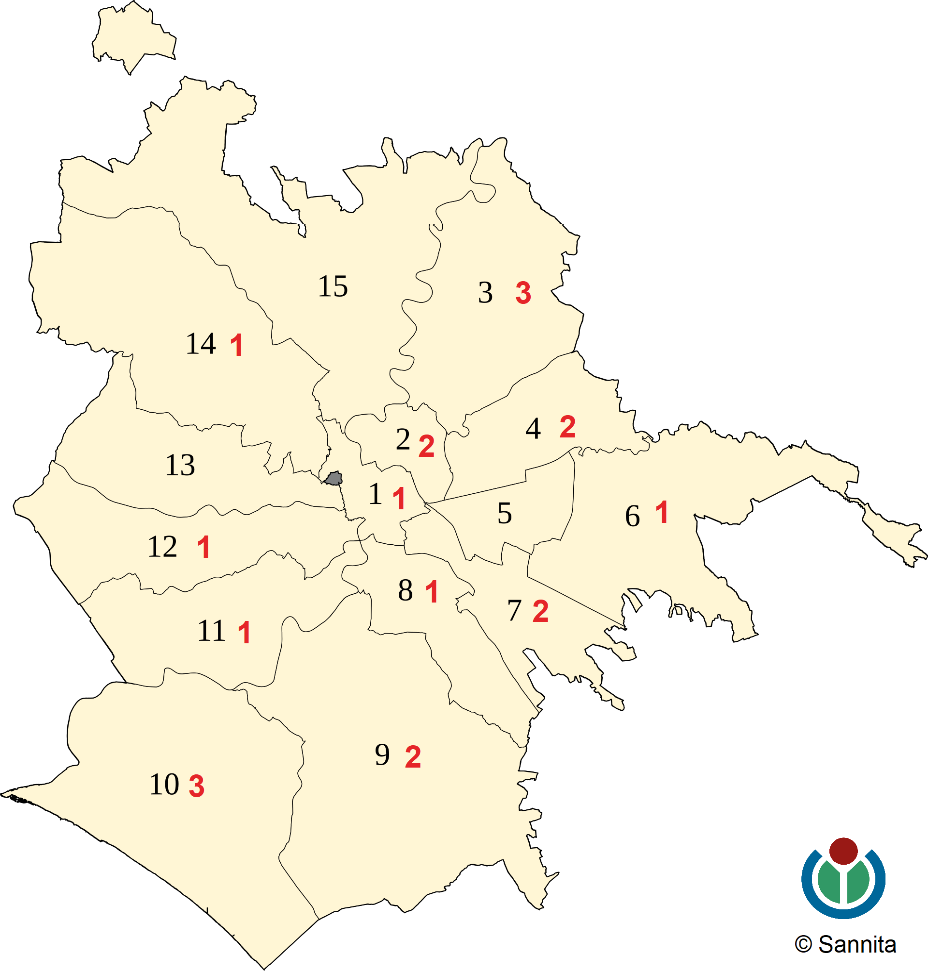
There are currently 26 facilities providing accommodation. More than half of them (16) are parishes, 3 are religious institutions, 2 are associations and 2 are families. Their distribution within the municipal area is fairly uniform: two municipalities (Municipi) (III and X) have 3 facilities, three have 2 and six have 1 (Fig. 1). Most of them have provided an accommodation within the facility itself and with a separate entrance, while in 6 cases the living space is outside the facility. The number of beds varies from one to five: two-thirds of the facilities have a capacity of at least three beds. In 6 cases, the facilities have provided users with the registration for residence (iscrizione anagrafica per residenza), which is necessary to guarantee the full exercise of civil and political rights and to access numerous social services.
A total of 88 households – all of them foreign – were accommodated in 45 reception facilities, involved in five different projects. The most numerous countries of origin were Nigeria (11), Ivory Coast (10) and Afghanistan (9). Over a quarter of the households (24) consisted of two people, while a third (33) of three. Two-thirds of the facilities (16) accommodated families with minors (half of the households (43) were single-parent families), while the remaining third accommodated single individuals (6 men and 2 women). The average length of stay was 1 year and 4 months (16 months). The facility of Casa S. Giacomo welcomed the majority of guests (8).
A total of 352 individuals were hosted (the vast majority of whom were men): 135 Italians and 209 foreigners. The most common nationalities were Ukrainian (21 people), Afghan (19), Nigerian and Senegalese (18 each). The average length of stay was 8 months. The reception facilities involved were 72 (including 4 families). Ten of these had more than 10 guests. The facility that hosted the most people was the parish of Sant’Andrea Corsini (39). The reception took place within two main projects: Emergenza Freddo (Cold Emergency, 233 people) and Centri di Accoglienza Straordinaria (CAS) (Extraordinary Reception Centres, 91 people).
“Widespread Reception” was created with the aim of guaranteeing reception in order to re-include excluded individuals. This was achieved through the construction of social networks within stable local communities, by means of a well-defined plan characterised by clear objectives and guiding principles, aimed at ensuring the protection and promotion of individuals – either single persons or families – affected by multidimensional fragility. The ultimate goal is to bring these people to full social inclusion in its various forms (housing, work and social), through the building of relationships that can be maintained over time and represent a point of reference for those involved. From a territorial point of view, this means activating a stable social protection network, based on cooperation between volunteers, nonprofit entities and institutions.
The project can be considered a social intervention that fits perfectly within the Welfare Community model (Barnes 1997; Raineri 2013; Di Santo 2022). Such model is based on structured cooperation between public institutions and civil society actors – including private companies, citizens and social economy organisations – aimed at improving the “civitas” and enhancing the common good (Rossi and Zamagni 2011). This paradigm is rooted in the so-called “horizontal subsidiarity”, which implies a redistribution of welfare responsibilities and presupposes the pooling of material and immaterial resources, as well as the development of innovative forms of governance. In this perspective, collective well-being is no longer considered the exclusive prerogative of the State, but a task that involves the entire community.
In analytical terms, it is possible to identify certain constituent elements of the welfare community: a) the development of public-private and private-private partnerships; b) the extensive involvement of local society actors and active citizens, understood in the broadest sense of the term; c) the adoption of a self-activating approach by the local community, which contributes to collective well-being through the mobilisation of its own resources – first of all, time, but also organisational and economic resources (Ponzo 2014).
Each of these elements can be found in the “Widespread Reception” experience. In particular, with regard to the first aspect, this initiative involves a mix of interventions carried out and financed partly through the use of professional expertise and public funds (Municipal Social Services, Regional Funds, CAS centres, and the Emergenza Freddo project), and partly through reception activities carried out in facilities owned and/or managed by private social organisations (Caritas Romana in this case), which provide support and empowerment interventions involving volunteers, tutors and guests.
As a group of volunteers, we learned how to network with different public and private organisations, such as the local soccer club. We learned to look around and collaborate with schools, institutions, medical centres, local health authorities, and so on. We learned how to create a network with them. We realised that we cannot do it alone, we cannot do everything by ourselves (Parish priest of a parish involved)9.
It is something we insist on, again and again: the actors in the project are the guests, the community, and the tutors. They are the three pillars of the project: if one of them is missing, the project does not work. In other words, if the tutor is not present, the project is very fragile. If the guest does not take responsibility, the project is useless, i.e., it is stuck, and the objectives are not achieved. If the community is not present, the project is not effective, and the result is very poor. (Caritas worker).
With regard to the involvement of the various “actors” in the community (in the broadest possible sense), Law 328/00 and the integrated system of social interventions and services have to be mentioned. From this perspective, a functioning welfare system is not possible without a “civic” community capable of building a culture of solidarity that gives rise to widespread social capital (Putnam 1994; 2001). This civic community is socially balanced and includes “high levels of cooperation, trust, reciprocity, civic engagement and collective well-being” (Putnam 1994: 209).
In my opinion, the parishes themselves – that is, priests and communities – changed their approach. It is not just about giving money. It is about directly and fully committing yourself and your life, your family and the parish spaces in an experience of hospitality that is different from what we have experimented up to this point.
“Widespread Reception” is something that lasts over time: it keeps you very busy and then it is no longer something occasional, even for the community. It becomes like a personal project, a real ongoing commitment (Caritas worker).
Finally, with regard to the “self-activating approach” of the local community, this welcoming experience has succeeded in stimulating initiatives and solutions that have led, at the same time, to growth for both the community and its guests.
What this project highlights is your experience as a Christian when faced with the difficulties of others. And then, obviously, it brings out the best in you, so that you can approach the person in a certain way and according to their characteristics, because you cannot behave in the same way with everyone. Everyone has their own identity and plans, and you have to be attentive to that identity and those plans, in order to bring out the best from the person you are helping (Volunteer).
I think it is very important for the community to recognise and reflect the guests’ personal growth. As said earlier, the community recognises their progress. It is like to say: “Look, you’ve done this!”. It gives value to them, recognising that they have value and that they are discovering it, or rather, that the community and the guests are discovering it together (Caritas worker).
The creation of this “integrated system of interventions” is important not only for generating a public-private support network, but also in terms of cost reduction in an era of shrinking welfare funding.
In my opinion, this is important not only for individuals and the community, but also for the State, since this model saves public money and, what’s more, the community covers part of the costs. In fact, in CAS (Extraordinary Reception Centres) projects the State invests much less than usual: now the State only covers the cost of keeping people alive. So, people who are lucky enough to be included in a CAS with us still benefit from a whole range of integration tools that they would not have elsewhere (Caritas worker).
A central dimension of community welfare lies in the ability to enhance social ties and interdependent relationships between the actors involved. The territorial and relational nature of the “Widespread Reception” project, based on the idea of proximity, allows for the construction of social networks within which individuals, through mutual interaction, become part of a shared relational system. In this perspective, the community takes on a dual function: it represents both the ultimate goal of welfare action and the preliminary condition that makes its implementation possible.
“Widespread Reception”, therefore, is a service that closes the gap between the function of large centres (which provide a first and essential response) and a Housing First experience. Given the immediate availability of accommodation, people are involved in a process of community integration, since it is the community that takes responsibility for their reception.
I have always said – long before “Widespread Reception” – that for years in our society we have treated these adults as if they were under guardianship, as if they were minors under guardianship. And then suddenly, from one day to the next, it is decided that reception is over and, without knowing how and on the basis of what skills, these people should be able to move independently in the outside world, which they do not know, because no one has really introduced them to it (Caritas worker).
Usually, in the centre there is this logic that you have a single operator who has to take care of a number of people. In this case, we completely reverse this logic, because sometimes you have one or two guests, or a family unit, but around these people, you have an entire community. The guests are at the centre, and around them revolves a whole series of people who have various roles, who then take care of the person. You have the operator, who in this case may be the tutor or the parish priest; you have the volunteers; and then you have the whole local network that you can activate, i.e., the local associations. In the case of families with minors, there are schools and sports associations where the child plays soccer or goes swimming, and then you activate the local social services. You completely change this logic and put the person at the centre of a circle, with different rays which can activate different resources (Caritas worker).
Another strength of this project is the central role played by the implicit alliance between users and operators, which typically characterises guidance and support interventions. In fact, the agreement clearly refers to the “contract” (Fargion 2013) that is established in social services between operator and guest. This agreement calls on tutors, guests and the community to take responsibility, so that the reception is productive for all parties and is not reduced to welfare dependency.
There is also the fact of giving them responsibility right from the start, which can be done when they have their own accommodation, and then they can really begin to understand how to manage their own accommodation. Because families and individuals who have their own mini-apartment – even if it is the community that brings them food – they still have tasks to do in that space, which is their own space (Caritas worker).
There is a tool used by tutors that I think is very useful, which is the “reception agreement”. It is a very effective tool for promoting the guest, because it is a tangible element in which the guest is given responsibility. It is not taken for granted that he or she is in that place and has no role, but rather he/she is given a central role (Caritas worker).
It is precisely this approach that allows to create lasting bonds, which extend over time and space, going beyond the duration of participation in the project. These relationships demonstrate the success of the individual’s path towards autonomy, but also the protective value of the community, beyond the explicit mutual recognition of this bond.
The guests usually do not thank you explicitly, but in my opinion they do it anyway by calling you every now and then or telling you things like… for example, once a guy who left the centre and moved to England called me and said: “My second daughter was born, I’ll send you a picture”. If someone sends you a picture, you are not just the person who helped them. No, in many cases, you are their anchor. You are a point of reference, you understand? For example, one of these guys called us and said: “Can I come over for lunch?” I mean, he invited himself! [Laughter] He said: “I need to talk to you”, because he had to choose between going to live in England, where he had a girlfriend, or staying here, right? So, since he did not have parents or anyone to talk with, he asked us for advice… (Volunteer).
At a first evaluation, the “Widespread Reception” project seems to be positioned precisely between low-threshold forms of reception – still very common in Italy – and the Housing First experiences that are beginning to spread in the country (Cortese and Consoli 2022). Therefore, the project seems to provide a further response to the severe marginalisation of individuals and families without secure housing: it is capable of integrating the advantages of Housing First with those typical of community experiences lamented by Putnam.
The advantage of the project lies in “reversing” the typical logic of low-threshold structures. In those structures, a small number of operators deal with a large number of people. The need, in this case, is to provide immediate support to those who have experienced extreme marginalisation and homelessness, and therefore need immediate help to reconnect with a life that suffered a more or less sudden collapse (Bonadonna 2001). “Widespread Reception”, instead, gives operators the opportunity and time to devote themselves to the guests and their personal growth. It is not a question of determining whether one approach is better than the other, but rather of reaffirming the importance of having diversified interventions, adapted to different stages of life and people’s different resources. Some people need immediate help and a facility that is sometimes, but not always, as impersonal as the Ostello [“Hostel”], where they can blend in with others. Before making a fresh start, they need to “find themselves”. Others need to set their lives in new directions, therefore finding themselves at the centre of a community that can help them start again becomes a powerful tool for assistance.
However, structures and functions must not be confused.
The Hostel is not only functional for those who need an impersonal structure, it can also help a person’s plans if they feel more comfortable in a structure that accommodates many people at the same time. It is not the type of structure itself that defines the efficacy of the service. It is the centrality of the person’s needs and characteristics that makes the difference.
Of course, the “Widespread Reception” scheme is affected by weaknesses and problems. First and foremost, the turnover of parish priests determines whether or not the project can be implemented in the community.
That’s how it works: it’s a cyclical process. From time to time, a parish gets a new priest: when the leadership changes, the dynamics often shift completely, and in many cases we’ve seen that when a priest moves on, the programme or course comes to an end and things do not continue (Caritas worker).
This highlights the central problem that has characterised the initiative along the years, at least until recently: its still unstructured nature. Only lately, “Widespread Reception” has taken on a more formal organisational structure. In the past, the project used to operate informally, with its own mission, but without a formal definition of objectives, roles and methods, or a clear allocation of budgets and resources. This meant that the initiative, whilst laudable, was all too often at the mercy of events. The turnover of parish priests is just an example.
Another highlighted limitation concerns the lack of training received by participants in the initiative. As a matter of fact, the role of tutors, as well as the potential contribution of volunteers, is most likely affected by the very absence of a formal structure that clarifies the characteristics of these roles.
In summary, as one of the project coordinators likes to say, “Widespread Reception” is many things at once:
It is an opportunity that people can voluntarily seize in terms of community, in terms of people who are on a path towards emancipation. And it is certainly an experience of relationship. I also insist a lot when I talk about “Widespread Reception” and its potential for beauty. What we see and perceive from the testimonies of the people who have taken part in the project and give us feedback is precisely that feeling of having experienced “something beautiful”. Finally, another word that comes to mind is development, in the etymological sense of removing anything that may hinder human growth. The project is an opportunity that allows people to grow in many ways – humanly, relationally, spiritually – and has a strong potential to promote humanity itself (Caritas worker).
4. Final remarks
In conclusion, and despite the limitations just highlighted, “Widespread Reception” represents an innovative approach within the landscape of policy responses to homelessness, which distinguishes it from other housing models. Indeed, differently from the Housing First approach, there is not a direct placement in independent flats: “Widespread Reception” follows the staircase model, since the guest is initially hosted in other facilities. Instead, in the Housing First model, the aim is first and foremost to provide the individual with a stable accommodation (minimising not only the time spent on the streets but also in hostels), while, at the same time, people are initiated to a personalised support pathway (Pleace and Bretherton 2012).
From this perspective, the “Widespread Reception” model seems closer to the Communal Housing First (CHF) than to the Housing First Light Services (HFL) model. In fact, the former represents a kind of application of HF principles to the staircase model, since it provides forms of shared accommodation in former hostels or social housing, but maintains some HF principles (self-determination, contribution to rent, harm reduction). The latter, on the other hand, was developed in countries such as the United Kingdom, where homelessness is addressed through light support services, which do not involve the direct provision of assistance, but only act as an intermediary between the person experiencing housing difficulties and local services.
This initiative also differs from the Social Housing model, which is aimed at middle-class families and couples who cannot afford a home at market prices, but whose income is too high to qualify for council housing. In this case, the prerequisite of vulnerability and social exclusion is absent. Furthermore, Social Housing is based on the principle of housing sustainability, both in terms of community (shared spaces, green areas) and energy efficiency (construction of buildings according to the principles of bio-architecture).
As already highlighted, the “Widespread Reception” model falls within the Community-Based Welfare paradigm, the fundamental premise of which is to recognise the local community –conceived as a collective of citizens, associations and third-sector organisations – as an active player in promoting social well-being. From this perspective, these actors complement or integrate traditional public intervention, helping to move beyond a purely provision-based conception of welfare in favour of a generative model, geared towards making the most of the resources available in the local area (Fondazione Emanuela Zancan 2015). Within this framework, housing takes on a meaning that transcends the purely material dimension of accommodation: the home is understood as a relational space and a community context, capable of supporting pathways towards autonomy and integration, including through initiatives such as Housing First and cohousing.
As highlighted in the introduction of this paper, social sciences have shown that the experience of homelessness should be conceived as a dynamic process rather than a static condition. In particular, guaranteeing stable access to housing and adequate forms of support requires overcoming structural obstacles, such as the lack of affordable housing, as well as facing organisational challenges, such as the fragmentation of social and health services and the difficulty of integration between different sectors. The systems effectively oriented to overcoming homelessness are called upon to prioritise systemic interventions – by intervening on the set of policies and services facing homelessness – rather than approaches focused on “individual changes”. This approach is based on the empirical evidence that homelessness can be tackled and potentially resolved through the adoption of appropriate policies and practices, as well as through broader cultural and organisational change (Jones et al. 2021; Kaakinen 2023) aimed at designing integrated service delivery models, as in the case of “Widespread Reception”. A model of integrated strategic governance makes it possible to overcome fragmented approaches and ad hoc interventions, thus promoting coordinated management of responses and more effective mitigation of negative impacts.
However, the implementation of holistic programmes and interventions for homelessness requires broader processes of transformation – which are often complex and difficult to achieve – of welfare systems and organisations at the local level. The inability to complete these transitions helps explain why many innovations remain limited to small-scale experiments and do not have a significant impact on reducing the phenomenon as a whole. In this sense, the reconfiguration of local welfare systems towards integrated and long-term responses, rather than emergency interventions, requires profound and interconnected changes in housing provision, as well as in support mechanisms and welfare services, including health and income support, in which the activation of the wider community plays a crucial role.
As highlighted by the “Widespread Reception” experience, welfare systems characterised by diversified services, the presence of public or privately-provided social housing, and a high level of integration between services specifically geared towards homelessness tend to have a more effective impact on mitigating the phenomenon. This is due to the existence of multiple overlapping safety nets, each of which responds to different dimensions of human needs (Banjaminsen 2023).
References
Acocella I. and Cataldi S. (2021), Using Focus Group. Theory, Methodology, Practice, Sage, London.
Alcock P. and Siza R. (2003), La povertà oscillante, FrancoAngeli, Milano.
Bairéad C. and Norris M. (2022), «Homelessness Duration and Stability: A Typology of Emergency Accommodation Usage Patterns in Dublin», in Cities, 127, https://doi.org/10.1016/j.cities.2022.103735.
Batterham D. (2019), «Defining “At-risk of Homelessness”. Re-connecting causes, mechanisms and risk», in Housing, Theory and Society, 36(1): 1-24.
Benjaminsen L. (2023), «Homelessness and Welfare Systems», in J. Bretherton and N. Pleace (eds.) The Routledge International Handbook of Homelessness, Routledge, London, pp. 60-70.
Blau J. (1992), The Visible Poor: Homelessness in the United States, Oxford University Press, Oxford.
Bonadonna F. (2001), Il nome del barbone. Vite di strada e povertà estreme in Italia, DeriveApprodi, Roma.
Busch-Geertsema V., Benjaminsen L., Filipovič Hrast M. and Pleace N. (2014), The Extent and Profile of Homelessness in European Member States: A Statistical Update, FEANTSA, Brussels.
Camporesi P. (2003), Il libro dei vagabondi, Garzanti, Milano.
Caritas Diocesana Roma (1987), Essere barboni a Roma, Edizioni T.E.R., Roma.
Culhane D.P. (2008), «The Cost of Homelessness: A Perspective from the United States», in European Journal of Homelessness 2(1): 97-114.
Culhane D.P. and An S. (2021), «Estimated Revenue of the Nonprofit Homeless Shelter Industry in the United States: Implications for a More Comprehensive Approach to Unmet Shelter Demand», in Housing Policy Debate, 32(6): 823-836.
DeLuca S. and Rosen E. (2022), «Housing Insecurity Among the Poor Today», in Annual Review of Sociology, 48: 431-471.
Esping-Andersen G. (1990), The Three Worlds of Welfare Capitalism, Polity Press, Oxford.
Cortese C. and Consoli T. (2022), «Homelessness in Italy», in J. Bretherton and N. Pleace (eds.), The Routledge Handbook of Homelessness, Routledge, London, pp. 344-354.
Fargion S. (2013), Il metodo del servizio sociale. Riflessioni, casi e ricerche, Carocci, Roma.
Ferrera M. and Jessoula M. (2025), Le politiche sociali, il Mulino, Bologna.
Fondazione Emanuela Zancan (2015), Welfare generativo. Responsabilizzare, rendere, rigenerare. La lotta alla povertà, Rapporto 2014, il Mulino, Bologna.
Fourastié J. (1979), Les Trente Glorieuses. Ou la révolution invisible de 1946 à 1975, Fayard, Paris.
Gerrard J. (2017), «The Interconnected Histories of Labour and Homelessness» in Labour History, 112: 155-174.
Guidicini P. and Pieretti G. (1988), I volti della povertà urbana, FrancoAngeli, Milano.
Hastings C. (2021), «How Do Poor Families in Australia Avoid Homelessness? An fsQCA Analysis», in Housing, Theory and Society, 39(3): 275-295, https://doi.org/10.1080/14036096.2021.1936624.
Hastings C. (2023), «Why do some Disadvantaged Australian Families become Homeless? Resources, Disadvantage, Housing and Welfare», in Housing Studies, 39 (10): 2479-2503, https://doi.org/10.1080/02673037.2023.2194248.
Jones S., Albanese F. and Revelli M. (2021), Achieving a New Systems Perspective to Ending Homelessness Through Housing First, Housing First Europe Hub, Helsinki.
Challenges of Housing First in Finland», in European Journal of Homelessness, 15(3): 45-48.
Kaakinen J. (2023), Home. Report on the Measures Needed to End Homelessness by 2027, Y Foundation, Helsinki.
Kozol J. (1988), Rachel and Her Children: Homeless Families in America, Crown Pub, New York.
Krueger R.A. (1988), Focus Groups: A Practical Guide for Applied Research, CA Sage, Thousand Oaks.
Kuhn R. and Culhane D.P. (1998), «Applying Cluster Analysis to Test a Typology of Homelessness by Pattern of Shelter Utilization: Results from the Analysis of Administrative Data», in American Journal of Community Psychology, 26(2): 207-232.
Istat (2015), Le Persone senza Dimora in Italia. Anno 2014, Istat, Roma.
Istat (2022), Popolazione residente e dinamica demografica. Anno 2021, Roma.
Istat (2025), La povertà in Italia - Anno 2024, Roma.
Lakshminarayanan M., Bhandari R., Mantri S. and Singh S. (2023), Why Interventions to Improve the Welfare of People Experiencing Homelessness Work or Not: an updated evidence and gap map, 4th Edition, Centre for Homelessness Impact, London.
Lavanco G. and Santinello M. (2009), I senza fissa dimora. Analisi psicologica del fenomeno e ipotesi di intervento, Paoline editoriale libri, Milano.
Lee B.A., Shinn M. and Culhane D.P. (2021), Homelessness as a Moving Target, in The Annals of the American Academy of Political and Social Science, 693(1): 8-26, https://doi.org/10.1177/0002716221997038.
Matei A., Ghența M. and Mladen-Macovei L. (2025), «Understanding the Problems of Homeless People: Solutions from the Perspectives of Social Services Providers», in Journal of Social Service Research, 1-11, https://doi.org/10.1080/01488376.2025.2604053.
Mauceri S. and Di Censi L. (a cura di) (2024), Povertà estreme. Un’analisi sul Sistema dei Servizi per le persone senza Dimora a Roma, FrancoAngeli, Milano.
Morelli S., Nolan B., Palomino J.C. and Van Kerm P. (2022), «The Wealth (Disadvantage) of Single Parent Households», in The Annals of the American Academy of Political and Social Science, 702(1): 188-204.
Munthe-Kaas H., Berg R.C. and N. Blaasvær (2018), Effectiveness of Interventions to Reduce Homelessness: A Systematic Review, Campbell Systematic Reviews, Oslo, https://doi.org/10.4073/csr.2018.3.
Negri N. and Saraceno C. (1996), Le politiche contro la povertà in Italia, il Mulino, Bologna.
OECD (2024), Indicator HM1.1. Housing stock and construction, Affordable Housing Database, https://oe.cd/ahd.
O’Flaherty B. (2004), «Wrong Person and Wrong Place: For Homelessness, the Conjunction is What Matters», in Journal of Housing Economics, 13(1): 1-15.
O’Flaherty B. (2010), «Homelessness as Bad Luck: Implications for Research and Policy», in I.G. Ellen and B. O’Flaherty (eds.), How to House the Homeless, Russell Sage Foundation, New York, pp. 143-182.
O’Sullivan E., Pleace N., Busch-Geertsema V. and Hrast M.F. (2020), «Distorting Tendencies in Understanding Homelessness in Europe», in European Journal of Homelessness, 14(3): 109-135.
Parsell C. (2023), Homelessness: A Critical Introduction, Polity Press, Cambridge.
Paugam S. (2005), Les forms élémentaires de la pauvreté, Presses Universitaires de France, Paris.
Pleace N. and Bretherton J. (2012), What do we Mean by Housing First? Categorising and Critically Assessing the Housing First Movement from a European Perspective, Paper presented to the Conference “Housing: Local Welfare and Local Markets in a Globalised World”, Lillehammer, United Kingdom.
Pleace N., Baptista I., Benjaminsen L. and Busch-Geertsema V. (2018), Homelessness Services in Europe Comparative Studies on Homelessness, No. 8, European Observatory on Homelessness, Brussels.
Pleace N. and Hermans K. (2020), «Counting All Homelessness in Europe: The Case for Ending Separate Enumeration of ‘Hidden Homelessness’», in European Journal of Homelessness, 14(3): 35-62.
Pleace N., Baptista I., Benjaminsen L., Busch Geertsema V., O’Sullivan E. and Teller N. (2021), Financing Homelessness Services in Europe - Comparative Studies on Homelessness No. 11, European Observatory on Homelessness, Brussels.
Ponzo I. (2014), Il welfare di comunità applicato alla cura, paper presentato alla ESPANET Conference dal titolo “Sfide alla cittadinanza e trasformazione dei corsi di vita: precarietà, invecchiamento e migrazioni”, Torino, 18-20 settembre.
Putnam R. D. (1994), Making Democracy Work: Civic Traditions in Modern Italy, Princeton University Press, Princeton (NJ).
Putnam R. D. (2001), Bowling Alone: The Collapse and Revival of American Community, Simon & Schuster, New York.
Rossi P. H. H. (1989), Down and Out in America: The Origins of Homelessness, University of Chicago Press, Chicago.
Rossi E. and Zamagni S. (2011), Il terzo settore nell’Italia unita, il Mulino, Bologna.
Saraceno C., Benassi D. and Morlicchio E. (2020), Poverty in Italy: Features and Drivers in a European Perspective, Policy Press, Bristol.
Sarpellon G. (1991), Percorsi di povertà e reti di servizi, FrancoAngeli, Milano.
Shinn M. and Weitzman B. C. (1990), «Research on Homelessness: An Introduction», in Journal of Social Issues, 46(4): 1-11.
Stern M. J. (1984), «The Emergence of the Homeless as a Public Problem», in Social Service Review, 58(2): 291-301.
Taylor S. and Johnson G. (2019), Service Use Patterns at a High-Volume Homelessness Service: A Longitudinal Analysis of Six Years of Administrative Data, Unison Housing Research Lab, Melbourne
Waldron R., O’Donoghue-Hynes B and Redmond D. (2019), «Emergency Homeless Shelter Use in the Dublin Region 2012–2016: Utilizing a Cluster Analysis of Administrative Data», in Cities, 94: 143-152.
1 In general, but not for everyone, the term “homeless” refers to an individual who does not have a fixed, regular and adequate place to sleep at night. Conversely, “homelessness” refers to the phenomenon of not having stable and permanent accommodation. “Homelessness” will be preferred here, since it is a structural condition and not the result of individual responsibility and (even less) individual choices.
2 A distinction between the various degrees of severe housing exclusion and homelessness is provided by the ETHOS classification developed by FEANTSA.
3 The first official report on homelessness in the United States was published in 1984 under the Reagan administration, authored by Margaret Mary Heckler. The 1980 decennial census was the first official estimate of the extent of homelessness.
4 At the time of writing, the III Homeless National Survey was underway. On January 2026, a survey investigated the presence of homeless people in 14 major Italian cities.
5 The World Social Summit, Doha 4-6 November 2025: https://social.desa.un.org/world-summit-2025/blog/300million-people-homeless-worldwide.
6 In Italy, Milan and Rome account for 38.9% of homeless people: 23.7% in the former (slightly decreasing from 27.5% in 2011), and 15.2% in the latter. Palermo is the third municipality with the highest number of homeless people (5.7%) (down from 8% in 2011), followed by Florence (3.9%), Turin (3.4%), Naples (3.1%, up from 1.9% in 2011) and Bologna (2%) (Istat 2015: 2-3).
7 The World Migration Report 2024 (by International Organisation for Migration) estimates that in 2020 the number of international migrants was around 281 million (3.6% of the world’s population), of which 28 million were children.
8 Here a first analysis of data relating to the “Accoglienza diffusa” project is presented. The data were provided directly by the project managers. Any inaccuracies or inconsistencies is the sole responsibility of the authors of this paper.
9 The testimonies are taken from three separate focus groups, one conducted with the participation of all Caritas operators involved, and the other two with a self-selected sample of volunteers and parish priests.