https://doi.org/10.36253/smp-17097
Ageism in Healthcare and Social Care Settings in Europe: A Scoping Review
University of Genoa, Italy
E-mail: stefano.poli@unige.it; paola.giannoni@edu.unige.it; giada.moretti@edu.unige.it
*Corresponding author
Abstract. Ageism is a widespread, complex form of discrimination negatively affecting older adults’ health, well-being, and access to healthcare and social services. In rapidly ageing societies, particularly in Europe, it has become a critical social determinant of health, shaping clinical decision-making, professional practices, organizational routines and health policies. Despite growing research on ageism, evidence remains fragmented, highlighting the need for systematic synthesis. This scoping review maps recent literature on ageism toward older adults in healthcare and social care settings. Searches were conducted in Scopus and PubMed for peer-reviewed articles published between 2021 and 2025, following the COVID-19 emergency. Fifty-five studies in European contexts were included and analysed using Template Analysis with MAXQDA. Findings show that ageism operates across four interrelated levels: internalized/self-ageism, individual/interpersonal, institutional/organizational, and structural/systemic. These levels are associated with a range of specific outcomes: internalized stereotypes, psychological distress, compromised clinical communication, ethical implications, biased service design, health and digital inequalities. While educational and organizational efforts are effective, they remain insufficient. Addressing ageism requires integrated, multilevel strategies, combining education, organizational change, policy interventions, and age-inclusive technological design.
Keywords: ageism, older adults, healthcare, social care, scoping review.
Contents
2. Objectives of the scoping review
1. Introduction
The concept of ageism, first introduced by Butler (1969), refers to discrimination based on age and was defined as “prejudice by one age group toward other age groups” (Butler 1969: 243), rooted in fears of ageing, decline, and loss of social value. Although initially conceived as applicable across the lifespan, the term is now predominantly used to describe negative attitudes and practices directed toward older adults. Thus, beyond multidimensional theoretical approaches to generative patterns and predictive factors (Bytheway 1995; COST 2015; Snellman 2016), ageism can be broadly defined as a set of stereotypes, prejudices, and discriminatory practices that negatively affect older people’s self-esteem, well-being, and social recognition (WHO 2021; Paoletti 2024).
Attention to ageism has grown alongside the rapid demographic shift toward older populations, particularly in Europe, one of the world’s oldest regions. As of 2024, individuals aged 65 and over accounted for 21.6% of the EU-27 population, with an old-age dependency ratio of 37% (Eurostat 2025), and further ageing projected through 2050 (UN 2024; WHO 2025). These demographic trends pose significant challenges for health and social care systems, increasing demand for chronic care and long-term support while potentially intensifying ageist practices under conditions of resource constraint (Mikton et al. 2021).
In healthcare and social care contexts, ageism operates at multiple levels, shaping clinical interactions, organizational routines, and institutional norms. Empirical evidence shows that age-based stereotypes influence clinical judgment and care pathways, contributing to symptom under-recognition, restricted access to diagnostics or treatments, and age-based prioritization rather than need-based decision-making (Chrisler et al. 2016; Chang et al. 2020). These mechanisms disproportionately affect older adults with complex or chronic conditions.
Beyond formal care settings, ageism also manifests through everyday interactions and personal beliefs. Older adults may internalize negative age stereotypes, which are associated with poorer mental health, reduced autonomy, lower social participation, and diminished engagement in health-promoting behaviours (Levy 2017; McDarby et al. 2022).
Above all, public discourse and institutional communication often reinforce representations of older adults as uniformly frail or dependent, a tendency particularly amplified during the COVID-19 pandemic, when age-based policies legitimized paternalistic and restrictive practices (Previtali et al. 2020; Poli 2020; Ayalon et al. 2021).
Thus, despite the growing body of research on ageism, existing evidence remains fragmented across disciplines, settings, and methodological approaches, with limited integration between theoretical frameworks and empirical operationalization. In particular, studies addressing ageism in healthcare and social care often focus on isolated outcomes or single levels of analysis, while comparatively less attention has been paid to how ageism is measured, translated into professional practices, and addressed through training and organizational interventions, especially in the post-pandemic European context.
Accordingly, this scoping review aims to systematically map recent evidence on ageism toward older adults in healthcare and social care settings, with particular attention to post-pandemic theoretical mainstreams in Europe, and a specific focus on measurement approaches, professional training initiatives, and documented outcomes of ageism, in order to inform future research, policy, and practice.
2. Objectives of the scoping review
This contribution considers the socio-healthcare domain broadly, encompassing clinical and community-based services, the validation of research and diagnostic instruments, educational contexts (university-level or specialist training) for health professionals, and experimental studies, including those involving artificial intelligence.
The primary objective of the review is to provide a structured and comprehensive classification of recent studies addressing ageism in later life within healthcare and social care sectors. To this end, a scoping review methodology was adopted in accordance with the PRISMA extension for Scoping Reviews (PRISMA-ScR) guidelines (Tricco et al. 2018). This approach is particularly suited to mapping heterogeneous bodies of evidence, clarifying key concepts, examining methodological approaches, and identifying research gaps (Peters et al. 2017; Munn et al. 2018). Moreover, scoping reviews allow for the inclusion and comparison of studies adopting diverse research designs and epistemological perspectives (Pham et al. 2014). Relevant studies were identified through searches in the Scopus and PubMed databases. Articles were included if they contained the terms “ageism” AND “health” AND (“older” OR “elder*”), were published between 2021 and 2025 (following the end of the global pandemic emergency), written in English, published (excluding “in press” articles), available in full text, involved populations aged >60, and were conducted in or explicitly referred to European or North American contexts (given the limited availability of accurate territorial filters in PubMed). A wide range of publication types was considered, including empirical studies, reviews, clinical trials, evaluation and validation studies, and practice-oriented contributions.
The initial search yielded 213 records, of which 6 duplicates were removed. The remaining 207 titles and abstracts were screened, excluding 148 articles that did not meet the predefined classification criteria. Screening and classification were performed by three independent reviewers who assigned binary scores (1 = present; 0 = absent) for three criteria: target population (i.e., recipients of ageist behaviors or internalized ageism), concept (ageism conceptualized as attitudes or practices enacted by healthcare or social care professionals, including studies validating relevant measurement instruments), and context (hospital settings, community-based social care services, or professional training aimed at counteracting ageism) (Grosse and Kokorelias 2025; Springer et al. 2025). Only studies achieving the maximum cumulative score of 9/9 were retained. Geographical relevance was ultimately confirmed through full-text screening, in line with established scoping review practices. Therefore, a final territorial screening was applied, restricting the review to studies conducted in Europe, given its advanced demographic ageing and relevance for the analytical framework adopted.
After the screening process described in Fig. 1, we obtained a final sample of 55 articles, which were deemed eligible and imported into MAXQDA (version 24) and analyzed using Template Analysis (Cardano 2020). This involved developing an initial codebook through both inductive and deductive processes, which was iteratively refined by integrating or removing concepts during analysis.
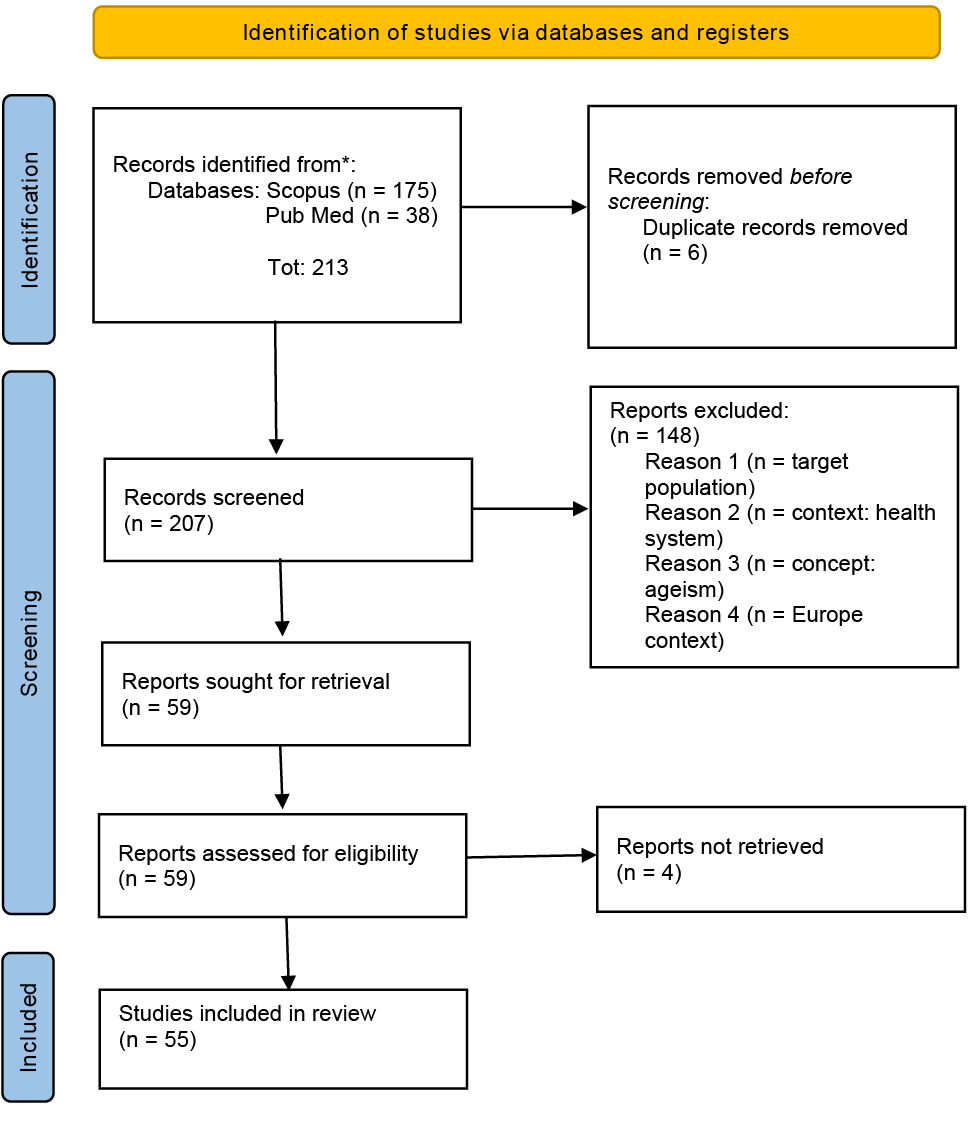
For the publication year 2025, contributions available as of December 3, 2025 were considered. For each article, a structured data extraction form was completed to collect publication metadata, intervention setting, clinical area, sample size, methodological approach, and research techniques.
The results of the scoping review are first presented by outlining the descriptive characteristics of the included studies, followed by findings from a template analysis. This method enabled the development of interpretative categories, initially derived deductively from the literature and previous classifications (Springer et al. 2025; Cesari et al. 2025) and then refined iteratively (Cardano 2020), providing a structured yet flexible framework to identify recurring patterns, themes, and relationships across studies. The analysis focused on two main dimensions: types of ageism and its outcomes and consequences.
3. Results
3.1 Study characteristics
All studies included in this scoping review (n=55) refer to the European context. Most studies were published between 2022 and 2024 (n=39), and the main disciplinary fields were nursing (n=17), public health (n=15), and medicine (n=11). Research was conducted in a variety of settings, mainly clinical training (n=20), health systems (n=15), and community services (n=12).
Studies were grouped into four clinical areas: “health professions education and workforce” (n=21) focuses on students, professionals, and training; “clinical care of older adults” (n=14) covers geriatric and long-term care; “health systems, services, and policy” (n=15) includes access, governance, and public health interventions; and “ethical, conceptual, and methodological issues” (n=5) comprises theoretical, ethical, and methodological research.
Regarding healthcare levels, most studies addressed the micro-level (n=25, direct interactions) or macro-level (n=20, systems and policies), with fewer at the meso-level (n=8, organizational processes) or multilevel (n=2). Studies engaged mainly multi-actor collaborations (n=26) and students/trainees (n=18), with other actors including healthcare professionals, organizations/policy makers, society/media, and industry/technology. Quantitative designs were most common (n=23), followed by qualitative (n=9), reviews (n=9), conceptual/theoretical studies (n=9) and mixed methods (n=5).
Table 1 provides a detailed summary of the included studies and their characteristics.
| Number of Articles | |||||||||||||||||||
|---|---|---|---|---|---|---|---|---|---|---|---|---|---|---|---|---|---|---|---|
| Publication Year 2021 2022 2023 2024 2025 |
7 14 11 14 9 |
||||||||||||||||||
| Disciplinary field Public Health Medicine Nursing Healthcare Management Psychology |
15 11 17 7 5 |
||||||||||||||||||
| Setting Community Services Clinical Training Health System Hospital Specialist Services Residential / Long-Term Care |
12 20 15 3 2 3 |
||||||||||||||||||
| Clinical Area Health professions education and workforce Clinical care of older adults Health systems, services and policy Ethical, conceptual and methodological issues |
21 14 15 5 |
||||||||||||||||||
| Healthcare level Micro Meso Macro Multilevel |
25 8 20 2 |
||||||||||||||||||
| Actors Multi-actors Students / Trainees Healthcare Professionals Organizations / Institutions / Policy makers Industry / Technology / Research |
26 18 7 2 2 |
||||||||||||||||||
| Study Design Quantitative Qualitative Mixed Methods Review Conceptual / Theoretical |
23 9 5 9 9 |
||||||||||||||||||
| Source: Authors’ own elaboration. | |||||||||||||||||||
3.2 Qualitative template analysis: types and outcomes of ageism in healthcare and social care settings
The analysis of the 55 included studies led to the identification of a multi-level structure of ageism and its outcomes. Four interrelated levels emerged inductively from the data: internalized/self-ageism, individual/interpersonal, institutional/organizational and structural/systemic, each associated with specific patterns of outcomes.
Internalized or self-ageism (n=5) captured the process through which older individuals internalize societal and institutional stereotypes, shaping self-perceptions and expectations about ageing. This level was associated with internalized stereotypes and self-stigma (Aytulun and Erden Aki 2022), psychological well-being and emotional vulnerability, including loneliness and perceived risk (Naughton-Doe et al. 2024; Gallistl et al. 2024; Bellanova et al. 2024), as well as subjective experiences of frailty and health (Chenhuichen et al. 2024). These processes contributed to altered health-related behaviors, reduced agency in decision-making, and forms of self-limitation in the relationship with healthcare services.
Individual/interpersonal ageism (n=19) referred to age-based stereotypes, attitudes, and discriminatory practices enacted in everyday interactions within healthcare and educational contexts. At this level, ageism was associated with negative or ambivalent attitudes and stereotypes toward older adults (Lampersberger et al. 2023; Pons et al. 2025; Elvira-Zorzo and Vega Rodríguez 2025; Catalao et al. 2025), representations of ageing among students and professionals (Heckemann et al. 2022; Schüttengruber et al. 2022; Cerqueira et al. 2023), and implicit or ambivalent forms of ageism (D’hondt et al. 2024; Piaton et al. 2024). These attitudes influenced educational trajectories and professional orientations (Özdil et al. 2021; Knight et al. 2022; Castellano-Rioja et al. 2022; Nitschke et al. 2022 ; Allué-Sierra et al. 2023). In this domain, several studies explicitly operationalised ageism using validated scales and measurement tools, aimed at quantifying ageism and assessing explicit or implicit ageist attitudes (Schüttengruber et al. 2022; D’hondt et al. 2024). Interpersonal ageism also affected clinical communication and the quality of care in direct one-to-one interactions, shaping patient–professional relationships, decision-making processes, and experiences of healthcare. In particular, studies highlighted age-based assumptions in clinical interactions and care practices (Martínez-Angulo et al. 2023a; Martínez-Angulo et al. 2023b), exclusion or marginalization of older patients in preventive pathways such as screening (Gram et al. 2023), and the role of age-related anxieties and stereotypes among healthcare trainees in influencing attitudes toward older patients and care delivery (Draper et al. 2024).
Institutional/organizational ageism (n=9) concerned age-based dynamics embedded in organizational structures, professional practices, and educational systems within healthcare settings. At this level, ageism was associated with organizational practices and workforce outcomes, including the influence of age stereotypes on professional well-being, motivation, and intention to leave the workplace (Helaß et al. 2024), as well as the role of age-related beliefs in shaping burnout and quality of working life in long-term care contexts (López-Frutos et al. 2022). Institutional ageism also emerged in relation to education and training processes, highlighting how formal learning environments can both reproduce and mitigate ageist attitudes. Studies documented the impact of educational interventions and training models on attitudes toward ageing and older patients (Başer and Hisar 2024; Bouwmeester Stjernetun et al. 2024a; Bouwmeester Stjernetun et al. 2024b), professional identity and career orientation toward geriatrics (Pearson et al. 2025), and the development of competencies and awareness related to ageism in healthcare practice (Fitzpatrick et al. 2021; Fernandes et al. 2022), including the validation of scales for measuring ageist attitudes in students (Piaton et al. 2023).
Structural/systemic ageism (n=22) referred to age-based inequalities produced and legitimized at the macro-social level through healthcare systems, public policies, ethical frameworks, and socio-cultural norms. At this level, ageism was associated with health inequities and unequal access to care, including disparities in diagnostic testing and service availability (Trevisan et al. 2021; Miralles et al. 2021), missed or delayed healthcare during crises and policy responses (Settels and Leist 2022; Rodriguez-Rodriguez et al. 2022), age-based resource allocation and prioritization (Pinho and Araújo 2022; McDonald 2022), and clinical outcomes shaped by age-related decision-making and prescribing practices (Paar et al. 2024; Fumagalli et al. 2025). Structural ageism also emerged as a driver of global mental health inequities (Teaster and Giwa 2023) and vulnerabilities among specific populations, such as older adults with rare diseases (Uwitonze et al. 2024). Beyond material inequalities, structural ageism was reflected in ethical, normative, and symbolic dimensions of ageing, including debates on dignity, vulnerability, and epistemic justice in healthcare (Langmann 2023; Bortolotti 2025; Langmann et al. 2025), intersectional forms of age-based disadvantage related to gender and social inequalities (Bows et al. 2024; Costa et al. 2025), and age discrimination in public health and legal frameworks (Nitschke et al. 2021; Lloyd-Sherlock et al. 2022). Finally, studies highlighted the emergence of digital ageism and its implications for service design and technological innovation in healthcare. Research showed how stereotypes about older adults’ digital abilities shape professional attitudes and technological practices (Mannheim et al. 2021), while broader socio-technical transformations in healthcare risk reinforcing inequalities and exclusion of older populations (Stypińska & Franke 2023). Other contributions emphasized how implicit ageist assumptions can influence participatory design processes and the co-creation of services for older users (Comincioli et al. 2022), as well as how regulatory and technological frameworks may embed or mitigate algorithmic bias and age-based discrimination in digital health systems (Van Kolfschooten, 2023).
Overall, these findings illustrate how ageism operates across multiple interconnected levels, generating heterogeneous but systematically related outcomes. A detailed synthesis of types of ageism, associated outcomes, and mapped studies is provided in Table 2.
| Type | Specific outcome | Studies | |||||||||||||||||
|---|---|---|---|---|---|---|---|---|---|---|---|---|---|---|---|---|---|---|---|
| Internalized / Self Ageism | Internalized stereotypes and self-stigma | Aytulun & Erden Aki, 2022 | |||||||||||||||||
| Psychological well-being | Naughton-Doe et al. 2024; Gallistl et al. 2024; Chenhuichen et al. 2024; Bellanova et al. 2024 | ||||||||||||||||||
| Individual / Interpersonal Ageism | Attitudes and stereotypes toward older adults | Özdil et al. 2021; Knight et al. 2022; Heckemann et al. 2022; Schüttengruber et al. 2022; Castellano-Rioja et al. 2022; Nitschke et al. 2022; Cerqueira et al., 2023; Allué-Sierra et al. 2023; Lampersberger et al. 2023; Piaton et al. 2024; D’hondt et al. 2024; Gümüşler Başaran et al. 2024; Pons et al. 2025; Elvira-Zorzo and Vega Rodríguez 2025; Catalao et al. 2025 | |||||||||||||||||
| Clinical communication and care quality | Gram et al. 2023; Martínez-Angulo et al. 2023a; Martínez-Angulo et al. 2023b; Draper et al. 2024 | ||||||||||||||||||
| Institutional / Organizational Ageism | Organizational practices and workforce outcomes in hospital and socio-healthcare settings | López-Frutos et al. 2022; Helaß et al. 2024 | |||||||||||||||||
| Education and training effects | Fitzpatrick et al. 2021; Fernandes et al. 2022; Piaton et al. 2023; Bouwmeester Stjernetun et al. 2024a; Bouwmeester Stjernetun et al. 2024b; Başer and Hisar 2024; Pearson et al. 2025 | ||||||||||||||||||
| Structural / Systemic Ageism | Health inequities and access to care | Trevisan et al. 2021; Miralles et al. 2021; Crosignani et al. 2021; Pinho and Araújo 2022; McDonald, 2022; Rodriguez-Rodriguez et al. 2022; Settels and Leist 2022; Teaster and Giwa 2023; Uwitonze et al. 2024; Paar et al. 2024; Fumagalli et al. 2025 | |||||||||||||||||
| Ethical, normative and symbolic outcomes | Nitschke et al. 2021; Lloyd-Sherlock et al. 2022; Langmann 2023; Bows et al. 2024; Bortolotti, 2025; Costa et al. 2025; Langmann et al. 2025 | ||||||||||||||||||
| Digital ageism and service design | Mannheim et al. 2021; Comincioli et al. 2022; Stypińska and Franke 2023; Van Kolfschooten 2023 | ||||||||||||||||||
| Source: Authors’ own elaboration. | |||||||||||||||||||
4. Discussion
This scoping review provides a comprehensive and policy-relevant synthesis of recent European research on ageism toward older adults in healthcare and social care contexts. By systematically mapping 55 studies published between 2021 and 2025, the review highlights the multidimensional and multi-level nature of ageism and its consequences, showing how age-based discrimination is not confined to individual attitudes but is embedded in professional practices, organizational arrangements, and structural features of healthcare systems. The analytical framework emerging from the review, distinguishing internalized, interpersonal, institutional, and structural forms of ageism, offers a useful lens for understanding how these dimensions interact and generate cumulative effects on health outcomes, access to care, and professional conduct.
One important contribution of this review lies in its attention to internalized or self-ageism, which, although addressed by a limited number of studies, emerges as a significant pathway through which broader social and institutional ageism affects older adults’ well-being. The evidence suggests that internalized stereotypes shape self-perceptions of health, frailty, and vulnerability, influencing help-seeking behaviors, engagement with healthcare services, and participation in decision-making. From a policy perspective, these findings point to the need for public health strategies that counter negative societal narratives about ageing and promote more diverse and empowering representations of later life. Interventions aimed at improving older adults’ health literacy and agency should therefore be understood not only as individual-level initiatives but also as components of broader efforts to address ageism as a social determinant of health.
At the interpersonal level, the review confirms that ageist attitudes and stereotypes remain widespread among healthcare students and professionals, with tangible implications for clinical communication, care quality, and professional trajectories. A substantial portion of the literature focuses on educational settings, underscoring the formative role of health professions training in shaping representations of ageing and older patients. Notably, many studies highlight implicit and ambivalent forms of ageism, suggesting that discrimination may persist even in contexts where explicit attitudes appear neutral or positive. This has important implications for policy and regulation in health education: curricula should systematically integrate ageing and ageism as cross-cutting themes, emphasizing reflective practice, ethical reasoning, and sustained exposure to older adults in varied care settings. Regulatory bodies and accreditation agencies may play a key role in promoting minimum standards for age-inclusive education across health professions.
Institutional and organizational ageism represents a critical meso-level dimension connecting individual attitudes with system-level outcomes. The reviewed studies show how age-based stereotypes are embedded in organizational cultures, workforce management practices, and service delivery models, particularly in hospital and long-term care contexts. These dynamics affect not only older patients but also healthcare workers, contributing to burnout, reduced job satisfaction, and intentions to leave among staff working with older populations. At the same time, the evidence indicates that organizationally supported training and educational interventions can mitigate ageist attitudes and strengthen professional competencies. From a policy standpoint, this suggests the importance of embedding age-inclusivity into organizational governance, quality assurance frameworks, and workforce strategies, rather than treating ageism solely as an individual ethical issue.
Structural and systemic ageism emerges as the most extensively documented level in the reviewed literature, reflecting growing concern about age-based inequities in healthcare access, resource allocation, and policy responses. The findings illustrate how ageism is institutionalized through healthcare policies, legal frameworks, and crisis management strategies, particularly during the COVID-19 pandemic. Age-based thresholds for diagnostics, preventive services, or intensive treatments exemplify how chronological age is often used as a proxy for vulnerability, efficiency, or social worth, rather than clinical need or individual preference. These practices raise critical ethical and governance issues and underscore the need for policy instruments that explicitly address ageism within health systems. Integrating age-sensitive equity assessments into health policy design and evaluation could represent a concrete step toward reducing structural ageism and ensuring that resource allocation decisions are transparent, proportionate, and justifiable.
An emerging and particularly policy-relevant theme concerns digital ageism and technological innovation in healthcare. Several studies highlight the risk that digital health tools, artificial intelligence, and algorithmic decision-making may reproduce or amplify age-based biases if older adults are inadequately represented in design, testing, and implementation processes. Assumptions about limited digital competence among older people can lead to exclusionary service models and reinforce existing inequalities. These findings point to the need for regulatory and governance frameworks that explicitly consider age-related bias in digital health technologies, as well as for participatory approaches that involve older adults in co-design and evaluation. Addressing digital ageism is especially urgent given the rapid expansion of digital healthcare and its growing role in shaping access, quality, and continuity of care.
From a methodological perspective, the predominance of quantitative and cross-sectional designs highlights the need for more longitudinal, mixed-methods, and intervention-based research capable of capturing how ageism evolves over time and across institutional contexts. Greater conceptual and measurement consistency would also strengthen the evidence base and support more effective policy translation. While this review deliberately focused on the European context, the structural mechanisms identified are likely to operate across different welfare regimes, suggesting the value of comparative and transnational research to inform policy learning.
Several limitations should be acknowledged. The restriction to English-language publications and to two major databases may have led to the exclusion of relevant studies, and, consistent with scoping review methodology, no formal quality appraisal was conducted. Moreover, the heterogeneity of ageism conceptualizations and outcome measures limits direct comparability across studies. Nevertheless, the review provides a robust and timely synthesis of a rapidly expanding field, offering a policy-relevant framework for understanding how ageism shapes healthcare systems and outcomes.
Overall, the findings indicate that tackling ageism in healthcare requires coordinated, multi-level policy action. Interventions focused solely on individual attitudes are unlikely to produce sustainable change if organizational routines and structural incentives remain unaltered. Conversely, system-level reforms that overlook everyday clinical interactions risk remaining symbolic. An integrated approach, linking education, organizational governance, health system design, and regulatory oversight, is therefore essential to promote equitable, age-inclusive, and person-centered healthcare systems in ageing societies.
5. Conclusion
This scoping review highlights ageism as a pervasive and structurally embedded phenomenon in healthcare and social care systems, with far-reaching implications for older adults’ health, well-being, and social inclusion. By synthesizing recent European evidence, the study demonstrates that ageism operates across interconnected levels, from internalized beliefs to systemic policies, producing cumulative and mutually reinforcing effects. Addressing ageism, therefore, requires moving beyond isolated interventions toward integrated, multi-level strategies that simultaneously target individual attitudes, professional practices, organizational cultures, and policy frameworks.
The findings underscore the importance of early and continuous education on ageing and ageism within health professions training, as well as the need for organizational commitment to age-inclusive practices in workforce management and service delivery. At the policy level, greater attention is needed to ensure that healthcare systems do not rely on chronological age as a proxy for vulnerability or value, particularly in contexts of resource scarcity and technological innovation. Finally, the emerging evidence on digital ageism calls for inclusive design, ethical oversight, and regulatory safeguards to prevent the reproduction of age-based inequalities in digital health.
Overall, this review contributes to consolidating ageism as a key social determinant of health and provides a conceptual and empirical basis for future research and action aimed at promoting equity, dignity, and justice across the life-course and within increasingly complex and digitalized health systems
References
Allué-Sierra L., Antón-Solanas I., Rodríguez-Roca B., Anguas-Gracia A., Echániz-Serrano E., Fernández-Rodrigo M. T., … and Satústegui-Dordá P. J. (2023), «Ageism and nursing students, past or reality?: A systematic review», in Nurse Education Today, 122: 105739.
Ayalon L. and Tesch-Römer C. (2018), Contemporary perspectives on ageism, Springer. https://doi.org/10.1007/978-3-319-73820-8
Ayalon L., Chasteen A., Diehl M., Becca R. L., Shevaun D. N., Rothermund K., Tesch-Römer C., and Hans-Werner W. (2021), «Aging in times of the COVID-19 pandemic: Avoiding ageism and fostering intergenerational solidarity», in The Journals of Gerontology: Series B, 76(2): 49–52. https://doi.org/10.1093/geronb/gbaa051
Aytulun A. and Erden Aki Ö.S. (2022), «Relationship Between Perceived Ageism, Autonomy, And Symptoms Of Depression And Anxiety During The COVID-19 Curfew In Old Age Psychiatric Patients», in Turkish Journal Of Geriatrics/Türk Geriatri Dergisi, 25(3).
Başer G. and Hisar F. (2024), «Effect of interventions for health care students to develop positive attitude toward the elderly: A meta‐analysis study», in Geriatrics & Gerontology International, 24(12): 1370-1379.
Bellanova M., Romaioli D. and Contarello A. (2024), «Stemming the “ageism pandemic”: A qualitative inquiry with older adults in residential care facilities during the COVID-19 outbreak», in Journal of Health Psychology, 29(4): 332-346.
Bortolotti L. (2025), Epistemic Justice in Mental Healthcare: Recognising Agency and Promoting Virtues Across the Life Span, Springer Nature.
Bouwmeester Stjernetun B., Gillsjö C., Odzakovic E. and Hallgren J. (2024a), «“It´ s like walking in a bubble”, nursing students´ perspectives on age suit simulation in a home environment–group interviews from reflection seminars», in BMC nursing, 23(1): 124.
Bouwmeester Stjernetun B., Hallgren J. and Gillsjö C. (2024b), «Effects of an age suit simulation on nursing students’ perspectives on providing care to older persons-an education intervention study», in Educational gerontology, 50(3): 240-253.
Bows H., Bromley P. and Walklate S. (2024), «Practitioner understandings of older victims of abuse and their perpetrators: not ideal enough?», in The British Journal of Criminology, 64(3): 620-637.
Burnes D., Sheppard C., Henderson C. R., Jr. Wassel M., Cope R., Barber C. and Pillemer K. (2019), «Interventions to reduce ageism against older adults: A systematic review and meta-analysis», in American Journal of Public Health, 109(8): e1–e9. https://doi.org/10.2105/AJPH.2019.305123
Butler R. N. (1969), «Age-ism: Another form of bigotry», in The Gerontologist, 9(4): 243–246. https://doi.org/10.1093/geront/9.4_Part_1.243
Bytheway B. (1995), Ageism. Rethinking ageing, Buckingham, PA: Open University Press.
Cardano M. (2020), Defending qualitative research: Design, analysis, and textualization, Routledge.
Castellano-Rioja E., Botella-Navas M., López-Hernández L., Martínez-Arnau F. M. and Pérez-Ros P. (2022), «Caring for the elderly enhances positive attitudes better than knowledge in nursing students», in Medicina, 58(9): 1201.
Catalao M. J., Arco H., Carrajola N. and Tavares J. (2025), «Ageism among newly graduated nurses: The influence of sociodemographic variables and gerontogeriatric nursing education», in Nurse Education in Practice, 83: 104285.
Cerqueira A. F., Ramos A. L. and Palma J. (2023), «Ageism in nursing education: Students’ views of ageing», in Social Sciences, 12(3): 142.
Cesari M., Canevelli M., Zhang W., Thiyagarajan J. A., Azzolino D., Cherubini A., … and Moorthy V. (2025), «Enhancing the methodology of clinical trials in older people: A scoping review with global perspective», in The Journal of nutrition, health and aging, 29(6): 100582.
Chang E. S., Kannoth S., Levy S., Wang S. Y., Lee J. E. and Levy B. R. (2020), «Global reach of ageism on older persons’ health: A systematic review», in PloS ONE, 15(1): e0220857. https://doi.org/10.1371/journal.pone.0220857
Chenhuichen C., O’Halloran A. M., Lang D., Kenny R. A. and Romero-Ortuno R. (2024), «The lived experience of frailty: beyond classification and towards a holistic understanding of health», in European Geriatric Medicine, 15(2): 435-444.
Chrisler J. C., Barney A. and Palatino B. (2016), «Ageism can be hazardous to women’s health: Ageism, sexism, and stereotypes of aging», in Journal of Social Issues, 72(1): 86–104. https://doi.org/10.1111/josi.12156
Comincioli E., Hakoköngäs E. and Masoodian M. (2022), «Identifying and addressing implicit ageism in the co-design of services for aging people», in International journal of environmental research and public health, 19(13): 7667.
COST (2015), «Ageism. A multi national, interdisciplinary perspectictive», in EU Framework Programme Horizon 2020. European Commission, Retrieved May 22, 2015, from http://www.cost.eu/COST_Actions/isch/Actions/IS1402.
Costa J. R., Quintero-Flórez A., García-Cabrera E., Romero-Barranca J. and Vilches-Arenas Á. (2025), «Ageism and the feminization of old age: A Systematic review», in Archives of Gerontology and Geriatrics, 106084.
Crosignani S., Fantinati J. and Cesari M. (2021), «Frailty and geriatric medicine during the pandemic», in Frontiers in Medicine, 8: 673814.
D’hondt S., Aujoulat I. and Degryse J. M. (2024), «Development and validation of a revised ambivalent ageism scale for use in the health care sector: The AAShc», in The Gerontologist, 64(4): gnad136.
Draper E. J., Meiboom A. A., van Dijk N., Ket J. C., Kusurkar R. A. and Smalbrugge M. (2024), «How do ageism, death anxiety and ageing anxiety among medical students and residents affect their attitude towards medical care for older patients: a systematic review», in BMC medical education, 24(1): 199.
Elvira-Zorzo M. N. and Vega Rodríguez M. T. (2025), «Changing Attitudes Towards Retirement and Ageing Through Flipped Classroom and Collaborative Learning: A Social Psychological Study with Psychology and Social Work Students», in Social Sciences, 14(9): 562.
Fernandes J. B., Ramos C., Domingos J., Castro C., Simões A., Bernardes C., Fonseca J., Proença L., Grunho M., Moleirinho-Alves P., Simões S., Sousa-Catita D., Vareta D. A. and Godinho C. (2022), «Addressing Ageism—Be Active in Aging: Study Protocol», in Journal of Personalized Medicine, 12(3): 354. https://doi.org/10.3390/jpm12030354
Fitzpatrick J. M., Hayes N., Naughton C. and Ezhova I. (2021), «Evaluating a specialist education programme for nurses and allied health professionals working in older people care: A qualitative analysis of motivations and impact», in Nurse Education Today, 97: 104708.
Fumagalli C., Zampieri M., Presta R., Pini G., Vetere G., Argirò A., … and Cappelli F. (2025), «Prognostic Value of Malnutrition, Frailty, and Physical Performance in Transthyretin Cardiac Amyloidosis: Insights From a Prospective Multicenter Cohort Study», in Circulation: Heart Failure, e012777.
Gallistl V., Richter L., Heidinger T., Schütz T., Rohner R., Hengl L. and Kolland F. (2024), «Precarious ageing in a global pandemic–older adults’ experiences of being at risk due to COVID-19», in Ageing & Society, 44(5): 991-1009.
Gram E. G., Knudsen S. W., Brodersen J. B. and Jønsson A. B. R. (2023), «Women’s experiences of age‐related discontinuation from mammography screening: A qualitative interview study», in Health Expectations, 26(3): 1096-1106.
Grosse A. and Kokorelias K. (2025), «Exploring ageism in medical education: A scoping review of the educational factors affecting the attitudes of medical students and junior doctors towards older inpatients», in Australasian journal on ageing, 44(1): e70016.
Gümüşler Başaran A., Genç Köse B. and Kefeli Çol B. (2024), «Elderly Discrimination, Willingness to Provide Care to the Elderly and View on Aging of Students in Some Departments in the Field of Health», in Journal of Multidisciplinary Healthcare, 5035-5045.
Heckemann B., Schüttengruber G., Wolf A., Großschädl F. and Holmberg C. (2022), «Attitudes towards oldest‐old adults (age≥ 80 years): A survey and international comparison between Swedish and Austrian nursing students», in Scandinavian Journal of Caring Sciences, 36(4): 1083-1093.
Helaß M., Greinacher A., Müller A., Friederich H. C., Maatouk I. and Nikendei C. (2024), «The role of negative age stereotypes and sociodemographic factors in the intention to leave among German university hospital nursing staff», in INQUIRY: The Journal of Health Care Organization, Provision, and Financing, 61: 00469580241277912.
Knight R. L., Chalabaev A., McNarry M. A., Mackintosh K. A. and Hudson J. (2022), «Do age stereotype‐based interventions affect health‐related outcomes in older adults? A systematic review and future directions», in British Journal of Health Psychology, 27(2): 338-373.
Lampersberger L. M., Schüttengruber G., Lohrmann C. and Großschädl F. (2023), «Nurses’ perspectives on caring for and attitudes towards adults aged eighty years and older», in Scandinavian Journal of Caring Sciences, 37(2): 458-471.
Langmann E. (2023), «Vulnerability, ageism, and health: is it helpful to label older adults as a vulnerable group in health care?», in Medicine, Health Care and Philosophy, 26(1): 133-142.
Langmann E., Kainradl A. C., Weßel M. and Rokvity A. (2025), «Endometriosis in later life: an intersectional analysis from the perspective of epistemic injustice», in Medicine, Health Care and Philosophy, 28(1): 151-159.
Levy B. R. (2017), «Age-stereotype paradox: Opportunity for social change», in The Journals of Gerontologist, 57(Suppl. 2): S118–S126. https://doi.org/10.1093/geront/gnx059
Lloyd‐Sherlock P., Guntupalli A. and Sempé L. (2022), «Age discrimination, the right to life, and COVID‐19 vaccination in countries with limited resources», in Journal of Social Issues, 78(4): 883-899.
López-Frutos P., Pérez-Rojo G., Noriega C., Velasco C., Carretero I., Martínez-Huertas J. Á., Galarraga L. and López J. (2022), «Burnout and quality of life in professionals working in nursing homes: the moderating effect of stereotypes», in Frontiers in Psychology, 13: 772896.
Mannheim I., Wouters E. J., van Boekel L. C. and van Zaalen Y. (2021), «Attitudes of health care professionals toward older adults’ abilities to use digital technology: Questionnaire study», in Journal of Medical Internet Research, 23(4): e26232.
Marques S., Mariano J., Mendonça J., De Tavernier W., Hess M., Naegele L., Peixeiro F. and Martins D. (2020), «Determinants of ageism against older adults: A systematic review», in International Journal of Environmental Research and Public Health, 17(7): 2560, 1–27. https://doi.org/10.3390/ijerph17072560
Martínez-Angulo P., Munoz-Mora M., Rich-Ruiz M., Ventura-Puertos P. E., Cantón-Habas V. and López-Quero S. (2023a), «“ With your age, what do you expect?”: Ageism and healthcare of older adults in Spain», in Geriatric nursing, 51: 84-94.
Martínez-Angulo P., Rich-Ruiz M., Ventura-Puertos P. E. and López-Quero S. (2023b), «Integrating shared decision-making, expressing preferences and active participation of older adults in primary care nursing: a systematic review of qualitative studies and qualitative meta-synthesis», in BMJ open, 13(6): e071549.
McDarby M., Ju C. H., Picchiello M. C. and Carpenter B. D. (2022), «Older adults’ perceptions and experiences of ageism during the COVID-19 pandemic», in The Journal of social issues, 10.1111/josi.12557. Advance online publication. https://doi.org/10.1111/josi.12557
McDonald T. (2022), «Lethal ageism in the shadow of pandemic response tactics», in International Nursing Review, 69(2): 249-254.
Mikton C., de la Fuente-Núñez V., Officer A. and Krug E. (2021), «Ageism: a social determinant of health that has come of age», in Lancet (London, England), 397(10282): 1333–1334. https://doi.org/10.1016/S0140-6736(21)00524-9
Miralles O., Sanchez-Rodriguez D., Marco E., Annweiler C., Baztan A., Betancor É., … and Vall-Llosera E. (2021), «Unmet needs, health policies, and actions during the COVID-19 pandemic: a report from six European countries», in European geriatric medicine, 12(1): 193-204.
Munn Z., Peters M. D., Stern C., Tufanaru C., McArthur A. and Aromataris E. (2018), «Systematic review or scoping review? Guidance for authors when choosing between a systematic or scoping review approach», in BMC medical research methodology, 18(1): 143.
Naughton-Doe R., Barke J., Manchester H., Willis P., & Wigfield A. (2024), «Ethical issues when interviewing older people about loneliness: reflections and recommendations for an effective methodological approach», in Ageing & Society, 44(7): 1681-1699.
Nitschke I., Gegner U., Hopfenmüller W., Sobotta B. A. and Jockusch J. (2022), «Student perceptions of age and ageing—an evaluation of Swiss dental students receiving education in gerodontology», in International Journal of Environmental Research and Public Health, 19(12): 7480.
Nitschke I., Hahnel S. and Jockusch J. (2021), «Health-related social and ethical considerations towards the utilization of dental medical services by seniors: influencing and protective factors, vulnerability, resilience and sense of coherence», in International journal of environmental research and public health, 18(4): 2048.
Özdil K., Öztürk G. K., Çatıker A. and Büyüksoy G. D. B. (2021), «Views of senior nursing students on the problems of the elderly during the COVID-19 process and attitudes against ageism», in Dokuz Eylül Üniversitesi Hemşirelik Fakültesi Elektronik Dergisi, 14(4): 357-369.
Paar E., De Lai E., Držaić M., Kummer I., Bužančić I., Ortner Hadžiabdić M., … and Fialová D. (2024), «Fall risk-increasing drugs and associated health outcomes among community-dwelling older patients: A cross-sectional study in Croatian cohort of the EuroAgeism H2020 project», in Acta pharmaceutica, 74(4): 635-653.
Paoletti I. (2024), «Ageism: The Need for New Imagery for Growing Old», In Paoletti, I. (eds) Creating New Meanings For Old Age, pp. 35–62. Palgrave Macmillan, Singapore. https://doi.org/10.1007/978-981-97-5041-2_2
Pearson G. M., Dowling S., Ben-Shlomo Y. and Henderson E. J. (2025), «Inspiring tomorrow’s geriatricians: a qualitative exploration of the facilitators and barriers to medical students choosing geriatric medicine», in Gerontology & Geriatrics Education, 1-15.
Peterson J., Pearce P. F., Ferguson L. A. and Langford C. A. (2017), «Understanding scoping reviews: Definition, purpose, and process», in Journal of the American Association of Nurse Practitioners, 29(1): 12-16.
Pham M. T., Rajić A., Greig J. D., Sargeant J. M., Papadopoulos A. and McEwen S. A. (2014), «A scoping review of scoping reviews: advancing the approach and enhancing the consistency», in Research synthesis methods, 5(4): 371-385.
Piaton S., Adam S., Roger-Leroi V. and Vallet G. T. (2024), «Implicit ageism in dental students: general representations of ageing health and specific representations of the mouth», in Educational Gerontology, 50(7): 659-670.
Piaton S., Roger-Leroi V., Vallet G. (2023), «Specific form of ageism in dental care: Convergent validity of the Ageism Scale for Dental Students and its implications for education», in European Journal of Dental Education, 27(2): 368-373.
Pinho M. and Araújo A. (2022), «How to fairly allocate scarce medical resources? Controversial preferences of healthcare professionals with different personal characteristics», in Health Economics, Policy and Law, 17(4): 398-415.
Poli S. (2020), «Invecchiamento e Coronavirus: la costruzione sociale del rischio e la marginalizzazione degli anziani oltre il lockdown», in SocietàMutamentoPolitica, 11(21): 271-280. https://doi.org/10.13128/smp-11967
Pons E. G., Pinazo-Clapés C., Galan A. S., Pinazo-Hernandis S. and Esquiva I. C. (2025), «Ageism and suicide: A structural equation modeling analysis and evaluation of a high-fidelity simulation-based intervention for future healthcare professionals», in Geriatric Nursing, 66: 103674.
Previtali F., Allen L. D. and Varlamova M. (2020), «Not only virus spread: The diffusion of ageism during the outbreak of COVID-19», in Journal of Aging & Social Policy, 32(4-5): 506–514. https://doi.org/10.1080/08959420.2020.1772002
Rodriguez-Rodriguez V., Rojo-Perez F., Perez de Arenaza Escribano C., Molina-Martínez M. Á., Fernandez-Mayoralas G., Sánchez-González D., Rojo-Abuin J., Rodríguez-Blázquez C., João Forjaz M. and Martin Garcia S. (2022), «The impact of COVID-19 on nursing homes: study design and population description», in International journal of environmental research and public health, 19(24): 16629.
Schüttengruber G., Stolz E., Lohrmann C., Kriebernegg U., Halfens R. and Großschädl F. (2022), «Attitudes towards older adults (80 years and older): a measurement with the ageing semantic differential‐a cross‐sectional study of Austrian students», in International journal of older people nursing, 17(3): e12430.
Settels J. and Leist A. K. (2022), «The role of country-level availability and generosity of healthcare services, and old-age ageism for missed healthcare during the COVID-19 pandemic control measures in Europe», in Journal of aging and health, 34(6-8): 1016-1036.
Snellman F. (2016), «Whose ageism? The reinvigoration and definitions of an elusive concept», in Nordic Psychology, https://doi.org/10.1080/19012276.2015.1125301.
Springer F., Matsuoka A., Obama K., Mehnert-Theuerkauf A., Uchitomi Y. and Fujimori M. (2025), «Quality of life in older patients with cancer and related unmet needs: a scoping review», in Acta Oncologica, 64: 42602.
Stypińska J. and Franke A. (2023), «AI revolution in healthcare and medicine and the (re-) emergence of inequalities and disadvantages for ageing population», in Frontiers in Sociology, 7: 1038854.
Teaster P. B. and Giwa A. O. (2023), «Ageism as a source of global mental health inequity», in AMA Journal of Ethics, 25(10): 765-770.
Trevisan C., Pedone C., Maggi S., Noale M., Di Bari M., Sojic A., … and Epicovid Working Group (2021), «Accessibility to SARS-CoV-2 swab test during the COVID-19 pandemic: Did age make the difference?», in Health policy, 125(12): 1580-1586.
Tricco A. C., Lillie E., Zarin W., O’Brien K. K., Colquhoun H., Levac D., Moher D., Peters M. D. J., Horsley T., Weeks L., Hempel S., Akl E. A., Chang C., McGowan J., Stewart L., Hartling L., Aldcroft A., Wilson M. G., Garritty C., … and Straus S. E. (2018), «PRISMA extension for scoping reviews (PRISMA-ScR): Checklist and explanation», in Annals of Internal Medicine, 169(7): 467–473. https://doi.org/10.7326/M18-0850.
United Nations (2024), World population prospects 2024: Highlights, Department of Economic and Social Affairs.
Uwitonze J. P., Duminy L. and Blankart C. R. (2024), «Identifying health inequities faced by older adults with rare diseases: A systematic literature review and proposal for an ethical spectrum and resource allocation framework», in Health Policy, 149: 105176.
Van Kolfschooten H. (2023), «The AI cycle of health inequity and digital ageism: mitigating biases through the EU regulatory framework on medical devices», in Journal of Law and the Biosciences, 10(2): lsad031.
WHO (2021), Global report on ageism, World Health Organization.
WHO (2025), Ageing and health, World Health Organization.