https://doi.org/10.36253/smp-17093
Dwelling Among the Ruins
University of Trento, Italy
E-mail: paolo.dox@gmail.com
Abstract. This article examines how people experiencing homelessness in Rome use archaeological ruins to secure a minimal continuity of dwelling under conditions of radical precarity. Ruins, in this reading, are not simply spatial supports or remnants of the past. Rather, they are material devices through which time becomes spatially available and through which space is experienced, inhabited, and reorganized through temporal practices. From this perspective, the article contributes to debates on space and time by shifting the focus from the general theoretical claim that space and time are inseparable to the empirical question of how this inseparability can be observed. Adopting the analytical lens of the situated project – understood as a mundane and incremental organization of urgency across space and time sustained through tactics of duration – this contribution focuses on the micro-practices of people experiencing homelessness. It shows how ruins are reconfigured into provisional forms of dwelling and how these practices redefine boundaries, functions, and tacit norms of use while producing alternative spatial orders and temporal rhythms within the city.
Keywords: homelessness, archaeological ruins, urban ruins, Rome.
Contents
1. Analytical framework and research focus
2. The temporalities materialized through the spatial use of ruins: a conceptual framework
3. The use of urban ruins by people experiencing homelessness in Rome
3.1 How ruins are materially appropriated, adapted and organized to generate forms of dwelling
3.2 How dwelling practices produce specific temporalities within precarious conditions
1. Analytical framework and research focus
The article examines how people experiencing homelessness in the city of Rome use archaeological ruins to construct relatively durable forms of shelter, arrangements capable of securing a minimal continuity of dwelling under conditions of precarity. This overarching inquiry unfolds into a set of mutually intertwined sub-questions, each addressing a distinct analytical dimension of the phenomenon.
First, at the level of spatial practices, the article asks how ruins are materially appropriated, adapted, and organized to generate forms of dwelling. It observes how people experiencing homelessness move through urban space, as well as the kinds of knowledge they mobilize to render ruins habitable and usable for survival. This spatial dimension is made particularly distinctive by the specific figure of people experiencing homelessness, who transform space into something as ambiguous as it is complex: an “inside of the outside”. Their state of being “outside” social, economic, and cultural centrality simultaneously constitutes a particular form of being “inside” society (Simmel 1985). The simple oppositional logic between an “inside” and an “outside” conceived as separate and internally homogeneous domains is thereby weakened. These practices take root in hybrid metropolitan spaces capable of hosting different and often conflicting worlds: public and private spaces, seemingly the same for everyone, yet differentiated by necessity and oriented toward passage, the provisional, and the ephemeral (Rossi 2016).
Second, focusing on temporal organization, the article examines how these dwelling practices produce specific temporalities within precarious conditions. Drawing on descriptive observation of the micro-practices of survival, it shows how the use of ruins highlights a set of constitutive elements in which spatial arrangements are inseparable from a temporal dimension of continuity. From this perspective, duration is not given but rather actively produced through a situated organization of adaptations and gestures that articulate the practical need to stabilize over time a condition that nonetheless remains highly precarious. Survival practices on the street involve sophisticated forms of temporal organization that measure, anticipate, and design survival within a temporal horizon of continuity. This dimension is often neglected by public policies addressing homelessness, which in Rome are largely organized according to an emergency-based logic and activated in response to specific seasonal or climatic thresholds, such as so-called “cold weather emergencies” (Do et al. 2025). On the one hand, this approach favours short-term, fragmented, and poorly coordinated interventions. On the other, it contributes to obscuring the spatial and temporal forms of organization through which people experiencing homelessness construct relatively stable modes of dwelling. This article seeks to account for the complexity of these practices by foregrounding the embedded dimensions of duration, situated projectuality, and the production of continuity.
To address these research questions, the study interweaves temporal and spatial coordinates, treating them as interconnected and co-constitutive dimensions that shape the social processes of urban life. The article posits that ruins are analytically important because they make visible a form of dwelling in which space and time are inseparable at the level of practice. They allow us to see how people experiencing homelessness produce continuity within discontinuity, duration within precarity, and habitation within spaces officially defined as residual, monumental, or unusable. The ruin is therefore not only the setting of the analysis but also an operational device: It renders observable the material consistency of the bond between space and time.
Building on this perspective, the article advances the analytical lens of the “situated project”, conceptualizing the micro-practices of people experiencing homelessness as a set of pragmatic, locally grounded practices. These practices do not deny urgency; rather, they organize responses to immediate needs through tactics of duration and forms of intermittent stabilization. The notion of the “situated project” treats urgency as something spatially and temporally organized, giving rise to tactics of duration through which a minimal continuity is constructed day by day by way of choices and compromises within a structurally precarious and discontinuous context. In this way, the article explores the tensions that emerge between these informal uses of ruins and the regulatory frameworks governing public space.
The empirical work draws on field observation conducted between June 2025 and January 2026. Although the observation period was not exclusively in winter, it included the cold months and therefore made it possible to grasp a central dimension of the phenomenon, since homelessness is strongly shaped by seasonality (De Rosa et al. 2025). The fieldwork was carried out in the east of Rome, within and along the edges of the city’s railway ring – more specifically, in the archaeological area of Ad Duas Lauros between the municipal districts V and VII. This area is not among those with the highest concentration of people experiencing homelessness in Rome. As De Rosa et al. (2025) show, the majority of people experiencing homelessness in the city can be found near the main railway station, Termini, and in the area around Vatican City, particularly around St Peter’s Basilica. Precisely for this reason, Ad Duas Lauros offers a significant field of observation, since it allows attention to be shifted away from the most obvious concentrations of homelessness towards more dispersed and less immediately visible forms of dwelling. Ad Duas Lauros is located in a high-density residential area where the concentration of Roman-period archaeological remains is second only to the historic centre. In this part of the city ruins, both visible and invisible traces of historical epochs layered into the duration of the present are dispersed across the urban fabric. In the so-called “Eternal City”, the use of ruins as shelter is embedded in a long history of reuse and cohabitation between material remains and everyday life: What is now framed as “heritage” has also functioned as a spatial, logistical, and relational resource (Ferrarotti 1970; 1974). In this sense, ruins have long operated as a kind of “second city” composed of interstices, niches, arches, level changes, thick walls, and zones of shadow. They constitute a “reserve of space” within a dense and unequal urban environment. At the same time, Rome is the Italian city with the highest number of individuals experiencing homelessness. A recent city-level estimate of visible homelessness counted 2,204 people, including 1,018 unsheltered individuals identified within the railway ring area and 1,186 sheltered individuals accommodated in night shelters and emergency or temporary facilities across the city (Fondation pour le Logement des Défavorisés; FEANTSA 2025).
The present study is based primarily on field observation. This approach aligns with traditions of urban ethnography (Duneier et al. 2014; Duneier 2016), understood as the close study of everyday urban life through sustained attention to practices, spaces, and forms of practical competence, here extended with an emphasis on spatiality and materiality. The research favours direct observation of spatial arrangements while placing immediate interaction with people in the background, except when it emerged spontaneously through narratives or informal exchanges.
The fieldwork was conducted by way of repeated visits at different times of day and under varying environmental conditions, allowing for the observation of temporal patterns and strategies of duration. Particular attention was paid to how material elements of ruins such as walls, arches, recesses and zones of shade are employed as operative spatial devices enabling specific forms of use. Observation focused on practices of adaptation, on the materials employed (tarpaulins, ropes, cardboard, nails, protective items, decorations), and on temporalities of use (hours, days, months).
2. The temporalities materialized through the spatial use of ruins: a conceptual framework
Ruins have been the object of significant analyses across disciplines. Tim Edensor (2005) has approached them primarily in the shape of industrial and post-industrial ruins, emphasizing their “undomesticated” materiality as spaces in which decay, improvisation and sensorial dimensions unsettle the codes of urban order and enable unforeseen possibilities of use. Caitlin DeSilvey (2017) has shifted attention to the “material life” of deterioration, advancing a perspective that views decay as a process for observing how memory, care, maintenance, and abandonment are negotiated over time. According to Adam Przywara (2025; 2023), ruins should be read not as nostalgic “icons” but as material metabolisms: processes of transformation, selection, and re-use of matter (rubble, fragments, residues) along practical and institutional chains. From this perspective, the ruin becomes a resource and a contingent infrastructure, capable of reorganizing labour, techniques, and the politics of reconstruction and urban management. Finally, together with Lia Fassari, we have proposed reading ruins as a constitutive part of a hybrid (nature–ruin) that reshapes practices, conflicts, and criteria of public space quality (Do and Fassari 2023).
Yet ruins can be understood not only as spatial infrastructures or physical residues within urban space; beyond their materiality, they can also be viewed as forms of “temporal thickness” that do not simply represent the past but articulate multiple temporalities simultaneously. On the one hand, their existence highlights conditions of continuity; on the other, it makes explicit how this existence is a stratified accumulation of objects and practices that render them proper temporal infrastructures.
This way of comprehending ruins emerges particularly clearly if we consider the Roman context, where ruins appear not as isolated exceptions but as structural elements of the city. In his text on Rome (1898, 2018), Georg Simmel interprets the city as a composition of layers, differences, and times that Rome “holds together”: The ruin becomes an operator of relation, a threshold in which the city displays its history not as a linear narrative but as a coexistence of temporalities. In other words, Rome is a city in which the ruin participates in the everyday configuration of space and its possibilities of use. In another sociological text, however, Georg Simmel offers an especially dense formulation of the ruin. To him, the ruin makes visible in almost didactic manner the relation between an intentional project and the forces exceeding intention and control: The original form does not disappear but is reshaped, diverted, and recomposed through the combined action of nature, history, and use (Simmel 1958). This oscillation between permanence and transformation, between form and deformation means that, according to Simmel, the ruin simultaneously reveals the force that willed the form and the force that surpasses it.
If, as for Martina Löw, space is not a frame or container but living matter (Löw 2008) – a construction shaped by cultural, social, and symbolic interactions – Simmel allows us to see with particular clarity how this production of space passes through the life of forms: their duration, their vulnerability, and their capacity to be reactivated through unforeseen uses. In the stratified city of Rome, ruins become surfaces and volumes that participate in the possibilities of the present. Simmel offers us a language for describing how the city is never only what it was designed to be, but also what it becomes when different forces, unequal and situated, traverse it and rewrite it.
Taking into account Simmel’s reflections, and focusing on the use of ruins as configurations that hold together the spatial and the temporal dimension of continuity and duration, this article analyses the micro-practices of people experiencing homelessness in the city of Rome as they build relatively durable forms of shelter. To do so, the research adopts the analytical lens of the situated project, understood as a set of pragmatic and locally grounded practices that do not deny urgency but organize it through tactics of duration and forms of intermittent stabilization. The term ‘project’ refers to the ensemble of procedures, adjustments, and decisions through which people experiencing homelessness coordinate their action with the environment, with objects, and with contingencies (Suchman 1987). From this perspective, precarious dwelling can be read as a social-material practice grounded in specific competences: identifying urban micro-opportunities (shelter, warmth, water, light, controlled visibility), managing the logistics of mobility (assembling and dismantling, transporting, concealing, negotiating), and interpreting the city’s rhythms and signals (checks, pedestrian flows, schedules).
The qualifier ‘situated’ indicates that these practices unfold under determinate material and relational conditions, within horizons of constraints, inequalities, and forms of visibility that cannot be bracketed. In this sense, ‘situated’ does not merely describe an external context that “influences” action; rather, it signals that action is inseparable from the very conditions that both enable and limit it (Haraway 1988). Moreover, ‘situated’ here also means that these practices do not simply occur within urban space as if the city were a pre-given container, but that they participate in its everyday production as a social and political configuration (Lefebvre 1991 [1974]; Löw 2008). This orientation helps to avoid an interpretation that opposes “projectuality” (ascribed to non-marginal subjects and institutions) to “reaction” (ascribed to marginal subjects). Even under extreme precarity, one can observe forms of spatial projectuality through which duration becomes possible.
In dialogue with de Certeau’s theory of everyday practices (1984 [1980]) – particularly the distinction between “strategies” and “tactics” – one might argue that precarious dwellings transform urgencies into tactics of duration that maximize the continuity of taking shelter in a given place while minimizing the risk of being displaced.
Thus, the notion of the situated project developed here does not primarily aim to differ analytically from what de Certeau, Suchman, and Haraway have defined and proposed. Rather, it seeks to mobilize and interweave these categories in a more specific way in relation to the case of people experiencing homelessness. In this sense, the concept of the situated project makes it possible to focus on how practices of survival are neither merely tactical reactions to constraint nor simply situated responses to immediate circumstances, but forms of practical organization through which space, time, material supports, and everyday practices are assembled into precarious yet relatively durable modes of dwelling.
From this vantage point, the street is not only a “place” but a field of temporal possibilities: What is accessible in space is always accessible through windows of time, rhythms, and cadences. For those living on the street, a shelter is not simply where one can stay, but when one can stay: when an arch can be traversed without being moved on; when a recess becomes effectively invisible; when an area is emptied by daily flows; when surveillance loosens; when urban maintenance has not yet installed fencing or restored barriers. Rather than appearing as a continuous surface, urban space offers itself as an assemblage of temporal intervals and thresholds (hours, days, seasons) within which forms of habitability are produced and where niches, ruins, and discarded materials (ropes, tarpaulins, cardboard, supports) become components of a practical “making do”.
Indeed, for those living on the street, the city is not only a geography of places but also a grid of durations: temporal windows in which a site is accessible, tolerated, or effectively invisible – or conversely, exposed; cycles of opening and closure (services, transport, commercial activities); alternations between crowding and emptiness; shifts in control and surveillance; and climatic seasonality that redefines what is practicable. What emerges is a temporality made of thresholds and interruptions, in which dwelling coincides with adjusted movements. In this sense, marginality is inscribed not only in space but in the possibility of “making time” in the city, allowing traces to sediment.
Space and time, however conceived, are the great framework within which we order our experience. As Kevin Lynch observes, “we live in time-places” (1972: 241). Building on this notion, and by exploring Rome’s time-places, this article examines how people experiencing homelessness use archaeological ruins: material diapositives that incorporate duration and render observable, so to speak, the concrete consistency of the bond between space and time that is often difficult to grasp in the city’s more fleeting practices.
Social theory has long recognized the need to think space and time together. David Harvey (1990) insists on “spatiotemporality” as a structural entanglement of the two dimensions; Doreen Massey (2005) speaks of “space-times” to dislodge space from the notion of a static container and show it as dynamic, traversed by social relations and histories that interweave different temporalities; finally, Karen Barad (2007) radicalizes this perspective with the idea of “spacetime mattering”, emphasizing the inseparability of space, time, and matter in the material-discursive constitution of the world. Yet while theoretically generative, these formulations do not in themselves provide a concrete methodological framework for capturing, investigating and empirically analysing the intertwining of spatial and temporal processes (Baxter et al. 2025). It is precisely the difficulty of observing and describing the co-constitution of space and time without reducing it to background around which the article develops its attempt to take space as a central empirical object and treat temporality as a constitutive dimension of the dwelling practices of people experiencing homelessness.
3. The use of urban ruins by people experiencing homelessness in Rome
The empirical work draws on field observation conducted within the archaeological area of Ad Duas Lauros, a high-density residential area whose concentration of Roman-period archaeological remains is second only to the city’s historic centre. In this part of the city, ruins are not merely monumental presences. Rather, they form a dispersed constellation of arches, plinths, recesses, walls, and interstices which, depending on conditions of access, visibility, and control, may become supports for the construction of precarious forms of dwelling.
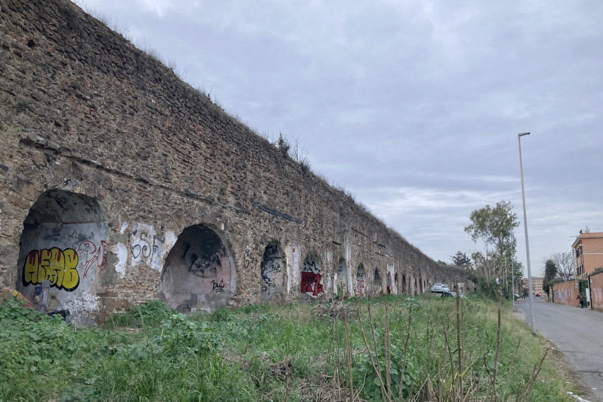
The observational trajectory followed in this research moves from the outer parts of the city toward its interior. It begins at the eastern edge of the Pigneto district, at a point which, on the city map, coincides not so much with an address as with a fold: an interstice between what Rome displays and what it leaves in suspension. From here, the line of the Acqua Felice aqueduct extends as a sequence of arches (Fig. 1).
Following a sinuous trajectory, the aqueduct leads toward the Aurelian Walls, which appear as a dense urban threshold layered with successive temporalities and uses (Fig. 2).
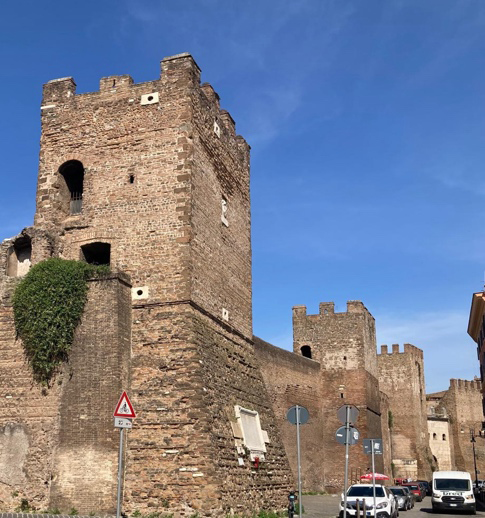
The remains of these walls do not simply mark a line of separation between an “inside” and an “outside”. Rather, they constitute a thick margin made of later adaptations, openings, closures, repairs, and interruptions that register the transformations of the city over time. In this sense, the Aurelian Walls do not function as a clear-cut boundary but as a porous edge: once a military infrastructure, later absorbed into the expanding urban fabric, and now continuously crossed, reworked, and redefined by everyday practices. It is along this trajectory, between aqueduct and walls, that the empirical material analysed in this article was collected.
The following pages focus on two observed configurations of dwelling within Rome’s archaeological and infrastructural landscape: the use of arches of the Acqua Felice aqueduct along the Mandrione, and the placement of tents against the Aurelian Walls. In both situations, the ruin works as an urban resource. It offers thickness, protection, enclosure, and support, becoming part of the practical organization of survival.
3.1 How ruins are materially appropriated, adapted and organized to generate forms of dwelling
The first case concerns the remains of the Acqua Felice aqueduct along the Mandrione, at the eastern edge of the Pigneto district. From the street, the sequence of arches seems almost identical: the same curvature, the same masonry, the same monumental repetition. Yet as one approaches, this uniformity breaks down: some recesses are empty; others are obstructed by debris and vegetation; others still bear signs of occupation.
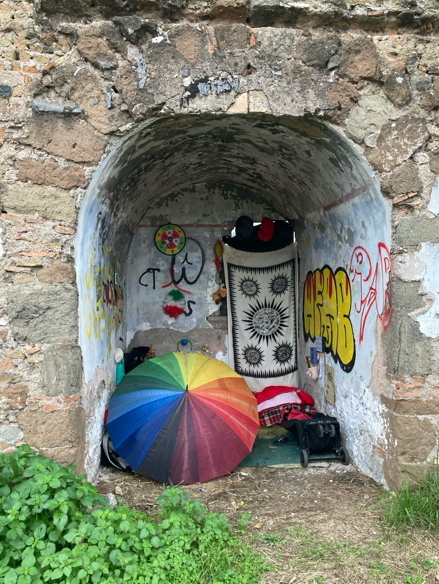
These are not generic traces of use, but in fact organized arrangements that transform architectural cavities into inhabitable interiors. The observed arch presents itself as a sharp opening in the wall: a stone mouth, high enough to allow passage and deep enough to offer protection. Its material form already provides a minimal spatial grammar. The vault shelters; the lateral walls draw a perimeter; the recess creates a distinction between inside and outside. In this case, the ruin is appropriated by entering this space. Its depth is used to produce an interior where no formal dwelling should exist (Fig. 3).
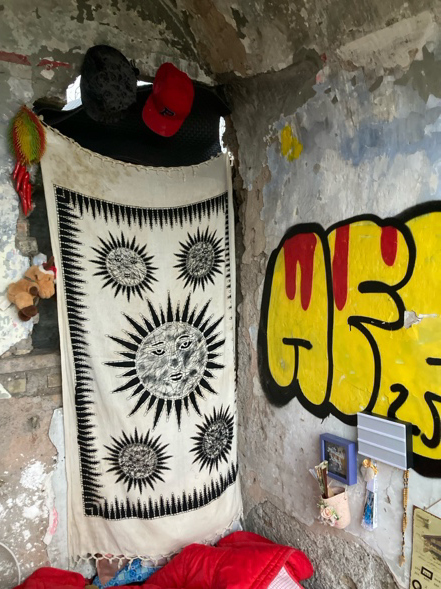
Inside the arch, the environment remains rough: worn plaster, damp stains, layered graffiti. However, the arrangement of objects is not left to chance. A light-coloured drape with a repeated sun motif is hung at the back, functioning as a soft inner wall. It does not fully close the space, nor does it declare possession in an explicit fashion. Rather, it creates depth, separation, and a second threshold within the cavity. Through this gesture, the public wall of the ruin is partially withdrawn and transformed into an interior surface.
On the ground, a green rug delimits a zone of use. Blankets and bedding are arranged laterally and toward the rear of the arch, leaving a clearer strip near the entrance. This produces a minimal spatial plan: an entry zone and a resting zone. The arrangement is elementary, but recognizable. It shows that dwelling is not only a matter of being sheltered by a structure; it also requires the internal organization of space.
A large multicoloured umbrella placed near the threshold further contributes to this organization. It simultaneously functions as a screen, a barrier against wind, and a device blocking direct visual access from outside. It does not turn the arch into a closed room, but it nevertheless modulates exposure by producing a partial opacity, allowing the space to remain accessible while reducing its visibility. Here, the act of dwelling consists in making a place liveable without making permanence too legible.
The vertical use of the walls confirms this domestic organization. Baseball caps placed high above the drape, small objects hung or propped against the walls, containers, a framed item, a rosary, and a calendar transform the ruin into something more than a refuge. They introduce a domestic grammar into a space that remains materially precarious. The wall becomes a support not only for protection but also for ordering, storing, displaying, and composing (Fig. 4).
The second case, observed along the Aurelian Walls, shows a different form of spatial use: here, the dwelling arrangement is not established inside the ruin but against it. A light grey tent is placed on the sidewalk, pressed against the masonry (Fig. 5).
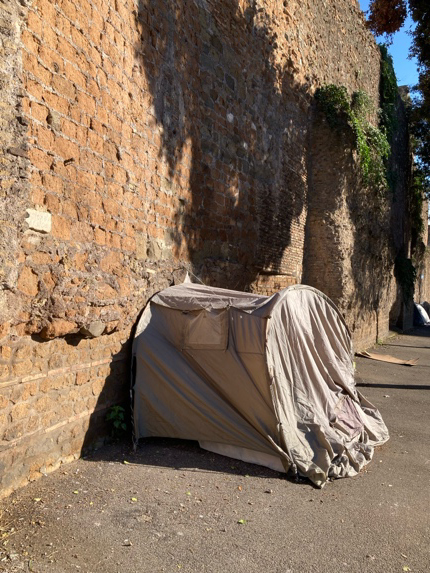
The wall functions as a fourth wall at no cost: it blocks wind, reduces lateral exposure and protects the tent from one side. The tent is not simply pitched, as in camping; it is wedged into space. Its shape appears slightly compressed, as if it had adapted itself to the wall’s presence: The shelter emerges from adhesion rather than enclosure.
This difference is important. In the case of the aqueduct, the ruin offers a cavity; in the case of the Aurelian Walls, it offers a backing. In one case, inhabitation depends on entering into the thickness of the ruin. In the other, it depends on aligning the shelter with a monumental surface. The tent’s very shape, slightly compressed as though it had relinquished part of its volume, signals adaptation: The point is not only to cover oneself, but to make a shelter and a context cohere, even though that context was never designed to host it. A tent leaned against a ruin does not “inhabit” a monument; it inhabits a threshold – a short circuit between temporalities and functions that the city did not anticipate, but that the practices of people experiencing homelessness render operable.
Yet both practices rely on the same operation: transforming a historical structure into an infrastructure of habitability. These actions do not erase the precariousness of the dwelling; they organize it materially. The arch becomes an interior; the wall becomes a support. Both are activated as partial infrastructures through which exposure is reduced and a minimal domestic order is generated.
3.2 How dwelling practices produce specific temporalities within precarious conditions
The use of ruins also produces specific temporalities. These are not stable or linear temporalities, but fragile forms of duration. In both cases, dwelling involves the attempt to transform uncertainty into a minimally organized sequence.
In the arch of the Acqua Felice aqueduct, this temporal dimension is made visible by the calendar hanging on the wall (Fig. 6). The calendar is not merely decorative. It introduces a grammar of time into a space that officially does not provide for dwelling. A calendar only makes sense if the place is expected to endure, if one expects to return, and if days can be counted from a relatively stable point. It presupposes repetition.
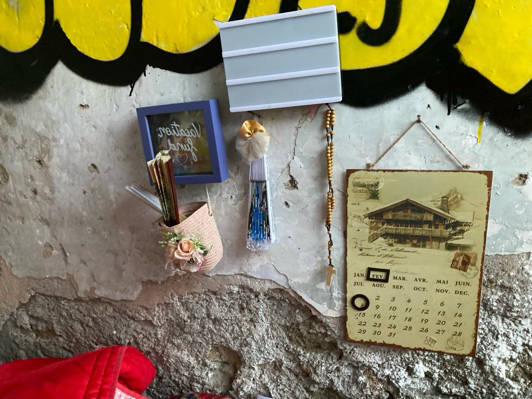
By hanging a calendar inside the ruin, the inhabitant attaches a short and fragile duration to the long historical duration of the aqueduct. The ancient structure carries the time of the city, of infrastructure, of ruin, and of historical stratification. The calendar introduces another temporality: the everyday time of the person who sleeps, returns, arranges, waits, and keeps track. The result is a temporal grafting: The brief and precarious duration of homelessness is attached to the extended duration of the ruin.
The calendar suggests that the site is not only used in the moment but incorporated into a sequence of days. It marks the possibility of “here again” that transforms the arch from a shelter for a single night into a place within a repeated practice of return. In this sense, the calendar materializes a minimal claim to continuity: not simply to be there, but to remain long enough for time to accumulate.
Other objects inside the arch reinforce this temporal structure. Bedding, rugs, hanging items, containers and personal objects indicate a dwelling arrangement that is both settled and ready to be interrupted. The presence of bags and a wheeled frame suggests that mobility remains necessary.
The inhabitant must be able to move, save what is essential, and minimize loss. Yet this mobility does not contradict the domestic order of the space; rather, it belongs to it. Precarious dwelling is organized around the possibility of interruption.
The case of the Aurelian Walls produces temporality differently. Here, the key temporal device is the anchoring point: the nail or insert between the bricks, together with the rope attached to it, turns the tent into an object oriented toward return (Fig. 7).
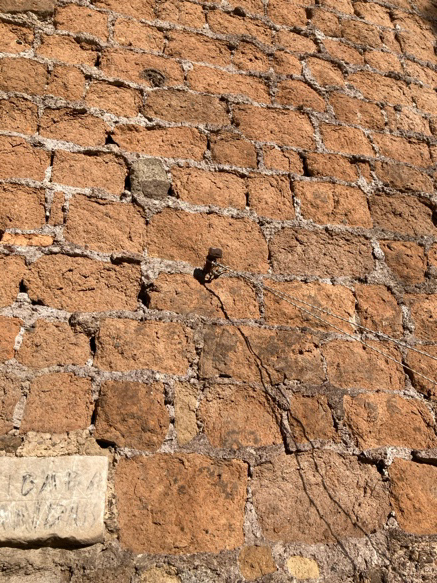
Anchoring is a spatial gesture, but also a temporal one. It implies that the shelter is not only placed for the present moment; it is prepared to resist, to remain, or to be reassembled.
The rope safeguards against wind, displacement, and possible disturbance. It anticipates what might happen. This anticipation is itself a temporal practice: a force applied in the present in order to avoid rupture in the near future. The doubled or braided rope makes this logic especially clear. It does not promise permanence, but it creates the conditions for repeated, low-intensity stability.
The temporal form produced here is not permanence in the full sense. The tent may need to be dismantled; the site may become unusable; the presence may be interrupted by control, circulation, weather, or removal. Yet the anchoring point enables a form of intermittent permanence: staying when possible, loosening when necessary, returning when conditions allow. The nail makes reassembly faster, return more reliable, and repeated effort less costly.
This is one of the central temporal features shared by the two cases. The use of ruins does not abolish uncertainty, it organizes it. The arch and the wall allow the production of rhythms: returning, arranging, repairing, fastening, storing, withdrawing, and reappearing. Dwelling emerges not as a fixed state but as a repeated practice.
In both cases, the duration of dwelling remains fragile, exposed, and reversible – but it is not insignificant. It is produced through material devices: a drape, a rug, an umbrella, a calendar, a nail, a rope, a tent. Each object participates in the stabilization of time. Together, they make possible a situated project of dwelling: a way of rendering the present more manageable by linking it to a possible repetition.
The temporalities generated by these practices are therefore neither those of formal residence nor those of pure transience. They are intermediate temporalities: precarious but organized, unstable but repeated, exposed but partially protected. The ruin becomes the support through which the time of survival is stretched, sequenced, and made minimally inhabitable.
4. Conclusion
In this contribution, the notion of the situated project has been developed both analytically and through empirical field research conducted at the level of micro-practices. Taking into account that the use of ruins constitutes a configuration that holds together both the spatial and the temporal dimension of continuity and duration, this article has analysed the micro-practices of people experiencing homelessness in the city of Rome as they build relatively durable forms of shelter, securing a minimal continuity of dwelling under conditions of extreme precarity.
Rome’s ruins can be understood as particularly dense time-places – material formations where different temporalities intersect: the longue durée of archaeological remains, the rhythms of the contemporary city, the cycles of surveillance and tolerance, and the everyday routines through which survival is organized. In this sense, ruins are not simply spatial supports or remnants of the past. They are material devices through which time becomes spatially available and through which space is experienced, inhabited, and reorganized through temporal practices.
Building on this perspective, the article contributes to debates on space and time by shifting the focus from the general theoretical claim that space and time are inseparable to the empirical question of how their inseparability can be observed. While Harvey’s notion of “spatiotemporality”, Massey’s “space-times”, and Barad’s “spacetime mattering” offer conceptual resources for thinking the co-constitution of space, time, and matter, the article shows empirically how this co-constitution becomes visible in urban practices through practices of dwelling. In doing so, people experiencing homelessness establish a close, material, and unauthorized relation to ruins, engaging with them through practices of touch, movement, anchoring, hanging, and adaptation. In such practices, ruins are made to function in another sense: as shelter – places in which objects can be stored, where one can sleep with a degree of regularity, and where some protection can be secured. This mode of use exists in direct tension with the touristic imaginary of modernity, which tends to stabilize ancient remains as aesthetic objects to be contemplated from a distance as frame, scenery, or monument (Stewart 2020; Schnapp 2020).
The ruin becomes a field of forces in which conservation and use, visibility and invisibility, monumentality and everydayness, long historical duration and the short duration of precarious dwelling coexist and collide. In Rome, a paradigmatically stratified city, this collision is structural: ruins are active components of the urban morphology, and therefore also of its inequalities. Observing Rome through the practices of people experiencing homelessness brings into view a city marked by asymmetries, which tolerates such presences so long as they remain discreet and removes them when they become too visible. What is observed here is not only shelter in time, but the very possibility of making time in public space.
A further development of this research would be to extend the same analytical lens beyond the level of everyday practices, applying it to the study of public policies, territorial planning and urban regulations that structure, constrain or render invisible these practices. In this direction, the concept of the situated project could offer a way to rethink the relation between informal dwelling practices and institutional forms of spatial governance. The point would not be to replace institutional policies with the micro-practices of those who live on the street, nor to romanticize survival tactics as alternatives to institutional intervention. A politics of the situated project would therefore not consist in transforming precarious arrangements into acceptable solutions, but rather in using them as a point of departure for rethinking the city and its inequalities.
Similarly, the notion of the situated project could help to interrogate the plurality of urban knowledges at stake – practical, institutional, technical, social and experiential – and the ways in which this plurality may coexist. Such knowledges are often heterogeneous and asymmetrical; they may also be in tension or conflict. Yet it is precisely from this friction that a different understanding of urban policy might emerge: one oriented toward the recognition of the spatial competences, temporal routines, and material arrangements through which precarious lives are sustained in the city.
This does not mean accepting ruins as appropriate places to live, nor legitimizing the conditions of inequality that make such uses necessary. On the contrary, it means taking seriously the capacity of people experiencing homelessness to generate other spaces (Meert 2006; Mela et al. 2024) and multiple temporalities as a concrete mode of urban production.
Through adjustments, reuses, and forms of maintenance, homelessness is not only a condition of lacking, but also a mode of inhabiting and producing urban space. Through these practices, people experiencing homelessness outline original ways of imagining the city and their own lives, challenging interpretations of life on the street as merely passive marginalization or a “parasitic” condition. Rather, they act as inventive actors, bricoleurs capable of actively constructing the reality around them in the course of everyday life (Barnao 2004; Bonadonna 2005; Bergamaschi 2009). In this sense, people experiencing homelessness should be recognized as legitimate social actors who contribute to redefining functions, boundaries and the implicit norms of the metropolitan environment for everyday continuity. They interact continuously with the city, reinventing and re-signifying it; through their daily practices, they contribute to the production of urban space itself. This active dimension composed of micro-practices, adaptation and resistance offers an empirical lens through which to read the city not as a mere backdrop, but as a processual and relational formation in which urban space is both the product and the stake of social practices that produce alternative spatial configurations, multiple temporalities, and uses within the city.
References
Barad K. (2007), Meeting the Universe Halfway: Quantum Physics and the Entanglement of Matter and Meaning, Duke University Press, Durham, NC.
Barnao C. (2004), Sopravvivere in strada: Elementi di sociologia della persona senza Dimora, FrancoAngeli, Milano.
Baxter J.-S., Heinrich A. J., Marguin S. and Sommer V. (2025), «Introduction: Multiple Spacetimes and How They Matter», in J.-S. Baxter., A. J. Heinrich., S. Marguin and V. Sommer (eds.), Spacetimes Matter: A Collection of Mapping Methodologies, Jovis Berlin, Berlin, pp. 7-21.
Bergamaschi M. (2009), «Between Mobility and Sedentariness: Homeless People in Urban Space», In M. Bergamaschi, M. Colleoni and F. Martinelli (eds.), La città: bisogni, desideri, diritti. Dimensioni spaziotemporali dell’esclusione urbana, FrancoAngeli, Milano, pp. 204-220.
Bonadonna F. (2005), Il nome del barbone. Vite di strada e povertà estreme in Italia, DeriveApprodi, Roma.
De Rosa E., Di Leo F. and Scambia F. (2025), «Homelessness in Rome 2024: The PIT Count», in European Journal of Homelessness 19 (1): 205-223.
de Certeau M. (1984 [1980]). The Practice of Everyday Life, University of California Press, Berkeley.
DeSilvey C. (2017), Curated Decay: Heritage Beyond Saving, University of Minnesota Press, Minneapolis.
Do P., Fassari L. G. and Pompili G. (2025), Marginalità ibride. Pratiche di rifigurazione spaziale, Carocci, Roma.
Do P. and Fassari L. G. (2023), «The Quality of Public Space Among Hybrid Nature-Ruins: The Case of Bullicante Lake in Rome», in Quaderni di Sociologia 91(LXVII): 29-45.
Duneier M., Kasinitz P. and Murphy A. (2014), The Urban Ethnography Reader, Oxford University Press, New York.
Duneier M. (2016), Ghetto: The Invention of a Place, the History of an Idea, Farrar, Straus and Giroux, New York.
Edensor T. (2005), Industrial Ruins: Space, Aesthetics and Materiality, Berg, Oxford.
Ferrarotti F. (1970), Roma da capitale a periferia, Laterza, Roma-Bari.
Ferrarotti F. (1974), Vite di baraccati: contributo alla sociologia della marginalità, Liguori, Napoli.
Fondation pour le Logement des Défavorisés, FEANTSA (2025), Tenth Overview of Housing Exclusion in Europe 2025, Report. September 2025.
Haraway D. J. (1988), «Situated Knowledges: The Science Question in Feminism and the Privilege of Partial Perspective», in Feminist Studies, 14 (3): 575–599.
Harvey D. (1990), The Condition of Postmodernity: An Enquiry into the Origins of Cultural Change, Blackwell, Cambridge MA and Oxford.
Lefebvre H. (1991 [1974]), The Production of Space, Blackwell, Oxford.
Löw M. (2008), «The Constitution of Space: The Structuration of Space through the Perception and Action of Social Actors», in European Journal of Social Theory 11 (1): 25-49.
Lynch K. (1972), What Time Is This Place?, MIT Press, Cambridge MA.
Massey D. (2005), For Space, Sage, London.
Meert H. (2006), The Changing Profiles of Homeless People: Conflict, Rooflessness and the Use of Public Space, FEANTSA, Brussels.
Mela A., Battaglioni, E. and Palazzo L. (2024), La società e lo spazio, Carocci, Roma.
Przywara A. (2023), «Mining for Embodied Coal: Building Material Reuse in the Postwar Reconstruction of Warsaw», in Ardeth, 13: 141-159.
Przywara A. (2025), «Wartime Circularity: Adapting Buildings, Salvaging Materials, and Designing Supply Chains for Ukraine», in Urban Research & Practice, 19 (1): 139-156.
Rossi G. (2016), Le forme dello spazio nella tarda modernità, FrancoAngeli, Milano.
Schnapp A. (2020), Une histoire universelle des ruines: Des origines aux Lumières, Éditions du Seuil, Paris.
Simmel G. (1958), «The Ruins», in The Hudson Review 11 (3): 371–385.
Simmel G. (1985), La moda e altri saggi di cultura filosofica, a cura e trad. di M. Monaldi, Longanesi, Milano.
Simmel G. (2018), The Art of the City: Rome, Florence, Venice, Pushkin Press, London.
Stewart S. (2020), The Ruins Lesson: Meaning and Material in Western Culture, University of Chicago Press, Chicago.
Suchman L. A. (1987), Plans and Situated Actions: The Problem of Human–Machine Communication, Cambridge University Press, Cambridge.