https://doi.org/10.36253/smp-17078
«Two Heads Are Better Than One but They Must Be Good Ones»: Ethical and Methodological Challenges of Social Work With «people Living on the Street»
Catholic University of the Sacred Heart, Italy
E-mail: andrea.gollini@unicatt.it
Abstract. This paper presents a case study analysis focused on an accompaniment process with a person living on the street, developed in a city in Northern Italy. Through the story of Arnold – a migrant man facing housing, employment, and relational precarity – the article examines key ethical and methodological challenges of social work with people who live on the street: managing relational timeframes, negotiating the boundaries between support and control, holding together protection and freedom, and the effort to sustain without substituting, especially when access to rights remains uncertain. The analysis, based on a case study design and on qualitative materials collected throughout the accompaniment process, is interpreted through Relational Social Work and the Poverty-Aware Paradigm. This highlights a form of networking that does not coincide with mere inter-agency coordination, but actively involves the person being supported as a reflective subject and knowledge-holder, while interrogating power asymmetries, access criteria, and everyday practices that may generate stigma or exclusion. The phrase that gives the article its title “Two heads are better than one but they must be good ones” spoken by Arnold during a focus group, encapsulates helping as a relational practice grounded in dialogue and reflexivity, whose effectiveness depends on reciprocity and on the capacity to integrate care and justice, also through advocacy and policy practice.
Keywords: homelessness, social work, relational social work, caring relations, ethics.
Contents
2. Theoretical and empirical background
2.1 Understanding homelessness today: definitions, measurement, determinants and policy context
2.2 People’s experiences, stigma, and othering
2.3 Social work practices: from emergency services to rights-based and de-oppression paradigms
5.2 Initial reception and first problems of cohabitation
5.4 Experimenting with Housing First as an alternative to cohabitation
5.6 Daily life: steps forward and new obstacles
6.1 Life horizons and accompaniment
6.4. Power in the helping relationship
1. Introduction
Severe adult marginalization and social work with people living on the streets are increasingly present in Italian public debate and policies (Meo and Consoli 2020), yet they remain shrouded in stereotypes. However, this increase in resources and strategies has not translated into proportional collective awareness. The risk is that as further interventions are implemented, the meaning and direction of practice will remain uncertain. This contribution questions the ethical and methodological conditions that make aid consistent with inclusion. The article examines social work as a practice that faces dilemmas between protection and freedom, support and control, and accompaniment and substitution, showing these dilemmas as inherent to professional action with people in precarious housing. «Two heads are better than one, but they must be good ones»: this phrase, spoken by Arnold, the protagonist of the case study presented here, captures what is at stake in proximity-based social work, where reciprocity and shared reflection are necessary conditions for navigating the uncertainties of helping processes.
Working with people in this condition means confronting a relationship that resists procedural regulation, forcing engagement with power imbalances, individual timeframes, outcome uncertainty, and social injustices (Locatelli 2025). This contribution engages with the sociological debate on precarious housing, viewing “home” as both a material resource and a condition enabling routine, recognition, and social citizenship. Street and temporary solutions represent the absence of housing and rights vulnerability. The analysis explores how living possibilities can be constructed when access to rights is uncertain and the ethical choices that make social work supportive without becoming controlling. This article presents a single qualitative case study - the support process of Arnold, a 44-year-old Nigerian man in precarious housing conditions in northern Italy – as a reflective device for examining the ethical and methodological tensions inherent in proximity-based social work, interpreted through Relational Social Work (Folgheraiter 1998; 2011) and the Poverty-Aware Social work Paradigm (Krumer-Nevo 2016).
2. Theoretical and empirical background
This section offers interpretative lenses for reading the case presented in the paper and is organized around three themes: (1) the definition of the phenomenon; (2) people’s experiences and social representations; and (3) practices and models of intervention, with main open questions for practitioners, services, and territorial governance.
2.1 Understanding homelessness today: definitions, measurement, determinants and policy context
A “classical” framework describes homelessness as a condition of extreme poverty including life “on the streets” and hidden forms, showing seasonality and varying over lifetimes (episodic, recurrent, chronic), given difficulties in quantifying it comparably (Johnson and Cnaan 1995). In European debate, comparison challenges led to convergence toward shared taxonomies. The Ethos1 typology by FEANTSA2(2005) shifted focus from not having a home to conditions of housing exclusion, clarifying transitions between situations. Comparative literature shows definitions are not neutral; they influence measurements, service targets, and policy priorities (Busch-Geertsema 2010). In Italy, national surveys made homelessness statistically visible: the ISTAT report on homeless people’s conditions (with surveys in several Italian cities) was key toward policy alignment (ISTAT 2015). The national guidelines formalized the need for an integrated approach (services, care, housing, health, and work) and minimum standards in coping severe adult marginalization (MLPS3 2015). More recently, the European Platform on Combatting Homelessness (2021) and the Italian Essential Levels of Social Services (LEPS) framework have defined specific standards for people experiencing homelessness, including emergency social intervention and civic registration services as gateways to citizenship rights (MLPS 2025).
Recent scholarship warns against reducing homelessness to “housing”: it intertwines with structural inequality, disadvantage, criminalization, and hidden forms of housing exclusion (Awad 2023; Bramley, Fitzpatrick and Sosenko 2020;). Homelessness expresses extreme poverty affecting income, health, work, and social capital, shaped by institutional arrangements and individual trajectories (Bramley et al. 2020; McGrath et al. 2023). It includes hidden forms of housing exclusion, which escape purely housing-based definitions (Batterham 2018). In Italy, the typical image of the homeless person as someone “outside” society is being challenged; situations include different thresholds of exclusion, residual skills, intermittent ties, and informal work (Antinori, Fontanari and Leonardi 2025; Bianciardi 2019). Literature emphasizes that a universally accepted “contemporary” definition of homelessness remains elusive; this uncertainty affects social policies and practices, including access, criteria, rights, and responsibilities (Decembrotto 2017). Tosi Cambini (2004) proposed «people who live on the street» as terminology that is epistemological and political, avoiding definitions by lack (homeless, roofless) and reducing stigmatization. Regarding causes, reconstructions from the 1990s rejected monocausal models (e.g., only psychopathology or deviance), proposing multifactorial interpretations combining personal vulnerabilities, biographical ruptures, and structural factors (Johnson and Cnaan 1995). Multiple exclusion homelessness describes the intertwining of exclusions (housing, income, health, addiction, justice, relationships) and avoids reductionism: exclusions reinforce each other in trajectories (Manthorpe et al. 2015).
2.2 People’s experiences, stigma, and othering
Much recent literature focuses not only on material needs but also on the social processes that lead to distance, stigmatization, and the symbolic dehumanization of people experiencing homelessness (Locatelli 2025). In international research, stigma is described as a mechanism that reduces access to resources, produces mutual distrust, and justifies exclusionary practices; furthermore, it persists even when the social profiles of the people involved change (Belcher and DeForge 2012; Mahlangu and Kgadima 2021). In the Italian context, in addition to the reflections of Tosi Cambini (2004), Porcellana (2018) discussed how “becoming homeless” is a process involving stages, institutions, and constraints, and how public representations tend to moralize extreme poverty, producing othering and distance.
This symbolic dimension cannot be separated from the daily experience of life on the streets, which also profoundly restructures the coordinates of time and space. Life on the streets can generate survival routines and precarious geographies that both protect and expose, making it difficult to build continuity and plans for the future (Meo 2008). Additionally, a rift often opens up between “service time” and time spent on the margins, with direct effects on the ability to meet deadlines, appointments, and administrative procedures (Lavanco and Santinello 2009). In this sense, homelessness tends to compress life horizons and narrow the imagined possibilities, as Gui (1995) has indicated in describing the processes of uprooting typical of severe marginalization.
Read in context, this compression also affects the ability to aspire, not as an individual trait, but as a socially distributed competence made (in)accessible by recognition, resources, and opportunities (Appadurai 2004). Therefore, stigma is not only a problem of “image.” Critical social work literature shows that stigma can manifest in everyday micro-exclusions (humiliating procedures, controls, gatekeeping, blaming language) and that the relationship with institutions is often part of the experience of vulnerability, not only the context in which interventions take place (Krumer-Nevo 2008).
Access to services and building alliances depend on how people feel they are seen, named, and treated. Alongside basic needs detailed in Johnson and Cnaan’s (1995) review, contemporary literature emphasizes the need for recognition and “re-narration” of the self, especially when extreme poverty leads to status breakdown and public shame (Krumer-Nevo 2008; Paugam 2013). Italian contributions highlight how homelessness should be understood as the coexistence of material and immaterial poverty, where isolation and loss of ties become integral to deprivation (Bianciardi 2019; Decembrotto 2017).
2.3 Social work practices: from emergency services to rights-based and de-oppression paradigms
A classic review showed prevalence of emergency responses (shelters, soup kitchens, healthcare, income support, addiction, and mental health services), organizing access through “step-by-step” support processes and selective criteria (Johnson and Cnaan 1995). This approach continues, though literature indicates a shift toward integrated models focused on housing stability, interpreted within welfare structures and multilevel governance (Kazepov 2009). In Italy, Housing First makes housing a basic right rather than final reward (MLPS 2015; Molinari and Zenarolla 2018). Housing First is an evidence-based model that provides immediate access to permanent independent housing combined with support services, prioritizing housing stability as a precondition rather than an outcome of recovery (Padgett, Henwood and Tsemberis 2016). International evidence shows high effectiveness in housing stability (Baxter et al. 2019), but variable results for health, work, and integration (Keenan et al. 2021). In European debates, data comparability remains a significant issue for policy priorities (Busch-Geertsema 2010; Edgar 2009; Tosi 2010). New social work practices are emerging: multiuser centers, social farming, adult foster care, and mechanisms linking needs and bonds (Bianciardi 2019; Meo and Consoli 2020). Participatory design practices show effectiveness depends on building participation and reducing asymmetries (Porcellana 2018).
Recent literature shows that choosing “what to do” is insufficient; how and position must also be chosen: anti-oppressive approaches, criticism of paternalism, and power relations between institutions and homeless people are central. Oppression forms a barrier to health and housing reintegration; hence, tools like counter-narratives, critical reflexivity, and agency are needed (Glumbíková et al. 2017).
Another perspective, closer to critical social work, holds that homelessness results from social relations, inequalities, and service governance. This implies that addressing homelessness requires combining micro (relationships, support) and macro (rights, policy, access to resources) aspects (Busch-Geertsema 2010; Weng and Clark 2018). Locatelli’s (2025) contribution shows how services build relationships with homeless people: engagement quality, continuity, accessibility, and ability to support realistic micro-goals become crucial in avoiding “nominal care” and promoting agency. The literature identifies key service system limitations: persistence of “stopgap” responses, fragmentation, focus on control of deviance, and lack of inclusion of people’s voices in service design (Johnson and Cnaan 1995; Krumer-Nevo 2008; Porcellana 2018). The ethical dimension can be interpreted as the practical work of negotiating functions and boundaries in complex contexts, where care, control, and responsibility toward third parties overlap (Philippart 2014).
Therefore, territorial governance policies are crucial: integrating welfare, housing, and local services is a condition for effectiveness (MLPS 2015; Prandini and Ganugi 2021).
The literature reviewed here offers rich analytical tools for understanding extreme poverty and homelessness, yet leaves a specific question insufficiently addressed: what happens within the helping relationship when social work tries to be simultaneously close, non-oppressive, and structurally aware? It is precisely this gap, between the conditions described in the literature and the situated, relational experience of support, that the theoretical framework adopted in this article is designed to address.
3. Theoretical framework
This contribution follows Relational Social Work (RSW), developed by Folgheraiter (1998, 2011), which considers relationships as the foundation of social intervention. From this perspective, social problems are not individual shortcomings or technical issues but difficulties within complex relational configurations of social life. The task of social work is to activate shared coping processes, where the person is recognized as a reflective and competent subject. A central concept of RSW is a coping network, understood as a space where different actors, professionals, volunteers, and people receiving support think and act together regarding problematic situations (Folgheraiter 1998, 2011; Raineri 2004). The effectiveness of intervention depends on the quality of reflective relationships built and the ability to support agency, even in conditions of great precariousness. The helping relationship is interpreted as a process of mutual learning marked by uncertainty, negotiation, and nonlinearity.
This theoretical framework integrates the Poverty-Aware Social Work Paradigm (PA-P) (Krumer-Nevo 2016), which views poverty as a structural and relational condition marked by inequalities and institutional oppression. The PA-P recognizes that people in poverty possess situated knowledge from daily experience, often invisible in support systems. Social work must question its position, avoiding moralizing views and treating poverty as a public issue. A key feature of PA-P is its focus on power asymmetries in helping relationships: intervention practices can empower people or reproduce control and stigma (Krumer-Nevo 2016). The two frameworks are complementary: RSW provides the relational and methodological lens, while PA-P situates helping relationships within structures of power, poverty, and rights.
This combined framework guided the case analysis and provided the interpretative categories for the emerging themes.
4. Methodology
This study adopts a qualitative case study research design (Bryman 2016; Stake 2005) focusing on the support trajectory of one person as the unit of analysis. In methodological literature, case studies analyze complex phenomena in depth, examining interactions between actors, context, and change dynamics, while favoring analytical over statistical generalization (Gerring 2004; Stake 2005). This method allowed us to question approaches and reasons for the processes observed, revealing decision-making junctures, alternatives, and dilemmas in the practices. As Flyvbjerg (2006) clarified, many criticisms of case studies stem from misunderstandings about their rigor and generalizability, which can be addressed by stating the design, sources, and inferential logic.
In social work, case studies are a methodology aligned with knowledge as situated, relational, and practice-oriented. Gilgun (1994) emphasized that case studies produce “practice-proximal” knowledge, connecting biographical trajectories, institutional contexts, and professional choices. Folgheraiter (2022) noted that in social work research, which focuses on subjectivity, vulnerability, and helping relationships, case studies question support processes and reveal tacit professional knowledge and methodological appropriateness. The case is not a good practice to replicate but a reflective device for problematizing conditions that make interventions socially and ethically meaningful.
This case was reconstructed from empirical materials from the author’s doctoral research (Gollini 2025). The unit of analysis is the support process, comprising interactions, negotiations, and decisions between the person and actors they interacted with (practitioners, volunteers, services, community contexts) in an urban environment. Table 1 summarises participants’ roles and the citation codes used in the paper.
| Name (pseudonym) | Role | Sex | Code | ||||||||||||||||
|---|---|---|---|---|---|---|---|---|---|---|---|---|---|---|---|---|---|---|---|
| Ernesto | Social Worker | Male | SW1 | ||||||||||||||||
| Giorgia | Social Worker | Female | SW2 | ||||||||||||||||
| Enrica | Social Worker | Female | SW3 | ||||||||||||||||
| Arturo | Volunteer | Male | V1 | ||||||||||||||||
| Arnold | Service User | Male | SU1 | ||||||||||||||||
| Source: Author’s elaboration. | |||||||||||||||||||
The documentary corpus covers 10 months from formal reception and support; prior information from low-threshold contexts (soup kitchen) exists but was not included in the materials used to reconstruct the process.
Data was collected through participant observation within the intervention, allowing observation of interactions between the accompanied person, practitioners, volunteers, and services (Bryman 2016). Additional data sources are summarised in Table 2, together with the source codes used in the paper.
| No. | Date | Activity | Document type | Code | |||||||||||||||
|---|---|---|---|---|---|---|---|---|---|---|---|---|---|---|---|---|---|---|---|
| 1 | 16/06/23 | Preparatory meeting | Initial report | IR1 | |||||||||||||||
| 2 | 17/06/23 | Initial assessment | Assessment tool | AT1 | |||||||||||||||
| 3 | 30/08/23 | Network meeting | Facilitator’s log | FL1 | |||||||||||||||
| 4 | 19/10/23 | Network meeting | Facilitator’s log | FL2 | |||||||||||||||
| 5 | 18/01/24 | Network meetm | Facilitator’s 10 | FL3 | |||||||||||||||
| 6 | 13/02/24 | Network meeting | Facilitator’s log | FL4 | |||||||||||||||
| 7 | 02/04/24 | Network meetin | Facilitator’s 10 | FL5 | |||||||||||||||
| 8 | 16/08/23 | Supervision session | Transcript | SUP1 | |||||||||||||||
| 9 | 09/11/23 | Supervision session | Transcript | SUP2 | |||||||||||||||
| 10 | 09/02/24 | Supervision session | Transcript | SUP3 | |||||||||||||||
| 11 | 03/04/24 | Evaluation focus group | Transcript | FG1 | |||||||||||||||
| Source: Author’s elaboration. | |||||||||||||||||||
Analysis followed iterative thematic analysis (Bryman 2016): familiarization with data, initial coding of critical moments, theme aggregation, and stabilization of interpretative categories through source triangulation.
For ethical reasons and confidentiality, the case is presented anonymously. All names are pseudonyms, and identifying details (place names, organizations, and program labels) have been modified or generalized. Quotations are reproduced selectively with minimal context to reduce recognition risk while preserving meaning for analysis.
5. Case study presentation
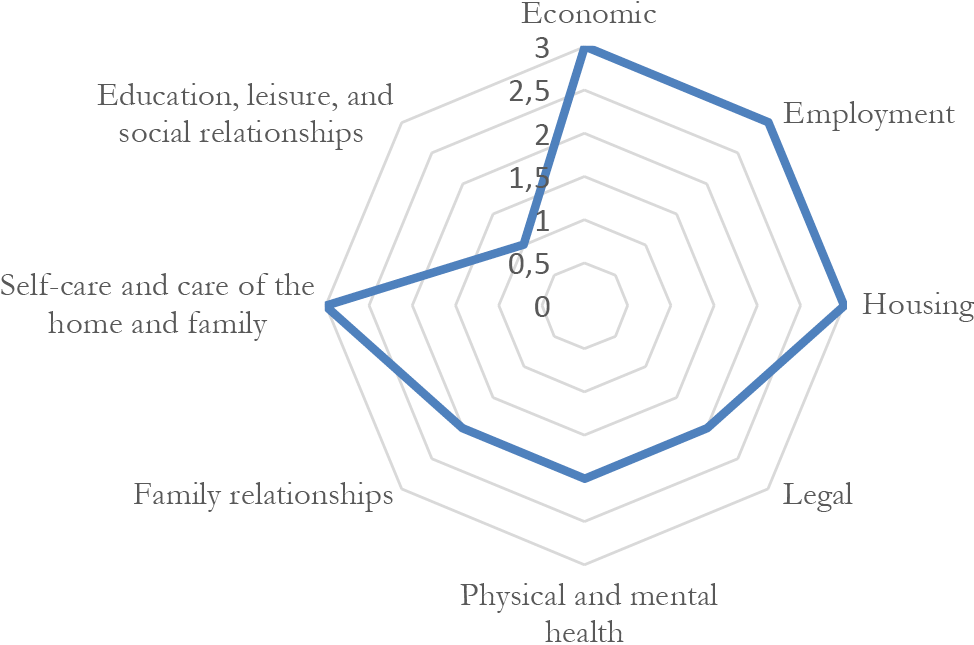
Arnold is a 44-year-old Nigerian man encountered at low- barrier services of a faith-based third-sector organization in a mid-sized city in Northern Italy during a period of housing, employment, and documentation precariousness. His situation was marked by unstable finances, fragile social networks, and a migratory trajectory of moves and temporary solutions, which he summarized as biographical loss: «I lost everything… I lost my life» (FG1). The initial request focused on immediate needs, housing and work, and was reconstructed by practitionersas a clear objective: « what he asked for from the beginning was to have a place to live»(Ernesto, social worker, IR1). A difficulty emerged in the initial assessment: «Arnold reports having many difficulties with regard to work» (AT1). During the process, his needs broadened and became more specific, revealing additional vulnerabilities and support requirements not initially formulated, as shown in Fig. 1.
5.1 The context: an informal settlement in a former industrial area and a municipal regeneration program
Arnold lived in an informal settlement in a former industrial area housing about one hundred residents. Despite precarious conditions, the settlement developed internal organization with social spaces including bars, barber shops, and a chapel. The area faced problems of conflict, crime, and informal control, making it complex for residents and institutional actors. Arturo, a volunteer, described Arnold’s stay as harsh: «Arnold lived at the settlement, the settlement was not the best place […] he had negative experiences» (FG1). Ernesto, a social worker (SW1), described an incident: «One of the other residents of the settlement went to his workshop and, armed with an axe, broke down the door, threatened him, and took away some bicycles. Arnold did not want to return to the settlement» (AT1).
This occurred within a municipal regeneration program promoted by local authorities together with civil-society actors to help settlement residents find alternative solutions and reclaim the area for urban development. With the project’s launch, the organization was asked to help create support processes out of the settlement for some identified people, including Arnold.
5.2 Initial reception and first problems of cohabitation
After the municipal regeneration program launch, Arnold was placed in shared temporary accommodation by the organization: an apartment with three other people. This arrangement was meant as a transition toward permanent settlement. From the first weeks, it proved a fragile environment prone to conflict. In Arnold’s account, relationship difficulties with roommates were seen through a religious lens, helping him interpret misunderstandings and daily tensions. As shown in the focus group, this interpretation was intertwined with the dynamics of belonging and minority status within the apartment:
Arnold: In my first placement, I had problems with Muslims.
Arturo, volunteer (V1): You have to understand that he feels more Biafran than Nigerian, and being Biafran, he is also Catholic, so he has some problems coexisting with Muslims.
Enrica, social worker (SW3): There were indeed two Muslim gentlemen who formed a group of their own. They were very close. Because, obviously, religion, culture, and language unite you […] Arnold was actually a bit in the minority, so to speak (FG1).
Critical issues emerged regarding the management of cohabitation, implicit rules, and mutual expectations. The tension extended beyond religious aspects to include broader elements of daily life and cohabitation. The project team and volunteers observed deterioration in the domestic atmosphere. During supervision, violations of house rules were reported, including disturbances and unauthorized entry.
Ernesto SW1: The stories of the others roommates concerned returning home in an altered state and inappropriate behavior, such as urinating on doors and wardrobes or letting unauthorized people into the apartment (SUP1).
5.3 The dilemma of discharge
The fragile balance of the initial reception entered crisis when cohabitation, intended as temporary and “bridging,” was fraught with growing tension. As weeks passed, the tension mounted from “over-the-top” incidents to open conflict. The point of no return came with an escalation culminating in Arnold’s serious act against his roommate’s property. This episode alarmed those in the accommodation and raised questions about protecting other guests and the educational appropriateness of handling the case. In supervision, the assessment was clear: «We gave him the opportunity, but he blew it […] He is not capable of sticking with a project» (Enrica, SW3, SUP1).
The project team faced a critical decision regarding Arnold’s dismissal from the shelter. Dismissal appeared logical given the breakdown of cohabitation and the need to signal consequences to others. However, this risked his return to the settlement or streets while alternatives were being sought within the municipal regeneration program. Discussions among practitioners, including through Arturo, revealed competing concerns: the need to restore safety and address rule violations versus avoiding reducing Arnold to a “cohabitation problem” and preventing expulsion without a plan. This situation highlighted the gap between rigid criteria and case management, as noted by Giorgia, SW2: « [The point we are at now stems] from the decision not to throw Arnold out when it was time to throw him out, if we had used rigid criteria in a service-oriented approach» (SUP3).
The questions that guided the project team were: Could Arnold be dealt with differently? Was there an alternative to cohabitation that would better address the aspirations he was gradually expressing: stability, independence, work, and the chance to “put his life back in order”, without interrupting his progress during his greatest vulnerability?
5.4 Experimenting with Housing First as an alternative to cohabitation
The project team began considering a different solution for Arnold that would go beyond rigid rules and reflect his emerging aspirations for independence and stability. This reflection addressed professional attitudes. A facilitation diary noted the team’s difficulty in reorienting the project: « The educational team… was unable to break away from a project that was not sufficiently focused on the people and the issues they faced» (FL1). During discussions, the idea of individual accommodation based on the Housing First approach emerged. This option would ensure continuity and reduce factors that made Arnold’s life fragile when living with others.It was perceived not as a shortcut or “reward,” but rather as a coherent response to his initial request.In focus groups, Ernesto, SW1, stated: « He was by himself, this is what he is asking for from the beginning to have accommodation and independence… closer to his desire» (FG1). A concrete proposal emerged when an empty rectory from Arturo’s parish was identified as potential housing.
Initially, Arnold resisted leaving the city but agreed to visit the house with the practitionersand Arturo. After visiting, he accepted the proposal. The focus group highlighted the role of proximity in facilitating the change:
Initially, Arnold was not enthusiastic about moving out of the city, but then he realized that I was in a nearby town and he began to see things differently. He met the people who live in a nearby town, immediately bonded with the families, and a beautiful relationship was born (Arturo, V1, FG1).
The project team then took steps to facilitate his integration while ensuring his housing choice connected with the broader process. Housing was viewed as a foundation for stability, from which Arnold’s financial and relational resources could be reorganized, along with administrative and work issues from previous phases.
5.5 The role of the community
Moving into the rectory marked a change in Arnold. He not only “had a roof” but also entered a recognizable community structure. The availability of the property and Arturo’s presence as a bridge figure enabled reception within a relational framework that supported daily life aspects (orientation, connections, commitments) while offering a symbolic context different from the previous refugee settlement. The rectory functioned as a stepping stone toward normality and a space to rebuild stability without exposure to the competition and judgment of forced cohabitation.
Within this framework, the community dimension was particularly important, as Arturo emphasized in the focus group reconstruction: «However, the new relationships with local families within the community changed his perspective, and Arnold got involved with everyone and opened up to everyone» (FG1). From Arnold’s point of view, the quality of the relationship with those who accompanied him was described in terms of trust and perceived authenticity:
They gave me trust […] it’s not easy to find someone who works with their heart in this way… When your heart is sincere, you feel the warmth, so it’s easy for me to accept you because I feel that you are sincere (Arnold, SU, FG1).
This community setting created new opportunities for relationships. Arnold, who was Catholic, participated in Christian community events for support and shared language. Arturo clarified their relationship was based on deeper common reference; Arturo, V1: « The bond between him and me is not so much our relationship with the settlement… but has always been our faith» (FG1). Arnold attended parish events, experiencing recognition beyond the “beneficiary” label. He joined initiatives like the parish theater group, offering an informal space to be with others less marked by precariousness. This participation helped multiply his relationships, fostering contacts beyond survival needs and expanding his social network.
5.6 Daily life: steps forward and new obstacles
Moving into the rectory and connecting with the community significantly improved Arnold’s quality of life. Stable housing reduced his exposure to the risks of the street and made it possible to reestablish some daily routines, such as rest, more regular meals, more continuous contact with the project team, and participation, albeit sporadic, in some community activities. In this trajectory, the team also recognized signs of change observable in everyday life:« He has grown and improved a lot in this time in terms of autonomy, behavior […] even with regard to housekeeping: before it was a disaster, really a disaster, today his house is his home» (Giorgia, SW2, FG1).
However, this reception did not coincide with a solution to the case. In the following months, several vulnerabilities remained open and intertwined. Difficulties persisted in managing practical tasks (e.g., appointments, calls, documentation), as did inconsistency in commitments, fluctuation between enthusiasm and withdrawal, and health vulnerabilities that made necessary actions less predictable.
At this stage, the project team sometimes interpreted these difficulties as passivity or lack of responsibility, fearing support might foster dependence rather than autonomy. This perception is recorded in the assessment tool:
The perception is that he takes advantage of these things, pretends not to understand them or to be hearing them for the first time, so he can always be helped and supported by us in everything, when he has the ability to do them himself (AT1).
Consistently, in supervision, difficulties moving forward with certain operational steps, even on simple tasks, were reported:
For about a month now, we have been telling him to correct the things he wants to fix on his resume by hand, to send them to Elena via photo, and he is not doing anything. Arnold tends to always ask me or Arturo for help, even for very trivial things, and we’re at a standstill (Giorgia, SW2, SUP2).
Within this interpretative tension, a specific episode caused a shift in their perspectives. In a focus group, Giorgia reconstructed a situation about managing a healthcare task, in which insistence on autonomy clashed with anxiety and blockage:
I always insisted that Arnold be autonomous in healthcare matters and asked him for months to book this dentist appointment himself, but he told me he couldn’t get through. One day at his house, I suggested making the call; I called, and when the dentist answered, I threw the phone at him and said, “You talk to them.” He was shaking and stammering but made an appointment. When he hung up, he said, “See, it was not that difficult after all…” and I realized how much of a hurdle this call had been for him. He was probably afraid they would ask him questions (Giorgia, SW2, FG1).
The episode revealed a gap between the practitioners’ perception of the task as straightforward and Arnold’s experience of anticipatory anxiety and inadequacy. These difficulties appeared less due to reluctance than practical and emotional barriers which, if unrecognized, risked undermining the support process toward autonomy.
5.7 The issue of work
With his documents in order and cohabitation arrangement over, work became central to Arnold’s journey. He reported previous work experience in Switzerland as a carpenter and in the car trade, and while in the city, he secured an internship at a painting company after starting the support project. The internship, preceded by a safety course funded by the organization, turned into a monthly contract through a temporary employment agency. This improved his economic situation but maintained uncertainty, as the precarious contract hindered his housing access and life plans. Workplace difficulties arose, including colleague issues and renewal concerns, which were discussed with the project team and Arturo, who remained an important reference for daily support.
When Arnold asked about greater stability, the project team organized a network coping meeting with Arnold’s employer. The meeting clarified expectations and job aspects but did not change the contract type, as the company used temporary contracts across the sector. In the focus group feedback, Arturo reconstructed this turning point, highlighting recognition and structural constraints:
He started working as a painter at the company […] in June. He still works for this company, but there are problems because the employer is not complying, but he does this with everyone, as he told us yesterday during the network meeting. Instead of hiring, he uses temporary contracts with monthly renewals. We said we should look for something else for him, as he performs very well at work, which was also confirmed by Mauro, the owner. So, the problem is clear, we know about the job insecurity, but that’s okay, we’re doing very well, in short (Arturo, V1, FG1).
The link between job stability and housing plans emerged particularly clearly in the operational reflections, in which the contract uncertainty was seen as a concrete barrier to the transition to ordinary housing solutions, as Giorgia, SW2, stated: «We agreed that looking for an apartment with a one-month contract is not feasible» (FL3). Moreover, Arnold explained that job stability was a prerequisite for him to be able to invest in emotional and family ties, summarizing the sense of urgency with an expression that placed work within a broader biographical horizon; Arnold: « At 44… I would like to have a family» (FG1).Moving into the rectory allowed Arnold to leave the settlement and gain work stability. However, his housing relies on an extraordinary solution that isn’t replicable, while his fixed-term contract maintains high uncertainty. This limits planning, weakens housing access, and prevents linear progress toward autonomy. The trajectory continues as an unstable balance between progress and vulnerabilities, with precariousness remaining a constant challenge.
6. Discussion
Arnold’s case allowed for the examination of methodological and ethical tensions in interventions with people living in poverty and severe precariousness, particularly when support intersects proximity, institutional networks, and community resources. We examined these issues through two lenses: RSW, which focuses on shared meanings, coping networks, and relationship quality as help infrastructure; and the PA-P, which recognizes structural conditions, avoids blame-based interpretations, and combines care, rights, and experiences of oppression. The discussion draws on themes emerging from the thematic analysis of the collected materials, showing how ethical and methodological issues extend beyond technical aspects to relational and political dimensions. Table. 3 summarises the thematic map and structures the discussion into four areas: (1) life horizons and accompaniment; (2) dwelling dimensions; (3) access to rights; and (4) power in the helping relationship.
| Category | Methodological themes | Ethical themes | |||||||||||||||||
|---|---|---|---|---|---|---|---|---|---|---|---|---|---|---|---|---|---|---|---|
| 1. Life horizons and accomparument | Time in helping relationships | Self-determination vs necessary intervention in situations of risk | |||||||||||||||||
| Difficulty keeping a future-oriented plan | Non-blaming interpretation of discontinuit | ||||||||||||||||||
| Service timelines vs lived time | Responsibility toward others/community when safety is at stake | ||||||||||||||||||
| Continuity/discontinuity of the project | |||||||||||||||||||
| 2. Direlling dimensions | Space as identity | Protection vs freedom in housing decisions | |||||||||||||||||
| Non-chosen cohabitation as a vulnerability factor | Unconditional support vs eligibility/criteria in access to housing | ||||||||||||||||||
| Precarious accommodation Support processes and fragility of transitional placements | |||||||||||||||||||
| Shift to individual housing as an enabling condition for stability | |||||||||||||||||||
| 3. Access to rights | Bureaucratic rigidity and administrative obstacles | Discrimination and unequal access to nghts | |||||||||||||||||
| Discontinuities and fragmentation across services and pathways | Rights on paper vs nights in practice | ||||||||||||||||||
| Enabling practical access to rights | Stigma and institutional barriers as forms of oppression | ||||||||||||||||||
| 4. Power in the helping relationship | Managing autonomy: supporting without substituting; avoiding dependence | Professional boundaries and trust: closeness without overstepping | |||||||||||||||||
| Boundaries in proximity-based practice | Self-determination vs necessary intervention | ||||||||||||||||||
| Tension between support and control in multi-actor projects | Unconditional help vs access criteria | ||||||||||||||||||
| Interpretive work on meanings and attributions | Avoiding pateralism and disciplinary responses | ||||||||||||||||||
| Source: Author’s elaboration. | |||||||||||||||||||
6.1 Life horizons and accompaniment
The material reveals temporal tension affecting continuity in planning. Initial demand focuses on immediate needs (housing and work), with support measured against instability, displacement, and discontinuous resources: a condition crushing the future onto the present and hindering the transformation of desires into personal plans. What Gui (1995: 29) described as « progressive uprooting» reduces available options and erodes the possibility of “imagining” viable alternatives. Here, the capacity to aspire emerges: when life centers on urgency and contingency, aspiration is not merely individual but a culturally and socially distributed capacity, weakened by prolonged precariousness (Appadurai 2004). Arnold’s story is consistent with the literature on the cultural distance between service time and street time; in street time, daily life is organized around urgent actions (e.g., eating, sleeping), and opening one’s perspective to medium-term goals is a struggle (Lavanco and Santinello 2009; Locatelli 2025).
Accompaniment reopens the space for the future by helping people name credible goals, articulate steps, and reconnect everyday life to a less fragmented horizon. In line with RSW and PA-P, goal-work is treated as co-constructed and discontinuities are read as effects of structural constraints rather than moral traits, requiring both care and access to rights. Arnold’s aspiration, «At 44… I would like to have a family», shows that “work” also concerns recognition and the possibility of imagining a meaningful adult life.
6.2 Dwelling dimensions
The case shows that where one lives is not merely a logistical backdrop but also shapes one’s identity, perceived safety, relationships, and self-determination. The former settlement, although marked by conflict, crime, and informal control, appeared as an inhabited and partially organized space, with structured forms of cohabitation and places for social life and worship: an ambivalent context that both protected and exposed people to risk, a city within the city. The homelessness literature captures this ambivalence: even precarious spaces can become stable reference points, as people equip them and make them recognizable until they begin to resemble a home. Thus, leaving such spaces does not automatically improve living conditions; it may generate disorientation and new burdens (Locatelli 2025; Meo 2008). In the materials analyzed, this dynamic became visible in the shift to non-chosen cohabitation: designed as a bridging solution, it proved vulnerable, as the precariousness and absence of choice increased breakdown risks and created discontinuities.
The subsequent move toward an individual Housing First solution (made possible through the parish house) appeared not as a mere “technical” adjustment but as a change of frame: dwelling became an enabling condition and lever for stabilization. From a PA-P perspective, this shift represents a move toward a more claimable right to housing, one not subordinate to merit-based prerequisites. From an RSW perspective, it foregrounds work on meaning attribution: What does that place represent for Arnold? What fears or expectations does it trigger? What role does the coping network play in sustaining the transition? Because space is not neutral: it is identity-forming, relational, and political.
6.3 Access to rights
The materials showed that Arnold’s difficulties primarily concerned navigating citizenship and welfare systems: documentation, registration/domicile, access to health services, regular employment, and housing. Along this trajectory, vulnerability was produced and amplified by formal requirements (e.g., residence permits, procedures, waiting times) that became barriers when employment continuity and housing stability were missing. Contractual insecurity, here, precarious work that increased income but was renewed “month by month”, showed how transitions toward autonomy remained structurally obstructed, despite significant efforts. Access to rights (e.g., housing, stabilizing one’s life, planning) remained uncertain, raising questions about whether these can truly be called “rights.”
From an RSW perspective, this highlights relational support as a mediation between worlds (e.g., languages, expectations, institutional codes), and the role of the coping networks in making complexity manageable: not by substituting for the person but by enabling conditions through which rights become claimable.
From a PA-P perspective, focusing on rights helps prevent blaming interpretations: “discontinuity” often results from a system demanding high administrative performance from those most exposed to stress, poverty, exclusion, and discrimination, with less economic, relational, and symbolic capital. The case shows how rights become a site of everyday struggle, and how practitioners’ interventions must hold care and justice together without collapsing into mere assistance or bureaucracy.
6.4. Power in the helping relationship
The empirical material revealed dilemmas where the core issue was how to redistribute power in an asymmetrical relationship without slipping into control or abandonment disguised as self-determination. The “to discharge or not to discharge” dilemma was emblematic: the team had to balance interests while avoiding mere expulsion from the support system. Ethical issues intersected (self-determination vs. intervention; unconditional help vs. eligibility criteria; professional boundaries and trust) with methodological concerns (the boundary between support and control; fostering autonomy; sustaining relationships when alliance is fragile). The phone call episode uncovered the gap between practitioners’ perceptions and the person’s experience: what seemed simple for practitioners became a barrier, charged with anxiety and fear of inadequacy for Arnold.
This evidence invites reframing “passivity” and shows autonomy is not a prerequisite but a relational outcome supported through trust and accompaniment. From an RSW perspective, this requires attention to meaning-making (What does “being autonomous” mean for Arnold? What does “helping” mean for the team?) and to relationship quality, including volunteers like Arturo and the community, which create spaces beyond need response. From a PA-P perspective, power focus highlights the need to monitor practices that may reproduce oppression: help can become conditional and normalizing, or expand people’s real choices.
This is where the structural point becomes salient: even when life improves, precarious work and systemic constraints can make housing autonomy difficult, due to contextual conditions that practice must name. The case shows that exiting street homelessness extends beyond securing accommodation to reconstructing rights, meaning, and social recognition. Barriers in residence, timelines, service access, and labor-market insecurity reveal how vulnerability is co-produced by institutions and housing markets. In this framework, proximity-based relationships function as infrastructures of access and meaning yet remain affected by power dilemmas requiring reflexivity to avoid disciplinary slippages.
7. Conclusions
Placement through a Housing First approach, joint work within a coping network, and the consolidation of a broader relational network enabled Arnold to leave the informal settlement and to gain a more stable base, with observable improvements in everyday life and in labor-market inclusion. Nevertheless, the trajectory did not fully stabilize: the desired housing autonomy remained sustained by an exceptional arrangement and, above all, employment stabilization occurred within a framework of contractual insecurity that made future planning difficult, limited access to ordinary housing solutions, and hampered the transformation of incremental progress into a linear transition toward full independence.
From this perspective, we should not interpret fluctuations in support processes as individual faults, but as effects of structural conditions (e.g., precarious work, administrative constraints, housing market, and intermittent access to rights) that shape people’s daily lives and possibilities. This requires abandoning the notion that help is solely professionals’ task and that people must undergo it passively. Arnold, reflecting on his trajectory, captures this reciprocity: «Two heads are better than one but they must be good ones» (FGV1). What the analysis has shown is precisely what makes those heads «good»: first, that autonomy is not a prerequisite for support but a relational outcome, emerging through trust and the patient work of a coping network that neither substitutes for the person nor abandons them to self-sufficiency; second, that the gap between practitioners’ perceptions of a task and the person’s lived experience of it, visible in the phone call episode, can only be bridged through sustained relational proximity and shared reflexivity.
A final implication follows. The dilemmas highlighted cannot be treated solely as issues of the dyadic relationship between practitioner and person supported. They require political action by social workers through advocacy and policy practice: documenting barriers that obstruct rights enforcement, building alliances within institutional forums, and helping shape organizational and policy choices (on employment, housing, access to residence/domicile, and service integration) so individual progress does not depend on exceptional arrangements but becomes a sustainable trajectory for all.
Bibliography
Antinori S., Fontanari E. and Leonardi D. (2025), «Muoversi tra i margini. Intersezioni tra processi migratori e homelessness», in Rassegna Italiana di Sociologia, 2: 257-285, https://doi.org/10.1423/113557.
Appadurai A. (2004), «The capacity to aspire: Culture and the terms of recognition», in V. Rao e M. Walton (eds.), Culture and Public Action, Stanford University Press, Palo Alto, California, pp. 59-84.
Awad M. (2023), «Everything, all the time: Engaging the social problem of homelessness in entrepreneurship research and practice», in Journal of Business Venturing Insights, 20: e00400, https://doi.org/10.1016/j.jbvi.2023.e00400.
Batterham D. (2018), «Homelessness as capability deprivation: A conceptual model», in Housing, Theory and Society, 35(3): 268-284.
Baxter A.J., Tweed E.J., Katikireddi S.V. and Thomson H. (2019), «Effects of Housing First approaches on health and well-being of adults who are homeless or at risk of homelessness: Systematic review and meta-analysis of randomised controlled trials», in Journal of Epidemiology and Community Health, 73: 379-387.
Belcher J.R. and DeForge B.R. (2012), «Social stigma and homelessness: The limits of social change», in Journal of Human Behavior in the Social Environment, 22(8): 929-946.
Bianciardi C. (2019), «Vecchi miti e nuove evidenze: come stanno cambiando o dovrebbero cambiare le strategie di presa in carico delle persone senza dimora», in Welfare Oggi, 3: 37-49.
Bramley G., Fitzpatrick S. and Sosenko F. (2020), «Mapping the “hard edges” of disadvantage in England: Adults involved in homelessness, substance misuse, and offending», in The Geographical Journal, 186(4): 390-402.
Bryman A. (2016), Social research methods (4th ed.), Oxford University Press, Oxford.
Busch-Geertsema V. (2010), «Defining and measuring homelessness», in E. O’Sullivan, V. Busch-Geertsema, D. Quilgars and N. Pleace (eds.), Homelessness Research in Europe, FEANTSA, Brussels, pp. 19-40.
Decembrotto L. (2017), «Homelessness e possibili interventi di contrasto alla povertà estrema», in LLL, 30: 42-51.
Edgar B. (2009), European review of statistics on homelessness, European Observatory on Homelessness, FEANTSA, Brussels.
European Platform on Combatting Homelessness (2021), Lisbon Declaration on the European Platform on Combatting Homelessness, European Commission, Brussels.
FEANTSA (2005), Ethos: European Typology on Homelessness and Housing Exclusion, Brussels.
Flyvbjerg B. (2006), «Five misunderstandings about case-study research», in Qualitative Inquiry, 12(2): 219-245, https://doi.org/10.1177/1077800405284363.
Folgheraiter F. (1998), Teoria e metodologia del servizio sociale. La prospettiva di rete, FrancoAngeli, Milano.
Folgheraiter F. (2011), Fondamenti di metodologia relazionale. La logica sociale dell’aiuto (Nuova ed.), Erickson, Trento.
Folgheraiter F. (2022), «La ricerca scientifica di social work. Quale oggettività per lo studio della soggettività profonda?», in Studi di Sociologia, 60(2): 1-16, https://doi.org/10.26350/000309_000030.
Gerring J. (2004), «What is a case study and what is it good for?», in American Political Science Review, 98(2): 341-354, DOI: 10.1017/S0003055404001182.
Gilgun J.F. (1994), «A case for case studies in social work research», in Social Work, 39(4): 371-380, https://doi.org/10.1093/sw/39.4.371.
Glumbíková K., Gojová A. and Vávrová S. (2017), «Use of antioppressive approach in Czech social work with homeless people», in CBU International Conference Proceedings, 5: 611-615, https://doi.org/10.12955/cbup.v5.994.
Gollini A. (2025), «Se sei con me mi sento più forte». Nuove pratiche di contrasto alla povertà nelle Caritas della diocesi di Reggio Emilia-Guastalla, Tesi di dottorato, Università Cattolica del Sacro Cuore, Milano.
Gui L. (1995), L’utente che non c’è. Emarginazione grave, persone senza dimora e servizi sociali, FrancoAngeli, Milano.
Johnson A.K. and Cnaan R.A. (1995), «Social work practice with homeless persons: State of the art», in Research on Social Work Practice, 5(3): 340-382, https://doi.org/10.1177/104973159500500306.
Kazepov Y. (2009), Rescaling social policies: Towards multilevel governance in Europe, Ashgate, Aldershot.
Keenan C., Miller S., Hanratty J., Pigott T., Hamilton J., Coughlan C., Mackie P., Fitzpatrick S. and Cowman J. (2021), «Accommodation-based interventions for individuals experiencing, or at risk of experiencing, homelessness», in Campbell Systematic Reviews, 17: e1165, https://doi.org/10.1002/cl2.1165.
Krumer-Nevo M. (2008), «From noise to voice: How social work can benefit from service users’ knowledge», in European Journal of Social Work, 11(3): 295-309, https://doi.org/10.1080/13691450802187478.
Krumer-Nevo M. (2016), «Poverty-aware social work: A paradigm for social work practice with people in poverty», in The British Journal of Social Work, 46(6): 1793-1808.
Lavanco G. and Santinello M. (2009), I senza fissa dimora. Analisi psicologica del fenomeno e ipotesi di intervento, Paoline, Milano.
Locatelli M. (2025), Le relazioni di aiuto nell’Outreach Social Work con persone senza dimora. Una ricerca etnografica per studiare l’esperienza di Caritas Ambrosiana, Tesi di dottorato, Università Cattolica del Sacro Cuore, Milano.
Mahlangu T. and Kgadima N.P. (2021), «Social exclusion and marginalisation of homeless people: A clarion social work call for the spirit of ubuntu to reign», in Social Work/Maatskaplike Werk, 57(4): 443-454, https://doi.org/10.15270/57-4-970.
Manthorpe J., Cornes M., O’Halloran S. and Joly L. (2015), «Multiple exclusion homelessness: The preventive role of social work», in British Journal of Social Work, 45(2): 587-599, https://doi.org/10.1093/bjsw/bct136.
McGrath J., Crossley S., Lhussier M. and Forster N. (2023), «Social capital and women’s narratives of homelessness and multiple exclusion in northern England», in International Journal for Equity in Health, 22: 41.
Meo A. (2008), «Vite in strada: ricostruire “home” in assenza di “house”», in Meridiana. Rivista di Storia e Scienze Sociali, 62: 115-133.
Meo A. and Consoli T. (2020), Homelessness in Italia: biografie, territori, politiche, FrancoAngeli, Milano.
Ministero del Lavoro e delle Politiche Sociali (2015), Linee di indirizzo per il contrasto alla grave emarginazione adulta in Italia, Roma.
Ministero del Lavoro e delle Politiche Sociali (2025), Piano nazionale degli interventi e dei servizi sociali 2024-2026, Decreto interministeriale 2 aprile 2025, Roma.
Molinari P. and Zenarolla A. (2018), Prima la casa: La sperimentazione housing first in Italia, FrancoAngeli, Milano.
Padgett D.K., Henwood B.F. and Tsemberis S.J. (2016), Housing First: Ending Homelessness, Transforming Systems, and Changing Lives, Oxford University Press, New York.
Paugam S. (2013), Le forme elementari della povertà, il Mulino, Bologna.
Philippart F. (2014), «Negoziare funzioni e confini», in L’etica in pratica nel servizio sociale. Casi e commenti in prospettiva internazionale, Erickson, Trento.
Porcellana V. (2018), «Diventare “senza dimora”. Politiche e pratiche del welfare alla lente dell’etnografia», in Antropologia, 5(1): 113-132.
Prandini R. and Ganugi G. (2021), Governance territoriali e politiche di contrasto alla grave emarginazione adulta. Verso un modello strategico integrato, FrancoAngeli, Milano.
Raineri M.L. (2004), Il metodo di rete in pratica. Studi di caso nel servizio sociale, Erickson, Trento.
Stake R. (2005), «Qualitative case studies», in N.K. Denzin e Y.S. Lincoln (eds.), The Sage handbook of qualitative research, Sage, Thousand Oaks, London, and New Delhi.
Tosi A. (2010), «Coping with diversity. Reflections on homelessness in research in Europe», in E. O’Sullivan, V. Busch-Geertsema, D. Quilgars and N. Pleace (eds.), Homelessness Research in Europe, FEANTSA, Brussels, pp. 221-236.
Tosi Cambini S. (2004), Gente di sentimento. Per un’antropologia delle persone che vivono in strada, CISU, Roma.
Weng S.S. and Clark P.G. (2018), «Working with homeless populations to increase access to services: A social service providers’ perspective through the lens of stereotyping and stigma», in Journal of Progressive Human Services, 29(1): 81-101, https://doi.org/10.1080/10428232.2018.1394784.
1 European Typology on Homelessness and Housing Exclusion
2 European Federation of National Organisations working with the Homeless
3 Ministero del Lavoro e delle Politiche Sociali.