https://doi.org/10.36253/smp-17021
Drill, Baby, Drill. How Misogynist and Far-right Narratives Are Connected to Issues of Environmentalism
Faculty of Social Sciences, Charles University, Czech Republic
E-mail: linda.coufal@fsv.cuni.cz
Abstract. Through empirical observation of far-right politicians currently present in national politics of several countries, as well as scientific research, we know, that far-right ideology goes hand in hand with misogyny and anti-environmentalism. Nevertheless, this ideological triad hasn’t been subject to scientific scrutiny. There is research on far-right ideology and patriarchal misogyny, on far-right populism and anti-environmental attitudes and further on anti-environmentalism and patriarchal gender roles. This article connects these three research paradigms through quantitatively assisted discourse analysis of environmental issues in an online forum of Incels (involuntary celibates). Incels are an online community of misogynist extremists, or far-right white supremacists, depending on which academic and security agency sources one considers. This ambiguity of Incel ideology makes them a perfect candidate to research the ideological triad of far-right, misogyny and anti-environmentalism. The analysis shows, technocratic and knowledgeable engagement with scientific or policy issues frequently coexisting with, and lending legitimacy to, conspiratorial interpretations. Incel environmental discourse does not simply reject climate science but selectively reinterprets it in ways that reinforce far-right worldviews, demonstrating how environmental issues can function as sites where scientific (mis)information, misogyny, and far-right ideology mutually reinforce.
Keywords: far-right, misogyny, anti-environmentalism, incels, climate denialism.
Contents
2. The dark triad of politics: connecting misogyny, white supremacy and climate denialism
3. Incels: on the intersection of white supremacy and misogynist extremism
5.1 The topic of climate change
5.2 The topic of severe weather events
5.3 The topic of transition: environmentally friendly dimension
5.4 The topic of transition: environmentally destructive dimension
1. Introduction
When Donald Trump, on his first day of presidency, revitalised the old republican slogan ‘drill baby drill’ (abandoned after the BP Deepwater Horizon Spill in 2010) and quit the Paris Agreement yet again, perhaps fewer people were surprised by this connection between climate science denialism and far-right populism than in his first term. Nevertheless, certain media commentators have still been dazed by the sheer amount of climate-destructive policies that Trump signed as executive orders (Friedman, 2025). On the other hand, his misogynist and transphobic executive orders have not come unexpectedly, as these issues have been intensely present in the campaign as well as in the infamous Project 25 (Dewan & Harmon, 2025). This example shows how far-right ideology can go hand in hand with misogyny and anti-environmentalism. Surprisingly, this ideological triad has not been subject to scientific scrutiny, although we see right-wing governments adopting misogynistic and anti-LGBTQ policies globally and increasingly engaging in climate denialism through criticism or outright abandonment of green policies.
In far-right rhetoric, green policies and climate justice movements are often labelled as “gender ideology” alongside feminism, LGBTQ+ rights movements, and a variety of rights-based policies in an attempt to discredit them (Kováts, 2017). “Gender ideology” is a term pioneered by the Holy See in the 1990s (Kaiser, 2022) that has proven to be a “symbolic glue” for all conservative, radical-right, and nationalist movements (Kováts, 2017), and is viewed as harmful to the nation and a foreign imposition (Heinemann & Stern, 2022). The far right frequently employs gender as a “meta-language” to negotiate broader anxieties about inequality, power, cultural change, and national identity (Dietze & Roth, 2020). The “obsession with gender” can act as a condensation of cultural anxieties (Butler, 2020). Gender equality norms, including increased acceptance and legal rights for LGBTQ+ people, are sometimes framed as part of a negative “globalization agenda” (Fangen & Skjelsbæk, 2020), which is loosely linked to the “New World Order” conspiracy theory. This discourse creates a “them/us” divide, delegitimizing any perspective that is labelled this way (Kováts, 2017).
Far-right climate science denial tapped into public distrust of the state and the establishment using a rhetoric that was both populist and patriarchal. Far-right climate science sceptics describe themselves as marginalized, banned and oppressed dissidents. By using terms like “elite” or “the fancy people,” they framed climate change advocates as a detached and exclusive group, disconnected from the realities of ordinary people’s daily lives (Anshelm and Hultman, 2014, p. 91). Forchtner (2019) identifies evidence scepticism and process scepticism (scepticism towards scientific, bureaucratic and political processes) and performance of patriarchal masculinity as root explanations of the connection between far-right political orientation and climate science denialist attitudes.
The connection between the far-right, misogyny and anti-environmentalism has historical roots that reach back to European colonization, and to ideas of the Enlightenment. In this paper, I briefly explain the joint history of white supremacy and heteropatriarchal gender order, which both rely on extractivist logic of relations, therefore providing fertile ground for climate science denialism. White supremacy, heteropatriarchal gender order, and climate-destructive attitudes combine in mainstream far-right ideology. I conceptualize them as a dark triad of politics and conduct an exploratory, quantitatively assisted discourse analysis of discussions about climate science and climate policies on incels.is, an online forum on the intersection of white supremacy and extreme misogyny. Researching the discourses on this particular forum uncovers the practical interplay of the dark triad of politics in one of the far-right subcultures.
2. The dark triad of politics: connecting misogyny, white supremacy and climate denialism
Climate change denial, misogyny and white supremacy are not separate issues. They are interconnected manifestations of a shared desire to maintain a social order in which white cisgender heterosexual men hold power (Anshelm & Hultman, 2014; Daggett, 2018). In contemporary cultures, they usually appear hand-in-hand in the ideological repertoire of far-right parties and movements (Anshelm & Hultman, 2014; Byrne, 2020; Daggett, 2018; Dietze & Roth, 2020; Fangen & Skjelsbæk, 2020; Forchtner, 2019; Hartman, 2024; Heinemann & Stern, 2022; Jylhä et al., 2020; Lockwood, 2018). The far right can be defined as a political ideology that combines nationalism, authoritarianism, and exclusionary identity politics, often rooted in racial or ethnic superiority (Mudde, 2007; 2019). White supremacy is a power structure prioritising white male superiority (Ferber, 2007), and is often named as the main ideology of the far-right (Stinton, 2019). Misogyny, on the other hand, is a system that polices and enforces patriarchal gender norms and expectations. These norms and expectations have been changing, but to this day encompass the idea that men are entitled to sex, care, affection, and admiration, as well as claims to knowledge and power, and women are expected to provide these and to not take them away (Manne, 2017). Climate denialism, on the other hand, is different from white supremacy and misogyny in a sense that it is not a systemic structure; rather, it is a set of attitudes that reject the existence of scientific consensus on climate change and global warming (Diethelm & McKee, 2008). But the racial prejudice of white supremacism, as well as the gendered prejudice of misogyny, “requires a rejection of scientific method. The same is true of climate change denial” (Byrne, 2020, p. 30).
It is not just the rejection of scientific method and scientific consensus that connect this ideological dark triad of politics; it is rather a commitment to a particular logic of relations on which patriarchal capitalism stands. This logic of relations relies on narratives about masculinity that separate it from femininity and of culture separated from nature, which creates an arbitrary dichotomy of men = culture who rule over women = nature (Anshelm and Hultman, 2014, p. 91). This patriarchal dichotomy functions not only in the subjugation of women and nature but also of men of colour, who have been depicted as feminine and therefore subordinate (Clary, 2015). “Domination of both bodies as well as land has […] been intimately connected to whiteness, from the period of so-called European discovery” (Hartman, 2024, p. 379).
This logic of relations that structures the relations between men, women and their varied others, while privileging whiteness and heterosexuality, is the same structure that justified European colonial conquests (e. g., Badinter, 1997; Butler, 2011; Connell, 2002; Lugones, 2007; Manne, 2017; Oyěwùmí, 1997), and that justifies environmental destruction to this day. Sustaining an economy based on energy sources that inherently produce toxic byproducts during extraction and refining has always depended on sacrifice zones and entire groups of people deemed less than fully human, making their exposure to harm in the name of progress seem justifiable (e. g., Chakrabarty, 2009; Daggett, 2021; Lockwood, 2018; Klein, 2014). Throughout the 20th and 21st centuries, the global oil industry relied on a range of coercive and oppressive actions by Western governments and oil corporations to maintain artificial oil scarcity and maximize profits. While publicly advocating democratic values, Western powers simultaneously profited from and upheld authoritarian regimes and extremist groups in the Middle East and North Africa (Daggett, 2018, p. 30).
3. Incels: on the intersection of white supremacy and misogynist extremism
Research in climate science denial overwhelmingly finds that the performance of patriarchal ‘breadwinner’ masculinity is connecting different groups engaged in this denial (Anshelm & Hultman, 2014; Daggett, 2018; Forchtner, 2019; Hartman, 2024; Hultman, 2013). At the same time, radical right parties and movements often promote rigid, binary, and patriarchal constructions of gender. This typically involves a belief in essential differences between men and women and the idea that each gender has naturally ordained roles to fulfil (Heinemann & Stern, 2022). The attachment to the idea of two (and only two) sexes as hierarchically arranged binaries is logical if we consider far-right ideological grounding in racial superiority, often named white supremacy. The gender binary was invented to advance the racist project of colonization. It emerged around the eighteenth century and posited that a specific form of binary sex/gender difference – a complementary male-female couple – manifested in social relationships, became a defining characteristic of Whiteness. By establishing White Europeans as the only group to fully embody this ideal, the concept of the gender binary served as a crucial tool in constructing and naturalizing racial differences and White supremacy (Markowitz, 2024). The gender binary was imposed through colonialism (Lugones, 2007; Markowitz, 2024), as European powers forced indigenous societies, which often had more fluid understandings of gender, into Western models of male and female roles (Lugones, 2007; Oyěwùmí, 1997). This erasure of diverse gender identities was part of a broader effort to dominate and “civilize” non-white peoples, further intertwining white supremacy with strict gender norms (Markowitz, 2024).
In the systematic research review by Frochtner (2019), several publications identified that people scoring high on the desire to protect the status quo also score high on climate change denial. Hartman (2024, p. 377) claims that a shared commitment to the structural power of whiteness is what connects pro- and anti-environmental fractions of far-right. These findings demonstrate, that climate science denialism is not just a policy choice of the far-right, but a logical culmination of their ideological commitments to white supremacy and misogyny. “Money is rarely enough on its own to stabilize a status quo. Coal and oil do more than secure profit and consumerist lifestyles. They also secure worldviews and political subjectivities” (Daggett, 2021, p. 650).
In this paper, I am exploring the interplay of the dark triad of politics in one of the contemporary subcultures in the online far-right ecosystem. I am interested in how climate change and it’s impacts are discussed in this online subculture (RQ1) and how specific strategies of mitigation are discussed in this subculture (RQ2). In particular, I scrutinize the ideological signalling present in this discussion, and in the quantifiable patterns in this discourse. For this research, I have chosen one of the groups of the manosphere: a diverse group of forums, communities, and web pages loosely structured around the idea that boys and men are victimized in contemporary culture due to feminism (Champion & Frank, 2021). Manosphere has recently gained prominence in the media landscape as one of the most influential far-right adjacent online subcultures, and Donald Trump has been effectively courting the manosphere in his appearances on various podcasts during his presidential campaign (Caramanica, 2024). In particular, out of the whole manosphere, I choose to study incels, a group that is considered to be the most radical of the whole manosphere, due to the fact that they are the only group to which acts of domestic terrorism have been linked (Tomkinson et al., 2020). I believe studying the most radical end of the ideology is beneficial, because the material contains sort of a ‘pure form’ of the ideology, while it has been observed that users within the manosphere move from less radical to more radical groups (Ribeiro et al., 2021), making incels the potential endpoint of users’ trajectory through this online subculture.
Incels are at the intersection of extreme misogyny and white supremacy. They are conceptualized as misogynist extremists (e. g., Coufal & Wedel, 2025; O’Hanlon et al., 2024), but because of their intense racism and homophobia, they are often labelled as white supremacist (e. g., DiBranco, 2022; Perliger et al., 2022). Incels, short for “involuntary celibates,” are members of an online movement primarily composed of men who feel unable to form romantic or sexual relationships despite desiring them. They mobilize around their inability to find a sexual partner. Many incels believe that physical appearance, social status, and genetics determine romantic success, and personal effort and qualities play a negligible role, leading to fatalistic or nihilistic worldviews. Some members express frustration and self-loathing, while others blame women and society for their situation. Incels have been linked to online harassment and, in extreme cases, real-world violence (Tomkinson et al., 2020). They mobilize on forums that are overtly misogynistic, promoting violence against women and stripping women of human qualities (Wedel & Coufal, 2025; Sugiura, 2021). Incels are selected as a case study for climate science denialism on the intersection of misogyny and white supremacy because (1) they are the most radical group of the manosphere and therefore the endpoint of misogynist radicalization; (2) they are difficult to classify because of the overt misogyny as well as racism present on the forum; and (3) far-right climate denialist politicians express interest in mobilizing the manosphere as their electoral base.
4. Methodology
In this article, I am interested in four topics of climate change and environmentalism. These topics are: climate change, severe weather events (RQ1), energy transition, and diet transition (RQ2). Two of these topics are broad topics generally mapping the discourse about the environment, climate change, and its viscerally felt impacts (climate change and severe weather events). The next two topics are the two most impactful areas of climate change mitigation and can be divided into environmentally friendly vs environmentally destructive dimensions (energy transition and diet transition). Each of these topics is represented by a series of keywords which are displayed in Appendix 4 §1. These keywords have been selected based on the scientific consensus on these topics as described by United Nations educational material on Climate change (United Nations 2025a, 2025b, 2025c, 2025d), and have been deliberately selected to be as neutral as possible. Because the data presented in later parts of this paper often includes climate change denialism, in the Appendix 4 §2, I summarise the scientific consensus on these topics as described by the United Nations (Ibidem).
The data used in this article are sourced from the incel forum incels.is. This forum is one of the most popular incel forums and has over 6 million posts. The timeframe of these posts spans from November 2017 when the forum was created to September 2024 when the data collection was finished. The public part of the forum was downloaded in its entirety, which resulted in 6,194,904 messages. The data was pre-processed in 3 steps – firstly, stop words were removed based on the list of English stop words from the nltk Python library, secondly, the simple preprocess function from the Gensim Python library was applied to the data to create standardized tokens, and lastly, from these tokens bigrams were created. On these tokens consisting of bigrams and unigrams, the word2vec model was trained.
The word2vec model (Pennington et al., 2014) transforms a text corpus into a so-called vector space, a numerical representation of the corpus. In this vector space, each word is assigned a sequence of numbers, which is called a word vector. The probability that any two words will appear in the same context determines this numerical representation. Therefore, words that appear in the same context in the corpus end up close to each other in the vector space (Mikolov et al. 2013). The same context can mean that the words are used next to each other in the text, or that the text surrounding these words is close to identical even though the words are not used next to each other. This means that synonyms will have very similar vectors and, therefore, will be close to each other in the vector space. That is why I refer to these words that are close to each other in the vector space as contextual synonyms, or semantically similar words. Another property of word vector spaces is that the meaning of words can be discovered through analogy tasks. For instance, the trajectory between vectors for “king” and “man” is analogous to the trajectory between vectors for “queen” and “woman” (Mikolov et al., 2013).
This ability to learn the meaning of words from the corpus has been shown to carry biases present in the corpus. For example, in the general English language corpus, the word vector for “receptionist” would be closer to the word vector “she” than “he” and the word vector “captain” would be closer to “he” than “she”, suggesting implicit bias in the usage of the English language about who can occupy which position. This was shown first by Caliskan et al. (2017), who found that the association between word vectors of professions with female word vectors increased with the percentage of women in that profession. The same increase in association was found for first names and the percentage of women carrying that first name. Several papers have described this troublesome attribute of text representation in a vector space, and many researchers are trying to develop ways to remove the learned bias from the vector representation of a text (Garg et al. 2018; Gonen & Goldberg 2019). However, for this research, this attribute of word2vec is precisely the thing of interest, as I am interested in the quantifiable biases, assumptions, and ideological connections present in the studied material.
For closer analysis of the data, I leaned on discourse analysis, which is well suited to uncovering the traces of ideology in varied cultural texts. Although this application of discourse analysis was limited because the synonym graphs only consisted of individual words, the word2vec algorithm was developed following Wittgenstein’s and Firth’s (Firth and Palmer 1968) approach to discovering the meaning of words through the contexts in which they are used, which is the key grounding principle of this analysis. Discourse analysis is apt to uncover discourses’ accumulation into “productive performances” through the repetition of certain discursive patterns (Butler 2011; Gill 1996). Word2vec is a suitable computational approach to quantify discourse if we are interested in these “productive performances” through the repetition of discursive patterns in large quantities of data. To analyse the discourses, I created discourse maps (the procedure is described in Appendix 4 §3, and is similar to the procedure in Coufal et. al., 2025). By treating the biases encoded in word embeddings as analytically meaningful rather than as noise, this analytical method called computationally assisted discourse analysis uncovers how themes are embedded in broader ideological formations.
5. Discussion of results
5.1 The topic of climate change
The topic of climate change has been captured by three keywords – climate change, global warming, and climate crisis, and is visualized in Figure 1. Immediately, when looking at the discourse map, it is apparent that climate change is a polarizing issue in the incels.is forum. Firstly, we can see that two keywords – global warming and climate change – are positioned very close to each other, suggesting that they are understood to be interchangeable. On the other hand, the keyword climate crisis is located rather far away and surrounded by very different discourse than the other two keywords. Scattered in the discourse map in between other words and bigrams, we find ‘coronavirus’, ‘war on drugs’, ‘war in ukraine’, and ‘world hunger’, suggesting that climate change is regarded similarly as other important societal issues that last a long time and are subjected to political attention – or so-called polycrisis (Morin and Kern 1996).
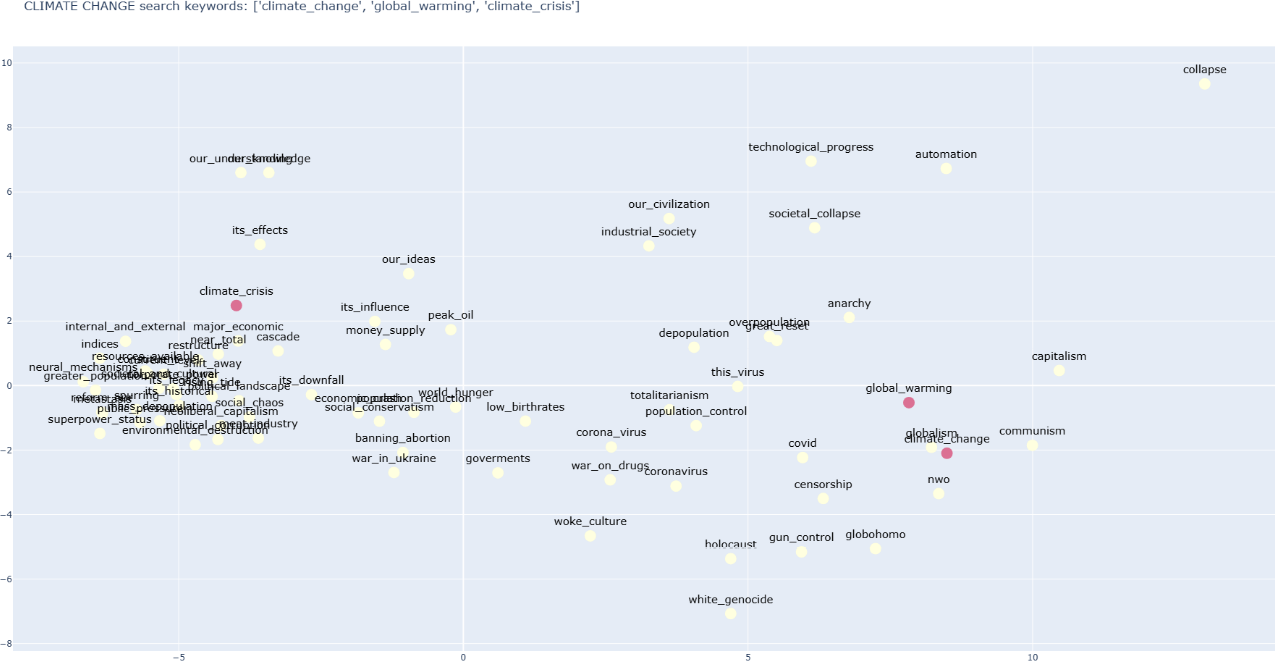
In the closest proximity to the keywords global warming and climate change (Figure 1, Appendix 4 §4) are words ‘globalism’ and ‘nwo’, which stands for new world order, a conspiracy theory ‘that a secretive power elite with a globalist agenda is conspiring to eventually rule the world through an authoritarian one-world government—which will replace sovereign nation-states’ (Wikipedia contributors, 2025c). Globalism is often used by far-right movements to refer to Jewish people, and is used interchangeably with the New World Order and Deep State conspiracies (Wikipedia contributors, 2025a). In close proximity to these conspiracy theories are words describing social systems like ‘capitalism’, ‘anarchy’ and ‘communism’, suggesting that the conspiracy theory of globalist new world order is discussed with the same seriousness as real social systems. Further away, we see words and bigrams like ‘globohomo’, ‘gun control’, ‘holocaust’, ‘white genocide’ and ‘woke culture’. White genocide is a white nationalist conspiracy theory, claiming there is a deliberate plot (often blamed on Jewish people) to cause the extinction of white people (Wikipedia contributors, 2025d). Globohomo is a ‘supposed promotion of homosexuality, neoliberal economics, and progressive values coupled with the paternalistic curtailment of freedoms by corporate and political interests’ (Wiktionary 2024). The conspiracy theories of ‘globohomo’ and ‘white genocide’ are connected through their antisemitism and homophobia. Jewish people have been stigmatised as sexually deviant and disobeying patriarchal gender norms for centuries. Today, we see many of these antisemitic tropes tightly connected to anti-lgbt protests (Center on Extremism, 2023).
From these words we can discern that climate change is connected to so-called ‘woke culture’ (in the map close to ‘war on drugs’, ‘coronavirus’, ‘holocaust’ and ‘white genocide’) and its ideas of social injustice. Woke, as a derogatory term for social justice activism and ideas, began to be used in 2010 and is often employed to deny any claims of racial, misogynist or homophobic injustice (Wikipedia contributors, 2025e). From the proximity of these words and their meaning, we can understand that climate change is seen in this discourse as a plot by the evil political elites, who are trying to eradicate white people through the promotion of homosexuality. This is in line with what Forchtner found in his systematic review of climate change and the far-right research. He writes: “climate change might be doubted and climate-change policies rejected because activities combating climate change are linked to “cosmopolitanism”, “globalism,” a “liberal world government” and a loss of [national] sovereignty—all themes strongly opposed by the far right” (Forchtner, 2019, p. 5).
On the other hand, in the close proximity to the keyword ‘climate crisis’ (Figure 2, Appendix 4 §4), we find terms like ‘our knowledge’, ‘its effects’, ‘major economic’, but perhaps more importantly ‘neoliberal capitalism’, ‘meat industry’, ‘environmental destruction’, ‘political corruption’, and ‘corporate power’. This suggests discourse that actually resembles the scientific consensus (United Nations 2025a, 2025b, 2025c, 2025d), as well as discourse used by climate change activists (Chen et al. 2023). This stark contrast in the language used implies that the forum contains both people who believe in the science of climate change and people who deny it, as can be said about far-right politics in general (Hartman, 2024). Interestingly though, these people use vastly different vocabularies when talking about this issue, which is perhaps symptomatic of the broader societal discussions – two camps with largely different vocabularies and contexts of discussion, that end up disconnected from each other when the discourse is quantified, likely because they don’t necessarily talk to each other even though they are in the same forum.
5.2 The topic of severe weather events
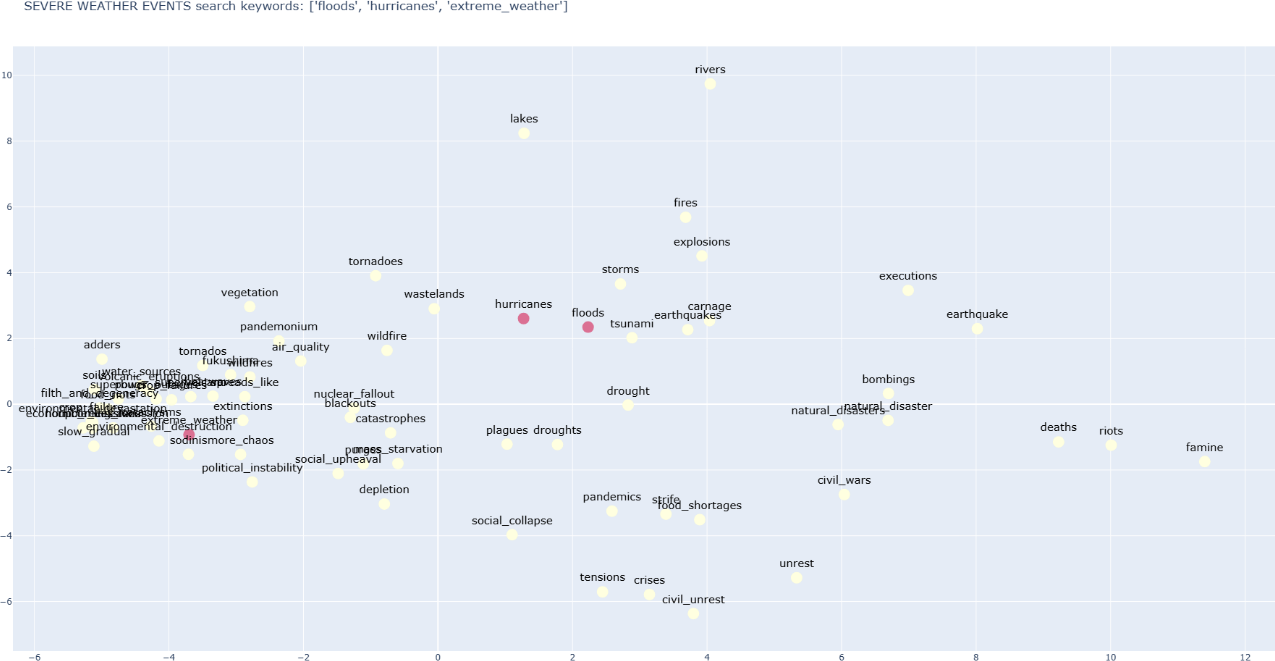
Another topic of inquiry is severe weather events, which is perhaps the most directly observable impact of climate change. The discourse surrounding severe weather events is displayed in Figure 2 and was captured using three keywords – ‘extreme weather’, ‘hurricanes’ and ‘floods’. The last two are positioned very closely together in the discourse map (Figure 3, Appendix 4 §4) and surrounded by words like ‘tsunami’, ‘drought’, storms’, ‘earthquakes’, ‘plagues’. Further away we see ‘social collapse’, ‘civil wars’, ‘bombings’, ‘catastrophes’, ‘nuclear fallout’, ‘wildfire’, etc. This suggests that these two examples of common severe weather events are associated more broadly with other ‘natural disasters’, and it shows that incels perceive the potential of these events to cause ‘social collapse’.
The bigram keyword ‘extreme weather’ (Figure 4, Appendix 4 §4) stands further away from the other two keywords and is tightly knit with the discourse that surrounds it. Zooming in on the discourse reveals words like ‘supervolcano’ and ‘volcanic eruptions’, which suggests that incels perhaps justify the presence of extreme weather by volcanic activity – an argument often iterated by climate science denialists (Ramos et al., 2024). The rest of the words revealed in the contextual synonyms map suggest a certain analytical discussion of impacts of extreme weather events. We find words like ‘cataclysm’, ‘environmental destruction’, ‘water sources’, ‘power outages’, ‘superbugs’, ‘food riots’, ‘crop failures’ and ‘environmental devastation’. On the other hand, the closest word to the ‘extreme weather’ keyword is ‘sodinis’, which is the name of a mass killer motivated by extreme misogyny (Kimmel 2013). This discourse map suggests a wide variety of perspectives on the topic ranging from serious discussions of the societal impact of severe weather events to reiterating climate denialism, and even tying ‘extreme weather’ to misogynist mass murder.
5.3 The topic of transition: environmentally friendly dimension
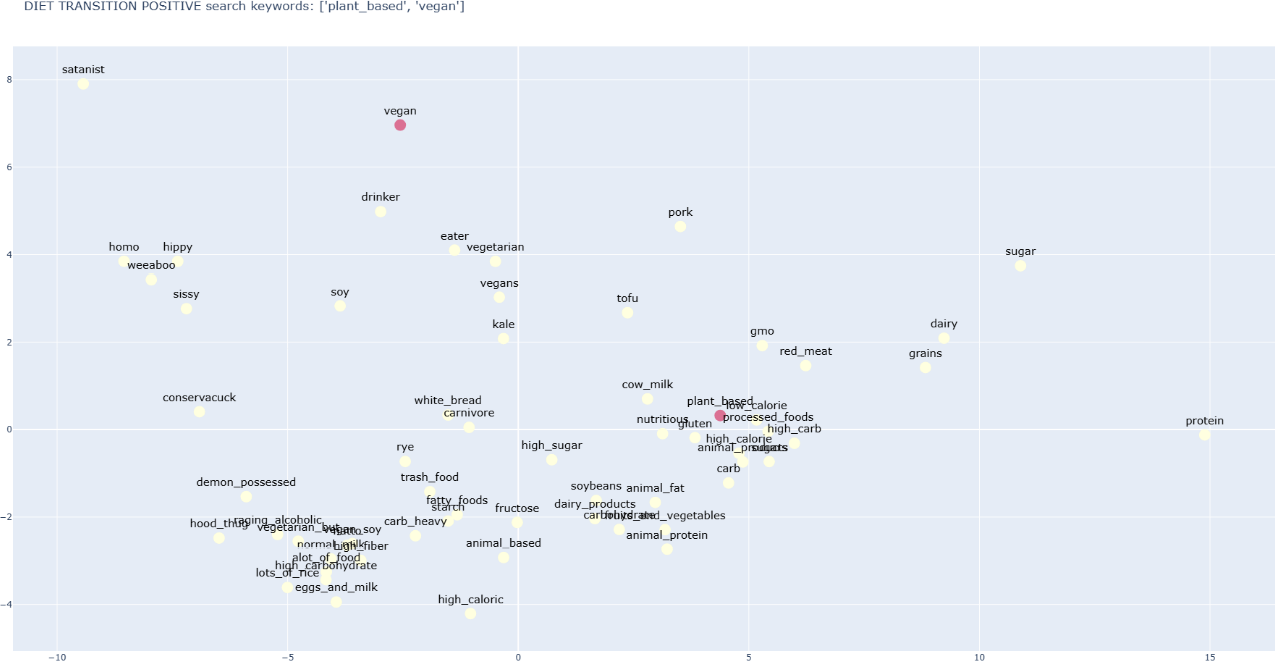
The next two topics subjected to analysis in this paper are diet transition and energy transition. Both of these topics are divided into environmentally friendly vs environmentally destructive dimensions. Firstly, looking into the environmentally friendly diet transition discourse map, displayed in Figure 3, we see that the keywords ‘vegan’ and ‘plant based’ are relatively distant from each other, even though they are describing the same thing.
We see that the keyword ‘plant based’ is surrounded by relatively technocratic discourse about diet. We see words like ‘low calorie’, ‘high calorie’, ‘high carb’, ‘animal products’, ‘gluten’, ‘processed foods’, etc. On the other hand, the keyword ‘vegan’ has brought into the discourse map a rather different set of words. In Figure 5 (Appendix 4 §4) we find ‘satanist’, ‘hippy’, ‘homo’, ‘weeaboo’, ‘sissy’, ‘conservacuck’ and ‘demon possessed’. These are derogatory terms often used in far-right online spaces as insults, and suggest not only that ‘vegan’ is viewed as a similar insult to ‘homo’, ‘sissy’, ‘weeaboo’ and ‘conservacuck’, but also ties Satanic ritual abuse (moral panic conspiracy theory about satanic cults ritually abusing children) with homosexuality and vegan diets (Wikipedia contributors, 2025b). These two camps of discourse again suggest something similar to the climate change discourse map, that is, an existence of two completely different and separate discourses – one very technocratic, the other intensely political and conspiracy-driven.
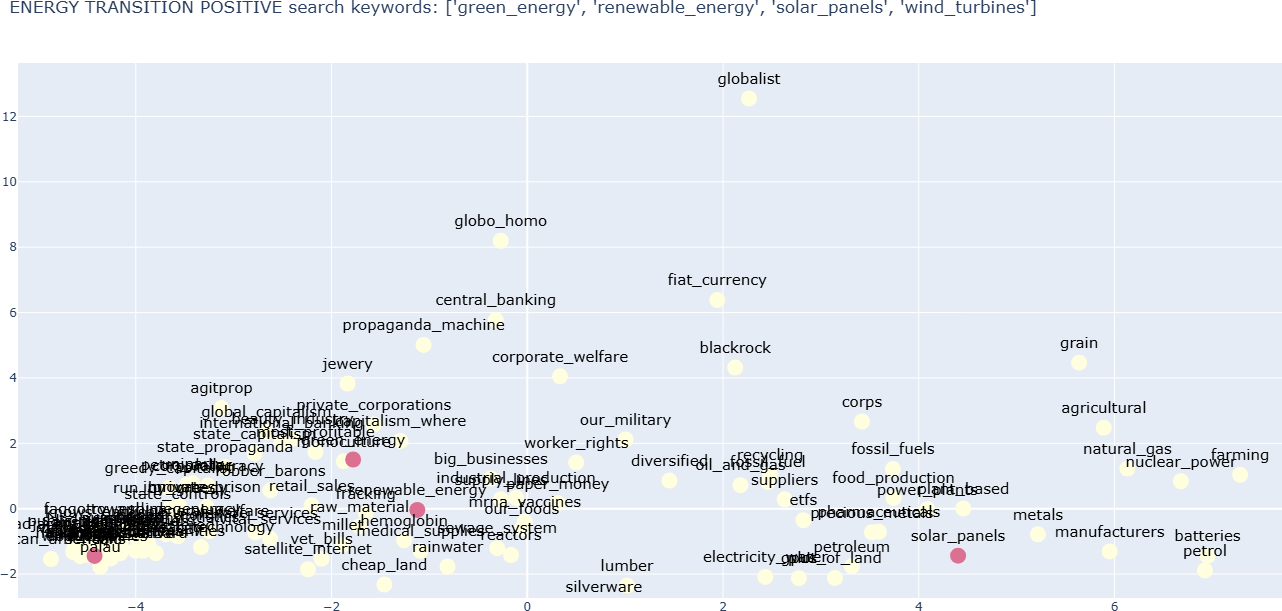
In the environmentally friendly discourse map of energy transition, displayed in Figure 4, we find these keywords: ‘green energy’, ‘renewable energy’, ‘solar panels’ and ‘wind turbines’. We see that discourse in this map is again relatively varied. We see ‘power plants’, ‘recycling’, ‘metals’, ‘batteries’ and similar technocratic terms, but also find association with far-right conspiracy theories with words like ‘globalist’, ‘globo homo’, ‘propaganda machine’, ‘jewery’, and ‘agitprop’, entering the map. Further, we see discourse suggesting disenchantment with neoliberal capitalism through words like ‘run by greedy’, ‘state control’, ‘greedy capitalists’, ‘corporatocracy’, and ‘petro dollar’.
Interestingly, with the keyword wind turbines (Figure 6, Appendix 4 §4), we arrive at a rather dense cluster of derogatory discourse about Aboriginal people and communities. Overwhelmingly, we see words like ‘srilanka’, ‘mexican americans’, ‘uoguelph’ (University of Guelph), ‘suomi’ (indigenous people of Findland), ‘vanuatu’, ‘palau’ (countries in Oceania), ‘Vojvodina’ (region in Serbia), ‘svalbard’ (islands in the north of Norway), ‘mauritania’, ‘osterreich’ (Austria in German), ‘hani’ (region in Turkey), ‘qld’ (country in Australia) and ‘australasia’. This suggests rather in-depth discussion of wind turbine deployments across the world. For example, in Vojvodina, Serbia, a largest wind farm in the country was recently built (NOVA.news 2023) and University of Guelph opened first wind powered building in 2005 (Renewable Enery World 2005). Forchtner (2019, p. 4) writes that wind turbines are often attacked in far-right discourse as a response to climate change. From the discourse map, the discussion seems rather technocratic; however, a slight tint of far-right ideology is suggested by the words ‘faggotry and degeneracy’ and ‘state control’ present in the cluster.
5.4 The topic of transition: environmentally destructive dimension
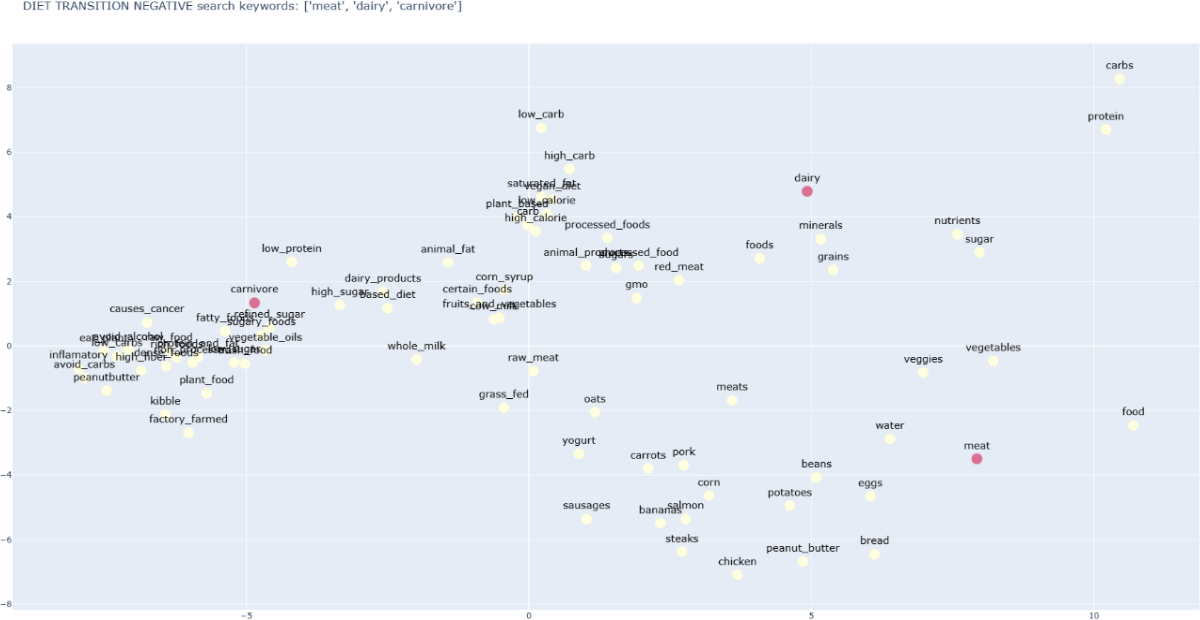
Looking at the discourse map of environmentally destructive diet transition, displayed in Figure 5, with keywords ‘meat’, ‘dairy’ and ‘carnivore’, we see very similar results as with the ‘plant based’ keyword in the environmentally friendly diet transition discourse map (Figure 3). In fact, ‘plant based’ is present in the discourse map along with other words that are discussing diet-related issues. Nowhere in the map is any term that suggests a political dimension of discussion of these issues. This shows that diets that include meat are viewed as neutral, non-controversial dietary choices among many other dietary options, and are discussed in a depoliticized way (unlike vegan diets, which are, according to the discourse in Figure 8, homosexual and satanist).
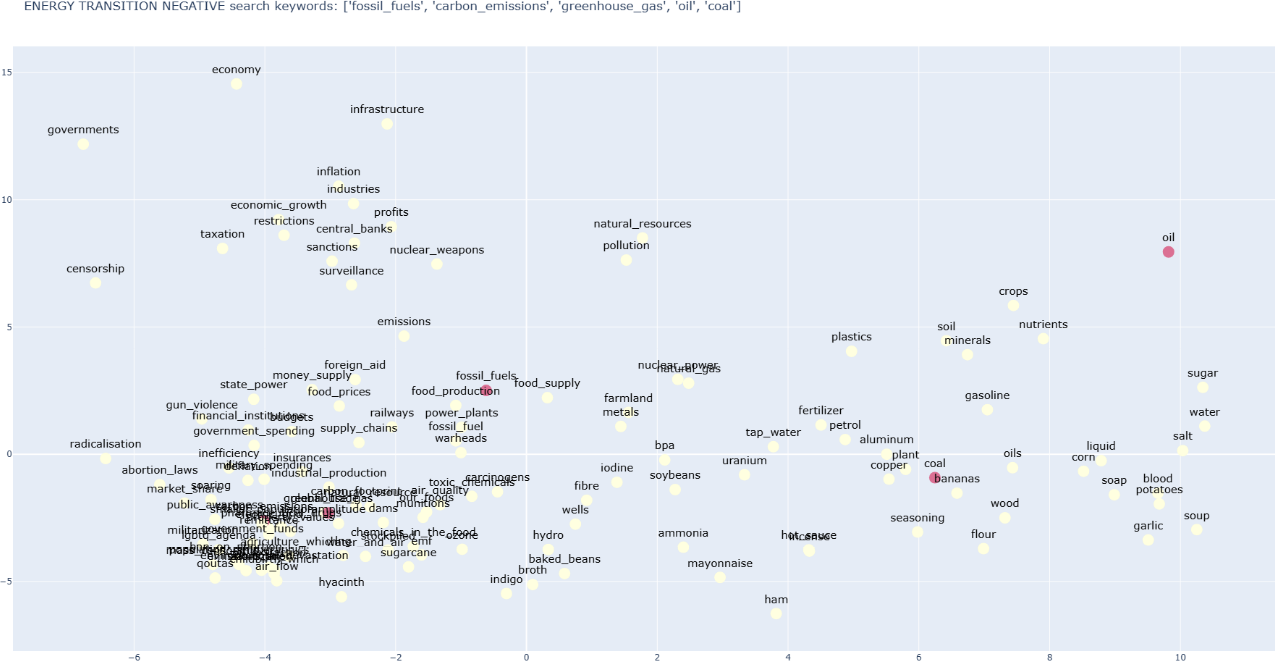
Lastly, we look at the environmentally destructive dimension of energy transition discourse map displayed in Figure 6. The keywords are: ‘fossil fuels’, ‘carbon emissions’, ‘greenhouse gas’, ‘oil’ and ‘coal’. With keywords ‘oil’ and ‘coal’, we find technocratic discourse once again. Words like ‘petro’, ‘fertilizer’, ‘tap water’, ‘gasoline’, ‘soap’, ‘water’, ‘sugar’ don’t suggest any political dimensions of the most frequent context of these keywords.
Zooming in on the keywords ‘fossil fuels’, ‘greenhouse gas’ and ‘carbon emissions’ in Figure 7, Appendix 4 §4, which are positioned closest together in the discourse map, we find a mix of words carrying technocratic and negative meaning. Among technocratic words, we find ‘emissions’, ‘food production’, ‘power plants’ or ‘railways’. Among negative words, we find ‘surveillance’, ‘nuclear weapons’ or ‘censorship’. Close to ‘fossil fuels’, we also find discourse about the impact of their use with words like ‘carcinogens’, ‘toxic chemicals’, ‘air quality’, ‘water and air’ and ‘carbon footprint’. This discourse can be found between the keywords ‘fossil fuels’ and ‘greenhouse gas’. The closest contextual word to greenhouse gas is the word ‘global trade’, which suggests a discursive connection between climate change and the capitalist economy. In a close contextual cluster around the keyword ‘carbon emissions’ we find ‘smaller population’, ‘electric grid’, ‘remittance’, pharmaceutical drugs’ and ‘property values’. Further away but still in proximity, we find words like ‘mass censorship’, ‘lgbtq agenda’, ‘quotas’, ‘militarization’, ‘environmental destruction’ and ‘ban on abortions’, which suggest that ‘carbon emissions’ are connected to some conspiracy thinking. Incels often engage with scientific knowledge, and participate in a selective (re)interpretation of it to justify their worldviews (Cannito and Ferrero Camoletto, 2022; Daly and Reed, 2022; Johansson Wilen et al., 2024). Energy scholars have become increasingly sceptical of the concept of “energy transition,” arguing that its widespread use among engineers, economists, policymakers, and the general public places disproportionate emphasis on fuel substitution and relies on overly technocratic models of change (Daggett, 2021, p. 644). This scientific criticism of energy transition could have served as a basis for the connection incels draw between carbon emissions, global capitalism, and far-right conspiracy theories. The fact that it is now relatively well known that the concept of carbon footprint (very close to greenhouse gas in the map) has been invented by fossil fuel publicists to shift the responsibility for climate change from petro-companies to individuals is likely only supporting this shift to conspiracy thinking.
6. Conclusion
This paper has argued that misogyny and climate change denial within far-right movements are not separate or incidental phenomena, but interrelated expressions of a broader project to preserve racialized, patriarchal power (white supremacy). Drawing on scholarship on far-right ideology, coloniality, and political ecology, it demonstrated how rigid gender binaries, opposition to feminism and LGBTQ+ rights, and hostility toward climate science are rooted in a shared commitment to maintaining the structural dominance of whiteness and heteronormative masculinity. Climate denialism functions as an identity-protective strategy that defends fossil-fuel–based social orders historically tied to authoritarianism, racial hierarchy, and the exploitation of both labor and land. By situating climate change denial within longer histories of colonialism, capitalist extraction, and gendered domination, it underscores that far-right resistance to climate action is best understood as part of a wider backlash against egalitarian social transformation. This paper conducted quantitatively assisted discourse analysis in the incels.is forum – a manosphere forum which lies at the intersection of misogynist extremism and white supremacy and is part of the wider ecosystem of far-right online subcultures. The analysis focused on four overarching climate change-related topics – climate change, severe weather events, diet transition, and energy transition.
The discourse analysis reveals that environmental topics within the incels.is forum are deeply polarized and fragmented, with climate change, severe weather events, energy transition, and diet transition articulated through sharply divergent discursive frames. Climate change emerges as a particularly contested issue, split between a denialist discourse rooted in far-right conspiracy theories - linking global warming to “globalism,” “woke culture,” and antisemitic and homophobic narratives - and a smaller, distinct discourse aligned with scientific consensus and climate justice critiques of neoliberal capitalism. A similar two-camp tendency is present in discussions of severe weather events, which range from analytical engagement with societal impacts to climate denialist explanations and even misogynist violence. Diet and energy transitions further illustrate how environmental mitigation is selectively politicized: vegan diets are heavily stigmatized through misogynistic, homophobic, and conspiratorial language, while meat consumption remains depoliticized; renewable energy is discussed through a mix of technocratic detail, capitalist critique, and far-right ideology, whereas fossil fuels are largely normalized through neutral or instrumental framings.
All of the discourse maps reveal large variance in the tone in which these topics are discussed. Across topics, technocratic and knowledgeable engagement with scientific or policy issues frequently coexists with, and lends legitimacy to, conspiratorial interpretations. These findings suggest that incel environmental discourse does not simply reject climate knowledge but selectively reinterprets it in ways that reinforce far-right worldviews, demonstrating how environmental issues can function as sites where scientific information, misogyny, and extremist ideology become mutually entangled.
Funding
This project has received funding from the European Union’s Horizon Research and Innovation Action program under Grant Agreement no. 101132327. Views and opinions expressed are however those of the author(s) only and do not necessarily reflect those of the European Union. Neither the European Union nor the granting authority can be held responsible for them.
References
Anshelm, J., & Hultman, M. (2014). A green fatwā? Climate change as a threat to the masculinity of industrial modernity. NORMA, 9(2), 84–96. https://doi.org/10.1080/18902138.2014.908627
Badinter, E. (1997). X Y, On masculine identity. Columbia University Press.
Butler, J. (2011). Bodies that matter: On the discursive limits of sex. Taylor & Francis.
Butler, J. (2020). Gender, whose Fantasy.
Byrne, G. (2020). Climate change denial as far-right politics: How abandonment of scientific method paved the way for Trump. Journal of Human Rights and the Environment, 11(1), 30–60. https://doi.org/10.4337/jhre.2020.01.02
Caliskan, A., Bryson, J. J., & Narayanan, A. (2017). Semantics derived automatically from language corpora contain human-like biases. Science, 356(6334), 183–186. https://doi.org/10.1126/science.aal4230
Cannito, M., & Ferrero Camoletto, R. (2022). The Rules of Attraction: An Empirical Critique of Pseudoscientific Theories about Sex in the Manosphere. Sexes, 3(4), 593–607. https://doi.org/10.3390/sexes3040043
Caramanica, J. (2024, November 14). Where to Find the Avuncular Donald Trump? Check the Manosphere. The New York Times. https://www.nytimes.com/2024/11/14/arts/donald-trump-podcasts-men.html
Center on Extremism. (2023). Antisemitism & Anti-LGBTQ+ Hate Converge in Extremist and Conspiratorial Beliefs | ADL. Anti-Defamation League. https://www.adl.org/resources/article/antisemitism-anti-lgbtq-hate-converge-extremist-and-conspiratorial-beliefs
Chakrabarty, D. (2009). The Climate of History: Four Theses. Critical Inquiry, 35(2), 197–222. https://doi.org/10.1086/596640
Chen, K., Molder, A. L., Duan, Z., Boulianne, S., Eckart, C., Mallari, P., & Yang, D. (2023). How Climate Movement Actors and News Media Frame Climate Change and Strike: Evidence from Analyzing Twitter and News Media Discourse from 2018 to 2021. The International Journal of Press/Politics, 28(2), 384–413. https://doi.org/10.1177/19401612221106405
Christensen, A.-D., & Jensen, S. Q. (2014). Combining hegemonic masculinity and intersectionality. NORMA, 9(1), 60–75. https://doi.org/10.1080/18902138.2014.892289
Clary, F. (2015). Dismantling Southern Codes of Black Masculinity: The Black Male’s Demystified Image in Hal Bennett’s Lord of Dark Places (1970). Babel, 31, 75–101. https://doi.org/10.4000/babel.4072
Collins, P. H. (2019). Intersectionality as Critical Social Theory. Duke University Press. https://doi.org/10.1215/9781478007098
Connell, R. W. (2002). Globalization, Imperialism and Masculinities. In M. Kimmel, J. Hearn, & R. W. Connell (Eds), Handbook of Studies on Men & Masculinities (pp. 71–89). SAGE Publications, Inc. https://doi.org/10.4135/9781452233833
Coufal, L., Saresma, T., & Kosonen, H. (2025). Fight with words: Misogynist extremism on an incel discussion forum. NORMA, 1–19. https://doi.org/10.1080/18902138.2025.2513103
Coufal, L., & Wedel, L. (2025). Radicalization within a network of misogynist extremists: A case study of an incel forum. Humanities and Social Sciences Communications, 12(1), 852. https://doi.org/10.1057/s41599-025-05161-8
Crenshaw, K. (1991). Mapping the Margins: Intersectionality, Identity Politics, and Violence against Women of Color. Stanford Law Review, 43(6), 1241. https://doi.org/10.2307/1229039
Daggett, C. (2018). Petro-masculinity: Fossil Fuels and Authoritarian Desire. Millennium, 47(1), 25–44. https://doi.org/10.1177/0305829818775817
Daggett, C. (2021). Energy and domination: Contesting the fossil myth of fuel expansion. Environmental Politics, 30(4), 644–662. https://doi.org/10.1080/09644016.2020.1807204
Daly, S. E., & Reed, S. M. (2022). “I Think Most of Society Hates Us”: A Qualitative Thematic Analysis of Interviews with Incels. Sex Roles, 86(1–2), 14–33. https://doi.org/10.1007/s11199-021-01250-5
Dewan, S., & Harmon, A. (2025, January 24). Trump Bars Transgender Women From U.S. Prisons for Female Inmates. The New York Times. https://www.nytimes.com/2025/01/23/us/trump-transgender-inmates-prison.html
DiBranco, A. (2022). Mobilizing Misogyny. In E. K. Carian, A. DiBranco, & C. Ebin (Eds), Male Supremacism in the United States: From Patriarchal Traditionalism to Misogynist Incels and the Alt-Right (1st edn, pp. 3–20). Routledge. https://doi.org/10.4324/9781003164722
Dietze, G., & Roth, J. (2020a). Right-wing populism and gender: A preliminary cartography of an emergent field of research. Right-Wing Populism and Gender: European Perspectives and Beyond, 7–22.
Dietze, G., & Roth, J. (2020b). Right-Wing Populism and Gender: A Preliminary Cartography of an Emergent Field of Research. In G. Dietze & J. Roth (Eds), Gender Studies (1st edn, pp. 7–22). transcript Verlag. https://doi.org/10.14361/9783839449806-001
Fangen, K., & Skjelsbæk, I. (2020). Editorial: Special issue on gender and the far right. Politics, Religion & Ideology, 21(4), 411–415. https://doi.org/10.1080/21567689.2020.1851866
Ferber, A. L. (2007). The Construction of Black Masculinity: White Supremacy Now and Then. Journal of Sport and Social Issues, 31(1), 11–24. https://doi.org/10.1177/0193723506296829
Firth, J. R., & Palmer, F. R. (1968). Selected Papers of J. R. Firth, 1952-59. Indiana University Press. https://books.google.cz/books?id=gaAbAQAAIAAJ
Forchtner, B. (2019). Climate change and the far right. WIREs Climate Change, 10(5), e604. https://doi.org/10.1002/wcc.604
Friedman, L. (2025, January 21). 3 of the Most Important Trump Executive Orders on Climate. The New York Times. https://www.nytimes.com/2025/01/21/climate/trump-climate-change-executive-orders.html
Garg, N., Schiebinger, L., Jurafsky, D., & Zou, J. (2018). Word embeddings quantify 100 years of gender and ethnic stereotypes. Proceedings of the National Academy of Sciences, 115(16), E3635–E3644. https://doi.org/10.1073/pnas.1720347115
Gill, R. (1996). Discourse analysis: Practical implementation. In Handbook of qualitative research methods for psychology and the social sciences (pp. 141–159). BPS Books Leicester.
Gonen, H., & Goldberg, Y. (2019). Lipstick on a Pig: Debiasing Methods Cover up Systematic Gender Biases in Word Embeddings But do not Remove Them. CoRR, abs/1903.03862. http://arxiv.org/abs/1903.03862
Hartman, M. R. (2024). Beyond Climate Denial: White Supremacy and the Growth of Nationalist Environmentalism on the Right. Journal for the Study of Religion, Nature and Culture, 18(3), 376–392. https://doi.org/10.1558/jsrnc.23634
Heinemann, I., & Stern, A. M. (2022). Gender and Far-right Nationalism: Historical and International Dimensions. Introduction. Journal of Modern European History, 20(3), 311–321. https://doi.org/10.1177/16118944221110721
Horta Ribeiro, M., Blackburn, J., Bradlyn, B., De Cristofaro, E., Stringhini, G., Long, S., Greenberg, S., & Zannettou, S. (2021). The Evolution of the Manosphere across the Web. Proceedings of the International AAAI Conference on Web and Social Media, 15(1), 196–207. https://doi.org/10.1609/icwsm.v15i1.18053
Hultman, M. (2013). The Making of an Environmental Hero: A History of Ecomodern Masculinity, Fuel Cells and Arnold Schwarzenegger. Environmental Humanities, 2(1), 79–99. https://doi.org/10.1215/22011919-3610360
Johansson Wilén, E., Wemrell, M., & Gunnarsson, L. (2024). Gender knowledge production and epistemology in the incelosphere. Journal of Gender Studies, 1–11. https://doi.org/10.1080/09589236.2024.2427192
Jylhä, K. M., Strimling, P., & Rydgren, J. (2020). Climate Change Denial among Radical Right-Wing Supporters. Sustainability, 12(23), 10226. https://doi.org/10.3390/su122310226
Kaiser, S. (2022). Political Masculinity: How Incels, Fundamentalists and Authoritarians Mobilise for Patriarchy (V. A. Pakis, Trans.). Polity Press. https://books.google.cz/books?id=42VsEAAAQBAJ
Kimmel, M. S. (2013). A Glance Back: A Brief History of American Angry White Men. In Angry white men: American masculinity at the end of an era (pp. 46–53). Nation Books.
Klein, N. (2014). This Changes Everything: Capitalism Vs. The Climate. Simon and Schuster.
Kováts, E. (2017). The Emergence of Powerful Anti-Gender Movements in Europe and the Crisis of Liberal Democracy. In M. Köttig, R. Bitzan, & A. Petö (Eds), Gender and Far Right Politics in Europe (pp. 175–189). Springer International Publishing. https://doi.org/10.1007/978-3-319-43533-6_12
Lockwood, M. (2018). Right-wing populism and the climate change agenda: Exploring the linkages. Environmental Politics, 27(4), 712–732. https://doi.org/10.1080/09644016.2018.1458411
Lugones, M. (2007). Heterosexualism and the Colonial / Modern Gender System. Hypatia, 22(1), 186–209. JSTOR.
Manne, K. (2017). Down Girl: The Logic of Misogyny. Oxford University Press. https://books.google.cz/books?id=Mpc4DwAAQBAJ
Marwick, A. E., & Caplan, R. (2018). Drinking male tears: Language, the manosphere, and networked harassment. Feminist Media Studies, 18(4), 543–559. https://doi.org/10.1080/14680777.2018.1450568
Mikolov, T., Chen, K., Corrado, G., & Dean, J. (2013, January 16). Efficient Estimation of Word Representations in Vector Space. International Conference on Learning Representations. https://www.semanticscholar.org/paper/Efficient-Estimation-of-Word-Representations-in-Mikolov-Chen/f6b51c8753a871dc94ff32152c00c01e94f90f09
Morin, E., & Kern, A. B. (1996). Terre-patrie. Ed. du Seuil.
Mudde, C. (2007). Populist Radical Right Parties in Europe (1st edn). Cambridge University Press. https://doi.org/10.1017/CBO9780511492037
Mudde, C. (2019). The Far Right Today. Polity Press.
NOVA.news. (2023). Serbia: The largest wind farm in the country will be built in Vojvodina. https://www.agenzianova.com/en/news/serbia-in-vojvodina-sorgera-il-parco-eolico-piu-grande-del-paese/
O’Hanlon, R., Altice, F. L., Lee, R. K.-W., LaViolette, J., Mark, G., Papakyriakopoulos, O., Saha, K., De Choudhury, M., & Kumar, N. (2024). Misogynistic Extremism: A Scoping Review. Trauma, Violence, & Abuse, 25(2), 1219–1234. https://doi.org/10.1177/15248380231176062
Oyěwùmí, O. (1997). The Invention of Women: Making an African Sense of Western Gender Discourses. University of Minnesota Press. https://books.google.cz/books?id=G6bobv2boIYC
Pennington, J., Socher, R., & Manning, C. (2014). GloVe: Global Vectors for Word Representation. Proceedings of the 2014 Conference on Empirical Methods in Natural Language Processing (EMNLP), 1532–1543. https://doi.org/10.3115/v1/D14-1162
Perliger, A., Stevens, C., & Leidig, E. (2022). Mapping the ideological landscape of extreme misogyny. International Centre for Counter-Terrorism. https://read-me.org/s/mapping-ideological.pdf
Ramos, R., Rodrigues, M. J., & Rodrigues, I. (2024). Climate Change Denialism: Critical Analysis of Arguments in Confrontation with Climate Science. Climate Literacy in Education, 2(1). https://doi.org/10.24926/cle.v2i1.6150
Renewable Enery World. (2005). University of Guelph’s First Wind-Powered Building. https://www.renewableenergyworld.com/wind-power/university-of-guelphs-first-wind-powered-building-37864/
Stinton, C. (2019). Combining the aberrant with the ordinary: The role of white supremacy in the far-right radicalisation of women. Journal of Applied Psychology and Social Science, 5(1), 86–115.
Sugiura, L. (2021). The Incel Rebellion: The Rise of the Manosphere and the Virtual War Against Women. Emerald Publishing Limited. https://doi.org/10.1108/9781839822544
Tomkinson, S., Harper, T., & Attwell, K. (2020). Confronting Incel: Exploring possible policy responses to misogynistic violent extremism. Australian Journal of Political Science, 55(2), 152–169. https://doi.org/10.1080/10361146.2020.1747393
Wedel, L., & Coufal, L. (2025). Radicalization or relief: Divergent impacts of the COVID-19 lockdown on incels by seniority. New Media & Society, 14614448251336432. https://doi.org/10.1177/14614448251336432
West, C., & Zimmerman, D. H. (1987). Doing Gender. Gender and Society, 1(2), 125–151. JSTOR.
Wikipedia contributors. (2025a). Globalism. https://en.wikipedia.org/w/index.php?title=Globalism&oldid=1268330464
Wikipedia contributors. (2025b). LGBTQ grooming conspiracy theory—Wikipedia, The Free Encyclopedia. https://en.wikipedia.org/w/index.php?title=LGBTQ_grooming_conspiracy_theory&oldid=1327993119
Wikipedia contributors. (2025c). New World Order conspiracy theory. https://en.wikipedia.org/w/index.php?title=New_World_Order_conspiracy_theory&oldid=1270608064
Wikipedia contributors. (2025d). White genocide conspiracy theory. https://en.wikipedia.org/w/index.php?title=White_genocide_conspiracy_theory&oldid=1268520503
Wikipedia contributors. (2025e). Woke. https://en.wikipedia.org/w/index.php?title=Woke&oldid=1270478732
Wiktionary. (2024). Globohomo. https://en.wiktionary.org/w/index.php?title=globohomo&oldid=82658270