https://doi.org/10.36253/smp-16976
An Obstacle to the Sustainability Transformation? How Conspiracy Beliefs Shape Climate (In)action
Department of Sustainable Behavior and Management, University of Hohenheim, Stuttgart, Germany
E-mail: kevin.winter@uni-hohenheim.de
Abstract. Conspiracy theories about climate change and climate policies are deliberately spread, mainly by right-wing actors. Such narratives can limit societies’ ability to address climate change. But what exactly are the consequences of believing in climate-related conspiracy theories and who is susceptible to believe them? Political ideology is known to shape citizens’ views on climate-related topics, yet another worldview might be relevant. Recent empirical work suggests that the so-called conspiracist worldview (i.e., the assumption that societal events are the result of secret plots by malevolent and powerful groups) can be a strong determinant of climate-related conspiracy beliefs and behavior. The current article reviews this work and provides a theoretical framework for studying the link between conspiracy beliefs and climate-related behavior. In many cases, the conspiracist worldview appears to be more influential than political ideology in predicting climate-related beliefs and behavior. At the same time, the current review doubts that conspiracy beliefs per se are an obstacle to sustainability. Disentangling effects of different worldviews and differentiating between types of conspiracy beliefs can provide a more nuanced view. This approach could inform the design of future studies and help address the challenges that misinformation and conspiracy theories pose for communicators and institutions who aim to bring about the sustainability transformation.
Keywords: conspiracist worldview, conspiracy beliefs, climate-friendly behavior, political ideology, misinformation.
Contents
1.1 How worldviews shape appraisals of climate change and climate-related behaviors
1.2 Extending the scope: Conspiracist worldview as another dimension of political attitudes
2. Conspiracy beliefs as an obstacle to the sustainability transformation?
2.1 Conspiracist worldview and climate change denial
2.2 Conspiracist worldview and climate policy conspiracy beliefs
2.3 Conspiracy beliefs and private-sphere climate-friendly behaviors
2.4 Conspiracy beliefs and climate policy support
2.5 Conspiracy beliefs and climate activism
3. Evaluation of the empirical evidence and critical remarks
1. Introduction
Human-made climate change poses a significant threat to human existence on Earth, including negative impacts on physical and mental health, water and food supply as well as damages to infrastructure (IPCC 2023). Despite an overwhelming scientific consensus about human-made climate change (Cook et al. 2016; Myers et al. 2021), it remains a contentious topic in the public and political debate. Survey data and social media analyses point to growing ideological polarization about climate change and climate solutions (Bayes & Druckman 2021; Falkenberg et al. 2022). While this trend might be more pronounced in certain contexts (e.g., US politics), it has been noted that right-wing political actors across the globe fuel this polarization by spreading climate contrarian claims (Falkenberg et al. 2022; Lewandowsky 2021). Such organized disinformation campaigns shape public opinions about climate change (Chater & Loewenstein 2023; Oreskes & Conway 2010). According to a YouGov survey conducted in 2020, the statement that “the idea of man-made global warming is a hoax that was invented to deceive people” was rated as “probably true” or “definitely true” by, for instance, 27% of respondents in the US, 16% in Germany, and 14% in Italy (Ibbetson 2021). Yet, a shift has been observed recently in that these contrarian claims increasingly target climate solutions rather than climate change as such (Coan et al. 2021) – a development that scholars have coined “new denial” (Nicolosi et al. 2025). Understanding when and why people adopt such claims and refrain from acting in climate-friendly ways is important to identify and overcome potential barriers to sustainability.
Research has so far largely focused on right-wing political ideology as core psychological determinant of climate change denial and opposition to climate policy. The current article sheds light on another ideology that has yet received (too) little scholarly attention in the context of the sustainability transformation: the conspiracist worldview. People who endorse this worldview “believe that it is commonplace for networks of people with malevolent intentions to exact elaborate hoaxes on the public and to do so in near-perfect secrecy” (Hornsey 2020: 586). The current article reviews the emerging body of empirical work on the relationships between conspiracist worldview, belief in conspiracy theories and misinformation, and climate-related behaviors. Thereby, it aims to improve our understanding of the relative importance of conspiracist worldview and political ideology in the climate domain and to provide a more nuanced view on whether conspiracy beliefs actually pose an obstacle to sustainability.
1.1 How worldviews shape appraisals of climate change and climate-related behaviors
When speaking of worldviews in the current article, I refer to “people’s broad, cognitive orientations towards the world” (Hornsey 2021: 36). The term worldview is sometimes used interchangeably with the term ideology, which becomes apparent in definitions of ideology as “a system of beliefs and values that represent one’s worldview” (van Bavel & Pereira 2018: 214). This terminological ambiguity notwithstanding (for a more detailed discussion on the worldview concept, see Koltko-Rivera 2004), choosing the term worldview seems adequate for the current purpose, because it allows to capture and compare a broad array of general beliefs in the ecological and socio-political sphere. Given that worldviews determine how we navigate through the (social) world, it seems reasonable to assume that they provide a basis for how people appraise climate change and act in response to it.
In environmental psychology, there is considerable theorizing and empirical work on the so-called ecological worldview, which comprises the general belief that human activity is potentially harmful to the natural environment (Dunlap et al. 2000; Stern 2000). At the core of political psychology is the examination of the structure, antecedents and consequences of political worldviews (or ideologies), which are classically conceived as a unidimensional construct ranging from left (or liberal/progressive) to right (or conservative), but more fine-grained approaches focusing on different aspects or types of political ideologies also exist (Jost et al. 2009). More recently, yet another worldview has attracted the attention of psychologists, focusing on the role of powerful actors in secretly determining the fate of the world. This worldview has been called conspiracist worldview (Hornsey 2020), conspiracist ideation (Lewandowsky, Gignac & Oberauer 2013) or conspiracy mentality (Imhoff & Bruder 2014). These worldviews find expression in people’s more specific beliefs and behaviors, for instance, in the climate domain.
The ecological worldview is a core component of one of the most prominent psychological theories that aim to explain when and why people engage in pro-environmental (including climate-friendly) behavior – the value-belief-norm theory (Stern 2000; Stern et al. 1999). According to this theory, individuals develop an ecological worldview when they endorse a biospheric value orientation (i.e., “values emphasizing the environment and the biosphere”; de Groot & Steg 2007: 320), which can be distinguished from orientations towards altruistic or egoistic values. People with a more pronounced ecological worldview are more likely to judge the environmental consequences of human behavior as severe and acknowledge that humans have the capacity to reduce these consequences (Stern 2000). The value-belief-norm theory predicts that people act in environmentally-friendly ways out of a sense of moral obligation. In support of this prediction, research has shown that individuals who self-identify as pro-environmental persons feel morally obliged and, hence, act more environmentally-friendly (e.g., intend to use green energy or choose sustainable products; van der Werff et al. 2013). Moreover, people who are generally committed to environmental protection (i.e., they highly value the goal of protecting the environment) are more likely to support environmental policies (Kaiser et al. 2023).
Past research has demonstrated that individuals’ political ideology is an important psychological predictor of how they appraise climate change and climate policies. In a nutshell, those on the political right tend to deny the existence of climate change and human contribution to it to a larger extent than those on the political left. This is supported by a large-scale meta-analysis of roughly 200 empirical studies across 56 nations (Hornsey et al. 2016), in which political affiliation (i.e., self-reported support for a certain political party) and political ideology were more strongly related to climate change denial than demographic variables (e.g., age, gender, income, education). Similar results emerged when looking more specifically at the personal values associated with a right-wing political ideology. People who endorsed the view that businesses should operate freely without government regulation (i.e., free-market ideology), valued independence and self-reliance (i.e., individualistic values) or embraced existing social status structures (i.e., hierarchic values) were more likely to deny climate change. It has been argued that those on the political right are more skeptical of climate change and climate science, because the solutions suggested to fight climate change (e.g., governmental regulations) are in conflict with these personal values (Hornsey 2021; Lewandowsky 2021). Interestingly, ideological factors statistically contributed more to climate change denial than, for instance, (objective and subjective) scientific knowledge or personal experience of extreme whether events (i.e., one of the consequences of climate change; Hornsey et al. 2016). The relationship between right-wing political ideology and climate change denial has been confirmed in subsequent multinational studies (Berkebile-Weinberg et al. 2024; Hornsey et al. 2018). These studies also suggest that denying climate change might be consequential in terms of individuals’ climate-related behaviors. In fact, climate change denial was related to lower support for climate change mitigation policies (e.g., a carbon tax) and lower intentions to engage in climate-friendly behaviors (Hornsey et al. 2016). Moreover, a direct connection between a right-wing political ideology and rejection of climate policy is evident in many studies (Bergquist et al. 2022; Berkebile-Weinberg et al. 2024). This relationship becomes even more pronounced, when individuals’ own political party affiliation is made salient (Unsworth & Fielding 2014). This suggests that social (or specifically political) affiliation is an important motive of engaging in climate policy support or opposition (Ehret et al. 2018; van Boven & Sherman 2021). In sum, those on the political right seem to be more likely to oppose climate policies, because these policies are in conflict with their personal (e.g., individualistic or hierarchic) values and because they rely on the cues provided by their political parties.
1.2 Extending the scope: Conspiracist worldview as another dimension of political attitudes
Drawing on findings from the US, scholars have argued that political ideology (on a left-right dimension) is not the only relevant worldview to explain how citizens look at politics (Uscinski et al. 2021). In fact, they propose an additional (presumably independent) “anti-establishment” dimension that contains populist, conspiracist, and Manichean worldviews. Individuals who score high on this dimension dislike “elites”, favor narratives that distinguish between “us” (i.e., “the good people”) and “them” (i.e., “the evil elites”) and have a strong aversion against the existing political order. Notably, an anti-establishment orientation can be found both on the political left and right (Uscinski et al. 2021). This parallels the theorizing in research on conspiracy beliefs, where a conspiracist worldview has been conceptualized as a generalized political attitude next to traditional (i.e., left-right) political ideologies – one that is characterized by strong prejudice against powerful groups (Imhoff & Bruder 2014). Indeed, large multinational studies on the empirical relationship between conspiracist worldview and political ideology suggest that those at the political extremes (either left or right) are more likely to endorse a conspiracist worldview compared to political moderates (Enders et al. 2023; Imhoff, Zimmer, et al. 2022). This research highlights that conspiracist worldview and political ideology are distinct constructs that might have differential effects in the climate domain.
In the psychological literature, conspiracy theories are usually defined as explanations of important events based on the assumption of secret plans forged by powerful groups to serve their own benefit or to harm the public (Douglas et al. 2017; Sassenberg et al. 2023). Conspiracy belief then is the extent to which one personally thinks that such an explanation is true, for instance that “climate change is a hoax invented to deceive the public”. Inspired by the observation that believing in one conspiracy theory is often related to believing in other (unrelated) conspiracy theories, scholars proposed the concept of a conspiracist worldview. This worldview is thought of as a relatively stable person characteristic that is endorsed to a lesser or stronger degree by different individuals and that shapes how they appraise societal events. Individuals with a more pronounced conspiracist worldview have a stronger tendency to see (any) societal events as the result of secret arrangements by powerful actors with mean intentions and accordingly are more likely to believe in (any) specific conspiracy theory (Imhoff, Bertlich & Frenken 2022). Accordingly, the term conspiracy belief comprises both the general tendency to belief conspiracy theories (i.e., conspiracist worldview) and the belief in specific conspiracy theories (e.g., about climate change). Despite growing interest in the topic (Douglas & Sutton 2015; Tam & Chan 2023; Uscinski et al. 2017; van Prooijen et al. 2025), the psychological literature is only about to understand which role conspiracy beliefs and particularly a conspiracist worldview play in shaping individuals’ appraisals of climate change and climate-related behaviors.
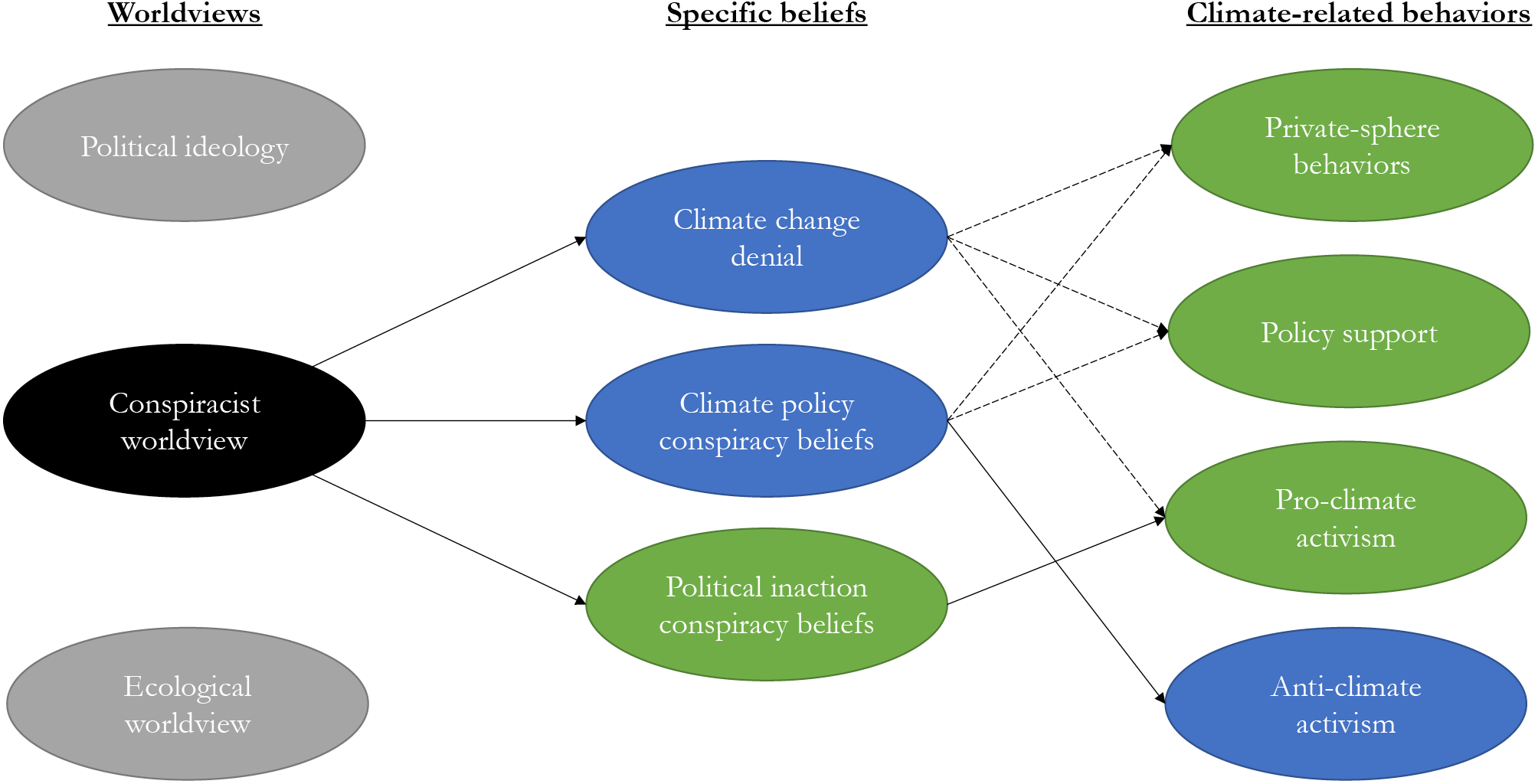
The following section reviews the literature on the relationships between conspiracist worldview, specific (conspiracy) beliefs in the climate domain and climate-related behaviors. Notably, the focus of this review is on climate change rather than environmental issues more broadly. This is mostly due to the lack of empirical studies linking conspiracy belief with environmental topics other than climate change (e.g., biodiversity loss, pollution). Although individuals’ attitudes and behaviors towards climate change and other environmental issues are often highly correlated and reflect the same underlying motivation (Kaiser 2021), it cannot be ruled out that the effects of conspiracy beliefs might vary depending on the specific issue. In line with the psychological literature (Stern 2000; Stern et al. 1999), I use a broad conceptualization of climate-related behavior that includes private-sphere behaviors (e.g., private energy consumption, transportation behavior), public-sphere behaviors (e.g., expressing support for climate policies), and climate activism (e.g., protesting for stricter political regulations). Adding to this conceptualization, the current review treats activism that is directed against the implementation of climate policies as a separate category that has so far not been considered in the broader literature. Going beyond previous reviews, different types of specific conspiracy beliefs are distinguished – including those referring to climate change itself or climate policies, but also belief in conspiracy theories that allege political climate inaction (and are thus “climate-friendly” in nature). According to the conceptual model depicted in Fig. 1, these specific conspiracy beliefs act as a link between the general conspiracist worldview and climate-related behaviors. In the case of available evidence, effects of conspiracist worldview are compared to those of political ideology and other worldviews.
2. Conspiracy beliefs as an obstacle to the sustainability transformation?
Most research has focused on belief in misinformation and conspiracy theories that deny the existence or anthropogenicity of climate change, which is sometimes summarized under the term climate change denial (Biddlestone et al. 2022; Hornsey et al. 2016; Lewandowsky, Gignac & Oberauer 2013; Lewandowsky, Oberauer & Gignac 2013; Tam & Chan 2023). Yet, analyses of online content suggest that conservative think tanks and lobby groups put an increasing effort in spreading misinformation about climate policies and particularly renewable energy (Coan et al. 2021; Nicolosi et al. 2025) and that their narratives become much more sophisticated than outright climate change denial (e.g., by acknowledging climate change as such but justifying a delay in climate action; Lamb et al. 2020). Currently, however, only few empirical studies have investigated different types of climate misinformation or conspiracy theories and their effects (e.g., Spampatti et al. 2024, 2025). It should be noted that psychological research often does not clearly distinguish between misinformation and conspiracy theories, although the two can be conceptually separated. A defining feature of misinformation is the truth value of a statement, but widely accepted definitions are more or less strict in this regard. They range from more lenient definitions such as “publicly available information that is misleading or deceptive relative to the best available scientific evidence […]” (Southwell et al. 2022: 98) to stricter ones such as “information that turns out to be false” (Lewandowsky 2021: 2). Definitions of the term conspiracy theory are usually neutral with regard to the truth value of a statement and refer to them as “explanations for important events” (see above) that might be true or not. Nevertheless, scholars have associated a certain epistemic risk with believing in conspiracy theories as they usually show properties (e.g., large numbers of assumed conspirators) that make them by default less likely to be true (Douglas & Sutton 2023). However, there are cases in which conspiracy theories can be conceived as plausible (Frenken et al. 2024), reflect majority positions (Pummerer et al. 2025) or social realities (such as country-level corruption; Alper & Imhoff, 2023), or even turn out to be true (e.g., in case of Exxon Mobil suppressing information on the climate impact of burning fossil fuels; Supran et al. 2023). One other important distinction is that conspiracy theories by definition refer to secret arrangements of powerful actors behind societal events, while misinformation does not necessarily relate to such arrangements. From a practical viewpoint, it might still be reasonable to look at the two constructs jointly, because (a) in reality (e.g., on social media) both occur and are disseminated side by side, (b) conspiracy theories sometimes contain misinformation and vice versa, and (c) empirical studies show that agreement with misinformation and conspiracy theories on specific topics (e.g., wind energy, electric vehicles) is highly correlated and forms a coherent index (Bretter et al. 2025; Winter et al. 2024).
2.1 Conspiracist worldview and climate change denial
The earliest studies investigating the conspiracist worldview in the climate domain, examined its correlations with climate change denial. Notably, these studies operationalized climate change denial in a way that captures agreement with statements opposing the scientific consensus about climate change (e.g., “Humans are too insignificant to have an appreciable impact on global temperature”) and, thus, represent instances of misinformation according to the abovementioned definitions. Conspiracist worldview was measured via agreement with several logically unconnected conspiracy theories (e.g., “The Apollo moon landings never happened and were staged in a Hollywood film studio” and “The assassination of Martin Luther King Jr. was the result of an organized conspiracy by U.S. government agencies such as the CIA and FBI”) that formed a coherent scale. These studies conducted in the US found that endorsing a conspiracist worldview was related to lower acceptance of climate science (Lewandowsky, Gignac & Oberauer 2013; Lewandowsky, Oberauer & Gignac 2013). Using similar measures, no reliable relationship between conspiracist worldview and climate change denial could be found outside the US in a large-scale study covering 24 nations (Hornsey et al. 2018). In all these studies, the relationship between political ideologies and climate change denial was more pronounced, but mainly occurred in English-speaking countries. Other studies measured the conspiracist worldview with more abstract items about the role of (political) elites in secretly arranging societal events (e.g., “Much of our lives are being controlled by plots hatched in secret places”) rather than agreement with single specific conspiracy theories. These studies – again conducted in the US – find much larger and more stable correlations between a conspiracist worldview and climate change denial (Uscinski et al. 2021; Uscinski & Olivella 2017). Adding up to this work, a recent set of studies found that the conspiracist worldview (using both types of measures described above) was strongly associated with climate change denial among convenience samples in the US, UK, and Germany (Winter, Pummerer & Sassenberg 2025). Despite the apparent heterogeneity of effects, it seems that overall, those with a stronger conspiracist worldview are more prone to engage in climate change denial and to believe in climate change conspiracy theories. However, these results might depend on the national context under investigation and on the concrete measure of conspiracist worldview. It should also be taken into account that over the last years the topic of climate change has become more politicized and maybe more central to the beliefs of those holding a conspiracist worldview, which might explain larger correlations in more recent studies. In any case, climate change denial does not seem to be only a matter of political ideology, but at least to a certain degree also of a conspiracist worldview. As of now, research in this area has rarely compared the relative effects (i.e., statistically controlling for the respective other construct) of political ideology and conspiracist worldview in a systematic way, which makes it difficult to judge their relative importance when it comes to climate change denial.
2.2 Conspiracist worldview and climate policy conspiracy beliefs
More recently, psychologists have started to investigate the relationship between conspiracist worldview and agreement with misinformation and conspiracy theories about climate policies (rather than climate change itself). This work has so far mainly been conducted in the context of renewable energies. A first remarkable finding across these studies is that misinformation and conspiracy theories about these technologies are much more prevalent when compared to those about climate change in other studies (reported above). For instance, in a study with over two thousand German citizens (quota-based for age, gender, education, and federal state), 26% of the participants tended to believe in conspiracy theories (e.g., “The municipality withholds important information that would speak against the construction of the wind turbines”) about a (hypothetical) local wind energy project (Winter et al. 2022). Even higher numbers were found in a follow-up study covering a range of misinformation statements and conspiracy theories about wind energy (e.g., “Climate scientists manipulate facts in order to portray wind energy in a particularly positive light” or “The underground power cables of wind turbines can cause cancer in local residents”). Here, in quota-based (for age, gender, and education) samples in Australia, the UK, and the US, between 15% and 45% of participants (depending on the exact statement and the country) agreed with such claims (Winter et al. 2024). These findings could be extended to the context of electromobility with quota-based (for age, gender, and education) samples in Austria, Australia, Germany, and the US (Bretter et al. 2025). In these surveys, some misinformation statements were even believed by a majority of the populations (e.g., over 50% of Germans and Austrians agreed that “Electric vehicles are more likely to catch fire than petrol cars”) and overall, more participants agreed than disagreed with misinformation about electric vehicles.
These studies consistently identified the conspiracist worldview as the main psychological determinant of agreement with misinformation and conspiracy theories. Conspiracist worldview was measured with the Conspiracy Mentality Questionnaire including items such as “Events which superficially seem to lack a connection are often the result of secret activities” (Bruder et al. 2013). Indeed, the conspiracist worldview explained up to 20% of variance in misinformation agreement in the context of wind energy (Winter et al. 2024). At the same time, political ideology was not a consistent predictor of misinformation agreement, but if anything, those on the political right were more likely to agree with such claims. The ecological worldview was related to less agreement, but only explained about half the variance compared to conspiracist worldview (Winter et al. 2024). Although the central role of conspiracist worldview was evident in the context of electromobility, too, there were slight differences when it comes to the role of the other worldviews. A more right-wing political ideology was linked to more agreement with misinformation about electric vehicles, but the role of an ecological worldview was negligible (Bretter et al. 2025). Overall, conspiracist worldview explained about six times the variance of agreement with misinformation about electric vehicles compared to all other included predictor variables together. These effect sizes are striking and underscore the importance of conspiracist worldview in predicting agreement with misinformation and conspiracy theories about climate policies, while political ideology seems to play only a minor role in this context. These studies investigated beliefs in misinformation and conspiracy theories on a very general level. However, a recent study looked at conspiracy beliefs about local political issues. In this study with a sample of London citizens, the conspiracist worldview was related to belief in conspiracy theories about the implementation of a low emission traffic zone in the city center (e.g., that it “[…] is a money-making scheme for the government rather than a genuine effort to reduce emissions”) (Douglas et al. 2025). These findings underscore that the conspiracist worldview is a relevant predictor of more specific (conspiracy) beliefs about political measures intended to reduce carbon emissions.
A rather new avenue of research has brought forth the notion of conspiracy theories that accuse politicians of deliberately doing too little to combat climate change in favor of secret agreements with industry, at the same time being aware of and accepting the negative consequences for future generations. On the one hand, these conspiracy theories are fundamentally different from the ones classically studied, because they acknowledge climate change itself and the need for political climate action. On the other hand, they share all definitional criteria with other conspiracy theories (i.e., secret arrangements, powerful groups, malevolent intentions). These political inaction conspiracy theories are shared by a majority of people and appear quite plausible as a row of studies conducted in Germany shows. Here, a majority of participants agreed with statements such as “Discussions between politics and business on climate issues take place behind closed doors” or “When it comes to climate protection, politicians do what they want without considering the interests of future generations” (Pummerer et al. 2025). In these studies, conspiracist worldview strongly predicted agreement with these statements, which underscores that they qualify as conspiracy theories. On the contrary, political ideology was not a consistent predictor of political inaction conspiracy beliefs, which might be surprising given that such narratives seem to resonate more with the political left. More systematic research on the role of conspiracist worldview and political ideology in predicting (different types of) political inaction conspiracy theories is necessary.
Overall, it can be concluded that conspiracist worldview predicts different types of conspiracy beliefs in the climate context, ranging from climate change conspiracy beliefs (or climate change denial) to climate policy conspiracy theories and political inaction conspiracy theories. In contrast, political ideology seems to be particularly relevant for climate change denial, but less so for climate policy and political inaction conspiracy beliefs. Compared to the conspiracist worldview, believing in specific conspiracy theories might be a more proximal predictor of climate-related behaviors. The empirical work linking both conspiracist worldview and more specific conspiracy beliefs with climate-related behaviors will be reviewed in the following.
2.3 Conspiracy beliefs and private-sphere climate-friendly behaviors
Predictors of private-sphere climate-friendly behaviors are intensely studied in environmental psychology (Steg & Vlek 2009). This group of behaviors comprises relatively mundane everyday actions such as switching off the light when leaving the room or buying seasonal fruits and vegetables, but also more impactful behaviors such as buying an electric car or insulating one’s home. Psychological research is only beginning to understand how conspiracist worldview and specific conspiracy beliefs shape these behaviors. In a recent set of studies, participants in Germany and the UK with a pronounced conspiracist worldview (measured with the Conspiracy Mentality Questionnaire) reported lower frequencies of private climate-friendly behaviors (e.g., wearing warm clothes instead of turning up the heating at home, buying seasonal fruits and vegetables) (Winter, Pummerer & Sassenberg 2025). Interestingly, in the same research, US participants with a stronger conspiracist worldview (measured via agreement with several specific conspiracy theories not related to the climate-domain) were actually more likely to engage in private climate-friendly behaviors (e.g., use public transport, reduce one’s meat intake). Whether this inconsistency appeared due to different national contexts, the type of measure used or the specific behaviors investigated remains an open question for future research. Another set of studies, though, demonstrated quite convincingly that conspiracist worldview (again, measured with the Conspiracy Mentality Questionnaire) was related to lower intentions to buy an electric vehicle across quota-based samples in Austria, Australia, Germany and the US (Bretter et al. 2025). Notably, in these studies, right-wing political ideology predicted lower purchase intentions for electric vehicles to a similar degree, but the ecological worldview did not play a meaningful role. Thus, overall, the conspiracist worldview seems to be associated with a lower readiness to perform climate-friendly behaviors in the private sphere.
Somewhat more empirical research has been conducted on the relationship between specific conspiracy beliefs and private climate-friendly behavior. In the abovementioned studies (and other than for conspiracist worldview), climate change conspiracy beliefs were consistently related to a lower frequency of performing private climate-friendly behaviors (Winter, Pummerer & Sassenberg 2025). This is in line with meta-analyses covering several individual studies that have linked belief in climate change conspiracy theories and climate change denial with lower intentions to show private climate-friendly behaviors (Biddlestone et al. 2022; Hornsey et al. 2016). One of these individual studies tested this relationship in an experimental design, thus, allowing for causal interpretations. In this study, participants who were confronted with a text promoting climate change conspiracy theories afterwards reported a lower likelihood to act in a climate-friendly way (e.g., buying energy-efficient household appliances) compared to those not reading a climate conspiracy text (Jolley & Douglas 2014). The relationship between climate change conspiracy beliefs and lower (self-reported) climate-friendly behaviors in the private sphere has been confirmed in longitudinal studies in China and the US (Chan et al. 2023). Beyond the climate domain, exposure to climate change conspiracy theories can reduce individuals’ intention to engage in politics more broadly (e.g., voting in an election; Jolley & Douglas 2014). Furthermore, this study suggests that the effects on political disengagement could be explained by increased feelings of political powerlessness induced by the conspiracy theories. Thus, being confronted with a climate change conspiracy theory can have detrimental effects on individuals’ readiness to engage in climate action and political behavior more generally. However, more recent studies using a very similar design found that whether climate change conspiracy beliefs translate into lower climate-friendly behavioral intentions might depend on characteristics of the person receiving the conspiracy theory (Mang et al. 2024). Conspiracy beliefs referring to a concrete policy or product might be even more strongly and directly linked to private climate-friendly behavior. Indeed, individuals who believe in misinformation and conspiracy theories about electric vehicles show lower purchase intentions (Bretter et al. 2025). However, more research is needed given that this relationship has so far been empirically investigated in only a single study.
2.4 Conspiracy beliefs and climate policy support
Verbally expressing support for climate policies can be seen as a form of public-sphere climate-related behavior (Kaiser et al. 2023; Stern 2000). Given its inherent political nature, a growing body of work examines whether climate policy support is shaped by (both general and specific) conspiracy beliefs. In the context of wind energy, the conspiracist worldview has been identified as a central predictor of lower policy support. For instance, in a quota-based German sample the conspiracist worldview strongly predicted a lower likelihood to vote in favor of a planned wind farm and explained five times more variance than political ideology (Winter et al. 2022). This pattern of results could be replicated in a longitudinal study design allowing to draw conclusions about the temporal relationship between the variables. Here, an increase in conspiracist worldview predicted more negative attitudes towards wind farms close to one’s hometown four months later (Winter, Pummerer, von Oertzen et al. 2025). In the context of electric vehicles, conspiracist worldview and (right-wing) political ideology turned out to be equally strong predictors of lower policy support – while the ecological worldview was almost irrelevant (Bretter et al. 2025). In further studies, the conspiracist worldview predicted lower support for local (Douglas et al. 2025) as well as national and international climate policies (Lezak & Thibodeau 2016). However, in the latter case, conspiracist worldview did no longer significantly predict lower policy support when statistically controlling for other worldviews including (right-wing) political ideology – which remained a significant predictor of lower policy support. This suggests that the stability and size of the relationship between conspiracist worldview and (lower) policy support over and above other worldviews might depend on the concrete policy domain or setting.
A considerable amount of research has examined how belief in climate change conspiracy theories and misinformation relates to policy support. Based on meta-analyses on the correlates of climate change conspiracy theories (Biddlestone et al. 2022) and climate change denial (Bergquist et al. 2022; Hornsey et al. 2016), these specific beliefs are clearly negatively related to support for climate policies (e.g., carbon taxes). This is further corroborated by individual studies testing the effects of exposition to climate change misinformation (Cook et al. 2017; McCright et al. 2016; Ranney & Clark 2016; Spampatti et al. 2024; van der Linden et al. 2017). A similar pattern occurs for beliefs in misinformation and conspiracy theories about specific policies or climate change mitigation measures. In the contexts of wind energy (Winter et al. 2022, 2024; Winter, Pummerer, von Oertzen et al. 2025), electric vehicles (Bretter et al. 2025) and low emission traffic zones (Douglas et al. 2025), these specific beliefs predicted lower expressed support for the respective policies. In this domain, a single experimental study has been conducted that leads to similar conclusions. Here, participants who received a seeming news article that alleged a conspiracy of fossil fuel companies behind the promotion of the carbon capture technology supported the implementation of this technology to a lesser degree compared to participants who did not read conspiratorial content (Bolsen et al. 2022). Overall, the available empirical evidence speaks for a strong relationship of belief in conspiracy theories and misinformation about a specific policy with lower support of this policy.
2.5 Conspiracy beliefs and climate activism
Public support for climate policies is crucial for their implementation. Yet, citizens can express their opinion about a policy (or policies more generally) in more (publicly) visible forms, for instance, participating in protests, signing petitions, joining citizens’ initiatives, or writing letters to politicians. These behaviors have been conceptualized as climate activism (Stern 2000) and the dominant approach is to investigate activism that aims for stricter and more comprehensive climate change mitigation measures. However, the same behaviors can be performed with the goal of preventing or reversing the implementation of climate policies (e.g., protesting against the construction of a wind farm or against higher carbon taxes). Given that entirely different beliefs and motivations might underlie these different forms of activism, it seems necessary to distinguish between pro-climate and anti-climate activism in this review. Although the conspiracist worldview has been linked to an increased readiness to perform (predominantly non-normative) activist behaviors (Gkinopoulos & Mari 2022; Imhoff et al. 2021), only a handful of studies so far investigated this relationship in the climate domain.
Research on pro-climate activism shows no consistent relationship between the conspiracist worldview and support for radical pro-climate activist groups (e.g., the “Last Generation”) with the two constructs being either slightly negatively related or unrelated (Pummerer et al. 2025). This result calls for a closer inspection of the role that specific conspiracy beliefs play in this context. On the one hand, believing in a conspiracy theory that alleges political inaction in the domain of climate change (e.g., “When it comes to climate protection, politicians do what they want without considering the interests of future generations”) is related to higher support for radical pro-climate activist groups (Pummerer et al. 2025). On the other hand, confrontation with a climate change conspiracy theory video reduced the likelihood that participants in an experiment signed a petition aimed at mitigating climate change (van der Linden 2015). As reviewed above, the conspiracist worldview is related to all sorts of different specific conspiracy beliefs in the climate domain. Accordingly, it might be that in the context of climate activism the effects of specific conspiracy beliefs (pulling into different directions) cancel each other out, overshadowing any direct effects of conspiracist worldview on pro-climate activism. This highlights that more conceptual nuance is needed to fully understand this relationship.
A clearer picture emerges when looking at anti-climate activism – a phenomenon that is only about to attract attention in psychological research. In this work, both the conspiracist worldview and specific conspiracy beliefs about a concrete climate policy were correlated with stronger intentions to engage in political action against these policies. For instance, believing in misinformation and conspiracy theories about wind farms (e.g., about their seeming health consequences or impact on bird populations) strongly predicted the intention to protest or sign petitions against wind farms (Winter et al. 2024). Similarly, believing in conspiracy theories about low traffic zones in the city center was related to higher normative (e.g., send a complaint to city councilors) and non-normative (e.g., verbally or physically attacking people who are in favor of the policy) political action intentions with regard to this local climate policy (Douglas et al. 2025). Although providing only initial evidence, these studies show that (general and specific) conspiracy beliefs potentially come with behavioral consequences that can be detrimental to the implementation and success of climate policy measures.
3. Evaluation of the empirical evidence and critical remarks
This article reviewed the empirical evidence on the relationships between (a) the conspiracist worldview and specific conspiracy beliefs in the climate domain, (b) conspiracist worldview and climate-related behaviors, as well as (c) specific conspiracy beliefs in the climate domain and climate-related behaviors. This emerging body of research suggests that the conspiracist worldview predisposes individuals to belief (different types of) specific conspiracy theories that, in turn, are related to (different types of) climate-related behaviors (see Fig. 1). Crucially, the conspiracist worldview in many cases explains unique (and often bigger) portions of variance beyond established ideological predictors of climate-related behaviors such as political ideology or the ecological worldview. Yet, in many studies these different worldviews are not systematically compared with each other. The reviewed findings highlight the need to acknowledge the conspiracist worldview as a relevant factor in predicting climate-related outcomes and to examine its correlates and consequences more closely. Some work points out that populist attitudes (which are closely related to a conspiracist worldview) might reinforce the relationship between political ideology and climate policy support (Huber et al. 2020). Accordingly, it can be worthwhile to consider not only additive, but also interactive effects of conspiracist worldview with political ideology or other worldviews in the future. In addition, it should be critically acknowledged that most of the reviewed studies do not measure actual climate-related behaviors but rely on reports of behavioral intentions, which are prone to biases (e.g., social desirability). What is more, the conceptual model displayed in Fig. 1 resonates with the dominant approach in the literature to view the conspiracist worldview (or worldviews in general) as the basis for (i.e., the cause of) more specific beliefs and behaviors (Hornsey 2021; Imhoff & Bertlich et al. 2022). Yet, this approach can be criticized, because it is mostly based on correlational findings and ignores other potential causal pathways. There is evidence that people sometimes endorse conspiracy theories to justify or rationalize their behaviors (van Prooijen & Böhm 2024) and even an increase in conspiracist worldview might occur in response to changes in more specific beliefs (Liekefett et al. 2023; Winter, Pummerer & von Oertzen et al. 2025). Thus, as plausible as the reasoning behind the displayed conceptual model is, future research should account for bidirectional relationships and test them rigorously in experimental study designs.
As of now, the majority of research focuses on the negative correlations of conspiracy beliefs with climate-friendly behaviors and portrays conspiracy beliefs as a potential obstacle to the sustainability transformation, accordingly. In line with this view, research has linked the conspiracist worldview with belief in misinformation and conspiracy theories about climate change (e.g., that climate change is a hoax) or climate policies (e.g., that wind farms or electric vehicles pose a health threat). These specific beliefs (and in many cases conspiracist worldview itself) are related to outcomes that are harmful to the climate such as a lower frequency of or intention to perform climate-friendly behaviors in the private sphere (e.g., to buy energy efficient household appliances), lower support of climate policies (e.g., the extension of wind energy, higher carbon taxes) and higher willingness to protest against the implementation of such policies. Based on this work, one could well justify the position that conspiracy beliefs pose an obstacle to the sustainability transformation (Biddlestone et al. 2022; van Prooijen et al. 2025). However, this dominant approach ignores two crucial aspects that leave room for a different, more nuanced conclusion. First, the conspiracist worldview is not inherently marked by a lack of environmental concern. Actually, empirical findings show that the conspiracist worldview and the ecological worldview are not substantially related to each other (Winter et al. 2024). Thus, the relevant dimension on which those endorsing a conspiracist worldview base their judgements in the climate domain is probably not so much whether their behavior protects or harms the climate, but rather if their behavior is in line with or opposed to what established authorities (e.g., scientists, politicians) promote. This means that the negative relationship between conspiracist worldview and climate-friendly behaviors potentially only holds as long as climate action is (perceived to be) promoted by established authorities. On the contrary, this relationship might be attenuated or even reversed in cases where, for instance, governments reduce their efforts to protect the climate or actively promote policies with a negative climate impact (e.g., expand fossil fuel industries). Second, the dominant approach ignores that there are specific conspiracy theories that can be seen as climate-friendly such as the ones that blame politicians of knowingly harming the climate and future generations. One of the empirical papers reviewed above shows that believing in such conspiracy theories is related to more support for pro-climate activism (Pummerer et al. 2025). Studying the conspiracist worldview in different societal and political contexts as well as a broader array of conspiracy beliefs (including climate-friendly ones) and behavioral outcomes, therefore, seems pivotal to get a more nuanced understanding of the role that the conspiracist worldview plays in the sustainability transformation. To gain a complete picture of the link between conspiracy beliefs and environmental issues more broadly, research beyond the climate domain is necessary. There is reason to assume that this relationship might vary depending on the specific topic and that in some cases, conspiracist worldview is positively linked to pro-environmental attitudes. For instance, those with a stronger conspiracist worldview were more sensitive to the potential environmental dangers of genetically-modified foods (Lewandowsky, Gignac & Oberauer 2013) and supported the phase-out of nuclear energy in Germany to a stronger degree (Imhoff & Bruder 2014). Whether these attitudes reflected a genuine interest in protecting the environment or, for instance, a skeptical view on certain technologies remains unclear. In addition, it seems likely that these relationships can change over time and depend on the socio-political context.
4. Conclusion
Worldviews play a crucial role in determining how citizens appraise climate change and climate action. While previous research has mainly considered the role of (right-wing) political ideology in this context, the current article adds the conspiracist worldview as another ideological base of more specific beliefs and behaviors in the climate domain. Crucially, the endorsement of a conspiracist worldview predisposes people to believe in misinformation and conspiracy theories about climate change and climate policies. Conspiracist worldview also predicts less private climate-friendly behaviors, less climate policy support and anti-climate activism – and it often does so to a stronger extent than (right-wing) political ideology. Yet, the conspiracist worldview is also related to believing in “climate-friendly” conspiracy theories that allege secret arrangements and mean intentions on the part of politicians to deliberately delay climate action. These specific conspiracy beliefs are related to a support for pro-climate activism. This review shows that the relationship between conspiracy beliefs and climate-related behaviors might be more complex and diverse than often assumed. Accordingly, it seems premature to judge the conspiracist worldview and specific conspiracy beliefs as a barrier to the sustainability transformation per se. Rather it seems to depend on the type of conspiracy beliefs and potentially also the socio-political context they are embedded in. Future research needs to disentangle these different aspects conceptually and empirically. This would help to clarify when and how conspiracy beliefs affect climate-related (or broader environmental) behaviors and how the associated societal challenges could be addressed by communicators and institutions.
References
Alper S., & Imhoff R. (2023), «Suspecting Foul Play When It Is Objectively There: The Association of Political Orientation With General and Partisan Conspiracy Beliefs as a Function of Corruption Levels», in Social Psychological and Personality Science, 14(5): 610–620, https://doi.org/10.1177/19485506221113965.
Bayes R., & Druckman J. N. (2021), «Motivated reasoning and climate change», in Current Opinion in Behavioral Sciences, 42: 27–35, https://doi.org/10.1016/j.cobeha.2021.02.009.
Bergquist M., Nilsson A., Harring N., & Jagers S. C. (2022), «Meta-analyses of fifteen determinants of public opinion about climate change taxes and laws», in Nature Climate Change, 12(3): 235–240, https://doi.org/10.1038/s41558-022-01297-6.
Berkebile-Weinberg M., Goldwert D., Doell K. C., Van Bavel J. J., & Vlasceanu M. (2024), «The differential impact of climate interventions along the political divide in 60 countries», in Nature Communications, 15(1), https://doi.org/10.1038/s41467-024-48112-8.
Biddlestone M., Azevedo F., & van der Linden S. (2022), «Climate of conspiracy: A meta-analysis of the consequences of belief in conspiracy theories about climate change», in Current Opinion in Psychology: 101390, https://doi.org/10.1016/j.copsyc.2022.101390.
Bolsen T., Palm R., & Kingsland J. T. (2022), «Effects of Conspiracy Rhetoric on Views About the Consequences of Climate Change and Support for Direct Carbon Capture», in Environmental Communication, 16(2): 209–224, https://doi.org/10.1080/17524032.2021.1991967.
Bretter C., Pearson S., Hornsey M. J., MacInnes S., Sassenberg K., Wade B., & Winter K. (2025), «Mapping, understanding and reducing belief in misinformation about electric vehicles», in Nature Energy, 10: 869–879, https://doi.org/10.1038/s41560-025-01790-0.
Bruder M., Haffke P., Neave N., Nouripanah N., & Imhoff R. (2013), «Measuring individual differences in generic beliefs in conspiracy theories across cultures: Conspiracy mentality questionnaire», in Frontiers in Psychology, 4, https://doi.org/10.3389/fpsyg.2013.00225.
Chan H. W., Tam K. P., & Hong Y. Y. (2023), «Does belief in climate change conspiracy theories predict everyday life pro-environmental behaviors? Testing the longitudinal relationship in China and the US», in Journal of Environmental Psychology, 87: 101980, https://doi.org/10.1016/j.jenvp.2023.101980.
Chater N., & Loewenstein G. (2023), «The i-frame and the s-frame: How focusing on individual-level solutions has led behavioral public policy astray», in Behavioral and Brain Sciences, 46, https://doi.org/10.1017/S0140525X22002023.
Coan T. G., Boussalis C., Cook J., & Nanko M. O. (2021) «Computer-assisted classification of contrarian claims about climate change», in Scientific Reports, 11, 22320, https://doi.org/10.1038/s41598-021-01714-4.
Cook J., Lewandowsky S., & Ecker U. K. H. (2017), «Neutralizing misinformation through inoculation: Exposing misleading argumentation techniques reduces their influence», in PLoS ONE, 12(5): 1–21, https://doi.org/10.1371/journal.pone.0175799.
Cook J., Oreskes N., Doran P. T., Anderegg W. R., Verheggen B., Maibach E. W., … & Rice K. (2016), «Consensus on consensus: a synthesis of consensus estimates on human-caused global warming», in Environmental Research Letters, 11(4): 048002, https://doi.org/10.1088/1748-9326/11/4/048002.
De Groot J. I. M., & Steg L. (2007), «Value orientations and environmental beliefs in five countries: Validity of an instrument to measure egoistic, altruistic and biospheric value orientations» Journal of Cross-Cultural Psychology, 38(3): 318–332, https://doi.org/10.1177/0022022107300278.
Douglas K. M., Green R., Toribio-Flórez D., Biddlestone M., De Gourville D., & Rowden C. (2025), «Conspiracy Theories About Local Political Issues», in Journal of Community and Applied Social Psychology, 35(6), https://doi.org/10.1002/casp.70198.
Douglas K. M., & Sutton R. M. (2015) «Climate change: Why the conspiracy theories are dangerous», in Bulletin of the Atomic Scientists, 71(2): 98–106; https://doi.org/10.1177/0096340215571908.
Douglas K. M., & Sutton R. M. (2023), «What Are Conspiracy Theories? A Definitional Approach to Their Correlates, Consequences, and Communication», in Annual Review of Psychology, 74: 271–298, https://doi.org/10.1146/annurev-psych-032420.
Douglas K. M., Sutton R. M., & Cichocka A. (2017), «The psychology of conspiracy theories», in Current Directions in Psychological Science, 26(6): 538–542, https://doi.org/10.1177/0963721417718261.
Dunlap R. E., Van Liere K. D., Mertig A. G., & Jones R. E. (2000), «Measuring endorsement of the new ecological paradigm: A revised NEP scale», in Journal of Social Issues, 56(3): 425–442, https://doi.org/10.1111/0022-4537.00176.
Ehret P. J., Van Boven L., & Sherman D. K. (2018), «Partisan Barriers to Bipartisanship: Understanding Climate Policy Polarization», in Social Psychological and Personality Science, 9(3): 308–318, https://doi.org/10.1177/1948550618758709.
Enders A., Farhart C., Miller J., Uscinski J., Saunders K., & Drochon H. (2023), «Are Republicans and Conservatives More Likely to Believe Conspiracy Theories?», in Political Behavior, 45(4): 2001–2024, https://doi.org/10.1007/s11109-022-09812-3.
Falkenberg M., Galeazzi A., Torricelli M., Di Marco N., Larosa F., Sas M., … & Baronchelli A. (2022), «Growing polarization around climate change on social media», in Nature Climate Change, 12(12): 1114-1121, https://doi.org/10.1038/s41558-022-01527-x.
Frenken M., Reusch A., & Imhoff R. (2024), « ‘Just Because It’s a Conspiracy Theory Doesn’t Mean They’re Not Out to Get You‘: Differentiating the Correlates of Judgments of Plausible Versus Implausible Conspiracy Theories», in Social Psychological and Personality Science, https://doi.org/10.1177/19485506241240506.
Gkinopoulos T., & Mari S. (2022), «How exposure to real conspiracy theories motivates collective action and political engagement ? Τhe moderating role of primed victimhood and underlying emotional mechanisms in the case of 2018 bushfire in Attica», in Journal of Applied Social Psychology, https://doi.org/10.1111/jasp.12923.
Hornsey M. J. (2020), «Why Facts Are Not Enough: Understanding and Managing the Motivated Rejection of Science», in Current Directions in Psychological Science, 29(6): 583–591, https://doi.org/10.1177/0963721420969364.
Hornsey M. J. (2021), «The role of worldviews in shaping how people appraise climate change», in Current Opinion in Behavioral Sciences, 42: 36–41, https://doi.org/10.1016/j.cobeha.2021.02.021.
Hornsey M. J., Harris E. A. Bain, P. G., & Fielding K. S. (2016), «Meta-analyses of the determinants and outcomes of belief in climate change», in Nature Climate Change, 6(6): 622–626, https://doi.org/10.1038/nclimate2943.
Hornsey M. J., Harris E. A., & Fielding K. S. (2018), «Relationships among conspiratorial beliefs, conservatism and climate scepticism across nations», in Nature Climate Change, 8(7): 614–620, https://doi.org/10.1038/s41558-018-0157-2.
Huber R. A., Fesenfeld L., & Bernauer T. (2020), «Political populism, responsiveness, and public support for climate mitigation», in Climate Policy, 20(3): 373–386, https://doi.org/10.1080/14693062.2020.1736490.
Ibbetson C. (2021, January 18). Where do people believe in conspiracy theories? https://yougov.co.uk/international/articles/33746-global-where-believe-conspiracy-theories-true.
Imhoff R., Bertlich T., & Frenken M. (2022), «Tearing apart the «evil» twins: A general conspiracy mentality is not the same as specific conspiracy beliefs», in Current Opinion in Psychology, 46: 101349, https://doi.org/https://doi.org/10.1016/j.copsyc.2022.101349.
Imhoff R., & Bruder M. (2014), «Speaking (un-)truth to power: Conspiracy mentality as a generalised political attitude», in European Journal of Personality, 28(1): 25–43, https://doi.org/10.1002/per.1930.
Imhoff R., Dieterle L., & Lamberty P. (2021), «Resolving the puzzle of conspiracy worldview and political activism: Belief in secret plots decreases normative but increases nonnormative political engagement», in Social Psychological and Personality Science, 12(1): 71–79, https://doi.org/10.1177/1948550619896491.
Imhoff R., Zimmer F., Klein O., António J. H. C., Babinska M., Bangerter A., Bilewicz M., Blanuša N., Bovan K., Bužarovska R., Cichocka A., Delouvée S., Douglas K. M., Dyrendal A., Etienne T., Gjoneska B., Graf S., Gualda E., Hirschberger G., … van Prooijen J. W. (2022), «Conspiracy mentality and political orientation across 26 countries», in Nature Human Behaviour, 6(3): 392–403, https://doi.org/10.1038/s41562-021-01258-7.
IPCC. (2023). Summary for Policymakers, in Climate Change 2023: Synthesis Report. Contribution of Working Groups I, II and III to the Sixth Assessment Report of the Intergovernmental Panel on Climate Change. IPCC.
Jolley D., & Douglas,K. M. (2014), «The social consequences of conspiracism: Exposure to conspiracy theories decreases intentions to engage in politics and to reduce one’s carbon footprint», in British Journal of Psychology, 105(1): 35–56, https://doi.org/10.1111/bjop.12018.
Jost J. T., Federico C. M., & Napier J. L. (2009), «Political ideology: Its structure, functions, and elective affinities», in Annual Review of Psychology, 60: 307–337, https://doi.org/10.1146/annurev.psych.60.110707.163600.
Kaiser F. G. (2021), «Climate change mitigation within the Campbell paradigm: doing the right thing for a reason and against all odds», in Current Opinion in Behavioral Sciences, 42: 70–75, https://doi.org/10.1016/j.cobeha.2021.03.024.
Kaiser F. G., Gerdes R., & König F. (2023), «Supporting and expressing support for environmental policies», in Journal of Environmental Psychology, 87, https://doi.org/10.1016/j.jenvp.2023.101997.
Koltko-Rivera M. E. (2004), «The Psychology of Worldviews», in Review of General Psychology, 8(1): 3-58, https://doi.org/10.1037/1089-2680.8.1.3.
Lamb W. F., Mattioli G., Levi S., Timmons Roberts J., Capstick S., Creutzig F., Minx J. C., Müller-Hansen F., Culhane T., & Steinberger J. K. (2020), «Discourses of climate delay», in Global Sustainability, 3. https://doi.org/10.1017/sus.2020.13.
Lewandowsky S. (2021), «Climate Change Disinformation and How to Combat It», in Annual Review of Public Health, 42: 1–21, https://doi.org/10.1146/annurev-publhealth.
Lewandowsky S., Gignac G. E., & Oberauer K. (2013), «The role of conspiracist ideation and worldviews in predicting rejection of science», in PLoS ONE, 8(10): e75637, https://doi.org/10.1371/journal.pone.0075637.
Lewandowsky S., Oberauer K., & Gignac G. E. (2013), «NASA Faked the Moon Landing-Therefore, (Climate) Science Is a Hoax: An Anatomy of the Motivated Rejection of Science», in Psychological Science, 24(5): 622–633, https://doi.org/10.1177/0956797612457686.
Lezak S. B., & Thibodeau P. H. (2016), «Systems thinking and environmental concern«, in Journal of Environmental Psychology, 46: 143–153, https://doi.org/10.1016/j.jenvp.2016.04.005.
Liekefett L., Christ O., & Becker J. C. (2023), «Can conspiracy beliefs be beneficial? Longitudinal linkages between conspiracy beliefs, anxiety, uncertainty aversion, and existential threat», in Personality and Social Psychology Bulletin, 49(2): 167–179, https://doi.org/10.1177/01461672211060965.
Mang V., Epstude K., & Fennis B. M. (2024), «When do conspiracy theories shape behavioural intentions? The moderating role of the need to evaluate», in Personality and Individual Differences, 218, https://doi.org/10.1016/j.paid.2023.112481.
McCright A. M., Charters M., Dentzman K., & Dietz T. (2016), «Examining the effectiveness of climate change frames in the face of a climate change denial counter-frame», in Topics in Cognitive Science, 8(1): 76–97, https://doi.org/10.1111/tops.12171.
Myers K. F., Doran P. T., Cook J., Kotcher J. E., & Myers T. A. (2021), «Consensus revisited: quantifying scientific agreement on climate change and climate expertise among Earth scientists 10 years later», in Environmental Research Letters, 16(10): 104030, https://doi.org/10.1088/1748-9326/ac2774.
Nicolosi E., Medina R., Brewer S., Vorkink M., & Allred A. (2025), «The new denial: climate solution misinformation on social media», in Global Sustainability, 8: e31, https://doi.org/10.1017/sus.2025.10016.
Oreskes N., & Conway E. M. (2010), Merchants of doubt: How a handful of scientists obscured the truth on issues from tobacco smoke to global warming, Bloomsbury Press, New York.
Pummerer L., Ditrich L., Winter K., & Sassenberg K. (2025), «Belief in a Norm-Consistent Climate Policy Conspiracy Theory and Non-Normative Collective Action», in Journal of Applied Social Psychology, 55: 343–358. https://doi.org/10.1111/jasp.13094.
Ranney M. A., & Clark D. (2016), «Climate change conceptual change: Scientific information can transform attitudes», in Topics in Cognitive Science, 8(1): 49–75, https://doi.org/10.1111/tops.12187.
Sassenberg K., Bertin P., Douglas K. M., & Hornsey M. J. (2023), «Engaging with conspiracy theories: Causes and consequences», in Journal of Experimental Social Psychology, 105: 104425, https://doi.org/https://doi.org/10.1016/j.jesp.2022.104425.
Southwell B. G., Brennen J. S. B., Paquin R., Boudewyns V., & Zeng J. (2022), «Defining and Measuring Scientific Misinformation», in Annals of the American Academy of Political and Social Science, 700(1): 98–111, https://doi.org/10.1177/00027162221084709.
Spampatti T., Brosch T., Mumenthaler C., & Hahnel U. J. J. (2025), «Blueprint of a smokescreen: Introducing the validated climate disinformation corpus for behavioural research on combating climate disinformation», in British Journal of Psychology, https://doi.org/10.1111/bjop.70012.
Spampatti T., Hahnel U. J. J., Trutnevyte E., & Brosch T. (2024), «Psychological inoculation strategies to fight climate disinformation across 12 countries», in Nature Human Behaviour, 8(2): 380–398 https://doi.org/10.1038/s41562-023-01736-0.
Steg L., & Vlek C. (2009), «Encouraging pro-environmental behaviour: An integrative review and research agenda», in Journal of Environmental Psychology, 29(3): 309–317, https://doi.org/10.1016/j.jenvp.2008.10.004.
Stern P. C. (2000), «Toward a coherent theory of environmentally significant behavior», in Journal of Social Issues, 56(3): 407–424, https://doi.org/10.1111/0022-4537.00175.
Stern P. C., Dietz T., Abel T., & Guagnano G. A. (1999), «A Value-Belief-Norm Theory of Support for Social Movements: The Case of Environmentalism», in Human Ecology Review, 6(2): 81–97.
Supran G., Rahmstorf S., & Oreskes N. (2023), «Assessing ExxonMobil’s global warming projections», in Science, 379: eabk0063, https://doi.org/10.1126/science.abk0063.
Tam K. P., & Chan H. W. (2023), «Conspiracy theories and climate change: A systematic review», in Journal of Environmental Psychology, 91, https://doi.org/10.1016/j.jenvp.2023.102129.
Unsworth K. L., & Fielding K. S. (2014), «It’s political: How the salience of one’s political identity changes. climate change beliefs and policy support», in Global Environmental Change, 27(1): 131–137, https://doi.org/10.1016/j.gloenvcha.2014.05.002.
Uscinski J. E., Douglas K., & Lewandowsky S. (2017), «Climate Change Conspiracy Theories», in Oxford Research Encyclopedia of Climate Science (Issue September 2017, pp. 1–37). Oxford University Press, https://doi.org/https://doi.org/10.1093/acrefore/9780190228620.013.328.
Uscinski J. E., Enders A. M., Seelig M. I., Klofstad C. A., Funchion J. R., Everett C., Wuchty S., Premaratne K., & Murthi M. N. (2021), «American politics in two dimensions: Partisan and ideological identities versus anti-establishment orientations», in American Journal of Political Science, 65(4), 877–895, https://doi.org/10.1111/ajps.12616.
Uscinski J. E., & Olivella S. (2017), «The conditional effect of conspiracy thinking on attitudes toward climate change», in Research and Politics, 4(4), https://doi.org/10.1177/2053168017743105.
van Bavel J. J., & Pereira A. (2018), «The partisan brain: An identity-based model of political belief», in Trends in Cognitive Sciences, 22(3): 213–224, https://doi.org/10.1016/j.tics.2018.01.004.
van Boven L., & Sherman D. K. (2021), «Elite influence on public attitudes about climate policy», in Current Opinion in Behavioral Sciences, 42: 83–88, https://doi.org/10.1016/j.cobeha.2021.03.023.
van der Linden S. (2015), «The conspiracy-effect: Exposure to conspiracy theories (about global warming) decreases pro-social behavior and science acceptance», in Personality and Individual Differences, 87: 171–173, https://doi.org/10.1016/j.paid.2015.07.045.
van der Linden S., Leiserowitz A., Rosenthal S., & Maibach E. (2017), «Inoculating the Public against Misinformation about Climate Change», in Global Challenges, 1(2): 1600008, https://doi.org/10.1002/gch2.201600008.
van der Werff E., Steg L., & Keizer K. (2013), «It is a moral issue: The relationship between environmental self-identity, obligation-based intrinsic motivation and pro-environmental behaviour», in Global Environmental Change, 23(5): 1258–1265, https://doi.org/10.1016/j.gloenvcha.2013.07.018.
van Prooijen J. W., & Böhm N. (2024), «Do Conspiracy Theories Shape or Rationalize Vaccination Hesitancy Over Time? », in Social Psychological and Personality Science, 15(4): 421–428, https://doi.org/10.1177/19485506231181659.
van Prooijen J. W., Šrol, J., & Maglić M. (2025), «How belief in conspiracy theories could harm sustainability», in Nature Human Behaviour, https://doi.org/10.1038/s41562-025-02243-0.
Winter K., Hornsey M. J., Pummerer L., & Sassenberg K. (2022), «Anticipating and defusing the role of conspiracy beliefs in shaping opposition to wind farms», in Nature Energy, 7(12): 1200–1207, https://doi.org/10.1038/s41560-022-01164-w.
Winter K., Hornsey M. J., Pummerer L., & Sassenberg K. (2024), «Public agreement with misinformation about wind farms», in Nature Communications, 15(1): 8888, https://doi.org/10.1038/s41467-024-53278-2.
Winter K., Pummerer L., & Sassenberg K. (2025), «Not that different after all: Pro-environmental social norms predict pro-environmental behaviour (also) among those believing in conspiracy theories», in British Journal of Psychology, https://doi.org/10.1111/bjop.70030.
Winter K., Pummerer L., von Oertzen T., Hornsey M. J., & Sassenberg K. (2025), «Conspiracy belief and opposition to wind farms: A longitudinal study», in Journal of Environmental Psychology, 104: 102620, https://doi.org/10.1016/j.jenvp.2025.102620.