https://doi.org/10.36253/smp-16840
Populist Attitudes, Ideology, and Climate Change Beliefs: A Comparative Analysis of Six European Countries
1 University of Turin, Italy
2 eCampus University, Italy
3 University of Milan, Italy
E-mail: moreno.mancosu@unito.it; cecilia.biancalana@unito.it; riccardo.ladini1@gmail.com; arturo.bertero@unimi.it
*Corresponding author
Abstract. Existing literature highlights ideology as a key factor in shaping public opinion on climate change. Overall, left-wing individuals are more likely to believe in climate change and express concern about it than their right-wing counterparts. Moreover, in recent years, research has increasingly focused on the role of (right-wing) populism and nationalism, showing that individuals with populist and nationalist attitudes are less likely to believe in human-induced climate change and more likely to oppose environmental protection and fossil fuel taxes. However, the interaction between populist attitudes and ideological orientation remains partially underexplored. Does the relationship between populist attitudes and belief in the anthropogenic nature of climate change vary depending on individuals’ ideology? This study provides novel and up-to date evidence to the research question, drawing on an original and recent large-N comparative survey (n~15,000) conducted after the 2024 European elections and covering six European countries (Italy, France, Poland, Germany, Sweden, and Spain). Our results confirm that right-wing identification is substantially associated with lower levels of belief in the anthropogenic climate change. Moreover, populist attitudes are associated with lower levels of belief in anthropogenic climate change across the ideological spectrum, and their impact is especially strong among left-wing individuals. These patterns vary cross-nationally, with Germany and Sweden displaying stronger associations, likely due to the greater politicization of climate issues in such contexts.
Keywords: populism, ideology, climate change beliefs, comparative.
Contents
2.1 Attitudes towards climate change
2.2 The determinants of climate change attitudes: the role of ideology and populism
2.3 Hypotheses and research questions
3.3 Independent and control variables
1. Introduction
The XXI century has brought forth significant global challenges, with climate change standing out among the most pressing (IPCC 2023). The scientific community broadly agrees that human activities are the primary drivers of this phenomenon and stresses the urgent need for action by governments and policymakers to tackle the escalating environmental crisis posed by global warming (Lynn and Peeva 2021). However, this consensus does not uniformly translate into elite positions and public opinion attitudes, which in Western societies tend to be polarized (Birch 2020). One of the most consistent predictors of public attitudes toward climate change and climate policies in Western advanced capitalist democracies is indeed political orientation: citizens identifying with the left are more likely to report pro-climate views (in terms of belief, perceived seriousness and worry, and support for climate policies) than do their counterparts on the right (Hornsey et al. 2016; McCright et al. 2016; Lewis et al. 2019; Poortinga et al. 2019; Fisher et al. 2022). Climate change is indeed considered as a positional issue, since it implies the unique combination of altruistic imperative and restructuring of the economy (Farstad 2018).
Together with the rising social consequences of climate change, the XXI century has been characterized by the rising consensus of populist parties in Europe (Mudde 2021). Several studies have analyzed the relationship between populism sentiments, especially in its right-wing version, and climate change beliefs. We know that right-wing populist parties tend to adopt denialist or ambiguous positions on climate change (Lockwood 2018) and express hostility toward policies aimed at reducing emissions (Lockwood and Lockwood 2022). Given that populism is characterized by anti-elitism, and that the effects of climate change are not immediately visible, the issue may be perceived by populists as a concern of a liberal, cosmopolitan elite influenced by powerful global interests – an attitude that often intersects with conspiratorial thinking (Uscinski et al. 2017). Moreover, climate change is a complex issue that challenges the populist aspiration to provide simple and direct solutions, which may further contribute to climate change denial.
Additionally, right-wing populist parties use to view the ecological transition as a threat to the economic system, and then to employment. According to Lockwood (2018), these parties tend to attract supporters who have been “left behind” by globalization and who are disproportionately affected by its negative consequences – including climate policies, which may lead to job losses in highly polluting industries. Consequently, it has been demonstrated that, among the public, populist attitudes influence opinions toward climate change (Huber 2020). Individuals who exhibit strong populist attitudes or vote for populist parties (see Crulli and Zulianello 2025) are indeed less likely to believe in human-induced climate change and more likely to oppose environmental protection.
Nonetheless, little is known about whether populist attitudes, per se, impact climate change attitudes and, at the same time, have differentiated effects depending on left-right orientation. In this regard, the only empirical contribution comes from Huber (2020), who show that in the UK populist attitudes are associated with lower belief in human-induced climate change and support for environmental protection, net of left-right ideology. Furthermore, the effect of populist attitudes did not substantially vary by left-right orientation.
This study draws on an original and recent large-N comparative survey (approximately 15,000 respondents) conducted after the 2024 European elections, covering six European countries (Italy, France, Poland, Germany, Sweden, and Spain) to explore the extent to which individuals with specific ideological and populist leanings are inclined to endorse views that minimize or deny the significance of climate change. Building on previous research, we hypothesize that individuals holding right-wing ideological beliefs (Hornsey et al. 2016) and populist attitudes (Huber 2020) are more likely to downplay or deny the reality and urgency of climate change.
Furthermore, we aim to investigate the interaction between populism and ideology: what happens when an individual is both right-wing and populist? Does the combination of these two traits have a multiplicative effect on climate change uncertainty and denial? Or, conversely, should right-wing ideology and populism be treated as distinct and independent dimensions, each exerting its own influence on climate attitudes?
Finally, the third objective of this study is to examine how this relationship unfolds across different countries. Specifically, we seek to determine whether the interaction pattern between populism, ideology, and attitudes toward climate change remains consistent across national contexts or varies depending on local political and cultural factors.
Our findings reveal that left-right political orientation influences climate attitudes as expected, with individuals on the right being more likely to exhibit lower belief in the anthropogenic climate change. Overall, populist attitudes show a negative relationship with climate change beliefs, with higher populist attitudes associated with lower belief in the anthropogenic climate, though the relationship shows a substantial heterogeneity across contexts – many countries show no significant populist effect (see Kulin and Johansson-Seva 2024). When left-right orientation and populist attitudes are analyzed together and interacted, the results suggest that being on the right does not significantly amplify disbelief for populist individuals, as their disbelief remains high regardless of populism. Conversely, the interaction reveals that populism has a stronger effect among left-leaning individuals, with notable differences in patterns across nations.
2. Background
2.1 Attitudes towards climate change
Over the past decade, there has been a significant increase in scholarly interest in understanding how the public perceives global warming (Steg, 2023; Bogert et al., 2024). Attitudes toward climate change are a multidimensional concept, encompassing several dimensions such as belief, threat, salience, responsibility, willingness to act and pay, and support for climate policies (Poortinga et al. 2019; Crawley et al. 2022; Kenny et al. 2024). The Belief Gateway Model (Van der Linden et al. 2015) integrates several dimensions of climate change attitudes, by explaining that consensus within the scientific community regarding the existence and origin of climate change reflects in higher perceived scientific consensus among the public which influences concerns, belief in climate change existence and causes. In turn, these factors are associated with support for climate policies.
Regarding climate change beliefs, literature has distinguished between belief in the rising of global temperature (trend), the human activity as its main cause (attribution), and the earth’s consequences of global warming (Poortinga et al. 2019). However, researchers often refer to climate change beliefs as a single construct by combining belief in the existence of global warming and its anthropogenic origin, with the aim of distinguishing between belief, uncertainty and denial (Lübke 2021; Biancalana and Ladini 2024). While the prevalence of denial is residual across Europe, a large portion of the public remains uncertain about the anthropogenic nature of climate change (according to European Social Survey 11 data, ranging between 32% and 54% in European countries). Since belief in human-induced climate change is consequential to support for adaptation and mitigation policies, this figure becomes particularly significant.
2.2 The determinants of climate change attitudes: the role of ideology and populism
Political orientation is one of the most consistent predictors of environmental beliefs, attitudes, and policy preferences in advanced Western capitalist democracies (McCright et al. 2016). In these contexts, individuals who identify with the political left are more likely to express pro-climate views compared to those on the right (Hornsey et al. 2016; Poortinga et al. 2019). Research suggests that these differences are largely elite-driven, as political leaders, media, and party discourses shape public opinion on climate change (Carmichael and Brulle 2017). Right-wing elites have often politicized climate issues by framing them as threats to economic freedom, national sovereignty, or cultural identity, reinforcing disbelief among their supporters.
This pattern can be explained by the ideological foundations of conservatism. Right-wing ideology tends to resist interventions aimed at addressing social and environmental problems associated with industrial capitalism, including climate change. Conservatives prioritize economic freedom, private property rights, and free markets, which makes them more likely to defend the legitimacy of the existing economic system and oppose actors –such as scientists and environmental movements– that advocate for government intervention to address its negative externalities (McCright 2016). Additionally, conservatives tend to uphold the moral authority of the free market and perceive government regulations, such as taxes and environmental policies, as an unwarranted intrusion (Nilsson and Jost 2016). This ideological stance may contribute to a reduced acknowledgment of environmental problems and lower levels of concern about climate change (Lakoff 2010). In contrast, left-wing elites tend to emphasize the urgency of climate action and the need for government intervention, aligning their constituencies with pro-climate positions. Left-wing political values, which emphasize state intervention and regulatory measures –even at the expense of economic freedoms and property rights– align more naturally with stronger concern for climate change and support for policies aimed at environmental protection.
However, while this ideological divide is well-documented in advanced capitalist democracies, and particularly prominent in the United States and other Anglophone countries, the same pattern does not necessarily hold in other political contexts, particularly in post-communist countries (see Birch 2020; Lewis et al. 2019; Caldwell et al. 2024). In Eastern Europe, the relationship between political orientation and climate change attitudes appears weaker, likely due to the distinct historical and political trajectories of these countries, shaped by the legacy of communism and the specific dynamics of party competition (Poortinga et al. 2019).
While the relationship between left-right ideology and climate change beliefs is more consolidated, both the theoretical and empirical level, the same does not apply when considering populist attitudes as an explanatory factor. Among the three dimensions of populism, namely, anti-elitism, people-centrism and good versus evil view of politics (Castanho-Silva et al. 2017), only the first one is theoretically related with climate change beliefs (Huber 2020). First, it fosters disbelief in climate change, often portraying it as a concern of a liberal, cosmopolitan elite advancing a globalist agenda. Given that climate change is a complex and long-term issue with effects that are not always immediately visible, populists may reject it as a narrative imposed by powerful interests rather than a pressing problem. This perception frequently intersects with conspiratorial attitudes (Castanho Silva et al. 2017), reinforcing uncertainty and denial toward climate policies (Uscinski et al. 2017). Additionally, populism often fosters distrust of scientific expertise, portraying scientists, environmental activists, and international organizations as part of an elite seeking to impose regulations that threaten people’s interests (Lockwood 2018; Eslen-Ziya and Giorgi 2022). Populist positions may also reflect in disapproval of those corporate elites aiming at obtaining economic advantages from the green transition (Sapinski 2015). However, a cross-national study using European Social Survey 2016/2017 data (round 8) shows that anti-elitism is negatively associated with support for climate policies only in some countries, net from other ideological variables, and the same applies for people-centrism (Kulin and Johansson-Seva 2024).
So far, literature has devoted specific attention in studying the relationship between right-wing populism and climate change belief. Right-wing populist parties tend to adopt ambiguous or openly skeptical positions on climate change (Lockwood 2018) and frequently oppose environmental and energy policies aimed at reducing emissions (Lockwood and Lockwood 2022). The relationship between right-wing populism and climate change can be understood through two main explanations: an ideological and structuralist one (Lockwood 2018). The former focuses on the central role of nationalism in right-wing populism, which emphasizes nature, landscape, and territory as part of the national heritage. Rather than engaging with climate change as a global issue requiring coordinated action, right-wing populists often frame environmental concerns through a nativist lens, portraying the environment as a resource to be protected from external influences (Forchtner & Kølvraa 2015; Kulin et al. 2021; Kulin and Johansson-Seva 2024). Spoon and Williams (2023) argue that for right-wing populists, environmental protection is embedded within a broader ideology of safeguarding the nation and its native population, a framework they define as “environmental chauvinism”.
According to the structuralist explanation, right-wing populists relate climate policies to broader grievances about globalization and economic decline. The ecological transition is often perceived by right-wing populists as a threat to employment, particularly in industrial sectors heavily relying on fossil fuels and heavy manufacturing. Right-wing populist parties frequently attract voters who have been (or perceive themselves as) “left behind” by globalization and who experience climate policies as an additional burden, leading to job losses in polluting sectors (Lockwood 2018). A recent study by Forchtner and Lubarda (2023) further suggests that right-wing populists frame economic well-being as a priority over environmental concerns, arguing that climate policies should not jeopardize national prosperity.
Going beyond right-wing populism, one could argue that populism per se is not inherently tied to climate uncertainty and denial or opposition to environmental policies. Some authors, indeed, argue that left-wing populists play the anti-elitist card differently when compared to right-wing ones (Huber et al. 2021; Chazel and Dain 2024). Huber and colleagues (2021) show that left-wing populists parties rely on populist discourses to demand more ambitious climate and energy policy measures. Analyzing the case of La France Insoumise, Chazel and Dain (2024) show that left-wing populists point out that the economic elite contributes to the climate crisis through harmful practices and profit-driven decisions, while also blaming the political elite for failing to act on climate change and for prioritizing corporate interests over environmental protection. As regards science, left-wing populists tend to emphasize the importance of science and take a broad, global view of environmental issues. However, they are also critical of how scientific knowledge is produced and advocate for more inclusive, participatory approaches that incorporate local knowledge alongside scientific expertise (Buzogány and Mohamad-Klotzbach 2022). Overall, while right-wing populists tend to resist climate policies, often framing them as threats to national sovereignty, left-wing populists can incorporate environmental concerns into their broader critique of neoliberalism and economic inequality.
Also, left-wing populists may approach the economic implications of climate policies differently from right-wing ones. Chazel and Dain (2024), indeed, highlight how left-wing populists can incorporate environmental concerns into their broader vision of social justice, positioning themselves as defenders of the people against both economic elites and the environmental consequences of capitalism, identified as responsible for the environmental crisis. Given the differences between right-wing and left-wing populism, it is important to examine how the interaction between ideology and populism shapes attitudes toward climate change. While the literature has documented the link between populism and climate belief, very few studies have investigated whether and how populism operates differently depending on ideological positioning. To our knowledge, the only study that explicitly explores this interaction at the public opinion level is Huber (2020), which demonstrates that populism constitutes an independent dimension of political orientation that intersects with, but is not reducible to, left-right ideological positioning. Using data from the 2015 British Election Study, he finds that populist attitudes are negatively associated with climate belief and support to environmental protection, even when controlling for partisanship and self-reported ideological placement. This suggests that populism, through its rejection of elites and expertise, contributes to climate uncertainty and denial independently of traditional ideological divides1. His findings indicate that while populist individuals, both on the left and the right, are more likely to exhibit climate disbelief, there is no clear interaction effect between populism and political ideology. In other words, populism appears to be a key determinant of climate belief across the ideological spectrum, rather than one that interacts significantly with left-right political orientation.
This study builds on Huber’s (2020) work by providing empirical evidence from a comparative perspective, using up-to-date data collected in a period when climate change has become a more salient and polarized issue in the European context (Caldwell et al. 2024; Ladini and Biancalana 2025). Expanding the scope of analysis to other European contexts may yield additional insights into the interplay between ideology and populism. Prior research highlights that the impact of right-wing populist attitudes on climate policy preferences varies across countries, with nationalism and nativism playing a stronger role in some contexts than others (Kulin, Johansson Sevä & Dunlap 2021). This underscores the need for a cross-national approach that considers contextual differences in how populism and ideology shape climate belief.
2.3 Hypotheses and research questions
This article adopts a demand-side approach that centers on the ideological determinants of climate change attitudes – with special reference to climate change belief. In other words, rather than focusing on elite discourses, policy designs, or institutional arrangements, the emphasis here is on how individual-level predispositions – particularly ideological self-placement and populist orientations – shape climate change views. In line with much of the existing literature, we posit that individuals who place themselves on the right of the ideological spectrum will be less likely to belief in the anthropogenic climate change (Hp1). Similarly, considering the strong association between populism and anti-elite and anti-expert positions, we hypothesize that populist attitudes will also be negatively associated with climate change belief (Hp2).
While prior research in this area has yielded robust evidence of these relationships, most of it (especially regarding populist attitudes) has focused on single-country contexts, leaving open the question of whether these patterns are consistent across diverse national settings. Consequently, the first two research questions aim to address these patterns are consistent across diverse national settings. This is particularly relevant when analysing the relationship between populist attitudes and climate change beliefs, as extant research has focused on single-country contexts. Therefore, RQ1 asks whether the relationship between right-wing self-placement and climate change belief (H1) holds across all the countries under consideration. RQ2, by the same token, explores whether the relationship between populism and climate change beliefs (H2) is similarly widespread and robust.
Although studies such as Huber (2020) suggest that the relationship between populist attitudes and climate change beliefs does not substantially vary by left–right orientation, we argue that the interplay between these two dimensions remains underexplored and potentially context-dependent. Understanding this interaction is theoretically relevant because ideological orientations and populist attitudes capture distinct yet potentially overlapping sources of political reasoning. While right-wing ideology is often associated with economic conservatism and opposition to state intervention, populist attitudes reflect anti-elitism and distrust in scientific and political institutions. These mechanisms could reinforce one another, leading to particularly high levels of climate change denial among individuals who are both right-wing and populist. However, given the limited empirical evidence on whether and how such an interaction occurs, we formulate a third research question rather than a formal hypothesis (RQ3): Does the interaction between populist attitudes and left-right ideological self-placement influence climate change beliefs, and does this pattern vary across countries?
Moreover, the relationship between these factors may vary across national contexts, making it crucial to explore their interaction rather than assuming uniform additive effects. RQ4, therefore, examines whether this hypothesized interactive effect remains stable or differs across countries.
3. Data and methods
3.1 Data and contexts
This research employs data coming from an extensive opt-in online survey involving approximately 15,000 respondents, with around 2,500 participants drawn from each of six European nations: Spain, France, Italy, Poland, Germany, and Sweden. The samples reproduce socio-demographic distribution of the countries’ population2. These countries were selected for their demographic significance and their prominent roles within the European Union, collectively representing nearly 70% of the EU’s population. Data collection was conducted shortly after the June 2024 European elections in five of the countries, capturing immediate public attitudes and voting behaviors in the post-election period. For France, data were gathered following the legislative elections, held one month after the European elections, to account for the specific national political timeline. This strategic timing ensures that the survey captures the prevailing political climate and reflects voter sentiments closely linked to recent electoral events, providing a nuanced and contemporaneous view of public opinion3.
Moreover, the contexts substantially differ in terms of the salience of the climate change issue among the public. According to Eurobarometer data collected in Spring 2024 (April/May, Standard Eurobarometer 101), “the environment and climate change” is considered one of the two most important issues facing the European Union and the respective countries by 49% and 35% of Swedish respondents, respectively. The issue is considered far less salient in other countries involved in the study. Regarding the issues facing the European Union, “the environment and climate change” ranks among the two most important issues for 19% (12% at the country level) of French respondents, 17% (18%) of Germans, 14% (11%) of Italians, 11% (8%) of Spaniards, and 10% (9%) of Poles.
Such differences could reflect into cross-country differences in the role of populist attitudes and ideological orientations, and their interplay, in explaining climate change belief. Indeed, previous research has argued out that the relationship between political orientation and climate change attitudes is stronger is contexts characterized by higher issue salience (McCright et al. 2016; Ladini and Biancalana 2025). In such contexts, indeed, there is higher polarization on the climate change issue at the elite level which, in turn, translates in larger difference in climate change attitudes among people with different political orientations.
3.2 Dependent variable
The dependent variable of the study is climate change belief. The original variable assesses beliefs about the causes of global climate change, with the following answer categories4: “The global climate has not changed”, “the global climate has changed mainly due to natural processes”, “the global climate has changed due to both natural processes and human activity, in equal measure”, “the global climate has changed mainly due to human activity”). Considering the low prevalence of denialist positions and our aim to distinguish between those who believe in anthropogenic climate change and those expressing uncertainty or denial, we decided to simplify the analyses, by recoding the original variable into a binary variable (1 = human attribution of climate change; 0 = all other responses)5.
3.3 Independent and control variables
The independent variables for this study are left-right ideological self-placement and the Akkerman populist attitudes scale (Akkerman et al., 2014). The left-right scale is a widely used measure of ideological orientation, ranging from 0 (extreme left) to 10 (extreme right). Respondents who were unable or unwilling to position themselves on this scale were excluded from the analyses. The Akkerman scale (Akkerman et al., 2014) is one of the most consolidated scales measuring populist attitudes (Castanho-Silva et al. 2020). It is a standardized tool designed to measure populist attitudes through six specific items (in the original scale the sixth item does not exist, but other versions of the scale use it, see Hameleers et al., 2017). These items assess the degree to which individuals hold populist views, emphasizing themes such as the primacy of the people, distrust in traditional political institutions, and skepticism toward elites, including politicians and journalists. Given its high internal consistency (α = 0.77), we computed its sum score (which we further normalized into a 0-10 scale).
The logistic regression control for gender, age, educational attainment (categorized into primary, secondary, and tertiary education), political interest (4-point scale, considered as cardinal variable in the analysis), and country.
The analytical sample (N = 12,862) excludes respondents who did not place themselves on the left-right scale, with country-level non-placement rates ranging from approximately 1.9% (Sweden) to 18.2% (Spain). As a robustness check, we re-estimated all four models with left-right recoded as a four-category variable (Left, Center, Right, and a separate category for non-placed respondents), which raises the sample to N = 13,951. The substantive results are unchanged, with non-placed respondents consistently fall between Center and Right in terms of climate change acceptance, and the interaction patterns reproduce those reported in the main text (see full results in Appendix 1 – Supplementary Material, especially Figures A2b, A3b, and A4).
3.4 Models
We fit four logistic models to examine the relationships between political affiliations and climate change beliefs, incorporating both main effects and interaction terms (see Appendix 1, Table A1 for the coefficients’ table). Model 1 assesses the net effects of populist attitudes and ideological self-placement on climate change attitudes, without including any interaction terms. This model directly tests H1 and H2, focusing on whether populism and left-right ideology independently influence belief in the anthropogenic climate change.
Model 2 introduces two two-way interaction terms: one between country and populism and another between country and left-right ideology. This approach allows us to investigate whether the coefficients of populism and ideology are consistent across all six countries or if there is heterogeneity across contexts. This model addresses RQ1 and RQ2, shedding light on potential country-specific dynamics.
Model 3 examines the interaction between populist attitudes and left-right ideology, adding a layer of complexity to the analysis. By including this interaction term, the model evaluates whether the relationship between ideology and climate change belief is modified by the degree of populist attitudes, thus testing RQ3.
Finally, Model 4 incorporates a three-way interaction term between populism, left-right ideology, and country. This model addresses RQ4, exploring how the interplay of populism and ideology operates within different national contexts and whether this interaction exhibits unique patterns across the six countries.
All models are fitted with listwise deletion and incorporate the above-mentioned controls. To enhance the interpretability of the results, findings will be illustrated using predicted probabilities and average marginal effects6.
4. Results
Before testing our hypotheses, we examined the average marginal effects (AME) of control variables, as displayed in Table 1. Gender appears to have a modest but significant effect, with women exhibiting slightly higher (and significant) levels of climate change belief compared to men (about 3 percentage points). Age also plays a role, with older individuals showing slightly higher belief in anthropogenic causes of climate change, although the effect is very small. Political interest demonstrates a similar trend, with more politically engaged respondents being marginally less uncertain/denialist (2 percentage points at every additional interest level on average).
| Marginal effect | S.E. | |
|---|---|---|
| Gender (ref. Man) | ||
| Woman | 0.03 *** | (0.01) |
| Age | 0.00 *** | (0.00) |
| Education (ref. primary) | ||
| Secondary | 0.02 | (0.02) |
| Tertiary | 0.03 | (0.02) |
| Interest in politics | 0.02 *** | (0.01) |
| Country (ref. Italy) | ||
| France | 0.01 | (0.02) |
| Germany | -0.08 *** | (0.02) |
| Spain | -0.04 ** | (0.01) |
| Poland | -0.14 *** | (0.01) |
| Sweden | -0.03 ** | (0.01) |
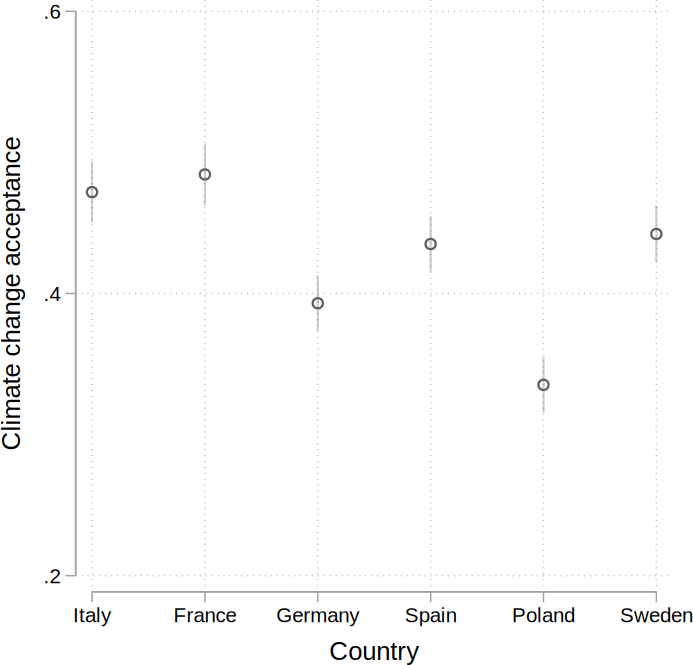
The observed differences in climate change belief across countries are illustrated in Figure 1, which presents the estimated probabilities of belief for each country. In line with extant empirical studies showing lower belief in anthropogenic climate change in Eastern European countries (Birch 2020; Lewis et al. 2019; Caldwell et al. 2024), Poland stands out as having the lowest levels, while Italy, France, and Spain show higher levels of belief overall. Sweden occupies an intermediate position, while Germany shows slightly higher prevalence of belief when compared to Poland7.
Passing on the hypotheses and research questions that emerged in the previous paragraph, Figure 2 illustrates the effects of populist attitudes and left-right ideological self-placement on climate change belief. Both effects are negative and statistically significant, indicating that higher levels of populism and a stronger right-wing orientation are associated with lower belief in human-induced climate change. Notably, the effect of left-right self-placement is stronger than that of populist attitudes, suggesting that ideological positioning has a more pronounced impact on skepticism compared to populist beliefs (the predicted proportion of people believing in the anthropogenic climate change is equal to 60% among left-wingers against about 20% among right-wingers).
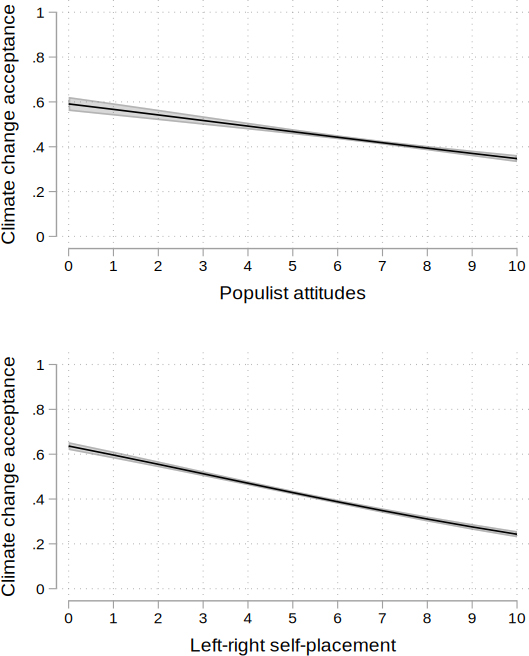
Figure 3 presents the average marginal effects (AME) of populist attitudes and left-right ideological self-placement on climate change belief, broken down by country. The results reveal a more nuanced picture when disaggregated by national context.
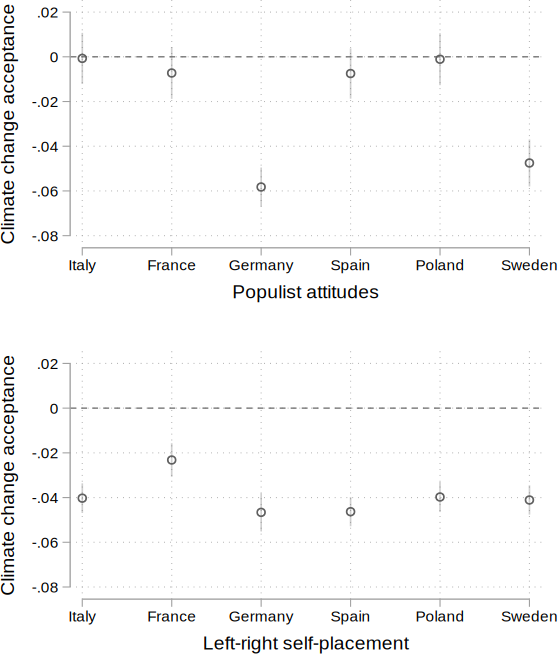
For left-right self-placement, the effects are largely consistent across the six countries, with a negative and significant association observed everywhere. The only exception is France, where the effect is smaller but statistically significant. This suggests that ideological positioning on the left-right spectrum influences climate change skepticism in a relatively uniform way across most of the countries analyzed.
The effects of populist attitudes (top panel of figure 3), however, are considerably weaker and more variable, as shown in Kulin and Johansson-Seva (2024). Populism appears to have a significant impact only in Germany and Sweden, two countries where environmental issues are more politicized, as we will discuss later. In the other countries - Italy, France, Spain, and Poland - the effects of populist attitudes are not statistically significant once left-right ideology and the other controls are accounted for. This pattern is directly reflected in the coefficients of Model 2 (Table A1 - Supplementary material): the main effect of populism is essentially zero and non-significant, while the country-by-populism interactions are negative and significant only for Germany and Sweden. Populism is therefore associated with lower acceptance of anthropogenic climate change only in these two contexts, and is statistically indistinguishable from zero elsewhere.
Figure 4 focuses on the interaction between populist attitudes and left-right ideology, overall, revealing a more complex dynamic than initially hypothesized. While we expected an overall multiplicative effect, where right-wing individuals with high levels of populist attitudes would exhibit extremely low levels of anthropogenic climate change belief, the results partially disprove RQ3. Instead, the dominant factor appears to be ideology, with a stark divergence between those on the far right and far left.
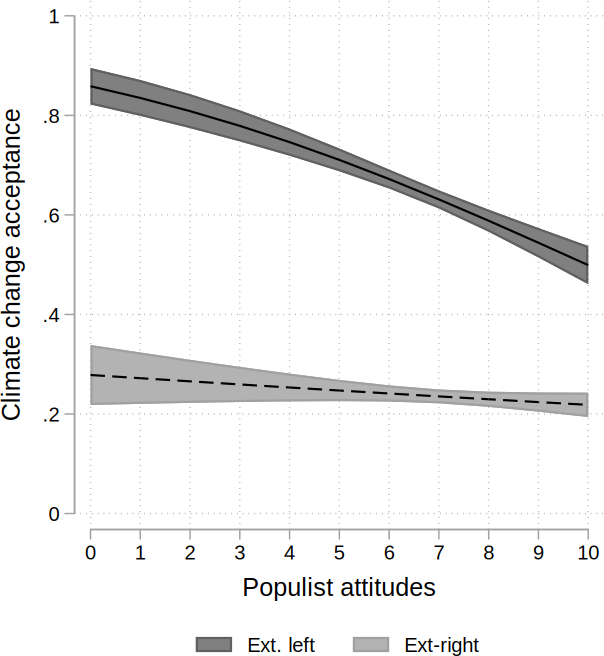
For far-right individuals, belief in anthropogenic climate change remains consistently low, regardless of their level of populist attitudes. This suggests that, for these individuals, climate change belief is primarily driven by ideological positioning rather than populist beliefs. In the discussion and conclusions, we will propose possible explanations of this finding. In contrast, among those on the far left, populist attitudes play a more relevant role. Individuals with low levels of populist attitudes exhibit very high levels of belief, but as populist attitudes increase, the percentage of uncertain/denial positions increases. This points to a distinct mechanism at work for the left, where populist attitudes– plausibly mostly driven by anti-elitism –correlates with a greater rejection of the scientific consensus on climate change. In Model 3 (Table A1, Supplementary Material), this corresponds to a positive and significant populism-by-ideology interaction, meaning that the negative association between populist attitudes and acceptance of anthropogenic climate change is strongest among left-leaning respondents and progressively weakens– rather than strengthens –as respondents move toward the right of the ideological spectrum. The multiplicative effect we initially hypothesized between right-wing positioning and populist attitudes is therefore not supported by the data.
These findings highlight two divergent processes: for the far right, climate change belief appears to be largely insulated from other factors due to the issue’s deep entrenchment in ideological discourse. For the far left, however, populism interacts with ideological positioning to influence attitudes, suggesting a more conditional relationship between these variables.
Figure 5 provides result for a three-way interaction between populist attitudes, left-right ideology, and national context, addressing RQ4. The overall pattern observed previously generally holds across countries, with varying degrees of strength. However, notable exceptions emerge, particularly in Germany and Sweden, where the dynamics deviate from the broader trend.
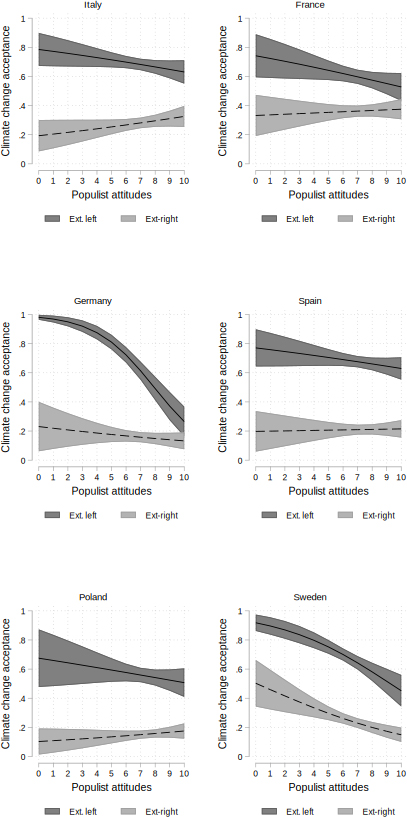
In Germany, the relationship between populism, ideology, and climate belief appears to show a form of convergence. As populist attitudes increase, the gap in belief between individuals on the far left and far right diminishes, suggesting that populism reduces ideological polarization on this issue.
In Sweden, as well, populism seems to be a strong driver of climate skepticism. While there is still a baseline difference between the far left and far right, populist attitudes significantly amplify skepticism across the ideological spectrum. This suggests that, in the Swedish context, populism attitudes play a crucial role, in shaping attitudes toward climate change, independent conditional from left-right ideology.
These patterns are mirrored in Model 4 (Supplementary Table A1). The overall populism-by-ideology interaction estimated in Model 3 is broadly similar across countries: most three-way terms do not reach statistical significance, indicating that cross-national variation in the interaction itself is limited and partly noisy. The main exception is Germany, where the Germany×Left-right×Populism coefficient is significant and points to a slightly steeper attenuation of the populism slope as respondents move rightward - consistent with the very flat far-right curve and the steep far-left curve in Figure 5. Taken together, ideology remains the dominant driver of variation in acceptance of anthropogenic climate change across most contexts, while the deviations from this baseline pattern cluster in the same two countries (Germany and partially Sweden) where populism already mattered most in Model 2.
5. Discussion and conclusion
Our results confirm several hypotheses already consolidated in the literature, while also revealing unexpected nuances. First, as expected, we observe that left-right orientation is the strongest and most consistent predictor of climate change belief. Individuals on the right of the political spectrum exhibit a significantly lower likelihood of supporting the scientific consensus on climate change compared to those on the left. This finding aligns with previous studies that emphasize the role of conservative and right-wing values in resisting environmental policies, often framed as threats to economic growth and individual freedoms. Second, populist attitudes are negatively associated with climate change belief, but this relationship is less robust and more context-dependent, in line with previous research (Kulin and Johansson-Seva 2024). Moreover, as regards the interaction between populism, ideology, and climate change belief, our results show that for individuals on the right populist attitudes are less influential. This finding disproves our assumption of a multiplicative effect between populism and right-wing ideology, as belief among right-wing individuals remains consistently low, regardless of their level of populist attitudes. On the contrary, populist attitudes have a stronger negative impact on belief among left-leaning individuals, suggesting a distinct mechanism at work for the left.
This finding may indicate that at least two possible dynamics are at play in the relationship between populism, ideology, and climate beliefs. For individuals on the right, belief in the anthropogenic climate change seems to be primarily driven by ideological positioning rather than populist beliefs. This pattern likely stems from the strong politicization of climate change by right-wing leaders, who have framed the issue as a positional one, making their followers resistant to other influences, including anti-populism. Once climate change has been labeled as a left-wing concern, right-wing individuals tend to reject it outright, reinforcing a rigid and ideologically entrenched form of skepticism. Moreover, in the six countries analyzed in this paper, the most popular radical right parties can be even defined as populist (see PopuList, Rooduijn et al. 2023)8. In other words, all the political supply at the radical right side of the ideological framework is populist, namely, belongs to right-wing populism. As literature suggests that the formation and dynamics of climate change attitudes is mostly elite-driven (Carmichael and Brulle 2017), right-wing people are supposed to be influenced by the parties locating in such political ideological area. Therefore, we could expect that, among people with far-right orientation, even those people holding low levels of populism tend to follow the positions of those parties representing the available political supply. Accordingly, there is slight variation in climate change beliefs depending on the populist attitudes. In contrast, among those on the left, populist attitudes play a more significant role, suggesting a different mechanism at play: while left-wing individuals are generally more inclined to accept climate change as a serious issue, those with strong populist orientations are more likely to distrust the scientific consensus on climate change. Here, skepticism appears to emerge not from ideological opposition to climate policies but from a broader suspicion toward elites, including scientists and policymakers. Moreover, in the far-left ideological area the political supply is more heterogeneous regarding populism, both within and across countries.
These findings have important implications for understanding the different pathways through which climate skepticism develops and for policymakers seeking to address climate change. On the right, climate change belief appears to be deeply embedded in ideological identity, making it less susceptible to external influences. Efforts to counteract climate uncertainty and denialism in this group may require a reframing of climate policies in ways that align with right-wing values, such as emphasizing national security, energy independence, or economic competitiveness. On the left, skepticism seems to be more contingent on populist attitudes, suggesting that increasing trust in scientific institutions and enhancing transparency in climate policymaking could help mitigate skepticism among left-wing populists.
Also, at the country-level analyses highlight significant variations in the interaction between populism, ideology, and skepticism. While left-right ideology is consistently positively associated with climate change belief across all countries, the effects of populism vary widely. For example, in Germany and Sweden - the two countries in which our data show a significant negative effect of populism on climate change acceptance - the literature documents both a particularly salient and politicized climate change debate and the prominence of right-wing populist actors that have explicitly framed climate policy in anti-elite terms (see Küppers 2024; Hultman et al. 2019). While our analyses do not directly measure the diffusion of anti-elitism along the ideological spectrum within each country, this contextual configuration offers a plausible interpretive frame for the stronger populism effect observed in these two cases.
More broadly, our results underscore how individual-level ideological orientations and populist sentiments interact with the broader “supply” of political cues provided by parties and elites – especially in contexts where climate change has become a highly politicized issue. On one hand, the lower belief among right-wing people suggests that conservative parties across Europe effectively mobilize concerns about regulation, economic disruption, and national sovereignty, making climate denial/uncertainty a salient component of their political platforms. Voters who place themselves on the right promptly respond to these signals, reinforcing party cues that frame environmental policies as elitist, costly, or overly intrusive. On the other hand, the more variable effect of populist attitudes might indicate that populist supply may not be uniformly strong across all countries; in some contexts, populist parties aggressively adopt anti-expert and anti-elite rhetoric on climate issues, thereby intensifying denialist beliefs. These dynamics illustrate that even when individuals hold populist attitudes, the translation of those attitudes into climate denial depends on the particular set of messages championed by political actors.
While this study provides valuable insights, it also highlights several avenues for future research. First, our focus on six European countries, while providing a robust comparative framework, leaves room for broader analyses that include additional contexts with diverse political systems and environmental policy contexts. For example, incorporating countries outside the European Union or with varying presence of populist parties in the political supply could provide a more comprehensive understanding of these dynamics. Second, longitudinal studies tracking changes over time would help assess how shifts in political power and party platforms influence public attitudes toward climate change. This would be particularly relevant in understanding the evolving role of populist movements and their adaptation to mainstream politics. Finally, our study does not analyzed support for climate policies, which is crucial to understand to what extent the public is engaged in enhancing institutional actions for the ecological transition. Nonetheless, without believing that climate change is entirely or mostly caused by the human activity, supporting climate actions –carried out by humans themselves– remains limited.
References
Akkerman, A., Mudde, C., and Zaslove, A. (2014), «How populist are the people? Measuring populist attitudes in voters, in Comparative political studies, 47(9), 1324-1353.
Biancalana, C., and Ladini, R. (2024), Emergenza lenta: Il cambiamento climatico in Italia tra politica, media e società. Milano: Fondazione Giangiacomo Feltrinelli.
Birch, S. (2020), «Political polarization and environmental attitudes: A cross-national analysis», in Environmental Politics, 29(4): 697-718, https://doi.org/10.1080/09644016.2019.1673997
Bogert, J. M., Buczny, J., Harvey, J. A., and Ellers, J. (2024), «The effect of trust in science and media use on public belief in anthropogenic climate change: A meta-analysis», in Environmental Communication, 18(4): 484-509.
Buzogány, A., and Mohamad-Klotzbach, C. (2021), «Populism and nature—the nature of populism: New perspectives on the relationship between populism, climate change, and nature protection», in Zeitschrift für Vergleichende Politikwissenschaft, 15(2): 155-164.
Buzogány, A., and Mohamad-Klotzbach, C. (2022), Environmental populism. The Palgrave handbook of populism, 321-340.
Caldwell, D., G. Cohen, and N. Vivyan (2025), «Long-run trends in partisan polarization of climate policy-relevant attitudes across countries», in Environmental Politics, Online first: 1-26, https://doi.org/10.1080/09644016.2024.2403957
Carmichael, J. T., and Brulle, R. J. (2017), «Elite cues, media coverage, and public concern: an integrated path analysis of public opinion on climate change, 2001–2013», in Environmental Politics, 26(2): 232-252.
Castanho Silva, B., Jungkunz, S., Helbling, M., and Littvay, L. (2020), «An empirical comparison of seven populist attitudes scales», in Political Research Quarterly, 73(2): 409-424.
Castanho Silva, B., Vegetti, F., and Littvay, L. (2017), «The elite is up to something: Exploring the relation between populism and belief in conspiracy theories», in Swiss Political Science Review, 23(4): 423-443.
Chazel, L., and Dain, V. (2024), «Left-wing populism and environmental issues: An analysis of la france insoumise’s ‘popular environmentalism’», in Political Studies, 72(3): 1223-1249.
Crawley S., Coffé, H., and Chapman, R. (2022), «Climate belief and issue salience: comparing two dimensions of public opinion on climate change in the EU», in Social Indicators Research, 162: 307-325, https://doi.org/10.1080/17524032.2019.1630463
Crulli, M., and Zulianello, M. (2025), «Not really concerned? Populist radical right voters and climate change», in Environmental Politics, 35(4): 745-770.
Eslen-ziya, H., and Giorgi, A. (ed. by) (2022), Populism and science in Europe. Cham: Palgrave Macmillan.
Farstad, F. M. (2018), «What explains variation in parties’ climate change salience?», in Party Politics, 24(6): 698-707, https://doi.org/10.1177/1354068817693473
Fisher, S. D., J. Kenny, W. Poortinga, G. Böhm, and L. Steg, L. (2022), «The politicisation of climate change attitudes in Europe», in Electoral Studies, 79: 102499, https://doi.org/10.1016/j.electstud.2022.102499
Forchtner, B., and Kølvraa, C. (2015), «The nature of nationalism: Populist radical right parties on countryside and climate change», in Nature and Culture, 10(2): 199-224.
Forchtner, B., and Lubarda, B. (2022), «Scepticisms and beyond? A comprehensive portrait of climate change communication by the far right in the European Parliament», in Environmental Politics, 32(1): 43-68, https://doi.org/10.1080/09644016.2022.2048556
Hameleers, M., Bos, L., and de Vreese, C. H. (2017), «The appeal of media populism: The media preferences of citizens with populist attitudes», Mass Communication and Society, 20(4): 481-504.
Hornsey, M. J., E. A Harris., P. G. Bain, and K. S. Fielding. (2016), «Meta-analyses of the determinants and outcomes of belief in climate change», in Nature Climate Change, 6(6): 622-626, https://doi.org/10.1038/nclimate2943
Huber, R. A. (2020), «The role of populist attitudes in explaining climate change skepticism and support for environmental protection», in Environmental Politics, 29(6): 959-982, https://doi.org/10.1080/09644016.2019.1708186
Huber, R. A., Greussing, E., and Eberl, J. M. (2022), «From populism to climate scepticism: the role of institutional trust and attitudes towards science», in Environmental Politics, 31(7): 1115-1138, https://doi.org/10.1080/09644016.2021.1978200
Huber, R. A., Maltby, T., Szulecki, K., and Ćetković, S. (2021), «Is populism a challenge to European energy and climate policy? Empirical evidence across varieties of populism», in Journal Of European Public Policy, 28(7): 998-1017.
Hultman, M., Björk, A., and Viinikka, T. (2019), The far right and climate change denial: denouncing environmental challenges via anti-establishment rhetoric, marketing of doubts, industrial/breadwinner masculinities enactments and ethno-nationalism. In The far right and the environment (pp. 121-135). Routledge.
IPCC, (2023), Climate Change 2023: Synthesis Report. Contribution of Working Groups I, II and III to the Sixth Assessment Report of the Intergovernmental Panel on Climate Change [Core Writing Team, H. Lee and J. Romero (eds.)]. IPCC, Geneva, Switzerland, pp. 35-115, https://doi.org/10.59327/IPCC/AR6-9789291691647
Kenny, J., L. Geese, A. Jordan and I. Lorenzoni. (2025), «A framework for classifying climate change questions used in public opinion surveys», in Environmental Politics, Online first: 1-26 https://doi.org/10.1080/09644016.2024.2429264
Kulin, J., and Johansson Sevä, I. (2024), «Rightwing populist attitudes and public support for climate policies in Western Europe: widening the scope using the European Social Survey», in PLOS Climate, 3(10): e0000443.
Kulin, J., Johansson Sevä, I., and Dunlap, R. E. (2021), «Nationalist ideology, rightwing populism, and public views about climate change in Europe», in Environmental Politics, 30(7): 1111-1134.
Küppers, A. (2024), «‘Climate-soviets,’‘alarmism,’ and ‘eco-dictatorship’: The framing of climate change scepticism by the populist radical right alternative for Germany», in German Politics, 33(1): 1-21.
Ladini, R. and Biancalana, C. (2025), «The role of public issue salience in the relationship between political orientation and climate change concern: Cross-sectional and longitudinal evidence from Europe, 2008-2021», in Acta Politica, online first, https://doi.org/10.1057/s41269-025-00395-5
Lakoff, G. (2010), «Why it matters how we frame the environment», in Environmental Communication, 4(1): 70-81, https://doi.org/10.1080/17524030903529749
Lewis, G. B., R. Palm, R., and B. Feng. (2019), «Cross-national variation in determinants of climate change concern», in Environmental Politics, 28(5): 793-821, https://doi.org/10.1080/09644016.2018.1512261
Lockwood, B., and Lockwood, M. (2022), «How do right-wing populist parties influence climate and renewable energy policies? Evidence from Oecd countries», in Global Environmental Politics, 22(3): 12-37.
Lockwood, M. (2018), «Right-wing populism and the climate change agenda: exploring the linkages», in Environmental Politics, 27(4): 712-732.
Lubarda, B. (2024), The ‘fake’virus and the ‘not necessarily fake’climate change: ambiguities of extreme-right anti-intellectualism. In: Kinga Allen, I., Ekberg, K., Holgersen, S., and Malm, A. (2024), Political ecologies of the far right: Fanning the flames. Manchester University Press.
Lübke, C. (2022), «Socioeconomic roots of climate change denial and uncertainty among the European population», in European Sociological Review, 38(1): 153-168.
Lynn, J., and Peeva, N. (2021), «Communications in the IPCC’s Sixth Assessment Report cycle», in Climatic Change, 169(1): 18.
McCright, A. M. (2016), «Anti-reflexivity and climate change skepticism in the US general public», in Human Ecology Review, 22(2): 77-107, https://doi.org/10.4225/13/58213a5387787
McCright, A. M., R. E., Dunlap, and S. T. Marquart-Pyatt. (2016b), «Political ideology and views about climate change in the European Union», in Environmental Politics, 25(2): 338-358, https://doi.org/10.1080/09644016.2015.1090371
Mudde, C. (2021), «Populism in Europe: an illiberal democratic response to undemocratic liberalism (The Government and Opposition/Leonard Schapiro Lecture 2019)», in Government and Opposition, 56(4): 577-597.
Nilsson, A., and J. T. Jost. (2020), «The authoritarian-conservatism nexus”, in Current Opinion in Behavioral Sciences, 34: 148-154.
Poortinga, W., L. Whitmarsh, L. Steg, G. Böhm, and S. Fisher. (2019), «Climate change perceptions and their individual-level determinants: A cross-European analysis», Global Environmental Change, 55: 25-35, https://doi.org/10.1016/j.gloenvcha.2019.01.007
Sapinski, J. P. (2015), «Climate capitalism and the global corporate elite network», in Environmental Sociology, 1(4): 268-279.
Spoon, J. J., and Williams, C. J. (2023), «Environmental chauvinism? Ex- plaining issue expansion among non-mainstream parties», in Party Politics, 29(6): 1077-1087.
Steg, L. (2023), «Psychology of climate change», in Annual Review of Psychology, 74(1): 391-421.
Uscinski, J. E., Douglas, K., and Lewandowsky, S. (2017), «Climate change conspiracy theories», in Climate Science, 1-35.
Van der Linden, S. L., Leiserowitz, A. A., Feinberg, G. D., and Maibach, E. W. (2015), «The scientific consensus on climate change as a gateway belief: Experimental evidence», in PloS one, 10(2): e0118489.
1 Huber and colleagues (2022) identify two main mechanisms through which populism influences climate skepticism: distrust in political institutions and skepticism toward science. Populists tend to distrust institutions responsible for climate policy and perceive climate scientists as part of an elite, leading them to reject the scientific consensus.
2 A descriptive overview of the dependent variable and of all covariates used in the analyses, broken down by country (N, minimum, maximum, mean, and standard deviation), is provided in Supplementary Material - Table A3.
3 The survey was conducted as part of the SUSPECTS project that focuses on the prevalence and impact of conspiracy theories in Europe. The CAWI data were materially collected by the polling firm Dynata. While the project has a broader scope, the data relevant to this study pertain specifically to attitudes toward climate change and political affiliations.
4 The wording and answer categories of the original variables are analogous to those used in international survey projects, such as the International Social Survey Programme (ISSP).
5 As an additional robustness check, we also included an alternative specification of the models that include, as dependent variable, the original one, modeled by means of a set of ordered logit models. The models presented here and the ordered logit specification produce substantively equivalent results (see Appendix 1 – Table A2 of the Supplemental Material).
6 Coefficients for all the models can be seen in Appendix 1 – Table A1 of the Supplemental Material
7 Analogously, European Social Survey data collected in 2023/2024 show that the lowest prevalence of climate change belief was found in Poland (35%). The ranking of the other countries is slightly different when compared to the data here employed: Sweden reports the higher percentage of people believing in anthropogenic climate chenge (63%), followed by France (56%), Italy (53%), Spain (50%) and Germany (49%)
8 This is indeed true for Alternative fur Deutschland in Germany, Lega and Fratelli d’Italia in Italy, Rassemblement National in France, Vox in Spain, Sverigedemokraterna in Sweden and Prawo i Sprawiedliwosc in Poland.