https://doi.org/10.36253/smp-16838
Far-right Climate Skepticism Across Europe: The Transnationalization of Narratives?
1 Scuola Normale Superiore, Italy
2 Université de Namur, Belgium
E-mail: manuela.caiani@sns.it; nicolo.pennucci@unamur.be
*Corresponding author
Abstract. This article explores the evolving relationship between radical right actors and environmental issues in Europe, focusing on whether a transnational environmental politics is emerging within the radical right beyond the traditional stance of denialism. Through a quantitative text analysis (Topic Model and Dictionary Based Content Analysis) of Facebook data (77116 posts) from political parties, social movements, and leaders across seven European countries (138 actors from Italy, France, the United Kingdom, Austria, Hungary, Poland, and the Czech Republic), we aim to identify the frames and narratives used by radical right actors to discuss environmental issues. The study is guided by two central research questions: (a) How do political ideologies along the classic right – left axis influence the framing and positioning of environmental issues among radical right actors in Europe? (b) Are there more similarities or differences across these actors, and are there indications of cross – border alignment? Building on these inquiries, we investigate whether radical right actors are increasingly adopting an environmentalist position, distinct from denialism, to articulate a climate ideology rooted in far-right values such as nationalism, identity preservation, and anti – globalism. By identifying shared frames and narratives, our study seeks to uncover potential patterns of transnationalization in radical right environmental discourses, shedding light on the interplay between ideological evolution and strategic positioning in response to environmental challenges. This study provides both an empirical contribution and a typological – analytical perspective, offering a more comprehensive understanding of how radical right actors currently discuss and frame environmental issues.
Keywords: far-right, climate skepticism, environmental discourse, transnationalisation, social media.
Contents
2. Theory: far-right and climate skepticism
4. Saliency and forms of far-rightdiscourses on environment and climate change across Europe
4.1 What does the far-right talk about when it talks about the environment? Subthemes
5. Framing far-right skepticism on climate change: a cross country overview in Europe
1. Introduction
Environmental issues and climate change have increasingly become a battleground for the far-right. On September 23, 2025, President Donald Trump addressed the 80th session of the United Nations General Assembly, dismissing renewable energy sources such as wind power as a “joke” and sharply criticizing the UN’s climate initiatives. “This “climate change,” it’s the greatest con job ever perpetrated on the world, in my opinion,” Trump declared. “All of these predictions made by the United Nations and many others – often for bad reasons – were wrong. They were made by stupid people who have cost their countries fortunes and deprived them of any chance of success. If you don’t get away from this green scam, your country is going to fail.” Trump has long been a critic of climate science and policies aimed at helping the world transition to green energies like wind and solar. His speech however marked a step further: it included false statements and made random connections between aspects of the social and political reality constructing a new frame.
This prevailing perspective characterises the far-right in the USA and beyond, as sceptical with regard to climate protection. Previous studies have shown that the far-right often criticise ambitious climate policies at both the European and national levels (Huber et al., 2021; Tosun and Debus, 2020; Vihma et al., 2020). The denial of the human impact on the climate is a position espoused by certain political parties, a notable example being Germany’s Alternative für Deutschland (AfD). The hostility exhibited towards liberal, cosmopolitan and green elites, as well as the rejection of international commitments, is coherent with the stance of opposition to climate protection as an alleged elite endeavour (Caiani and Lubarda 2023). However, it is important to note that certain right – wing populist parties and far-right movements also advocate for environmental protection as a means of safeguarding national identity. In this interpretation, climate change can also be a concern for the far-right because it poses a threat to the environment of the nation state. One must observe that far-right movements frequently reinterpret climate science as a means of manipulation (Eslen–Ziya and Giorgi 2022).
In this article we focus on Europe and the political discourse of the far-right on climate change. In particular we examine far-right climate skepticism across seven European countries (France, Austria, Poland, Hungary, Italy, England and Czech Republic), asking how much and how environmental issues are integrated in the political discourse of the far-right1, including both political parties and not party social and political movements of the far-right, and whether a shared environmental discourse is developing transnationally. More in particular, we are interested in evaluating whether there is a shift in the far-right environmental discourse from denialism to something more elaborated, engaged and nuanced, as well as whether these “frames” are commonly developed across far-right actors in European countries.
(Common) narratives and similar frames (or “cognitive schemas”) on environmental issues and climate change may facilitate exchanges across national borders (Snow and Benford, 1999), as well as the potential alignment of these forces around common political regressive agendas on environmentally delicate issues (Zeller 2024). We thus qualify transnationalization in the far-right when groups and organizations from more than one country place similar discursive emphasis (and construct similar cognitive frames) on specific issues (Froio and Ganesh 2019). As noted, transnational exchanges among far-right forces do not necessarily result in organizational collaborative endeavours, but can also be manifested in the dissemination of analogous frames pertaining to issues, as well as practices. This may have an important impact on the development of a common collective identity on certain issues (e.g. on gender, see Lavizzari and Siročić, 2022; Paternotte and Kuhar, 2017). In fact, mainstream politicians and commentators are concerned that right – wing forces could exploit a “climate backlash”. According to anti – racism campaigners and academics, the adverse effects of the climate crisis and globalisation have resulted in marginalisation and vulnerability for many citizens, e.g. farmers, in Europe, making them susceptible to the influence of populist politicians and far-right discourses and mobilisations.
Methodologically the analysis combines computational and qualitative approaches (e.g. Bonikowski and Nelson 2022; Pennucci, 2023), using text statistics to build a corpus of 61500 Facebook posts (2008–2024) by far-right organizations in the last two decades, in order to unveil the saliency and forms of the far-right engagement on environmental issues and climate change as well as the similarities and differences across countries in terms of framing of these environmental issues(for a similar methodology Hilmar 2025)2. In a nutshell, we look at how much (intensity) and how (forms) far-right actors across seven European countries are talking about environmental issues through their official Facebook pages. Our focus on environmental issues is due to the fact that in the midst of the fourth wave of far-right politics in postwar Europe (Mudde, 2019), it is evident that the ideological core of the far-right discourse is expanding beyond the traditional topics of race, ethnicity, nationalism, and immigration, now encompassing new issues.
Frame, as a concept developed especially (but not exclusively) in social movement studies, is defined as a cognitive instrument that allows making sense of the external reality (see also for an application to the radical right Caiani 2023). It is very much fitting to capture new ideas on social orders and political assets of power. Interpretative frames also produce new definitions of the foundations of collective solidarity, to transform actors, identity in a way which favours action. In doing so, framing processes also allow for the definition of the self and the opponents, namely developing identity frames (Tilly, 2003, p. 139). Frames are very often produced by organizational leadership, which provides the necessary background within which individual activists can locate their actions (Snow and Benford, 1988). As it is the case for any collective actor, far–right organizations have to motivate individuals to action, providing actual and potential followers with rationales for participating and supporting their organizations. In particular, diagnostic frames allow for the conversion of a phenomenon into a social problem, potentially the object of collective action; prognostic framing also involves the suggestion of future developments that could solve the identified problems; and motivational frames are needed to produce the motivations and the incentives for action. Indeed, in order to convince individuals to act, frames must generalize a certain problem or controversy, showing the connections with other events or with the condition of other social groups; and also demonstrate the relevance of a given problem to individual life experiences (Ibid.).
2. Theory: far-right and climate skepticism
A few years ago, Foucart (2010), coined the concept of “populisme climatique” (i.e. “climate populism”), to indicate the instrumentalisation of the sciences. The election of Donald Trump also triggered the expression of negative positions towards sustainable transition policies for populist parties worldwide (Selby, 2019). In the wake of Donald Trump’s election, various far-right groups worldwide have begun to voice their concerns about climate change, often using the term “climate change science denialism” to describe their position. This term refers to a strong belief that climate policies are costly for the economy and society. Additionally, there has been a rise in nationalist sentiments, driven by the perception that international bodies like the EU and the UN are exerting undue influence on national governments (Vihma et al 2020).
The mainstream literature on political science talks about far-right actors as denialists or sceptics when it comes to their relationship with environmental issues (Dobson, 2016; Lowles, 2021).
Undoubtedly, the environment has become an increasingly important arena of political conflict for the far-right and right – wing populist actors in recent years. Leaders such as Mateusz Morawiecki (Poland’s PiS), Viktor Orbán (Hungary’s Fidesz) and the Italian party Lega have all publicly embraced ecological issues, as evidenced by statements such as those in the 2019 Lega manifesto. On the surface, these claims resemble those of Green parties. However, given the historical hostility of far-right populist parties towards environmental protection (Tosun and Debus, 2020; Vihma et al., 2020; Huber et al., 2021), one must ask whether these positions reflect a genuine ideological shift or are merely strategic responses to political opportunities.
With regard to the ideological dimension, earlier research indicates that far-right populist actors are often critical of ambitious climate policies at both European and national levels. Indeed, right – wing populist ideology might shape environmental discourse by privileging national sovereignty over global policy frameworks (Farstad 2018); drawing on nostalgia and “retropias” – the idealization of past environments as templates for restoration (Elçi 2022; Hanusch and Meisch 2022); or framing “the people” against “polluting outsiders” or elites who are accused of shifting climate costs onto ordinary citizens (Lubarda 2017).
Studies have shown that nationalism is often a stronger determinant of environmental positions than traditional left–right divides, environmental values, or political trust (Kulin et al. 2021). Moreover, populist attitudes further encourage climate skepticism and opposition to environmental protection (Huber 2020), acting as an amplifier of ideological dispositions (Huber et al. 2021). Finally, in the far-rightsocial movement sector, ideologies can take the form of ecofascism, emphasizing blood – and – soil notions of homeland and purity (Hughes et al. 2022; Lubarda 2020). Pittnerová and Kopeček (2025) for example examine how the Czech far-right populist party Freedom and Direct Democracy (SPD) frames environmental issues, especially the European Green Deal. While not denying climate change, the SPD casts transnational initiatives as ineffective and harmful to national interests, instead promoting national solutions tied to food and water quality, “Czech traditions”, and economic sovereignty. This shows how far-right populists embed environmental debates within identity – based and anti – EU narratives. A discourse analysis of how Germany’s far – right–ranging from populists to neo – Nazis–frames climate change. They often express skepticism, sometimes combining nature ideals with ethnic or sovereigntist messaging (Forchtner et al. 2018).
Despite the common anti – environmentalist framing, recently the literature acknowledges heterogeneity. Some far-right factions adopt “green” populist discourses, for instance in anti – extractive or climate justice movements (Buzogány and Mohamad – Klotzbach 2021), or in broader far-right ecologism (Forchtner and Lubarda 2023). Still, much research remains focused on their climate denialism and anti – establishment stance against “green lobbies”. In conclusion, this literature review suggests some emerging trends in the relationship between the environment and far-right actors: nationalistic frames to climate policies (Pospieszna and Vetulani Cegiel, 2021; Timmer and Docka Filipek, 2018); eco – nationalism (Falkner 20253), conditional environmentalism (Caiani and Lubarda, 2023), denouncing the socioeconomic negative effects of green policies (Yazar and Haarstad, 2023). In this study, we treat these new trends as emerging frames adopted by the far-right to deal with environmental issues.
In sum, a growing body of literature signals a recent development in the scholarship on the far-right and the environment, by suggesting a shift from denialism to other discursive strategies employed by far-right actors to deal with the environment. Nevertheless, these emerging strategies adopted by the far-right to look at the environment are far from being systematized in the field.
In this article, we address these issues by examining various types of far-right actors – including both political parties and social or political movements – across seven European countries and over time. In doing so, we seek to bridge a traditional division of labour in the literature (see Caiani et al., 2012) between social movement scholars, who have typically analyzed the discourse of collective actors on the progressive side, and party politics scholars, who have focused primarily on far-right parties and electoral behaviour.
3. Methods and sources
This study is based on a comparative design to analyze far-right political communication across seven European countries: Italy, France, Austria, the United Kingdom, Hungary, the Czech Republic, and Poland. Facebook data from all the available far-right actors have been collected from 20082 to 2024 (Caiani, 2025). The empirical focus is on the environmental discourse of far-right actors on social media. Data was collected through CrowdTangle, extracting all available posts on the environment. In total 61.500 posts were collected, roughly 10.000 per country.
The research relies on a triangulation of computational and qualitative methods, combining large – scale text classification with qualitative frame analysis. We proceed through several steps.
The first step involved thematic classification of all posts into standard far-right issue areas: immigration, gender, education and culture, environment, social policy, and other. This classification was carried out using a multilingual BERT – based transformer model. To fine tune and validate the model, a manually labeled dataset of 100 posts per category was created, stratified by country (15 posts per country per category). This dataset was then split into training, validation, and test sets. The model performance on the classification task is reported in methodological annex, which details a confusion matrix, precision, recall, and F1 scores.
The second step was focusing on posts classified as dealing with the environment. Following this initial thematic classification, the analysis zooms on the frames used in order to talk about environmental content. Posts classified under the environment category underwent a two – stage frame analysis. First, a qualitative, inductive manual coding of frames was conducted. Posts from all seven countries were read and manually annotated to identify dominant interpretive frames used by far-right actors when discussing environmental issues. The reviewed relevant literature was used in order to check for relevant frames, however the process of annotation was primarily inductive. This qualitative coding produced a codebook of recurring frames that can be consulted in the methodological appendix (Appendix 3).
Consequently, an LLM based classification using a few shot prompt based method was performed in order to ask a Large Language Model (gpt 4o) to classify all the environmental content into one of the spotted frames. Metrics on the evaluation of the model are available in the methodological appendix (Appendix 3 – GPT Analysis performance)
This two – level content analysis allows us to answer the core research questions concerning the centrality of environmental issues in far-right discourse (BERT based content analysis) and the interpretive frames through which these issues are communicated (computational frame analysis). Specifically, thematic classification and keyword extraction provide insight into the relative prominence and substantive content of environmental discussions, while frame analysis reveals how such content is ideologically framed and presented to the public.
4. Saliency and forms of far-rightdiscourses on environment and climate change across Europe
When looking at the issue saliency of environmental matters in the far-right discourses, studies based on electoral manifestoes signal a slowly increasing interest in mobilising this topic (e.g. see Caiani and Lubarda, 2023). Figure 1 presents the relevance of the environment in the (social media) debate of the far-right in the last two decades (2008-2023) in our seven European countries (both political parties and not party groups).
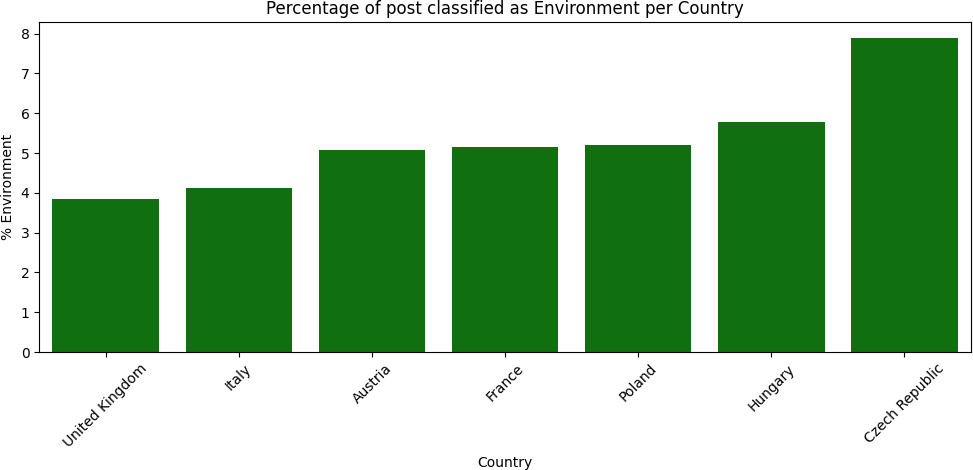
While environmental issues are generally underrepresented compared to other issues of debate in the discussions of far-right groups in Europe such as immigration, gender nationalism, etc. (e.g. Caiani et al. 2024), they are not absent in the far-right discourse on social media (Figure 1). Moreover, our data reveal meaningful cross-national variation in their relative salience. The Czech Republic stands out with the highest proportion (nearly 8%), suggesting a comparatively stronger engagement with environmental topics in its public discourse. This may reflect heightened political attention, media coverage, or civic activism around environmental concerns in that context.
Mid-range values are observed in Hungary, Poland, France, and Austria, all ranging between approximately 5 and 6%. These figures indicate a moderate but notable level of environmental discussion, particularly in Central and Eastern European countries. This pattern is noteworthy, as it challenges common assumptions that Western Europe is more environmentally engaged, and suggests that Eastern European countries may be experiencing a growing environmental awareness, potentially linked to local environmental degradation, EU environmental policy pressures, or increased civil society mobilization.
By contrast, Italy and the United Kingdom exhibit the lowest percentages, with environmental content representing less than 4.5% of total posts. This suggests a relatively marginal position of environmental issues in their broader discourse, possibly overshadowed by more pressing political or socio – economic topics.
Overall, while environmental themes remain a minority focus across all countries, the observed differences underscore the uneven integration of environmental concerns into national public agendas, with Eastern and Central European countries showing relatively higher levels of engagement than some of their Western counterparts.
4.1 What does the far-right talk about when it talks about the environment? Subthemes
Before going deeper into the development of the frames (i.e. justifications and reasons) of far-right positioning on environmental issues, namely framing and the symbolic construction of the political and social reality of the far-right vis a vis this issues, we can look at the main sub-themes mobilized by these actors when dealing with the environment (i.e. keywords as proxy of sub-themes in environmental issues from the far-right). To this end, we used the most prominent words used by far-right actors in posts classified as environmental. Through this strategy we aimed at using words as a proxy of sub-themes. Overall, the data reveals that far-right environmental discourse is not uniform across Europe. While some countries integrate mainstream ecological language, others emphasize national sovereignty, traditional values, or infrastructural concerns, by leaving open the hypothesis that despite ideological alignments and diffusions, national contexts still matter for the independent development of communication on climate issues.
Figure 2 summarizes the top 20 words on the environment overall, in order to have an idea of what subtopics are more talked about in the European selected countries. What follows is the most used 20 words overall.
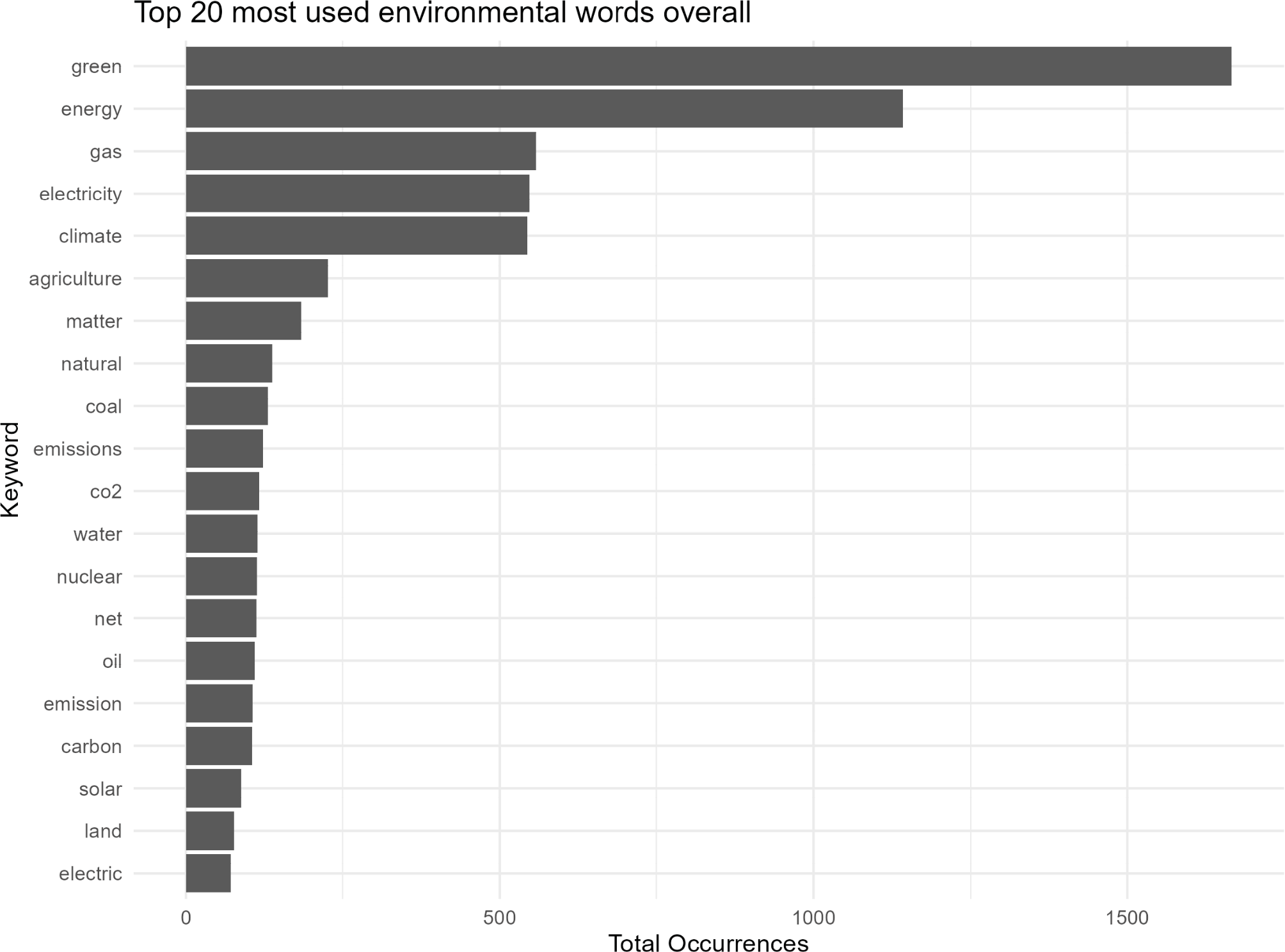
The aggregated data on the top 20 most used environmental keywords across countries provides insight into how environmental themes are selectively appropriated in far-right political communication. The lexical distribution reflects a pattern of engagement that is heavily skewed toward generic and infrastructural terms, with a notable absence of systemic, scientific, or justice-oriented language typically found in progressive environmental narratives.
The term green dominates the distribution by a large margin. Its semantic ambiguity allows far-right actors to signal environmental concern while avoiding alignment with progressive environmentalism. “Green” is often used as a symbolic placeholder – denoting tradition, purity, or national identity – rather than as a commitment to ecological sustainability or transformation.
Following green, terms such as energy, gas, electricity and climate occupy prominent positions. These terms suggest a focus on resource management, energy security, and economic infrastructure rather than environmental degradation or ecological justice. In far-right narratives, this vocabulary is often mobilized to advocate for national energy independence, anti-globalist policy stances, and protectionist economic strategies. Words like nuclear and coal further indicate a tendency to valorize domestic or “traditional” energy sources, often positioned against renewable alternatives promoted by global institutions or environmental NGOs.
The limited occurrence of terms like carbon, emission, solar, and land is equally telling. These are central in climate science discourse but appear only marginally in far-right communication, reflecting either indifference or strategic avoidance of climate accountability. Moreover, the near absence of justice-related or biodiversity terms (e.g., ‘sustainability”, “equity”, “ecosystem”, “biodiversity”) reinforces the view that far-right environmentalism is primarily technocratic, economistic, or nationalist in orientation.
In summary, the overall keyword profile illustrates that the far-right engages with environmental discourse through a narrow set of depoliticized and infrastructural terms. This allows for the projection of environmental concern without adopting the epistemic, ethical, or global dimensions of ecological thought. The result is a form of “post-environmentalism” aligned with nativism and technonationalism – what can be conceptualized as a strategic reframing of ecology within the bounds of identity politics and state sovereignty.
As the analysis suggests, the difference in keywords not only suggests a difference in subthemes developed in each country, but also a potential different framing of environmental issues. In order to further unpack this dimension, the next section will highlight the frame analysis on environmental content in order to unpack the way far-right organizations talk about the environment on Facebook.
5. Framing far-right skepticism on climate change: a cross country overview in Europe
More in detail, when looking at the framing of the far-right on environmental issues and climate change (intensity) through our two steps procedure the following key frames emerge, as shown in Table 1. These frames account for the different ways through which climate issues can be discussed by far-right actors, both political parties and not-party organisations. The frames result from a double process: on the one hand, they derive from a deep reading of the relevant literature that helps highlight innovative frames used by the far-right in dealing with environmental issues. On the other hand, they derive from an inductive reading of a subsample of the dataset. The result of the process is summarized in Table 1.
| 1. Denial and Scepticism | |||||||||||||||||||
|---|---|---|---|---|---|---|---|---|---|---|---|---|---|---|---|---|---|---|---|
| Frames that challenge the scientific basis of climate change or question its significance. | |||||||||||||||||||
| 2. Policy Engagement Frames | |||||||||||||||||||
| Frames that acknowledge environmental issues but reorient them through nationalist, economic, or anti – globalist logics. | |||||||||||||||||||
| Economic Frame (Conditional Environmentalism) → Criticizes green policies for their economic costs, framing environmental concern as secondary to growth, competitiveness, or energy independence. | |||||||||||||||||||
| Nationalistic Frame → Positions environmental policy as a matter of sovereignty, insisting climate decisions should be taken at the national level to protect domestic interests. | |||||||||||||||||||
| Anti – Globalist Frame → Rejects the influence of supranational, unelected, or “undemocratic” bodies (e.g., EU, UN) in shaping environmental governance. | |||||||||||||||||||
| 3. Populist / Reactive Frames | |||||||||||||||||||
| Frames that attack the legitimacy, consistency, or motives of environmental actors. | |||||||||||||||||||
| 4. Neutral Frames | |||||||||||||||||||
| Frames that mention the environment in descriptive terms without adopting a clear ideological or political stance. | |||||||||||||||||||
| Source: Far-right actors post on environmental issues and climate change, from 2008-2024. | |||||||||||||||||||
The first frame represents the classical denialist position of far-right actors on the environment. Frame two and three represent policy engagement frames as they try to develop an argument for the discussion of environmental issues based on economic and political arguments that are coherent with the overall ideological milieu of the far-right. Elite Ipocrisia and Climate Activism as a Misplaced Ideology are populist frames as they are negatively framing environmental advocates as the enemy. Finally, ineffectiveness of climate policies is a frame related to response scepticism.
It is noteworthy to say that this analysis confirms that the far-right still only uses diagnostic and identitarian frames. Prognostic frames were not detected. This means that despite a shift towards a more nuanced and engagement relationship with the environmental issues, the employed frames are still reactive and oppositive, still lacking a proper positive and policy oriented engagement towards concrete proposal and solutions on the environmental issues.
In particular, economic frames refers to post dealing with the economic problems and harms caused by climate policies. In a nutshell it sustains an opposition to progressive climate policies on the basis of negative economic effects for the population. While this first frame represents an economic argument against climate policies, nationalistic and anti – globalist frames sustain a political argument against climate activism and progressive climate policies through the classical far-right distinction between national and supranational settings where to discuss political issues. These posts either denounce the fact that climate policies are often dictated by non democratic and illegitimate supranational bodies or that key decisions on the environment must be taken by looking at the national interest by national institutions looking at the interest of national people. In both cases there is a nationalistic frame to look at environmental issues that is centred on either cheering nationalism or criticizing globalism.
Elite hypocrisy is a frame that sustains an oppositional argument against environmental issues. Indeed it denounces hypocritical or incoherent behaviour by climate advocates. Climate activism as a misplaced ideology contains posts dealing with the logical inconsistencies or contradictions of climate activism and progressive policies. Oppositional frames are coherent with populist interpretations of the matter implicitly dividing us and them on identitarian lines, with the us defined through the negation of them in an oppositional way. Finally, the ineffectiveness of climate policies denounces fallacy in the application of climate policies in terms of results and efficiency.
While the climate denialism frame is still present, this analysis demonstrates that competing frames are on the rise and make the plethora of environmental frames developed by the far-right more complex and multifaceted. Despite employing economic, political and populist frames, what is constant is the reactive and negative dimension of all these frames. In a nutshell, the vast majority of the vehiculated content is critical towards progressive policies and climate activism rather than building concrete alternative policies. They either deny climate change or the climate issue or build economic or political arguments against the adoption of specific policies, by advocating economic costs or nationalistic justification to oppose a certain set of policies or positions. Finally they either denounce the hypocrisy of climate advocates behaviour or the inefficacy of specific progressive policies. The argument against climate change and environmental progressivism is therefore more complex, by going beyond denialism and scepticism. However, it appears that far-right actors rarely talk about concrete climate and environment issues in a constructive and concrete way in terms of positive ideas and actions. They are not denying or sceptical all the time, but still construct innovative frames in a negative and reactive way.
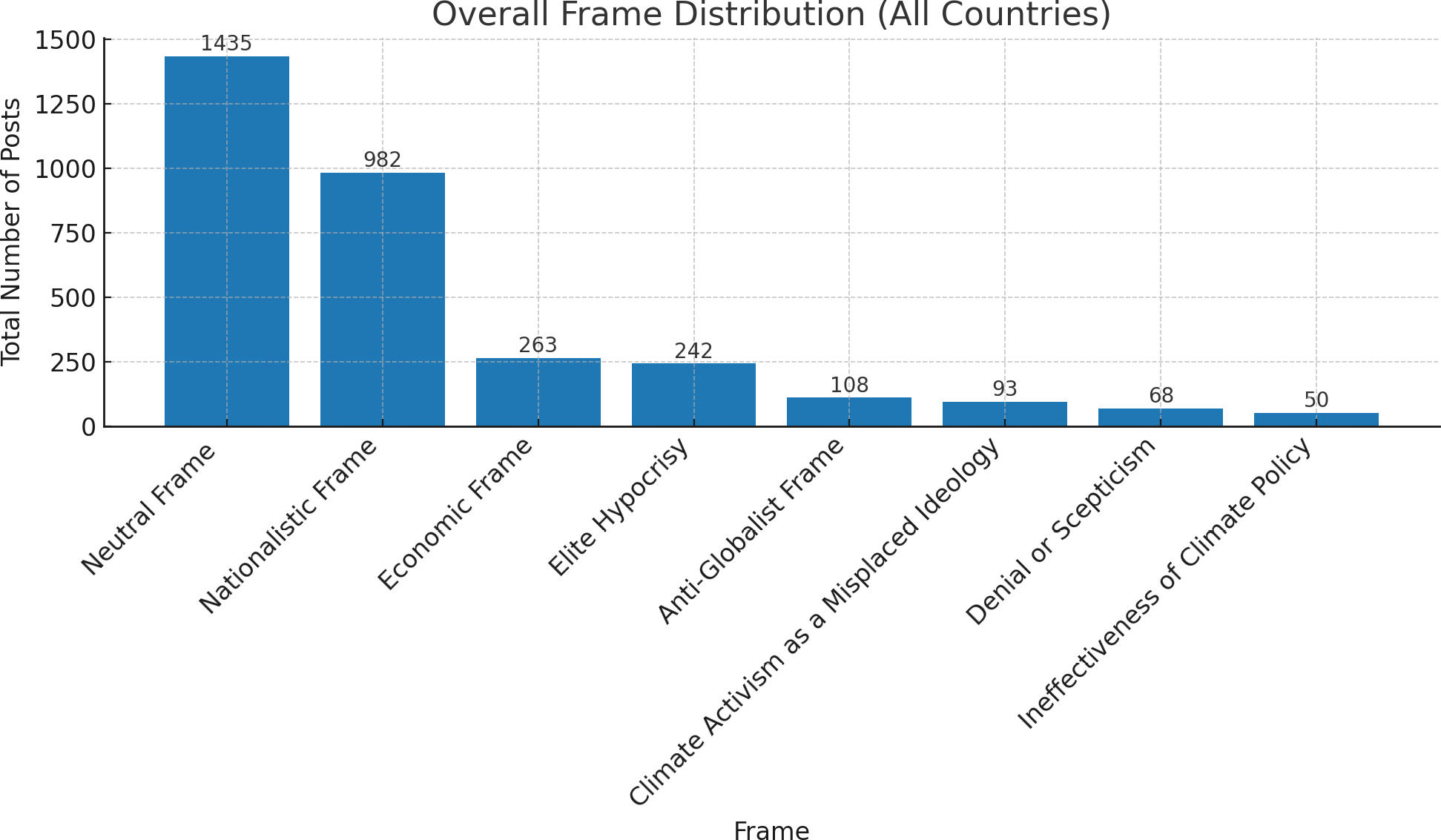
In terms of relevant frames, the “Nationalistic Frame” (982 occurrences) emerges as the most clearly defined and dominant ideological narrative. This frame typically constructs the environment as an extension of national identity and sovereignty. Nature is portrayed as a sacred national resource under threat from globalization, immigration, or supranational institutions (e.g., the EU or UN). This framing allows far-right actors to co-opt ecological language while redirecting it toward exclusionary and protectionist ends, a hallmark of ecological nativism or eco-nationalism.
The “Economic Frame” (263) reflects a discourse that emphasizes cost, efficiency, and national economic interests in environmental debates. Rather than promoting ecological sustainability for its own sake, this frame instrumentalizes environmental themes to advocate for national industrial competitiveness or energy independence–frequently in opposition to climate regulation perceived as detrimental to domestic economic growth.
Frames such as “Elite Hypocrisy” (242) and “Anti-Globalist Frame” (108) point to a populist logic underpinning far-right environmental narratives. These frames position environmentalism as a domain controlled by unaccountable elites or foreign interests. Climate policy is framed not as a moral imperative but as a vehicle for elite manipulation or geopolitical control, further deepening the far-right’s anti-establishment appeal.
Less frequent but still ideologically significant are frames like “Climate Activism as Ideological Manipulation” (93), “Denial or Scepticism” (68), and “Ineffectiveness of Climate Policy” (50). These reflect a discursive strategy that seeks to discredit climate science, portray climate activism as politically motivated (often leftist or globalist), and frame environmental policies as either futile or damaging. The relatively low frequency of outright denial suggests a shift from classical climate scepticism toward more subtle delegitimization strategies.
Taken together, the chart highlights that far-right actors do not reject environmental discourse outright but reshape it through the lenses of nationalism, economic protectionism, and anti-elitism. This strategic reframing allows them to appeal to environmental concerns without endorsing the foundational values of environmentalism-equity, interdependence, and global cooperation.
In particular, when looking at similarities and differences across countries (Figure 3), we see that the English far-right wing rhetoric on the environment is often built through a populist dichotomous style dividing us and them with identitarian frames. As a consequence Elite hypocrisy is the most employed frame in this country. Such an operation is most often seen in the denunciation of hypocrisy of left wing and progressive climate advocates frame that is used towards left wing activists for the environment. Such a populist interpretation is also present in the anti-globalist frame that portrays the elites as developing a plan to enrich themselves through green policies. At the same time, the economic frame of the environmental issue is still present in the UK, for instance climate policies are seen as an obstacle to economic growth. The argument against green policies in the UK is also sustained by the argument that they are ineffective.
The far-right discourse on the environment in Poland is dominated by nationalistic and economic frames. One important issue for the Polish debate on the environment is agriculture. Indeed, in recent years (2023-2025), Polish agriculture has been at the heart of a heated public debate over the rollout of the new Common Agricultural Policy (CAP) 2023-2027 measures and investments under the National Recovery and Resilience Plan (NRRP). While Brussels demands stricter environmental and digitalization standards for farms, growers on the ground decry the unsustainable costs of upgrading machinery, precision-farming technologies, and agro-ecological practices. “Green” requirements – such as reduced pesticide use, nitrogen emission limits, and eco-scheme payments tied to ecological conditions – have sparked numerous protests and roadblocks since 2024, led by groups like Rural Solidarity, which urge the Polish government to revise funding criteria and strike a balance between sustainability and profitability. This tension highlights the central challenge of the green transition: how to finance modernization without overburdening farm households, while preserving competitiveness in domestic and international markets.
Several posts in the Polish dataset deal with such a reform of the sector endorsed by left wing forces that is said to be disruptive for the economy by right-wing actors and contrast the national Polish interest. In this respect, while agriculture as a keyword was detected, the post contained an economic frame, which was most of the time built on the opposition between the common sense of the right-wing position, defending basic economic rights of the sector vs the green ideology of the left which lack common sense and is said to produce economic damage to the Polish economy.
The European Green Deal is also framed under economic terms by denouncing the high cost of its implementation in the name of what has been defined as a “quasi–religious madness”. Similarly to what concerns the agricultural sector, even in this case the economic argument is paired with the distinction between ideology and common sense.
Energy is also an important theme touched upon while talking about the environment. Most often this theme is treated under nationalistic frames as an attack from Germany to Polish energetic independence.
The anti-globalist frame in Poland is usually associated with anti-EU sentiment as well as with the idea that global governance is an elite conspiracy whose goal is to make technocrats rich at the expenses of common people: “we threaten the Green Deal, Fit for 55, EU taxes, eliminating combustion cars and other climate crazies that destroy agriculture and the entire economy! It is these crazy values that we want to stop, and for this we want to bring in as many MEPs as possible in the European Parliament elections!”. On the same note, on the anti-EU side of the frames, the implementation of the EU green deal is seen as a betrayal of the Polish people by the Law and Justice.
Often the anti-globalist sentiment is paired with a frame of elite hypocrisy. When a denial/skepticism frame is detected, there is still an attempt at a scientific development of the argument, rather than simply denying a statement, by suggesting that a constructive attempt at a counterargument is being made. For instance, they denounce the development of electric cars as a scam. Coal is a recurring word in the post classified as dealing with the environment. When the word occurred, most often the post was treated through an anti-globalist perspective. The underlying argument is that emerging and competitor economies will produce coal at the expense of the West which is not doing so anymore because of green regulations. This is framed as a geopolitical problem with emerging countries being conceded a competitive advantage in the production of coal at the expense of the west.
The nationalist frame was often detected when the keyword was “eco”. Most of the time the actual word was eco-fanatic; or eco-nazi. Usually when this is the keyword, the frame is a nationalistic one that depicts a distinction between us vs them, namely the nation vs the globalist elite.
Such a frame has a populist structure which is also seen in another used frame, namely the one of elite hypocrisy. Rather than denying climate change, these posts point out to the incoherent behaviour of globalist environmentalists with the aim of destroying their credibility.
The economic frame is also widespread among posts dealing with the topic of electric cars: “Interestingly, electricity has become 100 percent more expensive in 5 years!”. Sometimes there are also posts dealing with electric cars that develop a counternarrative by stating that electric cars are actually worse for the environment than their internal combustion competitors. This line of argument is skeptic towards the new technology thus developing a new denialism/skepticism frame. As for before such a denialism/skepticism is developed through supposedly scientific counterargument, making far-right actors more engaged in the scientific debate, by developing their argument through the quotation of right-wing intelligentia.
In Italy the main framework used in order to talk about the environment is the economic one. Notably, elite hypocrisy is substantially present, suggesting a style of reporting news from progressive policies or ideas with a comment pushing towards hypocrisy. Coherently with the general trend, nationalistic and economic frames are used to talk about the environment. Similarly, in France as well the elites are attacked for being hypocritical concerning their allegedly green ideology vs their actual behaviors, as the following post demonstrates: “three months ago Emanuelle Wargon, (new secretary of State for ecology) defended palm oil use for children’s nutrition”. However, the denial/skepticism frame is extremely rare in the France context, demonstrating the shift towards a more nuanced and engaged argument.
Besides neutral content, the nationalistic frame is the most widely used in the Czech Republic when the far-right deals with the environment. The economic frame is largely present in the Czech Republic specifically when dealing with the theme of electricity or energy. For instance, the clean energy transition is seen as EU imposed measures that will destroy the Czech economy. Interestingly, even in cases when the classification is economic, the post has some aspects of anti globalism and nationalism as the following example clarifies: “clean energy transition policies as EU imposed measures that will destroy Czech economy”. An example is the critique of the green deal, interpreted as a plot of the EU to harm the Czech economy. Indeed, the economic argument in these themes is built through the development of a nationalistic and anti globalist rhetoric. This is strictly connected with the geopolitical implications of the energy theme and so it is natural that the economic and political arguments are often merged when framing these issues by right-wing actors in the country.
The economic argument against energy policies is often mixed up with the need to go on in buying Russian gas. Again, the economic and geopolitical argument against green energy policies go hand in hand
Still dealing with energy policy, some issues are framed in order to demonstrate the inefficacy of green policy. One example is a post dealing with the fact that solar panels have been destroyed due to natural causes in Texas, demonstrating that building these panels is useless because they cannot resist natural events like storms. This is interesting because it does not deny the need of green policies on energy, it rather builds the argument for their inefficacy. When dealing with energy, in the Czech Republic the frames are economic, nationalistic and anti-globalist, by putting together a narrative that makes the global elite responsible for the economic crises and at the same time picturing a nationalistic management of the energy policy as the only possible solution. Sometimes, such rhetoric is further strengthened by the denunciation of the effectiveness of green policies.
In the Czech Republic, a lot of posts dealing with energy have to do with the harm to the Czech-Russian relationship as a consequence of green policies.
Besides this peculiar element of framing, in the Czech Republic as well the demonization of the enemy is part of a broader strategy against green political actors. The populist manichean division between us and them is present there as well and an example is the following: “We are at war, but at war with the green lunatic”. This is sometimes backed by denialism and skepticism towards green policies and arguments.
Most often, the economic argument is linked to a comparative analysis between countries, such as the Czech Republic, that still adopt European framework on energy policies vs Visegrad countries that dare to develop an independent agenda. Thus, the economic argument is often interlinked with a distinction between countries who are under the European control (anti-Globalist frame) and countries which undertake nationalist policies on energy (nationalism) with the aim of “thinking about their own citizens”. For instance, National government is said to enact climate protectionist policies as corrupt and knowingly damaging Czech citizens.
In this respect, the economic argument, although prevalent in the post, is still embedded in a populist distinction between global elites and nationalistic governments. The wellness of the citizen is one of the two poles, the other one being the corrupter (European and globalist) elites who are trying to enrich themselves through green policies that are on the contrary making ordinary citizens poorer.
The discussion on energy policies and its economic negative sides is also interlinked with euroskepticism. So the economic argument is shaped through nationalistic or anti-globalist frames that eventually lead to euroskeptic rhetoric. Also the use of the frame on the criminalization of the elite is interlinked with economic arguments on energy policies. Sometimes, indeed, they use the term thief to refer to politicians guilty of making the energy prices go up.
Finally, Nationalistic and economic frames are the most employed in Austria as well. Anti globalist frames are present in Austria notably in the form of the EU pushing an anti-democratic agenda through the green deal: “Austria is marching in steps with Europe towards eco-dictatorship”. More in general, the environmentalist agenda is seen as a globalist plot at the expense of common citizens who are impoverished by these measures, as the following post exemplifies: “in june 2020, the World Economic Forum announced its plans for a great reset; what may sound nice at first glance turns out to be a dystopia on closer inspection. Crises such as the corona crisis or the climate crisis; serve as a pretext for realising the new world order, designed by globalists”. At the same time, such a globalist plot is said to be developed by leftist and progressive actors at the national level. Besides such a nationalistic and anti globalist approach, the Austrian far-right also develops a populist understanding of climate activists by portraying them as both inconsistent and corrupt, by denouncing their criminalization and at the same time hypocrisy, as in the following example: “with 114 private jets to the climate conference at the luxury resort in Italy”. (all tables disaggregated per country are available upon authors request)
6. Conclusion
Overall, the literature shows a shift from outright scepticism of the far-right on environmental issues and climate to strategic framing, balancing shared ideological tendencies with country-specific contexts. Economic critiques, nationalist arguments and selective engagement with international institutions are now central to far-right environmental discourse, highlighting the complexity and evolution of their relationship with environmental politics.
This article has investigated this still under researched dimension in the scholarship on the far-right, showing how far-right actors in Europe have integrated environmental issues into their political discourse, with a particular focus on discursive framing and potential cross-national emulation or resonance. The findings reveal a strategic reframing of environmental discourse by far-right actors: rather than rejecting environmentalism outright, they co-opt it to reinforce pre-existing ideological narratives. Such nuanced engagement, occasionally manifesting as conspiratorial forms of political conflict, emphasizes the necessity of examining the evolution of far-right discourse amid global challenges like climate change and its possible repercussions on public perception and policy. In the light of our results, we therefore argue that the growing presence of environmental themes in the far-right’s discourse might signal not only a shift in issue salience, but also the emergence of new interpretive schemas that travel across borders and political contexts and that can be a threat to sustainable development (Żuk and Żuk 2024).
Interestingly, a potential debate arises between the diffusion of common ideas and frames due to a shared ideological milieu, and the emphasis on national specificities that shapes different nationalistic responses and positions in each country.
While the overall salience of environmental discourse varies across countries, we observe clear patterns of convergence in framing. The recurrent use of nationalist and anti-globalist frames, the critique of green policies” economic costs, and the demonization of climate activists suggest the emergence of transnational discursive templates. These shared frames operate as ideational infrastructures that enable far-right actors to articulate common grievances and identities across borders, reinforcing the potential for symbolic alignment even in the absence of formal coordination.
Aligning with studies on collective action, we can therefore argue that there exists a potential for the emergence of transnational coalition-building among far-right actors (Van Dyke and Amos 2017).
In conclusion, the far-right’s engagement with environmental issues represents a discursive mutation rather than a return to outright denial. By framing climate politics as threats to sovereignty, prosperity, and cultural identity, far-right actors appropriate ecological themes while challenging mainstream narratives. Understanding this evolution is crucial for assessing both the ideological trajectory of the far-right and its potential influence on public debate and policy, also in terms of politicization of new political identities related to new socio and political climate change inequalities.
References
Bonikowski, B. & Nelson, L. K. (2022), «From ends to means: the promise of computational text analysis for theoretically driven sociological research», in Sociological Methods & Research, 51(4): 1469-1483, https://doi.org/10.1177/00491241221123088
Buzogány, A. and Mohamad-Klotzbach, C., (2021), «Populism and nature–the nature of populism: New perspectives on the relationship between populism, climate change, and nature protection», in Zeitschrift für Vergleichende Politikwissenschaft, 15(2): 155-164, https://doi.org/10.1007/s12286-021-00492-7
Caiani, M. (2023), «Framing and social movements», Discourse Studies, 25(2): 195-209.
Caiani, M. (2025), La transnazionalizzazione della destra radicale. Bologna: Il Mulino.
Caiani, M., della Porta, D. and Wagemann, C. (2012), Mobilizing on the Extreme Right: Germany, Italy, and the United States, Oxford, Oxford University Press.
Caiani, M. & Lubarda, B. (2023), «Conditional environmentalism of right-wing populism in power: ideology and/or opportunities?», in Environmental Politics, 22(4): 591-611, https://doi.org/10.1080/09644016.2023.2242749
Caiani, M., Tranfić, I., Eren, B. & Pennucci, N. (2024), Paper on the forms of cooperation among authoritarian forces. “AUTHLIB”. Available Online: https://www.authlib.eu/forms-of-cooperation-among-authoritarian-forces/ (Accessed 23 October 2025)
Caiani, M., Pennucci, N. (2026). Far-Right Climate Skepticism Across Europe. In: Caiani, M., Solinas, M., Trenz, HJ. (eds.) Conspiracism and Political Conflict. Palgrave Studies in European Political Sociology. Palgrave Macmillan, Cham. https://doi.org/10.1007/978-3-032-13933-7_12
Campos, S., Rodrigo, D.E., Barcelos, B., Severo, G, (2019), Conspiracy theories and anti-environmentalism in Bolsonaro’s Brasil, in I.K. Allen, K. Ekberg, S. Holgersen, A. Malm, (eds.), Political Ecologies of the Far-right, Fanning the flames, Manchester University Press: Manchester.
Dobson, A. (2016), Citizenship and the environment: the ecological citizen. Oxford: Oxford University Press.
Elçi, E. (2022), «Politics of nostalgia and populism: evidence from Turkey», in British Journal of Political Science, 52(2): 697-714, https://doi.org/10.1017/S0007123420000666
Eslen-Ziya, H. & Giorgi, A. (2022), Populism and science in Europe. London/New York: Palgrave.
Falkner, R. (2025), Conference on climate change and eco-nationalism hosted at the London School of Economics and Political Science: https://www.lse.ac.uk/events/economic-nationalism
Farstad, F. M. (2018), «What explains variation in parties” climate change salience?», in Party Politics, 24(2): 135-152, https://doi.org/10.1177/1354068817693473
Forchtner, B., Kroneder, M. & Wetzel, C. (2018), «“Don’t confuse me with facts”: right-wing populism, institutional distrust, and climate change scepticism in Germany», in Environmental Politics, 27(4): 591-612.
Forchtner, B. & Lubarda, B. (2023), «Scepticisms and beyond? A comprehensive portrait of climate change communication by the far-right in the European Parliament», in Environmental Politics, 32(1): 43-68.
Foucart, S. (2010), Le populisme climatique: Claude Allègre et Cie, enquête sur les ennemis de la science. Paris: Denoël.
Froio, C. & Ganesh, B. (2019), «The transnationalisation of far-right discourse on Twitter: Issues and actors that cross borders in Western European democracies», in European Societies, 21(4): 513-539, https://doi.org/10.1080/14616696.2018.1494295
Grigoropoulou, N. & Small, M. L. (2022), «The data revolution in social science needs qualitative research», in Nature Human Behaviour, 6(7): 904-906. https://doi.org/10.1038/s41562-022-01333-7
Hanusch, F., & Meisch, S. (2022), «The temporal cleavage: the case of populist retrotopia vs. climate emergency», in Environmental Politics, 31(5): 883-903, https://doi.org/10.1080/09644016.2022.2044691
Hilmar, T. (2025), «Cassandra from the far-right: how the German and Austrian populist radical right links climate skepticism with economic issues», in Environmental Politics, https://doi.org/10.1080/09644016.2025.2560188
Huber, R. A. (2020), «The role of populist attitudes in explaining climate change scepticism and support for environmental protection», in Environmental Politics, 29(6): 959-982.
Huber, R. A., Maltby, T., Szulecki, K., & Ćetković, S. (2021), «Is populism a challenge to European energy and climate policy? Empirical evidence across varieties of populism», in Journal of European Public Policy, 28(7): 998-1017, https://doi.org/10.1080/13501763.2021.1918214
Hughes, B., Jones, D., and Amarasingam, A., (2022), «Ecofascism: An examination ofthe far-right/ecology nexus in the online space», in Terrorism and Political Violence, 34(5): 997-1023.
Kuhar, R. & Paternotte, D. (Eds.) (2017). Anti-gender campaigns in Europe: mobilizing against equality. London: Rowman & Littlefield International.
Kulin, J., Johansson Sevä, I. & Dunlap, R. (2021), «Nationalist ideology, right-wing populism, and public views about climate change in Europe», in Environmental Politics, 30(7): 1111-1134, https://doi.org/10.1080/09644016.2021.1898879
Lavizzari, A. & Siročić, Z. (2022), «Contentious gender politics in Italy and Croatia: diffusion of transnational anti-gender movements to national contexts», in Social Movement Studies, 22(4): 475-493.
Lubarda, B. (2017), Polluting outsiders: green nationalism as a concept – case study: Latvia, in Aydın, M., Şirin Pınarcıoğlu, Ö. Uğurlı (Eds.), Current debates in public finance, public administration, and environmental studies (pp. 437-457). London: IJOPEC.
Lubarda, B. (2020a), «Beyond ecofascism? Far-right ecologism (FRE) as a framework for future inquiries», in Environmental Values, 29(6): 713-732, https://doi.org/10.3197/096327120X15752810323922
Lubarda, B. (2020b), «“Homeland farming” or “rural emancipation”? The discursive overlap between populist and green parties in Hungary», in Sociologia Ruralis, 60(4): 810-832, https://doi.org/10.1111/soru.12289
Mudde, C. (2019). The Far-right Today. Chichester: John Wiley & Sons.
Pennucci, N. (2023), «Resisting right-wing populism in power: a comparative analysis of the Facebook activities of social movements in Italy and the UK», in Journal of Information Technology & Politics, 21(3): 234-257, https://doi.org/10.1080/19331681.2023.2262973.
Pittnerová, Š. & Kopeček, L. (2025), No to the “mad” Green Deal, yes to “quality” Czech food: How the far-rightpopulist Freedom and Direct Democracy messages on environmental issues. Journal of Contemporary European Studies, Advance online publication, 1-19, https://doi.org/10.1080/14782804.2025.2525145
Pospieszna, P. & Vetulani-Cęgiel, A. (2021), «Polish interest groups facing democratic backsliding», in Interest Groups & Advocacy, 10(2): 158-180, https://doi.org/10.1057/s41309-021-00119-y
Selby, J. (2019), «The Trump presidency, climate change, and the prospect of a disorderly energy transition»; in Review of International Studies, 45(3): 471-490.
Snow, D. A. & Benford, R. D. (1988). “Ideology, frame resonance, and participant mobilization”. In Klandermans, B., Kriesi, H. & Tarrow, S. (Eds.), From structure to action: international social movement research (Vol. 1, pp. 197-217). Greenwich, CT: JAI Press.
Snow, D. A. & Benford, R. D. (1999), “Alternative types of cross-national diffusion in the social movement arena”. In della Porta, D., Kriesi, H. & Rucht, D. (eds.), Social movements in a globalizing world (23–39). London: Palgrave Macmillan.
Tilly, C. (2003), The politics of collective violence. Cambridge: Cambridge University Press.
Timmer, A. D. & Docka-Filipek, D. (2018), «Enemies of the nation: understanding the Hungarian state’s relationship to humanitarian NGOs», Journal of International and Global Studies, 9(2): Article 3.
Tosun, J. & Debus, M. (2020), «Right-wing populist parties and environmental politics: insights from the Austrian Freedom Party’s support for the glyphosate ban», Environmental Politics, 30(1-2): 224-244.
Trump, D. J. (2025), Speech at the 80th session of the United Nations General Assembly, New York, 23 September 2025. [Video]. YouTube. https://www.youtube.com/watch?v=G7Y8_0zAzXc
Van Dyke, N. & Amos, B. (2017), «Social movement coalitions: Formation, longevity, and success», in Sociology Compass, 11(7): e12489.
Vihma, A., et al. 2020. Climate Change and Populism. Comparing the Populist Parties” Climate Policies in Denmark, Finland and Sweden. Report, 64, Helsinki FIIA.
Wondreys, J. & Mudde, C. (2022), «Victims of the pandemic? European far-right parties and COVID-19», in Nationalities Papers, 50(1): 86-103.
Yazar, M. & Haarstad, H. (2023), «Populist far-right discursive-institutional tactics in European regional decarbonization», Political Geography, 105: Article 102936, https://doi.org/10.1016/j.polgeo.2023.102936
Zeller, M. (2024), «Framing conspiracism: violent right-wing extremist trends in post-pandemic Europe», Paper presented at the conference Conspiracies and Conflict, 7-8 November 2024, Scuola Normale Superiore, Florence.
Żuk, P., & Żuk, P. (2025), «Power, Environment, and Depoliticized Conflict in Social Space: Threats to Sustainable Development from the Perspective of Environmental Activists in Poland», in Annals of the American Association of Geographers, 115(3): 671-687. https://doi.org/10.1080/24694452.2024.2445289
1 We follow scholars who adopt a broad and inclusive definition of the category ‘far-right,’ one that also encompasses related labels frequently used in the literature, such as ‘radical right’ or ‘populist radical right’ (Wondreys and Mudde 2022).
2 The data have been collected within the framework of the project AUTHLIB on Neoauthoritarianism in Europe (https://www.authlib.eu/)