Resisting the Malls. Communication and Networking Practices of Solidarity Purchasing Groups (GAS) in Italy
Department of Communication and Social Research (CoRiS), Sapienza University of Rome, Rome, Italy
E-mail: marco.binotto@uniroma1.it; milena.cassella@uniroma1.it; ignazio.terrana@uniroma1.it
*Corresponding author
Abstract. In neoliberal governance, the space for addressing most issues, whether private or public, is market driven. Political consumerism movements have for decades promoted a set of values, proposals, and “narratives” that aim to combine concern for the environment and social justice with profound changes in everyday life and lifestyles. In Italy, the purchase of products made by adopting criteria of sustainability and social responsibility or from organic farming, made through the collective organization of GAS, the Solidarity Purchasing Groups, is a distinctive solution among the many ethical consumption practices implemented in different territories or countries. The research’s objective was a) to analyze the external communication tools of GAS; and b) to study, through a network analysis, the structure of the connections and relationships between the websites of the groups and social movement organizations. The websites, profiles on social network sites and visual identity of more than 300 GAS present in the Italian territory were analyzed. Despite the fact that network strategy remains central to the movement’s repertoire of action and is articulated in a plentiful and karstic flow of relationships or, even intense, local activities and community-purchasing initiatives, these still struggle to emerge in digital communication, this potential does not invariably result in the transformation of resistance into communicative communities.
Keywords: Political consumerism, social movements, network analysis, websites, content analysis.
Index
2. FROM POLITICAL CONSUMERISM TO COMMUNITY ECONOMIES
3.1. The significance of the network strategy
3. Digital Communication Analysis
6. CONCLUSION: RESISTING THE MALLS
In neoliberal governance, market logic shapes virtually every sphere, turning individual and corporate choices into levers for social change. Consumer culture has thus become more attuned to environmental and social sustainability, and political consumerism has long promoted “narratives” that blend ecological concern with social justice, urging profound shifts in everyday life (Boström, Micheletti and Oosterveer 2019). To resonate, alternative food networks need to weave this prefigurative politics into compelling imagery and storytelling.
In Italy, Solidarity Purchasing Groups (GAS) exemplify a distinctive form of ethical consumption. By pooling purchases of sustainably and socially responsible – or organic – products, GAS not only encourages changes in daily habits but also demands visible, ongoing collective engagement (Forno, Grasseni and Signori 2015; Guidi and Andretta 2015; Grasseni 2013). It is a solution that requires both a broader change in daily behaviour and consumption habits alongside ongoing, visible, structured participation (Tavolo RES 2010; Brunori, Rossi and Guidi 2012). We focused our attention on this social movement precisely because of its dispersion and individualization: its diffusion is fragmented and molecular, but it still requires continuity over time and more stable forms of engagement, organization, and cooperation.
2. FROM POLITICAL CONSUMERISM TO COMMUNITY ECONOMIES
The utilisation of consumption choices to exert influence over the behaviour of companies, political opponents, governments and entire states is a practice with a long-standing history. Matthew Hilton explores the development of consumer activism around the world as part of the expansion of the US model of capitalism (2009). The United States was established as a «Consumer’s Republic» (Cohen 2003; Clarke et al. 2007), an economic system founded upon consumerism. Consumer organisations, originating in the United States, were established in several European countries in the years that followed, with the significant assistance of the Marshall Plan. The establishment of the Consumer Union in the United States in 1936 resulted in the formation of analogous associations in several major European countries in the aftermath of World War II. These efforts reinforced the central idea of a market economy as a system capable of promoting individual well-being through informed and effective choices, thereby strengthening the concept of «consumer sovereignty».
consumers were to be encouraged to debate the end results of the system of supply, but not to question the entire system of provision. (Hilton 2009: 23).
In this context, the concept of political consumerism has emerged as a distinct phenomenon, separate from traditional forms of political activism. It refers to «market-oriented engagements emerging from societal concerns associated with production and consumption» (Boström, Micheletti and Oosterveer 2019: 2). For several scholars, it is an umbrella term, not a set of clearly defined practices, but rather «a convenient catch-all phrase for a range of tendencies within contemporary consumer culture today» (Lewis and Potter 2011: 4; Harrison, Newholm and Shaw 2005; Humphery 2013; Littler 2009). Lifestyle change, or more precisely the endeavour to effect «more profound changes» in patterns of living and consumption, it is often associated with the development of movements that promote a «lifestyle political consumerism» (Boström, Micheletti and Oosterveer 2019: 3).
In recent decades, the global food system has faced increasing scrutiny due to its environmental, social, and economic impacts. Conventional food supply chains, characterized by long distances, industrialized production, and corporate concentration, have raised concerns related to food security, sustainability, and social justice (Goodman, DuPuis and Goodman 2012). In response, Alternative Food Networks (AFNs) have emerged as a counterpoint to the dominant agro-industrial model, advocating for localized, sustainable, and ethically grounded approaches to food production and consumption.
AFNs encompass a diverse array of initiatives, including farmers’ markets, community-supported agriculture (CSA), food cooperatives, and short food supply chains (Renting, Marsden and Banks 2003). These networks aim to reconnect producers and consumers, reduce environmental footprints, and foster more equitable socio-economic relations within food systems (Sonnino and Marsden 2006). Unlike conventional food networks, AFNs prioritize values such as transparency, trust, and ecological responsibility, often incorporating principles of food sovereignty and active civic engagement (Feagan 2007; Hassanein 2003).
The academic discourse on AFNs has grown significantly, with scholars examining their implications for rural development, urban food governance, and environmental sustainability. While some studies highlight the transformative potential of AFNs in fostering resilient local food systems, others critique their limited scalability and capacity to drive systemic change (Tregear 2011; Oncini et al. 2020; Wahlen, Forno and Laamanen 2024). It is increasingly evident that these practices are being interpreted as a concerted effort to realign the prevailing balance, to establish a form of «food democracy» (Renting, Schermer and Rossi 2012). The focus on food citizenship is an important starting point for the establishment of sustainable movement organisations, engaged in «encouraging ongoing and direct relationships between producers and consumers» (Forno and Graziano 2014: 5). Communities «rendered as face-to-face, human, small-scale, caring, and above all local» (Gibson-Graham 2006: 86). Community emerges as a pivotal concept in the intentional process of «resocializing economic relations» (Ivi: 79).
The paper outlines the principal findings of the research, which pursued two main objectives: (a) to analyse the values, symbolic representations, and communication strategies – both internal and external – of solidarity purchasing groups; and (b) to investigate, via network analysis, the structural relationships and linkages among the websites of these groups and affiliated social movement organizations.
The websites, social media profiles, and visual identities of over 300 GAS across Italy were analysed. As is well established, symbols play a crucial role in shaping collective identities and guiding social behaviour (Castells 2011b; Hunt and Benford 2008). In recent years, the study of contemporary social movements has increasingly emphasized the importance of visual production, narrative construction, and shared collective imagery (Jasper 2014; Polletta 2009).
Since the birth of the solidarity economy movement, the metaphor of the network has been used to describe collaborative and organizational activities among groups and social movement organizations across the territory. In recent years, this has been complemented by the image of the community, used to describe the attempt to build stable relationships while maintaining autonomy and diversity. This dual imagery has roots in the new social movements of the 1970s, which often exhibited complex and fragmented organizational structures. In such contexts, forging a shared identity or coordinated action has frequently proven challenging. To better understand these dynamics, research has gone beyond analyzing individual websites to examine the hyperlinks that connect them – both inbound links (those pointing to a site) and outbound links (those directing to external resources). These hyperlinks reveal more than just digital pathways; they serve as indicators of relational density and as nodes of exchange, fostering both organizational coordination and identity formation. The study of these linkages highlights a compelling interplay between the straightforward storytelling of community experiences and the more intricate, symbolic language needed to articulate broader organizational networks. Ultimately, the challenge lies in developing a communication style that resonates with the realities of contemporary networked activism – one that bridges personal narratives with the strategic complexity of today’s political consumerism and social movements.
3.1. The significance of the network strategy
The movement of GAS emerged in the early 1990s in northeastern Italy. Within a few years, the concept had spread across the country, gaining traction and inspiring similar initiatives nationwide. By the end of the decade, the movement had articulated its principles in a foundational text – the Basic Document (1999) – and established the first loosely organized networks of social movement, known as the «GAS Connection Network». As the movement matured, national conventions became more frequent and structured, culminating in the drafting of a new foundational manifesto: the Charter for the Italian Solidarity Economy Network (hereafter referred to as the RES Charter). This charter formally adopted the definition of the solidarity economy inspired by the Brazilian model, which had gained prominence through the Social forums of the preceding years. Alongside this, a new organizational framework for the movement was introduced, marking a significant step in its institutional evolution. Once again, this refers to local networks that link purchasing groups on the consumer side with agricultural enterprises, as well as with other economic actors from various sectors, including those in the social and non-profit economy. These Networks and «Districts» are defined in the Charter as «pilot projects», which envisage them as «“laboratories” of civic, economic and social experimentation, in other words as leading experiences in view of future wider applications of the principles and practices characteristic of the solidarity economy» (3). The RES Charter thus imagines a development of the movement similar to that of the early years – through the emergence and spread of grassroots social experiments – without centralised and bureaucratic structures, yet still maintaining some form of connection and coordination. This networked dissemination becomes the key metaphor for this «network strategy». In the following years, a form of informal national coordination between existing local networks, the “RES Table”, will emerge, and projects and experiences of joint distribution and purchasing will continue to develop.
As this movement illustrates, ever since the mobilizations of the “new social movements” in the 1970s and 1980s (Touraine 1993; della Porta and Diani 2020) – through the rise of the Global Justice Movement and more recent international mobilizations – these movements have been marked by distinctive organizational forms (Bennett and Segerberg 2013; Castells 2012; della Porta and Diani 2015; Fominaya 2014). These forms reflect the dispersed, decentralized, and networked nature of the information society (Castells 2011a), with a strong preference for networked activism (Kavada 2016; Gerbaudo 2017; Treré 2018; Nunes 2021). The network has become a powerful metaphor with deep social significance (Freeden 2003: 51), offering a comprehensive framework for understanding both the institutions of contemporary informational capitalism and the movements that challenge them (Castells 2013). Consequently, the network succinctly encapsulates its ideological characteristics, with its representation aligning closely with the «highly figurative nature» of ideologies (Geertz 1973: 220). It provides an impeccable synthesis of this symbolic code, conceptualising ideology as a «schematic image of social order» (Geertz 1973: 218).
The image chosen as the logo for the movement’s main national web portal (economiasolidale.net) – as well as for the national association that succeeded the RES Table, the RIES – effectively embodies this interpretation of the network metaphor. It emphasizes connection and cohesion, visually represented by lines linking various points. The metaphor of the network as a space for interaction among heterogeneous entities, or the convergence of differences, is further reinforced by the use of distinct colours for each node. These coloured nodes symbolize diverse entities, interconnected through lines that signify relationships. In typical network representations, nodes are portrayed as equal and decentralized, with their relationships depicted as dynamic interactions among elements occupying equivalent positions – both in relation to one another and within the broader network structure (see Fig. 1). This makes it especially important to examine how these relationships are structured, including the reciprocal connections formed through the websites of groups and organizations.

3. Digital Communication Analysis
The initial phase of the research involved the establishment of a database through the mapping of solidarity purchasing groups (GAS) registered in Italy. This process was carried out in two phases: the first from April to June 2019, and the second from April to June 2021. The reconstruction process was challenging due to the unavailability of official, contemporary data. Consequently, the available data were sourced from multiple archives1 maintained by various entities, often compiled through direct reporting by the purchasing groups themselves.
The initial database identified a total of 782 GAS groups across 16 Italian regions and autonomous provinces. Since one of the primary objectives of the research was to explore the practices and activities related to how these groups communicate their initiatives – and, more broadly, how they convey their existence and the values of responsible consumption they promote – the subsequent analysis focused exclusively on those groups with a discernible external communication presence. This included groups with a website, an official profile on social media platforms, or other publicly accessible channels.
It is hypothesised that a more structured and/or consolidated communication presence is indicative of a group that is more aware and cohesive in terms of the values around which it is gathered. Therefore, it is anticipated that this group may be capable of expanding the scope of its responsible consumption practices and extending its activism to related areas – such as engagement and mobilization around issues of participation, active citizenship, and concerns that go beyond strictly local contexts. This selection criterion resulted in the formation of a subgroup consisting of 316 GAS (40.3% of the total listed); these were investigated in terms of content analysis as a survey (Krippendorff 2018; Losito 1993), utilising a data collection form that identified the official presentation page of the group on its primary communication channel as the textual unit.
The form comprises 85 questions and investigates three key dimensions. The first is the organizational dimension, which includes elements such as basic information, the degree of formalization, and internal structure. The second is the communication dimension, focusing on the channels used, communication style and tone, as well as the presence of visual identity markers like a logo and slogan. The third is the relational dimension, which examines evidence of collaborative relationships with other groups and organizations in the area, along with participation in networks and local districts. The following pages present a summary of the findings related to the first two dimensions. The third dimension will be explored through a network analysis, detailed in the subsequent paragraphs.
Amongst the 782 GAS traced in the research, more than half are located in the North (409, 52.3%), with a significant concentration in the North-West (281, 35.9%). The remaining GAS are situated in the Centre (357, 45.7%). Only a few units are to be found in the South (12) and on the islands (4). This distribution partly reflects the regions where the phenomenon of purchasing groups has historically been more established. The highest concentrations are found in Lombardy, Lazio, and Tuscany, which together account for 65.5% of all GAS in Italy. A comparison between the number of GAS with a communicative presence and the total number of GAS confirms that the North remains the most represented area. In fact, the proportion of GAS with a communicative presence exceeds the national average in both the North-East (44.5%) and the North-West (43.7%). In contrast, the Centre falls below the national average, with only 34.7% of GAS exhibiting a communicative presence. Interestingly, in the southern and insular regions, although the overall number of GAS is relatively low, a majority of those surveyed do maintain a communicative presence. This pattern can be partly explained by the criteria used to compile the database, which rely heavily on self-reporting by GAS in national and regional archives – a practice more common in areas where the phenomenon is well established. In the South, where purchasing groups are more scattered and less consolidated, the need for external visibility is often greater, making communicative tools not only more widely adopted but perhaps essential for the group’s survival.
From an organisational perspective, the majority of GAS are constituted as informal groups (62%), while a comparatively smaller proportion (38%) are formally recognised as legal entities, predominantly comprising cultural associations and associations involved in social promotion. In 22.5% of cases, the GAS is an emanation of a related organisation that pre-existed it, and which inspired and guided its establishment (again, mainly cultural and associations involved in social promotion). The majority of GAS with a formal legal status are concentrated in the North (70.7%), whereas informal groups are predominantly located in the Centre-South and the islands (49.7%). Regarding group size – measured by the number of individuals or families involved – data was available for only half of the total cases. Among these, large groups (over 80 members) were the most common and were more likely to be formalised (52.5%). The remaining groups were almost evenly split between small groups (up to 39 members, 31.9%), which were predominantly informal (84.4%), and medium-sized groups (40 to 80 members, 26.4%).
Focusing on the communicative presence of GAS, the vast majority maintain a website (90.2%). Most of these are standalone websites (62.1%), while in about a quarter of cases the web presence takes the form of a page hosted on an external platform or service (24.9%). Additionally, 10.5% of GAS have a page integrated into the website of a related organization. The majority of GAS websites follow a conventional structure, featuring standard navigation menus and section layouts – an attribute observed in 69.5% of cases. The primary function of these websites is typically that of a “showcase,” aimed at presenting the group and its activities, a role fulfilled by 40.1% of the sites. The tone of voice employed is predominantly informative, as demonstrated in 56.9% of cases, and it is only in 25.6% of cases that the tone becomes friendlier and more direct. The majority of cases (55.7%) utilise the third-person singular voice, while the third-person plural voice is employed in a third of cases (37%).
Furthermore, an analysis of the data reveals that 57.6% of GAS are present on one or more social channels, primarily Facebook (54.4%), predominantly in the form of a page to follow rather than a group to join, with an average of approximately 500 contacts. In over half of the cases (58.3%), no news or posts were found in the seven days preceding the survey; in only 15.5% of cases were the posts accompanied by comments. A similar trend is observed in the overall communication style: an informative tone dominates in 51.2% of cases, while a more direct and friendly approach is used in 32%. Additionally, one-third of the groups reported using alternative communication methods, with electronic newsletters being the most common (23.4%).
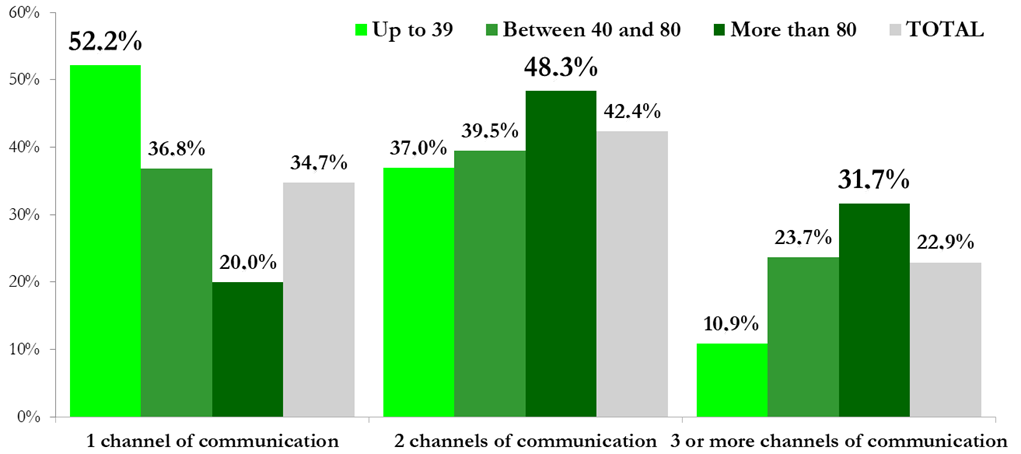
The media presence of the GAS has been consolidated into a unified index, under the assumption that the diversification of communication across multiple channels signifies an investment by the group in its own communication and a willingness to be present and represented in various digital environments. The GAS are almost evenly split between those that use a single communication channel (40.2%) and those that rely on two – typically a website combined with a social media page (40.8%). Only a fifth (19%) expand their communication strategy beyond these primary channels, incorporating additional tools such as newsletters, instant messaging platforms, magazines, radio broadcasts, or podcasts. This latter group is predominantly made up of GAS located in the North (68.3%). As with logo usage, media presence correlates with group size: smaller groups tend to limit themselves to a single communication channel (48%), whereas larger groups are more likely to manage multiple channels – 47.5% are active on two channels, and 57.6% on three or more (see Fig. 2). A similar pattern emerges in relation to legal status: informal groups use only one channel in 71.8% of cases, while formalised groups adopt a multichannel approach in 51.7% of cases.
A comprehensive observation of the visual identity of the groups reveals that in 64.9% of cases there is an absence of discernible visual identity, coherence, or even a minimally recognisable style, while in 35.1% of cases a certain degree of coherence can be observed. The GAS with a discernible style are predominantly those who have designed their own logo (58%), while those lacking a brand are among the groups exhibiting a weak visual identity (61.3%). Furthermore, the majority of these groups utilise a single communication channel (either exclusively via the website or exclusively via social media) (44.2%). In contrast, those exhibiting a more consistent media presence through two channels have been found to possess a more discernible visual identity (52.3%).
The presence of visual identity has been observed to increase in proportion to the size of the group; it is predominantly evident among large groups (54.8%), while its absence is particularly pronounced among small groups (38%). The majority of GAS located in metropolitan areas (76.8%) do not exhibit a clearly defined communication style. These groups are predominantly small in size, with 47.8% comprising up to 39 members. It is plausible that in metropolitan areas GAS are primarily organized at the neighbourhood or district level, which may explain why the size of the urban centre does not correspond to the size of the group itself.
Network analysis, broadly defined, reframes social life as a web of relations rather than a set of atomised units (Freeman 2004). Actors become nodes, their exchanges are edges, and the resulting graph can be interrogated to expose influence, brokerage, and cohesion.
In this study, network analysis is conducted through a hyperlink map – a sociogram in which each web domain managed by or closely associated with the Solidarity Purchasing Group (GAS) milieu is treated as an actor, and every clickable hyperlink embedded from one domain to another represents a directed relational tie. The theoretical premise underlying this approach is that embedding a hyperlink to another actor constitutes an act of recognition: it makes the target visible to a shared audience, directs traffic toward it, and signals at least a minimal intent to affiliate. The resulting network forms a digitally traceable layer of informational attention that may precede or accompany offline coordination, and thus merits analysis in its own right. In essence, network analysis provides a structural complement to ethnographic or discursive methods, revealing how GAS groups are situated within – and shaped by – the topology of their communicative environment.
To build the network we began with the URLs listed in Italy’s principal online GAS directories. The next step was to identify which additional actors these sites deemed worthy of linking to. For that purpose, we employed a web crawler, a software that imitates a human visitor by automatically downloading a page’s source code, scanning it for the hyperlinks (the links pointing towards another site’s page). By logging each hyperlink’s origin and destination, the crawler generates ordered pairs of URLs that serve as directed edges. The initial crawl captured over 5,000 hyperlink instances across roughly 100 distinct domains, illustrating the network’s raw magnitude. The raw harvest contained thousands of duplicate links, which were removed through several rounds of filtering. After cleaning, the observed network contains n=57 actors: n=32 local GAS collectives and n=25 intermediary entities – including national umbrella organisations, ethical producers, specialised news outlets, and NGOs – that serve as the movement’s digital connective tissue.
The network comprises n=57 connected websites, distilling a much larger set of potential URLs down to those whose pages actively hyperlink to one another. Despite its modest size, the graph appears asymmetrical (Fig. 3). Most sites issue only a handful of outbound links, whereas a small group functions as broadcasters: n=25 receive two or fewer, and a further n=16 attract no more than eight. At the opposite extreme, three actors form a towering hierarchy of recognition. The organic producers’ co-operative “Iris Bio” absorbs ninety-five weighted incoming hyperlinks, more than half of all endorsements circulating in the field, while the magazine “Altreconomia” follows with twenty-seven and the national coordination portal ReteGas with nineteen. In the visual rendering, Iris Bio appears as an oversized disc at the centre. Visibility here is therefore best understood as a collective attribution of authority: local GAS sites treat Iris Bio as the definitive reference for provisioning, Altreconomia as a trusted source of news, and ReteGas as the canonical archive of organisational resources.
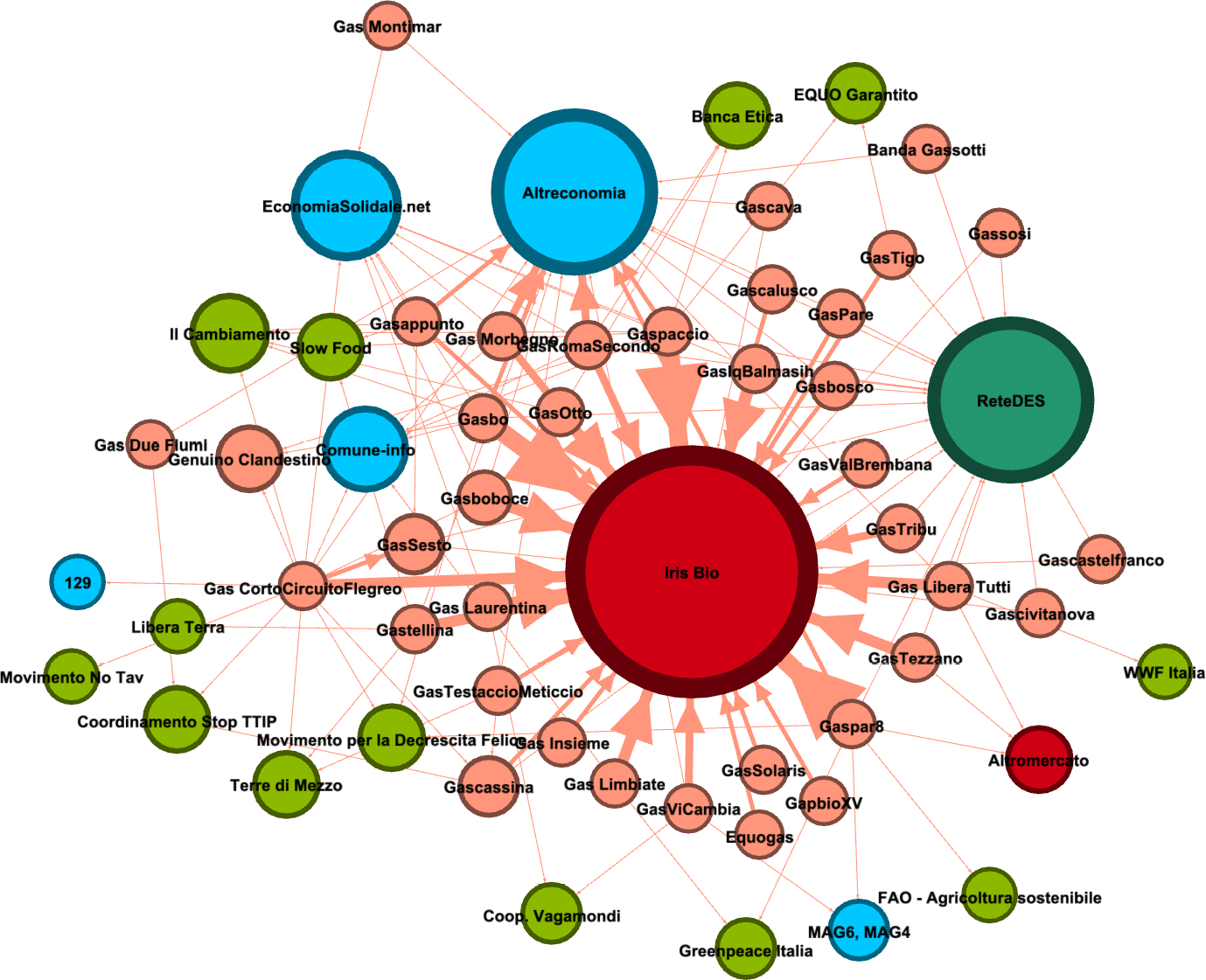
If inbound links measure prestige, outward linking measures curatorial labour. The actors who shoulder this task are not the hubs mentioned above, but a handful of mid-sized GAS whose pages point energetically outward. Gas Cortocircuito Flegreo, based in the outskirts of Naples, lists eighteen distinct destinations, followed by Gaspar8 and Gasbo, each with fourteen. Because closeness centrality (the reciprocal of the average shortest path from one node to all others) is calculated on the graph of the outbound paths, these three sites occupy the top positions, with GasCortocircuito Flegreo registering a normalised score of 0.94 and requiring on average fewer than two clicks to reach any other actor. They thus serve as potential digital gateways: a visitor who happens to land on one of their pages could traverse the movement’s hyperlink landscape far more efficiently than if they began with the heavyweight hubs. A similar redistribution of importance emerges from the analysis of betweenness centrality (how much a node sits on routes between other pairs). The sites that most often sit on the shortest weighted paths between third parties are ordinary purchasing groups. Their brokerage role stems from giving and receiving links. Thus, attention flows upward through unequal lines of recognition.
Based on this information, we can organize the field into four statistically cohesive blocs (Tab. 1). The first and largest cluster, centred on Iris Bio, comprises twenty purchasing groups united by a focus on food provisioning. Their websites predominantly link inward to the cooperative – for price lists, order calendars, and certification documents – but seldom link to one another, reinforcing the star-like network pattern. The second cluster, anchored by Altreconomia, brings together movement media and issue-oriented NGOs such as Greenpeace Italia and Slow Food. Here, linkage is more distributed: media outlets attract many inbound links but reciprocate selectively, weaving advocacy pages, investigative blogs, and campaign platforms into a cohesive discursive sub-public. The third community, smaller and geographically compact, is formed by seven southern GAS whose sites exhibit dense mutual linking while maintaining only two outward ties, both aimed at ReteGas. Finally, a bridging cluster central-Italian GAS contains the chief structural brokers (Gas CortoCircuitoFlegreo, Gaspar8, Gasbo and Gas Cascina), positioning as the actors with the highest betweenness value.
| Blocs | Core anchors | Size (Sites) | Link Pattern | Role in the network |
|---|---|---|---|---|
| Provisioning | Iris Bio | 20 | Dozens of GAS point for price lists and order forms; no lateral links among the GAS themselves | Concentrates recognition on the main organic producer |
| Media and advocacy | Altreconomia (with ReteGas as secondary pole) | ≈ 20 | Media/NGO receive links and reciprocate selectively | Diffuses frames and acts as discursive commons |
| Regional cohort | No single hub | 7 | Dense linking inside the group | Reflects a local cohesion; relies on national portal |
| Bridging bloc | Gas CortoCircuito Flegreo, Gaspar8, Gasbo, Gas Cascina | 10 | High outbound generosity | Keep the three blocs reachable in two-three clicks |
In the aggregate, the hyperlink landscape is neither a densely knit commons nor a pure hub-and-spoke system. Instead, it is a hybrid in which symbolic authority is sharply centralised while the practical labour of digital connectivity is diffused among medium-scale GAS.
A further layer consists of the tenuous yet charged interface between the GAS galaxy and broader social-movement organizations (e.g. NoTAV, No TTIP). Their presence indicates that local groups look outward to anchor their everyday practice in wider repertoires of contention. However, these links remain mere endorsements and do not disrupt the network’s star-shaped core.
The aggregate topology overall corroborates these observations. Density appears low, yet the average weighted distance between two arbitrary sites is only 2.8 steps, passing through narrow corridors. The directed-graph centralisation index for weighted in-degree stands at 0.71, indicating that symbolic authority is heavily concentrated in just a few landmark nodes. Reciprocity is equally limited: only 5% of all dyadic ties are mutual. The practical consequence is a marked asymmetry in communicative capability. Eccentricity scores make the same point from the opposite angle: while the median actor is at most four weighted steps away from the furthest site, twenty one nodes lie at the very edge of the star and would require five or more transfers to reach certain peers.
The challenge of obtaining a census of the GAS that was as accurate as possible was compounded by the nature of the object of study itself. The GAS is an informal phenomenon that is managed autonomously by the individual, with no obligation for authorisation or registration, and no need for an organisational structure or federation to join or depend on. The resultant data set revealed a multifaceted and intricate array of experiences, whose geographical distribution mirrors that of activities more broadly associated with the non-profit sector in Italy (Barbetta, Zamaro and Ecchia 2016). Nevertheless, there is a sense of a perpetually evolving environment, the complexity of which defies comprehensive representation through a faithful snapshot due to the inherently subjective nature of responsible consumption experiences.
These network traits, together with the informal, non-professional involvement of GAS participants, make it especially worthwhile to examine how each group manages its internal operations and conducts external communications – practices that vary considerably from one case to another. In the context of the business world, communication has traditionally been linked to profit. However, it has gradually evolved into a recognised strategic asset, (a status that is still recognised on paper, but often not in terms of investment in resources, budget and expertise). In the realm of associations and volunteering, the role of communication is even more unstable and ancillary, due to the sector’s greater economic and organisational instability.
On the one hand, the overall data reveal a low effectiveness of the tools implemented by the groups, as evidenced by the majority of cases in which there is no perceived originality in visual communication aspects or consistency in terms of visual identity. Conversely, a positive relationship has been demonstrated between the effort expended to represent the group’s identity through a logo or dedicated communication channels and the potential recognisability of the group externally. Communicating the GAS beyond the group’s immediate environment not only serves to promote itself and potentially increases its membership and scope of action – which is not always a priority or objective for members – but is also a thoughtful attempt at self-representation and a useful tool for disseminating the values and practices of responsible consumption that underpin the group’s existence. Although a strong commitment to communication often reflects group cohesion – rooted in members’ prior activism around responsible consumption or the unique social and cultural history of their locale – it is frequently undermined by amateurism and a lack of technical expertise, which diminishes its overall effectiveness.
Reflecting on the role of communication within solidarity purchasing groups meant observing a commitment on the part of the group in terms of time and resources, an investment that was not deemed to be indispensable for the functioning of the GAS itself. For this reason, it was interesting to understand what kind of groups acted in this sense, the communication tools they utilised, and the forms they adopted.
A first implication of the findings is that the digital life of the movement reproduces a stratification it disavows in day-to-day practices. While the GAS universe champions horizontal exchange and mutual aid, in the context of our analysis it seems that its hyperlink landscape concentrates symbolic capital in three focal nodes: provisioning (e.g. Iris Bio), framing (Altreconomia), documentation/organization (ReteGas). Thus, there is a notable tension between an egalitarian vision and the inevitable emergence of field effects in which scarce resources are unevenly distributed. First, the mere fact that so many groups choose to point upward rather than laterally generates a de facto hierarchy. The result is a core-periphery structure that naturalises certain actors as unquestioned reference points, allowing the movement digital sphere to crystallise around an unequal economy of attention. On the surface, the reason behind this may appear trivial: every local group, confronted with the practical need to reassure visitors about the reliability of producers, the legality of collective buying or the ethical pedigree of supply chains, does the sensible thing and points to the most authoritative and professionally maintained resources available. Yet, when hundreds of micro-decisions accumulate over time they generate the macroscopic hierarchy we observe. Framed as a social movement, GAS’s digital traces are far from neutral indicators of solidarity; they’re the sedimented outcomes of unequal communicative capacities. Consequently, many collectives struggle to reciprocate hyperlinks generously, constrained by scarce resources and an implicit hierarchy of media practices.
As a matter of fact, decentralised movements thrive by multiplying overlapping channels of coordination, succeeding as they assemble and sustain the resources (material goods, specialised skills, organisational infrastructures) that permit collective action (Jenkins 1983). In digitally network phase of social movements, hyperlinks, as symptom of communicative capacity, have become mobilising structures that coordinate attention, lower costs for newcomers and funnel legitimacy to authoritative nodes. Though GAS groups excel at coordinating the practical choreography of weekly deliveries, they often struggle to convey its broader significance to outsiders, relying on a narrative that collective local buying is inherently virtuous. The communicative deficiency revealed by a sparse and unreciprocated hyperlinking may reflect an organisational culture in which logistical efficiency (provisioning) risks to eclipse political signalling. Consequently, each group’s website functions as a silo: it efficiently provides members with order schedules but fails to articulate a shared vision of alternative consumption. In this configuration, “freeriding” no longer refers solely to those who collect products – it extends to the abdication of communicative labour itself. A range of activities, such as network coordination or organisational tasks, are less aligned with the enjoyment of responsible consumption or solidarity-based relationships (Hirschman 1982).
The result is a communicative ecology marked by implicit forms of activism, namely practices of resistance enacted in everyday routines but rarely translated into discursive claims that travel beyond the immediate circle. Consequently, while the movement succeeds in coordinating consumption with great efficiency, it may struggle to reshape the public sphere, as it aspires to.
6. CONCLUSION: RESISTING THE MALLS
Resisting the malls entails challenging the dominant retail model – centralized, anonymous, and consumption-driven – by organizing food provisioning around proximity, reciprocity, and a transformative purpose. The evidence from this investigation shows that, even when their online presence is fragmented and concentrated around a few hubs, the GAS movement indeed succeed in enacting an everyday alternative to “the mall”: relationships of trust with producers, ethics in price formation and collective deliberation for purchase decisions turn distribution into occasions to imagine alternative consumption trajectories. On one hand, the communicative ecology here observed (a few strong hubs in the results of the network analysis) is marked by implicit forms of activism, namely practices of resistance enacted in everyday routines but rarely translated into discursive claims that travel beyond the immediate circle of activists. Consequently, while the movement succeeds in coordinating consumption with great efficiency, it may struggle to reshape the public sphere, as it aspires to. Alternatively, this can be seen as a pragmatic approach to daily labour. The logistical routines of GAS – collective order planning, rotational task sharing, and public supplier discussions – are modest yet cumulative acts that foster social and personal accountability, even if they remain largely invisible in the communicative sphere.
It is precisely this “under the radar” infrastructure that has lent the movement durability. A mall’s competitive advantage rests on scale and spectacle; a GAS thrives on redundancy, local knowledge, and interpersonal obligation. Thus, reflecting on the role of communication within solidarity purchasing groups meant observing a commitment on the part of the group in terms of time and resources, an investment that was not deemed to be indispensable for the functioning of the GAS itself. For this reason, it was interesting to understand what kind of groups acted in this sense, the communication tools they utilised, and the forms they adopted. It is therefore pivotal to note that when only a handful of members shoulder the invisible labour that keeps the group coherent, the boundary between active co-producers and passive consumers becomes stark.
For this reason, the behaviour of those who are content with merely purchasing products (freeriding), without contributing to the essential activities necessary for the group’s proper functioning – such as maintaining relationships with producers, organizing and exchanging information, or handling external communications – has been commonly referred to in the GAS jargon as “treating the group like a supermarket.” The reference to large-scale retail in this type of criticism is revealing. It is significant how the GAS movement is experienced as a form of resistance to malls and large-scale organized retail, a resistance to industrialized and concentrated agriculture, as well as to the obsessions of consumerism, opposing production practices considered unethical, dangerous, and disrespectful of labour rights and the environment.
This study was guided by the twin challenges of politicising individual practices and averting their depoliticization (Burnham 2014; De Nardis 2017). The study set out to examine whether sharing practices and networked organizing could collectively prefigure alternative worlds through food activism. Although “acting in a network” remains central – evident in a rich web of intergroup ties and vibrant local purchasing initiatives – these collaborative dynamics still struggle to surface in digital communications. The potential for novel trends in mass consumption (Boström et al. 2005) does not invariably result in the transformation of resistance, from an individualistic approach to solutions, into communicative communities.
Barbetta G.P., Zamaro N. and Ecchia G. (eds) (2016), Le istituzioni nonprofit in Italia: dieci anni dopo, Il Mulino, Bologna.
Bennett W.L. and Segerberg A. (2013), The Logic of Connective Action: Digital Media and the Personalization of Contentious Politics, Cambridge University Press, Cambridge.
Boström M., Føllesdal A., Klintma M., Micheletti M., and. Sørensen Mads P, (eds) (2005), «9. Private Choice and Public Influence: Political Consumers behind the Mirror of the Market», in Political Consumerism: Its Motivations, Power, and Conditions in the Nordic Countries and Elsewhere : Proceedings from the 2nd International Seminar on Political Consumerism, Oslo August 26-29, 2004: 183-201. Nordic Council of Ministers.
Boström M., Micheletti M. and Oosterveer P. (eds.) (2019), The Oxford Handbook of Political Consumerism, Oxford University Press, New York.
Brunori G., Rossi A. and Guidi F. (2012), «On the New Social Relations around and beyond Food. Analysing Consumers’ Role and Action in Gruppi Di Acquisto Solidale (Solidarity Purchasing Groups)», in Sociologia Ruralis 52 (1): 1-30.
Burnham P. (2014), «Depoliticisation: Economic Crisis and Political Management», in Policy & Politics 42 (2): 189-206.
Castells M. (2011a), The Rise of the Network Society: The Information Age: Economy, Society, and Culture, John Wiley & Sons.
Castells M. (2011b.) The Power of Identity: The Information Age: Economy, Society, and Culture, Blackwell, Oxford, UK.
Castells M. (2012), Networks of Outrage and Hope: Social Movements in the Internet Age, Mass, Polity Press, Cambridge.
Castells M. (2013), Communication Power, Oxford University Press, Oxford.
Clarke J., Newman J., Smith N., Vidler E. and Westmarland L. (2007), Creating Citizen-Consumers: Changing Publics and Changing Public Services, Sage, London.
Lizabeth C. (2003), Consumers’ Republic, Random House, New York.
De Nardis F. (2017), «The Concept of De-Politicization and Its Consequences», in Partecipazione e Conflitto 10 (2): 340-56.
Feagan R. (2007), «The Place of Food: Mapping out the ‘Local’in Local Food Systems», in Progress in Human Geography 31 (1): 23-42.
Fominaya C.F. (2014), Social Movements and Globalization: How Protests, Occupations and Uprisings Are Changing the World, Palgrave MacMillan, Houndmills.
Forno F., Grasseni C. and Signori S. (2015), «Italy’s Solidarity Purchase Groups as “Citizenship Labs», in Putting Sustainability into Practice: Applications and Advances in Research on Sustainable Consumption, (eds.) E. Huddart Kennedy, M. J. Cohen and N. Krogman, Edward Elgar Publishing, Cheltenham, UK.
Forno F. and Graziano P. R. (2014), «Sustainable Community Movement Organisations», in Journal of Consumer Culture 14 (2): 139-57.
Freeden M. (2003), Ideology: A Very Short Introduction, OUP, Oxford.
Freeman L. (2004), «The Development of Social Network Analysis», in A Study in the Sociology of Science 1 (687): 159-67.
Geertz C. (1973), The Interpretation Of Cultures, Basic Books.
Gerbaudo P. (2017), The Mask and the Flag: The Rise of Anarchopopulism in Global Protest, Oxford University Press, Oxford.
Gibson-Graham J. K. (2006), A Postcapitalist Politics, University of Minnesota Press, Minneapolis.
Goodman D., DuPuis E.M. and Goodman M. (2012), Alternative Food Networks. Knowledge, Practice, and Politics, Routledge, New York.
Grasseni C. (2013), Beyond Alternative Food Networks: Italy’s Solidarity Purchase Groups, Bloomsbury Academic, New York.
Guidi R. and Andretta M. (2015), «Between Resistance and Resilience. How Do Italian Solidarity Purchase Groups Change in Times of Crisis and Austerity?», in Partecipazione e Conflitto 8 (2): 443-77.
Harrison R., Newholm T. and Shaw D. (2005), The Ethical Consumer, SAGE, London, New York.
Hassanein N. (2003), «Practicing Food Democracy: A Pragmatic Politics of Transformation», in Journal of Rural Studies 19 (1): 77-86.
Hilton M. (2009), Prosperity for All: Consumer Activism in an Era of Globalization, Ithaca: Cornell University Press.
Hirschman A.O. (1982) Shifting Involvements : Private Interest and Public Action, Princeton Paperbacks, Princeton (New Jersey).
Humphery K. (2013), Excess: Anti-Consumerism in the West, John Wiley & Sons.
Hunt S. and Benford R. (2008), «Collective Identity, Solidarity, and Commitment», In The Blackwell Companion to Social Movements, edited by D.A. Snow, S,A. Soule and H. Kriesi, 433-60. John Wiley & Sons, Oxford.
Jasper J.M. (2014), Protest: A Cultural Introduction to Social Movements, John Wiley & Sons, Oxford.
Jenkins J.C. (1983), «Resource Mobilization Theory and the Study of Social Movements», in Annual Review of Sociology, 527-53.
Kavada A. (2016), «Social Movements and Political Agency in the Digital Age: A Communication Approach», in Media and Communication 4 (4): 8–12. https://doi.org/10.17645/mac.v4i4.691.
Krippendorff K. (2018), Content Analysis: An Introduction to Its Methodology, SAGE Publications, New York.
Lewis T. and Potter E. (2011), Ethical Consumption: A Critical Introduction. Routledge, London. New York
Littler Jo. (2009), Radical Consumption: Shopping for Change in Contemporary Culture, Maidenhead, Berkshire, England; New York: Open University Press//McGraw-Hill Education.
Losito G. (1993), L’ analisi del contenuto nella ricerca sociale. Metodologia delle scienze umane, Franco Angeli, Milano.
Nunes R. (2021), Neither Vertical nor Horizontal: A Theory of Political Organization, Verso Books.
Oncini F., Bozzini E., Forno F. and Magnani N. (2020), «Towards Food Platforms? An Analysis of Online Food Provisioning Services in Italy», in Geoforum 114 (August): 172-80. https://doi.org/10.1016/j.geoforum.2020.06.004.
Polletta F. (2009), It Was Like a Fever: Storytelling in Protest and Politics, University of Chicago Press, Chicago.
Della Porta D. and Diani M. (2015), The Oxford Handbook of Social Movements. Oxford University Press, Oxford.
Della Porta D. and Diani M. (2020), Social Movements: An Introduction, John Wiley & Sons, Oxford.
Renting H., Schermer M. and Rossi A. (2012), «Building Food Democracy: Exploring Civic Food Networks and Newly Emerging Forms of Food Citizenship», in International Journal of Sociology of Agriculture and Food 19 (3): 289-307.
Renting H., Marsden T.K. and Banks J. (2003), «Understanding Alternative Food Networks: Exploring the Role of Short Food Supply Chains in Rural Development», in Environment and Planning A Abstract 35 (3): 393-411. https://doi.org/10.1068/a3510.
Sonnino R. and Marsden T. (2006), «Beyond the Divide: Rethinking Relationships between Alternative and Conventional Food Networks in Europe», in Journal of Economic Geography 6 (2): 181-99. https://doi.org/10.1093/jeg/lbi006.
Tavolo RES (2010), Il Capitale Delle Relazioni. Come Creare e Organizzare Gruppi d’acquisto e Altre Reti Di Economia Solidale, in Cinquanta Storie Esemplari. Milano: Altreconomia.
Touraine A. (1993), La Voix et Le Regard: Sociologie Des Mouvements Sociaux, Ed. du Seuil, Paris.
Tregear A. (2011), «Progressing Knowledge in Alternative and Local Food Networks: Critical Reflections and a Research Agenda», in Journal of Rural Studies, Subjecting the Objective– Participation, Sustainability and Agroecological Research, 27 (4): 419-30. https://doi.org/10.1016/j.jrurstud.2011.06.003.
Treré E. (2018), Hybrid Media Activism: Ecologies, Imaginaries, Algorithms, Routledge, London.
Wahlen S., Forno F. and Laamanen M. (2024), «Neo-Materialist Movement Organisations’ Scaling Through Strategies and Consumer Collective Action: Comparing Three European Food Movement Scenes», in Consumers and Consumption in Comparison, edited by Eivind Jacobsen, Pål Strandbakken, Arne Dulsrud, and Silje Elisabeth Skuland, 37:93–113. Comparative Social Research. Emerald Publishing Limited. https://doi.org/10.1108/S0195-631020240000037005.
1 The constitution of the mapping process firstly involved consultation with national and territorial archives – the Italian Solidarity Economy Network (Rete Italiana Economia Solidale) (economiasolidale.net); BioBank, the database of organic products in Italy (https://www.biobank.it/), the Distretti di Economia Solidale (DES, Solidarity Economy Districts) and the Reti di Economia Solidale (RES, Solidarity Economy Networks). Concurrently, a search for groups was conducted through direct exploration of the web. This exploration involved searching institutional sites through search engines and searching for groups and pages within the main social networking sites, especially Facebook.