Resistance Communities. Processes of Participation, Symbolic Conflicts and Liminality
1 Scuola IaD, Università degli Studi di Roma Tor Vergata, Italy
2 Dipartimento di Ingegneria dell’Impresa “Mario Lucertini”, Università degli Studi di Roma Tor Vergata, Italy
E-mail: fabiana.battisti@uniroma2.it; andrea.volterrani@uniroma2.it
*Corresponding author
Abstract. This paper examines resistance communities as critical actors in socio-political transformation within an increasingly digital society where social relationships shape collective action despite the atrophy of community norms. Investigating communities in liminal spaces facing economic, environmental, and cultural crises, we analyze how they challenge power structures through collective action and symbolic resistance. Our research examines the European Cerv Co-Green project across four countries and two grassroots associations in Rieti province defending mountain ecosystems. Through participant observation, workshops and interviews (2022-2024), we identify the forms of aggregate resistance, bonds of belonging, and differences between digital and non-digital approaches. We propose a conceptual model systematising the four activation spheres of resistance communities within the nexus identified in resistance studies concerning the interplay between the individual and collective dimensions, as well as constructive and destructive dissent. These spheres are: individual-value, communicative-relational, operational-strategic and socio-political-territorial. The model offers a nuanced understanding of the dynamics of liminal resistance experiences.
Keywords: resistance, social participation, liminal spaces.
Index
2.1. Questioning neoliberalism through social disintegration and political ecology
2.2. A challenging mixture: resistance, community and educommunication
4.1.1. Network development and social capital
4.1.2 Environmental priorities
4.1.3 Intergenerational collaboration and Demographic engagement
4.1.6 Energy Transition Approaches
4.2. PosTribù and Balia dal Collare
4.2.2 Community connectors through practices
In an increasingly digital society, social relationships and interactions significantly shape individuals’ perspectives and forms of collective action. However, there is also a marked atrophy of implicit social and community norms, crushed on the strictly individual dimension. In this scenery resistance communities have emerged as critical actors for socio-political transformations. These communities arise in liminal spaces (Sorice and Volterrani 2023) facing economic, environmental, and cultural crises. They challenge dominant power structures through collective action, cultural production, and symbolic resistance, often blending digital and physical engagement strategies. As «the failure of resistance ought to be differentiated from the failure to resist» (Chandra 2015: 565) and so from the relevance to study resistance, the following questions guided this study:
RQ.1. What forms of aggregate resistance do communities create? RQ.2. To what extent can this resistance structure bonds of belonging, processes of knowledge and symbolic rupture in the public sphere? RQ.3. What differences, challenges and opportunities emerge between the digital and non-digital practices among communities?
The paper focuses on two case studies (macro and micro) that are emblematic for analyzing complex forms of bottom-up resistance, both mediated by European projects and spontaneous:
a) the European Cerv Co-Green project, which involved liminal communities in Italy (Panebianco, Cosenza, Magione), Poland (Górno, Starachowice, Elbląg), Croatia (Drenova, Opatija, Njivice) and Greece (Karditsa) to activate and accompany the bottom-up ecological transition through the youths, b) the grassroots associations PosTribù and Balia dal collare in the province of Rieti (central Italy). Founded in 2009 and 2020, they both safeguard the water and mountain ecosystem. The former shows in its name the overcoming of the return to tribalism of individual interests in favour of social and environmental justice, the latter takes its name from the bird typical of the centuries-old beech forests of Terminillo mountain, which is threatened with extinction due to new anthropisation plans.
The structure of the contribution opens with a critical reconstruction of the neoliberal framework, problematising the individual and collective dimensions in the growing individualisation of society in relation to political ecology. It then outlines studies that highlight the relationship between community and social resistance action and educommunication. The qualitative methods adopted are then presented and include participant observation, workshops and interviews (period 2022-2024). The results propose the peculiarities and limitations emerging from the communities investigated, while in the discussion and conclusion we present a conceptual model that systematises the activation spheres of the resistance community and offers a more nuanced understanding of it, namely the individual-value, socio-political, operational-strategic and operational-relational spheres.
2.1. Questioning neoliberalism through social disintegration and political ecology
The contemporary social landscape is increasingly characterized by processes of individualization and the emergence of micro-identities that challenge traditional notions of social cohesion. Neoliberalism serves as the foundational context for these transformations, representing what Antonucci et al. (2024: 164) describe as the «substantial marketisation of public life and ‘commodification’ of social relations». This perspective conceives neoliberalism as a global political rationality (Dardot and Laval 2019) with profound implications for communicative processes, giving rise to what Dean (2019) terms communicative capitalism. The latter is the transformation that occurs in language when communicative processes merges with capitalism, becoming central to capital accumulation. The emptying of collective meanings in favour of their circulation in the media implies the crisis of the logic of the general, wherein civil, political, and democratic citizenship is being emptied of its original principles of equality and social inclusion (Reckwitz 2025 [2017]).
This singularization process extends beyond individuals to encompass objects, spaces, and even forms of social aggregation, creating what Reckwitz terms «singularized collectives» – neo-communities that coalesce around specific historical, geographical, or ethical uniqueness. These communities operate on a logic that attracts those similar to themselves while rejecting others, fundamentally challenging sociology’s central research question regarding integration capacity in plural societal contexts. Unlike in classical modernity, where social groups were perimetered and institutionalized by politicizing particular pre-political social bases, in singularized collectives, identity politics functions as an antagonistic affirmation operating on the dual track of valorization and devalorization. The resulting differential nature emphasizes not just particularity but a non-dilutable uniqueness in relation to others, characterized by internal complexity and density involving ethical, aesthetic, and planning dimensions. The bonding rather than bridging nature of such groups presents a significant challenge to social integration (Reckwitz 2025 [2017]).
This perspective aligns with Kossowska et al.’s (2023) framework detailing how individual motivation and social influence processes interact with media use, giving rise to virtual loyalties (micro-identities) and the construction of parallel social realities lacking cohesion with the broader community. Importantly, the authors note that the Internet serves as a facilitating environment rather than the root cause of micro-identity emergence. Drawing on Durkheim’s notion of disintegration, they describe the breakdown of social structures, values, norms, and institutions essential for community cohesion, leading to a prevalence of self-interest and loss of control and restraint, resulting in eroded trust, cooperation, and shared purpose (Kossowska et al. 2023). This perspective shifts attention away from technological determinism toward understanding the individual and psychological dynamics, as well as individual and collective resources, that shape polarization. Contrary to popular discourse about echo chambers and filter bubbles, also Bruns (2019) argues that we are experiencing polarization rather than fragmentation in the public sphere. He shows that filter bubbles and echo chambers are relatively minor effects primarily responding to human attitudes, emphasizing instead the importance of examining political demagoguery’s transformation of public debate.
In this vein, Kossowka et al. (2023) explains how individuals and groups harbor a fundamental need to feel respected, recognized, and valued, making them highly sensitive to experiences of diminished significance stemming from relative deprivation, humiliation, rejection, unfair treatment, and loss of social standing. This framework provides crucial context for understanding Bruns’ (2019) critique of echo chambers, especially considering the fundamental role of the public sphere as difference-friendly integration and integration-friendly differentiation based upon inclusive strategies towards those who are excluded (Della Porta 2022). As Della Porta (2022) argues, thanks to progressive social movements there are multiple (including subaltern) and counter public spheres that function as spaces of conflict but also of reciprocal recognition. Thus, social movements are constructing a European public sphere, which implies the relativization of national identity, a politics of recognition, critical and deliberative forms of culture, and inclusive conceptions of a European polity based on solidarity.
Although reconstructed in literature as deliberative, the digitalisation of collective processes of public awareness needs to be verified in terms of symbolic and substantive effectiveness, also taking into account the strong micro-identity fragmentation that inevitably has repercussions at the community level. This complex tension between neoliberalism, individual action and collectivity also calls into question the limits of anthropocentrism. In this regard, Bennett (2009) refers to a vibrant ecology of the world, considering ethics as a complex set of relationships between moral content, aesthetic-affective styles and public moods.
The author adopts a micropolitical perspective, according to which soft and psychocultural identity issues shape and reshape ethical sensibilities and social relations and are therefore themselves foundational and political, especially in neoliberal rationality. Bennett (2009: 8) argues that «there will be no greening of the economy, no redistribution of wealth, no application or extension of rights without human dispositions, moods and cultural sets favourable to these effects». A further advance in anthropocentric criticism is provided by Alaimo’s eco-crip theory (2017), which proposes reflecting on the contiguity between the mind-body and its social and natural environments. Challenging traditional neoliberal conceptions that privilege individual responsibility over collective action and structural change.
This ecological perspective finds resonance in contemporary environmental communication scholarship. Hannouch and Milstein (2025: 5) emphasize that «communication is a powerful social force in mindset and paradigm shifts, including in the production of identities», with regenerative forms of environmental communication potentially expanding ecocentric identification even within predominantly anthropocentric contexts. They note how social media enables individuals to discover like-minded communities and engage in political action, viewing these platforms less as a tool and more as agential when it comes to social change.
Ruiu et al. (2024) further complicate this picture capturing the interplay between structure and agency in shaping climate perception. This stems from a conceptualization of political and economic development based on Ecological Modernization Theory (EMT), which optimistically attributes the ability to address environmental issues to neoliberal institutions and modernization processes. However, the neoliberal dismantling of structural certainties embedded in a risk-stratified system where individuals are simultaneously perpetrators and victims (Ruiu et al. 2024). They identify a blaming/empowering paradox, rooted in a constructivist conceptualization of climate change vulnerable to interpretation. Such relativism can become instrumental in maintaining the status quo and serving certain economic interests (Ruiu et al. 2024). The relationship between the strong individualisation of society and the possibility of forming communities capable of social change through individual and collective agency will be explored in more detail in the next section.
2.2. A challenging mixture: resistance, community and educommunication
The concept of resistance is fluid and multifaceted, encompassing everyday practices, cultural upheavals and direct action (Scott 1990). A key theoretical perspective is that of «everyday resistance» (Lilja 2022), which highlights the subtle forms of opposition that emerge every day. Rather than engaging in large-scale protests or clashes with the state, many communities – which we can define as communities of resistance – operate through alternative narratives, micro-political actions and countercultural expressions, a prime example being the Palestinian people as is widely acknowledged in literature and digital communication (de Certeau 1984, Bayat 2013), up to and including current, daily, and atrocious testimonies of citizens on Instagram as a form of denunciation. Lilja (2022: 207) further elaborates on this perspective by observing that «resistance takes place in asymmetrical contexts and can be parasitic on power and/or feed it and undermine it at the same time». In this perspective, resistance actively engages with power through a dynamic combination of avoidance strategies, breaking patterns of resistance and building alternative subjectivities, narratives and communities.
This conception challenges simplistic dichotomies between power and resistance, pointing instead to their complex interrelation and mutual constitution. Chandra (2015) offers complementary insights by framing resistance as negotiation rather than denial of social power, which encompasses ambiguous or ambivalent acts in everyday life. This nuanced approach recognises that resistance itself can be to some extent empowered, but not completely, and this allows social change to occur at least in part from below. This perspective is in line with another crucial concept in resistance studies: liminality. It was initially introduced in anthropological studies to describe transitional phases in which identities and structures are renegotiated. In resistance communities, liminality manifests itself both through the marginalisation of specific groups occupying spaces of exclusion and through their ability to construct new forms of belonging and alternative imaginaries (Turner 1969, Thomassen 2014).
In a recent theoretical proposal, Mikael et al. (2023) problematise resistance in the context of neoliberal capitalism, emphasising that resistance must be understood contextually, as it changes with the economic, political and cultural topographies of power over time. They identify a relative silence in the literature regarding the various forms of activity that lie between individually and collectively organised resistance activities. These include individual resistance – which is neither hidden nor avoided and therefore does not fit neatly into the conventional conception of everyday resistance – and broader movements of dissent that tend to go unnoticed and avoid attention, such as those that «appear hidden online and are not easily detectable by observers as they would be in spectacular mass mobilisation events» (Mikael et al. 2023: 62).
The researchers’ approach shifts the focus from resistance against something to resistance that is productive of new lifestyles, institutions and so on. They suggest that resistance manifests itself through practices that produce and structure subjectivities, ways of life, desires and bodies, destabilising, displacing or replacing such production. These practices of resistance sometimes take digital forms, such as digital commons and open-source initiatives. Resistance thus emerges «in the collective/individual nexus and at the intersection of constructive/destructive dissent», with practices understood as «(1) a combination of avoidance, breaking, or constructive; (2) different resistance strategies that change/evolve over time; and (3) one resistance strategy enabling another» (Mikael et al. 2023: 74).
Symbolic conflicts are central to these dynamics of resistance. Many resistances communities struggle for meaning, using cultural symbols, digital media and performative actions to challenge dominant discourses. Media and communication technologies play a key role in these struggles, shaping both the internal organisation of resistance communities and their external visibility. The rise of digital activism and decentralised networks has further complicated traditional notions of power and agency in digital cultures (Couldry 2012, Bonini and Treré 2024). It is precisely at this intersection of communication, resistance and community formation that educommunication emerges as a powerful vehicle for community building beyond traditional social movements. Educommunication is a philosophy and practice informed by the work of Freire in the field of popular education (Freire 1985, 2022 [1970]).
Barbas and Treré (2022) were the first to highlight its fruitfulness in relation to the interpretation of social movements, due to the epistemological development it brings and its transdisciplinary nature, which establishes relationships of continuity between communicative and educational processes in a global, dynamic and interdependent way. Conceptualised as the communicative dimension of education and the educational dimension of communication, educommunication adopts a transformative approach as «a form of socio-critical pedagogy that conceives media both as educational agents and as means and tools for learning to participate in social and political processes» (Barbas and Treré 2022: 4). In this perspective, educommunication is committed to empowering citizens through the use of media and promoting long-term cultural and social transformations. The epistemology of educommunication goes beyond formal social movements to embrace various forms of resistance aimed at expanding spaces for political participation and developing practices of radical democracy.
This conceptualisation of educommunication as a community-building process is in line with and expands Mikael et al.’s (2023) notion of resistance as productive of new lifestyles and institutions. By integrating communicative and educational processes, educommunication creates spaces where resistance practices can generate alternative subjectivities and communities outside traditional institutional frameworks. These communities can emerge not only as reactions to dominant power structures, but as creative laboratories for new social arrangements and political imaginaries. In this way, educommunication acts as a bridge between individual resistance practices and collective transformation, enabling the development of communities capable of sustaining resistance over time and cultivating the capacities necessary to imagine and realise alternative futures.
This study uses a qualitative methodological approach with the aim of identifying the dynamics through which resistance communities are formed, organised and sustained over time involving digital and non-digital processes. Highlighting the limits and opportunities of hybrid participatory actions (Antonucci et al., 2024), symbolic and cultural conflicts in territorial liminalities and digital ecosystems (Sorice and Volterrani 2023), the study adopts an agerarchical stance inspired by edu-communication and action research. This theoretical direction recognises collaboration between researchers and community actors, seen as co-researchers, as the key to long-term knowledge mobilisation processes (Battisti and Volterrani 2025). Since exploring contextual ideas and critical issues allows for the recognition of individual perspectives, which contribute to critical knowledge, ethnographic research was conducted in the physical and digital spaces. The two case studies analyzed are macro and micro complex forms of bottom-up resistance, concerning the comparative international perspective of the European Cerv Co-Green project and the italian grassroots associations PosTribù and Balia dal collare. The first involved supporting the ecological transition of young people in five European countries, with parallel public and participatory discussions with associations and institutional representatives from the territories. As the European project included scheduled meetings, we list the main ones in the following Table 1.
| Date | Type | Participants by Gender and Country | TOT | ||||||||||||||||
|---|---|---|---|---|---|---|---|---|---|---|---|---|---|---|---|---|---|---|---|
| Sep. 23-24, ‘24 | HR | F: IT: 2, GR: 0, HR: 24, PL: 2 M: IT: 1, GR: 2, HR: 7, PL: 0 |
38 | ||||||||||||||||
| Nov. 29, ‘24 | Online | PL: 32, IT: 29, HR: 21, GR: 22 | 104 | ||||||||||||||||
| Jan. ‘23 – Nov. ‘24 | Multi-location | F: IT: 95, GR: 76, HR: 55, PL: 256 M: IT: 60, GR: 44, HR: 33, PL: 75 Non-binary: 9 |
703 | ||||||||||||||||
| Sep. – Oct. ‘24 | Multi-location | F: PL: 60, IT: 37, HR: 18, GR: 16 M: PL: 17, IT: 24, HR: 5, GR: 4 Non-binary: 2 |
183 | ||||||||||||||||
| Nov. 24, ‘24 | Online | PL: 103, IT: 80, HR: 35, GR: 35 | 253 | ||||||||||||||||
| May-June ‘24 | Multi-location | F: IT: 76, GR: 81, HR: 57, PL: 72 M: IT: 49, GR: 34, HR: 15, PL: 37 |
421 | ||||||||||||||||
| Source: Authors’ elaboration. | |||||||||||||||||||
The second concerns the spontaneous and organized initiative of two small environmental associations focused on protecting the natural ecosystem of the area of Rieti. The study involved participating in public demonstrations, observing interactions during activist meetings, and participating in online discussions on encrypted messaging platforms. The two-year ethnographic and participant observation approach (2022-2024) aimed to capture the everyday practices of resistance and the performative aspects of collective action for both the Co-Green project and the two organisations PosTribù and Balia dal collare (Balsiger and Lambelet 2014, Costa 2024). Specifically, the perception of struggles, the management of internal disagreements and strategies for future actions were explored in terms of symbolic resistance, also through the integration of informal in-depth interviews with key members, including activists, organisers and community participants. Ethically, the authors adhered to the code of conduct of the University of Rome Tor Vergata, ensuring transparency, anonymity and unwritten informed consent to interviewees to rigorously follow a situated and therefore flexible ethics with respect to the socio-cultural context of the research (Zayed 2021).
The interviews explored individual motivations and perceptions of the effectiveness of various resistance strategies, the role of digital media, and the challenges of maintaining long-term commitment. The interviews were transcribed and analysed thematically and inductively together with field notes to identify recurring patterns in the dynamics of resistance (Morris 2015, Barbas and Treré 2022). Systematisation was achieved by triangulating the analysis with the content of messaging apps (e.g. WhatsApp) used and online publications, blogs and alternative media sources produced by resistance communities. By integrating these methodological approaches, the study provides a comprehensive understanding of the multifaceted nature of resistance communities, highlighting their participatory processes, challenges and resistance strategies, as outlined in the next section.
It reveals distinct patterns of environmental engagement across the four participating countries (Poland, Italy, Croatia, and Greece), while also highlighting cross-cutting themes that transcend national contexts. This section presents a comprehensive analysis of eco-community engagement approaches and structural factors influencing green transition efforts.
4.1.1. Network development and social capital
Networks emerged as foundational for sustainable environmental action across all participating countries, serving as platforms for knowledge exchange and collaborative action. In Poland, networks integrated economic actors with municipal institutions and volunteer organizations, embedding sustainability within local economic systems. Croatian network development focused on energy democracy, connecting energy stakeholders with citizens through round tables. The formalization of these connections through the Green Network of Primorje-Gorski Kotar County (ZMPGŽ) represents a significant institutional outcome. This Croatian approach emphasized energy communities as enabling citizens, entrepreneurs and the public sector to invest in renewable energy projects and take active roles in the energy market, positioning community networks as alternatives to commercial energy companies.
Italian communities prioritized «neighborhood solidarity networks» as essential for increasing mutual support and sense of belonging, linking environmental sustainability with social cohesion. In Magione specifically, stakeholders with economic dependencies on Lake Trasimeno demonstrated high engagement levels, illustrating the intersection between environmental concerns and economic interests. In Greece, network development was framed within Municipal Authorities-Civil Society interaction, highlighting the importance of institutional-citizen collaboration. These networks, both locally and internationally, continued fostering collaboration beyond the project’s timeline, encouraging ongoing dialogue among community members, stakeholders, and institutions.
4.1.2 Environmental priorities
Each country demonstrated distinctive priorities shaped by local geography, immediate environmental threats, and climate change impacts. Italian communities, particularly Magione, focused on Lake Trasimeno’s ecosystem preservation, addressing climate change effects (drought) and microplastic pollution. They implemented cleanup operations that simultaneously served multiple functions: environmental education, community cohesion, citizen science, and sustainable waste management. Croatian communities emphasized coastal protection and climate resilience, developing practical adaptation measures for climate impacts, especially urban heat management through heat shelter development, white-painting of dark surfaces, and infrastructure planning for heat waves. Croatian initiatives also prioritized food sovereignty through preservation of autochthonous plant varieties, school Mediterranean garden development, and harvesting from abandoned fruit trees for social kitchens.
Greek communities concentrated on climate disaster prevention, particularly flood protection following two floods in three years. Polish activities focused on waste management, environmental education, and green space development, including canal-side green belt development, community gardens, and herb garden initiatives. Furthermore, Polish and Greek initiatives tended toward practical interventions with immediate results, while Italian communities developed comprehensive conceptual visions discussing regenerative and circular economy, bio-architecture, and urban forestry. Croatian communities balanced practical action with systemic approaches, implementing immediate measures while developing roadmaps for energy community development that included simplified registration processes, financial support systems, and municipal leadership in renewable energy development.
4.1.3 Intergenerational collaboration and Demographic engagement
A consistent pattern emerged regarding gender participation, with female participants substantially outnumbering male participants across all four countries. Age distribution showed participation primarily from seniors and youth, with notable absence of working-age adults. Multiple countries emphasized intergenerational collaboration as both strategy and outcome. Polish communities prioritized intergenerational integration through creative storytelling for environmental education, like the Starachowice Eco-fables competition connecting seniors and children. Croatian communities emphasized youth engagement, noting that «youth needs to restore trust through interactive, intragenerational, experiential activities that give them a sense of true influence». Italian communities in Cosenza demonstrated inclusive participation across age groups through community-building approaches including public gatherings and community art installations.
Greek analysis identified barriers including information gaps about environmental organizations, lack of awareness about events, time constraints, and skepticism about effectiveness of participatory processes. Geographic challenges were identified in Polish communities, where the community is spread over a large area lacking public transport. The Greek evaluation noted scarcity of active citizen initiatives to apply pressure on local government as a significant barrier, while observing that most NGOs are not actively utilizing participatory processes.
The importance of green activists as community catalysts consistently emerged. In Polish communities, these individuals activate the community and act as links between institutions and the community. Croatian communities emphasized professional youth workers in facilitating meaningful participation. Multiple countries identified institutional barriers to environmental progress. Croatian communities were particularly explicit, citing intensive dependence on fossil fuels and specific projects like marinas for megayachts in Porto Baroš and floating LNG terminal in Omišlja. In Greece, evaluations noted that the university has not been as open to collaborating with the local community as would be beneficial, while observing insufficient backing to support local actions and long-term projects from the municipality. A common challenge was integrating discrete environmental activities into coherent initiatives. Poland specifically called for continuity, for linking activities together, noting that municipalities have a series of disconnected activities.
4.1.6 Energy Transition Approaches
Croatia uniquely highlighted tensions between local development and external economic interests, noting strong consensus on fostering sustainable development independent of foreign capital and emphasizing local resilience over foreign capital. This reflected concerns about maintaining local autonomy in environmental decision-making. Energy transition emerged as significant, particularly in Croatian and Italian communities. Croatian communities focused explicitly on energy democracy and accessibility, addressing renewable energy sources, specifically energy poverty. Their roadmap emphasized simplified registration processes for energy communities, financial support systems, energy-sharing capabilities, and municipal leadership in renewable energy development, positioning energy communities as actors in the fight against energy poverty.
The Croatian consortium approach stands out for its institutional formalization through the Green Network of Primorje-Gorski Kotar County, which created a structured partnership between citizens, public institutions, and energy stakeholders. This mechanism established governance procedures that balanced grassroots participation with institutional support, creating a sustainable framework for ongoing collaboration beyond the project timeframe. By formally connecting municipal authorities with community initiatives, the consortium model facilitated both policy influence and resource allocation, demonstrating how institutional engagement can amplify rather than constrain community-led environmental action. Italian communities addressed community energy transition through initiatives involving citizens in renewable energy production and discussed projects for energy self-sufficiency, emphasizing citizen agency in energy production rather than energy poverty as a social issue.
4.2. PosTribù and Balia dal Collare
These organizations, active in the province of Rieti, demonstrate distinctive characteristics in their approach to community engagement and social transformation. These local initiatives exemplify the powerful relationship between educommunication processes and resistance practices, showcasing how educational communication strategies can be effectively deployed to challenge dominant paradigms and foster community resilience. Through their work, these organizations have developed context-specific methodologies that merge pedagogical innovation with territorial activism, creating spaces where learning becomes an act of resistance and where communication serves as a tool for reclaiming community identity and autonomy in response to the individualizing forces of contemporary society.
PosTribù and Balia dal Collare represent remarkable examples of territorial agency activators within the Rieti province, deliberately engaging in proactive resistance by drawing public attention to critical local needs. Despite operating as small groups of committed individuals, these organizations have demonstrated similar approaches in their battles against environmentally detrimental projects and policies, embodying a form of grassroots resistance that challenges institutional power dynamics. PosTribù (2025) achieved a historic victory against biomass plants in the Rieti area through coordinated public mobilization including demonstrations, sit-ins, and awareness campaigns featuring expert discussions on the environmental impacts of such facilities on local ecosystems. Their signature-gathering campaigns ultimately succeeded in halting political action that initially favored these installations. This triumph stands in stark contrast to the ongoing struggle regarding the Farfa River, concerning water concessions disputes between municipalities and the regional government dating back to 1996. In this case, mobilization efforts failed to persuade local municipalities to pursue legal action against Azienda Comunale Energia e Ambiente (ACEA) for environmental damages, despite the corporation’s activities nearly depleting the river’s springs and causing severe water supply shortages throughout the Sabine territory. This battle faced significant opposition from economic interests that manipulate the information system – notably, the leading local newspaper (Il Messaggero) consistently refused to publish or investigate the situation, as directly experienced by one of this paper’s authors who previously collaborated with the news outlet. This media blackout effectively prevented the development of public awareness regarding this critical environmental issue.
Balia dal Collare, appealing to a younger demographic and maintaining a more active presence on social media platforms like Instagram and Facebook, has been waging its own battle against TSM 2, the ski modernization plan for Mount Terminillo. While legal proceedings remain ongoing, the organization has leveraged a powerful strategy by reclaiming historical civic usage rights over the territories in question. These rights establish these lands as municipal public property and heritage that cannot be legally sold, transferred, or expropriated (Caroselli and Ciuffetti 2021). This legal approach has significantly hindered development efforts and represents an innovative fusion of historical legal frameworks with contemporary environmental activism. Both organizations exemplify how small but determined groups can effectively challenge powerful economic and political interests through strategic communication, legal ingenuity, and persistent community engagement. Their work demonstrates that resistance is not merely reactive but can be constructively proactive, creating alternative pathways for territorial development while safeguarding environmental resources and community rights.
By activating local agency through multifaceted approaches combining legal strategies, public demonstrations, expert knowledge mobilization, and strategic media engagement, these organizations have managed to transform seemingly inevitable development trajectories into contested spaces where community voices can meaningfully influence outcomes. Their experiences highlight the essential role of independent civic organizations in maintaining democratic checks on development processes, particularly in regions where economic interests might otherwise dominate decision-making processes at the expense of environmental sustainability and community wellbeing.
4.2.2 Community connectors through practices
The distinctive approach of PosTribù and Balia dal Collare lies in their ability to build networks among existing communities across the territory, connecting smaller, scattered associations that already safeguard areas from sustainability and eco-solidarity tourism perspectives. What guides these organizations is personal integrity – persevering even when circumstances appear hopeless, pursuing greater intentions despite limited personal time commitments, maintaining strategic discretion when necessary to protect collective achievements during legal proceedings, and balancing emotional and personal resources with intelligence. The long-term challenge remains significant, with a missing generation of participants and a profound crisis in volunteerism and civic engagement. As one member reflects, «It’s as if the great search for self, for finding meaning in one’s identity and the intimate desire to discover new values, has caused people to lose sight of others – who we are and what we can do and demand as a collective, which is always an active part of the surrounding environment in which we live.»
The networking capabilities of both associations enable them to bring an intersectional dimension to their battles and projects. Specifically, PosTribù worked to launch PosTerremoto, a project that achieved self-sustainability following the initial emergency of the Amatrice earthquake, connecting farmers across 70 different fractions who came to know each other well enough to exist and resist in depopulated territories. Other initiatives include solidarity purchasing groups, recycling days, and gift markets that offer circumstantial but cyclical opportunities to experience community practices and activation. Additionally, their territorial presence extends to managing free spaces serving citizens as places for meetings, study or prayer in the absence of a mosque in Rieti. Despite limited resources, their strength lies in creating projects that enable territories to move forward autonomously. This connective approach transforms isolated resistance efforts into a cohesive movement, weaving together diverse threads of local expertise and commitment into a resilient fabric of community engagement that can withstand external pressures while nurturing internal solidarity.
Our research findings illuminate how resistance communities operate as interpretive communities (Fish 1980) through their collective practices (RQ1). These communities demonstrate constructive resistance by drawing attention to the symbolic value of ecological struggles, demanding rights, and reframing the effectiveness of grassroots civic activation. Their approach is characterized by participatory knowledge production, where communities engage in edu-communication initiatives that empower marginalized groups through collective learning processes (Freire 1970). This co-construction of knowledge becomes particularly vital in contexts where formal institutions fail to address community needs, fostering a sense of agency and collective identity while negotiating the emotional burden of activism. In the spirit of educommunication, they form interpretive resistance communities that disseminate shared meanings to enhance public consciousness, creating spaces where diverse citizens can collaboratively engage in civic discourse.
The liminality of these communities is situated in their renegotiation of spaces and the public aggregation of diverse identities and associations that transform into generative projects (RQ2). These initiatives multiply across territories, offering interconnected counter-public spheres capable of attracting participation and generating tangible impacts for democratic deliberation (see Della Porta 2022). Concrete examples include the successful blocking of biomass plants and the formation of the Croatian consortium. Through symbolic resistance strategies – including artistic expression and performative protest – these communities challenge hegemonic discourses while reclaiming both public spaces and narrative power. This process demonstrates how interpretive communities can structure bonds of belonging by creating shared spaces for civic action, develop processes of knowledge through collaborative activism, and produce symbolic ruptures in the public sphere by challenging dominant narratives about ecological issues and citizen power. However, as our analysis reveals, symbolic resistance alone proves insufficient for achieving concrete political change without direct policy engagement or institutional recognition.
Despite their effectiveness in physical spaces, these communities struggle to inhabit digital environments (RQ3). They prioritize direct, in-person experiences or private communication channels such as WhatsApp groups, showing a limited digital presence. Though they position themselves as alternatives to societal individualization and fragmentation, this form of resistance does not offer a true alternative to communicative capitalism (Dean 2019), lacking even their own alternative media outlets. While some communities engage in hybrid activism – combining digital and online resistance strategies – many face challenges in effectively coordinating between decentralized digital networks and localized, embodied forms of protest. This creates a tension that limits their potential impact. Within the media ecosystem paradigm (Barbas and Treré 2022), the partial absence of media utilization by these interpretive communities constrains their potential pervasiveness in society and confines them to private, situated projects. This exposes them to control by unprepared yet decisive political actors and the interests reflected in legacy media narratives or non-narratives (see Ruiu et al. 2024), rather than enabling direct citizen engagement for social change through consensus-building and awareness-raising.
In conclusion, adopting Mikael’s et al. (2023) proposal of resistance as a link between individual and collective dimensions and between constructive and destructive dissent, we propose the following activation spheres in Fig. 1.
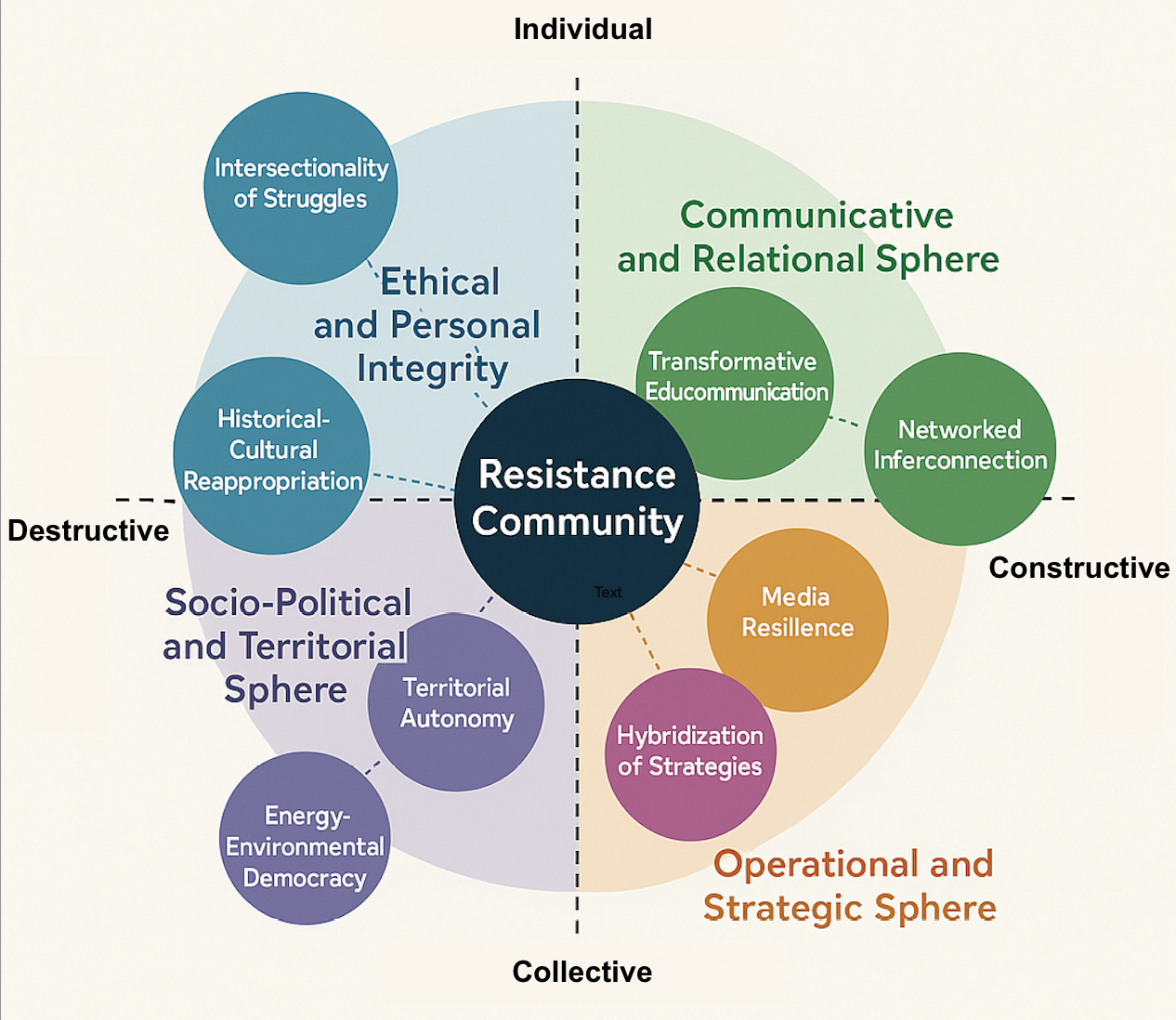
Resistance communities are effectively made up of proactive and monitorial citizens who can operate within their local areas. From this perspective, the individual and destructive dimension of dissent represents an intimate awareness of resistance that is subsequently transferred to collective action. The core values that guide resistance communities include perseverance in difficult situations and a balance between emotional resources and rationality in the pursuit of collective goals. Furthermore, the ability to recover and reuse historical, legal or cultural elements as tools of contemporary resistance, as demonstrated by the innovative use of historical civil rights to counter neoliberal modernisation projects. In addition, the capacity to link different social, economic and environmental issues within a holistic vision of resistance connects environmental concerns with social solidarity, cultural integration and sustainable economic development. Considering the communicative and relational sphere, the individual and constructive dimension of dissent – focusing on communication and education as tools for transformation – implies the ability to create networks between existing communities and small associations in different territories, connecting different local realities to build a broader and more cohesive fabric of resistance.
The strategic use of educational and communicative processes as tools for social transformation and resistance creates spaces where learning becomes an act of resistance. The collective and constructive dimension of dissent addresses internal negotiations and attractiveness through strategic approaches. The simultaneous use of multiple and complementary approaches combining social activism, legal strategies, the mobilisation of specialised knowledge and strategic communication creates alternative channels of communication, combating media blackouts through the strategic use of social media and other platforms. Furthermore, the collective and destructive dimension of dissent – which opposes dominant power structures through deliberative resistance – develops and implements initiatives independent of dominant institutional structures, mobilising to counter environmentally harmful projects and claiming historical civil rights. The commitment to democratic participation in decisions regarding natural and energy resources allows activities to be maintained over time despite limited resources, as demonstrated by projects that become self-sufficient and cyclical initiatives.
These four spheres contribute to the formation and survival of resistance communities over time, functioning in a cycle of influence that is not ordered, in which each reinforces and transforms the others. The scalability of resistance strategies emerges as a critical challenge (Tarrow 2011). While many communities succeed in mobilizing locally, they struggle to expand their influence beyond immediate environments. This limitation, coupled with the fragmentation of participation observed across multiple contexts, raises questions about the sustainability of resistance formations over time. Some communities persist through evolving strategies, while others dissolve due to internal conflicts, repression, or shifts in the political landscape. The question of how communities adapt their resistance practices in response to repression and co-optation from state institutions and private actors remains central to understanding their potential for lasting impact and structural change.
Alaimo S. (2017), Disability Studies and the Environmental Humanities: Toward an Eco-Crip Theory, University of Nebraska Press, Lincoln.
Antonucci M.C., Sorice M. and Volterrani A. (2024), «Liminalities: Social Vulnerabilities Between Participatory Processes and Digital Space in the Neoliberal Era», in SocietàMutamentoPolitica, 15(29): 163-177, https://doi.org/10.36253/smp-15505.
Balsiger P. and Lambelet A. (2014), «Participant observation», in D. Della Porta (a cura di), Methodological practices in social movement research, Oxford University Press, Oxford, pp. 144-172.
Barbas Á. and Treré E. (2022), «The rise of a new media ecosystem: exploring 15M’s educommunicative legacy for radical democracy», in Social Movement Studies, 22(3): 381-401, https://doi.org/10.1080/14742837.2022.2070738.
Battisti F. and Volterrani A. (2025), «I processi di educommunication nello sviluppo sociale di comunità. Esperienze di ricerca-azione nel Sud Italia», in E. Mangone, E. Martini, A. Volterrani (a cura di), Società digitale frammentata e traiettorie educative. Disuguaglianze, giustizia sociale e intelligenza artificiale, Mimesis, Milano, pp. 121-150.
Bayat A. (2013), Life as Politics: How Ordinary People Change the Middle East, Stanford University Press, Stanford.
Bennett J. (2009), Vibrant Matter. A political Ecology of Things, Duke University Press, Durham.
Bonini T. and Treré E. (2024), Algorithms of Resistance: The Everyday Fight against Platform Power, MIT Press, Cambridge.
Bruns A. (2019), Are Filter Bubbles Real?, Polity Press, Cambridge.
Caroselli S. and Ciuffetti A. (2021), «L’urbanizzazione del Terminillo e il Progetto TSM2: la storia e gli usi civici come strumenti di lotta», in Os. Opificio della storia, 2: 66-71, https://doi.org/10.6093/2724-3192/8254.
Chandra U. (2015), «Rethinking subaltern resistance», in Journal of Contemporary Asia, 45: 563-573, https://doi.org/10.1080/00472336.2015.1048415.
Costa E. (2024). Long-term holistic ethnography for new digital worlds. Ethnography, 0(0). https://doi.org/10.1177/14661381241260884
Couldry N. (2012), Media, Society, World: Social Theory and Digital Media Practice, Polity Press, Cambridge.
Dardot P. and Laval C. (2019), Common: On revolution in the 21st century, Bloomsbury Publishing, London.
Dean J. (2019), «Communicative Capitalism and Revolutionary Form», in Millennium, 47(3): 326-340, https://doi.org/10.1177/0305829819840624.
de Certeau M. (1984), The Practice of Everyday Life, University of California Press, Berkeley.
Della Porta D. (2022), «Progressive Social Movements and the Creation of European Public Spheres», in Theory, Culture and Society, 39(4): 51-65, https://doi.org/10.1177/02632764221103510.
Fish S. (1980), Is There a Text in This Class? The Authority of Interpretive Communities, Harvard University Press, Cambridge.
Freire P. (2022 [1970]), Pedagogia degli oppressi, Edizioni Gruppo Abele, Torino.
Freire P. (1985), The politics of education: culture, power and liberation, Bergin & Garvey, New York.
Hannouch B. and Milstein T. (2024), «Activating Ecocentrism: How Young Women Environmental Activists Produce Identity on Instagram», in Environmental Communication, 19(2): 198-217, https://doi.org/10.1080/17524032.2024.2376697.
Kossowska M., Kłodkowski P., Siewierska-Chmaj A., Czarnek G., Wyczesany M., Sekerdej M., Szwed P., Cwik S.S. and Seroczynska M. (2023), «Internet-based micro-identities as a driver of societal disintegration», in Humanit Soc Sci Commun, 10: 955, https://doi.org/10.1057/s41599-023-02441-z.
Lilja M. (2022), «The definition of resistance», in Journal of Political Power, 15(2): 202-220, https://doi.org/10.1080/2158379X.2022.2061127.
Mikael B., Lilja M., Schulz M. and Vinthagen S. (2023), «The ABC of resistance: towards a new analytical framework», in Journal of Political Power, 16(1): 59-80, https://doi.org/10.1080/2158379X.2023.2168369.
Morris A. (2015), «The what and why of in-depth interviewing», in Id., A Practical Introduction to In-Depth Interviewing, SAGE Publications Ltd, New York, pp. 1-16, https://doi.org/10.4135/9781473921344.
Reckwitz A. (2025 [2017]), La società delle singolarità. La trasformazione strutturale della modernità, Meltemi, Milano.
PosTribù (2025), Acqua: a Rieti e nel Lazio compiuto il “delitto perfetto”! https://postribu.net/2025/02/02/acqua-a-rieti-e-nel-lazio-compiuto-il-delitto-perfetto/
Ruiu M.L., Ruiu G. and Ragnedda M. (2024), «Between “Empowering” and “Blaming” Mechanisms in Developing Political/Economic Responses to Climate Change», in Sociol Inq, 94: 263-289, https://doi.org/10.1111/soin.12538.
Scott J.C. (1990), Domination and the Arts of Resistance: Hidden Transcripts, Yale University Press, New Haven.
Sorice M. and Volterrani A. (2023), «Liminalità, partecipazione ed ecosistemi mediali negli spazi urbani», in H-ermes. Journal of Communication, 24: 27-50, https://doi.org/10.1285/i22840753n24p27.
Tarrow S. (2011), Power in Movement: Social Movements and Contentious Politics, Cambridge University Press, Cambridge.
Thomassen B. (2014), Liminality and the Modern: Living Through the In-Between, Routledge, London.
Turner V. (1969), The Ritual Process: Structure and Anti-Structure, Aldine, Chicago.
Zayed H. (2021), «Researching Digital Sociality: Using WhatsApp to Study Educational Change», in Journal of Digital Social Research, 3(2): 44–69. https://doi.org/10.33621/jdsr.v3i2.80.