Ecological Resistance in Intentional Communities. A Case Study of Sociocratic Governance in an Ecovillage in Navarre (Spain)
University of Granada, Spain
E-mail: macpesce@gmail.com; lmlagos@ugr.es
*Corresponding author
Abstract. This paper explores ecological resistance through the lived experience of Arterra Bizimodu, an ecovillage in Navarre, Spain, where around 40 people have come together to create a life centred on cooperation, sustainability, and shared governance. As part of a wider neo-rural movement, many of the residents – mainly aged between 25 and 45 – have chosen to leave urban life behind in search of a more meaningful and ecologically aligned existence. The community is the headquarters of GEN-Europe (Global Ecovillage Network) and plays a key role in networks supporting transformative learning and regenerative living. Drawing on fieldwork conducted in 2024, including participant observation and 12 interviews, this study looks closely at how sociocratic decision-making, permaculture design, and everyday ecological practices shape both personal and collective transformation. Tools like non-violent communication and participatory democracy help foster mutual trust, emotional awareness, and a sense of shared responsibility. Rather than representing utopian idealism or retreat, Arterra Bizimodu functions as a grounded experiment in socio-ecological transition. It illustrates how ecovillages can act as real-world laboratories in the daily practice of care, participation, and interdependence.
Keywords: Neo-ruralism, Intentional communities, Transformative learning, Participatory democracy.
Index
1. INTRODUCTION: THEORETICAL FRAMEWORK UNDERSTANDING ECOVILLAGES AS SPACES OF RESISTANCE
1.1. Participatory democracy and eco-social innovation in ecovillages
1.2. Arterra Bizimodu: sociocratic governance in everyday practices
1.2.1. Eco-social challenges and transformative learning
2.1. Constructivist Grounded Theory
2.2. Emerging categories and key themes about the topic sociocracy
3. LIFE EXPERIENCE IN AN ECOVILLAGE
3.1. From urban life to neo-rural intentional community
3.2. Participants’ life trajectories and the reconfiguration of professional identities
3.3. Sociocracy in practice: participatory governance in everyday life
3.4. Intentional communities as spaces of counter-hegemonic political practice
1. INTRODUCTION: THEORETICAL FRAMEWORK UNDERSTANDING ECOVILLAGES AS SPACES OF RESISTANCE
1.1. Participatory democracy and eco-social innovation in ecovillages
This study investigates how participatory democracy – particularly through the sociocratic model adopted in ecovillages – serves as a form of socio-political resistance and fosters eco-social transformation. Specifically, it examines how inclusive decision-making processes, collective organization, and sustainable living practices contribute to constructing alternatives to dominant socio-economic paradigms.
The research focuses on Spain, a country where, following the Francoist dictatorship and the armed resistance of ETA, antimilitarist and non-violent social movements emerged. These movements, especially active during the 1970s and 1980s (Ordás García 2024), provided fertile ground for the later development of neo-rural intentional communities. Many of these communities today self-identify as ecovillages are interconnected through the Iberian Ecovillage Network (Red Ibérica de Ecoaldeas: RIE), recognized as the European area with the highest density of ecovillages (Renau 2018).
The term “ecovillage” was introduced by Diane and Robert Gilman in 1991, reflecting a conceptual shift towards integrating social, ecological, and economic sustainability at the local level (Gilman and Gilman 1991). The 1995 conference Ecovillages and Sustainable Communities – Models for the 21st Century (Litfin 2014) and the subsequent creation of the Global Ecovillage Network (GEN) (Jackson and Svensson 2002) further institutionalized ecovillages as part of an emergent global movement for sustainability and wellbeing (Gough 2017).
Building on prior sociological studies, this research draws on key contributions that explore ecovillages as pioneers of change and as models for cultural transformation in the pursuit of utopia (Andrea and Wagner 2012); as spaces where cosmological and symbolic dimensions of communal living are balanced (Salamanca and Silva 2015); and, in more recent work, as laboratories of socio-environmental resilience, highlighting the interconnections between individual and collective dimensions through practices of inner work and dream interpretation (Karavioti 2024).
The theoretical framework is anchored in the rich tradition of the new social movement theory and extends into contemporary debates on ecotopian imaginaries and critiques of growth-oriented paradigms (Veteto and Lockyer 2013). Central to this approach is the work of Melucci and Touraine (1988), who foreground the role of cultural codes, collective identity, and symbolic action in the emergence of social movements, moving beyond purely class-based analyses, including forms of activism such as pacifism and environmentalism. Rather than reducing collective action to economic grievances, their perspective emphasizes how alternative communities are shaped around shared meanings, ethical visions, and prefigurative practices that enact desired futures in the present.
This framework resonates strongly with recent research on ecological and degrowth-oriented movements, which are increasingly embraced by younger generations as responses to climate anxiety and socio-political disillusionment (Asara and Alietti 2024). These movements, and the intentional communities that embody them, propose not only a critique of capitalist modernity but also experimental alternatives rooted in ecological interdependence, participatory governance, and the reconfiguration of everyday life. Ecovillages can thus be understood as spaces where these theoretical insights take form, offering concrete expressions of post-capitalist imaginaries and pathways toward socio-ecological transformation.
This perspective aligns with recent scholarship on ecotopian movements, which conceptualize intentional communities not only as spaces of resistance but as laboratories for future-oriented social experimentation (Centemeri and Asara 2022). These communities do not merely reject dominant socio-economic structures – they actively enact alternative worldviews grounded in ecological interdependence, social cooperation, and self-limitation. They embody an ethico-political project, performing alternative and prefigurative ontologies of the buen vivir and redefining the boundaries of political engagement through everyday practice.
Furthermore, this research engages with critiques emerging from the degrowth literature, which challenges the logic of infinite economic expansion as both unsustainable and socially corrosive (Kallis et al. 2020). Degrowth scholars call for a fundamental rethinking of prosperity, rooted in sufficiency, care, and conviviality – principles that resonate deeply with the organizational and situated practices observed in ecovillages such as Arterra Bizimodu.
1.2. Arterra Bizimodu: sociocratic governance in everyday practices
The empirical investigation focuses on Arterra Bizimodu (Bizimodu is the name in Euskera; for simplicity, we will refer to it hereafter as Arterra), an ecovillage established in 2014 in Navarre, Spain. Since its founding, Arterra has embodied an experimental approach to communal life, rooted in horizontal governance and shared ethical values. The relocation of the GEN Europe office to Arterra in December 2014 (Dregger 2015) emphasized its role as a key reference point within the broader European ecovillage network.
The community organizes its internal life through the application of sociocracy,
a set of tools and principles that ensure shared power. […] Power is everywhere all the time, and it does not appear or disappear – someone will be holding it. We have to be intentional about how we want to distribute it. Power is like water: it will go somewhere, and it tends to accumulate in clusters: the more power a group has, the more resources they will have to aggregate more power. The only way to counterbalance the concentration of power is intentionality and thoughtful implementation (Rau and Koch-Gonzalez 2023: 3).
Sociocracy originated in the Netherlands with educator Kees Boeke, who in the 1920s experimented with a decision-making method based on assent. In the 1970s, engineer Gerard Endenburg formalised this approach within a business context, developing the Sociocratic Circle-Organization Method, inspired by cybernetics and systems theory (Buck and Villines 2007). At its core is the principle of making decisions that are “good enough for now and safe enough to try,” emphasising consensus that is reached through two rounds within the circle, where each member has the right to object – a right intended to serve the project constructively. Objections are not seen as blocks but as opportunities for improvement and can be integrated into the proposal during the round with the support of the facilitator. The four main principles of sociocracy are: decision-making by consent, the egalitarian election of function holders, the structuring of activities into functional circles, and the establishment of double links between circles to facilitate both vertical and horizontal coordination (Rau and Koch-Gonzalez 2023).
1.2.1. Eco-social challenges and transformative learning
Over the past eleven years, Arterra has faced multiple eco-social challenges while experimenting with a complex integration of sociocratic governance, ecological design, and intentional communal living. Each circle within Arterra functions as a semi-autonomous group with clearly defined domains and responsibilities – such as prosperity, ecology, communal living, and more specifically, hospitality, community well-being, the management of animals, food production, education, communication, and infrastructure (see Figure 1). This distributed structure, inspired by sociocracy, has enabled inclusive participation but also brought challenges related to time, coordination, and emotional labor. The layered circle system and double-linking mechanisms, while designed to ensure transparency and feedback, often resulted in meeting fatigue and decision-making overload, particularly during periods of growth or when onboarding new members unfamiliar with horizontal governance models. At the same time, Arterra’s spatial and ecological practices draw deeply from permaculture principles, seeking to harmonize human activity with natural ecosystems through strategies of resource optimization, biodiversity, and systemic thinking (Holmgren 2002; Ghelfi 2022). These principles, when applied to community-scale projects such as decentralized energy systems (e.g., biogas and solar), collective food production, and natural cosmetics, introduced significant organizational and technical complexity. Shifting from individual experimentation to collective enterprise required new forms of coordination, long-term planning, and a shared sense of responsibility, which were not always easy to sustain.
This combination of participatory governance and ecological design can be interpreted through the lens of terraforming, understood here as the conscious and collective effort to reconfigure the social and environmental landscape, cultivating interdependence among human and more-than-human actors (Latour and Schultz 2022; Ghelfi 2022). In practice, however, this reconfiguration is uneven and contingent. The community often struggled to balance autonomy and cooperation across diverse rhythms of life, worldviews, and social backgrounds. Efforts to nurture cohesion were supported by micropolitical methodologies – such as active listening, non-violent communication, and deep ecology –which were systematically integrated into everyday life to support self-awareness, conflict transformation, and the cultivation of collective intelligence (Devall 2020; Rosenberg 2015).
Moreover, Arterra actively engages in broader pedagogical and transformative learning processes (Mezirow 2018), participating in initiatives such as EU4-Transition and CLIPS (Community Learning Incubator Project for Sustainability), which aim to strengthen capacities for sustainable living and community resilience (Carraro et al. 2023). Yet even with such tools, the tension between inner transformation and collective functioning frequently emerged, particularly in emotionally charged contexts or moments of structural change. These challenges reveal the lived complexity of attempting to build a post-capitalist, eco-social alternative – not as a utopia, but as a situated and ongoing process of collective experimentation.
2.1. Constructivist Grounded Theory
This research adopted a qualitative, ethnographically inspired approach, conducted in two phases of fieldwork carried out in February and May 2024. The study employed participant observation to engage directly with the rhythms and dynamics of community life, complemented by semi-structured interviews.
Data analysis followed the principles of Constructivist Grounded Theory (CGT) (Charmaz, 2006), privileging an iterative and co-constructive process of meaning-making between researcher and participants. The coding process evolved through open, focused, and theoretical coding phases, with five sensitizing concepts guiding, but not constraining, the emergence of analytical categories (see Table 1). The decision to finalize codes and categories was guided by theoretical saturation, defined as the point at which new data no longer produced substantive changes to the developing theory.
| Substantive Categories | Conceptual Categories | Basic Social Processes (PSB) | |||||||||||||||||
|---|---|---|---|---|---|---|---|---|---|---|---|---|---|---|---|---|---|---|---|
| Duration in the ecovillage and motivation | Mindful engagement with life in the community. | Adjustment to new lifestyle | |||||||||||||||||
| Life trajectory | Personal journey, past experiences. | Integration of past and present | |||||||||||||||||
| Advantages and challenges of ecovillage life | Sustainability, community dynamics, sociocracy. | Adaptation to collective living | |||||||||||||||||
| Experiences with the sociocracy | Inclusivity, active listening, NVC. | Transparent decision-making | |||||||||||||||||
| Political ecovillage life | Think globally, act locally. | Programmatic dissemination of ecological best practices | |||||||||||||||||
| Source: Authors’ elaboration. | |||||||||||||||||||
This iterative approach allowed for the continuous integration of participants’ perspectives, enriching the shared construction of meaning and ensuring greater analytical depth. Advantages include flexibility and responsiveness to emerging data, while limitations encompass potential subjectivity arising from close researcher-participant interaction and the time-intensive nature of the process, which may restrict the study’s scalability.
To strengthen the validity and depth of the findings, methodological triangulation was employed, combining multiple qualitative techniques to capture different facets of the research object. Furthermore, discourse analysis was used to examine the narratives and symbolic constructions through which participants articulated their identities, values, and visions of change.
The empirical corpus includes twelve in-depth interviews (see Table 2), analysed across the following thematic dimensions (see Table 1):
a) Motivations for joining and duration of residence in the ecovillage;
b) Educational and professional backgrounds;
c) Advantages and challenges of ecovillage living;
d) Experiences with sociocratic governance;
e) Political dimensions of ecovillage life.
| P.C. | G. | Age | Y.C. | Country of Origin | Educational Background | Previous Profession | Current Role | ||||||||||||
|---|---|---|---|---|---|---|---|---|---|---|---|---|---|---|---|---|---|---|---|
| P.1 | F | 48 | 10 | Italy | Communication and Languages | Trainer | Facilitator | ||||||||||||
| P.2 | M | 42 | 3.5 | Spain | Computer Science (Amara Berri) | Computer Engineer | Environmental Engineer | ||||||||||||
| P.3 | F | 28 | 4 | Germany | Management Engineering | Engineer | Carpenter and Plumber | ||||||||||||
| P.4 | M | 34 | 2 | Spain | Sociology (UPNA) | Social Educator | Cybersecurity Teacher | ||||||||||||
| P.5 | M | 41 | 3 | Spain | Telecommunication Engineering | Software Project | IT Manager | ||||||||||||
| P.6 | M | 30 | 3.5 | Spain | Agricultural Engineering | Rural Engineer | Farmer | ||||||||||||
| P.7 | F | 49 | 4 | Spain | Speech Therapy | Speech Therapist | Group Facilitator | ||||||||||||
| P.8 | M | 36 | 10 | Spain | Agricultural Engineering | Agronomist | Horticulturist | ||||||||||||
| P.9 | M | 27 | 1 | Italy | Economics | Volunteer | Project Writer, Facilitator | ||||||||||||
| P.10 | F | 63 | 10 | Spain | Psychology | Clinical Psychologist | Facilitator | ||||||||||||
| P.11 | Q | 38 | 0.3 | Romania | PhD in Political Science | Researcher | Project Manager | ||||||||||||
| P.12 | F | 24 | 0.3 | Spain | Philosophy Student | Student | Volunteer | ||||||||||||
| Source: Authors’ elaboration. | |||||||||||||||||||
2.2. Emerging categories and key themes about the topic sociocracy
Initial theoretical reflections suggest that at Arterra, sociocracy is not merely adopted as a technical governance tool but is understood as a broader cultural and relational framework. It redefines authority and power, promoting distributed leadership based on trust rather than hierarchical control. It also requires conscious participation and shared responsibility, encouraging members to engage actively and accountably in collective decisions. Furthermore, sociocracy fosters continuous learning and dynamic negotiation between individual and collective needs, viewing conflict and feedback as opportunities for growth. Thus, sociocracy at Arterra becomes a living system that reshapes social norms, relational practices, and collective identities.
The table below (see Table 3) synthesizes the main empirical codes identified during the analysis of participants’ narratives about sociocracy. Each code is accompanied by a short description and the list of participants who mentioned or embodied in that theme. This structured overview supports the emerging theoretical proposition that sociocracy at Arterra functions as a transformative socio-cultural framework rather than a mere governance tool.
| Code | Description | Participants | |||||||||||||||||
|---|---|---|---|---|---|---|---|---|---|---|---|---|---|---|---|---|---|---|---|
| Discovery / Encounter with sociocracy | The moment and context in which they first encountered sociocracy | P.1, P.2, P.5, P.6, P.8, P.9, P.10 | |||||||||||||||||
| Comparison with other systems | Comparison with majoritarian democracy, consensus, and assembly-based decision-making | P.1, P.3, P.5, P.6, P.7, P.9, P.10 | |||||||||||||||||
| Horizontalism and power distribution | Value of power distribution, absence of hierarchy | P.2, P.3, P.5, P.7, P.9, P.10 | |||||||||||||||||
| Responsibility and fear of mistakes | Taking on decision-making roles, risk, and impact on the ego | P.2, P.3, P.6, P.9, P.11 | |||||||||||||||||
| Pragmatic efficiency | Practical value: decision-making, experimenting, adapting | P.4, P.5, P.8, P.10, P.11 | |||||||||||||||||
| Difficulties and challenges | Feedback, incomplete implementation, conflicts, understanding the system as a whole | P.2, P.3, P.4, P.6, P.8, P.9, P.12 | |||||||||||||||||
| Circles and roles | Participation in roles, operational circles, examples of tasks | P.2, P.3, P.4, P.6, P.10, P.11 | |||||||||||||||||
| Trust in the system and in others | Mutual trust between circles and individuals, collective intelligence, collaborative insight | P.4, P.6, P.7, P.9, P.12 | |||||||||||||||||
| Review and continuous improvement | The possibility of reviewing decisions, correcting, evolving | P.1, P.5, P.6, P.9, P.12 | |||||||||||||||||
| Attraction to the model | Motivation to join the project because of sociocracy | P.1, P.5, P.6, P.7, P.9, P.10 | |||||||||||||||||
| Source: Authors’ elaboration. | |||||||||||||||||||
With reference to Table 3, the results are discussed in subsection 3.3.
3. LIFE EXPERIENCE IN AN ECOVILLAGE
3.1. From urban life to neo-rural intentional community
Residents shared a variety of motivations for joining the ecovillage, ranging from ecological concerns and the desire for alternative ways of living, to deeper personal and existential search for alternative forms of living, or political quests (Van Schyndel Kasper 2008).
I’ve been living in Arterra Bizimodu since November 2020. My decision to move here didn’t happen all at once – it was a gradual process. I first learned about ecovillages in 2017 and, over time, got more involved through gatherings, facilitation trainings, and sociocracy workshops. Slowly, I began to realize that this kind of life really existed and could be possible for me.
At the beginning of 2020, I didn’t decide to move outright. What I decided firmly was to give it a try. I understood that it was a major life shift – from living in a city to considering life in a rural community far from urban centers. But I told myself: there’s no step I can’t undo. I can take it step by step and see what happens. I didn’t know what the outcome would be, but I saw it as a learning experience. Among the communities I had come across, Arterra stood out as the right place to explore this way of living (P.2)
3.2. Participants’ life trajectories and the reconfiguration of professional identities
Several participants described how their ecological and communal awareness was not a sudden revelation but rather a natural outcome of early formative environments. Many grew up in pedagogically progressive contexts – such as the Amara Berri school in San Sebastián or Waldorf-inspired institutions – where holistic education, creativity, and ecological sensitivity were integral to the curriculum, or were the children of psychoanalysts, educators, or academics who fostered critical engagement with ecological and existential questions from a young age.
This early cultivation of awareness appeared to lay the groundwork for their later interest in intentional community life. One young volunteer, currently a philosophy student, recounted how she had been raised on ecological theory and critical awareness of planetary care.
What I was taught at school or by my parents often contradicted the way we lived. We talked about ecology and caring for the planet, but then we consumed huge amounts of plastic – it just didn’t add up. That really upset me and made me feel quite sad; I couldn’t understand it. From quite an early age, I began to want to resolve those contradictions. That’s also why I chose to study philosophy – to make sense of what I was experiencing and to understand why things didn’t seem to align. Even within the university system, I didn’t feel at ease. That’s when I felt the need to come here and take part in a long-term volunteering experience (P.12)
Her story echoes a recurring theme: many residents arrived at Arterra not as passive consumers of sustainability discourse but as individuals seeking coherence between their upbringing, education, and lived experience.
Fieldwork reveals a significant shift in how residents redefine their professional paths and daily practices. Many come from conventional careers – such as engineering, agronomy, psychology, communication, education, and IT – but have chosen to apply their skills in hands-on, community-centred ways. Within the ecovillage, academic and professional identities are transformed into roles like gardeners, bakers, group facilitators, brewers, educators, engineers, social workers, environmental technicians, network coordinators, editors, and more.
This shift reflects not only a personal transformation but also a structural redefinition of labor, one that prioritizes community relevance, ecological awareness, and shared responsibility over conventional job prestige or linear career progression. Residents participate in a co-housing model in which each person or family lives in a small private unit with a bathroom and kitchen. Daily life is partially collectivized: breakfast and lunch are shared, while dinner is self-managed. A well-organized system tracks who signs up for meals and who takes on cooking duties, reflecting the sociocratic ethos of distributed responsibility and transparent communication.
3.3. Sociocracy in practice: participatory governance in everyday life
Since its foundation in 2014, Arterra has adopted a sociocratic governance model. Far from being a mere managerial tool, sociocracy is understood here as a deep, participatory structure that distributes power horizontally and encourages everyone to engage as both a citizen and a co-responsible actor. Circle-based decision-making, double-linking between groups, and rotating facilitators are all embedded into the fabric of daily life. For example, decisions on the allocation of common resources – such as water usage in agriculture or energy consumption from solar panels or biochar – are discussed and resolved collectively, reflecting not only logistical coordination but a shared ethic of deliberative cohabitation (P.1).
The sociocratic circles make decisions using consent-based governance, ensuring that all voices are heard and that objections are integrated constructively into the decision-making process. At the core of the structure is the General Circle, which connects delegates and operational leaders from each functional circle, maintaining alignment with the community’s broader vision and values. This double-linking mechanism – where one representative and one operational leader from each circle participate in the next-higher circle – ensures both horizontal accountability and vertical flow of information.
The circle structure supports not only organizational clarity but also personal empowerment, as each member is actively engaged in shaping the life and direction of the community (see Figure 1). Here’s how it’s clearly explained by one resident:
In sociocracy, we work in circles so everyone can see and hear each other equally. This structure supports transparency and equality. Each meeting is facilitated by someone elected from the circle, who prepares the agenda, helps guide discussions, and makes sure ideas and proposals are clearly expressed.
The facilitator isn’t the one who coordinates the group – that role belongs to the coordinator, who is either elected or sometimes appointed, especially in operational circles. The coordinator’s job is to keep the group energized and ensure everyone is fulfilling their roles. If conflicts come up or tasks aren’t being completed, the coordinator helps address the issue or guides a resolution process (P5).
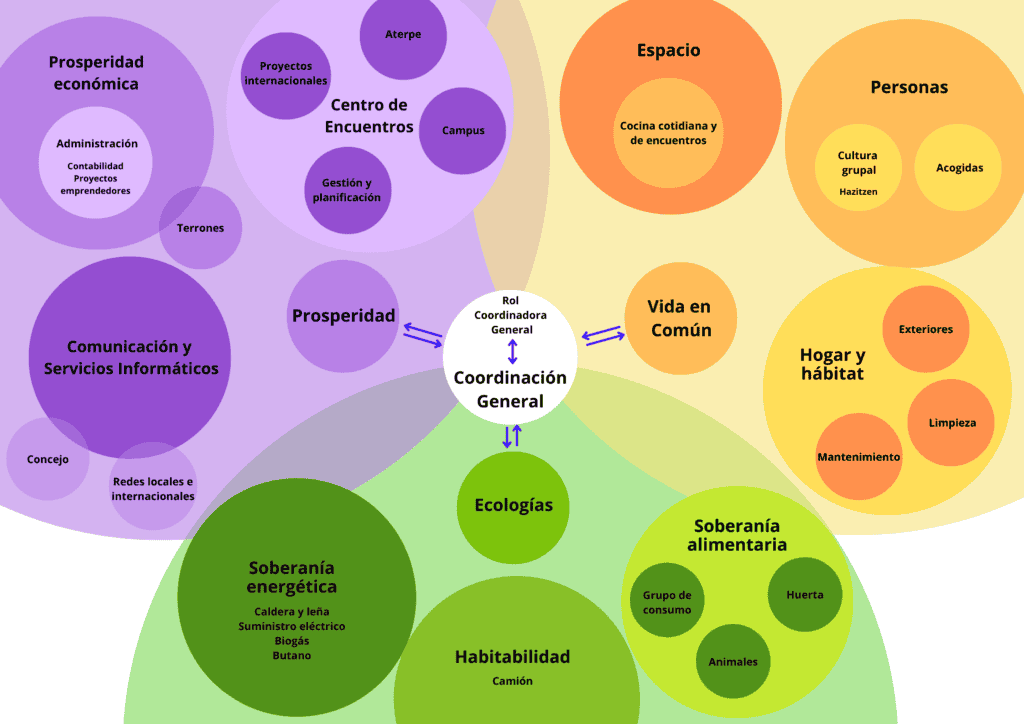
This embedded governance structure supports a model of “prefigurative politics,” where the desired social transformation is enacted in the present, not deferred to some utopian future (Andrea and Wagner 2012). Arterra, like other ecovillages in the Iberian Ecovillage Network (RIE) and the broader GEN-Europe network, is an experiment in lived democracy. Its members seek to demonstrate that another form of citizenship is possible – one where communication is active, embodied, and rooted in daily interaction, rather than mediated through abstract, symbolic, or media-driven channels.
As highlighted by the data in Table 3, presented in Subsection 2.2 of the methodology section, participants often came across sociocracy through self-initiated learning or prior involvement in intentional communities. This first encounter was marked by curiosity and a desire to experiment with governance models more aligned with their personal values – particularly inclusivity and decentralization. Many described it in contrast to consensus-based or assembly models, which they had experienced elsewhere. A recurring theme was the dynamic balance between shared decision-making power and individual responsibility. Participants stressed how the circles encouraged vulnerability, emotional expression, and personal accountability. This interplay supported not only group cohesion but also personal development, fostering a sense of agency grounded in mutual commitment. Participants acknowledged that it required ongoing training, strong facilitation, and collective effort to maintain the community. Ultimately, sociocracy was not only described as a tool for making decisions, but as a practice that shaped the culture and rhythms of everyday life.
3.4. Intentional communities as spaces of counter-hegemonic political practice
In an era increasingly characterized by the commodification of public discourse and the transformation of political actors into branded influencers, the gap between appearance and action has widened considerably. As Mirra and Pietropaoli (2024) argue, the political field has shifted from the realm of deliberative governance to a theatre of visibility, where citizens are more often spectators than participants. The social role of the “citizen” has morphed into that of a “follower,” a consumer of political narratives rather than an agent of political action.
Against this backdrop, intentional communities like Arterra offer a radical counterpoint. Their practices constitute a form of factual politics – not centred on rhetoric or symbolic gestures but on the reappropriation of collective agency through local, participatory structures. They do not merely critique existing systems; they model alternative pathways.
Well, from the beginning, as a feminist, I believe everything is political – even simple daily choices like living in an eco-village or deciding whether to drink bottled water or tap water. […] In today’s world, especially in Western societies, I don’t think it’s possible to live without engaging politically in some way. Here in Arterra, living together in the same place with so many people makes those dynamics even more visible. Thanks to the facilitation courses we do here, we have rich tools for giving feedback, managing conflict, and navigating interpersonal relationships – much more than you’d find elsewhere. What I really appreciate in Arterra is the intention to keep a balance between individual well-being and collective well-being. There’s real care, openness, and support for personal processes, but without putting individual needs above the project itself. The project, the shared life, remains at the centre (P.11)
Through their involvement with networks like GEN-Europe and ECOLISE (European Network for Community-Led Initiatives on Climate Change and Sustainability), these communities also engage in meta-political work: co-authoring policy proposals, participating in EU-level deliberations on climate transition, and contributing to manifestos that call for a redefinition of sustainability and governance. These initiatives, far from being utopian side projects, reflect a grounded political agency that merges everyday practice with broader structural change (Asara et al. 2015; Kunze and Avelino 2015). Here’s how one participant described it during the 2024 ECOLISE annual gathering, which took place at Arterra.
I came as volunteer in Arterra, and now I’m representing RIVE, the Italian ecovillage network. ECOLISE is a network of networks that plays a key role in connecting and coordinating many projects and communities with shared values. It acts as a bridge, helping community voices reach different levels – from local to institutional – while also creating opportunities for collaboration and positive cross-pollination between members of the network. Its work is political, not just in the personal or social sense, but also in terms of influencing policy. That bridging role is something no one else was really taking on, and it’s incredibly valuable (P.9).
The duration of the stay of the residents often reflects these motivations, with some arriving for a temporary experience – such as through European volunteering programs – and others committing to long-term transformation.
Permaculture also plays a political role here, not only as a method of ecological design or land management, but as a broader philosophy of social transformation – what some describe as a form of terraforming for just and sustainable futures. As one resident explains:
I see permaculture as deeply connected to the world of communities and collective projects. Of course, it includes things like gardening and self-sufficiency, but it goes far beyond that. It’s a broad approach that also touches on social and political dimensions. It’s guided by ethical principles and aims for fairness, cooperation, and an understanding of ecosystems – not just in nature, but among humans too. It’s about symbiosis and coexistence, recognizing that we, as humans, are part of the same web as animals, plants, and all living beings (P.8).
Moreover, each year the community welcomes long-term volunteers through European and international exchange programs, including Erasmus+, ESC (European Solidarity Corps), and other transatlantic initiatives. These volunteers, often young people from across Europe and the United States, engage in what can be described as transformative learning – gaining not only practical skills in ecological living and self-organization, but also undergoing a deeper personal and political awakening. Their immersion into the rhythms of communal life, ecological stewardship, and participatory governance positions the ecovillage as a pedagogical space, where knowledge is transmitted not through instruction but through experience, embodiment, and relational engagement.
By reclaiming communication as a collective, lived process – not a media construct – these communities reinstate politics as a verb: something done, shared, embodied. In this way, Arterra does not merely practice sustainability; it performs a deeply political act of resistance against the passive, consumers’ form of citizenship that dominates much of contemporary society.
As one participant reflects:
This is another way of doing politics – aligned with the feminist idea that the personal is political. What we do here is trying to give our lives meaning and impact through how we live together. It’s about transformation that starts at the root, through daily practices. For me, feminism is a key inspiration – not only for how it’s shaped my life, but because it has brought deep social change without relying on violence, simply by embodying the change it seeks (P.10).
In this sense, Arterra’s political practice aligns closely with the principles of ecofeminism – where caring for the planet and caring for people are inseparable.
This study has sought to illuminate how intentional communities like Arterra Bizimodu are not merely alternative lifestyles but dynamic laboratories of socio-political experimentation. The trajectories of the participants – often shaped by early exposure to holistic education, ecological awareness, and critical thinking – highlight the role of formative environments in cultivating a disposition toward communal and sustainable living. These individuals do not arrive in ecovillages as disillusioned idealists, but as citizens actively seeking coherence between their values and daily life.
It reinforces a culture of listening, feedback, and continuous learning – hallmarks of what we Mezirow (2018) defined as transformative learning. In this context, governance becomes not only a matter of logistics but a field of personal and collective growth. Decisions are not made on behalf of the community; they are made within it, by those directly affected.
What emerges is a form of prefigurative politics, where the community enacts in the present the values and systems it wishes to see more widely adopted. This stands in stark contrast to the current socio-political climate, where political discourse is increasingly reduced to spectacle, influence, and consumer branding (Mirra and Pietropaoli 2024). In such a landscape, Arterra’s practices offer a quiet yet powerful rupture: a return to embodied citizenship, where politics is not performed for visibility, but lived through shared space, mutual care, and situated decision-making. Furthermore, Arterra’s active engagement in European networks such as GEN-Europe and ECOLISE shows that these communities do not withdraw from the political sphere – they expand it. They propose new ways of relating, organizing, and envisioning futures that transcend individualism and economic instrumentalism. Their contributions to policy dialogues, educational initiatives, and regenerative practices mark them as political agents, not just lifestyle communities.
In this sense, Arterra challenges conventional understandings of both governance and political participation. Through the practical application of sociocracy, the community exemplifies a form of governance rooted not in abstract representation but in embodied dialogue, co-responsibility, and iterative learning. This system allows members to engage not merely as inhabitants but as co-creators of their social environment. Their political agency emerges through practice – planting gardens, facilitating circles, resolving conflicts – rather than through alignment with traditional ideologies or institutions.
At the same time, the findings suggest that such communities are not free from contradictions. The aspirations for inclusivity, resilience, and sustainability encounter material and relational limits: uneven participation, burnout, interpersonal tensions, and the constant friction with external socio-economic pressures. These communities enact what might be called transformative micropolitics, where individuals experiment with new ways of relating, deciding, and dwelling together. Yet their fragility remains. As Arterra grows and adapts, it must constantly balance its vision with the tensions of scale, sustainability, and external engagement. Its long-term impact will depend on its ability to remain porous and connected – sharing knowledge, influencing policy, and continuing to inspire through example.
Ultimately, ecovillages like Arterra do not offer blueprints, but seeds. They call for a rethinking of what is politically possible – not through abstraction, but through grounded, embodied, and relational ways of life. Their contribution to eco-social transformation lies not only in what they resist, but in what they quietly and persistently grow.
In this spirit, our intention as authors is to further explore these practices – particularly sociocratic governance and permaculture-based ecological design – through a comparative study between Arterra, as a territorially embedded intentional community, and other eco-social transition contexts. One relevant case is the Sicilian permaculture movement, which, unlike Arterra’s enclosed model, operates as a diffuse, polycentric network. Since 2020, this movement has formally articulated itself through a collective manifesto, positioning itself as a political actor rooted in agroecology, land reoccupation and community regeneration (Bertino and Martín-Lagos López 2025). Comparing these two contexts – one enclosed and intentional, the other dispersed and emergent – may illuminate the diverse strategies, tensions, and innovations shaping contemporary pathways of eco-social transformation across different cultural and territorial landscapes.
Andreas M. and Wagner F. (Eds.) (2012), Realizing Utopia: Ecovillage Endeavors and Academic Approaches, RCC Perspectives, no 8, Munich. https://doi.org/10.5282/rcc/5598.
Asara V. and Alietti A. (2024), «Sustainability Culture, Environmental Activism and Political Ideology Among Young Adults: A Survey on Students at the University of Ferrara», in Socie- tàMutamentoPolitica, 15(30): 95-108, https://doi.org/10.36253/smp-15458.
Bertino M. and López M. D. M. L. (2025), «Nueva visión ecológica en tiempo de crisis. Discursos de permacultores en Sicilia (Italia)», in Ager: Revista de estudios sobre despoblación y desarrollo rural= Journal of depopulation and rural development studies, 41: 213-243.
Buck, J. and Villines, S. (2007), We the people: Consenting to a deeper democracy: A guide to sociocratic principles and methods. Sociocracy, Washington DC, pp. 31-60.
Carraro G., Zorrilla M.C. and Eynaud L. (2023), «Scaling Up Alternative Pedagogies in Ecocommunities: The Case of Arterra Bizimodu and the “EU4Transition” Project», in C. Renouard, F. Brossard Børhaug, R. Le Cornec, J. Dawson, A. Federau, D. Ries, P. Vandecastele, N. Wallenhorst (Eds.), Pedagogy of the Anthropocene Epoch for a Great Transition. Anthropocene – A Novel Approach of Higher Education, Springer, Cham, pp. 141-153.
Centemeri L. and Asara V. (2022), «Prefiguration and Ecology: Understanding the Ontological Politics of Ecotopian Movements» In L. Monticelli (Ed.), The Future Is Now: An Introduction to Prefigurative Politics, Bristol University Press, Bristol, pp. 130-143.
Charmaz K. (2006), Constructing Grounded Theory: A Practical Guide through Qualitative Analysis, London, SAGE Publications.
Devall B. (2020), Living Deep Ecology: A Bioregional Journey, Rowman&Littlefiled, Lanham.
Dregger L. (2015), «Establishing a new GEN office». In Global Ecovillage Network. Retrieved from https://ecovillage.org/establishing-new-gen-office/
Ghelfi A. (2022), La condizione ecologica, Edifir, Firenze.
Gilman R. and Gilman D. (1991) Ecovillages and Sustainable Communities: A report for Gaia Trust, Langley, Bainbridge Island.
Gough I. (2017), Heat, Greed and Human Need: Climate Change, Capitalism and Sustainable Wellbeing, Edward Elgar Publishing, Cheltenham.
Holmgren D. (2002), Principles & pathways beyond sustainability, Holmgren Design Services, Hepburn. Retrieved from: https://derdejan.files.wordpress.com/2020/06/permaculture-principles-and-pathways-beyond-sustainability-pdfdrive.com-.pdf
Jackson H. and Svensson K. (Eds.), (2002), Ecovillage Living: Restoring the Earth and her People. Totnes, Green Books.
Kallis G., Paulson S., D’Alisa G. and Demaria F. (2020), The Case for Degrowth, John Wiley & Sons, Hoboken.
Karavioti A. (2024), Transformative Pathways to Sustainability in Ecovillages: Exploring Inner-Outer Dynamics (master’s thesis), Utrecht University.
Latour B. and Schultz N. (2022), On the Emergence of an Ecological Class: A memo, John Wiley & Sons, Hoboken.
Litfin K. T. (2014), Ecovillages: Lessons for sustainable community, Polity Press, Cambridge.
Melucci A. (1988), «Getting involved: identity and mobilization in social movements», in International social movement research, 1(26), 329-48.
Mezirow J. ([1991] 2018), «Transformative learning theory». In Contemporary theories of learning (pp. 114-128). Routledge, London.
Mirra G. and Pietropaoli M. (2024), «Dall’influenza della politica alla politica degli influencer», in SocietàMutamentoPolitica, 15(30): 171-176, https://doi.org/10.36253/smp-13672.
Ordás García C. Á. (2024), «The Antimilitarist Campaign against Compulsory Military Service in Spain during the 1970s and 1980s», in Contemporary European History, 33(1), 286-304, https://10.1017/S0960777322000224.
Rau, T. J. and Koch-Gonzalez J. (2023), Molte voci, una canzone: Condividere l’organizzazione attraverso la sociocrazia. Ayros Editore, Milano.
Renau L. D. R. (2018), «Ecovillages in Spain: Searching an emancipatory social transformation? », in Cogent Social Sciences, 4(1), 1–18, https://doi.org/10.1080/23311886.2018.1468200.
Rosenberg M. B. (2015), Nonviolent Communication: A Language of Life: Life-changing Tools for Healthy Relationships. PuddleDancer Press, Encinitas.
Salamanca López L. and Silva Prada D. F. (2015), «El movimiento de ecoaldeas como experiencia alternativa de Buen Vivir», in Polis (Santiago) 14 (40): 209-231.
Touraine A. (1988), Il ritorno dell’attore sociale, Editori Riuniti, Roma.
Van Schyndel Kasper D. (2008), «Redefining community in the ecovillage», in Human Ecology Review, 15(1): 12-24.
Veteto J. R. and Lockyer J. (2013), Environmental Anthropology Engaging Ecotopia Bioregionalism, Permaculture, and Ecovillages, Berghahn Books, New York & Oxford.