Alternative Tourism and Platform Cooperativism: The Resistance Practices of Abruzzo’s Community-based Cooperatives
1 Università degli Studi dell’Aquila, Italy
2 CulTurMedia Legacoop, Italy
3 Università di Chieti–Pescara, Italy
4 Sapienza Università di Roma, Italy
E-mail: francesca.belotti@univaq.it; antonio.opromolla@univaq.it; f.virgilio@legacoop.coop; giulia.candeloro@unich.it; luciana.mastrolonardo@unich.it; stefania.parisi@uniroma1.it
*Corresponding author
Abstract. The article presents the results of an action research project carried out in Abruzzo, a region in southern Italy characterized by high socio-economic marginalization. Eight community-based cooperatives active in alternative tourism and local services participated in the co-design of a digital mock-up of a platform that reflects their values and practices. The experience is analyzed as a form of resistance to the “hit-and-run” tourism promoted by mainstream platforms such as AirBnB and Booking. The theoretical framework draws upon studies on the platformization of tourism and the resulting socio-cultural transformations, as well as literature on alternative tourism and platform cooperativism. Inductively, it also integrates studies on community resistance practices and commoning actions. The methodological framework is based on digital co-design as a qualitative research method with a sociological vocation. The results show that the co-designed platform, AbiTerrò, has fostered the formation – albeit complex and not without tensions – of a collective identity among the cooperatives, which have thus positioned themselves as a community of resistance, even in the digital sphere, to the dominant tourism model enabled by mainstream platforms. Compared to the latter, the cooperatives adopt both oppositional and propositional practices and positions, which are immediately translated into the digital design of AbiTerrò.
Keywords: Communities of Resistance, Alternative Tourism, Platform Cooperativism, Digital Tourism, Design Sociology.
Index
2.1. Platform-mediated (over)tourism in urban contexts
2.2. Alternative tourism in marginalized areas
2.3. Cooperativism and digital platforms
2.4. Communal resistance between practices and identities
4.1. The oppositional component of AbiTerrò
4.2. The propositional component of AbiTerrò
Overtourism, conceptualized as the negative experience of both residents and visitors resulting from increased tourist flows and the insufficient carrying capacity of destinations (Dodds and Butler 2019), has become a pressing issue – particularly in urban contexts where mass tourism affects the identity of cities and the well-being of local communities. This phenomenon has been further intensified by digital platforms such as Airbnb and Booking (Nilsson 2020). The resulting influx has sparked growing discontent among residents, leading to protests both in physical spaces and online forums (Milano, Novelli and Russo 2024).
However, in rural or semi-urban settings, alternative tourism models have emerged, promoting slow, responsible, and community-centered hospitality (Giampiccoli and Saayman 2014). The case of Abruzzo, a southern Italian region with high socio-economic marginality, particularly in its mountainous inland areas (Vendemmia, Pucci and Beria 2021), is revelatory. It hosts multiple networks of community-based cooperatives that protect the territory and foster social cohesion while attracting what Butcher (2003) defines as “moral tourists”, i.e., guests who care about their impact on local economies and whose travel choices are gestures of lifestyle politics. This is why we embarked on a digital co-design process with some of these Abruzzo cooperatives: we were interested in understanding their experience with alternative tourism in the making of a digital platform mock-up that would reflect their cultural practices.
Indeed, digital platforms prove essential in the promotion of alternative tourism (Primi, Gabellieri and Moretti 2019), especially when showcasing eco-friendly accommodations or enabling concrete forms of social participation (Ossorio 2024). Moreover, digital platforms can be stepped into a moral agenda translating into technological affordances (Molz 2013) and provide viable alternatives to extractive digital intermediation, such as allowing local communities to retain control over tourism-generated value (Richter and Kraus 2022). Our work with Abruzzo community-based cooperatives exemplifies this approach: we were interested in understanding their experience with the ideation and prototyping of a tailored digital environment that would create more sustainable tourism ecosystems while enhancing social cohesion in local communities.
2.1. Platform-mediated (over)tourism in urban contexts
Overtourism mostly targets art cities and popular urban destinations (Liberatore et al. 2019) where “sectoral platforms” (Van Dijck, Poell and De Waal 2018) play a pivotal role in widening the ranks of the “temporary population” (Brollo and Celata 2022) while “selling off” the cities and their local cultures (Stors and Baltes 2018). Urban communities experience a sense of disconnection from their environment, mostly due to increased noise, congestion, and the loss of shared spaces (Jover and Diaz-Parra 2020). Meanwhile, cities shape their own image according to digital users’ expectations (Romano, Bonini and Capineri 2023), and are shrinked within the perimeters of zones identified as central by the interaction between users and algorithms (Celata, Capineri and Romano 2020).
In this regard, Törnberg (2022) speaks of “platform placemaking” to name how digital infrastructures mobilize user data to reshape urban spatial imaginaries in their favor. Cities become sites of temporary and transactional consumption rather than places for social interaction, thereby undermining local businesses and favoring international chains (Oluka 2024). Besides, the commercial nature of these platforms encourages users to continuously interact and create content that, in fact, serves their economic interests, thus consolidating a market-oriented social order in which popularity prevails over information reliability (Metzler and Garcia 2024).
Small towns, especially those in rural and high-altitude areas, are not exempt from these processes, where tourism flows are clustered in a limited number of highly attractive sites due to targeted promotion, pronounced seasonality, and limited infrastructure capacity (Boháč and Drápela 2022). Even in small-scale contexts the residents’ quality of life and the tourists’ experience deteriorate (Krajickova, Hampl and Lancosova 2022), with mountain areas recording infrastructure overload, environmental degradation, visitor congestion, conflicts between residents and tourists, and the loss of cultural authenticity (Boháč and Drápela 2022; Rogowski, Zawilińska and Hibner 2025).
2.2. Alternative tourism in marginalized areas
These socioeconomic and sociocultural dynamics are counterbalanced by the well-established strand of alternative tourism projects that excel in rural and semi-urban settings. This circuit adheres to a moral economy based on sustainable trade, fair labor, and ecological sensitivity (Gibson 2010), aiming at decommodifying the places’ value (Wearing and Wearing 2014). According to Cohen (1987), “alternative tourism” can be understood both as a countercultural rejection of modern consumerism, where travelers seek authentic experiences outside of commercialized tourist circuits, and a reaction against the exploitation of marginalized areas , promoting ethical and equitable relationships between tourists and host communities. We choose to adopt the expression “marginalized areas” rather than “marginal areas”, as this terminology proves more consistent with both the theoretical framework underpinning our research and the empirical evidence emerging from the study. The areas under consideration are clearly not per se marginal or peripheral; rather, their condition of marginality results from historically and politically situated processes. Among these, the deliberate concentration of services and productive infrastructures in urban centers plays a central role, leading to demographic decline and socio-economic vulnerability, often exacerbated by outmigration and the ageing of local communities; the marginalization of a geographical area is, in fact, a process that unfolds along spatial, symbolic, and relational dimensions. (Trudeau, McMorran 2011). In the Italian context, such areas are commonly referred to as “inner areas” (aree interne), a designation formalized by the National Strategy for Inner Areas. This policy framework highlights the need to enhance the cultural, natural, and social capital of these territories, also with a view to strengthening models of sustainable tourism (Presidenza del Consiglio dei Ministri, 2025, p. 137). However, the increasing popularity of such forms of tourism can lead to environmental damages and “staged” authenticity based on the commodification of local cultures (Gardiner et al. 2022).
The socially concerned variant of alternative tourism aims to foster mutual understanding between tourists and inhabitants, and fair economic exchanges through small-scale, community-driven initiatives. Building on this, the concept of “sustainable tourism” (Liu et al. 2013) has emerged to balance economic growth, environmental protection and social equity in the long term (Zolfani et al. 2015). Nevertheless, Bellato, Frantzeskaki and Nygaard (2023) critique this model for often prioritizing economic growth over environmental health and social equity. They advocate for “regenerative tourism” that emphasizes the importance of restoring and revitalizing ecosystems and communities affected by tourism, by valuing the specificity of places and promoting inclusive governance and transformative learning.
Another fruitful approach is the so-called “community-based tourism” (CBT), in which local communities directly manage tourism activities to ensure economic, social, and environmental benefits while preserving cultural and natural heritage (Goodwin and Santilli 2009; Candeloro and Tartari 2025), particularly in rural areas where it provides alternative livelihoods and keeps traditional lifestyles alive. The active involvement of local stakeholders in decision-making allows communities to align tourism development with their needs and values (Russell 2000). Economic benefits are equitably distributed, preventing wealth concentration among external investors; responsible tourism practices, such as homestays and cultural tours, minimize environmental and cultural degradation while enhancing cross-cultural understanding. Capacity-building programs in hospitality, business, and conservation are key to sustaining CBT (Scheyvens 2002), which, however, faces significant challenges, including limited access to markets, dependency on external funding, and internal governance issues (Butcher 2003).
Ultimately, these studies highlight the “moral economy of alternative tourism” (Molz 2013), which resists capitalist dynamics of mass tourism while catalyzing more intimate and meaningful social relations.
2.3. Cooperativism and digital platforms
In this scenario, community-based cooperatives play an essential role as they are cooperative societies providing local communities with goods and services that improve their well-being (Borzaga and Zandonai 2015). These enterprises precisely diverge from traditional cooperatives in that their services are not confined to their working members but intended for all citizens within the territory (Mori and Sforzi 2018). In this, community-based cooperatives are two-faced operators who look out for incoming tourists (as alternative tourism enterprises) while caring for the resident population (as mutualistic societies for local development).
In the wake of these experiences, the so-called “platform cooperativism” has recently taken hold, especially in the field of alternative tourism practices. Framed within the broader category of “digital commoning”– i.e., the collective production and management of digital resources (Henderson and Escobar 2024), this movement advocates for shared ownership and democratic governance of digital platforms (Scholz 2016) to counter the exploitation and precarity of “platform capitalism”– i.e., the use of online platforms to commercialize goods and services for profit maximization (Papadimitropoulos 2021).
Platform cooperativism can be intended as the combination between the traditional cooperative model, based on enduring ties, structured working relationships, trust, shared values and strong territorial bonds, and the sharing economy, originally considered as a driver of decentralisation and democratic participation. It leverages digital platforms as both relational and market spaces where to pursue social innovation, solidarity, and profit (Di Maggio 2019; Zhu and Marjanovic 2021). In doing so, platform cooperatives act as ideological resistors or challengers of the status quo (Wegner, Borba Da Silveira and Ertz 2024), addressing the needs of their members and promoting autonomy and welfare. They enhance work conditions and job security while promoting human relations and caring for shared resources (Papadimitropoulos 2021), with cascading benefits for the territory (Rose 2021).
However, recent studies on platform cooperativism also highlight limitations and challenges: it is difficult to ensure truly democratic governance of the platform; customers are poorly informed about the social benefits of cooperatives; and insufficient funding limits the hiring of qualified personnel and the improvement of the platform (Philipp et al. 2021; Bunders and De Moor 2024). In the field of alternative tourism, these difficulties can be decisive in terms of the platforms’ ability to convey the values of the moral economy that such projects aspire to promote.
2.4. Communal resistance between practices and identities
Alternative tourism and platform cooperativism can also be interpreted as practices of “resistance” enacted by marginalized communities against the hit-and-run tourism enabled by mainstream sectoral platforms. These experiences are different from those of the aforementioned urban movements that are rising up against overtourism, mostly because community-based cooperatives are organizations with a socioeconomic and sociocultural vocation that favor the propositional dimension of struggle before the contentious component (albeit implying both, as in any contemporary experiment of “commoning,” Dyer-Witheford 2020).
“Resistance” is a useful concept to understand the politics of lived spaces (Massey 2012), and yet it is not frequently applied to interpret community-based forms of countering the bad impact of mass tourism (Duignan, Pappalepore and Everett 2019). A few exceptions are the conceptualization of “community resistance” by Doǧan (1989), which accounts for how local people tactically cope with changes wrought by tourism based on their sociocultural characteristics, and the concept of “mediated, communal resistance” by Joseph and Kavoori (2001), which describes how local people can «transform an ambivalent and disempowered relationship into one that is culturally acceptable to the host community» (p. 999).
Without dragging in the concept of “biopolitics” – i.e., «the power of life to resist and determine an alternative production of subjectivity» (Hardt and Negri 2009: 57) – we can agree that communities engaged in the defense of material and immaterial goods they share (e.g., fields, waters, air, art, knowledge, traditions, etc.) can be identified as such precisely because of the social relationships they activate around the commons they protect (Belotti 2015). Defining the commons as all those natural or artificial resources shared and exploited by multiple users, where exclusion from use is difficult or costly (Ostrom 1990), we can recognize that any activity defending or promoting attentive behaviors with such goods operates as an actual commoning action (Aiken 2015). The production of a collective subjectivity comes into being thanks to what Foucault (1980) calls “devices,” i.e., networks of material, social, cognitive elements organized by a strategic purpose (e.g., the commons’ protection or promotion) around which subjectification based on interpersonal relationships occurs. As Hardt and Negri (2009) argue, in this case the experience of otherness aims at the constitution of the “commonwealth,” understood both as the set of material resources that a collectivity shares and the network of relationships and the store of knowledge, languages and affects exchanged within it.
When it comes to defining proactive communities of this kind, several concepts have been mobilized, ranging from “rhizome”– i.e., heterogeneous entities with multiple entry points and routes, which grow through diverse connections (Deleuze and Guattari, 1987) – to “multitude”–i.e. networks of singularities that assert the commonwealth from which they derive in social production and political engagement (Virno 2010). Sivanandan (1981)’s notion of “communities of resistance” effectively highlights the capacity of people in struggle to break down memberships into «a mosaic of unities» (p. 116). What matters to them is the “being-in-common” (Nancy 1991) – i.e., the shared commitment relationship springing from what that collectivity has in common, which also qualifies it politically (Rancière, 1999).
Communities of resistance are thus profiled from their practices of organization, reciprocal working, commoning and conviviality, representing perforations or disjunctures in the neo-liberal regime ruling any societal sphere (including the tourism sector and the technology industry). They are counter examples, at a micro level, of different ways of conceiving and doing things, including tourism projects enabled by digital platforms created for the purpose.
In designing the research, we followed Lupton’s (2018) proposal to employ digital design as a sociological method, conceiving design not merely as a means to realise technological solutions, but also as a method of analysis and reflection. Our approach is both critical and participatory, challenging values, norms, and power relations embedded in the platform-mediated tourism industry, while engaging typically excluded end-users in a collaborative and social process. It is intended not only as a space for ideating and testing solutions, but also as an opportunity for mutual learning, reflexive dialogue, and co-production of knowledge (Ibidem). Through this approach, we aimed to generate empirical insights that are grounded in lived experience, while simultaneously opening up alternative imaginaries for more inclusive and equitable tourism futures. In this context, people are considered not as mere sources of data, but co-creators capable of shaping both the content and direction of the research.
Concretely, we applied Design Thinking as a human-centered strategy aimed at creatively and collaboratively solving real problems within complex systems (Brown 2019). It involves empathizing, ideating, and testing user-centered solutions, and is increasingly applied to engage citizens in community-based innovation (Goi and Tan 2021). We followed the Design Sprint five-step workflow (Tab. 1), aiming at defining goals and challenges to address, generating innovative technological ideas, selecting the best solution, prototyping it, and validating it with real users (Knapp, Zeratsky and Kowitz 2016).
| Workshop phases | Activity type | Activity description | Type of materials produced/collected | ||||||||||||||||
|---|---|---|---|---|---|---|---|---|---|---|---|---|---|---|---|---|---|---|---|
| 1. Map | 1.1 Long-term goals | Defining the long-term objectives of the platform | Posters; fieldnotes; photos | ||||||||||||||||
| 1.2 Sprint questions | Identifying potential challenges to address | Posters; fieldnotes; photos | |||||||||||||||||
| 1.3 Map | Mapping out the user journey in the forthcoming platform; creating a flowchart of the user-platform interaction | Maps; posters; fieldnotes; photos | |||||||||||||||||
| 1.4 Ask the experts + “How Might We (HMW)” questions | Interviewing each other based on assigned areas of expertise and gathering insights on specific issues | Interview outlines; post-it notes; fieldnotes; photos | |||||||||||||||||
| 1.5 Cluster and vote | Clustering and ranking “HMW” notes | Posters; fieldnotes; photos | |||||||||||||||||
| 2. Sketch | 2.1 Divide or swarm + Lightning Demos | Scouting effective digital platforms and envisioning the forthcoming online journey (subscription, tourists services, community services, reviews, etc.) | Notes; posters; fieldnotes; photos | ||||||||||||||||
| 2.2 The four step sketch | Sketching out the interfaces of the key interactions with the forthcoming platform (one group for each section of the online journey) | Notes; papers; fieldnotes; photos | |||||||||||||||||
| 3. Decide | 3.1 Sticky decision | Choosing the best sketches after reviewing, critiquing, and voting them | Sketches; fieldnotes; photos | ||||||||||||||||
| 3.2 Storyboard | Creation of a storyboard of key moments of the user-platform interaction | Storyboard; notes; sketches; fieldnotes; photos | |||||||||||||||||
| 4. Prototype | 4.1 Assign roles | Prototyping of content, user interface, and interactions | Draws; screenshots; digital wireframes; notes; fieldnotes | ||||||||||||||||
| 4.2 Stitch it together | Merging the outputs into a single platform prototype | First prototype (realised with FIGMA design tool) | |||||||||||||||||
| 5. Test | 5.1 Show prototype | Refining the prototype and its features | Second prototype (realised with FIGMA tool) | ||||||||||||||||
| 5.2 Evaluation | Collecting feedback on the prototype | Posters; final version of the prototype; fieldnotes; photos | |||||||||||||||||
| Source: Authors’ own elaboration. | |||||||||||||||||||
We involved the spokespersons of eight Abruzzo’s community-based cooperatives (Tab. 2) that, at the time of the research, had already worked together and activated alternative tourism projects in their hometowns. The context in which they operate is doubly marginalized, both because of the (southern) region and the (internal) area to which they belong (Vendemmia et al. 2021).
| Name | Hometown (province) | Active tourism services | Active resident services | ||||||||||||||||
|---|---|---|---|---|---|---|---|---|---|---|---|---|---|---|---|---|---|---|---|
| La Maesa | Aielli (AQ) | Visitor reception; guided tours of the town’s street art pieces; social media marketing. | |||||||||||||||||
| Vallis Regia | Barrea (AQ) | Maintenance of green areas; managing an artist-in-residence program. | Snow road maintenance; cleaning services in public and private buildings. | ||||||||||||||||
| Oro Rosso | Navelli (AQ) | Hostel and restaurant; production and harvesting of saffron; events and public activities. | Free rental of spaces for cultural events; agriculture and farmer support; brownfields recovery. | ||||||||||||||||
| Vivi Calascio | Calascio (AQ) | Archaeological, nature and sports tours; souvenir shop and local crafts selling. | Green areas maintenance; telemedicine for elderly care; community cultural center. | ||||||||||||||||
| La chiave dei tre Abruzzi | Popoli (PE) | Management of the community emporium for selling local products and handmade souvenirs. | Management of a coffee bar. | ||||||||||||||||
| Tavola Rotonda | Campo di Giove (AQ) | Cleaning and sanitization services; management of local parks and campsites. | Green areas maintenance; community mill for flour production and educational workshops; recovery of abandoned agricultural fields. | ||||||||||||||||
| Cuore delle Valli | Goriano Valli (AQ) | Management of a diffuse museum. | |||||||||||||||||
| Sette Borghi | Sante Marie (AQ) | Management of a local emporium for local food promotion; school tourism guidance in local naturalistic routes. | |||||||||||||||||
| Source: Authors’ own elaboration. | |||||||||||||||||||
During the workshops, we conducted ethnographic activities aimed at collecting and recording data that were inherently multimodal – i.e., referred to abstract resources of meaning-making such as writing, speech, images, gesture, facial expression – and multimedia – i.e., including sounds, objects, visualities, actions and any other mode materialization (Dicks, Soyinka and Coffey 2006).
All data produced by the participants, along with the fieldnotes taken by the researchers, were anonymized and processed in a single circular and iterative coding process, informed by an abductive logic. Afterwards, we grouped and related the codes forming themes that would allow us to describe and interpret the phenomenon of our interest (i.e., “thematic analysis,” Guest MacQueen and Namey 2011). In the next section we illustrate the two main themes that emerged from the analysis. Quotations are reported only by mentioning the cooperative’s name (Tab. 2), the workflow activity number and the type of ethnographic medium (Tab. 1).
During the digital co-design process, community-based cooperatives came together to form a community of resistance – one that unites its members without erasing their differences (Sivanandan 1981). The co-designed platform, AbiTerrò, is intended to work as a “master key” for accessing the entire area covered by the cooperatives, making them “recognizable as a single entity” (“La Maesa”, activity 1.1, researchers’ fieldnotes). Yet, as we will see, this unified community is marked by internal tensions, reflecting the challenge and strength of accommodating diverse perspectives within a collective identity.
Here, we focus on the resistant vocation of such a community, which highlights the politics of both the space and the commitment that the cooperatives share (Massey 2012; Belotti 2015). Two key themes emerge from the analysis, referring respectively to the oppositional and propositional practices and stances that participants expressed in relation to dominant, extractive forms of tourism and the sectoral platforms that sustain them. These two dimensions of communal resistance are complementary and interconnected and end up embedded into the design of AbiTerrò.
4.1. The oppositional component of AbiTerrò
Since the first workshop, some participants expressed the cooperatives’ intention to “give a makeover to the very conception of tourism,” which in their areas is “still very much linked to second homes” and hence associated with “a privilege” (“Tavola Rotonda”, activity 1.1, researchers’ fieldnotes). Additionally, they aimed to move beyond the “economic subsistence vs. social care” dichotomy, identifying this as a key challenge for the forthcoming digital platform (activity 1.2, researchers’ fieldnotes). Unlike mainstream platforms in the tourism sector, AbiTerrò is meant to reflect the cooperatives’ dual mission – facilitating tourism that supports local economies while reinforcing local social cohesion (Molz 2013; Mori and Sforzi 2018).
This goal leads to two other contentious objectives. First, the co-designed platform is called upon to “overcome the e-commerce logic of local products”, often adopted by digital tourism platforms, and must instead promote “agricultural and cultural specificities as participatory services”, for example, by encouraging the engagement of schools or tourist groups in the harvest (“Tavola Rotonda”, activity 1.4, researchers’ fieldnotes). Second, the forthcoming platform must not slip into a folklorization of local culture, since this often reproduces sexist views of local communities, in which traditions are forcibly imbued with gender scripts and stereotypes, as when in many tourism websites “online images of traditional recipes zoom in on the woman with the traditional headscarf, rather than on the recipe itself” (“Vallis Regia”, activity 1.4, researchers’ fieldnote).
A particularly contentious issue that was effectively translated into AbiTerrò’s design concerns the content curation mechanism (Van Dijck, Poell and De Waal 2018). The cooperatives wondered how to suggest additional services to the users based on their previous reservations, without resorting to invasive methods of notification or data capturing. During activity 1.4 one of the participants clearly stated, “We shouldn’t do like Amazon”, referring to the e-commerce platform’s advice system indicating similar preferences of other buyers or suggesting products like the one purchased (“Tavola Rotonda”, researchers’ fieldnote). Various solutions were suggested to avoid bulletins, alert systems, and impersonal avatars (activity 3.1, researchers’ fieldnote). At the end, participants opted for providing an anthropomorphic virtual assistant that accompanies the user in online navigation and that can possibly start a videoconference with human members of the cooperatives (Fig. 1, activity 5.1, digital mockup). Its name is “Trusty” and he aesthetically resembles one of the participants. It serves to humanize the interaction with the users while bringing them closer to the territory in accordance with cooperatives’ vocation (Rose 2021). The bot suggests additional activities or services that may be of interest to the users according to typological, geographical or temporal proximity.
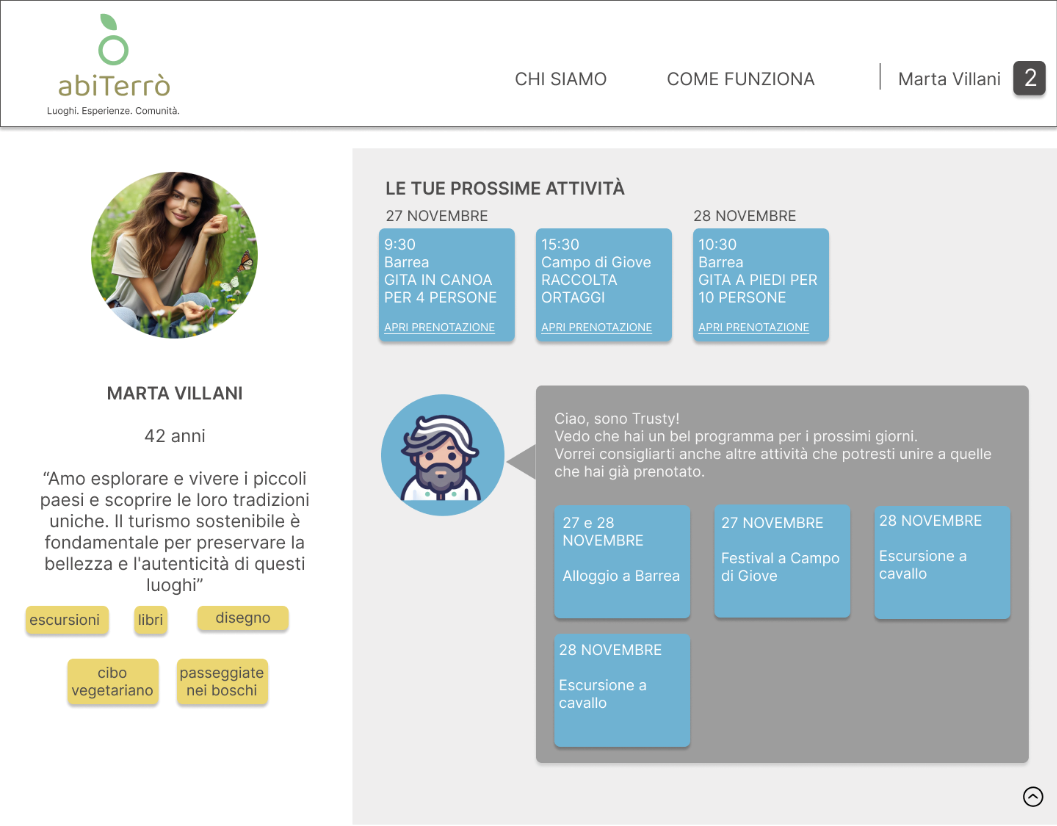
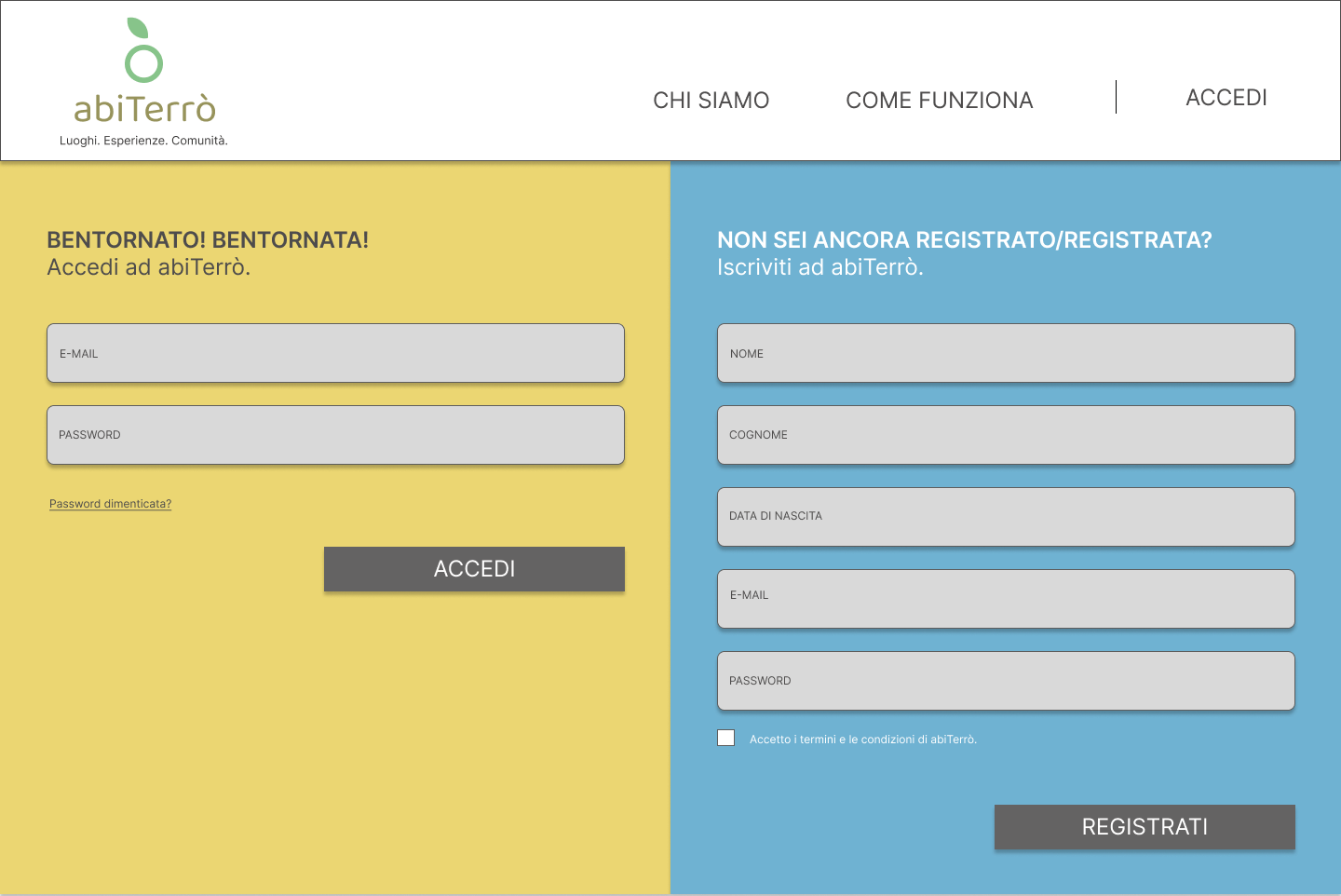
During the creation of the Storyboard, participants made clear that this type of curation mechanism by personalization on AbiTerrò can only take place after the user has created their account. The registration is, indeed, mandatory to request a reservation but it only appears as such when it is time to send such a request, rather than from the beginning as on mainstream platforms (activity 3.2, researchers’ fieldnotes). The data requested to create an account is deliberately few and there is no possibility to log in via Google or Facebook accounts, as counter-hegemonic gestures against the collection of user information that mainstream platforms typically initiate upon access (Fig. 2, activity 5.1, digital mockup).
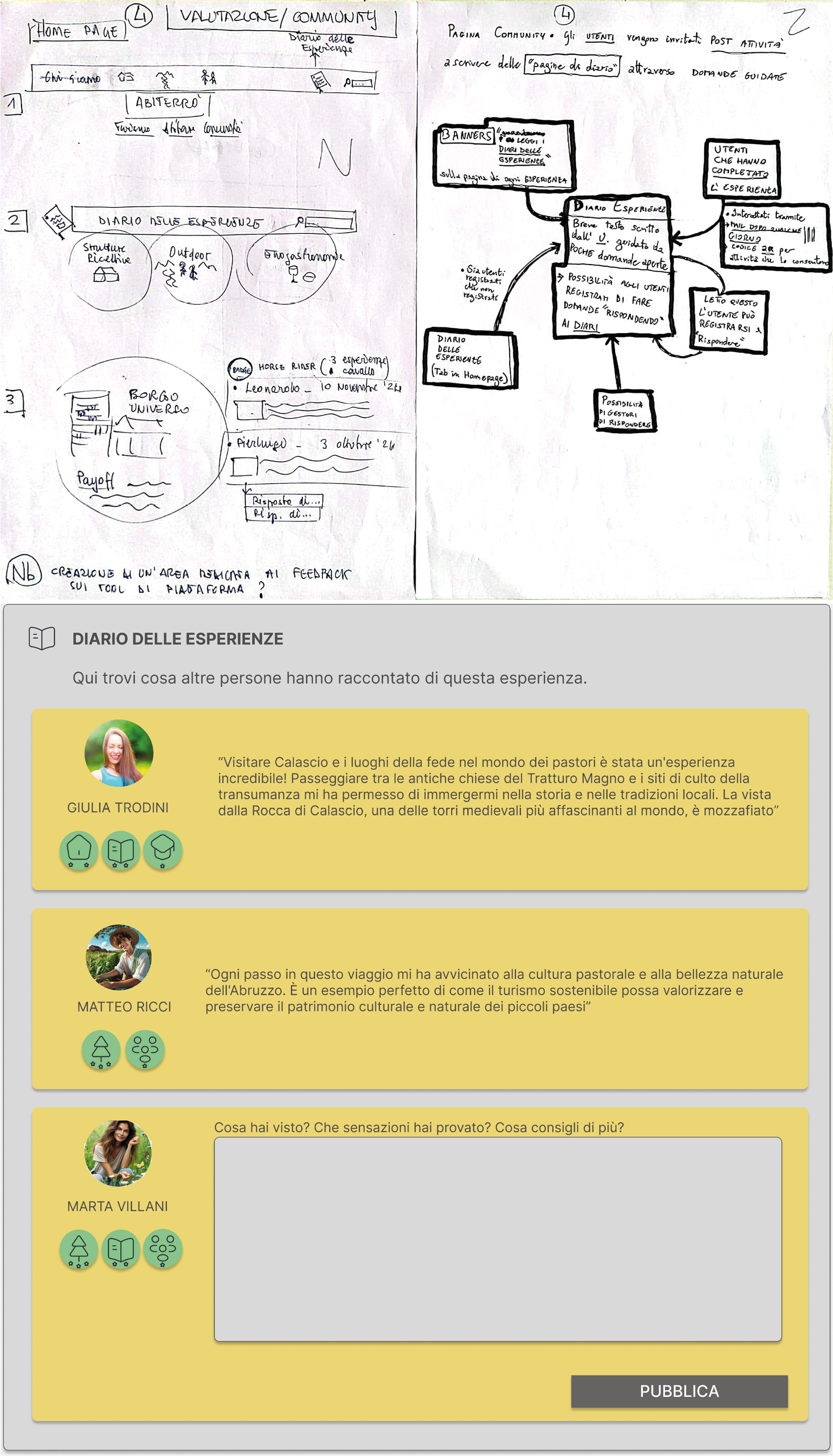
Even the space aimed at users’ evaluation of the experiences and services is not designed based on a reputation logic as in mainstream platforms (Van Dijck, Poell and De Waal 2018), but as a way to collect feedback that helps cooperatives improve their service or activity while maintaining human bonds with visitors and other users. This page is not about curation, but care (Papadimitropoulos 2021). Fig. 3 shows the sequential design as it emerged between the storyboarding and the prototyping stages (activity 3.2 and 5.1, hand drawings on paper and digital mockups).
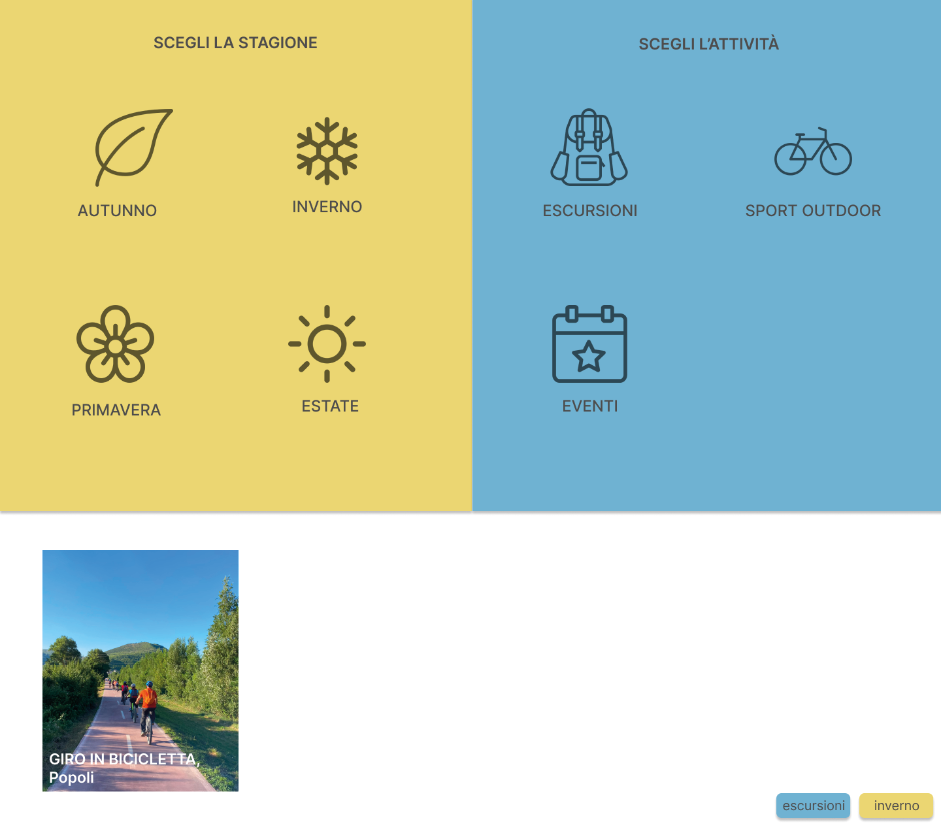
In line with this approach, also the booking system differs from the automated processes of mainstream platforms. The cooperatives need to reach a minimum number of participants to cover the costs of activities and ensure their feasibility. For this reason, they cannot afford instant booking, but need to adopt intermediate solutions, such as requiring users to submit a booking request through the platform, which the cooperatives then review and respond to (activity 3.2, researchers’ fieldnotes). Similarly, the scheduling of activities and services cannot be offered on a daily basis or year-round; therefore, the cooperatives have opted to organize their offerings on AbiTerrò using a seasonal calendar (Fig. 4, activity 5.1, digital mockup), which also strengthens the platform’s connection to the natural rhythms of a territory, still deeply influenced by the cycle of the four seasons.
Notwithstanding the points raised so far, the oppositional dimension appears less prominent than the propositional one in AbiTerrò and the community behind it. The contentious aspect serves as a backdrop to the cooperatives’ resistance practices, which are actively focused on building profitable alternatives. Their critique of the political economy of platforms is not antagonistic but proposes alternatives within both the tourism sector and the broader platform ecosystem. One participant remarked: “The content is alternative, not the format with which we present ourselves: books are all the same, they are made up of a cover and pages, then whether they are beautiful or not… Websites are like that, a cover and [buttons], then it is the content that distinguishes us” (activity 3.2, researchers’ fieldnotes). Neither the design of a digital platform nor its presence in the contemporary platform ecosystem was questioned.
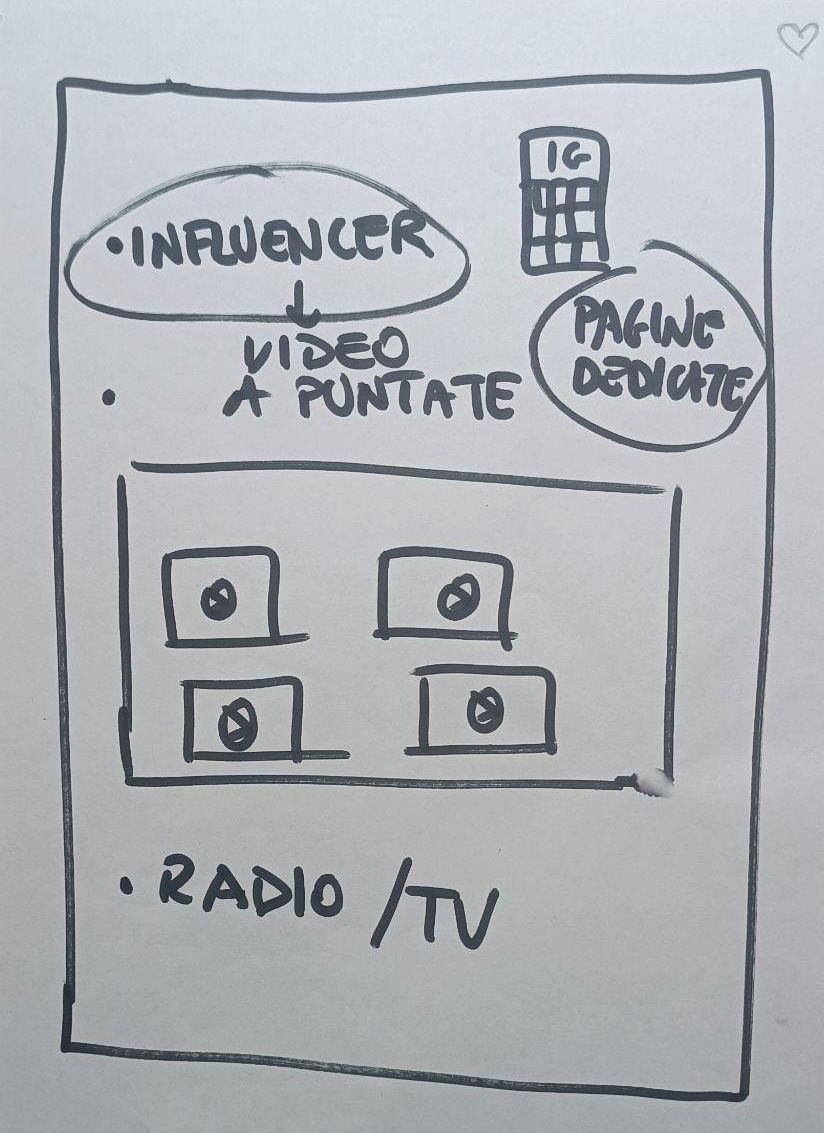
In this, AbiTerrò works as “ideological challenger” of the status quo (Wegner, Borba Da Silveira and Ertz 2024). This approach was already evident in the first workshop, where participants debated about “how to make the platform interoperable with others” such as mobility-sharing platforms, and during the “Storyboard” phase, when they debated how to engage with social media (activity 1.4, researchers’ fieldnotes) and came up with promotional strategies on Instagram, YouTube, radio and tv (Fig. 5, activity 3.2, hand drawing on paper).
The badges and rewards dynamics, typical of mainstream platforms (e.g., Superhost on AirBnb and Genius on Booking), are not completely discarded either, but only partially redefined in a logic of adherence to the cultural practices of cooperatives (which still need to incentivize their activities for profit) and to the objectives of social cohesion they pursue. Specifically, participants proposed a reward mechanism similar to those used by mainstream platforms to collect points (Fig. 6, activity 3.2, hand drawing on paper).
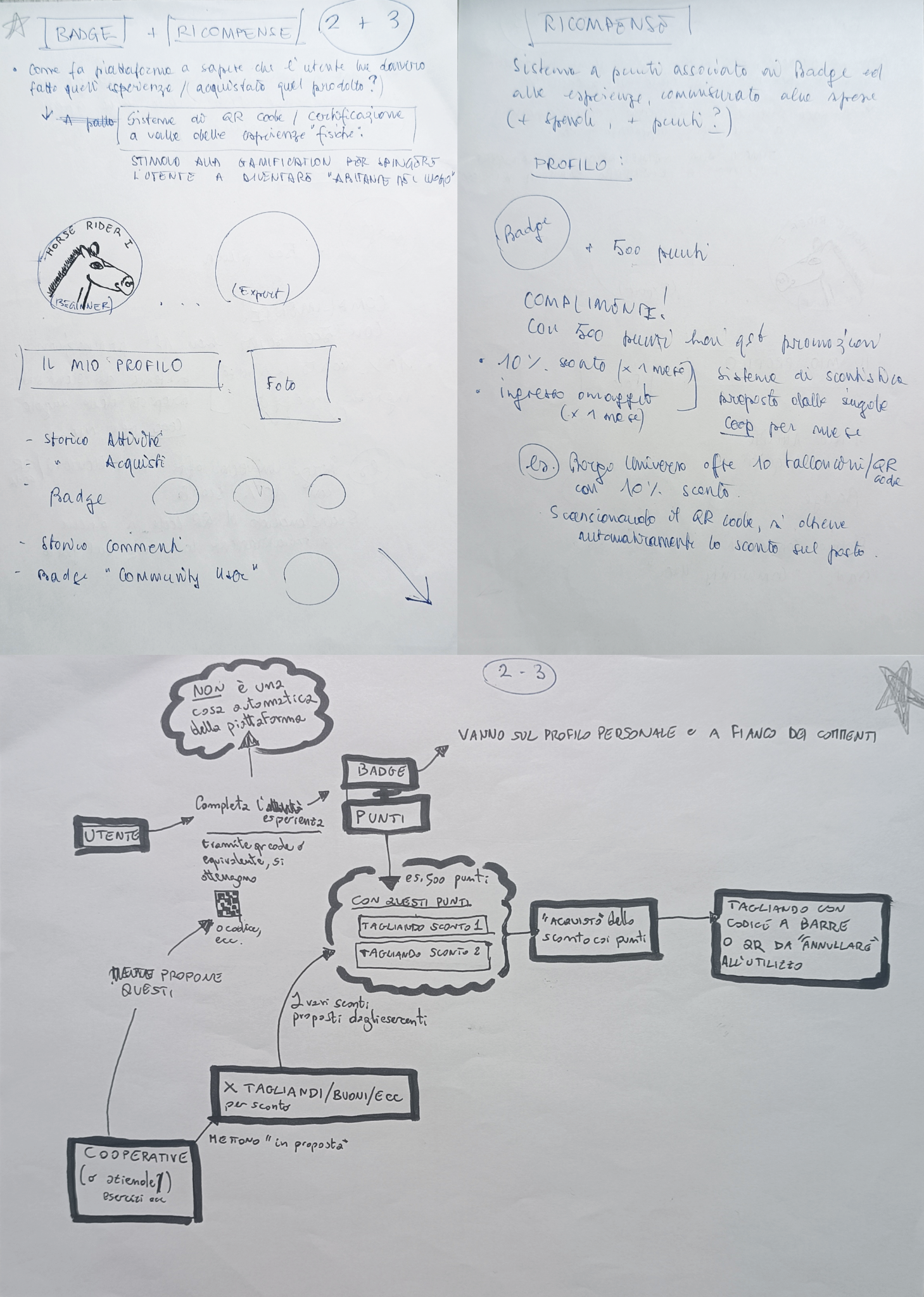
However, this approach seemed too commercial to most participants, who ended up preferring the adoption of a locally based cashback system. As for the badges, the participants kept the idea of recognizing user engagement through stamps like the ones in Fig. 7 (activity 5.2, digital mockup), which, for example, refer to the level of expertise gained in hiking, cultural visits, and neighborliness.

4.2. The propositional component of AbiTerrò
What most defines the political significance of the participating cooperatives and their co-designed platform is their propositional stance, i.e. the desire to rethink tourism based on “empathy and respect” for local communities (“Vivi Calascio”, activity 1.1, researchers’ fieldnotes), making it compatible with local ways of life (Joseph and Kavoori 2001; Butcher 2003). From the very first workshop, participants expressed a vision of hospitality that moves beyond the tourist vs. resident divide. Instead, they advocate for a third model: a person who stays in the area and connects with local communities (Giampiccoli and Saayman 2014), while engaging with the cooperatives’ services and activities (see blue labels in Fig. 8, activity 1.1, poster).
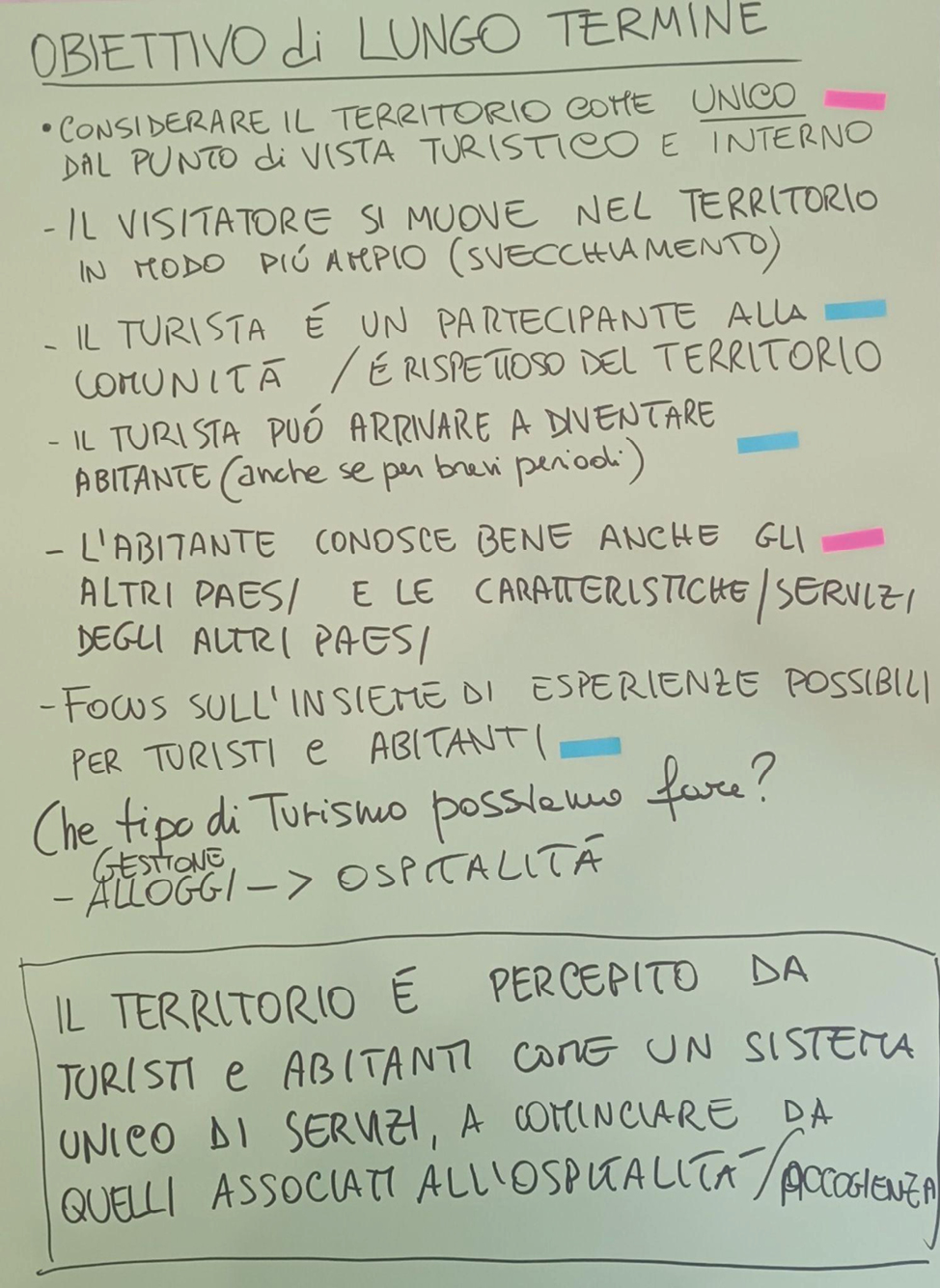
In this sense, participants speak of “redefining the idea of tourists as temporary inhabitants” (“Oro Rosso”, activity 1.1, researchers’ fieldnotes), who “must align with [the cooperatives’] philosophy” (“La chiave dei tre Abruzzi”, activity 1.1, researchers’ fieldnotes). This vision opens up imaginative possibilities for the role of the co-designed platform. The “Sprint Questions” reveals that, since participants asked each other: “What kind of activities can be proposed to involve the inhabitants?”, “How can tourists or new entries be included?”, “How can younger generations be involved?”, and “How can we engage those who stay?” (see blue labels in Fig. 9, activity 1.2, poster).
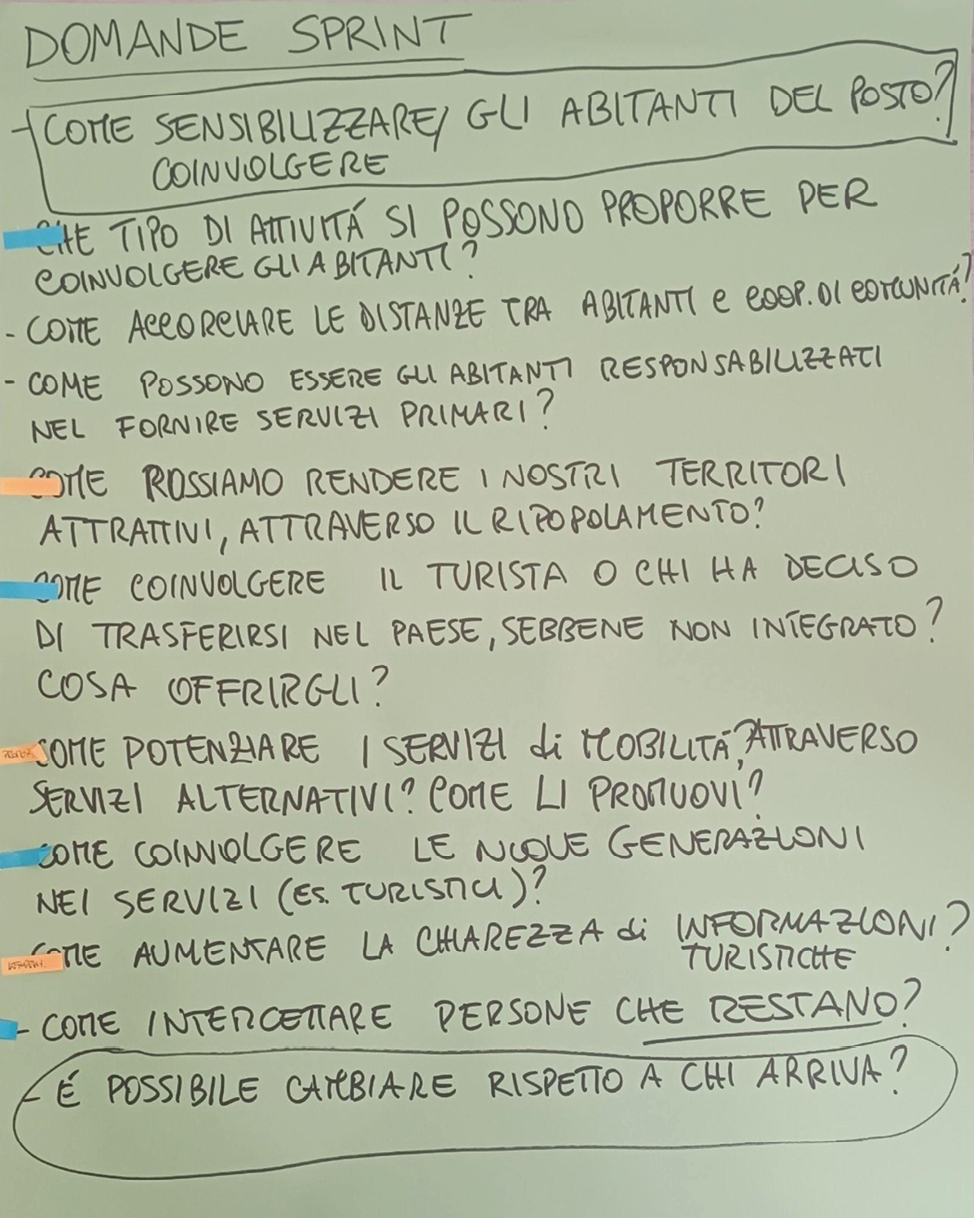
Albeit the co-designed platform serves the typical functions of digital tools in the tourism sector – management, promotion, and information (as exemplified by the Sprint Questions labeled in orange in Fig. 9) – these conventional roles are shaped by the community-based cooperatives’ values, as in any experience of platform cooperativism, where the advantages of the sharing economy are leveraged for social cohesion (Di Maggio 2019; Zhu and Marjanovic 2021). This is why AbiTerrò is envisioned as accessible to users with limited digital skills, physical impairments, or living abroad – e.g., paid virtual tours for people who cannot visit in person, as proposed by “La Maesa” during activity 1.4. Digital inclusivity reflects and promotes an inclusive territory.
Participants also envision the platform as a digital space that both attracts specific tourist flows and encourages residents to engage in service provision and activities, thus mirroring the dual vocation of community-based cooperatives and CBT (Liu et al. 2013; Mori and Sforzi 2018). This was especially clear during the “Ask the Expert” session, where usability discussions focused on how to reconcile this twofold goal. Participants raised questions such as “Should we integrate or separate services for residents and those for tourists?” and “How to design the platform for both the local community and visitors?” (Fig. 10, activities 1.4 and 1.5, poster and stickers). This dual-purpose paves the way for the hybridization of the ways in which participants imagine the visiting of their territory and hence the online navigation. Users are supposed to “move around” AbiTerrò by clicking on buttons that refer to both tourist experiences and community services, without having to declare if they are “tourist”, “inhabitant” or “temporary resident”.
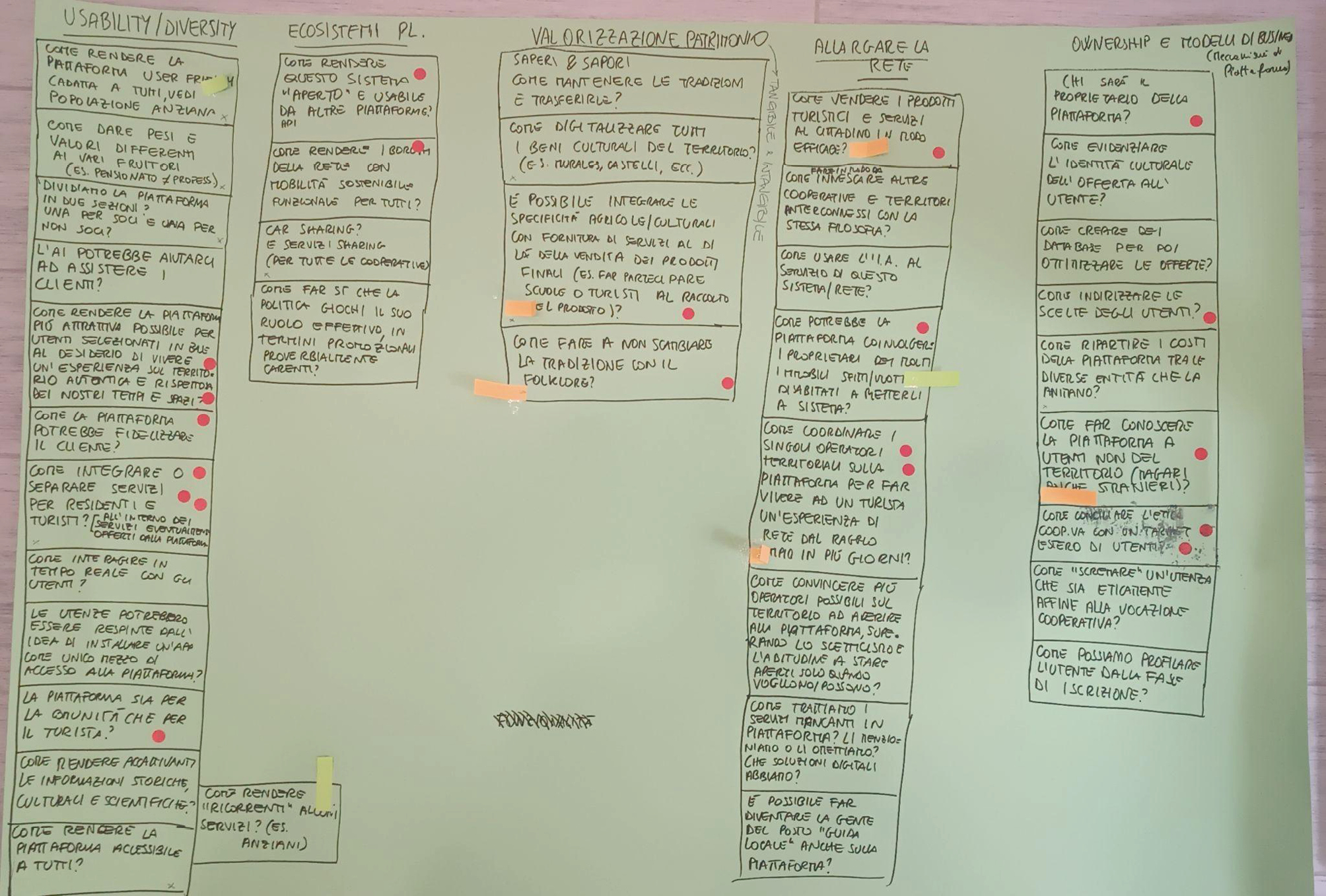
As for the tourist-users, participants want to attract those “interested in authentic experiences that respect the rhythms and spaces of the territory” (Fig. 10, activities 1.4 and 1.5, poster and stickers). In this sense, AbiTerrò is expected to act as a filter, guiding access both to the digital platform and the local area it represents. This is why participants proposed that new users should be invited to “say something about themselves based on what they have understood about [the cooperatives]” as a way to create “a link between the person and the territory” (“Tavola Rotonda”, activity 2.1, researchers’ fieldnotes). This intention was later translated into a design feature opening a dedicated space for user self-presentation (Fig. 11, activity 5.1, digital mockup) (Molz 2013).

As for the inhabitant-users, the “Ask the Expert” session highlighted the need for AbiTerrò to be easily usable by all age groups, to facilitate the recruitment of disused house owners in the tourist accommodation circuit, and to encourage “local people” to act as “local guides” (Fig. 10, activities 1.4 and 1.5, poster and stickers). These goals place the citizen at the heart of the digital experience, as a bridge between visitors and the local social fabric. The idea is to “emphasize sociability and knowledge of the people who live in the area” (“La chiave dei tre Abruzzi”, activity 1.4, researchers’ fieldnotes) while “turning the inhabitant into a tourist” inspired to rediscover their own territory (“Tavola Rotonda”, activity 1.4, researchers’ fieldnotes).
Moreover, AbiTerrò is envisioned as a tool to strengthen social ties within and around the territory, a hub for connecting with like-minded cooperatives and tour operators (activity 1.4, researchers’ fieldnotes), redirecting part of the income towards local projects, and “building trust” (activity 2.1, researchers’ fieldnotes). This overall vision aligns with the principles of community-based tourism, which emphasizes the active involvement of local communities to foster social cohesion and generate local economic development (Goodwin and Santilli 2009; Richter and Kraus 2022). In AbiTerrò, this is also reflected in the creation of a “notice board” where residents and cooperatives can post community service offers (Fig. 12, activity 5.1, digital mockup).
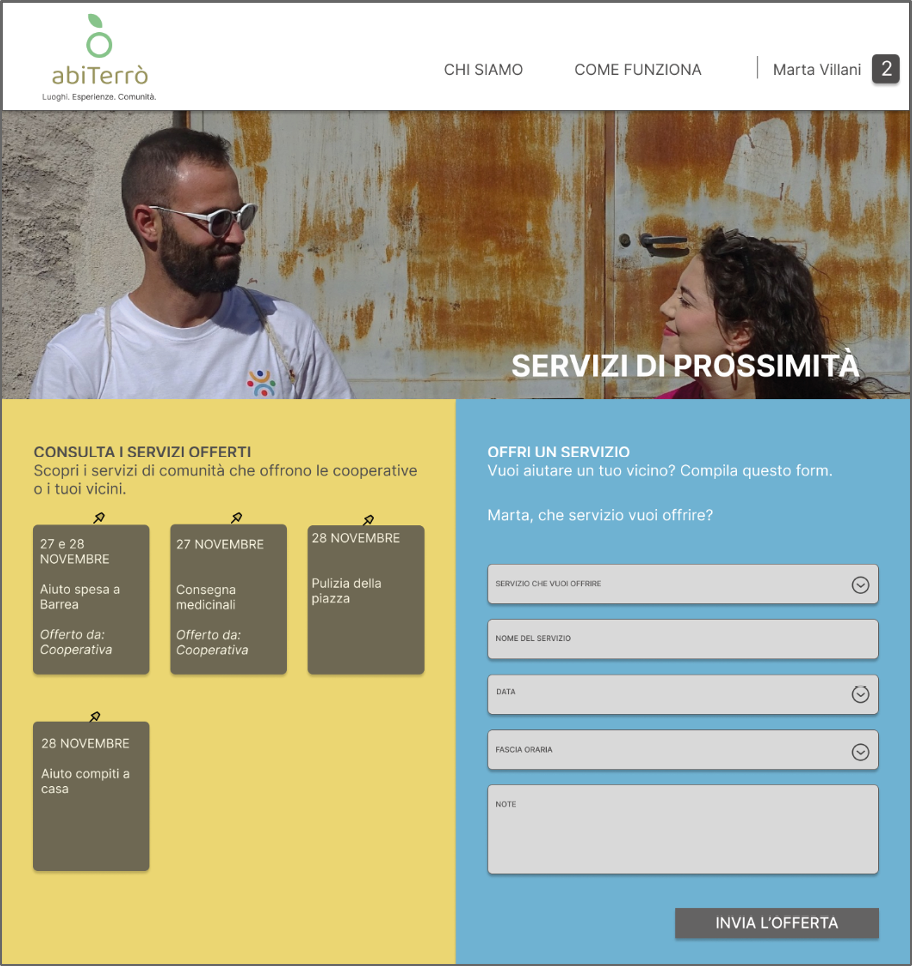
However, the creation of this online noticeboard has raised some tensions within the group. The spokesperson for Vallis Regia pointed out that local services are currently limited, while tourist services dominate the area. This imbalance, they argued, could be reflected on AbiTerrò’s pages, potentially harming the public image of the cooperatives it represents (activity 3.2, researchers’ fieldnotes). Conversely, representatives from Tavola Rotonda highlighted the value of opening this space regardless – both as a way to anticipate future services and as a potential hub for residents and temporary inhabitants (activity 3.2, researchers’ fieldnotes). This discussion highlights a different conceptualization of the co-designed platform: to the former participant, it is a showcase that should make the cooperatives’ proposals attractive to tourists and therefore cannot reveal their weaknesses; to the latter participant, instead, AbiTerrò is a space for strengthening social cohesion, where the weaknesses of the cooperatives can be faithfully displayed.
This contradiction also reveals that the resistance community formed around AbiTerrò is not a unified aggregate, but a collection of singularities that share goods and values without flattening their own worldviews (Sivanandan 1981; Virno 2010). With this lens we can also interpret another episode of internal discussion: some participants questioned if local businesses should join a cooperative – and thus share in its risks – in order to appear on the platform, or if they can be listed on AbiTerrò (and benefit from the consequent advertising) even if they are not members (researchers’ fieldnotes, activities 1.3 and 1.4). No consensus was reached on this issue, but the discussion revealed the different conceptions of partnership and community at the basis of both the cooperatives’ model and the platform cooperativism practices.
AbiTerrò emerges both as a sociotechnical infrastructure and as a medium understood in its strong sense, as an environment structuring relationships among subjects through specific representations of reality. The platform does not merely provide services and information for tourists, nor simply match supply and demand, as platforms based on private ownership and extractive control typically do. It rather embeds a grammar, and a vision rooted in practices of care, responsible hospitality, offering an alternative to commodified and decontextualized models of tourism.
Following this perspective, the platform can be interpreted as an instance of situated digital commoning (Henderson and Escobar 2024), where the production and governance of digital resources are grounded in the lived experiences and relational practices of local communities. AbiTerrò thus valorizes the commons as constitutive, political elements of a community of resistance, marked by internal heterogeneity and differentiated trajectories. In this sense, it can be understood both as a device (Foucault 1980) and as a technology of subjectivation (Rose 2021), through which emerging collective subjectivities articulate material and symbolic forms of resistance against the extractive logics of mainstream tourism and platform capitalism (Srnicek 2016; Van Dijck, Poell and De Waal 2018). Although it does not constitute a fully realized alternative to the hegemony of commercial platforms and dominant tourism models, it works as a relational space traversed by symbolic and political negotiation, discursive construction of collective subjectivities, as well as a site of tension where demands for economic sustainability, claims for social justice, and aspirations for cultural recognition intersect.
The co-design process also made visible a set of contradictory worldviews and identity practices that remain largely invisible within mainstream technological processes: this reflects the intrinsic political character of any commoning practice (Hardt and Negri 2009; Dyer-Witheford 2020). In this light, digital co-design emerges as a generative process, capable of fostering embryonic forms of communal resistance through commoning actions grounded in collective agency and social cooperation. Tourism itself may be reframed not simply as an economic sector or an opportunity for territorial growth, but as a conflictual and participatory terrain: a site of transformative potential for the situated production of collective subjectivities capable of transforming the extractive dynamics of contemporary digital capitalism.
Aiken M. (2015), «Communities of Resistance: Resistance is not futile. Understanding how neo-liberalism can be challenged by common and reciprocal action», in TNI’s call for papers for State of Power 2015 report.
Bellato L., Frantzeskaki N. and Nygaard C.A. (2023), «Regenerative tourism: A conceptual framework leveraging theory and practice», in Tourism Geographies, 25(4): 1026-1046.
Belotti F. (2015), «Political participation and commons: The case study of the “Water Common Good” referendum», in International Journal of Sociology and Social Policy, 35(9-10): 649-665.
Boháč A. and Drápela E. (2022), «Overtourism Hotspots: Both a Threat and Opportunity for Rural Tourism», in European Countryside, 14: 157-179, https://doi.org/10.2478/euco-2022-0009.
Borzaga C. and Zandonai F. (2015), «Oltre la narrazione, fuori dagli schemi: i processi generativi delle imprese di comunità», in Impresa Sociale, 5: 1-7.
Brollo B. and Celata F. (2023), «Temporary populations and sociospatial polarisation in the short-term city», in Urban Studies, 60(10): 1815-1832.
Brown T. (2019), Change by Design, Revised and Updated: How Design Thinking Transforms Organizations and Inspires Innovation, HarperCollins Publishers, New York.
Bunders D. J. and De Moor T. (2024), «Paradoxical Tensions as a Double-Edged Sword: Analysing the Development of Platform Cooperatives in the European Gig Economy», in Journal of Management Inquiry, 33(4): 366-382.
Butcher J. (2003), The Moralisation of Tourism: Sun, Sand… and Saving the World?, Routledge, London.
Candeloro G. and Tartari M. (2025), «Heritage-led sustainable development in rural areas: The case of Vivi Calascio community-based cooperative», in Cities, 161: 105920. https://doi.org/10.1016/j.cities.2025.105920.
Celata F., Capineri C. and Romano A. (2020), «A room with a (re)view. Short-term rentals, digital reputation and the uneven spatiality of platform-mediated tourism», in Geoforum, 112: 129-138.
Cohen E. (1987), «Alternative tourism – A critique», in Tourism Recreation Research, 12(2): 13-18.
Deleuze G. and Guattari F. (1987), A thousand plateaus. Capitalism and schizophrenia, University of Minnesota Press, Minneapolis and London.
Di Maggio U. (2019), Il cooperativismo di piattaforma: Per una nuova economia digitale e collaborativa, Homeless Book.
Dicks B., Soyinka B. and Coffey A. (2006), «Multimodal ethnography», in Qualitative research, 6(1): 77-96.
Dodds R. and Butler R. (2019), «The phenomena of overtourism: A review», in International Journal of Tourism Cities, 5(4): 519-528.
Doǧan H.Z. (1989), «Forms of adjustment: Sociocultural impacts of tourism», in Annals of tourism research, 16(2): 216-236.
Duignan M.B., Pappalepore I. and Everett S. (2019), «The ‘summer of discontent’: Exclusion and communal resistance at the London 2012 Olympics», in Tourism Management, 70: 355-367.
Dyer-Witheford N. (2020), «The state of the commons: commoners, populists, and communards», in Popular Communication, 18(3): 170-184, https://doi.org/10.1080/15405702.2020.1781859.
Foucault M. (1980), Power/Knowledge: Selected Interviews and Other Writings, 1972-1977, Harvester Press, Brighton.
Gardiner S., Vada S., Yang E.C.L., Khoo C. and Le T.H. (2022), «Recreating history: The evolving negotiation of staged authenticity in tourism experiences», in Tourism Management, 91: 104515, https://doi.org/10.1016/j.tourman.2022.104515.
Giampiccoli A. and Saayman M. (2014), «A conceptualisation of alternative forms of tourism in relation to community development», Mediterranean Journal of Social Sciences, 5(27): 1667-1677.
Gibson C. (2010), «Geographies of tourism: (un)ethical encounters», in Progress in Human Geography, 34(4): 521-527.
Goi H. C. and Tan W. L. (2021), «Design Thinking as a Means of Citizen Science for Social Innovation», in Frontiers in Sociology, 6. https://doi.org/10.3389/fsoc.2021.629808.
Goodwin H. and Santilli R. (2009), «Community-Based Tourism: a success?», in ICRT Occasional Paper, 11: 1-37.
Guest G., MacQueen K. and Namey E. (2011), Applied Thematic Analysis, Sage.
Hardt M. and Negri A. (2009), Commonwealth, Harvard University Press, Cambridge.
Henderson J. and Escobar O. (2024), «Reviving the Commons? A Scoping Review of Urban and Digital Commoning», in Data Civics Observatory, Edinburgh Futures Institute.
Joseph C.A. and Kavoori A.P. (2001), «Mediated resistance: Tourism and the host community», in Annals of tourism research, 28(4): 998-1009.
Jover, J. and Díaz-Parra I. (2020), «Gentrification, transnational gentrification and touristification in Seville, Spain», in Urban Studies, 57(15): 3044-3059. https://doi.org/10.1177/0042098019857585.
Knapp J., Zeratsky J. and Kowitz, B. (2016), Sprint. How to solve big problems and test new idea in just five days, Bantam Press.
Krajickova A., Hampl F. and Lancosova E. (2022), «Visitors’ perception of overtourism impacts in a small destination», in Anatolia, 33(2): 236-246. https://doi.org/10.1080/13032917.2022.2040915.
Liberatore G., Biagioni P., Talia V. and Francini C. (2019), «Overtourism in Cities of Art: A Framework for Measuring Tourism Carrying Capacity», in Urban Economics and Regional Studies eJournal, DOI:10.2139/ssrn.3481717.
Liu C.H., Tzeng G.H., Lee M.H. and Lee P.Y. (2013), «Improving metro–airport connection service for tourism development: Using hybrid MCDM models», in Tourism Management Perspectives, 6: 95-107.
Lupton D. (2018), «Towards design sociology», in Sociology Compass, 12(1): e12546. https://doi.org/10.1111/soc4.12546.
Massey D. (2012), «Power-geometry and a progressive sense of place», in J. Bird, B. Curtis, T. Putnam and L. Tickner (Eds.), Mapping the futures, Routledge, London, pp. 60-70.
Metzler H. and Garcia D. (2024), «Social Drivers and Algorithmic Mechanisms on Digital Media», in Perspectives on Psychological Science, 19(5): 735-748. https://doi.org/10.1177/17456916231185057
Milano C., Novelli M. and Russo A.P. (2024), «Anti-tourism activism and the inconvenient truths about mass tourism, touristification and overtourism», in Tourism Geographies, 26(8): 1313-1337.
Molz J. G. (2013), «Social networking technologies and the moral economy of alternative tourism: The case of couchsurfing», in Annals of tourism research, 43: 210-230.
Mori P.A. and Sforzi J. (2018), Imprese di comunità. Innovazione istituzionale, partecipazione e sviluppo locale, Il Mulino, Bologna.
Nancy J-L. (1991), The inoperative community, University of Minnesota Press; Minneapolis and Oxford.
Nilsson J.H. (2020), «Conceptualizing and contextualizing overtourism: The dynamics of accelerating urban tourism», in International Journal of Tourism Cities, 6(4): 657-671.
Oluka A. (2024), «The impact of digital platforms on traditional market structures», in Technology Audit and Production Reserves, 2(4): 21-29. https://doi.org/10.15587/2706-5448.2024.303462.
Ossorio M. (2024), «Digital Technologies for Sustainable Tourism: The Case of Ecobnb», in Y. El Archi, B. Benbba, L. Dávid and L. Cardoso (Eds.), Promoting Responsible Tourism with Digital Platforms, IGI Global Scientific Publishing, pp. 60-71.
Ostrom E. (1990), Governing the Commons. The Evolution of Institutions for Collective Action, Cambridge University Press.
Papadimitropoulos E. (2021), «Platform capitalism, platform cooperativism, and the commons», in Rethinking Marxism, 33(2), 246-262.
Philipp P., Hermes S., Schreieck M. and Böhm M. (2021), «Challenges and Success potentials of Platform Cooperatives: Insights from a Multiple Case Study», ECIS 2021 Research Papers, 74.
Presidenza del Consiglio dei Ministri, Dipartimento per le Politiche di Coesione e per il Sud (2025), Piano Strategico Nazionale delle Aree Interne: https://politichecoesione.governo.it/media/yamnr5sl/piano-strategico-nazionale-delle-aree-interne.pdf
Primi A., Gabellieri N. and Moretti I. (2019), «Smart tourism technologies per la fruizione dei territori: i portali per l’ospitalità turistica alternativa», in GEOTEMA, 59, 121-132.
Rancière J. (1999), Disagreement: Politics and Philosophy, University of Minnesota Press.
Richter C. and Kraus S. (2022), «Platform cooperatives in the sharing economy: How market orientation influences performance», in Journal of the Academy of Marketing Science, 50, 133-155. https://doi.org/10.1007/s11747-024-01042-9.
Romano A., Bonini T. and Capineri C. (2023), «Interfacing the space of flows and the space of places in the platform society: ten years of Airbnb in Florence», in Rivista geografica italiana, 130(2), 61-82.
Rogowski M., Zawilińska B. and Hibner J. (2025), «Managing tourism pressure: Exploring tourist traffic patterns and seasonality in mountain national parks to alleviate overtourism effects», in Journal of Environmental Management, 373, https://doi.org/10.1016/j.jenvman.2024.123430.
Rose F.M. (2021), «The unexpected persistence of non-corporate platforms: The role of local and network embeddedness», in Digital Geography and Society, 2, 100020.
Russell A. (2000), Crossing Boundaries: Postmodern Travel Literature, Palgrave.
Scheyvens R. (2002), Tourism for development: Empowering communities, Pearson Education Ltd.
Scholz T. (2016), Platform cooperativism. Challenging the corporate sharing economy, Rosa Luxemburg Stiftung.
Sivanandan A. (1981), «From resistance to rebellion: Asian and Afro-Caribbean struggles in Britain», in Race and Class, 23(2-3): 111-152.
Srnicek N. (2016), Platform Capitalism, Polity Press, Cambridge.
Stors N. and Baltes S. (2018), «Constructing Urban Tourism Space Digitally: A Study of Airbnb Listings in Two Berlin Neighborhoods», in Proceedings of the ACM on Human-Computer Interaction, 2(166): 1-29, https://doi.org/10.1145/3274435.
Törnberg P. (2022), «Platform placemaking and the digital urban culture of Airbnbification», in Urban Transform 4, 3, https://doi.org/10.1186/s42854-022-00032-w
Trudeau D., McMorran C. (2011), «The geographies of marginalization», in V. Del Casino, M. Thomas, P. Cloke and R. Panelli (Eds.), A companion to social geography, John Wiley & Sons, pp. 437–453.
Van Dijck J., Poell T. and De Waal M. (2018), The platform society: Public values in a connective world, Oxford University Press, Oxford.
Vendemmia B., Pucci P. and Beria P. (2021), «An institutional periphery in discussion. Rethinking the inner areas in Italy», in Applied geography, 135: 102537.
Virno P. (2010), E così via, all’infinito. Logica e antropologia, Bollati Boringhieri, Torino.
Wearing S. and Wearing M. (2014), «On decommodifying ecotourism’s social value: Neoliberal reformism or the new environmental morality», in M. Mostafanezhad and K. Hannam (Eds.), Moral encounters in tourism, Burlington, Ashgate, pp. 123-137.
Wegner D., Borba Da Silveira A. and Ertz M. (2024), «Mapping out Cooperative Digital Platforms: A Conceptual View», in Cureus Journal of Business and Economics, 3, 32, https://doi.org/10.7759/s44404-024-01904-z.
Zhu J. and Marjanovic O. (2021), «A different kind of sharing economy: A literature review of platform cooperatives», in T. X. Bui (Ed.), HICSS 2021: Proceedings of the 54th Hawaii International Conference on System Sciences, University of Hawaii at Manoa, pp. 4128–4137.
Zolfani S.H, Sedaghat M., Maknoon R. and Zavadskas E.K. (2015), «Sustainable tourism: a comprehensive literature review on frameworks and applications», in Economic Research-Ekonomska Istraživanja, 28(1): 1-30, https://doi.org/10.1080/1331677X.2014.995895.