Generations, Education and Common Values: a study on five Italian cohort-generations, from the Reconstruction to Gen Z
Abstract. The concept of values has long been at the core of sociological discussions. Considering the extensive range of literature and diverse approaches, there is a clear gap to be addressed. Lyons and colleagues (2005, 2007) have noted the absence of studies investigating value differences between generations. In this paper, data were used from the Italian subsamples of the European Social Survey (ESS) for the years 2018, 2020, 2022 to provide evidence to fill part of this gap. The paper’s goals are to fill the gap in literature and determine if values can differentiate generations that are close in time. These goals will be pursued using the Basic Human Values theory of S. H. Schwartz that are currently part of the ESS questionnaire and the cohort-generation tool for the comparison. Five different cohort-generations were considered: the Reconstruction generation (born between 1927 and 1948), the Baby Boom generation (born between 1948/49 and 1968), Generation X (born between 1968/69 and 1979), Y (1979/80 and 1995) and Z (1995/96 and 2008). The last, complementary goal is to understand whether education (which can be considered the biggest change that has affected generations over time) can describe the changes in values over generations. This will be done in line with an awareness of the fundamental role of education and its potential to change values, attitudes and expectations.
Keywords: generations, values, education, social change.
Index
2. THE BASIC/PERSONAL HUMAN VALUES
3. VALUES, MICRO AND MACRO CHANGE OF SOCIAL GENERATIONS
3.2 The channel of values: the role of education
5. DISTINGUISHING GENERATIONS BY VALUE ORIENTATION
5.2 Issue of values: education between generations
In contemporary times, individuals of all ages are intertwined in a mosaic of relationships and values that are in a constant flux of changes. From the post-World War II era to Generation Z, each generation has its own distinct perspective and worldview. These perspectives are mutable over time, shaped and reshaped by experiences, contexts, culture, technology and more. Within this intricate and dynamic framework, it is important to observe the divergent perspectives and values of these groups, which create a compelling landscape for studying social changes and identity. Examining a generation comprehensively is a complex task that requires focusing on the multiple levels that constitute it. In discussions about generational unity, it is crucial to always consider the contexts and connections that define them (Mannheim 1952; Casavecchia 2022). This paper aims to compare generations and differentiate them using values as a tool, which unlike other variables, can reflect historical contexts as well as the relationships inherent in each generation. While there has been extensive research on values and generations, particularly in relation to work and its evolution, few studies have focused on fundamental human values (Lyons et al. 2005; Robinson 2013). In this work, Basic Human Values (BHV) refer to Shalom A. Schwartz’s theory (1992), building upon Clyde Kluckhohn (1951) and Milton Rokeach’s (1973, 2008) studies on values. This theory is now part of the European Social Survey (ESS) questionnaire. According to Schwartz (1994: 20): «A value is a (1) belief (2) pertaining to desirable end states or modes of conduct, that (3) transcends specific situations, (4) guides selection or evaluation of behavior, people, and events, and (5) is ordered by importance relative to other values to form a system of value priorities».
Values, as understood here, represent elements that articulate conscious goals, theoretically and empirically addressing fundamental aspects of human and social nature, such as biological needs, the necessity of social interaction, and the requirements of well-functioning social groups.
2. THE BASIC/PERSONAL HUMAN VALUES
Schwartz’s values address the intrinsic aspects of individuals, societies, and cultures. These values consist of ten basic values and four higher-order values. These are operationalized through 21 items1 on a likert scale2 (PVQ 21) in the ESS questionnaire.
The foundation of this typology of values is based on the idea that they represent a circular continuum of motivations (Schwartz 1992, 2006, 2012, 2016). Each segment of this circle is a fuzzy subset of other values arranged conventionally (see Figure 1). There are 19 basic values in total, comprising ten personal or individual values encapsulated within four groups.
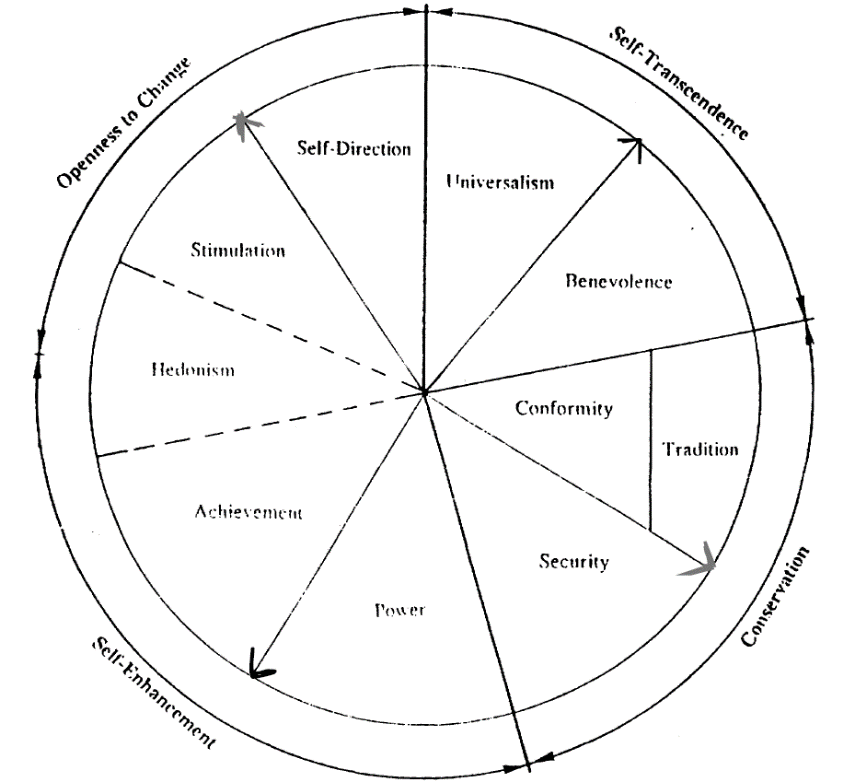
In the author’s early analyses (Schwartz and Sagiv 1995), different sets of values were studied using smallest space analysis, which supported the concept of regions of values. These configurational analyses enabled the observation, across various country samples, of the value structure theorized by the author and the specific relationships in terms of distance or proximity between values. The theoretical framework organizes the four highest values along two polarized dimensions: openness to change versus conservativism, and self-enhancement versus self-transcendence. The first dimension distinguishes between dynamic values and those oriented towards maintaining order, while the second dimension separates values focused on altruism and universalism from those emphasizing self-interest more broadly. This dynamic criterion of contrast is rooted in considering both the harmony and conflict among values in decision-making (Schwartz 2012). S. H. Schwartz explains this dynamic within a universal value structure: vertically, there is contrast between personally focused values (self-enhancement and openness to change) and socially focused values (conservation and self-transcendence). Horizontally, values are contrasted based on factors like anxiety, loss aversion, promotion of gain goals, and self-protection versus self-expansion and growth (self-enhancement and conservatorism versus openness to change and self-transcendence) (Schwartz 2006). These highest values lie above ten other values constituting them: Openness to change comprises self-direction, stimulation, and hedonism, which collectively signify independent thought and action, seeking novelty and challenge in life, and deriving gratification from oneself; Conservatorism comprises security, conformity, and tradition, reflecting desires for societal stability, adherence to social norms, and respect for customs, ideas, and traditional cultural or religious prescriptions, not to be confused with political conservatism; it should be understood as a general spirit of preservation which individuals tend to adopt; Self-enhancement includes achievement and power, indicating aspirations for success, demonstrating competence in social contexts, attaining prestige and status, and controlling resources; Self-transcendence encompasses values such as benevolence, universalism, and humility, focused on enhancing the well-being of close individuals, appreciating the well-being of people and nature in general (Sagiv and Schwartz 2022). As noted by Davidov (2010), these values are generally considered a fundamental aspect of culture that is not easily quantifiable. When considering generations as social groups and examining a cultural element such as basic values, we can hypothesize that these may offer distinct criteria that extend beyond social structures and the increasingly similar social contexts in which different generations live (Chisolm 2023). Regarding this topic, Lyons and colleagues (2005: 769), «despite the lack of empirical evidence to support a generational value typology», present some evidence related to the difference between the Baby Boom generation and the Generation X. The aim of the scholars is to specify differences in BHV between people of different generations (Lyons et al. 2007).
3. VALUES, MICRO AND MACRO CHANGE OF SOCIAL GENERATIONS
In this framework, generations play a dual role in social change, both driving and promoting it while also being influenced by it. Values concurrently undergo change (Cavalli 2004). This is especially evident when examining generations during their youth, where youth perspective acts as a primary catalyst for social change (Cuzzocrea 2022), distinct from viewing youth merely as alternatives to the dominant culture (sub-cultural perspective; Bennett 1999) or as immature individuals (big grown-up babies or choosy, as commonly portrayed in Italian public opinion).
To understand the change in values as a generation-defining element here, we can use the category “social generation” (Woodman and Wyn 2015), also seeking to integrate the critics of other authors (France and Roberts 2015). This approach not only considers the structural and biological aspects that define a generation, which would provide only a contextual definition, but also incorporates values, cultural elements, and individual factors. This comprehensive perspective enables a deeper study, encompassing the identity of a generation and its internal relationships to go beyond the conflicting relationships between the concept and associated critiques, which assert that the concept of social generation improperly challenges the notion of social change by disputing the role of class struggle or even technological innovation (Thorpe and Inglis 2019). In the conclusion of one of their works, the major critics of the approach affirm:
We think a more important and relevant way of looking at these questions is by exploring the interrelationship between macro- and micro-processes that underpin the everyday social practice of young people (ed. or generations in general) (France et al., 2012). For example, we need to recognize how neo-liberalism and global capitalism act as a force of creative destruction’ (Harvey, 2005) that not only constructs and shapes the macro world but also the types of relationships we have (through relations in the workplace, education, the family and beyond) (France and Roberts 2015: 227)
We can address this critique be recalling that in sociology, C.W. Mills (1959) asserted that a social study cannot be considered complete unless it addresses the intersections of biography and history. Following the previous academic and echoing earlier thinkers such as Ortega Y Gasset (1923) and Mannheim (1952), Abrams (1982) emphasized the importance of historical interpretation in understanding generations. Expanding upon the insights present in these classic perspectives, it is possible to provide a framework that considers both macro-social and micro-social aspects, as well as contextual and international dimensions. Furthermore, other approaches can be used that have provided tools for studying possible micro-macro combinations (Coleman 1994; Ramström 2018).
To better understand and use the concept of social generations, we necessarily explore two main paths: (1) focusing on the original concept to understand and study peculiarity and differences in micro and macro aspects of generations, and (2) exploring the expansion of the concept into the idea of a global generation (Roberts and France 2021). Regarding the first path, there is a notable oversight in considering elements of generational identity that define differences between generations. While this does not negate the validity concept of generation, the absence of common analysis criteria exposes the concept of generation to uncritical and popular usage by media and the marketing world. Moreover, the concept of social generation challenges the other theories of social change, such as the class struggle theory or that of technological innovation. Therefore, the proposal here is to consider the history and location of generations, trying to address the possibilities of conciliating these elements. As modernity progresses, interpreting the birth and constitution of generations becomes increasingly intricate, underscoring the necessity to identify criteria for identifying the generational unity. The discussion does not encompass the second path directly; however, it is possible to offer valuable insights for examining it. The concept of global generations (Beck 2008; Beck and Beck-Gernsheim 2009) poses many problems likely related to a misunderstanding of the original concept of generations (Thorpe and Inglis 2019). Firstly, it is true that global phenomena and international communication possibilities have multiplied, but it is equally true that these are experienced differently depending on individuals’ reference categories, which are partly influenced by geographical, historical, and social origins, as well as many other factors. Beck and Beck-Gernsheim’s (2009) critique of the concept of generation as methodological nationalism is fundamentally flawed because it fails to account for differences among individuals and, secondly, it conflates the global north and global south, which are not two precise generational units. Moreover, Mannheim already had a sensitivity that extended beyond national boundaries, and his arguments connected the emergence of new generations or generational units to history and geographical location, thus taking the context into account (Woodman 2016).
These digressions are useful for the following work, both to provide an overview of the discussion on the concept of generation and to introduce the comparative possibilities offered by Schwartz’s BHV in the debate on generations. Vertically across age groups and horizontally across countries, these values can be one of the elements that help to question and refine concepts, given the availability of data, questionnaires, and theoretical frameworks.
The discussion on values intersects debates about generations. Another influential figure in the discourse on values, Ronald Inglehart, preceded Schwartz with similar insights. Despite starting from different assumptions and operationalizations, their perspectives do not significantly differ.
In Schwartz’s theory, there appears to be an association between generational changes and values. For instance, he links the level of security experienced by generations to their values: during periods of high insecurity, values of conservatorism and self-enhancement tend to be more pronounced, whereas values of openness to change and self-transcendence are more prevalent during secure times (Egri and Ralston 2004).
In Inglehart’s Theory of Silent Revolution, he identifies a correlation between economic well-being, the affirmation of democracy, and changes in values over time (Inglehart [1977] 2015; Inglehart et al. 1998). Higher levels of economic and personal security are associated with the transition from materialist to post-materialist values. This theory is built on the pillars of resource scarcity and socialization: as societies satisfy basic needs and achieve a certain level of material and cultural wealth, values such as freedom, personal growth, health, and environmental concern emerge. These values have shown stability across time and generations. Translating these concepts into common generational labels, from the Baby Boomer generation onward, societies have moved into a post-materialist era (Inglehart 2018). The major difference between these two ways of observing change lies in the structural conception of value: in the case of personal or basic human values theory, these are defined «as desirable, trans-situational goals, varying in importance, that serve as guiding principles in people’s lives» (Schwartz 2016: 63); in the case of Inglehart’s theory the explanation is endogenous and focused on the mutation of values linked to the primary and secondary needs (Maslow 1948) caused by the socio-economic circumstances (Inglehart 1977; 1990). This difference partly explains the use of the BHV theory in this work. The debate is focused on the difference between the studies supporting the idea of the rank of values and their replacement and radical change over time, versus others that support the thesis of rating values, their co-presence, and their dominance-values mix over time (Bettin Lattes 2014). When considering values as a ranking, they are in conflict, while when considering values in a rating, there are some elements of rationality, and these are understood together in multiple and even contradictory shapes. The choice of approach depends on the researchers, yet we cannot establish whether one approach is better than the other, while we can bring evidence to help us determine which one better contributes to understanding social reality (de Lillo 1988).
In the Italian framework, Antonio de Lillo carried out some studies on values and youth. Like the more recent studies on the crisis’s effects on values, he noticed the necessities of security of the generation of the 1980s. In the classification of this work, these years represent Generation X’s full of youthfulness and the transition to adulthood, along with the birth of the first members of Generation Y (de Lillo 1988). This result already contradicted Inglehart’s findings. In the general and modern international landscape, there seems to have been a resurgence of material values in recent years according to the Inglehart’s thesis, likely due to various factors such as economic crises (2008), political turmoil, health crises (2019-2022), and armed conflicts (e.g., the Ukraine-Russia conflict, the renewed instability in the Middle East). This phenomenon has been referred to as a backlash (Norris and Inglehart 2019). Specifically, in relation to the global financial crisis of 2008, some scholars have noted a radical shift in values among certain cohorts of European youth (Sortheix et al. 2019). This shift primarily concerns the value of security, influenced by subsequent welfare state cuts. Inglehart also used the value of security to highlight these changes. However, using Schwartz’s categories, the financial crises led to an increase in values such as tradition and security, with a less pronounced rise in conformity. Conversely, values related to hedonism, self-direction, and stimulation have decreased, while benevolence has increased. Observing these first results, and moving from the same assumption, the theories of Schwartz and Inglehart demonstrate a different sensitivity to the changes and adaptive reaction to values of people in contemporary history, as highlighted by de Lillo in the 1980s.
3.2 The channel of values: the role of education
Values and education have always been analyzed in sociology. For instance, Karl Mannheim discussed the important role of education in fostering democratic values (Casavecchia 2017). In the education debate, structuralist views, which see the transmission of values as positive, are contrasted with critical views that consider them a tool of domination (Giancola and Salmieri 2024). This debate is relevant in the context of generational studies in Western societies, given the widespread expansion of education. This phenomenon is one of the most significant contributors to generational differentiation (Giancola and Bonanni 2023). The underlying hypothesis concerns the relationship between education and changes in BHV across generations, given that the increase in participation in formal education is the most evident phenomenon affecting different generations. Despite critical or functionalist perspectives on the role of education in value transmission, it is recognized that values and educational choices are strongly interconnected with individuals’ backgrounds and life circumstances. Educational institutions are specialized in transmitting values and could change them, while values can sometimes influence educational achievement (Vecchione and Schwartz 2022). All Western societies transmit values through education, fostering intellectual openness and the capacity to question established norms and cultural traditions as education levels rise. In the BHV theory, Schwartz (2007, 2012) identifies and reports a statistical association between universalism and participation and achievement in higher education, with the values in a reciprocal and linear relationship. In Italy, studies have shown a positive correlation between education levels and values of stimulation and self-direction, and a negative correlation with values of tradition and security (Schwartz et al. 2012; Capanna et al. 2005). It is important to acknowledge that many factors influence this association, such as teachers, peer groups, school principals, micro-policies, etc., especially in contemporary liberal democracies where educational inequalities persist.
In this sense, schools, rather than education in general, serve as a double-edged sword: they transmit both knowledge and competencies while also reproducing values across generations (Halstead and Taylor, 2005). In this intermediary position, schools and education are crucial for shaping value awareness, though their influence can at times be critical.
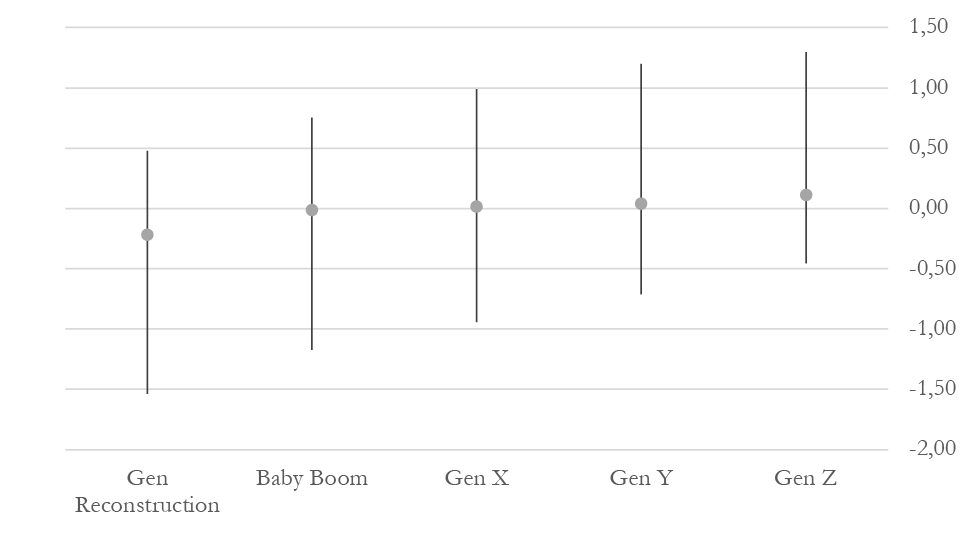
The ESS databases of waves 8, 9 and 10 (2016; 2018; 2020) were used for the analysis, extracting only the Italian subsample (15,639 cases). To identify the cohort-generations, the variable “Year of Birth” (yrbrn) was recoded into five categories: Generation Z, which includes those born between 1996 and 2008, Generation Y or millennials, which includes those born between 1980 and 1995, Generation X, which includes those born between 1969 and 1979, the Baby Boom generation, which includes those born between 1949 and 1968 and the Reconstruction Generation, which includes those born between 1927 and 1948. The logic behind these five cohort-generations is linked to the necessity to identify groups which make it possible to conduct statistical analyses, attempting to adhere as closely as possible to the definition of generation. The values were constructed using two sets of theoretically oriented principal component analyses (PCA), the first on the 21 items of the questionnaires divided by the ten personal values described above and the second on the ten extracted, divided by the four highest values. This was followed by a series of bi- and trivariate analyses aimed at highlighting differences and similarities in values among cohort-generations.
5. DISTINGUISHING GENERATIONS BY VALUE ORIENTATION
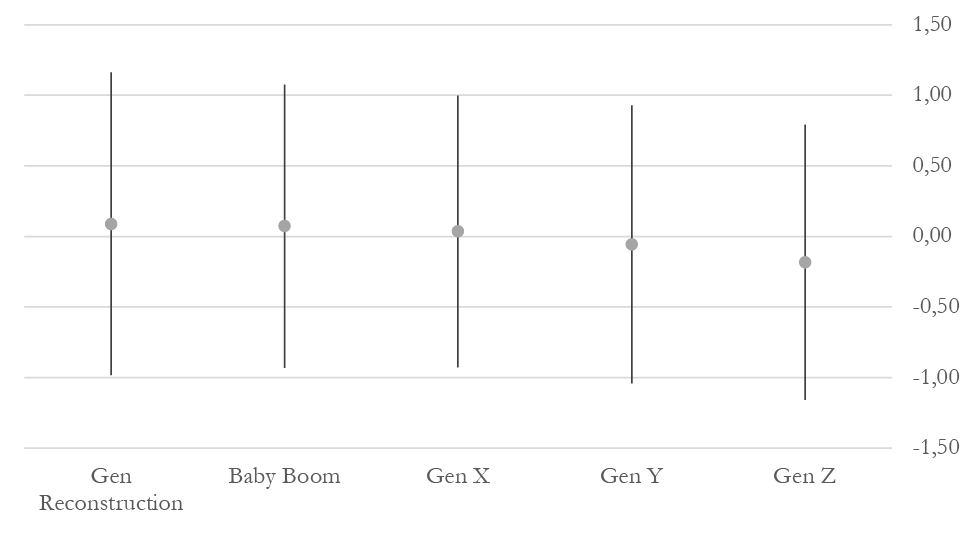
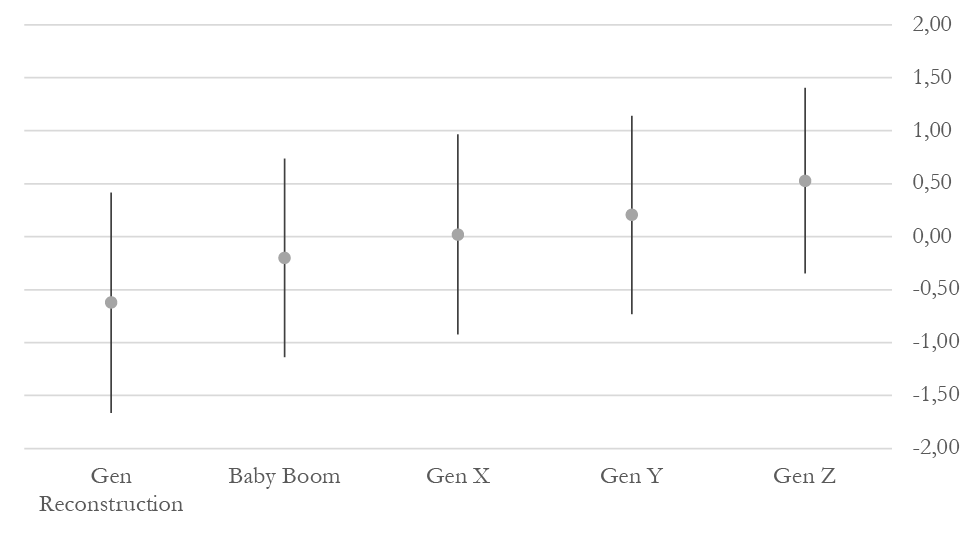
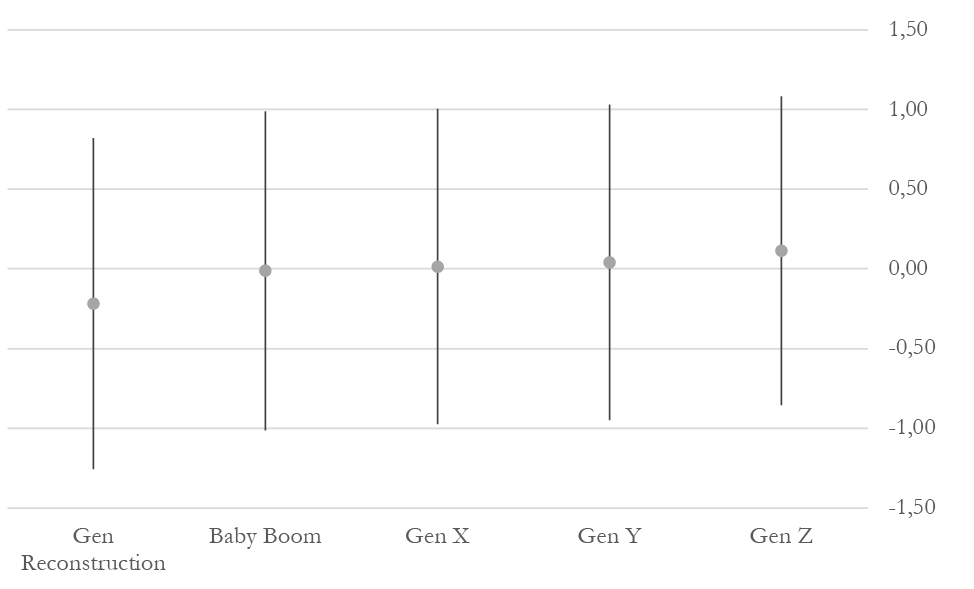
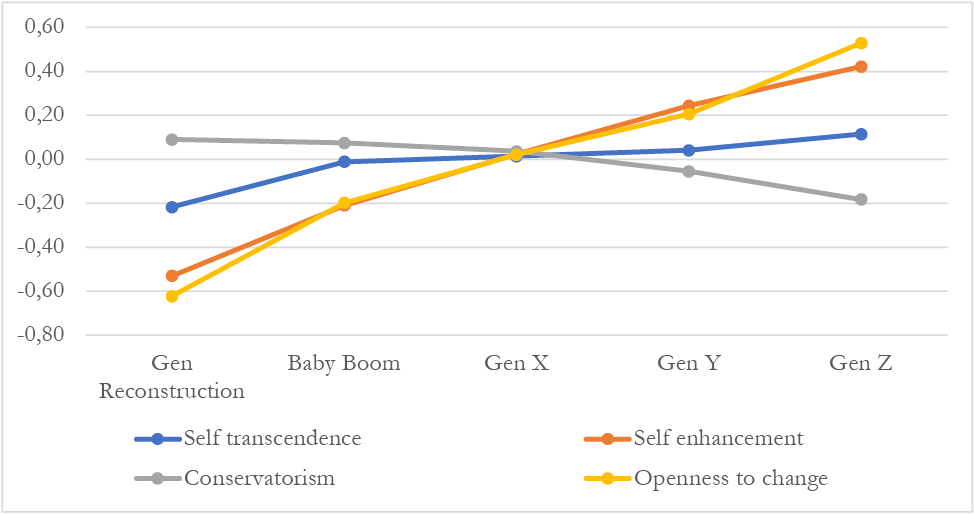
Observing the aggregate means of the components representing BHV, the differences between generations become apparent. Comparing these generations reveals significant contrasts, particularly between conservatorism and openness to change. The oldest generation scores highest on conservatorism and lowest on openness to change, while the youngest generation shows the opposite trend. This suggests a linear reduction across generations, likely influenced by age (p < 0.00).
Considering the values of self-enhancement and transcendence, both show higher means among younger generations. The difference is more pronounced in self-enhancement, indicating a notable interest among Generation Z in values related to power and achievement (p < 0.00).
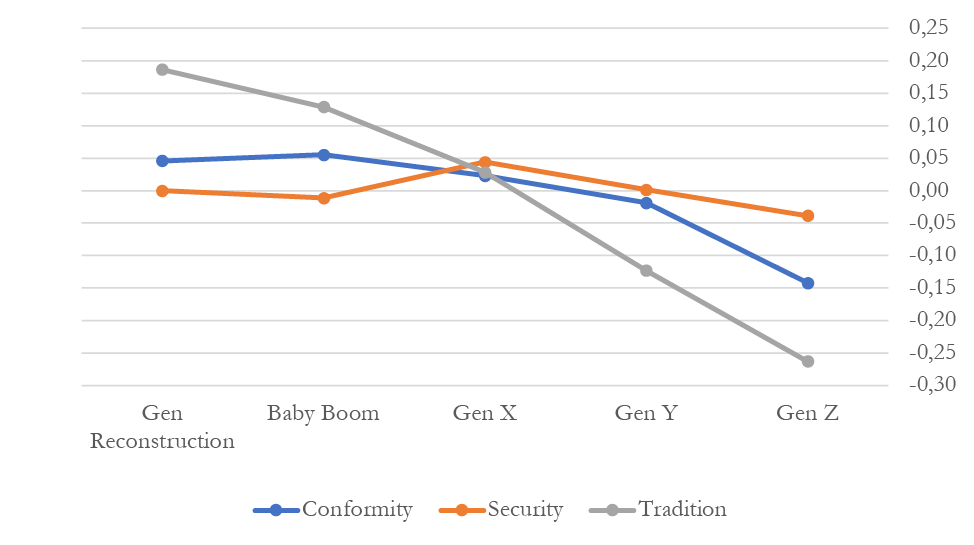
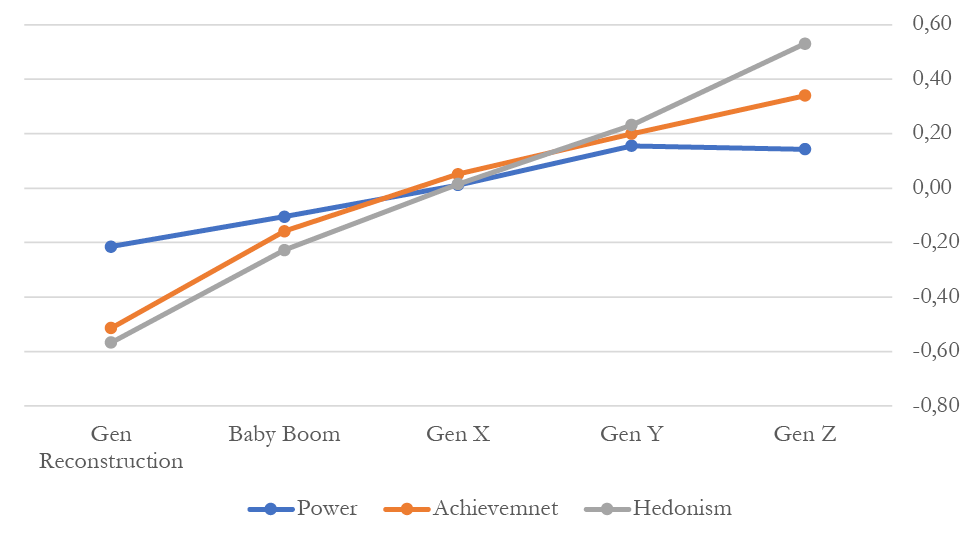
In attempting a general explanation, we observe both differences and similarities in how values are perceived across generations: Baby Boomers are closely aligned with the Reconstruction Generation in all the highest values. Generation X fluctuates between negative and positive sides of the spectrum, reflecting their unique experience straddling different social eras compared to the Baby Boomers. This generation serves as a foothold for social change, influencing subsequent generations in diverse ways. Moreover, Generation X differs from Generation Y, with the latter resembling Generation Z to a significant extent. Going deeper, breaking down the values we can observe that Generation X and Generation Y are differentiated by varying levels of self-enhancement and conservatorism, which manifest in differing means for values related to power, achievement, hedonism, tradition, conformity and security (p < 0.05).
This distinction is necessary, as these two generations are the most challenging to differentiate, in that they have not experienced significant historical breaks that set them apart. Moreover, social change has accelerated and made differences more difficult to discern. As stated previously and in line with the objective of using values as criteria for distinguishing between generations, especially those more closely spaced in time, it is also crucial to consider the details. This is precisely because these generations exemplify the point made by L. Chisolm (2023). In attempting to explain this, we can hypothesize that the Italian Generation X, being the first to experience worse conditions than their parents (Schizzerotto et al. 2011), developed a stronger inclination towards conservatorism not only culturally but also structurally. When we associate this with increasing levels of self-enhancement compared to previous generations, this combination of values can provide insight into the value orientations of these two generations. The first generation had to adapt to a crisis context, while the second generation was born into crisis conditions and was probably already equipped with some tools to navigate difficulties (McCrindle 2003, 2006).
Using cohort-generations as a proxy for historical periods, we observe an overall increase in self-transcendence, self-enhancement, and openness to change. Conversely, conservatorism shows a significant decrease.
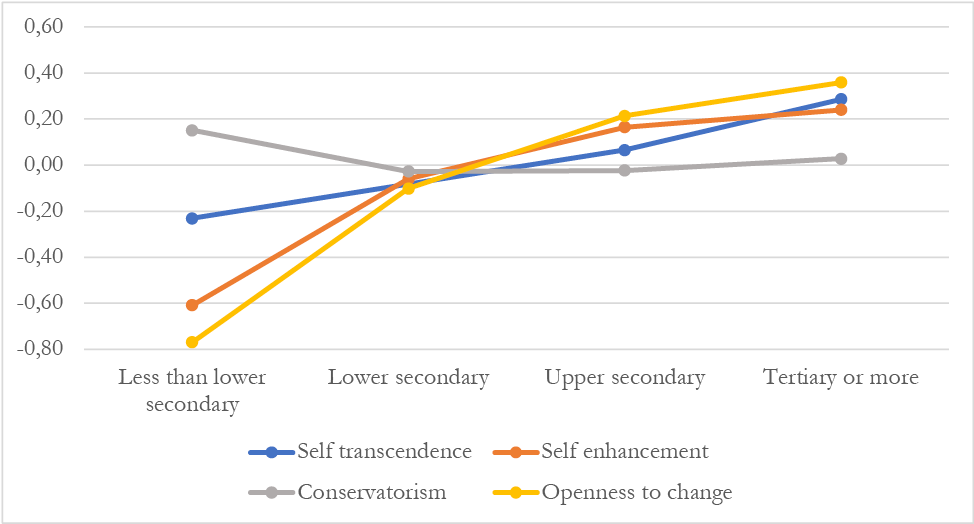
Arguably, one of the most significant changes in generational history is the expansion of the educational system (Giancola and Bonanni 2023). As discussed earlier, today’s younger generations are much more educated than their predecessors. The underlying hypothesis of this paper thus revolves around the idea that education, now playing a fundamental role, drives changes in values or is closely associated with them. Specifically, we anticipate that all four of the highest values will increase with higher levels of education, except conservatorism, which we expect to decrease. As illustrated in the following graphs (see Figure 9), the mean value increases across all cases except for conservatorism (p < 0.00).
As educational qualifications increase, self-transcendence – which includes values such as universalism and benevolence – increases. Similarly, self-enhancement, which encompasses values related to power, achievement, and hedonism, as well as openness to change, which consists of stimulation and self-direction values, also increase. This provides insight into the role of education and emerging trends across generations. We must first reiterate, as previously stated, that three of the five cohort-generations under observation (Generations X, Y, and Z) experienced what we have referred to as the expansion of education, a period in which education became more widespread and ceased to be the prerogative of the upper social classes. This shift may have led to changes in value systems. Naturally, this expansion means that the number of upper secondary graduates is significantly higher in Generation X, while the number of university graduates (due to demographic and social factors) is greater in Generation Y. It is important to clarify that the aim here is not to quantify the net effect of educational expansion on values, but rather to observe how these values change over time, with the understanding that this phenomenon may have influenced part of this transformation. Consistent with this, the following section will explore the trivariate relationship between education, generations, and BHV.
5.2 Issue of values: education between generations
Comparing the means for educational level attained within all generations, we observe some similarities and differences that highlight the closeness of certain generations. For self-transcendence, the effect of the level of education increases the means of the value bringing all generations closer, except for the Reconstruction Generation. The largest increases were observed in Generation Z, X and Y. For the Baby Boomers, the increase is less pronounced compared to the subsequent generations. We can infer that an increase in the level of education, apart from in the Reconstruction Generation, involves an increase in levels of self-transcendence that brings generations closer together (p < 0.00).
In self-enhancement, the distance between the generations remains constant. In order from the oldest to the youngest generation, we notice that as the cohort-generation increases, the starting point is higher than that of the previous generation and continues to increase, maintaining a constant distance between the levels of education. In other words, it is a scalar equivalent effect (p < 0.00).
In conservatorism, the similarities are more specific. As educational levels increase, the level of conservatorism increases for Generations X and Y, despite starting from much lower levels than the Baby Boomers and the Reconstruction Generation. While the increase for the former is substantial, it is not the case for the latter pair, where there is a decrease. For Generation Z, which starts from the lowest level of conservatorism of all, there is an increase that brings it roughly to the levels of the Baby Boomers and the Reconstruction Generation. Thus, it can be said that for Generations X and Y, the importance of tradition, conformity, and security returned with an increase in the level of education, opposite the trend seen in the older generations (p < 0.00).
The openness to change increases with the level of education starting from higher levels in successive generations. The results may be influenced by the number of cases in all categories (p < 0.00).
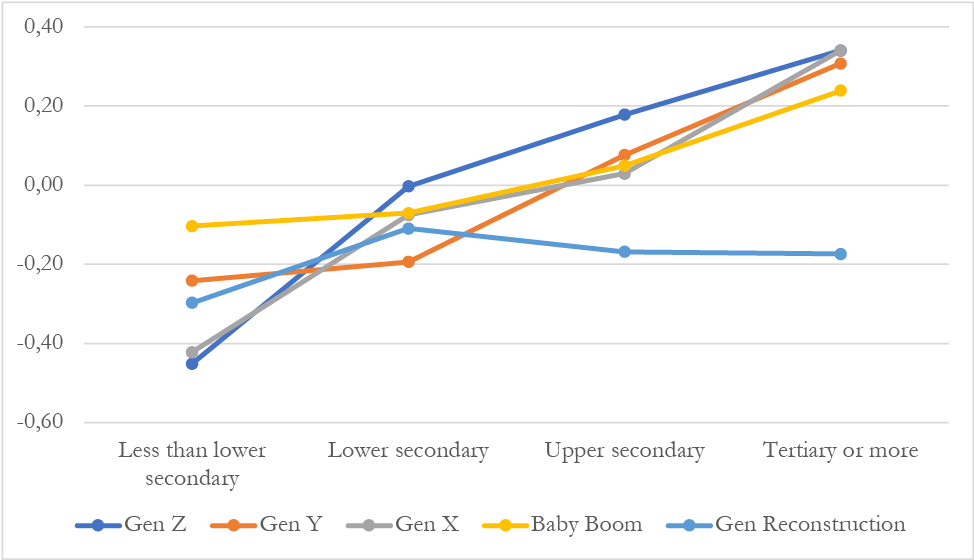
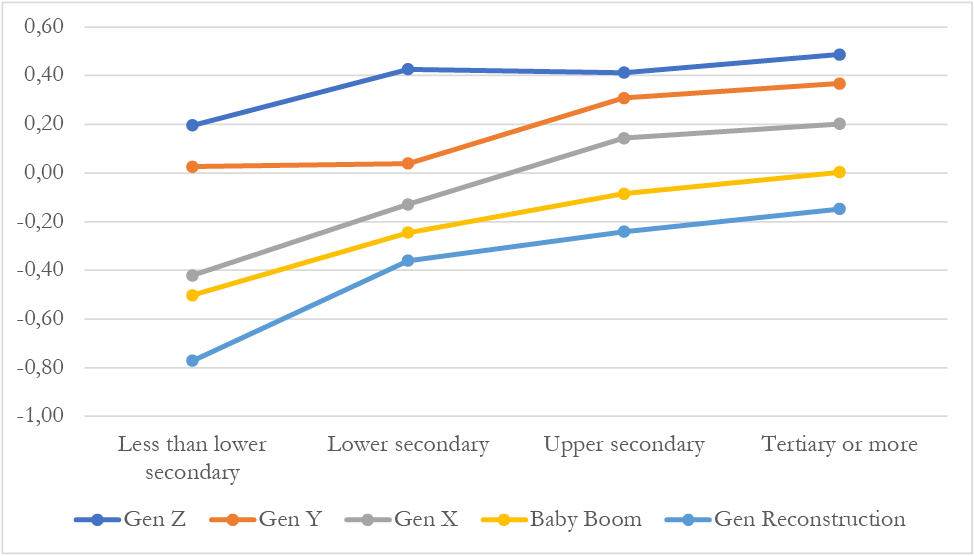
Considering these results, we can attempt to provide an interpretation related to the macro-themes characterizing the values debate. The growth in levels of self-transcendence and self-enhancement is probably related to changes in the production system and economic paradigm, currently neoliberal (Piurko et al. 2011; Beattie 2019). As educational qualifications increase, the younger generations exhibit higher levels of self-transcendence, even starting from lower averages, likely due to a greater awareness of the need for universalism in an interconnected world, and benevolence. For self-enhancement, as the neoliberal logic becomes increasingly embedded in individuals, the value means increase with educational qualifications across all generations. The distinction between generations is likely more pronounced for self-enhancement, but the latter and self-transcendence clearly indicate the combined effect of educational qualifications and generational differences. Openness to change and conservatorism likely tie in with the concept of crisis (Sortheix et al. 2019). For all generations except Gen Z, openness to change values increase as educational qualifications rise. These values instead decrease upon graduation from tertiary education for Generation Z, remaining very close to the levels of Generation Y. This aligns with the debate about the role of crises, but the effect of educational level reached appears independent of this, given that educational level reached increases across generations. This increase has been described as the largest and most stable change among generations, impacting values; vice versa, these values impact the elements that make up and characterize national educational systems (Benoliel and Berkovich 2018). For conservatorism, the trend is not general. As educational levels increase, the slope of conservatorism steeply decreases for the Reconstruction and Baby Boom Generations, where the prospect of growth was clear, and there was a possibility of aspiring to individual and collective improvement. For X-ers and Y-ers, particularly the first, the prospects were greatly reduced. It is conceivable that the tendency is to preserve the advantages acquired through qualifications, favoring security that is difficult to achieve and maintain. The same is true for Generation Y, but at lower mean values, and for Z, which starts from much lower levels of conservatorism compared to other generations but is growing rather than decreasing. These findings are consistent with the results of de Lillo (1988) on «changing in values»: the generation that lived through the 1980s, Generation X, was then and still is the generation with the highest levels of conservatorism or materialist values. The results of the analysis just presented and of the earlier work just mentioned provide clues as to the fact that we are probably not dealing with a backlash, but with new configurations of values resistant to change within generations. X-ers exemplify the enduring disposition of values over time and the latent unity that values represent. From a socio-political perspective, this trend in conservatorism can partly explain the return of the political right and the populist and security rhetoric, not considering all the other possible factors that can contribute to explaining this phenomenon. Right-wing parties are often, and generally, more inclined than others toward conservative strategies, tending to capture the prevailing spirit of preservation that individuals exhibit during certain historical periods (based on an association between historical and empirical evidence, this hypothesis should be verified through further research and consolidated data). Additionally, this trend challenges the materialist and post-materialist logic of value substitution from older to younger generations as a general trend because the disposition to conservatorism of the X-ers remains constant and is evident when comparing them with Y-ers. Furthermore, this trend is parallel to the trend of the other values, giving a consistent gradient of the Generation’s possible combination of values. Conservatorism increases alongside openness to change – the former a proxy for materialist values and the latter for post-materialist values. Noting this, we can affirm that there is not a backlash of materialist values in the Italian case, but rather a new configuration and shaping of values.
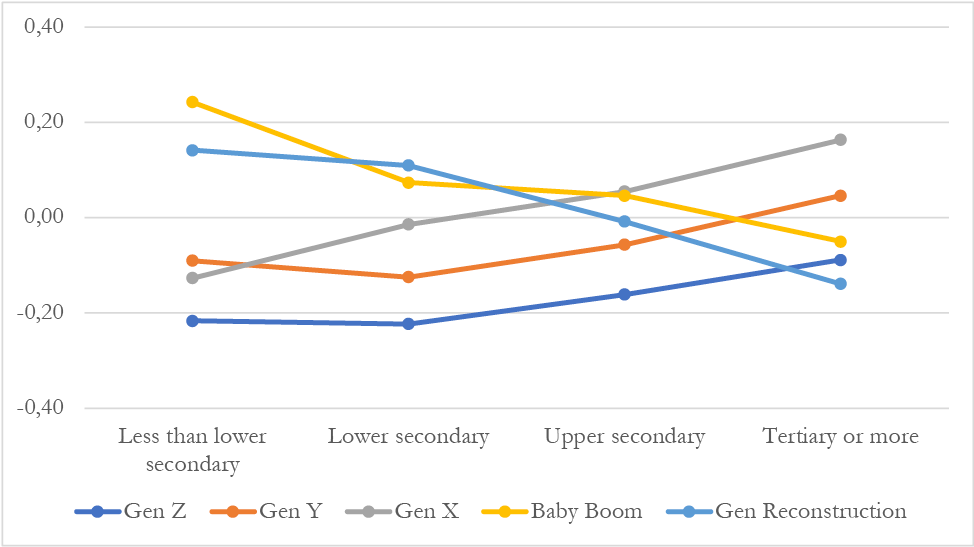
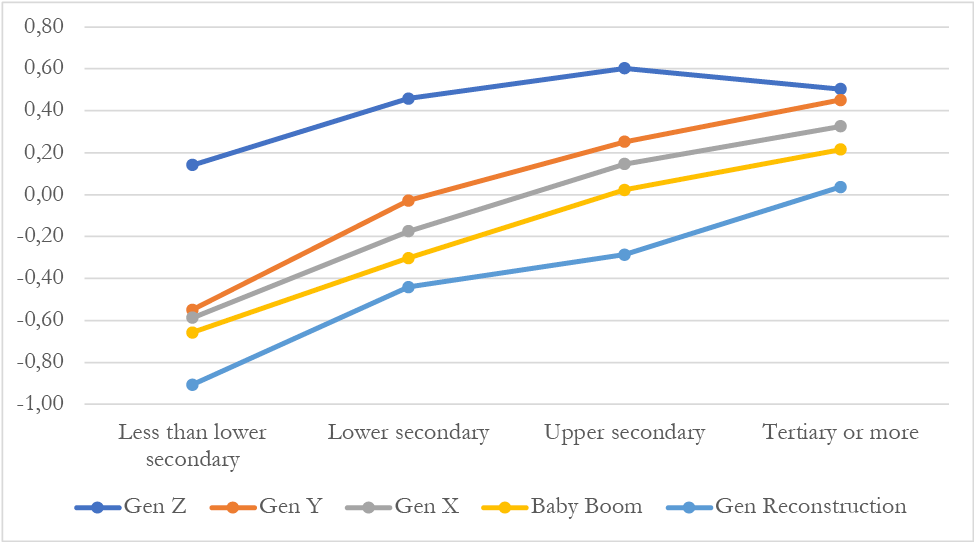
The study progresses through three stages of analysis – from monovariate to trivariate – emphasizing the importance of examining the nuances of generational values. Classical sociology teaches us that values can guide actions, beliefs, attitudes, and behaviors (Durkheim 1920; Weber 1922; Blumer 1966). From a monovariate perspective, it is notable that the differences between generations that are closer in time are more striking than those between the youngest and oldest. The shifts in polarity between Generation X and Y with respect to conservatorism levels are particularly notable (see Figure 6). All the component values of self-enhancement are observed increasing (see Figure 7). Regarding the first, while traditional and conformity values tend to decline, albeit slowly post-Generation X, security values remain relatively steady, with a peak observed in Generation X – current adults who experienced the 2008 crisis in their youth. These values then remain positive but begin to decline again for Generation X and Y. From a bivariate perspective, this trend is even more pronounced across generational continuities and educational attainment levels, where conservatorism is the only value that increases with higher education levels but decreases over generations. From a trivariate perspective, plotting education levels on the x-axis and mean values on the y-axis, we observe that all the values tend to increase with higher generations, with self-transcendence showing the most significant growth among education levels. Analyzed across generations, conservatorism shows a positive trend with increasing educational qualifications for Generations X and Y, while it increases but remains negative for Generation Z. This contrasts sharply with the older generations where conservatorism values remain low despite increasing educational qualifications, contradicting expectations. Education exhibits a variable role across generations and values. Up to the trivariate level, the observed potential of education confirms what is found in the literature and described in the initial paragraphs. For all values, except for conservatorism, the trend is increasing but not for all generations: for X and Y, the trend is increasing in this regard. It was expected that with increasing education levels, the mean for each cohort-generation would decrease for this highest value. Therefore, the results presented contradicting expectations, at least at the descriptive level.
In summary, values appear to be a useful criterion for distinguishing generations, alongside their historical context in space and time, at least within the Italian case considered here. Based on these analyses, we can assert that values have not simply been replaced from one generation to another; they are instead reconfigured, forming new combinations. Thus, positive conservatorism values coexist with openness to change, self-transcendence, and self-enhancement, indicating a general shift in societal values rather than a resurgence of old values. However, there has been a resurgence of populist and security-driven political rhetoric, emphasizing values associated with conservatorism, particularly security, over time. In conclusion, further analyses should explore generational shifts in values to better understand the deeper concerns of the population (particularly in Italy, capturing both the growing emphasis on security and the enduring openness to change). These analyses should also extend to countries where right-wing parties have regained support following periods of crisis and should further explore the findings presented so far, attempting to understand, from a multivariate perspective, the direct impact of cohort-generations on changing values, in combination with the education variable. The goal is to discern the net effect of both variables on value changes, and more importantly, to determine whether such an effect exists at a more complex level of analysis.
Abrams P. (1982), Sociologia storica, il Mulino, Bologna.
Beattie P., Bettache K. and Chong K. C. Y. (2019), «Who is the neoliberal? Exploring neoliberal beliefs across East and West», in Journal of Social Issues, 75(1): 20-48. https://doi.org/10.1111/josi.12309.
Beck U. (2008), «Global generations in world risk society», in Revista CIDOB d’Afers Internacionals: 203-216.
Beck U. and Beck-Gernsheim E. (2009), «Global generations and the trap of methodological nationalism for a cosmopolitan turn in the sociology of youth and generation», in European Sociological Review, 25(1): 25-36. https://doi.org/0.1093/esr/jcn032.
Bennett A. (1999), «Subcultures or neo-tribes? Rethinking the relationship between youth, style and musical taste», in Sociology, 33(3): 599-617. https://doi.org/10.1177/S0038038599000.
Benoliel P. and Berkovich I. (2018), «A cross-national examination of the effect of the Schwartz cultural dimensions on PISA performance assessments», in Social Indicators Research, 139: 825-845. https://doi.org/10.1007/s11205-017-1732-z.
Blumer H. (1966), «Sociological Implications of the Thought of George Herbert Mead», in American Journal of Sociology, 71(5): 535-544.
Bettin Lattes G. (2014), «I giovani e i valori nella sociologia di Antonio de Lillo», in SocietàMutamentoPolitica, 5(10): 129-146. https://doi.org/10.13128/SMP-15409.
Capanna C., Vecchione M. and Schwartz S. H. (2005), «La misura dei valori. Un contributo alla validazione del Portrait Values Questionnaire su un campione italiano», in Bollettino di Psicologia applicata, 246: 29-41.
Casavecchia A. (2017), «Connecting Education to Society through Karl Mannheim’s Approach», in Italian Journal Of Sociology Of Education, 9(3): 256-264. https://doi.org/10.14658/pupj-ijse-2017-3-11.
Casavecchia A. (2022), Karl Mannheim e le trasformazioni sociali del nostro tempo, Carocci, Roma.
Cavalli A. (2004), «Generations and Value Orientations», in Social Compass, 51(2): 155-168. https://doi.org/10.1177/0037768604043003.
Chisholm L. (2023), «Generazioni della conoscenza, conoscenza delle generazioni, generazione della conoscenza», in R. Rauty (eds.), Giovani nel tempo. Lezioni nell’Università di Salerno, Kurumuny, Calimera, pp. 17-38.
Coleman J.S. (1994), «A Rational Choice Perspective on Economic Sociology», in N.J. Smelser e R. Swedberg (eds.), The Handbook of Economic Sociology, Princeton University Press, Princeton, pp. 166-180.
Cuzzocrea V., Ilardi E. and Lovari A. (2022), Giovani e immaginari. Rappresentazioni e pratiche, Meltemi, Milano.
Davidov E. (2010), «Testing for comparability of human values across countries and time with the third round of the European Social Survey», in International Journal of Comparative Sociology, 51(3): 171-191. https://doi.org/10.1177/0020715210363534.
de Lillo A. (1988), «Gli orientamenti di valore», in A. Cavalli e A. de Lillo (eds.), Giovani anni 80. Secondo rapporto Iard sulla condizione giovanile in Italia, il Mulino, Bologna.
Durkheim É. (1920), «Introduction à la morale», in Revue philosophique, 89: 79-97.
Egri C. P. e Ralston D. A. (2004), «Generation Cohorts and Personal Values: A Comparison of China and the United States», in Organization Science, 15(2): 210-220. https://doi.org/10.1287/orsc.1030.0048.
France A., Bottrell D. and Armstrong D. (2012), A Political Ecology of Youth and Crime, Palgrave Macmillan, London.
France A. and Roberts S. (2015), «The problem of social generations: a critique of the new emerging orthodoxy in youth studies», in Journal of Youth Studies, 18(2): 215-230. https://doi.org/10.1080/13676261.2014.944122.
Giancola O. and Bonanni M. (2023), «Le destinazioni educative della Generazione X: risultati e disuguaglianze in una prospettiva generazionale», in Quaderni di Comunità: persone, educazione e welfare nella società 5.0, 3: 289-323.
Giancola O. and Salmieri L. (2024), Disuguaglianze educative e scelte scolastiche. Teorie, processi e contesti, FrancoAngeli, Milano.
Harvey D. (2005), A Brief History of Neoliberalism, Oxford University Press, Oxford.
Halstead M. and Taylor M. J. (2005), Values in education and education in values, Routledge, London.
Inglehart R. (2015 [1977]), The silent revolution: Changing values and political styles among Western publics, Princeton University Press, Princeton.
Inglehart R. (1990), Culture shift in advanced industrial society, Princeton University Press, Princeton.
Inglehart R. (2018). Cultural Evolution: People’s Motivations are Changing, and Reshaping the World, Cambridge University Press, Cambridge.
Inglehart R. F., Basanez M. and Moreno A. (1998). Human values and beliefs: A cross-cultural sourcebook, University of Michigan Press, Ann Arbor.
Kluckhohn C. (1951), «Values and value-orientations in the theory of action: An exploration in definition and classification», in T. Parsons e E. Shils (eds.), Toward a general theory of action, Harvard University Press, Cambridge, pp. 388-433.
Lyons S. T., Duxbury L. and Higgins C. (2005), «Are Gender Differences in Basic Human Values a Generational Phenomenon?», in Sex Roles, 53: 763-778. https://doi.org/10.1007/s11199-005-7740-4.
Lyons S. T., Duxbury L. and Higgins C. (2007), «An Empirical Assessment of Generational Differences in Basic Human Values», in Psychological Reports, 101: 339-352. https://doi.org/10.2466/pr0.101.2.339-352.
Mannheim K. (1952), Essays in the Sociology of Knowledge, Routledge, London.
Maslow A. H. (1968), Toward a psychology of being, Van Nostrand Reinhold, New York.
McCrindle M. (2003). «Understanding generation Y», in Principal Matters, 55: 28-31.
McCrindle M. (2006), New Generations at Work: Attracting, Recruiting, Retraining and Training Generation Y, McCrindle research, Lexington.
Mills C. W. (1959), The Sociological Imagination, Oxford University Press, Oxford.
Norris P. and Inglehart R. (2019), Cultural Backlash. Trump, Brexit, and Authoritarian Populism, Cambridge University Press, Cambridge.
Ortega y Gasset J. (1923), El tema del nuestro tiempo, Revista de Occidente, Madrid.
Piurko Y., Schwartz S. H. and Davidov E. (2011), «Basic Personal Values and the Meaning of Left-Right Political Orientations in 20 Countries», in Political Psychology, 32: 537-561. https://doi.org/10.1111/j.1467-9221.2011.00828.x.
Ramström G. (2018), «Coleman’s boat revisited: Causal sequences and the micro-macro link», in Sociological Theory, 36(4): 368-391. https://doi.org/10.1177/0735275118813676.
Roberts S. and France A. (2021), «Problematizing a popular panacea: A critical examination of the (continued) use of ‘social generations’ in youth sociology», in The Sociological Review, 69(4): 775-791. https://doi.org/10.1177/0038026120922467.
Robinson C. (2013), «Values and adult age: findings from two cohorts of the European Social Survey», in European Journal of Ageing, 10: 11-23. https://doi.org/s10433-012-0247-3.
Rokeach M. (1973), The nature of human values, Free Press, New York.
Rokeach M. (2008), Understanding human values, Simon and Schuster, New York.
Sagiv L. and Schwartz S. H. (2022), «Personal Values Across Cultures», in Annual Review of Psychology, 73: 517-546. https://doi.org/10.1146/annurev-psych-020821-125100.
Schwartz S. H. (1992), «Universals in the Content and Structure of Values: Theory and Empirical Tests in 20 Countries», in M. Zanna (eds.), Advances in Experimental Social Psychology, vol. 25, Academic Press, New York, pp. 1-65.
Schwartz S. H. (1994), «Are There Universal Aspects in the Structure and Contents of Human Values?», in Journal of Social Issues, 50(4): 19-45. https://doi.org/10.1111/j.1540-4560.1994.tb01196.x.
Schwartz S. H. (2006), «Les valeurs de base de la personne: Théorie, mesures et applications [Basic human values: Theory, measurement, and applications]», in Revue française de sociologie, 42: 249-288. https://doi.org/10.3917/rfs.474.0929.
Schwartz S. H. (2007), «Value orientations: Measurement, antecedents and consequences across nations», in R. Jowell, C. Roberts, R. Fitzgerald and G. Eva (eds.), Measuring attitudes cross-nationally: Lessons from the European Social Survey, Sage Publications, New York, pp. 169–203.
Schwartz S. H. (2012), «An Overview of the Schwartz Theory of Basic Values», Online Readings in Psychology and Culture, 2(1): 11- 20. https://doi.org/10.9707/2307-0919.1116.
Schwartz S. H. (2016), «Basic individual values: sources and consequences», in T. Brosch e D. Sander (eds), Handbook of value. Perspectives from Economics, Neuroscience, Philosophy, Psychology, and Sociology, Oxford University Press, Oxford, pp. 63-84.
Schwartz S. H. and Sagiv L. (1995), «Identifying Culture-Specifics in the Content and Structure of Values», in Journal of Cross-Cultural Psychology, 26(1): 92-115. https://doi.org/10.1177/0022022195261007.
Schwartz S. H., Cieciuch J., Vecchione M., Davidov E., Fischer R., Beierlein C., Ramos A., Verkasalo M., Lonnqvist J. E., Demirutku K., Dirilen-Gumus O. and Konty M. (2012), «Refining the Theory of Basic Individual Values», in Journal of Personality and Social Psychology, 103: 663-688. https://doi.org/10.1037/a0029393.
Schizzerotto A., Trivellato U. and Sartor N. (2011). Generazioni disuguali. Le condizioni di vita dei giovani di oggi e di ieri: un confronto, il Mulino, Bologna.
Sortheix F. M., Parker P. D., Lechner C. M. and Schwartz S. H. (2019), «Changes in young Europeans’ values during the global financial crisis», in Social Psychological and Personality Science, 10(1): 15-25. https://doi.org/10.1177/1948550617732610.
Thorpe C. and Inglis D. (2019), «Do ‘global generations’ exist?: From Mannheim to Beck and beyond», in Youth and Globalization, 1(1): 40-64. https://doi.org/10.1163/25895745-00101003.
Vecchione M. and Schwartz S. H. (2022), «Personal values and academic achievement», in British Journal of Psychology, 113(3): 630-652. https://doi.org/10.1111/bjop.12555.
Weber M. (1922), Gesammelte Aufsätze zur Wissenschaftslehre, Mohr, Tübingen.
Woodman D. (2016), «The Sociology of Generations and Youth Studies», in A. Furlong (eds.), Routledge Handbook of Youth and Young Adulthood, 2nd edition, Routledge, London, pp. 20–26.
Woodman D. and Wyn J. (2015), «Class, gender and generation matter: using the concept of social generation to study inequality and social change», in Journal of Youth Studies, 18(10): 1402-1410. https://doi.org/10.1080/13676261.2015.1048206.
1 ESS questions: «Now I will briefly describe some people. Please listen to each description and tell me how much each person is or is not like you. Use this card for your answer» – https://www.europeansocialsurvey.org/methodology/ess-methodology/source-questionnaire
2 Very much like me, Like me, Somewhat like me, A little like me, Not like me, Not like me at all