“The Girl Must Stay Quiet”: Marginalisation of Young Women in Political Spaces and the Impact of Gender Socialization and Ethnic Background1
Abstract. Studies on youth political participation reveal how engagement levels and forms differ due to gender, socioeconomic resources, and cultural backgrounds. Three key aspects are highlighted: first, political inequalities originate in adolescence, shaped by family political socialization, influencing gender differences, ideology, and ethnic disparities. Second, youth political engagement is affected by intersectional power dynamics, including gender and ethnicity. Third, young people face political institutions that are systematically gendered, with rules that have “gendered effects,” and must navigate male-dominated cultures. This article contributes empirical evidence on the relationship between political socialization, gender norms, and participation among late adolescents and young adults, using an intersectional framework. It employs an Explanatory Sequential Mixed Methods Design. The quantitative phase draws on Eurobarometer Youth survey and the MAYBE project (a multilevel survey with 2,756 Lombardy students, aged 18-20, from 81 schools and 165 classes). The qualitative phase consists of 3 focus groups (participants: 7 men, 14 women, 7 with migrant backgrounds, aged 18-35 in Lombardy), collected by YEP! Youth Equality Participation. The article emphasizes the need to address gender biases in socialization and political practices to foster inclusivity, while highlighting the additional challenges faced by young women from migratory family backgrounds.
Keywords: political participation, youth, gender norms, political socialisation, second generation.
Index
2.1 Ethnic and Gender discrimination in political spaces
2.2 The key role of political socialisation
2.3 How masculine norms shape political spaces and representation
2.4 Age, gender and ethnic political discrimination: an intersectional approach
4.2 Gender norms, socialization and political engagement: evidence from a student survey in Lombardy
4.2.1 Insights from the multi-level model: the pivotal role of family and classmates
Studies on youth political participation showed how the levels and forms of youth engagement differ internally and are shaped by social stratification. Variations in individual experiences, access to socioeconomic resources, and cultural backgrounds contribute to disparities in political participation (Giugni and Grasso 2021; Janmaat and Hoskins 2022; Lello and Bazzoli 2023). Within this framework, scholars highlighted three main aspects. Firstly, since influential studies by Jennings and Niemi (1968) it is well known that inequalities have deep-rooted origins, extending back to the formative years of adolescence when the foundations for long-term beliefs about politics are established. Family political socialization affects gender differences in youth political engagement (Cicognani et al. 2012), political ideology (van Ditmars 2023), and ethnic disparities (Guglielmi and Maggini 2025; Janmaat and Hoskins 2022; Ortensi and Riniolo 2020) through a complex process of intergenerational transmission (Boonen 2017; Durmuşoğlu et al. 2023; Mayer et al. 2024; van Ditmars 2023) and in interaction with different socializing agents (Ortensi and Riniolo 2020; Quintelier 2015). Secondly, youth political engagement is largely influenced by intersectional power dynamics embedded within social hierarchies, including gender and ethnic belonging (Collins 2021; Gatti et al. 2024; Harris and Roose 2014; Pfanzelt and Spies 2019). Third, young people who choose to engage in politics encounter political institutions that are systematically gendered: «Political opportunities and outcomes are shaped not only by rules “about gender” but also by seemingly neutral rules that have “gendered effects”, due to their interaction with institutions outside the realm of formal politics» (Lowndes 2020). In addition, young generations must navigate a prevailing culture that is often male-dominated and patriarchal, even in old democracies (Dahlerup and Leijenaar 2013).
Against this background, this article aims to contribute to the existing literature by providing empirical evidence on the relationship between gender socialization, gender political norms, ethnic background, and political participation among young individuals. To better investigate challenges related to interactions between age, gender and ethnic background an intersectional framework is adopted. The study employs a mixed-methods sequential explanatory design, combining survey data with high school students (aged 18 to 19) and focus groups with young people (aged 18 to 30) with different levels of political engagement. Original survey data were collected in Lombardy (Italy), while gender differences in youth political participation in Italy are described using secondary analysis of Eurobarometer data. Lombardy serves as a strategic case study in Europe, being the EU’s second most populous region and high in GDP. Young people in Lombardy enjoy better educational and employment opportunities than in the rest of Italy, and the region boasts a high female labour force participation rate of around 60%. Social and civic engagement levels are also above the national average, especially for women (Della Bella 2023). Additionally, Lombardy has a significant foreign resident population (Maiorino and Terzera 2024), with 1,176,169 foreign citizens making up 11.8% of the total population. It also hosts the largest number of students with migrant backgrounds in Italy, accounting for 24% of such students nationwide (MIM, Ministero dell’Istruzione e del Merito 2024). However, challenges persist, including high youth unemployment, job insecurity, and limited social mobility, reflecting Italy’s overall “youth-unfriendly” environment (Colombo and Rebughini 2024). The restrictive citizenship law based on jus sanguinis further complicates matters for young immigrant descendants. To address these issues, Lombardy has enacted Regional Law No. 4, a comprehensive framework law focused on youth, which allocates 10 million euros over three years to promote social and political inclusion, in line with the Youth Strategy 2019-2027.
The article is structured as follows: the next section presents the theoretical framework underpinning the mixed-methods research design and its arguments. Section 3 outlines the data and methodology employed in the study. Section 4 focuses on the empirical analysis, beginning with quantitative data followed by qualitative insights. The chapter concludes with a brief discussion of the main findings, highlighting the importance of addressing gender biases in socialisation processes, schools and everyday political practices to foster a more inclusive political environment. By adopting an intersectional approach, the study also emphasises the additional challenges faced by young women from diverse ethnic backgrounds.
Gender and ethnic inequalities in youth political participation show specific patterns of opportunities and obstacles. Furthermore, understanding sources and mechanisms of discrimination in political participation becomes more complex when the factors of age, gender and migrant background intersect (Matos et al. 2023).
2.1 Ethnic and Gender discrimination in political spaces
Regarding ethnic background, several studies have illustrated the exclusion of subjects with a migrant origin in political spaces: for example, Verba and colleagues (Verba et al. 1995) show in their seminal research that both Latinos and Black people usually participate less in politics than white people. More in-depth, Crowley (2001) highlights the existence of an ethnic problem within Western democracies due to marginalization of people with a migrant background; but, even if the term “ethnic minority” is commonly used, in each state it implies a different history about political debate and consequently participation. Moreover, as some scholars have proved, the level of exclusion depends both on the type of political participation and the age cohort (Quintelier 2009). In Italy, specifically, many children of migrants are excluded from formal political spaces due to the lack of citizenship, even if they can make their own political choices (Daher and Nicolosi 2023): this leads them to feel underrepresented and to develop alternative forms of activism (Farini 2019; Riniolo 2023).
Regarding gender inequalities, among others Belluati (2021) sheds light on women’s under-representation within the political sphere, which is mainly caused by the permanence of a masculinist culture, power imbalances, and the reproduction of unequal cultural models in the media. Another recent study by Grasso and Smith (2022) analyzed the political participation of young men and women in eight EU countries, showing that young women are less active than young men in traditional politics, but they are more engaged in other kinds of activism. Therefore, it is necessary to also consider unconventional political participation when studying youth engagement in political spaces (Lavizzari and Portos 2021). Here too, however, there are distinctions. Exclusion from political spaces based on gender and ethnic background is affected by additional elements, including the political interest of individuals, opportunities, education and family resources.
2.2 The key role of political socialisation
Since influential studies by Jennings and Niemi (1968), the literature consistently shows that people tend to form predispositions towards politics during adolescence and early adulthood. These formative years, often called the «impressionable years» (Dinas 2010), are characterized by increased cognitive openness and receptiveness to social influences, making it a crucial period for developing long-lasting political attitudes and inequalities. Social class, gender, and migratory background still impact youth political socialisation, despite it becoming more individualized, and influenced by a broader range of agents beyond family, including schools, peers, media, and digital platforms (Dalton 2016). Peer/classroom climate can influence political attitudes through shared discussions, habits and practices (Barber et al. 2021; Hoskins and Janmaat 2019). More in general, schools and educational institutions significantly contribute by providing civic education and opportunities for political engagement (Campbell 2008; 2019), often offering a “compensation effect” (Deimel et al. 2021; Hoskins and Janmaat 2019; Neundorf et al. 2016) for missing or poor parental political socialisation. Young people from higher socio-economic backgrounds typically have greater access to socialisation agents, such as high-quality educational institutions, extracurricular activities, and digital resources impacting civic and political development (Giugni and Grasso 2021; Janmaat and Hoskins 2022; Jungkunz and Marx 2024). Children of immigrants often face the dual challenges of having both a foreign (Gatti et al. 2024 for the Italian case; Stefani et al. 2021) and lower socio-economic background. In addition, the lower levels of political engagement among immigrant parents (Ortensi and Riniolo 2021; Terriquez and Kwon 2015; Dinesen and Andersen 2022) can have a detrimental effect on their political engagement (Guglielmi and Maggini 2025). Regarding gender inequalities, boys and girls are often exposed to different expectations and opportunities for political engagement. Both family and educational institutions play significant roles in perpetuating this gendered socialisation process. For example, some studies indicate that parents are more likely to discuss politics or legitimate political ambition with their sons than with their daughters, and schools frequently fail to address gender biases in political education (Cicognani et al. 2012; Fox and Lawless 2014; Pensiero and Janmaat 2024).
2.3 How masculine norms shape political spaces and representation
In this context, scholars emphasize the need to shift the focus away from women’s disadvantages and instead examine the advantages men hold in politics, particularly how norms of masculinity shape gendered political representation (Bjarnegård and Murray 2018; Galea and Gaweda 2018). Despite the resilience of patriarchal structures, emerging forms of “softer” political masculinities appear to challenge traditional notions of male dominance (Myrttinen 2019).
Additionally, numerous studies have uncovered specific micro-mechanisms embedded in everyday political practices that perpetuate male dominance while discouraging female participation. These include practices such as unequal turn-taking/imbalanced speaking time, role assignment, and gendered perceptions of competence and experience. In political meetings and debates, men frequently dominate discussions, speaking for longer periods and interrupting women more often, thereby controlling the flow of conversation. This dynamic – often labelled as «the silent sex» (Karpowitz and Mendelberg 2014) – not only sidelines women’s contributions but also reinforces the perception that men are inherently more knowledgeable and authoritative in political contexts, both online and offline (Chen and Han 2024). Women in political organizations are often relegated to roles that align with stereotypical gender expectations, such as administrative duties, note-taking, or event planning, rather than positions of influence or decision-making. In addition, they tend/are asked to specialize in issues perceived as more suitable for females, e.g., education, social policies (Blumenau 2021; Curini et al. 2023). Such role allocations limit women’s opportunities and ambition to gain leadership experience and visibility in the political competition, often interpreted as women’s election aversion (Kanthak and Woon 2015). Moreover, women face a higher threshold for proving their competence and experience. Research shows that voters are more likely to scrutinize female candidates harshly, whereas men are less affected by such concerns (Cella and Manzoni 2023; Ditonto 2017). The perception that women lack experience or knowledge in politics can deter them from pursuing leadership positions or taking initiative. This belief is often internalized, especially by younger women, leading them to undervalue their abilities and opt out of political participation (Fox and Lawless 2011).
2.4 Age, gender and ethnic political discrimination: an intersectional approach
As mentioned earlier, numerous factors contribute to explaining the barriers and obstacles young women face in accessing and participating in political spaces. Understanding the interaction of these factors through an intersectional lens may provide deeper insights. The theoretical approach of intersectionality was developed in the field of Critical Race Theory (CRT), which analysed gender, sexuality, colourism, race and class concerning migrants’ experiences (Delgado et al. 2023). Within this frame, in 1989 Kimberlé W. Crenshaw coined the theory of intersectionality in the legal field, as she realized that Black women in the United States suffered intersectional discriminations due to the intersection of multiple factors, in this case, gender and race as a social construction (Crenshaw 1991). This theory was central to social justice projects: A. J. Cooper (1892), bell hooks (1981), A. Davis (1982), N. Yuval-Davis (2006) and F. Anthias (2020) further elaborated intersectional knowledge projects able to fight both sexism and racism. As P. H. Collins (2015) clarifies, intersectionality consists of three interdependent dimensions: it is a field of study; an analytical strategy to better understand social phenomena; and a critical praxis guiding social justice projects.
From the analytical perspective, intersectional frameworks allow us to better understand social movements, and individual activism, as well as to rethink exclusion and other problems. Related to this, I. Wells-Barnett (1982) produced intersectional analyses of lynching starting from her activism, which was based on the experiences of exclusion suffered by Afro-American women (Collins 2022). Some studies have shown how the intersection of structural factors causes the exclusion of certain individuals, including women, LGBTQ+ people, etc., from social and political spaces. For example, N. E. Brown (2014) analysed how gender and race influence the participation of minority women in American politics, compared to white women. Additionally, T. Chiappelli (2016) explored the situation of women with a migrant background in Italy between exclusion and active participation in different fields, including the political domain. This research revealed that Italian policy lacks a framework that considers gender and migrant background factors in the promotion of subjects’ participation. Moreover, both laws and practices sensitive to gender and migrant background are lacking in politics, with the consequence that they often contribute to the reiteration of inequalities and the stigmatization of these women (Ibidem). Finally, intersectionality as a critical praxis refers to how social actors, such as activists, adopt intersectionality to realize effective social justice projects. Indeed, the marginalized status of black and migrant women can become a “strength” when they make it the focus of their activism for greater equity (Broad 2017).
Intersectionality holds dual value as an interpretative lens in our research: it enables us to examine how the intersection of gender and migrant background functions as a mechanism of both women’s activation and exclusion from political spaces.
Our research employs Explanatory Sequential Mixed Methods Design (Amaturo and Punziano 2016; Creswell and Plano Clark 2011) combining diverse techniques. It begins with the analysis of survey data to investigate gender and ethnic differences in youth political participation and assess the impact of gender political norms, as well as the role of educational institutions and family. This quantitative analysis informed and was subsequently complemented by three focus groups designed to explore specific aspects of how gender and migration background may hinder access to, or influence forms of, political participation. This mixed methods approach aims to integrate numerical data with personal narratives, thereby enhancing the understanding of young women’s engagement in politics and exploring specific aspects of how gender and migration background can shape or limit access to political participation, as well as influence the ways individuals engage politically. The first quantitative phase is based on two sources of data: data from the Flash Eurobarometer n. 2574 (European Youth Survey 2021) and original survey data taken from the MAYBE – Moving into Adulthood in uncertain times: Youth Beliefs, future Expectations, and life choices between changing social values and local policy initiatives (University of Milan, financed by the Cariplo Foundation). European Youth Survey 2021 interviewed a sample of 17953 young people aged 18 to 30 residents in each of the 27 Member States (age mean=23.8; 50.3% females) of which 1498 were from Italy. Among others, these data shed light on the various forms of youth political and social participation, revealing interesting gender dynamics across Europe and within Italy. The MAYBE project interviewed 2,756 fifth-year students aged 18-20 in Lombardy between February 2023 and March 2024, employing a probabilistic multistage sampling design (81 schools, 165 classes). The survey was self-administered during school hours in schools’ computer labs. The study was approved by the Ethics Committee of the University of Milan. The survey measures, among other topics, political engagement, participation, and attitudes towards gender roles in politics. Data are analysed using an intersectional framework to examine the interactions between gender and ethnic background.
To deepen the understanding of the interplay between youth, gender, and ethnic background in political spaces, three focus groups (FGs) were conducted as part of the YEP! (Youth Equality Participation) project. YEP! was financed by Cariplo Foundation2. More specifically, the focus groups aimed to examine the internalization of gender and ethnic stereotypes, the barriers these groups face in the political arena, and potential strategies for overcoming these challenges. In total, 21 young people aged 18-30 participated in the focus groups, which were conducted both in person (2 focus groups) and online (1 focus group), based on the following criteria. The first focus group consisted of young people aged 18-30, selected based on their predominant mode of political participation – whether online (e.g., through social media or other platforms) or in person (e.g., through political parties, trade unions, or institutional roles). The second focus group was organized by age, with very young participants aged 18-23 who had varying levels of political engagement or interest. Their activities ranged from membership in student associations and participation in public demonstrations to founding civic lists, membership in political parties, and serving as city council members or policy advisors for municipalities. The third focus group included young women activists aged 18-30 (criteria: gender) who were actively engaged in diverse political activities. The focus here was on the role of gender in political engagement, both in institutionalized and informal forms of participation. In total, 7 young men and 14 young women participated. The groups included young people with or without migrant backgrounds (7 with migrant backgrounds and 14 without). The majority were university students, one was attending a vocational school, and a minority were balancing studies with work. Only a few were solely employed. All focus groups were recorded and transcribed. All participants provided informed consent to participate in the research.
4.1 Gender and age differences in youth political participation in Italy: Evidence from the European Youth Survey
The European Parliament Youth Survey (2021) sheds light on interesting gender dynamics across Europe and within Italy. These data, based on large youth samples3 that allow for comparisons across age groups, provide valuable context for interpreting the findings from the original survey on students in Lombardy. Given the non-probabilistic nature of the sample, the findings should be interpreted with caution. However, they provide valuable insights into various forms of political participation and activism, as well as the frequency of political discussions within families and peer groups. Regarding traditional forms of political participation, such as voting in local, national, or European elections, young women are more active than young men. This is particularly evident in Italy, where 61.1% of young women reported voting at least once, compared to 47.0% of young men – a more significant gender gap than the European average (54.0% of women vs. 45.3% of men). Beyond voting, young women are also more engaged in certain forms of activism, such as signing petitions, whether online or offline, with 50.7% of European women and 41.2% of Italian women participating, compared to 36.1% of European men and 29.8% of Italian men4. In Italy, young women are more likely than men to participate in street protests or demonstrations (29.7% vs. 24.6% of men) and, to a lesser extent, in Europe as well (23% vs. 20.4% of men). However, it is worth noting that participation in street protests among Italian women decreases with age: 39.7% of women aged 15 to 20 participated, compared to 30.6% of those aged 21 to 25, and 24.1% in the 26-30 age group, where the dual burden of work and family life is a particular constraint. In contrast, men’s participation in street protests is lower overall and remains relatively stable across age groups (26.4% for ages 15-20; 23.3% for ages 21-25; 24.3% for ages 26-30). Young women are also more somewhat likely to express their political and social views online or on social media, both in Europe (27.3% of women vs. 25.6% of men) and particularly in Italy (34.3% of women vs. 29.7% of men). This trend extends to using hashtags or changing profile pictures to show support for political or social issues (25.2% of women vs. 18.9% of men in Italy, and 23.5% vs. 18.5% of men in Europe). Regarding age differences in online participation, young Italian women aged 15 to 20 reported posting opinions online at a rate of 36.5%, which remains stable in the 21 to 25 age group (36.6%) but decreases to 30.6% in the 26 to 30 age group. In contrast, men show an increasing trend in online posting with age: 23.2% for ages 15 to 20, 30.1% for ages 21 to 25, and 34.4% for ages 26 to 30. Finally, data highlights the gender gap in one of the most important political socialisation mechanisms, discussing political and social issues with family and friends. Notably, in the 15 to 20 age group in Italy, a higher percentage of females never engage in these discussions compared to males (19.0% of women vs. 9.1% of men), and this trend persists in the 26 to 30 group (8.6% vs. 4.8%). However, in the 21 to 25 age group, gender differences tend to disappear and a slightly higher percentage of males avoid these discussions (10.8% vs. 12.5%).
4.2 Gender norms, socialization and political engagement: evidence from a student survey in Lombardy
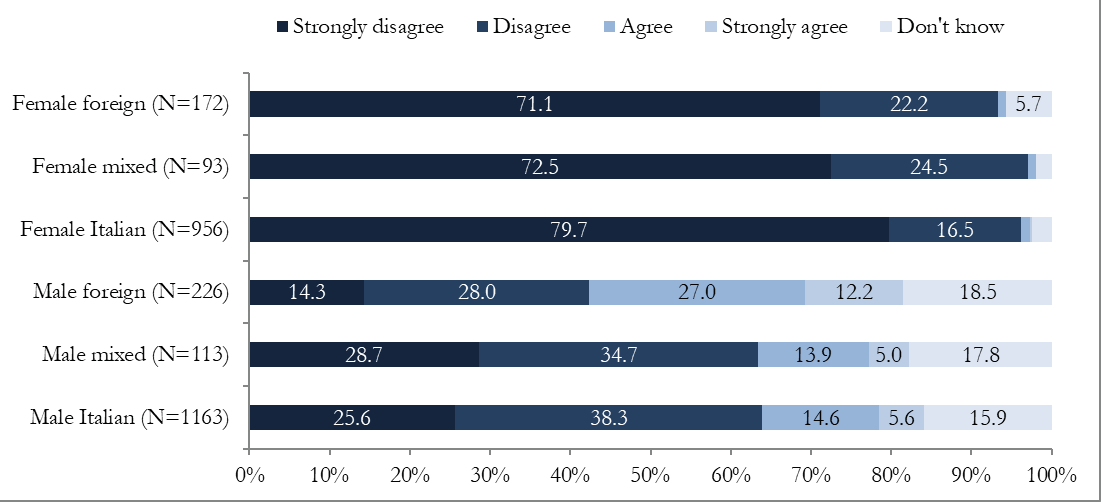
Building on this general framework, we can now turn to the Lombardy context, focusing specifically on mechanisms underlying gender and ethnic differences in political participation among students in their final year of secondary school. First, it is worth stressing that data collected among high school students in Lombardy reflect both entrenched gender norms and the strong opposition among female respondents. This suggests a potential shift in perceptions among younger generations and challenges traditional views of political leadership. Indeed, gender differences in opinions on the statement “Men make better politicians than women” are consistent across all family background groups (Fig. 1). A large majority of female respondents – Italian (79.7%), Mixed (72.5%), and Foreign (71.1%) – strongly disagreed with the statement. By contrast, this high level of disagreement is shared by significantly fewer male respondents, especially among students with a foreign background, Italians (25.6%), Mixed (28.7%), and Foreign (14.3%).
Building on this general picture and aiming to better understand the relationships between gender, ethnic/migratory background, gender political norms, political socialisation and youth political attitudes and participation, we employed a multilevel model. This model accounts for individual-level and group-level variations, which is crucial when dealing with hierarchical data structures such as individuals nested within schools and, in turn, nested within municipalities.
The dependent variables are two additive indices, based on previous factor analysis:
– Political Engagement Index: level of political interest (1-4 scale), party closeness (0= close to no party; 1= close to a party) and left-right self-placement (0= not self-placed on the left-right scale; 1= self-placed on the same scale).
– Non–Electoral Political Participation Index: this index is operationalized through the frequency of posts or comments, news, or videos related to politics on online social networks (never, rarely, sometimes, often) and by the question: “In the last 12 months, have you participated in a demonstration/protest?” (multiple times, once or twice at most, never happened).
Gender and Family migratory background were operationalized as follows:
– Gender: categorized as male (1510) or female (1226); 30 students who categorized themselves as “other” were not included in the analysis.
– Migratory Background: indicates whether the individual has an immigrant background (foreign birth of both parents, 401), a mixed background (one of the two parents is born in Italy, 208) or an Italian background (both parents are Italian, 2135).
To measure the effect of gender political norms, we considered both individual and classroom levels:
– Students’ Gender Political Norms: The original 1-4 scale measuring agreement with the statement “Men make better politicians than women” was recorded as a dummy variable (where 1 = strongly disagree; 0 = all other responses).
– Classroom Gender Political Norms: The average score of Gender Political Norms within each respondent’s class.
Regarding early political socialisation measures, we included family and classmate levels:
– Family Political Discussion: how frequently political topics are discussed within the family setting (measured on a scale from 0 to 10, where 0 means “There are never arguments/discussions about political issues” and 10 means “We very often have arguments/discussions about political issues”).
– Classroom Political Climate: The mean of the political engagement and non-electoral participation indexes within the respondent’s class.
Finally, the control variables are:
– Individual Level: a) Subjective economic well-being of the family (“Considering all available incomes, is it easy or difficult for your family to make ends meet at the end of the month? Very difficult; Difficult; Easy; Very Easy”); b) Education level of parents, with the following categories: “low” (both parents have low education, or one has low education and the other has upper secondary education), “medium” (both parents have upper secondary education), and “high” (both parents have tertiary education, or one has tertiary education and the other has upper secondary education).
– School Level: Type of school (Lyceum; Technical; Vocational).
All non-categorical binary variables have been normalized by adjusting values measured on different scales to a common scale between 0 and 1 according to the formula: X′= (X-Xmin)/(Xmax-Xmin). In this way, variables can be analysed on a comparable basis.
4.2.1 Insights from the multi-level model: the pivotal role of family and classmates
Table 1 presents the results of the final model we tested (other models, both with and without interactions, are available upon request).
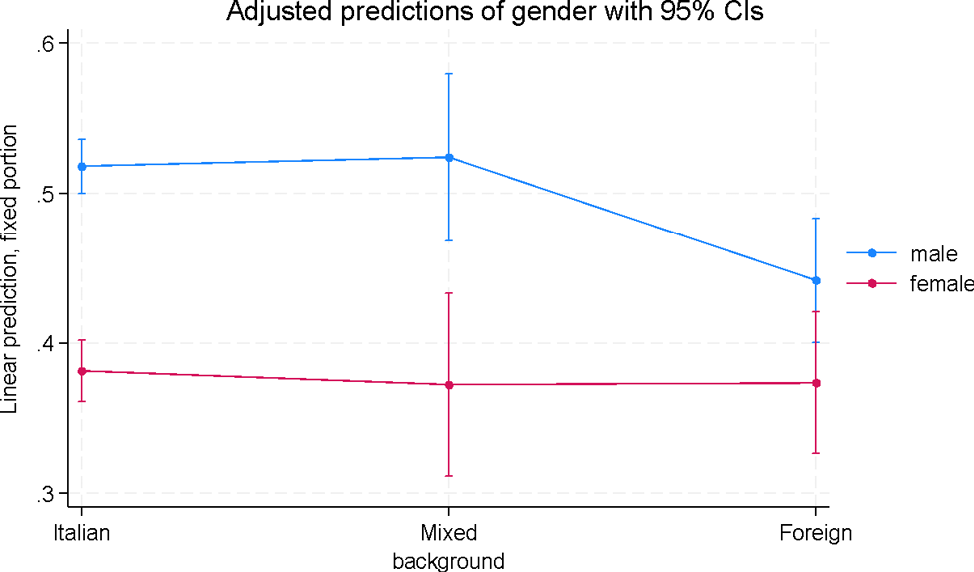
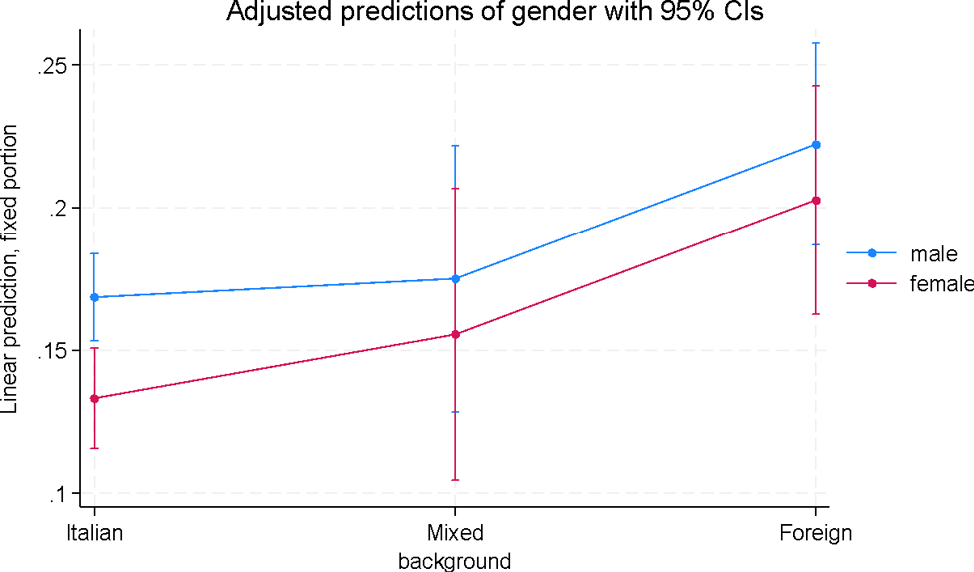
The findings presented in Table 1 reveal significant insights into the factors influencing political engagement and participation among youth. First, women exhibit a lower level of political engagement compared to men, with a coefficient of -0.125, while there is no significant impact on political participation. In terms of family background, individuals with a “foreign” background show a significant decrease in political engagement (-0.076) but an increase in political participation (+0.054) compared to their “Italian” counterparts. Interestingly, the interaction between gender and foreign background indicates that women from this group experience a significant boost in political engagement (+0.068), as also shown in Fig. 2. As result, the level of political engagement of females with foreign background does not differ neither from that of female natives Italians and from men with foreign background. By contrast, as far as political participation, the interaction terms between gender and family background categories are not statistically significant, with only a minimal difference in participation levels between Italian males and females (Fig. 3).
| Political Engagement | Political Participation | ||||||||||||||||||
|---|---|---|---|---|---|---|---|---|---|---|---|---|---|---|---|---|---|---|---|
| Fixed Effects: Gender (ref: male) |
|||||||||||||||||||
| female | -0.125 | *** | -0.023 | ||||||||||||||||
| (0.028) | (0.023) | ||||||||||||||||||
| Family background (ref. Italian) | |||||||||||||||||||
| Mixed | 0.006 | 0.007 | |||||||||||||||||
| (0.029) | (0.025) | ||||||||||||||||||
| Foreign | -0.076 | *** | 0.054 | ** | |||||||||||||||
| (0.022) | (0.019) | ||||||||||||||||||
| Gender (ref: male) # Family background (ref. Italian) | |||||||||||||||||||
| female # Mixed | -0.015 | 0.016 | |||||||||||||||||
| (0.043) | (0.036) | ||||||||||||||||||
| female # Foreign | 0.068 | * | 0.016 | ||||||||||||||||
| (0.034) | (0.028) | ||||||||||||||||||
| Men better politicians than women (strongly disagree) | 0.031 | * | 0.014 | ||||||||||||||||
| (0.013) | (0.011) | ||||||||||||||||||
| Political discussion at home | 0.255 | *** | 0.165 | *** | |||||||||||||||
| (0.022) | (0.018) | ||||||||||||||||||
| Class Gender Political Norms | 0.069 | * | 0.022 | ||||||||||||||||
| (0.030) | (0.026) | ||||||||||||||||||
| Family wellbeing | 0.104 | *** | -0.024 | ||||||||||||||||
| (0.028) | (0.024) | ||||||||||||||||||
| Family Education | |||||||||||||||||||
| Medium | 0.019 | -0.005 | |||||||||||||||||
| (0.013) | (0.011) | ||||||||||||||||||
| High | 0.037 | * | -0.021 | ||||||||||||||||
| (0.014) | (0.012) | ||||||||||||||||||
| Classroom Political Climate | 0.391 | *** | 0.201 | *** | |||||||||||||||
| (0.038) | (0.033) | ||||||||||||||||||
| Gender (ref: male) # Classroom Political Climate | |||||||||||||||||||
| female | -0.028 | -0.028 | |||||||||||||||||
| (0.054) | (0.046) | ||||||||||||||||||
| School (ref: Lyceum) | |||||||||||||||||||
| Technical | 0.025 | -0.019 | |||||||||||||||||
| (0.015) | (0.013) | ||||||||||||||||||
| Vocational | 0.046 | * | 0.011 | ||||||||||||||||
| (0.020) | (0.017) | ||||||||||||||||||
| Intercept | 0.138 | *** | 0.059 | * | |||||||||||||||
| (0.033) | (0.028) | ||||||||||||||||||
| Random effects: | |||||||||||||||||||
| School: SD(intercept) | 0.000 | 0.006 | |||||||||||||||||
| (0.000) | (0.023) | ||||||||||||||||||
| Municipality: SD(intercept) | 0.000 | 0.000 | |||||||||||||||||
| (0.0040004) | (0.0030003) | ||||||||||||||||||
| Number of observations | 1965 | 2101 | |||||||||||||||||
| AIC | 47.66 | -496.4946.59 | |||||||||||||||||
| BIC | 148.16 | -394.89-38794.2489 | |||||||||||||||||
| Log likelihood | -5.83 | 266.30 | |||||||||||||||||
| *** p<.001, ** p<.01, * p<.05. | |||||||||||||||||||
| Source: Original authors’ elaboration based on the MAYBEdataset (University of Milan). | |||||||||||||||||||
Consistent with the literature on the key role of early political socialisation by family and peers, the data show that active political discussions within the family correlate strongly with both political engagement (+0.255) and participation (+0.165). Simultaneously, high levels of political involvement in the classroom are associated with substantial increases in both students’ political engagement (+0.391) and participation (+0.201). Furthermore, the stereotype that “Men are better politicians than women” positively influences political engagement for those who strongly disagree with it (+0.031). Additionally, the Class Gender Political Norms variable, which reflects the average number of students in a class who strongly disagree with the notion that men are better politicians than women, positively influences political engagement (+0.069) but not political participation. While both effects are modest, the sustained statistical significance of political gender norms at both individual and group levels – even after controlling for other key factors influencing youth political engagement – suggests that an environment challenging traditional gender norms can enhance political engagement among students.
As regards random effects of the multilevel models, the results suggest that there is no significant variability in political engagement across schools, indicating that school characteristics do not substantially influence students’ political attitudes/behaviour, once the type of school is considered. Similarly, there is no significant variability at the municipal level.
To conclude, it is worth pointing out that all tested interactions between gender, family migratory background and key variables of interest – such as gender political norms, family political socialisation, and class political involvement – are not significant (analysis available on request), indicating that at this stage of life, the family and school context plays a pivotal role in encouraging or discouraging political participation for both males and females and regardless of ethnic background. However, this occurs in a polarised environment where young women strongly reject the notion that “men make better politicians”, while young men, especially those with foreign backgrounds, tend to not contrast it.
But what happens when young people – men or women, with and without migrant backgrounds – drawing on this background of beliefs and experiences, actively seek to engage with politics by connecting with parties or organisations?
4.3 Marginalization of Young Women with and without Migrant Backgrounds in Political Spaces: Qualitative Insights
During the three focus groups (FGs), young participants, men and women, reported encountering various stereotypes related to their political engagement. They are often perceived as disinterested in politics and apathetic (FG1, FG2). However, when they do participate, they are seen as needing guidance from older generations (FG2, FG3). They are also viewed as lacking competence (FG2, FG3) and are frequently told that the challenges they face today are less significant than those confronted by previous generations (FG2). Additionally, young people are criticized for both the topics they advocate for and the methods they use to make their voices heard. They are often told that «the methods they are using are wrong» (FG2). This highlights a broader context of delegitimization, where their ideas are frequently dismissed as unworthy or inherently flawed, coupled with negative rhetoric and narratives about young people in politics, and a lack of space for their engagement.
What comes to mind is the classic phrase like, ‘When you grow up, you’ll change your mind,’ for example. As if what I believe in right now, meaning me and other young people, is wrong. Wrong based on what, I don’t really understand. But often, I think, I don’t know, they interpret us [young people] as too radical, […] let’s say, not grounded enough. Maybe too detached from the reality of things, so they tell us, like, you’re talking about things you don’t know, you’re talking about nothing when in reality, I think it’s quite the opposite (FG2).
In these discussions, gender and ethnic background emerged as intersecting factors that create additional barriers both from “inside” – stemming from socialization processes and internalised societal pressures – and from “outside”, manifesting as subtle or overt forms of exclusion and the undermining of young women’s roles, competencies, and expertise, in particular when they have an ethnic background.
Our analysis shows that women often feel uncomfortable when assuming a political role, questioning their competence and capability for the position. In contrast, according to many young female participants, their male peers generally exhibit a strong sense of self-confidence and rarely question their own ability to hold a specific political position.
As women, there is also the issue of the underestimation of ourselves… For example, when I was appointed as vice president, the first question I asked myself was ‘Will I be up to the task?’ I mean, I have never seen a male colleague of mine, none of my male colleagues ever said, ‘Will I be up to the task?’ And there were young guys like me […]. If I had had a week, maybe I would have even consulted a passerby [asking them] if, in their opinion, I was capable or not! Men, I’m sorry, but on average, they don’t ask themselves all these things. (FG3)
This tendency shared by women to perceive lower self-efficacy compared to their male peers may be attributed to socialization processes that generate and perpetuate gender biases, leading to an internalisation of perceived incompetence in leadership roles and contributing to reduced political participation. As one focus group participant aptly stated:
There is also the matter that your voice, in the beginning, is worthless, or you choose for your voice to be worthless. When in assemblies or similar situations, you hear men speaking on topics they may not be extremely knowledgeable about, but you, who are aware [of not knowing enough about certain topics], say ‘well, I am not very knowledgeable on this subject, I will stay quiet and listen.’ But then you ask yourself: ‘why did I stay quiet and listen when the men, on the other hand, spoke nonsense? They were free to do so and, in fact, were applauded on topics that perhaps weren’t even within their competence!’(FG3)
As this quotation shows, limitations primarily stem from the perception of not being sufficiently competent on a specific topic or issue to take a stance. As highlighted above young people, regardless of gender, are often criticised for their lack of political engagement. However, when they become interested and active, they are frequently dismissed as inexperienced. This dynamic is particularly pronounced for young women, who often encounter additional barriers and forms of exclusion imposed by men, which often manifest as condescending attitudes towards young women.
I see very patriarchal and paternalistic dynamics in my area because when you go to talk to your mayor or your councillor, that’s the attitude. Even if you are 30 years old, you are approached as if you were a little girl. I think every girl, every person like us, in this age range, experiences the same thing. (FG3)
Exclusionary practices are not only perpetuated by dismissive attitudes but also through the reinforcement of gender stereotypes in everyday interactions. These stereotypes are often reproduced in subtle, seemingly innocuous ways, yet they contribute to a broader pattern of exclusion, as illustrated by the experience shared by this participant:
I clearly remember when I was first elected. The first thing they told me was: ‘Look, the library is down to the left.’ And on the second day, a colleague asked me: ‘Are you the new secretary?’ I mean, two different people in two different contexts. (FG3)
These overt or subtle forms of exclusion are particularly relevant in institutionalized forms of political participation, such as political parties, where men often predominate, and the environment is perceived as highly competitive. This situation risks widening the gap between women and political parties, unless women perceive a support or more women become involved.
When I joined my political group, there was one woman – me – and sixteen men. I would never have stayed if one of those sixteen hadn’t been my neighbour, whom I knew well, and he was the one who, when it came time to choose between him and me, said, ‘She should go ahead because she’s better than me.’ […] I mean, when I said ‘okay,’ I’ll stay, it was partly because I knew him, but also because other women joined. Otherwise, after two weeks, I probably would have said, ‘I’ll go do something else,’ because in the end, I like politics, but I can also engage in other ways, like being part of associations […] I wouldn’t have stayed in that environment, which is very competitive […] But, let’s say, for us, objectively, it’s much harder: it’s hard to find a group to join where you feel equal to others. It’s not easy at all. (FG3)
In the political scene, young women are often undervalued and perceived as having little to contribute. They are considered too inexperienced, not only by older men but also by their male peers.
What surprises me is that it’s not the old men, the councillor, or the mayor who treat you like a child. […] It was the young men themselves who treated me and told me, ‘the little girl should stay quiet,’ as if they were old men. (FG3)
Italy, as highlighted in the theoretical section, is considered an unfriendly country for both young and women, ranking among the least progressive countries in Europe regarding the gender gap in total working hours (both paid and unpaid) (Matteazzi and Scherer 2021). Additionally, Italy has a significantly lower female employment rate compared to the male employment rate (Istat 2024). This reflects not only the burden of gender stereotypes, but also systemic gender inequalities (Archard 2013; Carli 2001; Taft 2017) that hinder women’s access to the political field. For instance, familiar responsibilities5 often limit women’s ability to engage in political activities, and their life trajectories can pose barriers to sustained political commitment as an interviewee clearly pointed out:
Because a woman can generally do politics very actively until she is 30, until she generally dedicates her life to something else, because she chooses children because she chooses to dedicate more of her time to this and everything that it entails, only to usually resume it later when the children grow older. So when [the children] start to become independent, that is from 50 years old to 80. There is this gap of 20 years/15 years in which [the woman] is not politically active, or at least not as much as before. And obviously, the space that she used to occupy is then occupied by a man, who instead never stopped and whose career continued to grow. So, this is what I have seen in my personal experience: the fact that there are either women who do politics from a very young age or women who do politics when they are older. There is a gap in the middle that cannot be filled. (FG3)
In addition to this, when women, particularly young women, enter the political arena, they are often assigned roles and positions traditionally associated with feminine competencies. This practice reinforces gender stereotypes, limiting women to specific topics and granting them less power than their male counterparts. Such patterns are indicative of “thematic segregation” based on gender.
Sometimes we tend to limit ourselves, partly due to external reasons and partly to self-limit ourselves. They tend to limit us, and we self-limit ourselves to topics more related to care. We certainly have a central role, historically both in family care and in the community, but we tend to limit ourselves a bit. Instead, we should open our horizons a little, to have the opportunity to speak our minds and bring our contribution not only to certain specific areas of these topics, but in general also to everything else. (FG3)
Thematic segregation can sometimes arise not only from being a young woman but also from one’s ethnic background. Young women with migrant backgrounds reported a perception that their ethnic diversity is sometimes utilised by progressive parties to demonstrate inclusivity. However, they also described experiences in which their ethnic origin explicitly defined their responsibilities, relegating them to specific roles and positions.
For a progressive party, it is certainly the perfect profile to showcase. […] When I was elected, I was given the responsibility for relations with [immigrant] communities, but why? […] On one hand, I bring added value to this, I mean, who if not me can do this stuff? Because it’s true that I understand better – I was born and raised here, but I can have more empathy with a whole range of people and communities, and that is the added value I bring. But on the other hand, doesn’t this thing ghettoize you even more? I mean, there’s the dilemma between being put in a box even more and thus being further ghettoized. […] At first, it was fine, but if I had to do another term, I don’t know if I would accept it. (FG3)
Having a migrant background sometimes equates to not having Italian citizenship, which can hinder access to the political arena. The process of obtaining citizenship for immigrant descendants is quite long and difficult in Italy (Solano and Huddleston, 2020). Many children of immigrants – without Italian citizenship – are consequently excluded from some forms of participation, such as voting. Engaging in politics, therefore, becomes a “privilege”, as stated by participants in all focus groups (FG1, FG2, FG3). A young woman without Italian citizenship shared her experience of feeling distanced from politics, as the lack of this right effectively closes off access to the political sphere (FG1). The notion of politics as a privilege also emerged during a discussion in FG2. An 18-year-old participant with a migrant background attending a vocational school highlighted the intersection of factors, such as the low socio-economic status of young immigrant descendants, limited knowledge of the Italian language in some cases, living in peripheral areas, and being uninformed about politics. These intersecting factors create a unique condition of exclusion from the political scene. According to his experience, schools are not promoting their development as active citizens in the society in which they live, risking leaving them at the margins. The key role of the school environment resonates with the findings from our survey, pointing out that students are more politically involved and active when they attend classes where classmates, on average, are more politically engaged.
This article aimed to explore the complex interplay between gender socialization, ethnic background, and political participation among young people aged 18-30 in the Lombardy Region (Italy) through an intersectional lens and a mixed-method approach. Consistent with previous research, research findings highlighted that youth political engagement and participation are strongly influenced by political socialization from family and peers, with classroom/school also playing a crucial role. However, when considering the intersections of age, gender and ethnic background, numerous barriers to both access and inclusion within political spaces become apparent. The intersectional lens (Anthias 2013) is thus crucial to explore the role of young people’s multiple social identities in influencing their opportunities to participate.
Overall, our findings highlighted a wider pattern of delegitimization, where young people’s ideas are often regarded as unworthy. Moreover, in line with earlier studies (Pitti et al. 2023), the dominant narrative shapes which forms of political engagement are deemed appropriate and “right”, often framing the content and modes of youth participation as ‘inappropriate’ or ‘incorrect’. This issue is exacerbated by negative rhetoric and narratives surrounding youth in politics, alongside a scarcity of opportunities and spaces for their participation. Analysis of European Parliament Youth Survey (2021) data indicated higher representation of women in Italy across both traditional forms of political participation (such as voting) and other forms of activism but also that the level of engagement of young women decreases with age, from adolescence to young adulthood. Furthermore, in the 15 to 20 age group in Italy, a higher percentage of females never engage in these discussions compared to males. Considering the key role of political family discussion in youth political engagement, this gender gap could be problematic. Not surprisingly, the analysis of the political engagement of last year’s high school students in Lombardy showed a clear gender gap in both political engagement and active participation, once all other (micro, meso and macro) factors are considered. These findings suggest that, at least in the specific cohort and regional context under investigation consistently with the literature discussed before, the gender political gap is often masked by other factors, making it less visible but still significant.
Moreover, analysis revealed that, despite male and female students in Lombardy having opposite views about traditional male centrality in politics, this kind of political gendered norms does not impact on political engagement or participation. However, our qualitative analysis revealed that young women, despite participating, report lower levels of perceived internal self-efficacy compared to their male peers. This finding aligns with previous research, as discussed in the theoretical section. Furthermore, gender stereotypes and systemic gender inequalities continue to hinder women’s access to political spaces. Even when women manage to enter these spaces, they often face “thematic segregation” based on gender, where they are confined to roles traditionally associated with women. This segregation is particularly pronounced for young women with migrant backgrounds, whose perceived competencies are often limited to matters related to immigrant communities, further constraining their political opportunities.
Ethnic background is often associated with the lack of Italian citizenship and lower socio-economic conditions, creating an intersection of factors that push many young descendants of immigrants to the margins of the political scene. In certain cases, and under specific conditions, awareness of this marginalization can serve as a catalyst for action, counteracting the feelings of resentment typically associated with experiencing discrimination (Pinedo et al. 2024). The findings of this research suggest that the interplay of factors contributing to potential disadvantage (e.g., being young, gender or ethnic background) can give rise to «intersectional agency» (Lutz 2014; Rebughini 2021), term that refers to the modes of activation and reaction to exclusion that are directly enacted by those experiencing the intersection of multiple forms of discrimination. This is in line with recent research conducted in Italy (Bichi et al. 2025) which shows that the interactions among different factors of vulnerability among young people not only lead to exclusion but also give rise to processes of intersectional activation (Collins 2013). In this regard, our research on Lombardy high schools confirmed that young students with migratory backgrounds – both males and females – tend to be less interested in traditional politics, centered around parties and left-right ideologies. Nevertheless, they are more actively involved than their native peers in other forms of political engagement, like in street protests and online activities. This pattern persists even when controlling cultural and socioeconomic capital.
Our research also highlights examples of strategies that can break down both gender and ethnic barriers. The growing presence of women in high political roles, such as party leadership, is reshaping political spaces and creating new opportunities for women’s engagement. Initiatives like equal speaking time during discussions have also been effective in promoting greater female participation and leadership in political debates. While these findings show progress, more needs to be done. School’ environment too seems to play a pivotal role in fostering political engagement. Our research indicates that high levels of political involvement within the classroom are strongly correlated with significant increases in both engagement and political participation. Consequently, peer groups within schools can function as “incubators” of active citizenship, fostering young people’s interest and engagement. However, due to its unique socio-economic and political context, the focus on Lombardy may limit the generalisability of the findings. Future studies are needed to compare these findings with those from other regions or countries to better understand the wider implications of gender and ethnic inequalities on the political participation of young people.
Amaturo E. and Punziano G. (2016), I mixed methods nella ricerca sociale, Carocci, Roma.
Anthias F. (2013), «Intersectional what? Social divisions, intersectionality and levels of analysis», in Ethnicities, 1: 3-19. https://doi.org/10.1177/1468796812463547.
Anthias F. (2020), Translocational belongings: Intersectional dilemmas and social inequalities, Routledge, London.
Archard N. (2013), «Women’s participation as leaders in society: an adolescent girls’ perspective», in Journal of Youth Studies, 6: 759-775. https://doi.org/10.1080/13676261.2012.756974.
Barber C., Clark C.H., Torney-Purta J., Campbell D., Hahn C. and Kuhn D. (2021), «Learning Environments and School/Classroom Climate as Supports for Civic Reasoning, Discourse, and Engagement», in Educating for Civic Reasoning and Discourse, National Academy of Education, pp. 273-318.
Belluati M. (2021), «Meccanismi di riproduzione del gender gap nella sfera politica e nei media», in SocietàMutamentoPolitica, 22: 69-78. https://doi.org/10.13128/smp-12629.
Bichi R., Leone S. and Riniolo V. (Eds.) (2025), Giovani, disuguaglianze e pratiche di resistenza. Letture intersezionali, Il Mulino, Bologna.
Bjarnegård E. and Murray R. (2018), «Critical Perspectives on Men and Masculinities in Politics: Introduction», in Politics and Gender, 2: 264-265. https://doi.org/10.1017/S1743923X18000132.
Blumenau J. (2021), «The Effects of Female Leadership on Women’s Voice in Political Debate», in British Journal of Political Science, 2: 750-771. https://doi.org/10.1017/S0007123419000334.
Boonen J. (2017), «Political equality within the household? The political role and influence of mothers and fathers in a multi-party setting», in International Political Science Review, 5: 577-592. https://doi.org/10.1177/0192512116639745.
Broad L. K. (2017), «Social Movement Intersectionality and Re-centring Intersectional Activism», in Critical Studies in Gender, Culture and Social Justice, 1: 41-53.
Brown N. E. (2014), «Political Participation of Women of Color: An Intersectional Analysis», in Journal of Women, Politics and Policy, 4: 315-348. https://doi.org/10.1080/1554477X.2014.955406.
Campbell D. E. (2008), «Voice in the Classroom: How an Open Classroom Climate Fosters Political Engagement Among Adolescents», in Political Behavior, 4: 437-454. https://doi.org/10.1007/s11109-008-9063-z.
Campbell D. E. (2019), «What social scientists have learned about civic education: A review of the literature», in Peabody Journal of Education, 94(1): 32-47.
Carli L. L. (2001), «Gender and Social Influence», in Journal of Social Issues, 4: 725–741. https://doi.org/10.1111/0022-4537.00238.
Cella M. and Manzoni E. (2023), «Gender bias and women’s political performance», in European Journal of Political Economy, 102314. https://doi.org/10.1016/j.ejpoleco.2022.102314.
Chen Z. and Han J. (2024), «Her Lips Are Sealed: Effects of Negative Feedback on Women’s Participation in Online Political Discussions», in Socius: Sociological Research for a Dynamic World, 10: 1-14. https://doi.org/10.1177/23780231241271723.
Chiappelli T. (2016), «Migrant women in Italy between exclusion and active participation. A gender perspective in inclusion processes», in Comparative Cultural Studies - European and Latin American Perspectives, 2: 37–48. https://doi.org/10.13128/ccselap-19996.
Cicognani E., Zani B., Fournier B., Gavray C. and Born M. (2012), «Gender differences in youths’ political engagement and participation. The role of parents and of adolescents’ social and civic participation», in Journal of adolescence, 3: 561–576. https://doi.org/10.1016/j.adolescence.2011.10.002.
Collins P. H. (2013), On intellectual activism, Temple University Press, Philadelphia, PA.
Collins P. H. (2015), «Intersectionality’s Definitional Dilemmas», in Annual Review of Sociology, 1: 1-20. https://doi.org/10.1146/annurev-soc-073014-112142.
Collins P. H. (2021), «Intersectionality, Black Youth, and Political Activism», in S. Swartz, A. Cooper, C. M. Batan and L. Kropff Causa (Eds.), The Oxford Handbook of Global South Youth Studies, Oxford University Press, pp. 122–140.
Collins P. H. (2022), Intersezionalità: Come teoria critica della società, UTET Università, Torino.
Colombo E. and Rebughini P. (2024), «Generational Inequalities in Multiple Crises. Pandemic and Italian Youth on the Edge», in S. Maddanu and E. Toscano (Eds.), The COVID-19 pandemic series. Inequalities, youth, democracy and the pandemic, Routledge, Abingdon, Oxon, New York, NY.
Cooper A. J. (1892), A voice from the south: By a black woman of the south, University of North Carolina at Chapel Hill Library, Chapel Hill.
Crenshaw K. (1991), «Mapping the Margins: Intersectionality, Identity Politics, and Violence against Women of Color», in Stanford Law Review, 6: 1241–1299. https://doi.org/10.2307/1229039.
Creswell J.W. and Plano Clark V.L. (2011), Designing and conducting mixed methods research (2. ed.), SAGE, Thousand Oaks.
Crowley J. (2001), «The Political Participation of Ethnic Minorities», in International Political Science Review, 1: 99–121. https://doi.org/10.1177/0192512101221006.
Curini L., Decadri S., Ferrara A., Montanelli S., Negri F. and Periti F. (2023), «The Gender Gap in Issue Attention and Language Use within a Legislative Setting: An Application to the Italian Parliament (1948–2020)», in Politics and Gender, 20(1): 182-211. https://doi.org/10.1017/S1743923X2300051X.
Daher L. M. and Nicolosi D. (2023), «Italian Citizenship Now! The 5W+1H of Second-Generation Activism», in Migration Letters, 2: 287-300. https://doi.org/10.59670/ml.v20i2.2200.
Dahlerup, D. and Leijenaar M. (Eds.) (2013), Breaking male dominance in old democracies, Oxford University Press, Oxford.
Dalton R. J. (2016), The good citizen: How a younger generation is reshaping American politics (Second edition), CQ Press an Imprint of SAGE Publications Inc, Thousand Oaks California.
Davis A. Y. (1982), Women, race and class, Random House Inc, New York.
Deimel D., Hoskins B. and Abs H.J. (2021), «How do schools affect inequalities in political participation: compensation of social disadvantage or provision of differential access?», in X. Kuang, J. Zhu and K. J. Kennedy (Eds.), Civic Learning for Alienated, Disaffected and Disadvantaged Students, Routledge, pp. 6-26.
Delgado R., Stefancic J. and Harris A. P. (2023), Critical race theory: An introduction, New York University Press, New York.
Della Bella S. (2023), Gli indicatori di benessere equo e sostenibile in un’ottica di genere. Lombardia anno 2022 (Working Paper 4/2023), Polis Lombardia.
Dinas E. (2010). The Impressionable Years: The formative role of family, vote and political events during early adulthood. PhD Thesis, European University Institute, Florence, from https://hdl.handle.net/1814/14708.
Dinesen P.T. and Andersen R.F. (2022), «The (Re)socialization of participatory political culture: Immigrants’ political participation between their contemporary country and their ancestral country», in Political Geography, 102650. https://doi.org/10.1016/j.polgeo.2022.102650.
Ditonto T. (2017), «A High Bar or a Double Standard? Gender, Competence, and Information in Political Campaigns», in Political Behavior, 2: 301-325. https://doi.org/10.1007/s11109-016-9357-5.
Durmuşoğlu L. R., Lange S. L. de, Kuhn T. and van der Brug W. (2023), «The Intergenerational Transmission of Party Preferences in Multiparty Contexts: Examining Parental Socialization Processes in the Netherlands», in Political Psychology, 3: 583-601. https://doi.org/10.1111/pops.12861.
European Parliament (2021), Flash Eurobarometer 2574 (European Parliament Youth Survey), GESIS, Cologne, ZA7991 Data file Version 1.0.0.
Farini F. (2019), «Inclusion Through Political Participation, Trust from Shared Political Engagement: Children of Migrants and School Activism in Italy», in Journal of International Migration and Integration, 4: 1121-1136. https://doi.org/10.1007/s12134-018-00643-y.
Fox R.L. and Lawless J.L. (2011), «Gendered Perceptions and Political Candidacies: A Central Barrier to Women’s Equality in Electoral Politics», in American Journal of Political Science, 1: 59-73. https://doi.org/10.1111/j.1540-5907.2010.00484.x.
Galea N. and Gaweda B. (2018), «(De)constructing the Masculine Blueprint: The Institutional and Discursive Consequences of Male Political Dominance», in Politics and Gender, 2: 276-282. https://doi.org/10.1017/S1743923X18000168.
Gatti R., Buonomo A. and Strozza S. (2024), «Immigrants’ political engagement: gender differences in political attitudes and behaviours among immigrants in Italy», in Quality and Quantity, 2: 1753-1777. https://doi.org/10.1007/s11135-023-01714-8.
Giugni M. and Grasso M. (Eds.) (2021), Youth and Politics in Times of Increasing Inequalities, Springer International Publishing, Cham.
Grasso M. and Smith K. (2022), «Gender inequalities in political participation and political engagement among young people in Europe: Are young women less politically engaged than young men?», in Politics, 1: 39-57. https://doi.org/10.1177/02633957211028813.
Guglielmi S. and Maggini N. (2025), «Addressing Migrant Inequality in Youth Political Engagement: The Role of Parental Influences», in Politics and Governance, 13. https://doi.org/10.17645/pag.9282.
Harris A. and Roose J. (2014), «DIY citizenship amongst young Muslims: experiences of the ‘ordinary’», in Journal of Youth Studies, 6: 794-813. https://doi.org/10.1080/13676261.2013.844782.
Hooks B. (1981), Ain’t I a Woman?, South End Press, Boston.
Hoskins B., Janmaat J.G. and Melis G. (2017), «Tackling inequalities in political socialisation: A systematic analysis of access to and mitigation effects of learning citizenship at school», in Social science research, 68: 88-101. https://doi.org/10.1016/j.ssresearch.2017.09.001.
Istat (2019), I tempi della vita quotidiana: Lavoro, conciliazione, parità di genere e benessere soggetivo. Temi Letture statistiche, Istituto Nazionale di Statistica, Roma.
Istat (2024), Occupati e disoccupati, from https://www.istat.it/wp-content/uploads/2024/05/CS_Occupati-e-disoccupati-APRILE-2024.pdf.
Janmaat J.G. and Hoskins B. (2022), «The Changing Impact of Family Background on Political Engagement During Adolescence and Early Adulthood», in Social Forces, 1: 227-251. https://doi.org/10.1093/sf/soab112.
Jennings M.K. and Niemi R.G. (1968), «The Transmission of Political Values from Parent to Child», in American Political Science Review, 1: 169–184. https://doi.org/10.1017/s0003055400115709.
Jungkunz S. and Marx P. (2024), «Material deprivation in childhood and unequal political socialization: the relationship between children’s economic hardship and future voting», in European Sociological Review, 1: 72–84. https://doi.org/10.1093/esr/jcad026.
Kanthak K. and Woon J. (2015), «Women Don’t Run? Election Aversion and Candidate Entry», in American Journal of Political Science, 3: 595–612. https://doi.org/10.1111/ajps.12158.
Karpowitz C. F. and Mendelberg T. (2014), The Silent Sex, Princeton University Press, Princeton.
Lavizzari A. and Portos M. (2021), «Disclosing Inequalities: Gender and Patterns of Political Participation Among the Italian Youth», in M. Giugni and M. Grasso (Eds.), Youth and Politics in Times of Increasing Inequalities, Springer International Publishing, Cham, pp. 83-105.
Lello E. and Bazzoli N. (2023), «Youth political participation and inequalities: comparing European countries and different repertoires of engagement», in De Europa, 2: 41-59. https://doi.org/10.13135/2611-853X/7368.
Lowndes V. (2020), «How Are Political Institutions Gendered?», in Political Studies, 3: 543-564. https://doi.org/10.1177/0032321719867667.
Lutz H. (2014), «Intersectionality (brilliant) Career. How to understand the attraction of the concept?», in Working paper series, Gender diversity and migration, 1, Goethe University, Frankfurt, pp. 1-12.
Maiorino S. and Terzera L. (2024), «Overeducation of migrants in Lombardy: A trend analysis 2008–2021», in International Migration, 5: 217-236. https://doi.org/10.1111/imig.13306.
Matos Y., Greene S. and Sanbonmatsu K. (2023), «The politics of “women of color”: a group identity worth investigating», in Politics, Groups, and Identities, 3: 549-570. https://doi.org/10.1080/21565503.2021.2008992.
Matteazzi E. and Scherer S. (2021), «Gender Wage Gap and the Involvement of Partners in Household Work», in Work, Employment and Society, 3: 490–508. https://doi.org/10.1177/0950017020937936.
Mayer J. D., Andolina M. W. and McGrath R. J. (2024), «Listen to Me: Quality of Communication and Intergenerational Political Socialization», in Political Research Quarterly, 2: 451-468. https://doi.org/10.1177/10659129231220025.
MIM, Ministero dell’Istruzione e del Merito (2024), Gli alunni con cittadinanza non italiana a.s. 2022/23, from Notiziario agosto 2024: https://www.miur.gov.it/documents/20182/8426729/NOTIZIARIO_Stranieri_2223.pdf/d5e2aa0c-cbde-b756-646d-a5279e2b980d?version=1.0andt=1723104803484.
Myrttinen H. (2019), «Locating Masculinities in WPS», in S. E. Davies, J. True and H. Myrttinen (Eds.), The Oxford Handbook of Women, Peace, and Security, Oxford University Press, Oxford, pp. 87–97.
Neundorf A., Niemi R.G. and Smets K. (2016), «The Compensation Effect of Civic Education on Political Engagement: How Civics Classes Make Up for Missing Parental Socialization», in Political Behavior, 4: 921-949. https://doi.org/10.1007/s11109-016-9341-0.
Ortensi L.E. and Riniolo V. (2020), «Do Migrants Get Involved in Politics? Levels, Forms and Drivers of Migrant Political Participation in Italy», in Journal of International Migration and Integration, 1: 133-153. https://doi.org/10.1007/s12134-019-00703-x.
Pensiero N. and Janmaat J. G. (2024), «Why do women develop lower levels of political interest? Examining the influence of education, family socialisation and adult roles», in Acta Politica. https://doi.org/10.1057/s41269-024-00349-3.
Pfanzelt H. and Spies D. C. (2019), «The Gender Gap in Youth Political Participation: Evidence from Germany», in Political Research Quarterly, 1: 34-48. https://doi.org/10.1177/1065912918775249.
Pinedo A., Diemer M. A. and Frisby M. B. (2024), «Critical Consciousness and Youth Political Activism», in Annual Review of Developmental Psychology, 1: 351-372. https://doi.org/10.1146/annurev-devpsych-010923-113449.
Pitti I. (2018), Youth and Unconventional Political Engagement, Palgrave Macmillan, Cham.
Pitti I., Mengilli Y. and Walther A. (2023), «Liminal Participation: Young People’s Practices in the Public Sphere Between Exclusion, Claims of Belonging, and Democratic Innovation», in Youth and Society, 1: 143-162. https://doi.org/10.1177/0044118X211040848.
Quintelier E. (2009), «The Political Participation of Immigrant Youth in Belgium», in Journal of Ethnic and Migration Studies, 6: 919-937. https://doi.org/10.1080/13691830902957700.
Quintelier E. (2015), «Engaging Adolescents in Politics», in Youth and Society, 1: 51-69. https://doi.org/10.1177/0044118X13507295.
Rebughini P. (2021), «Agency in intersectionality. Towards a method for studying the situatedness of action», in Socio, 15: 189-205. https://doi.org/10.4000/socio.11329.
Riniolo V. (2023), «‘Granted’ and ‘Claimed’ Spaces of Participation: The Political Activism of Young Immigrant Descendants», in Migration Letters, 2. https://doi.org/10.33182/ml.v20i2.2874.
Solano G. and Huddleston T. (2020), Migrant integration policy index, COBOD and MPG, Barcelona/Brussels.
Stefani S., Prati G., Tzankova I., Ricci E., Albanesi C. and Cicognani E. (2021), «Gender differences in civic and political engagement and participation among Italian young people», in Social Psychological Bulletin, 1. https://doi.org/10.32872/spb.3887.
Taft J. K. (2017), «Teenage girls’ narratives of becoming activists», in Contemporary Social Science, 1-2: 27-39. https://doi.org/10.1080/21582041.2017.1324173.
Terriquez V. and Kwon H. (2015), «Intergenerational Family Relations, Civic Organisations, and the Political Socialisation of Second-Generation Immigrant Youth», in Journal of Ethnic and Migration Studies, 3: 425-447. https://doi.org/10.1080/1369183X.2014.921567.
van Ditmars M. M. (2023), «Political socialization, political gender gaps and the intergenerational transmission of left‐right ideology», in European Journal of Political Research, 1: 3-24. https://doi.org/10.1111/1475-6765.12517.
Verba S., Schlozman K. L. and Brady H. E. (1995), Voice and Equality: Civic Voluntarism in American Politics, Harvard University Press.
Wells-Barnett I. B. (1892), Southern Horrors: Lynch Law In All Its Phases, Bedford Books, Boston.
Yuval-Davis N. (2006), «Intersectionality and Feminist Politics», in European Journal of Women’s Studies, 3: 193-209. https://doi.org/10.1177/1350506806065752.
1 This article is the result of a collaborative effort among all the authors. The sections were written as follows:Simona Guglielmi: paragraphs 1, 2.2, 2.3, and 4.2; Veronica Riniolo: paragraph 4.3, the Conclusions (paragraph 5), and the qualitative phase of paragraph 3 (Data and Methods); Nicola Maggini: paragraph 4.2.1; Marta Visioli: paragraphs 2.1 and 2.4; Alice Sanarico: paragraph 4.1 and the quantitative phase of paragraph 3.
2 The YEP project was conceived as a continuation of the MAYBE initiative, with a specific focus on inequalities in youth political participation. The YEP project is implemented by a consortium made up of academia (University of Milan - lead partner, Università Cattolica del Sacro Cuore), civil society (CoNNGI, Coordinamento Nazionale Nuove Generazioni di Italiani) and social enterprises (Consorzio Comunità Brianza).
3 All interviews were carried via Computer-Assisted Web Interviewing (CAWI), using Ipsos online panels and their partner network. Respondents were selected from online access panels, groups of pre-recruited individuals who have agreed to take part in research. Sampling quotas were set based on age (16-18 year-olds, 29-24 year-olds, 25-30 year-olds), gender and geographic region (NUTS1, NUTS2 or NUTS 3, depending on the size of the country and the number of NUTS regions). (European Parliament Youth Survey 2021: 66)
4 A multivariate analysis done on the pooled Europaren sample confirm the gender gap, even controlling for other variables such as age, parents’ and respondents’ education, political discussion, social class (available on request).
5 In Italy, the inequality between men and women is particularly pronounced. Italy is the country in Europe with the largest gender gap in unpaid work, considering the time devoted to unpaid labor by both women and men (Istat 2019).