Ligatures and their leib-bound and socially mediated leib-bound ties – foundations for an actualization of Ralf Dahrendorf’s concept of life chances with recourse to Karl Popper’s theory of the three worlds and its extension
Abstract. This essay deals with the extension of two concepts that have proven themselves in social science research and philosophy, but also have the potential to be applied in other contexts on the one hand, and to enter into a reciprocal connection on the other, namely Ralf Dahrendorf’s life chances approach and Karl Popper’s theory of three worlds. The extension of the Three Worlds Theory concerns the intersubjective, that of the life chances approach the integration of the human leib (as a connection between body and mind) into the concept of ligatures (which, in conjunction with options, form and determine life chances). The leib not only shapes ligatures, but it also mediates social ligatures, so that it has a prominent influence on life chances.
Keywords: life chances, Karl Popper, Ralf Dahrendorf, leib-ligatures, leib-mediated social ligatures.
Index
4. EXPANDING THE UNDERSTANDING OF LIGATURES THROUGH LEIB-LIGATURES
5. EXPANDING THE UNDERSTANDING OF LIGATURES THROUGH LEIB-MEDIATED SOCIAL LIGATURES
The life chances approach is closely linked to Ralf Dahrendorf (1929-2009), a German-British sociologist, political theorist, and practitioner as well as public intellectual. Ralf Dahrendorf’s thinking was – as he himself explained – strongly influenced by his teacher Karl Popper (1902-1994), his political philosophy and philosophy of science. In this respect, the path to integrating the ideas of Popper and Dahrendorf, both advocates of a liberal society and open science, is quite short.
The life chances approach of Ralf Dahrendorf (1979) can not only be considered a central point of reference in his work alongside his role and conflict theory and his reflections on political philosophy, it also represents integral references to the other parts of his work, for example, acting in roles determines the possibility of developing life chances, conflicts develop not least from the pursuit of life chances and in his political philosophy the facilitation of life chances has a strong normative significance (Kühne and Leonardi 2020). Following Dahrendorf, life chances are characterized by options, as «opportunities to choose» (Dahrendorf 2007: 44) and ligatures, as «structurally predetermined fields of human action» (Dahrendorf 1979: 51) which express themselves in deep ties. The first aim of our essay is to work out the leib-bound meaning of ligatures – which also has an influence on options. This is a desideratum – not least in Dahrendorf’s work – as he focuses on the social and the relationship between the individual and the social. In this article, we want to work out the significance of the body for dealing with ligatures, but also options, in order to create a basis for updating Ralf Dahrendorf’s life chances approach and making it usable for further questions. In doing so, we draw on the concept of Leib, which is widespread in the German language and in German philosophy. Leib’ means living body – and thus connected with thinking and feeling.
In order to structure these considerations, we use Karl Popper’s theory of the three worlds (Popper 1979; Popper and Eccles 1977) which, in addition to the world of cultural content (World 3) and World 2 of individual consciousness, also identifies material World 1. If the desideratum in Dahrendorf’s considerations lies in the limited consideration of World 1, for Popper it lies in the intersubjectivity of the social. Although World 3 is often understood as social (as in Weichhart 2018 criticized), World 3 is ultimately only a product of intersubjective processes and cannot be equated with them. This gives rise to the second aim of our essay: To reflect on the integration of the intersubjective into the theory of the three worlds.
As has become clear from this introduction, our essay straddles the boundary between philosophy and sociology by linking the concept of life chances, which originates from Ralf Dahrendorf’s sociology, with the philosophical concept of Karl Popper’s Three Worlds Theory, but also with the concept of the body. The aim of this connection is to work out the differentiation of life chances on the one hand, but also the need for further differentiation – here in particular the concept of the ligature.
However, before we turn to expanding the concepts, we will first introduce our analytical framework, Karl Popper’s theory of three worlds (section 2). In this section, we will also address the question of why the Three Worlds Theory needs to be extended in order to provide a more appropriate analytical framework for studying social processes will then turn to the concept of life chances as developed by Ralf Dahrendorf (section 3). In section 4 we turn to considerations of leib-bound ligatures, to which we turn in section 5 when we deal with leib-mediated social ligatures. In section 6we link our considerations back to the concept of life chances and discuss the significance of our extension for this concept in a conclusion and outlook.
2. POPPER’S CONCEPT OF WORLDS – ANALYTICAL FRAMEWORK AND THEIR NEEDS FOR EXPANSION IN THE CONTEXT OF SOCIAL PROCESSES
In the following, we introduce a distinction based on the ideas of Karl Popper and his three-world theory, which addresses different ways of accessing or participating in the world (Niemann 2019; Popper 1979, 2019 [1987]; cf. also Kühne 2020; Kühne and Berr 2021; Weichhart 1993, 1999). Popper assigns World 1 to living and non-living bodies, World 2 to the contents of consciousness, i.e. individual thoughts and feelings, such as «perhaps also of subconscious experiences» (Popper 2018 [1984]: 82). World 3 can be described as «all planned or intentional products of human mental activity» (Popper 2019 [1987]: 17; Hervorhebung im Original) for example, scientific propositions or theories, but also socio-culturally shared understandings of “space” or “landscape”. World 3 serves as a supplement to Worlds 1 and 2 as «the world that anthropologists call ‘culture’» (Ivi: 18).
In summary, Popper’s approach does not imply a strict (extensional or ontological) separation of the three distinct “worlds”, but instead offers a “quasiontological” analytical framework for the (intensional or aspectual-ascriptive) recording of world accesses, world assignments and world participations, corresponding hybridities and typical interactions in their references to society, the individual and materialities (Kühne 2018; Weichhart 1999). Depending on the question and direction of analysis, a specific aspect of the human “world” can be emphasized without a specific world phenomenon being countervalently assigned to only one specific ‘world’ and thus one specific aspect of possible ways of accessing the world. Undoubtedly, there is only «one world» (Gethmann 2023: 109) but which is accessible in three specific world references (cf. Berr 2020; Davidson 2004; Gabriel 2019; Ganslandt 2004; Habermas 1995; Prange 2010). This means that entities or phenomena can be analytically and intensionally assigned to several worlds, whereby these worlds also interact with each other. The center of these interactions is World 2 of the individual consciousness, insofar as it is coupled back to World 1 and World 3 and – Popper does not address this aspect, which is why in the following (section 5) – communicates intersubjectively with other Worlds 2. For example, humans have a physical body (World 1), a consciousness (World 2) that can communicate and interact intersubjectively with other Worlds 2, and access to the world of social and cultural contents (World 3). As a physical-material “body”, people have a “share” in World 1; as an “animated body” or leib (cf. Waldenfels 2000) they have a share in both World 1 and World 2.
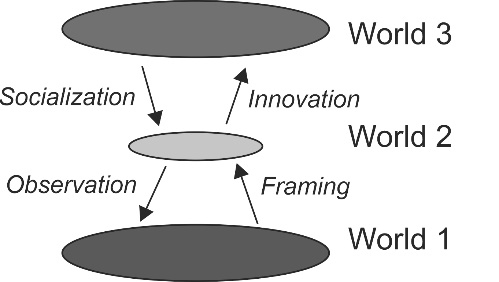
As far as the interactions between the three ‘worlds’ are concerned, World 2 is connected to World 3 by the fact that an individual is introduced to social knowledge, patterns of interpretation and evaluation (socialization) and has the opportunity to anchor new knowledge, patterns of interpretation and evaluation in society (innovation). World 2 is connected to World 1 through individual observation, while at the same time it receives a structuring framework for its activities through its corporeality and physicality, from which it cannot detach itself (more detailed: Kühne 2020) (see overview Figure 1). Moreover, individual consciousness not only has a central function for the conception of an open society (Kühne, Berr and Jenal 2022)but also for the resolution or settlement of conflicts (Dahrendorf 1979, 2002; Popper 2011[1947]).
If Popper and subsequent theories define World 3 as the realm of the cultural, the realm of the intersubjective (Worlds 2 as ‘ego’ and ‘alter’) must be disregarded, since World 3 is ultimately only a product of intersubjective processes and cannot be equated with them (cf. the exemplary critique by Weichhart 2018). Donald Davidson has therefore distinguished three mutually irreplaceable and irreducible world relations: an objective, an intersubjective and a subjective one (Davidson 2004). This means that people want (cf. Prange 2010) basically want to know “what is going on out there” (objective world reference); “what others think” (intersubjective world reference); “what I/we think” (subjective world reference). However, “out there” can now be interpreted in Popper’s sense not only as World 1, but also as World 3 (and even as Worlds 2 in the sense of Descart’s other-psychic); also, “what the others think” (intersubjectivity) can be understood simplistically and misleadingly as Popper’s World 3.
In order to avoid this ambiguous use of terms, it is advisable to consider three fundamental epistemological perspectives (see introductory and overview: Hartmann 2020): the observer perspective (third-person perspective), the first-person perspective (first-person perspective) and the participant perspective (we-perspective). The observer perspective is the “objective” standard perspective of the natural sciences, which aims to arrive at objective findings from a distance that observes phenomena and is supposedly detached from its integration into a community of language, action and culture. This is therefore often reserved for World 1 or the objective reference to the world, but can also be applied to World 2 (for example in psychology or behavioral research) and World 3 (for example in cultural sociology or the history of ideas) as well as to the subjective and intersubjective reference to the world. The “subjective” first-person perspective is the perspective of an individual “I” (as prototypically in Descartes 2008 [1637] and Locke 1981 [1689]), which is based on subjective evidence, experiences or views, also supposedly detached from integration into a linguistic, action and cultural community. This perspective, which underestimates or even ignores the significance of intersubjectivity as well as the contents of World 3, remains reserved for World 2. The “intersubjective” we-perspective is the perspective «that presents itself to each and every one of us as a participant perspective, the perspective of participating in a communication community» (Hartmann 2020: 88) – paradigmatic for the cultural and social sciences.
Accordingly, World 3 can only take the area of the intersubjective into account if a participant perspective is scientifically adopted with regard to intersubjective processes between Worlds 2 that lead to World ’ as the product of these intersubjective processes. For World 3 as a product of these processes, an observer’s perspective can be adopted that focuses on World 3 in its product character.
This relationship between intersubjective World 3 production by Worlds 2 and World 3 as a product of this production can also be illuminated in more detail from a specific anthropological perspective. The question of a purposeful understanding of “man”, of “who” or “what” he is, can also be reformulated as a question of his ineluctable activities. This means that people cannot see themselves exclusively from an ego perspective, for example through introspection (as in behaviorism; cf. Skinner 1978; Watson 1957), or from an observer perspective, such as neuroscientific studies (cf. Janich 2009; Roth and Strüber 2018) but only through their actions and the products of their actions themselves. If, with Popper, World 3 also means «the world that anthropologists call ‘culture’» (Popper 2019 [1987]: 18) then World 3 as a cultural product and thus also as a product of action also refers to culture-creating people in their authorship of action (Gethmann 2006). On the one hand, human life is part of an event that «takes place entirely without our intervention in the realm of the inanimate and animate» (Hartmann 2020: 234)and which we usually refer to as natural events (World 1). Human life is also largely communal life (intersubjective Worlds 2) and as such is culturally constituted by human action (World 3). People live in social contexts that create and produce infrastructures such as buildings, streets, cities and landscapes or tools, equipment and things of the most diverse kinds and also develop and pass them on over generations – in this way, a «cultural history» is created (Hartmann 2020: 234) which both provides the framework for cultural products and is itself a product of human activity.
If people can only become transparent and understandable in their own products, then this means that «culture […] is both the framework and product of the establishment of people» (Orth 2000: 7) or production and product at the same time. People can therefore only adequately understand themselves in relation to the participant perspective of human communities of language, action and communication. Every «self-assurance» (Mittelstraß 2003) any self-understanding and any self-determination of human beings are therefore only possible within the «spell of the results, exemplifications and instantiations of their actions […] just as the activity of a mole can only be recognized by its hills» (Hubig 2006: 86). In other words: «What a person is is revealed in their actions and in the products of their actions» (Hartung 2018: 130). With Hugo Dingler’s Faust quote: «In the beginning was the deed» (Dingler 1928: 73) with Friedrich Schiller: «The mind possesses nothing but what it does» (Schiller 2004: 680).
There is another aspect: people not only intersubjectively produce World 3 as a product, but this product also has an effect on them as producers. With regard to human cultural activities, this basically means that the world shaped in this way also retroactively shapes people. To summarize, this means: «We are the producers of culture. But then, through repercussions, we are also produced by it» (Landmann 1964: 185). Accordingly, people become ‘human worlds’ through the use of technical, structural and design products, but also through institutions and organizations created by themselves and through the entire field of the symbolic (Cassirer 2001, 2002b, 2002a; Reckwitz 2011) as human beings. For, according to Ernst Kapp, for example, man is in the «self-created creation of its means of culture» (Kapp 1877: 26) «is not simply given, but is made» (Maye and Scholz 2015: XLIV).
The differentiated nature of the Three Worlds and the importance of intersubjectivity emphasized here illustrate how the individual and the social are bound to and in the world 1. This bound has an impact not least on the emergence, development, utilization or denial of life chances.
3. THE CONCEPT OF LIFE CHANCES BY RALF DAHRENDORF AND THE NEED FOR CONCRETIZATION OF RALF DAHRENDORF’S LIGATURE CONCEPT
For those who have delved into Ralf Dahrendorf’s work, it seems almost strange that he left out the relationship between life chances and World 1, particularly by not giving due importance to the component of leib-mediated ligatures in his definition of life chances. It seems strange because the definition of life chances in Dahrendorf is functional to the analysis of active liberty in society making the normative concept operational. In addition, the impulse of this research, as Dahrendorf has repeated in many venues, goes back to a personal experience of imprisonment therefore of physical, hence leib-bound, constraint, habeas corpus being the basic right for individual freedom. By revisiting then his definition of life chances, we can also identify its limits and the opportunity for integration through a further articulation of the concept, notably in the component of leib mediated ligatures.
Life-chances are socially structured. They are a function of options, «alternative possibilities of choice of action in social structures», and of ligatures, «memberships, relationships that provide meaning to action» (Dahrendorf 1989: 17). Life-chances are not mere choices between alternatives, a range of opportunities, because they are social in nature. Since the individual is placed within «ties dense with emotional connotations» (Dahrendorf 1981: 41) that are configured as social relations (Ligatures), which give sense and anchorage to social belonging. Options refer to the horizon of action, they are decisions open to the future, while social bonds as social relations constitute the foundations of action. Options are, in turn, a combination of entitlements and provisions. Entitlements express a relationship to persons and things by which their access to them and their control over them is legitimate (Dahrendorf 1989: 14). Provisions have a quantitative aspect, more economic than legal and political, they are the bundle of alternatives in certain areas of activity (Dahrendorf 1981: 41). The constant tension between the components of life-chances is linked to the often decoupled relationship between the material provisions of economic sphere and the political and cultural conditions, the so called Martinez Paradox (Dahrendorf 1989: 11). In the terms of Popper’s three-world theory, it is clear that life chances, being related to the individual dimension of consciousness, reflexivity and feelings, finding realisation in individual autonomy, are centred on World 2, but at the same time are made possible by World 3 and are nourished by World 1.
Ligatures are cultural ties associated with ascriptive units as is the case with family, religion, gender or an age group, but also by class placement or place of birth. Ligatures therefore guarantee from an unquestioned bond a basis of certainty without which society could not structure itself. But in cases where they are too exclusive and prescriptive they can suffocate individual freedom. However, ligatures transform in modernity and from ascribed become increasingly a choice: «With increasing mobility, local and general local bonds too become available rather than given […] In the end, even the biologically based distinctions of age and sex, as it were, put up for auction» (Dahrendorf 1985: 45). Ligatures that are too weak, however, do not perform an anchoring and sense-making function for options, and this can degenerate into a state of anomie. Therefore, there is a continuous process of reconstructing culturally mediated ties: «The search of ligatures is evidently one of the forces of our time» (Ivi: 77).
Apart from referring to some aspects of leib-type ligatures that take on an open structuring power as opposed to some contexts in which they are rather a closing factor, Dahrendorf does not develop this aspect more, although an awareness shines through, in popperian terms, that the phenomena related to the corporeality of social life, such as mobility, locality, age, gender, to mention but a few, are produced by a continuous process of reshaping the World 1 that passes through the intersubjectivity of the social in the World 2 and is accompanied by changes in the World 3.
We can hypothesize that Dahrendorf assumed, and therefore did not elaborate, that leib-mediated ligatures are to be considered an integral part of agency freedom, to be sought also in the material world, in the so-called “realm of necessity”. He, for example, quoting Popper (but also paraphrasing Marx) problematizes the distinction that places the activity of fishing or hunting in World 1 and creative production in World 2, because the two are also qualitatively related each other and to the generative potential of World 3. Liberty of agency, therefore, is a cross problem running through the 3 Worlds, and this perhaps led Dahrendorf to drop the analytical distinction proposed by Popper (Dahrendorf 1981: 122), mentioning in this case the role of ligatures but not going deeper.
This article continues the series of publications in which Ralf Dahrendorf’s understanding of ligatures is differentiated and concretized (Kühne et al. 2024; Kühne 2024; Kühne and Koegst 2023). In comparison to this article, the aforementioned publications deal in particular with the ethical and moral dimension of ligatures, their degree of explicitness and the question of their directionality (whether as a commitment to one’s own actions or the actions of others). In this article, however, we will deal with the significance of the leib in relation to ligatures.
In his book Life Chances, Ralf Dahrendorf (1979: 199-204) deals with Karl Popper’s Three Worlds Theory by referring to his explanations in The Self and its Brain (Popper and Eccles 1977). In comparison to Popper’s later remarks on the theory of the three worlds (Popper 1996, 2018 [1984]), these three worlds tend to be thought of as separate. In the following sections, we will attempt to establish the links between the three worlds. Beyond these explanations in the book Life Chances, Dahrendorf hardly included Popper’s three worlds theory in his considerations, and certainly not conceptually (although this would have been possible). In this respect, we will ‘read Dahrendorf through the lens of Popper’ in the following in order to further work out the extent to which – also with regard to life chances – a Dahrendorfian worldview using Popper’s category system is helpful in understanding social problems (this has already been done in other contexts, especially in Dahrendorf’s conflict theory: Kühne 2020; Kühne and Leonardi 2022; Kühne, Parush et al. 2022).
We have already addressed two desiderata of Popper’s and Dahrendorf’s perspectives in the introduction, which we will deal with below: Popper’s limited consideration of intersubjective processes (other Worlds 2) on the one hand (see section 5) and Dahrendorf’s little consideration of World 1 in its significance for social processes. We will deal with this in particular in the following when we expand the concept of ligatures to include leib-bound and leib-bound-bound social ligatures.
In this context, we will also look at the extension of Dahrendorf’s and Popper’s understandings, whose conceptions of the three worlds and life chances do not fully spell out their temporal boundedness. This applies even more to the spatial and cultural boundedness. This applies to World 3, which exhibits spatial differentiations, for example in the ability to deal productively with specific parts of World 1 (Kühne et al. 2024). However, this also concerns life opportunities that are not available in the same way in all societies and sub-societies, whether due to material-spatial, socio-spatial or culturally bound ligatures.
4. EXPANDING THE UNDERSTANDING OF LIGATURES THROUGH LEIB-LIGATURES
Even if the concept of ligatures is initially directed towards the relationship of the individual (World 2) to the social (other Worlds 2, aggregated by contents of World 3), the physical constitution of the human being forms a ‘structurally predetermined field of human action’ (Dahrendorf 1979: 51). As has already been made clear, humans and their bodies are also part of World 1. Human being-in-the-world refers to all three of Popper’s worlds. In this sense, we refer to the human leib in our considerations, in the sense of the lived, sensed, living and experienced being of the human being, which is not limited to the material of the body alone. In this respect, we understand the leib as human’s being-in-the-world that extends to all three worlds and not just his share in World 1 (body). If we refer solely to human’s share of World 1, we explicitly designate this as human’s body.
In his leib-bound constitution, ligatures emerge with particular clarity and immediacy, as the human being can be seen as a «deficient being» (Gehlen 1940) can be described. Their physical constitution in particular considerably restricts their ability to interact in the World 1. However, despite these limitations, humans are able to interact with the world solely in and through their physicality. In this respect, leib-bound ligatures are a conditio qua non for intersubjective processes, which we will discuss in the following section on leib-mediated social ligatures. The understanding of leib-bound ligatures makes it clear which ligatures humans are subject to in principle as a hybrid of the three worlds.
Physical ligatures are initially based on the physical specifics of the deficient being human. His viability is linked to a relatively small section of the conditions of contingency offered by the universe. He is only able to live in a very specific composition of the atmosphere, connected to a very small air temperature range, he regularly needs food and is particularly dependent on drinking water. The human body is sensitive to kinetic influences and, compared to other living beings, is only able to carry small loads in relation to its body mass (an ant carries many times its body weight).
However, the ligatures of the leib do not only refer to the body. World 2 is also part of the leib. The state of the body is shaped not least by how bodily states (World 1) are interpreted by World 2 and how World 2 affects one’s own leib. And furthermore, through the mediation of one’s own leib, also on the rest of the world.
Leib-bound ligatures change in the course of life: in newborns they are so overpowering that the person just born would not be able to live without help from others. Even if leib-bound ligatures can be pushed back in the course of life, a person is dependent on the help of other people in many situations (a simple example: medical help). In old age and old age, the binding effect of leib-bound ligatures increases again, as does dependence on others. This is where the social significance of the leib becomes clear, which we will look at in more detail in the following section. Before that, however, we want to look at the possibilities of dealing with leib-bound ligatures.
Humans are – to a certain extent – able to limit the binding force of ligatures. The leib can be geared towards becoming more efficient and resilient through certain activities (such as sport), the enlargement of leib-bound ligatures can be restricted by means of medical interventions and people are able to (temporarily) override certain ligatures by means of technical devices (whereby they often subject themselves to other, social ligatures, as will become clear in the next section). To illustrate this with an example: By means of modern transportation, people are technically able to cover large distances in a short time, which they could not achieve on their own due to their physical limitations (at the same time, however, they subject themselves to a network of norms that are a condition for using transportation). The deficient being thesis can therefore be supplemented by the further thesis that humans are also «capable beings» (Gerhardus 1978: 157). In this understanding, ‘the human being’ is also equipped with «faculties, abilities, powers and talents […] which, depending on his entire biological make-up, are the basis of a multitude of different, mutually promoting and perfecting skills» (Ivi: 151; author’s emphasis). Seen in this light, people may have deficiencies, but they can more than compensate for them with abilities and skills, they can even surpass them: Humans may not be able to do many things (such as fly), but they can do many other things (such as manufacture airplanes). The «determination of man cannot succeed by recourse to biological factors alone» (Recki 2009: 46), with Kant: «The physiological knowledge of man goes to the exploration of what nature makes of man, the pragmatic to what he, as a freely acting being, makes of himself, or can and should make of himself» (Kant 1983: 29). The defects can therefore «be turned by man into the very means of his existence, in which man’s determination to act and his incomparable special position ultimately rest» (Gehlen 1993: 36). To stay with the terminology we use: The human being is able to push back the leib-bound ligatures or to circumvent them. The leib, in turn, also becomes a projection surface for one’s own aesthetic ideas (which in turn are socially mediated, which in turn illustrates the great social significance; Shusterman 2011).
From these brief remarks, the significance of the leib in relation to ligatures becomes clear on the one hand, and on the other, their social boundedness and relevance. With regard to Dahrendorf’s understanding of ligatures, one could speak of proto-ligatures in the case of leib-bound ligatures, as they are a necessary but not sufficient prerequisite for social ligatures and are necessarily upstream of them.
5. EXPANDING THE UNDERSTANDING OF LIGATURES THROUGH LEIB-MEDIATED SOCIAL LIGATURES
The previous section highlighted key aspects of the constitutive significance of dealing with leib-bound ligatures for human existence. However, it also became clear how much the individual is dependent on other people when dealing with leib-bound ligatures. Thus, leib-mediated social ligatures are based on a person’s leib-bound vulnerability. On the one hand, this relates to being integrated into World 1; on the other hand, it also relates to World 1 mediated exchange with other Worlds 2. This exchange has a central influence on leib-bound perception, but also on the effectiveness of leib-bound ligatures, which thus become leib-bound-mediated social ligatures. The leib-mediated social ligatures prove to be more interesting for the social science perspective than the leib-bound (proto)ligatures, as they make it possible to focus on social contexts, in this case, in relation to the integration of World 1 in general and, in particular, the integration of the human being (in its three-world hybridity) in World 1 by means of its body.
With Dahrendorf’s understanding of ligatures as «structurally predetermined fields of human action» (Dahrendorf 1979: 51) a categorical framework can be developed according to which the significance of leib-mediated social ligatures in such fields can be thought through:
a) In the field of economics, the leib-bound nature of social ligatures becomes particularly clear: as a bodily existence, humans are involved in the processes of production, distribution and consumption of goods and services. In a socially differentiated society, people are not able to secure their existence without being integrated into economic processes (even self-sufficient people remain dependent on the economic field in a variety of ways, such as tools or the need for medical care). Integration into the economic field by means of wage labor is associated with various physical consequences, such as compulsory attendance or certain (one-sided) physical burdens (whether physical or psychological).
b) The field of politics determines in part the possibilities and limits of the leib-bound interaction of people, the use of their technical aids, but also the interaction of people as a leib-bound existence with the rest of the World 1. Thus, the field of politics determines who is allowed to use technical aids for dealing with leib-bound ligatures and under what conditions - and who is not (for example, participation in motorized private transport is dependent on certain conditions: the suitable preparation of the material space by means of roads, the proven ability of the driver to participate in road traffic, and much more). The implementation and enforcement of this form of leib-bound social ligatures is carried out in the field of politics by the administration, while compliance with the rules is monitored by the judiciary. The judiciary, in turn, is able to maximize the application of ligatures to bodily involvement in World 1, for example through deprivation of liberty (in some states it is able to completely abolish bodily involvement in World 1 by means of the death penalty).
c) The field of social communitization is not least concerned with the social operationalization of ligatures in the form of norms and roles. These are often related to people’s physicality, but generally have an influence on it. For example, leib ideals emerge in social communities, which are generalized, find social resonance and spread, but can then also be replaced by new leib ideals.
d) The field of culture, to be found in Karl Popper’s terminology, especially in World 3, contains various leib-mediated social ligatures, for example with regard to the appreciation of the leib in comparison to consciousness, the conceptual separability of mind and body, but also the significance of the leib as an expression of social status, the desirability of interventions in physical appearance (for example through tattoos), and more generally, the bodily operationalization of leib-related aesthetic ideas. Overall, the influence of leib-mediated social ligatures on the meaning of options becomes clear at this point.
Innovations in dealing with ligatures have a double bodily reference: firstly, all innovations are mediated by the leib, because communication always takes place using World 1; secondly, the innovations can also have bodily relevance, for example when the changes in social-community and cultural ligatures are enforced intersubjectively to shape the leib.
From these remarks on leib-mediated social ligatures, but also on leib-bound (proto)ligatures, their temporal boundedness becomes clear. Different ligatures have different relevance in different phases of life, but ligatures also change in (World 1-mediated) intersubjective exchange. In this respect, World 3 is also subject to change and this change becomes relevant in changed, disappearing, newly emerging ligatures. Thus, innovations in the technosocial context can cause some ligatures to lose relevance, while others emerge or gain importance in order to contain the unintended side effects of innovations (as the example of motorized private transport suggests). However, leib-bound and especially leib-mediated social ligatures are not only subject to temporal changeability, they are also not (always) universally valid in terms of space. Thus, in different cultural and social contexts, leib-mediated social ligatures are differently pronounced, with the result that their physical manifestations meet with a different social resonance; in certain socio-cultural or spatial contexts, tattoos are considered a desirable expression of individuality even in middle-class circles (as in large parts of California), while in other contexts (East Coast) there is little acceptance of them in the same milieu. Linking leib-ligatures and leib-mediated social ligatures back into the concept of life chances.
The human leib (as the connection between worlds 1 and 2) was a prerequisite for the struggle for options and the confrontation with ligatures that had hardly been considered until then. However, as a result of his leib bound ties, man is bound to his bodily ligatures in all activities that he carries out. In this respect, their opportunities in life are always bound to these bodily ligatures. Since the human being is a social existence and only in special cases is able to exist outside of social integration over a longer period of time, his corporeality is not limited to individual interaction, but becomes the object and tool of social processes. As a result of the ineluctability of the corporeal, society – as shown in this article – makes use of the corporeality of the human being in order to enforce ligatures.
In sociology, the leib was long regarded as a basic condition of social relationships (whether between Worlds 2 or between World 2 and World 3) that was not questioned further. In recent years, researchers from various critical post-structuralist perspectives (prominent examples include Bourdieu 2016; Butler 2011; Foucault 2012[1985]) have worked out that corporeality is part of the social. The constitutive significance of people’s attachment to World 1 was not taken into account in Dahrendorf’s concept of life chances, nor was the intersubjective attachment of the development of World 2 in the work of his teacher Karl Popper. In combination with the constitutive extensions of the concept of life chances made here to include bodily and bodily-bound social ligatures on the one hand and the introduction of the intersubjective component in Popper’s three worlds theory on the other, we are in a position to establish an understanding of the social connections of humans via their bodily constitution, which places their creative handling, their self-determined handling and the innovative capacity of humans in dealing with their bodies at the focus of considerations, not the passive dimension as an object of the inscription of social processes.
The fact that the leib is undoubtedly an object of social measures has been sufficiently discussed in this article. However, ligatures, especially if they are self-chosen, are able to lend meaning to options. This gives rise to life chances. Life chances are – as shown – constitutively linked to the physical existence of human beings. Reflecting on the ligature-like nature of the leib can be a starting point for the development of options; this applies in particular to leib-mediated social ligatures. Only by becoming aware of leib-mediated social ligatures can they be questioned with regard to the degree to which they are binding and follow, partially follow or not follow them can arise. Life scope for action for a decision to opportunities arise from the possibility of making these decisions. A prerequisite for the ability to recognize ligatures (whether bodily bound or socially mediated) and to reflect on one’s own life situation is the ability to reflect, which does not arise solely from the individual World 2, but is mediated intersubjectively – by other Worlds 2, mediated via World 1 with recourse to World 3. In terms of the goal of increasing life chances, it is therefore the task of society to ensure the ability to question the binding nature and acceptance of ligatures.
In our essay, we have fundamentally addressed the question of expanding the concept of ligatures to include bodily and bodily-mediated social ligatures in order to emphasize the life-opportunity approach around the world-boundedness of human beings. On the other hand, it became fundamentally clear that the expansion of the three-world theory to include intersubjectivity has great potential for integrating the social into this quasi-ontological understanding of the world. Both on their own, but also in conjunction with each other, require further conceptual and, in particular, empirical study. This concerns, for example, the investigation of the effect of leib-related ligatures in different spatial-social environments, but also the investigation of the subjective interpretation of leib-related and leib-mediated social ligatures in different life situations or the connection of options in relation to forced or chosen ligatures.
Berr K. (2020), «Vom Wahren, Schönen und Guten. Philosophische Zugänge zu Landschaftsprozessen», In R. Duttmann, O. Kühne and F. Weber (Eds.), Landschaft als Prozess, Springer VS, Wiesbaden, pp. 83–117.
Bourdieu P. (2016), La distinction: Critique sociale du jugement (Le Sens commun), Editions de Minuit, Paris.
Butler J. (2011), Bodies That Matter. On the Discursive Limits of “sex”, Routledge, Abingdon, Oxon.
Cassirer E. (2001), Gesammelte Werke. Hamburger Ausgabe. Philosophie der symbolischen Formen, Erster Teil: Die Sprache (Band 11), Felix Meiner Verlag, Hamburg.
Cassirer E. (2002a), Gesammelte Werke. Hamburger Ausgabe. Philosophie der symbolischen Formen, Dritter Teil: Phänomenologie der Erkenntnis (Band 13), Felix Meiner Verlag, Hamburg.
Cassirer E. (2002b), Gesammelte Werke. Hamburger Ausgabe. Philosophie der symbolischen Formen, Zweiter Teil: Das mythische Denken (Band 12), Felix Meiner Verlag, Hamburg.
Dahrendorf R. (1979), Lebenschancen. Anläufe zur sozialen und politischen Theorie (Suhrkamp-Taschenbuch, vol. 559), Suhrkamp, Frankfurt (Main).
Dahrendorf R. (1981), La libertà che cambia, Laterza, Roma.
Dahrendorf R. (1985), Law and order, (The Hamlyn lectures, vol. 37), Stevens, London.
Dahrendorf R. (1989), Il conflitto sociale nella modernità. Saggio sulla politica della modernità, Laterza, Roma-Bari.
Dahrendorf R. (2002), Über Grenzen. Lebenserinnerungen, C.H. Beck, München.
Dahrendorf R. (2007), Auf der Suche nach einer neuen Ordnung. Vorlesungen zur Politik der Freiheit im 21, Jahrhundert (Krupp-Vorlesungen zu Politik und Geschichte am Kulturwissenschaftlichen Institut im Wissenschaftszentrum Nordrhein-Westfalen, vol. 3, 4. Auflage), C.H. Beck, München.
Davidson D. (2004), Subjektiv, intersubjektiv, objektiv, Suhrkamp, Frankfurt (Main).
Descartes, R. (2008 [1637]), Meditationes de prima philosophia, Lateinisch – Deutsch (Philosophische Bibliothek, vol. 597), Meiner, Hamburg.
Dingler H. (1928), Das Experiment. Sein Wesen und seine Geschichte, E. Reinhardt, München.
Foucault M. (2012[1985]), Discipline and Punish: The Birth of the Prison, Knopf Doubleday Publishing Group, New York.
Gabriel G. (2019), «Reich, Drittes», In J. Ritter, K. Gründer and G. Gabriel (Eds.), Historisches Wörterbuch der Philosophie, Band 8: R-Sc (vol. 8, Spalten 496–502), Schwabe Verlag, Basel.
Ganslandt H. R. (2004), «Dritte Welt», In J. Mittelstraß (Ed.), Enzyklopädie Philosophie und Wissenschaftstheorie (1, A – G, pp. 499–500), J.B. Metzler, Stuttgart.
Gehlen A. (1993), «Der Mensch. Seine Natur und seine Stellung in der Welt», In K.S. Rehberg (Ed.), Gesamtausgabe (1st ed., 3. Teilband 1.), Vittorio Klostermann, Frankfurt am Main.
Gerhardus D. (1978), «Ästhetisches Handeln. Skizze in konstruktiver Absicht», In K. Lorenz (Ed.), Konstruktionen versus Positionen, pp. 146–183, de Gruyter, Berlin-Boston.
Gethmann C. F. (2006), «Die Erfahrung der Handlungsurheberschaft und die Erkenntnisse der Neurowissenschaften», In D. Sturma (Ed.), Philosophie und Neurowissenschaften (Suhrkamp-Taschenbuch Wissenschaft, vol. 1770, pp. 215–239), Suhrkamp, Frankfurt am Main.
Gethmann C. F. (2023), Konstruktive Ethik. Einführung und Grundlegung, Springer Berlin Heidelberg, Berlin-Heidelberg.
Habermas J. (1995), Theorie des kommunikativen Handelns. Band I. Handlungsrationalität und gesellschaftliche Rationalisierung, Suhrkamp, Frankfurt (Main).
Hartmann D. (2020), Neues System der philosophischen Wissenschaften im Grundriss. Band I: Erkenntnistheorie, Mentis, Paderborn.
Hartung G. (2018), Philosophische Anthropologie, Reclam, Ditzingen.
Hubig C. (2006), Die Kunst des Möglichen I. Technikphilosophie als Reflexion der Medialität, transcript Verlag, Bielefeld.
Janich P. (2009), Kein neues Menschenbild. Zur Sprache der Hirnforschung, Suhrkamp, Frankfurt am Main.
Kant I. (1983), Anthropologie in pragmatischer Hinsicht, (Universal-Bibliothek, vol. 7541), Reclam, Stuttgart.
Kapp E. (1877), Grundlinien einer Philosophie der Technik. Zur Entstehungsgeschichte der Cultur aus neuen Gesichtspunkten, Georg Westermann, Braunschweig.
Kühne O. (2018), «Die Landschaften 1, 2 und 3 und ihr Wandel. Perspektiven für die Landschaftsforschung in der Geographie – 50 Jahre nach Kiel», in Berichte. Geographie und Landeskunde, 92, 3-4: 217–231.
Kühne O. (2020), «Landscape Conflicts. A Theoretical Approach Based on the Three Worlds Theory of Karl Popper and the Conflict Theory of Ralf Dahrendorf, Illustrated by the Example of the Energy System Transformation in Germany», in Sustainability: Science, Practice and Policy, 12, 17: 1–20. https://doi.org/10.3390/su12176772
Kühne O. (2024), Redescribing Horizontal Geographies. A Neopragmatist Approach to Spatial Contingency, Complexity, and Relationships, Springer, Cham.
Kühne O. and Berr K. (2021), Wissenschaft, Raum, Gesellschaft. Eine Einführung zur sozialen Erzeugung von Wissen, Springer VS, Wiesbaden.
Kühne O. and Koegst L. (2023), Land Loss in Louisiana. A Neopragmatic Redescription, Springer VS., Wiesbaden
Kühne O. and Leonardi L. (2020), Ralf Dahrendorf. Between Social Theory and Political Practice, Palgrave Macmillan, London.
Kühne O. and Leonardi L. (2022), «Approcci teorici allo studio delle nuove forme di conflitto: i conflitti paesaggistici a partire dalla teoria dei tre mondi di Karl Popper e dalla teoria del conflitto di Ralf Dahrendorf», In F. Antonelli, R. Iannone, M. Pendenza, and G. Ricotta (Eds.), Riassemblare la società. Crisi, solidarietà e conflitti sociali: prospettive di teoria sociologica sul mondo contemporaneo, Morlacchi Editore, Perugia, pp. 425–440.
Kühne O., Parush D., Shmueli D., and Jenal C. (2022), «Conflicted Energy Transition - Conception of a Theoretical Framework for Its Investigation», in Land, 11, 1: 116. https://doi.org/10.3390/land11010116
Kühne O., Berr K. and Jenal C. (2022), Die geschlossene Gesellschaft und ihre Ligaturen. Eine Kritik am Beispiel ‘Landschaft’, Springer VS, Wiesbaden.
Kühne O., Koegst L. and Berr K. (2024), Oilscapes of Louisiana. Neopragmatic Reflections on the Ambivalent Aesthetics of Landscape Constructions, Springer VS, Wiesbaden.
Landmann M. (1964), Philosophische Anthropologie. Menschliche Selbstdeutung in Geschichte und Gegenwart (Sammlung Göschen, Bd. 156/156a, 2., durchgesehene Auflage), de Gruyter, Berlin.
Locke J. (1981 [1689]), Versuch über den menschlichen Verstand. 2 Bände (Philosophische Bibliothek, vol. 75, 4., durchgesehene Auflage), Meiner, Hamburg.
Maye H. and Scholz L. (2015), «Einleitung der Herausgeber», In L. Scholz and H. Maye (Eds.), Ernst Kapp. Grundlinien einer Philosophie der Technik (Schriften des Internationalen Kollegs für Kulturtechnikforschung und Medienphilosophie, vol. 26, pp. VII–XLIV), Meiner, Hamburg.
Mittelstraß J. (2003), «Glanz und Elend der Geisteswissenschaften», In G. Kühne-Bertram, H.U. Lessing and V. Steenblock (Eds.), Kultur verstehen. Zur Geschichte und Theorie der Geisteswissenschaften, Königshausen & Neumann, Würzburg, pp. 35–50.
Niemann H.J. (2019), «Karl Poppers Spätwerk und seine‚ Welt 3’» In G. Franco (Ed.), Handbuch Karl Popper, Springer Reference Geisteswissenschaften, Wiesbaden, pp. 1–18.
Orth E. W. (2000), Was ist und was heißt »Kultur«? Dimensionen der Kultur und Medialität der menschlichen Orientierung (Trierer Studien zur Kulturphilosophie, vol. 4), Königshausen und Neumann, Würzburg.
Popper K. R. (1979), Three Worlds. Tanner Lecture, Michigan, April 7, 1978. Michigan Quarterly Review, 18, (1, 141–167). https://tannerlectures.utah.edu/_documents/a-to-z/p/popper80.pdf. Accessed: 12 May 2020.
Popper K. R. (1996), Alles Leben ist Problemlösen. Über Erkenntnis, Geschichte und Politik, Piper, München.
Popper K. R. (2011[1947]), The Open Society and Its Enemies, Routledge, Abingdon.
Popper K. R. (2018 [1984]), Alle Menschen sind Philosophen. Piper, München, (Herausgegeben von Heidi Bohnet und Klaus Stadler).
Popper K. R. (2019 [1987]), Auf der Suche nach einer besseren Welt. Vorträge und Aufsätze aus dreißig Jahren, Piper, München.
Popper K. R. and Eccles J. C. (1977), Das Ich und sein Gehirn, Piper, München.
Prange K. (2010), Die Ethik der Pädagogik. Zur Normativität erzieherischen Handelns, Ferdinand Schöningh, Paderborn.
Recki B. (2009), «Ernst Cassirer». In E. Bohlken and C. Thies (Eds.), Handbuch Anthropologie. Der Mensch zwischen Natur, Kultur und Technik, J.B. Metzler: Stuttgart, pp. 45–50.
Reckwitz A. (2011), «Die Kontingenzperspektive der ‚Kultur’. Kulturbegriffe, Kulturtheorien und das kulturwissenschaftliche Forschungsprogramm». In F. Jäger and B. Liebsch (Eds.), Handbuch der Kulturwissenschaften I, Springer VS, Wiesbaden, pp. 1–20.
Roth G. and Strüber N. (2018), Wie das Gehirn die Seele macht (Erste Auflage in dieser Ausstattung, überarbeitete und erweiterte Auflage), Klett-Cotta, Stuttgart.
Schiller F. (2004), Sämtliche Werke. Band 5: Erzählungen. Theoretische Schriften, dtv, München.
Shusterman R. (2011), Body consciousness. A philosophy of mindfulness and somaesthetics (Repr), Cambridge Univ. Press, Cambridge.
Skinner B. F. (1978), Was ist Behaviorismus? Reinbek bei, Rowohlt, Hamburg.
Waldenfels B. (2000), Das leibliche Selbst. Vorlesungen zur Phänomenologie des Leibes (Suhrkamp-Taschenbuch Wissenschaft, vol. 1472), Suhrkamp, Frankfurt (Main).
Watson J. B. (1957), Behaviorism, University of Chicago Press, Chicago.
Weichhart P. (1993), «How Does the Person Fit into the Human Ecological Triangle? From dualism to duality: the transactional worldview», In D. Steiner and M. Nauser (Eds.), Human Ecology. Fragments of Anti-Fragmentary Views of the World, Routledge, London, pp. 103–124.
Weichhart P. (1999), «Die Räume zwischen den Welten und die Welt der Räume», In P. Meusburger (Ed.), Handlungszentrierte Sozialgeographie. Benno Werlens Entwurf in kritischer Diskussion (Erdkundliches Wissen, vol. 130, pp. 67–94), Steiner, Stuttgart.
Weichhart P. (2018), Entwicklungslinien der Sozialgeographie. Von Hans Bobek bis Benno Werlen (Sozialgeographie kompakt, Band 1, 2., vollständig überarbeitete und erweiterte Auflage), Franz Steiner Verlag, Stuttgart.