https://doi.org/10.36253/rea-16936
Received: December 02, 2025; Revised: April 26, 2026; Accepted: May 07, 2026
Research article
Biodistricts as institutional innovations fostering agroecology transitions: the case of Chianti (Tuscany, Italy)
CREA – Research Centre for Agricultural Policies and Bioeconomy, Italy
*Corresponding author. E-mail: oriana.gava@crea.gov.it
Abstract. Agroecology transitions require institutional innovations that can reshape governance arrangements and actor coalitions to deliver positive socio-ecological feedback. It is still unclear how such transformations can take root in highly specialised European agrifood systems, where market concentration and path dependency constrain change. Biodistricts are examples of territorial initiatives that integrate organic farming with participatory governance. Although they have gained prominence, there is insufficient understanding of their underlying socio-ecological mechanisms. This study provides evidence from the Chianti Biodistrict (Tuscany, Italy), a bottom-up governance innovation that has emerged within a specialised, export-oriented viticultural landscape. Ostrom’s socio-ecological systems framework is applied to the case study through qualitative empirical methods, within the frame of a 4-year participatory research project. The analysis aims to show how multi-actor coalitions configure deliberation spaces; co-design strategies; and foster the adoption of practices such as interrow cover, composting hubs, and collective pest monitoring. The findings highlight four mechanisms that enable systemic redesign: coalition mobilisation; reconfiguration of the linkages among resource systems, resource units, actors, and governance system; ecological-institutional feedback loops; and the mitigation of structural lock-ins through coordination and stronger knowledge systems. These findings advance understanding of biodistricts as institutional innovations and show the value of the socio-ecological systems framework as both an analytical lens and a boundary object for participatory territorial governance research. Theoretical grounding and anchoring to theoretical propositions support analytical generalisation and clarify conditions for transferability to other likewise (European) agroecology initiatives.
Keywords: socio-ecological system, agroecology, institutional innovation, biodistrict, territorial governance.
JEL codes: Q10, Q18, Q19.
Contents
2. Theoretical and analytical framework
2.1. The SES perspective on agroecology transitions
4.1. Who mobilise the SES (P1)?
4.2. What changes in practice (P2)?
4.3. How do actors and coalitions produce desired outcomes (P3)?
4.4. What has prevented redesign and how it has been addressed (P4)?
5.3. Theoretical and critical assessment
Highlights:
- –Ostrom’s socio-ecological systems framework is applied to analyse the Chianti Biodistrict as a governance innovation fostering agroecology, using qualitative methods and participatory research to explore systemic redesign in a specialised, market-oriented viticultural context
- –Civic leadership, public brokers, and advisory actors co-created strategies, enabling agroecological practices (interrow cover, composting hubs, and pest monitoring) and integrating ecological improvements with policy and market instruments through feedback loops that sustained change
- –Territorial governance tools (integrated plans, thematic groups, and a helpdesk) created enabling conditions for experimentation and learning, linking ecological practices with institutional and economic innovations to operationalise territorial agroecology
- –Research and policy should strengthen advisory capacity, bridge research-practice gaps, and design flexible, actor-driven governance frameworks to overcome systemic lock-ins and enable territorial strategies for scaling agroecology.
1. Introduction
Many prevailing agricultural systems are structurally tied to logics that perpetuate environmental and social problems, demonstrating significant resistance to more sustainable approaches like agroecology (Sherwood et al., 2016). Institutional failures, such as entrenched power dynamics, institutional capture, and limited social capital, continue to hinder innovation in rural areas. Agricultural research has played a key role in advancing productivity, but its orientation has often aligned with dominant market priorities. This has contributed to the development of technologies and knowledge systems that are not always accessible or inclusive, thereby limiting innovation in areas such as social equity, and ecological sustainability (Bellon, Ollivier, 2018; Madureir, Torre, 2019; Montenegro de Wit, 2022). This context demands not only technical solutions but also institutional innovations, that is, new actor arrangements (norms, rules, and tools) that reshape governance and networks to drive systemic change towards sustainability and market integration (Gava et al., 2025). This is especially true for Mediterranean farming systems that are highly vulnerable to climatic hazards and face growing risks of environmental degradation and productivity decline due to combined environmental changes (Hoegh-Guldberg et al., 2018; Mrabet et al., 2020) and socio-economic drivers such as innovation lock-ins and the dual dynamics of land abandonment and intensification (Dax et al., 2021; Debolini et al., 2018; Doblas-Miranda et al., 2017; Long et al., 2016).
Agroecology transitions strengthen resilience by adapting practices to local socio-ecological contexts and rethinking market and governance arrangements to foster institutional innovation (Pimbert, 2025). These transitions rely on collaborative networks involving farmers, value-chain actors, public administrations, researchers, and consumers (Alarcon et al., 2020; Horlings, Marsden, 2011; Teschner, Orenstein, 2021). Such networks can help territorialise agroecology through iterative learning and the integration of traditional, technical, and scientific knowledge (Aguilera et al., 2020; Méndez et al., 2016; Wezel et al., 2020). In Italy, biodistricts defined areas where organic farming is integrated with local governance and citizen participation, offer a concrete example of this territorial governance approach (FAO, 2017). The growing prominence of biodistricts (or other similar initiatives) also reflects the ambitions of the European Union’s Farm to Fork strategy, which calls for territorially grounded governance innovations able to support agroecology transitions across diverse EU farming systems.
Researchers have investigated multiple aspects of biodistricts, including their potential to generate cross-sectoral synergies (Poponi et al., 2021), including through social innovation (Pomponi et al., 2026), upscale agroecology (Dara Guccione et al., 2024; Guareschi et al., 2020), and informed policy design (Assiri et al., 2021; Dias et al., 2021; Zanasi et al., 2020). Previous studies have examined governance structures and policy frameworks (Gava et al., 2025). However, important research gaps remain. Little attention has been paid to how biodistricts act as institutional innovations, by creating new rules, norms, and actor coalitions that reshape governance within socio-ecological systems (SES). The socio-ecological characteristics and dynamics needed to overcome systemic lock-ins are critical to enabling biodistricts to function as institutional innovations that support agroecology (Assiri et al., 2021; Padró et al., 2020; Tittonell et al., 2020; Williams et al., 2024).
This article addresses these research gaps through a case study of the Chianti Biodistrict (Tuscany, Italy), which has emerged through spontaneous, voluntary self-organisation led by local actors rather than through top-down policy design. It is located in the eponymous, globally recognised wine-producing region, which faces environmental pressures from the high agricultural specialisation and intensive use of hilly landscapes. Chianti provides a relevant case study to examine how a biodistrict can catalyse institutional change within a highly specialised and market-oriented setting, where governance innovation is essential to balance economic competitiveness with environmental sustainability. The aim of this research is to uncover the mechanisms through which the Chianti Biodistrict functions as an institutional innovation within a SES, and how it can contribute to agroecology transitions.
Among the frameworks available for the analysis of transitions, this study adopts Ostrom’s SES framework (McGinnis, Ostrom, 2014; Ostrom, 2009) to analyse governance transformations, actor interactions, and enabling conditions, due to its emphasis on governance and the role of actors. Compared with other frameworks for the analysis of transitions – such as the multi-level perspective, strategic niche management, transition management, innovation systems or practice-based approaches (Lachman, 2013; Loorbach et al., 2017; for agroecology-specific reviews, see El Bilali, 2019; Ollivier et al., 2018) – the SES framework offers a diagnostic lens that allows fine-grained analysis of how governance arrangements, rules-in-use, and actor coalitions interact with biophysical dynamics to shape transition pathways, especially at the territorial scale where collective action and social mediation unfold. Moreover, when applied to agroecology, other approaches often remain aspatial or overlook key biophysical drivers, feedback loops, and socially shaped behavioural dynamics, limiting their ability to capture the coupled social-ecological processes underpinning lock-ins and transitions (Angeon et al., 2024; Ruggieri et al., 2023, 2025; Suwannadi et al., 2026). Building on this literature, our article contributes by using the SES focus on action situations, institutional change, and feedback loops to explain how biodistricts operate as institutional innovations within territorial agroecology, complementing and extending frameworks that primarily emphasise technological niches, regime shifts or innovation networks.
Our analysis uses qualitative methods. The empirical work builds on a 4-year participatory research process (2018-2022) involving researchers and local stakeholders (Schwarz et al., 2022; Zawalińska et al., 2022). Data collection was guided by the SES framework and its adaptation to the agricultural sector (Marshall, 2015) and combines primary data (gathered on the ground through interviews for this specific research) with secondary data from related research activities under the same project. This article advances knowledge by (i) showing the potential role of biodistricts in reconfiguring governance and rules-in-use; (ii) applying the SES framework as both an analytical lens and a boundary object for participatory planning; and (iii) offering insights useful beyond the case study level for embedding biodistricts or likewise initialises into multi-actor governance strategies.
2. Theoretical and analytical framework
2.1. The SES perspective on agroecology transitions
The SES framework (McGinnis, Ostrom, 2014; Ostrom, 2009) offers a structured approach to analyse interactions between ecological resources, actors, and governance arrangements. Originally developed to study common-pool resource dilemmas, this framework has evolved into a diagnostic tool for diverse sustainability challenges, where governance and actor agency are central to mitigating negative outcomes and resolving resource conflicts (Hinkel et al., 2015; Partelow, 2018). The SES framework identifies four core subsystems:
- 1.Resource system – biophysical units providing goods and services (e.g., farming landscapes);
- 2.Resource units – tangible outputs managed and appropriated (e.g., crops, livestock, and water);
- 3.Actors – individuals or organisations managing or influencing the resource system;
- 4.Governance system – formal and informal institutions shaping decision-making and collective action.
These subsystems are embedded within broader social, economic, and political settings and related ecosystems, which influence and are influenced by the focal SES.
Interactions occur within focal action situations – social spaces where actors make decisions, exchange goods, and negotiate rules – shaping outcomes that feed back into the system (Ostrom, 2011). This recursive structure makes the SES framework particularly suited to studying transitions that require both technological and institutional change.
Recent research has expanded SES applications to agriculture and food systems, recognising its capacity to integrate physical resources, market and institutional environments, and farmer decision-making (Vallejo-Rojas et al., 2016). Some examples include applications to land-use changes (Schneider et al., 2020), water quality protection (Amblard, 2019), beekeeping (Patel et al., 2020), and smallholder resilience (Seghezzo et al., 2020). SES adaptations have involved vertical adjustments, refining variables within subsystems to fit sector-specific needs (Basurto et al., 2013; Partelow, 2018) and/or horizontal adjustments adding new subsystems or second-tier variables, such as technological transformation activities in agriculture (Marshall, 2015; Wohlfahrt et al., 2019).
Institutional innovations are defined as novel arrangements among diverse actors (norms, regulations, and practices) designed to foster sustainable agricultural practices and market linkage (Loconto et al., 2017). Such innovations are essential for enabling sustainability transitions in agriculture, particularly through collaborative action among farmers, researchers, advisory services, private actors, civil society organisations, and public authorities (Gaba, Bretagnolle, 2020; Gutiérrez Cano et al., 2023; Jia, 2021). From this perspective, multi-stakeholder approaches can create systemic capacity for innovation, thus enabling the move from linear, technology-oriented to more integrated, system-oriented changes. This is achieved by creating a space that facilitates experimentation, learning, interaction, negotiation, and collective action (Bellon, Ollivier, 2018; Blesh et al., 2023; Schut et al., 2016). Innovation intermediaries play a key role in bridging gaps within Agricultural Knowledge and Innovation Systems. These actors (individuals or organisations) facilitate knowledge exchange, technology transfer, and learning processes, helping to close cognitive, informational, and systemic gaps (Gutiérrez Cano et al., 2023; Jia, 2021; Loconto et al., 2017).
Agroecology transitions are inherently territorial, requiring coordination among local actors and supportive institutional changes that foster learning and co-creation of knowledge. Territorial governance approaches are crucial for addressing institutional failures and building social capital (Lamine et al., 2023; Wezel et al., 2016). European examples such as the Austrian Ökoregion and the French Biovallée illustrate early attempts to embed sustainability at territorial scale (Schermer, 2006; Stotten et al., 2018; Sturla, 2021). The concept of agroecology territories refers to regions where agroecological practices are scaled beyond individual farms and embedded in broader farming systems (FAO, 2018; Padró et al., 2020; Wezel et al., 2016). In Italy, biodistricts represent a practical attempt to operationalise agroecology territories, by aiming to align agricultural practices with multidimensional sustainability goals (Pomponi et al., 2026). Over the last decade, the model (also known as ecoregion) has spread internationally through the IN.N.E.R. network (IN.N.E.R., 2021) and has been compared with similar territorial food governance initiatives in other European contexts (Lamine et al., 2023).
2.2. Theoretical propositions
Given the above background, four theory-driven propositions (P) guide the empirical analysis and enable analytical generalisation of the findings.
P1: Agroecology transitions at the territorial level tend to emerge when cross-disciplinary actors form stable cross-scale coalitions that repeatedly activate focal action situations, thereby reshaping rules-in-use and strengthening collective action capacity (Amblard, 2019; Blanco, 2011; Hinkel et al., 2015; McGinnis, Ostrom, 2014; Patel et al., 2020).
P2: In a given territory, agroecological practices are more likely to change when focal action situations reorganise interactions among resource systems, resource units, actors, and governance, enabling iterative experimentation and coordinated adjustments (Basurto et al., 2013; Marshall, 2015; Partelow, 2018; Wohlfahrt et al., 2019).
P3: Agroecology transitions tend to stabilise when positive ecological and institutional outcomes generate feedback on actor perceptions and governance mechanisms, reinforcing shared norms, reducing perceived risks, and increasing commitment to redesigned practices (Hinkel et al., 2015; Landert et al., 2020; McGinnis, Ostrom, 2014; Schneider et al., 2020; Seghezzo et al., 2020).
P4: Structural lock-ins in specialised agrifood systems are more likely to be overcome when improvements in advisory capacity, boundary-spanning functions and knowledge flows co-occur with economic incentives that shift actor dependencies (Marshall, 2015; McGinnis, Ostrom, 2014; Partelow, 2018; Patel et al., 2020; Wohlfahrt et al., 2019).
2.3. Empirical strategy
This study applies the SES framework to analyse the Chianti Biodistrict as a territorial governance innovation supporting agroecology transitions in a highly specialised, market-oriented viticultural system. The framework serves a dual purpose: (i) as an analytical lens to examine how governance arrangements, actor networks, and rules-in-use are reconfigured to overcome systemic lock-ins; and (ii) as a boundary object in participatory research, offering a shared conceptual map that facilitated stakeholder dialogue and co-construction of transition strategies (Hertz, Schlüter, 2015).
The analysis centres on focal action situations, such as deliberation, investment decisions, and knowledge exchange, where institutional innovations emerge and reshape governance dynamics. These interactions occur within territorial collaboration spaces, represented by the biodistrict, where diverse actors co-design enabling conditions for agroecology. Agroecology transitions require aligning technological change with governance innovation, creating synergies between biophysical subsystems (resource systems and units) and human subsystems (actors and governance). These processes depend on shifts in actor agency and are reinforced by positive outcomes, such as diversification strategies, new norms, and collaborative practices (Gava et al., 2025; Schwarz et al., 2022). To support these dynamics, focal action situations must foster inclusive spaces where institutions, social movements, farmers, and organisations co-design strategies that integrate technical and institutional solutions (Tittonell, 2014; Wezel et al., 2020). The governance system plays a pivotal role by delivering market and policy instruments that: (i) remove lock-ins caused by path dependency and mitigate barriers to practice adoption (e.g., capital investment needs); and (ii) leverage enabling conditions such as machinery-sharing cooperatives and premium markets for agroecological products (Campbell et al., 2017; Ingram, 2017; Laforge et al., 2021).
Each SES element is characterised using second-tier variables tailored to the research aim, enabling a coherent understanding of the sub-systems (Eelderink et al., 2020). In this study, second-tier variables were identified based on the relevant literature (Marshall, 2015), under an overarching project-wide framework (Guisepelli et al., 2018) (Table 1).
| Subsystems (codes) | Second-tier variables | ||||||||||||||||||
|---|---|---|---|---|---|---|---|---|---|---|---|---|---|---|---|---|---|---|---|
| Resource system (RS) | Sector; clarity of system boundaries; size of the resource system; human-constructed facilities; productivity of the system; equilibrium properties; predictability of system dynamics; location; inputs | ||||||||||||||||||
| Resource units (RU) | Resource unit mobility; growth or replacement rate; interaction among resource units; economic value; number of units; distinctive characteristics; spatial and temporal distribution; marketing characteristics | ||||||||||||||||||
| Governance system (GS) | Policy area; geographic scale of governance system; size of population involved or affected; regime type; rule-making organisations; rules-in-use; property-rights system; repertoire of norms and strategies; network characteristics; history | ||||||||||||||||||
| Actors (A) | Number of actors; socio-economic attributes; history or past experiences; location; leadership/entrepreneurship; norms (trust-reciprocity)/social capital; knowledge of SES/mental models; importance of resource (dependence); technologies | ||||||||||||||||||
| Interactions (I) | Harvesting; information sharing; deliberative processes; conflicts; investment activities; lobbying activities; self-organising activities; networking activities; monitoring and sanctioning activities; evaluative activities | ||||||||||||||||||
| Outcomes (O) | Social performance measures; ecological performance measures; externalities to other SES | ||||||||||||||||||
| Social, economic, and political settings | Economic development; demographics; social and cultural settings; political stability; other governance systems; other markets; media organisation; other technology and infrastructure; history | ||||||||||||||||||
| Related ecosystems | Climate patterns; pollution patterns; flows into and out of focal SES | ||||||||||||||||||
| Source: Authors’ own elaboration based on Marshall (2015). | |||||||||||||||||||
The qualitative analysis followed a deductive coding logic derived from the SES second-tier variable, nested within (first-tier) subsystems. In-depth information about individual variables are available from Guisepelli et al. (2018); the definitions applied in this research are available in the Supplementary Materials.
3. Data and case study
3.1. Data collection
Face-to-face interviews were conducted with actors involved in the case study’s multi-actor platform (MAP), a forum for co-learning and co-creation bringing together a multiplicity of actors (researchers, policy-makers, and civil society) (Gava et al., 2025; Zawalińska et al., 2022). These interviews constituted one element within a broader 4-year participatory process of the UNISECO project (2018-2022), during which the MAP met repeatedly, through local and project-level workshops both in-person and online, to co-design and validate agroecology transition strategies. Table 2 presents the subset of local MAP actors selected to characterise the SES variables in this case study.
| Actor category | Description | Number of respondents | |||||||||||||||||
|---|---|---|---|---|---|---|---|---|---|---|---|---|---|---|---|---|---|---|---|
| Public | Tuscany region (local administrative organisation) | 3 (of which 1 female) | |||||||||||||||||
| Farm and value chain* | Farmers and winemakers and producer organisation | 3 | |||||||||||||||||
| Civic | Environmental non-governmental organisation | 1 (female) | |||||||||||||||||
| AKIS professionals | Professionals in the creation and diffusion of formal knowledge (i.e., advisors and researchers) | 3 (advisors, of which 2 female); 1 (research) | |||||||||||||||||
| Notes: Actor categories are adapted from Gava et al. (2025). | |||||||||||||||||||
| *Farmers are also wine producers, including within their representing organisation. | |||||||||||||||||||
To guide the interviews, a structured table listing second-tier SES variables and their definitions was used (see the Supplementary Materials), aligning with the project-wide framework (Guisepelli et al., 2018). The respondents were given ample time to reflect and respond in an open-ended format. They were not required to answer all questions. Instead, they were invited to contribute based on their specific areas of expertise, identifying the variables for which they could provide informed responses. The small sample size was appropriate for the complexity of the SES variables and the need for expert participation (McDermott, 2023). Most engaged actors requested additional time due to the complexity and level of detail required. The respondents could consult relevant documents to verify or elaborate on their responses. Following the interviews, each respondent received the data collection table via email, including variables and definitions and their preliminary answers, so that they could revise and/or complete the questionnaire, ensuring accuracy and allowing for deeper reflection. Asynchronous refinement aimed at reducing recall bias and ensure accuracy.
To complement and triangulate the findings, the primary data from the interviews were supplemented with information already available from related research activities within the project (McDermott, 2023):
- –Integrative information to characterise GS, A, and I was extracted from (i) governance evaluation, using social network analysis to identify key actors and relationships (Vanni et al., 2019); and (ii) identification of key supporting market and policy instruments and governance challenges using a mixed-methods approach based on multi-criteria assessment (Galioto et al., 2021)
- –Integrative information across all subsystems was extracted from the evaluation of the environmental, economic, and social performance of agroecological farming systems, and identification of sustainability trade-offs, synergies, and transition pathways (Landert et al., 2019).
The discussion of barriers and enabling strategies is based on findings from a related task within the same project, in which the respondents identified barriers and collaboratively developed strategies to overcome them through cooperation, knowledge sharing, and governance innovation (Schwarz et al., 2021a).
The two researchers participated in all interviews (60-90 minutes each) and acted as facilitators and co-producers throughout the process, drawing on insights from related project activities and MAP workshops to support reflection; to coordinate asynchronous exchanges; and to document the interviews through notes, recordings, and meeting summaries. Structured deductive coding was conducted jointly by the two researchers to reach a consensus, using a coding matrix to ensure consistency across data sources (see the Supplementary Materials, which also includes the final dataset).
3.2. Case study
The Chianti Biodistrict (Tuscany, Italy) was formally1 established in 2016 through a bottom-up initiative led by organic producers with the support of local municipalities. Its mission is to promote organic farming and food chains, crop diversification, sustainable landscape and forest management, research and extension on organic/agroecology, and sustainable tourism. It covers seven municipalities across 887 km2 and is characterised by a strong landscape identity, high diffusion of organic viticulture in the ‘Chianti Classico’ Protected Denomination of Origin (PDO) zone, and active civic engagement (Regione Toscana, 2015).
The resource system includes approximately 10,000 ha of vineyards and 5,000 ha of olive groves, which are the dominant land uses. Over 30% of the utilised agricultural area is organic. Productivity is constrained by PDO regulations for Chianti Classico wine (and Chianti Classico oil), which set strict yield and quality standards, and by the physical configuration of the landscape (terraces, dry-stone walls, and hedgerows) that shape both ecological dynamics and production costs. In a context of increasing biophysical pressures, land-use dynamics such as the expansion of vineyards coupled with the long-term reduction of arable and pasture areas have contributed to rising soil erosion and declining agrobiodiversity. This trend has been further exacerbated by climate-related shocks, as producers seek to secure predictable wine yields to maintain competitiveness in an export-oriented market. Wine accounts for more than 90% of farm net value added and benefits from strong branding through PDO certification and an export-oriented market. Olive oil and other minor products (e.g., cheese, meat, and honey) remain marginal and are primarily marketed locally, although PDO olive oil enjoys broader recognition due to its geographic indication. Labour demand is highly seasonal – particularly for pruning and harvesting – and is often met by temporary skilled workers (Regione Toscana, 2015). Diversification efforts, such as livestock reintroduction and the cultivation of grains or legumes on marginal land, are emerging, supported by agritourism, the high-end restaurant sector, and participatory initiatives such as living labs.
In January 2023, the Chianti Biodistrict was officially recognised by the Region of Tuscany and entered into the National Registry of Organic Districts, consolidating its institutional role in steering an agroecology transition. Its parity-based assembly includes seven representatives from organic farms and seven from municipal administrations; the presidency is held by a producer, reinforcing its bottom-up nature. Strategic planning is coordinated through a multi-year plan (Progetto Economico Territoriale Integrato – Integrated Territorial-Economic Plan), implemented via a helpdesk (Sportello Biologico – Organic Helpdesk), thematic working groups (e.g., biodiversity, agroecological practices, and social farming), and district assemblies that underpin participatory deliberation and accountability (Biodistretto del Chianti, 2022). These mechanisms and decision spaces, alongside the influence on normative change (e.g., municipal herbicide bans), position the Chianti Biodistrict as a territorial governance instrument that formalises multi-actor cooperation to amplify agroecology at territorial scale through participatory planning, diversified actor coalitions, and transdisciplinary knowledge flows (Gava et al., 2025).
The Chianti ‘region’ is internationally renowned for its winescape, a coupled SES shaped by vineyards, wineries, rural architecture, cultural heritage, and tourism. This long-standing tradition of quality wine production attracts hundreds of thousands of visitors annually and underpins the local economy (Brunori, Rossi, 2007). However, the strong specialisation in viticulture has displaced olives and other traditional activities (e.g., semi-extensive livestock and arable cropping), creating risks such as soil degradation, biodiversity loss, water pollution, depopulation of remote areas, and real-estate pressures within the SES and related ecosystems. These challenges prompted collective action on land and landscape management, supported by civic engagement and regional instruments (e.g., rural districts and biodistricts) to promote diversification and local food systems (Simoncini, 2011). The Chianti Biodistrict addresses these systemic risks by seeking to rebalance economic competitiveness with ecological stewardship through coordinated redesign of farming practices and governance arrangements. While actor networks and governance structures have created enabling conditions for agroecological practices, persistent barriers – such as limited advisory capacity and structural lock-ins linked to wine dependence – have constrained the uptake of more advanced practices. In response, Chianti Biodistrict actors have progressively agreed on targeted strategies (e.g., machinery rings, shared composting facilities, and policy adjustments) that triggered feedback loops, where ecological improvements reinforced collective norms, fostering iterative adaptation essential for sustaining the transition.
4. Results
Figure 1 shows how the SES framework was operationalised in practice through the characterisation of subsystems, by highlighting the systemic interdependencies underpinning the ability of the Chianti Biodistrict to foster agroecology transitions. Table A.1 provides a summary of the findings by subsystem.
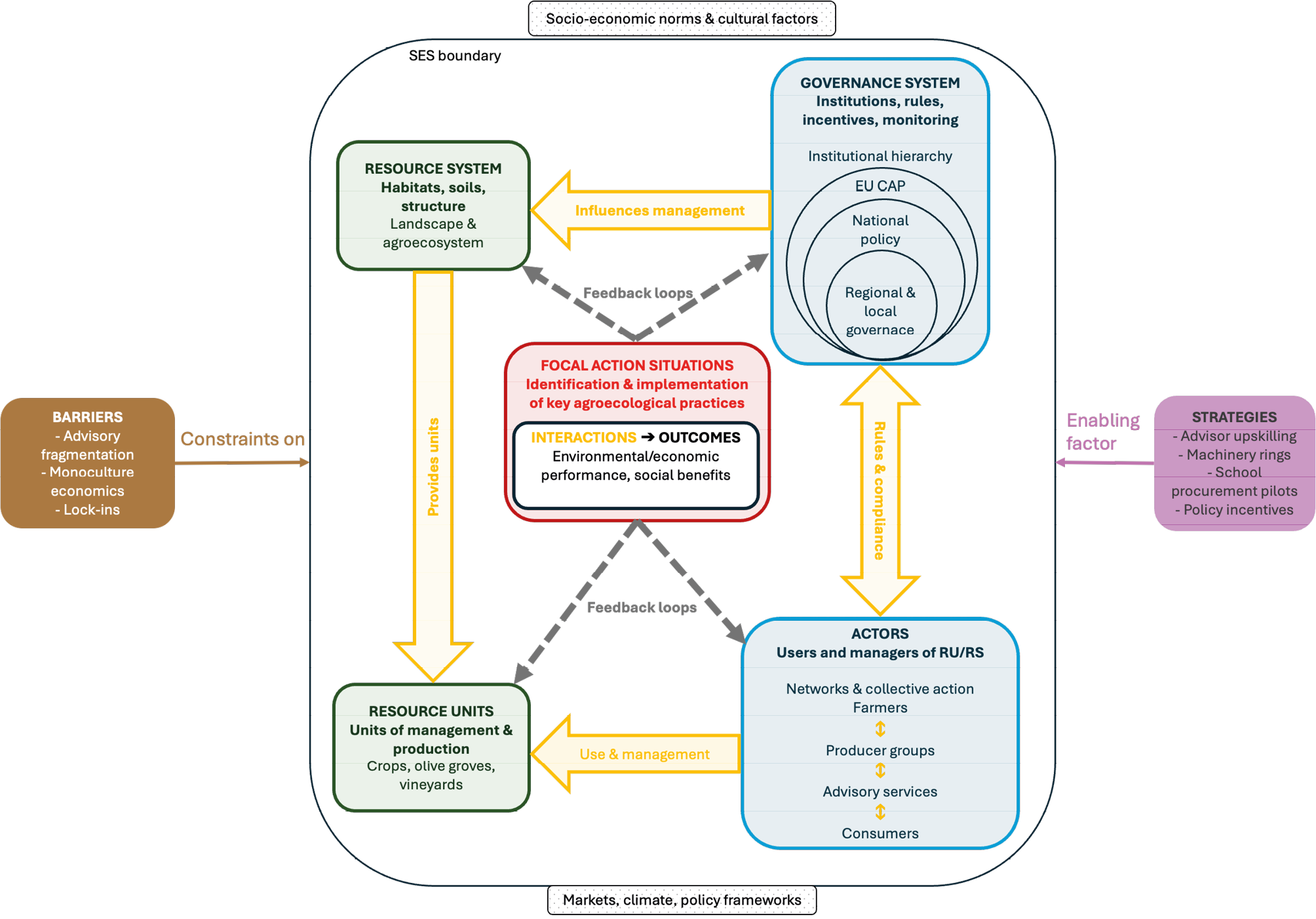
The analysis presented in this section focuses on actor-mediated dynamics across the SES, in line with the four propositions presented in Section 2.2. Table A.2 supports this analysis by systematising how different SES subsystems contribute to focal action situations, the interactions they enable, and the resulting outcomes, including key feedback loops, drivers, barriers, and resolution strategies at subsystem level. This section is organised around the four theoretical propositions, using the SES framework to examine how context-specific empirical patterns in the Chianti Biodistrict operationalise and substantiate these propositions.
4.1. Who mobilise the SES (P1)?
Under the SES perspective, actors and governance systems enter action situations as inputs and are themselves reshaped by outcomes, through feedback (Hinkel et al., 2015; McGinnis, Ostrom, 2014). In the Chianti Biodistrict, three actor groups (Table A.1) repeatedly activated and coordinated cross-subsystem interactions (A ↔ GS → I → O, with feedback to A and GS), thereby operationalising the conditions (P1) whereby stable cross-scale actor coalitions reshape rules-in-use and redistribute coordination capacity across the SES (Table A.2).
- –Civic leadership (the Chianti Biodistrict Association) functioned as a focal node convening organic and conventional farmers, municipalities, advisory services, and associations (environmental, organic farming, and consumer). It translated a diffuse concern towards the protection of the traditional winescape into collective decision-making (the Integrated Territorial-Economic Plan, the Organic Helpdesk, thematic working groups, and district assemblies), thus structuring deliberation, information sharing, self-organisation, and networking within focal action situations. Civic actors contributed to shifts in collective norms and coordination rules, by structuring deliberative arenas across focal action situations. These findings align with comparable territorial coalitions and civic coordination initiatives (Amblard, 2019; Blanco, 2011).
- –Public brokers (Tuscany region and municipalities) reduced coordination costs by aligning local initiatives with regional instruments (district plans and forestry rules) and by recognising the Chianti Biodistrict (2023), thereby institutionalising rules-in-use at collective/constitutional levels to support agroecology at territorial scale, in line with GS characteristics (Table A.1). These actors aligned incentives and formal recognition, modifying constitutional-level rules, reducing transaction costs and enabling new interaction patterns. This mirrors cases where multi-level governance couples incentives and rules for ecosystem services (Bennett, Gosnell, 2015).
- –Advisory and knowledge actors (local advisory service and experimental station, universities) acted as boundary spanners by integrating scientific evidence and local know-how to operationalise agroecological practices (e.g., inter-row cover, threshold-based pest control, and compost protocols), while mediating conflict and risk perceptions across heterogeneous interests (e.g., organic vs conventional farmers), similar to related research (e.g., beekeeping systems; Patel et al., 2020). The boundary-spanning role of these actors transformed actor perceptions and reduced conflict, enabling rule adoption and behavioural change across heterogeneous groups.
4.2. What changes in practice (P2)?
Focal action situations are structured towards the identification and implementation of key agroecological practices. Each focal action situation below exemplifies how governance and actor agency reconfigured RS-RU-A-GS linkages (building on subsystem characteristics; Table A.1) through iterative experimentation and coordinated adjustment, to produce outcomes and feedback (distinguishing provisioning [i.e., creating/maintaining collective goods] and appropriation [i.e., activities that subtract from a stock]; Table A.2) (Hinkel et al., 2015).
- –Inter-row cover and soil protection (centred on provisioning: RS ↔ A, with appropriation-linked co-benefits): Advisory-led demonstration and peer learning enabled site-specific grass mixes and mowing/rolling regimes, provisioning soil functions (erosion control and water retention) as a collective good at field and landscape scales. Short-term yield reductions were offset by quality gains and lower external inputs; visible ecological improvements reinforced norms and lowered perceived risk (O → A feedback), as observed for broader land-use/ecosystem services/well-being linkages (Schneider et al., 2020). Repeated cycles of demonstration and peer learning supported changes in actor mental models, which were translated into revised operational rules and reinforced practice adoption through positive ecological feedback;
- –Collective pest monitoring and decision support (GS ↔ A ↔ RU): Shared weather stations, harmonised field observations, and epidemiological bulletins replaced calendar spraying with threshold-based decisions. The local governance contributed, by co-financing infrastructure, harmonising protocols, ensuring homogeneous data processing across micro-climates, thereby enabling a reduction of pesticide pressure without compromising quality and generated a learning loop from observed efficacy to broader adoption (O → GS feedback), as shown in similar research to improve ecosystem-service governance (Bennett, Gosnell, 2015). Standardised protocols and co-financed infrastructure generated rule convergence (GS → A), enabling a shift from individual to coordinated decision rules.
- –Composting and nutrient circularity (A ↔ GS ↔ RS): Key barriers to the widespread adoption of agroecological practices (e.g., lack of composting ‘starters’, high machinery costs, and difficult labour scheduling) were addressed via machinery rings, shared composting hubs (oil-mill residues and urban green biomass), and targeted training, thereby closing nutrient loops, increasing soil carbon, reducing burning and chemical inputs, and reducing the workload for individual workers. The developed organisational arrangements and routines supported durable cooperation as shown in related research (Vallejo-Rojas et al., 2016). Shared infrastructure reduced individual costs, enabling joint assets to restructure sourcing and provisioning behaviours.
- –Recovery of olive groves and re-entry of arable/vegetable systems (GS ↔ RS/RU): Restoration costs on terraces were partially mitigated via district plans and non-productive investments. Additionally, demand-side actors created alliances with local producers, especially restaurant chefs, local caterers, school procurement pilots. This action situation intertwines RS/RU (characterised by long-term vineyard dominance and land-use simplification; Table A.1) with transformation/exchange activities (processing, school canteens, and retail), endogenising value-chain processes into agri-food-systems (Marshall, 2015) and aligns with research calling to govern cross-sectoral transformations at landscape scale (Wohlfahrt et al., 2019) and to have tourism-led collective action (Blanco, 2011). Cross-sector alliances linked value-chain incentives to land-use decisions, creating new feedback between market signals, rule adjustments, and agroecological practices.
4.3. How do actors and coalitions produce desired outcomes (P3)?
The following findings show how in the Chianti Biodistrict case study, positive ecological and institutional outcomes feed back into actor perceptions and governance arrangements through actor coalitions and rule configurations, thereby reinforcing systemic change (Table A.2).
- –Improved ecological performance: Farms adopting a broader set of agroecological practices demonstrate markedly superior environmental performance compared with those implementing only a few sustainable measures or conventional systems. In particular, they exhibit lower greenhouse gas emissions, higher soil carbon stocks, reduced toxicity, and improved soil quality. These outcomes reinforce the credibility of advisory recommendations and reduce uncertainty for more risk-averse farmers (O → A: learning feedback) (Landert et al., 2020). Positive environmental outcomes were associated with reduced perceived risks, reinforcing commitment to redesigned practices and supporting broader adoption (O → A → GS).
- –Economic/market effects: Wine, particularly PDO-labelled, continues to dominate value added, reflecting the specialised RU configuration and market structure (Table A.1). At the same time, the recovery of olive groves and the introduction of niche crops, supported by alliances with restaurant chefs, agritourism, and local farmers’ markets, have mobilised local demand (including from tourists), improved diversification margins, and justified non-productive investments. Diversification benefits and demand creation modified incentive structure, strengthening governance support for diversified systems (O → GS). These dynamics reinforce evidence on the importance of coupling governance reforms with targeted incentives and market coordination to sustain agroecology transitions (Bennett, Gosnell, 2015; Marshall, 2015).
- –Social/institutional effects: The Chianti Biodistrict assembly, the Organic Helpdesk, and thematic working groups played a central role in stabilising cooperation by codifying roles and routines, a process later reinforced by the establishment of a living lab. Regional recognition of the Chianti Biodistrict further strengthened its identity within the GS (Table A.1), unlocked access to policy instruments, and clarified its position relative to PDO wine and oil consortia as well as pre-existing territorial arrangements (e.g., the rural district). Codified roles and routines generated institutional stability, producing feedback where strengthened rules reinforced cooperation and collective agency. These findings underscore the importance of civic-public-advisory coalitions in addressing state capacity gaps and sustaining farmer-led pathways to agroecology transition (Seghezzo et al., 2020).
4.4. What has prevented redesign and how it has been addressed (P4)?
The agroecology transition in Chianti has made significant progress; however, structural and functional barriers rooted in SES subsystems (Table A.1) highlight the persistence of lock-ins despite the creation of the Chianti Biodistrict. These barriers indicate transition dynamics remain constrained, while the observed responses show how interventions contribute to realign rules, actor interactions and feedback (Table A.2).
- –Reduced diffusion of advisory capacity and fragmentation: Despite the presence of some advanced and long-established advisory services, expertise in agroecology, particularly for diversified systems, remains insufficient. Moreover, the uneven distribution of advisory services across the Chianti territory, much of which is remote, has slowed the uptake of redesigned agroecological practices. Targeted measures under the CAP Rural Development Programme (2014-2020), such as advice and training schemes, together with advisor upskilling (including facilitation skills), have been helpful so far. However, a coordination backbone to connect research and experimentation with monitoring and advisory services is still missing and strongly needed. Fragmented advisory systems weaken information-sharing rules), reducing feedback strength and slowing systemic change (A → weak I → suboptimal O; enhancing coordination recovers these pathways (GS → stronger I → improved O → feedback to GS: norms). Overcoming fragmentation also requires strengthening operational, collective, and constitutional rules-in-use and enhancing network structures and boundary-spanning roles to foster more integrated and effective knowledge flows (McGinnis, Ostrom, 2014; Patel et al., 2020);
- –Monoculture economics and path dependence: The strong branding and export orientation of Chianti PDO wine continues to bias investments towards vineyards, reinforcing economic lock-ins, associated with the specialised production and value-chain (Table A.1). To date, countermeasures primarily driven by locally based initiatives have combined demand creation (e.g., school procurement pilots, alliances with restaurant chefs, and tourism narratives) with supply-side cooperation (e.g., machinery rings and shared composting facilities) to reduce risk and transaction costs associated with diversification. Economic lock-ins reinforce existing rules and actor dependencies (RS/RU → A), but demand-side initiatives and shared infrastructures create new incentives that reconfigure subsystem interactions (A ↔ RS/RU ↔ GS). These strategies have contributed to reconfiguring interactions among actors, resource systems and units, and governance arrangements, supporting the emergence of new value chains, as documented in related studies (Schneider et al., 2020; Wohlfahrt et al., 2019).
5. Discussion
5.1. Implications
The SES analysis of the Chianti Biodistrict reveals how agroecology transitions can be embedded within territorial governance frameworks through a dynamic interplay of ecological, institutional, and social mechanisms. The empirical findings are consistent with established research directions (Ewert et al., 2023; Teixeira et al., 2018; Tittonell et al., 2020) and align with mechanisms observed in broader applications – for example, water governance and ecosystem services (Prost et al., 2023; Sachet et al., 2021; Sivini, Vitale, 2023). The transition was shaped by a systemic configuration of practices and relationships. In the Chianti Biodistrict case study, ecological strategies (e.g., interrow cover management to reduce erosion and improve soil moisture, composting hubs for oil mill residues and urban biomass to close nutrient loops, and shared pest monitoring systems that replaced calendar spraying with threshold-based decisions) were supported by inclusive decision-making processes institutionalised through tools like the Integrated Territorial-Economic Plan, thematic working groups, and the Organic Helpdesk. These mechanisms enabled coordination among farmers, municipalities, and advisory services, fostering a governance environment conducive to experimentation and learning. Food processing and exchange activities (e.g., school procurement pilots, collaborations with restaurant chefs, and agritourism) were integrated into the territorial food system, stimulating demand for diversified products and encouraging non-productive investments. Together, these mechanisms generated reinforcing feedback loops that strengthened ecological outcomes and governance adaptation. The underlying coordination and feedback logic, rather than the specific instruments, offers a replicable model for territorial agroecology.
The findings contribute to governance research in agroecology transitions by showing how and under which conditions models of civic leadership and bottom-up governance can be formalised and scaled within territorial frameworks. The Chianti Biodistrict association played a catalytic role in convening diverse stakeholders and structuring deliberative spaces that enabled inclusive planning and iterative learning (Dumont et al., 2021; van der Ploeg, 2021).
In the Chianti Biodistrict case study, public brokers, including the Region of Tuscany and local municipalities, were instrumental in embedding agroecological practices within multilevel governance structures, by institutionalising rules-in-use and aligning local initiatives with regional strategies. This exemplifies how agroecology transitions can be supported by policy coherence and administrative integration (Gliessman, 2020; Pimbert, 2025). Knowledge and advisory actors acted as boundary spanners, translating scientific evidence into actionable practices, mediating conflicts, and facilitating innovation uptake, emphasising the importance of distributed agency in SES governance (Goodrich et al., 2020; Vilas-Boas et al., 2022).
This case study advances knowledge on amplification dynamics in agroecology by empirically illustrating how governance networks can serve as engines of systemic change (Gava et al., 2025). The evolution of the system was actively shaped by actor diversity, collective agency, and the iterative adaptation of governance rules (Schiller et al., 2020; Wezel et al., 2018). Focal action situations, where actors converge to address specific resource or coordination challenges, enabled the progressive reconfiguration of subsystem variables (Williams et al., 2024).
This case study also highlights the role of feedback loops in sustaining transitions. Ecological improvements (e.g., enhanced soil conservation, pest management, and composting) reinforced social norms and reduced perceived risks, thereby influencing actor behaviour and governance adjustments (Kelinsky-Jones et al., 2023; Montenegro de Wit, 2022). These dynamics suggest that agroecology transitions are not linear but adaptive, shaped by reciprocal interactions between ecological outcomes and institutional responses across territorial contexts.
5.2. Recommendations
From a research perspective, this study reinforces the importance of methodological pluralism in assessing agroecological systems. Analysing trade-offs across environmental, social, and economic dimensions requires interdisciplinary and transdisciplinary approaches that integrate ecological science with social inquiry, especially by implementing participatory evaluation methods that promote social learning and stakeholder inclusion (Cruz et al., 2023; Rega et al., 2022; Schwarz et al., 2021b).
Capacity building from individual farmers to institutional frameworks emerges as a condition for sustaining agroecology transitions, to ensure that innovations are demand-driven, context-sensitive, and socially embedded. Strengthening advisory services, enhancing facilitation skills, and bridging the gap between research and practice are pivotal for overcoming fragmentation and addressing systemic lock-ins (Gutiérrez Cano et al., 2023; Helenius et al., 2020).
From a policy perspective, the Chianti Biodistrict experience underscores the need for public frameworks that can actively catalyse and amplify agroecology transitions. This involves better reorienting of public spending towards public goods, including advisory services, rural infrastructure, and participatory research (Fiore et al., 2024). Flexible, stakeholder-driven policy frameworks are essential to support adaptive management and the co-evolution of practices and institutions, particularly in contexts marked by uncertainty and diverse actor interests (Conway, 2023). The findings of this study support previous research by emphasising how targeted incentives; strategic planning; and coalitions among civic, public, and advisory actors can compensate for state capacity limitations and foster transitions that are both inclusive and resilient (Runhaar, 2021; Schoonhoven, Runhaar, 2018). This case study further highlights that procurement reforms, strengthened advisory systems, and cooperation-based investments (e.g., machinery rings, composting hubs, and shared monitoring infrastructures) can play an important role in addressing structural lock-ins. Enhancing coordination between policy instruments, local governance bodies, and producer organisations is critical for aligning incentives with ecological objectives. Territorial-level policy frameworks that bridge public-private initiatives, reduce administrative burdens, and encourage diversified value chains emerge as essential levers for accelerating agroecology transition in similar contexts.
5.3. Theoretical and critical assessment
This research supports analytical generalisation along four theoretical propositions and clarifies the conditions under which the biodistrict model can work in other territorial agroecology contexts:
- –P1 – Stable civic-public-advisory coalitions can act as mobilisation structures shaping rules-in-use and coordinating collective action.
- –P2 – Focal action situations exist that allow actors to redesign RS-RU-A-GS linkages through experimentation and shared learning.
- –P3 – Ecological and institutional feedback is visible enough to reinforce norms, lower perceived risks, and stabilise adoption.
- –P4 – Efforts to overcome structural lock-ins combine strengthened knowledge systems with territorial economic incentives.
Together, these conditions highlight when the mechanisms observed in the Chianti ‘region’ are transferable, thus transforming the case study into a generalisable theoretical contribution on SES-mediated agroecology transitions.
In this study, the qualitative application of the SES framework offers contextual depth and a nuanced understanding of governance dynamics within a single case study. Theoretical grounding supports the generation of insights that are broadly relevant for research and policy; however, this design may limit straightforward generalisation beyond the Chianti Biodistrict. Although focusing only on this biodistrict enables an in-depth exploration of underlying mechanisms, this approach limits the examination of variability across contexts and the identification of amplification dynamics under different socio-ecological conditions. Addressing these limitations would require comparative designs, such as multiple case studies or counterfactual analysis with similar agroecological territories.
The use of the SES framework as both an analytical lens and a boundary object proved effective, but its applicability is not universal. In Chianti, actors were already accustomed to co-creation practices and collaborative research, which facilitated shared understanding and participatory engagement. In less-prepared contexts, additional capacity building would likely be necessary to implement a similar research design and participatory strategy effectively.
Reliance on purposive sampling and expert interviews (through the MAP), while suitable for capturing diverse perspectives, may introduce potential biases related to actor positionality, differential visibility or influence within governance networks, and uneven knowledge distribution across SES subsystems. To mitigate these risks, the respondents were invited to contribute only on variables matching their expertise and were given time to consult documentation. The research team systematically triangulated perspectives emerging from participatory activities with independent data sources generated within the same project, helping to balance dominant narratives and cross-check interpretations. Asynchronous refinement further aimed at reducing recall bias and ensuring accuracy. Despite these mitigation strategies, some degree of perspective bias cannot be fully excluded.
While the sample includes both male and female respondents, this study did not explicitly incorporate gender aspects within the SES framework, with potential gendered dynamics influencing actor agency, governance interactions, or the co-production of agroecological practices remaining outside the scope of the analysis. Recent research has shown that gender equity is a key element in agroecology transitions and that women can play strategic roles in initiating and sustaining territorial innovations (Vizuete et al., 2025). Future (SES-based) research on agroecology transitions would benefit from integrating gendered perspectives to capture how differentiated roles and power relations shape governance and co-creation dynamics, and from comparative analyses of territories where women and other vulnerable groups hold varying degrees of agency to better understand their influence on transition trajectories.
6. Conclusions
This study advances the theoretical understanding of agroecology transitions by operationalising the SES framework within a specialised, market-oriented viticultural system. The analysis identifies four interconnected mechanisms linked to theoretical propositions underpinning systemic change: (i) the mobilisation of civic-public-advisory coalitions that activate and reshape rules-in-use (P1); (ii) the reconfiguration of RS-RU-A-GS linkages through focal action situations that structure practice redesign (P2); (iii) reinforcing ecological, behavioural, and institutional feedback loops that stabilise emerging trajectories (P3); and (iv) the mitigation of structural lock-ins through combined improvements in knowledge systems, coordination capacity and territorial incentives (P4). These mechanisms support analytically generalisable insights suggesting when territorial agroecology transitions, sustained by biodistrict-like initiatives, are likely to succeed. Transferability depends on the presence of stable multi-actor coalitions, institutional spaces for coordinated redesign, visible ecological feedback that can lower perceived risks, and governance capacity to mitigate structural lock-ins. Under these enabling conditions, biodistrict-like governance models can act as institutional innovations capable of orchestrating social-ecological reconfiguration beyond their original context. The findings also clarify how territorially anchored governance innovations can concretely support the Farm to Fork ambition by enabling the amplification of agroecology across the European Union. Finally, this study aligns with and contributes to advancing the European Strategic Research and Innovation Agenda for Agroecology by providing a real-world, scalable and place-based illustration of systemic transformation grounded in socio-ecological mechanisms and enabling conditions.
Acknowledgements and Funding
This work was supported by Horizon 2020, the European Union’s research and innovation funding programme from 2014 to 2020 (UNISECO– ‘Understanding & improving the sustainability of agroecological farming systems in the EU’, Grant Agreement No. 773901).
The funder had no role in study design, data collection and analysis, decision to publish, or preparation of the manuscript. The authors thank all stakeholders in the case study level activities for their contributions. The authors also thank the anonymous reviewers for insightful recommendations to improve the quality and scientific contribution of the article.
Author Contributions
The two authors Oriana Gava (OG) and Francesco Vanni contributed equally to this work.
References
Aguilera E., Díaz-Gaona C., García-Laureano R., Reyes-Palomo C., Guzmán G.I., Ortolani L., Sánchez-Rodríguez M., Rodríguez-Estévez V. (2020). Agroecology for adaptation to climate change and resource depletion in the Mediterranean region. A review. Agricultural Systems, 181: 102809. DOI: https://doi.org/10.1016/j.agsy.2020.102809.
Alarcon M., Marty P., Prévot A.C. (2020). Caring for vineyards: transforming farmer–vine relations and practices in viticulture French farms. Journal of Rural Studies, 80: 160-170. DOI: https://doi.org/10.1016/j.jrurstud.2020.08.029.
Amblard L. (2019). Collective action for water quality management in agriculture: the case of drinking water source protection in France. Global Environmental Change, 58: 101970. DOI: https://doi.org/10.1016/j.gloenvcha.2019.101970.
Angeon V., Casagrande M., Navarrete M., Sabatier R. (2024). A conceptual framework linking ecosystem services, socio-ecological systems and socio-technical systems to understand the relational and spatial dynamics of the reduction of pesticide use in agrifood systems. Agricultural Systems, 213: 103810. DOI: https://doi.org/10.1016/j.agsy.2023.103810.
Assiri M., Barone V., Silvestri F., Tassinari M. (2021). Planning sustainable development of local productive systems: a methodological approach for the analytical identification of ecoregions. Journal of Cleaner Production, 287: 125006. DOI: https://doi.org/10.1016/j.jclepro.2020.125006.
Basurto X., Gelcich S., Ostrom E. (2013). The social–ecological system framework as a knowledge classificatory system for benthic small-scale fisheries. Global Environmental Change, 23(6): 1366-1380. DOI: https://doi.org/10.1016/j.gloenvcha.2013.08.001.
Bellon S., Ollivier G. (2018). Institutionalizing agroecology in France: social circulation changes the meaning of an idea. Sustainability, 10(5): 1380. DOI: https://doi.org/10.3390/su10051380.
Bennett D.E., Gosnell H. (2015). Integrating multiple perspectives on payments for ecosystem services through a social–ecological systems framework. Ecological Economics, 116: 172-181. DOI: https://doi.org/10.1016/j.ecolecon.2015.04.019.
Biodistretto del Chianti (2022). Distretto Biologico del Chianti, Biodistretto del Chianti, Chianti. https://www.biodistrettodelchianti.it/wp-content/uploads/2025/08/DistrettoBiologicoChianti_13122022.pdf.
Blanco E. (2011). A social-ecological approach to voluntary environmental initiatives: the case of nature-based tourism. Policy Sciences, 44(1): 35-52. DOI: https://doi.org/10.1007/s11077-010-9121-3.
Blesh J., Mehrabi Z., Wittman H., James D., Madsen S., Smith O.M., Snapp S., Stratton A.E., Bakarr M., Bicksler A.J., Galt R., Garibaldi L.A., Gemmill-Herren B., Grass I., Isaac M.E., John I., Jones S.K., Kennedy C.M., Kremen C. (2023). Against the odds: network and institutional pathways enabling agricultural diversification. One Earth, 6(5): 479-491. DOI: https://doi.org/10.1016/j.oneear.2023.03.004.
Brunori G., Rossi A. (2007). Differentiating countryside: social representations and governance patterns in rural areas with high social density: the case of Chianti, Italy. Journal of Rural Studies, 23(2): 183-205. DOI: https://doi.org/10.1016/j.jrurstud.2006.10.001.
Campbell B.M., Beare D.J., Bennett E.M., Hall-Spencer J.M., Ingram J.S.I., Jaramillo F., Ortiz R., Ramankutty N., Sayer J.A., Shindell D. (2017). Agriculture production as a major driver of the Earth system exceeding planetary boundaries. Ecology and Society, 22(4). DOI: https://doi.org/10.5751/ES-09595-220408.
Conway T.M. (2023). An agroecological turn in intermediating sustainability transitions with continuous living cover. Frontiers in Sustainable Food Systems, 7. DOI: https://doi.org/10.3389/fsufs.2023.1009195.
Cruz J.L., Hewitt R.J., Hernández-Jiménez V. (2023). Can public food procurement drive agroecological transitions? Pathways and barriers to sustainable food procurement in higher education institutions in Spain. Agroecology and Sustainable Food Systems, 47(10): 1488-1511. DOI: https://doi.org/10.1080/21683565.2023.2248917.
Dara Guccione G., Vigano L., Sturla A., Vaccaro A., Colombo L., Pirelli T., Varia F. (2024). Insights into the agroecological transition: the case of two Italian bio-districts. Italian Review of Agricultural Economics, 79(1): 97-111. DOI: https://doi.org/10.36253/rea-14241.
Dax T., Schroll K., Machold I., Derszniak-Noirjean M., Schuh B., Gaupp-Berghausen M. (2021). Land abandonment in mountain areas of the EU: an inevitable side effect of farming modernization and neglected threat to sustainable land use. Land, 10(6): 591. DOI: https://doi.org/10.3390/land10060591.
Debolini M., Marraccini E., Dubeuf J.P., Geijzendorffer I.R., Guerra C., Simon M., Targetti S., Napoléone C. (2018). Land and farming system dynamics and their drivers in the Mediterranean Basin. Land Use Policy, 75: 702-710. DOI: https://doi.org/10.1016/j.landusepol.2017.07.010.
Dias R.S., Costa D.V.T.A., Correia H.E., Costa C.A. (2021). Building bio-districts or eco-regions: participative processes supported by focal groups. Agriculture, 11(6): 511. DOI: https://doi.org/10.3390/agriculture11060511.
Doblas-Miranda E., Alonso R., Arnan X., Bermejo V., Brotons L., de las Heras. J., Estiarte M., Hódar J.A., Llorens P., Lloret F., López-Serrano F.R., Martínez-Vilalta J., Moya D., Peñuelas J., Pino J., Rodrigo A., Roura-Pascual N., Valladares F., Vilà M., Retana J. (2017). A review of the combination among global change factors in forests, shrublands and pastures of the Mediterranean region: beyond drought effects. Global and Planetary Change, 148: 42-54. DOI: https://doi.org/10.1016/j.gloplacha.2016.11.012.
Dumont A.M., Wartenberg A.C., Baret P.V. (2021). Bridging the gap between the agroecological ideal and its implementation into practice. A review. Agronomy for Sustainable Development, 41(3): 32. DOI: https://doi.org/10.1007/s13593-021-00666-3.
Eelderink M., Vervoort J., van Laerhoven F. (2020). Using participatory action research to operationalize critical systems thinking in social-ecological systems. Ecology and Society, 25(1). DOI: https://doi.org/10.5751/ES-11369-250116.
El Bilali H. (2019). Research on agro-food sustainability transitions: a systematic review of research themes and an analysis of research gaps. Journal of Cleaner Production, 221: 353-364. DOI: https://doi.org/10.1016/j.jclepro.2019.02.232.
Ewert F., Baatz R., Finger R. (2023). Agroecology for a Sustainable Agriculture and Food System: From Local Solutions to Large-Scale Adoption. Annual Review of Resource Economics, 15(15): 351-381. DOI: https://doi.org/10.1146/annurev-resource-102422-090105.
FAO (2017). The experience of bio-districts in Italy, Food and Agriculture Organization of the United Nations, Rome. http://www.fao.org/agroecology/database/detail/en/c/1027958/.
FAO (2018). The 10 elements of agroecology: guiding the transition to sustainable food and agricultural systems, Food and Agriculture Organization of the United Nations, Rome. http://www.fao.org/3/i9037en/I9037EN.pdf.
Fiore V., Borrello M., Carlucci D., Giannoccaro G., Russo S., Stempfle S., Roselli L. (2024). The socio-economic issues of agroecology: a scoping review. Agricultural and Food Economics, 12(1): 16. DOI: https://doi.org/10.1186/s40100-024-00311-z.
Gaba S., Bretagnolle V. (2020). Social–ecological experiments to foster agroecological transition. People and Nature, 2(2): 317-327. DOI: https://doi.org/10.1002/pan3.10078.
Galioto F., Gava O., Povellato A., Vanni F. (2021). Innovative market and policy instruments to promote the agro-ecological transition strategies, UNISECO Deliverable 5.4. DOI: https://doi.org/10.5281/zenodo.5578065.
Gava O., Vanni F., Schwarz G., Guisepelli E., Vincent A., Prazan J., Weisshaidinger R., Frick R., Hrabalová A., Carolus J., Yoldi U.I., Pyysiäinen J., Smyrniotopoulou A., Vlahos G., Balázs K., Szilágyi A.J., Jegelevičius G., Mikšytė E., Zilans A., Povellato A. (2025). Governance networks for agroecology transitions in rural Europe. Journal of Rural Studies, 114: 103482. DOI: https://doi.org/10.1016/j.jrurstud.2024.103482.
Gliessman S.R. (2020). Transforming food and agriculture systems with agroecology. Agriculture and Human Values, 37(3): 547-548. DOI: https://doi.org/10.1007/s10460-020-10058-0.
Goodrich K.A., Sjostrom K.D., Vaughan C., Bednarek A., Lemos M.C. (2020). Who are boundary spanners and how can we support them in making knowledge more actionable in sustainability fields? Current Opinion in Environmental Sustainability, 42: 45-51. DOI: https://doi.org/10.1016/j.cosust.2020.01.001.
Guareschi M., Maccari M., Sciurano J.P., Arfini F., Pronti A. (2020). A methodological approach to upscale toward an agroecology system in EU-LAFSs: the case of the Parma bio-district. Sustainability, 12(13): 5398. DOI: https://doi.org/10.3390/su12135398.
Guisepelli E., Fleury P., Vincent A., Aalders I., Prazan J., Vanni F. (2018). Adapted SES framework for AEFS and guidelines for assessing sustainability of agricultural systems in Europe, UNISECO Deliverable D2.1. DOI: https://doi.org/10.5281/zenodo.4568477.
Gutiérrez Cano L.F., Zartha Sossa J.W., Orozco Mendoza G.L., Suárez Guzmán L.M., Agudelo Tapasco D.A., Quintero Saavedra J.I. (2023). Agricultural innovation system: analysis from the subsystems of R&D, training, extension, and sustainability. Frontiers in Sustainable Food Systems, 7. DOI: https://doi.org/10.3389/fsufs.2023.1176366.
Helenius J., Hagolani-Albov S.E., Koppelmäki K. (2020). Co-creating agroecological symbioses (AES) for sustainable food system networks. Frontiers in Sustainable Food Systems, 4. DOI: https://doi.org/10.3389/fsufs.2020.588715.
Hertz T., Schlüter M. (2015). The SES-framework as boundary object to address theory orientation in social–ecological system research: the SES-TheOr approach. Ecological Economics, 116: 12-24. DOI: https://doi.org/10.1016/j.ecolecon.2015.03.022.
Hinkel J., Cox M., Schlüter M., Binder C., Falk T. (2015). A diagnostic procedure for applying the social-ecological systems framework in diverse cases. Ecology and Society, 20(1). DOI: https://doi.org/10.5751/ES-07023-200132.
Hoegh-Guldberg O., Jacob D., Taylor M., Bindi M., Brown S., Camilloni I., Diedhiou A., Djalante R., Ebi K.L., Engelbrecht F., Guiot J., Hijioka Y., Mehrotra S., Payne A., Seneviratne S.I., Thomas A., Warren R., Zhou G. (2018). Impacts of 1.5°C global warming on natural and human systems. In Masson-Delmotte V., Zhai P., Pörtner H.O., Roberts D., Skea J., Shukla P.R., Pirani A., Moufouma-Okia W., Péan C., Pidcock R., Connors S., Matthews J.B.R., Chen Y., Zhou X., Gomis M.I., Lonnoy E., Maycock T., Tignor M., Waterfield T. (eds.) Global Warming of 1.5°C. An IPCC Special Report on the impacts of global warming of 1.5°C above pre-industrial levels and related global greenhouse gas emission pathways, in the context of strengthening the global response to the threat of climate change, sustainable development, and efforts to eradicate poverty IPCC, Cambridge University Press, Cambridge, UK and New York, NY, USA, pp. 175-312. DOI: https://doi.org/10.1017/9781009157940.005.
Horlings L.G., Marsden T.K. (2011). Towards the real green revolution? exploring the conceptual dimensions of a new ecological modernisation of agriculture that could ‘feed the world’. Global Environmental Change, 21(2): 441-452. DOI: https://doi.org/10.1016/j.gloenvcha.2011.01.004.
Ingram J. (2017). Perspective: look beyond production. Nature, 544(7651): S17. DOI: https://doi.org/10.1038/544S17a.
IN.N.E.R. (2021). Brochure INNER English, International Network of Eco Regions, Ceraso. https://www.ecoregion.info/research/.
Jia X. (2021). Agro-food innovation and sustainability transition: a conceptual synthesis. Sustainability, 13(12): 6897. DOI: https://doi.org/10.3390/su13126897.
Kelinsky-Jones L.R., Niewolny K.L., Stephenson M.O. (2023). Building agroecological traction: engaging discourse, the imaginary, and critical praxis for food system transformation. Frontiers in Sustainable Food Systems, 7. DOI: https://doi.org/10.3389/fsufs.2023.1128430.
Lachman D.A. (2013). A survey and review of approaches to study transitions. Energy Policy, 58: 269-276. DOI: https://doi.org/10.1016/j.enpol.2013.03.013.
Laforge J.M.L., Dale B., Levkoe C.Z., Ahmed F. (2021). The future of agroecology in Canada: embracing the politics of food sovereignty. Journal of Rural Studies, 81: 194-202. DOI: https://doi.org/10.1016/j.jrurstud.2020.10.025.
Lamine C., Pugliese P., Barataud F., Berti G., Rossi A. (2023). Italian biodistricts and French territorial food projects: How science-policy-experience interplays shape the framings of transitions towards sustainable territorial food systems. Frontiers in Sustainable Food Systems, 7. DOI: https://doi.org/10.3389/fsufs.2023.1223270.
Landert J., Pfeifer C., Carolus J., Albanito F., Müller A., Baumgart L., Blockeel J., Schwarz G., Weisshaidinger R., Bartel-Kratochvil R., Hollaus A., Hrabalová A., Helin J., Aakkula J., Svels K., Guisepelli E., Fleury P., Vincent A., Smyrniotopoulou A., Vlahos G., Iordanidis Y., Szilágyi A., Podmaniczky L., Balázs K., Galioto F., Longhitano D., Rossignolo L., Povellato A., Zīlāns A., Jegelevičius G., Frățilă M., Iragui Yoldi U., Astrain Massa C., Bienzobas Adrian J., Resare Sahlin KRöös E., Frick R., Bircher R., Aalders I., Irvine K., Kyle C., Miller D., Sanders J., Smith P. (2019). Report on Environmental, Economic and Social Performance of Current AEFS, and Comparison to Conventional Baseline, UNISECO Deliverable D3.1. DOI: https://doi.org/10.5281/zenodo.3625681.
Landert J., Pfeifer C., Carolus J.F. (2020). Assessing agro-ecological practices using a combination of three sustainability assessment tools. Landbauforschung: Journal of Sustainable and Organic Agricultural Systems, 70(2): 129-144. DOI: https://doi.org/10.3220/LBF1612794225000.
Loconto A., Poisot A.S., Santacoloma P. (2017). Sustainable practices, sustainable markets? Institutional innovations in agri-food system. In Elzen B., Augustyn A.M., Barbier M., van Mierlo B. (eds.) AgroEcological Transitions: Changes and Breakthroughs in the Making, p.176-191. Wageningen University & Research, Wageningen. DOI: https://doi.org/10.18174/407609.
Long T.B., Blok V., Coninx I. (2016). Barriers to the adoption and diffusion of technological innovations for climate-smart agriculture in Europe: Evidence from the Netherlands, France, Switzerland and Italy. Journal of Cleaner Production, 112: 9-21. DOI: https://doi.org/10.1016/j.jclepro.2015.06.044.
Loorbach D., Frantzeskaki N., Avelino F. (2017). Sustainability transitions research: transforming science and practice for societal change. Annual Review of Environment and Resources, 42(1): 599-626. DOI: https://doi.org/10.1146/annurev-environ-102014-021340.
Madureira L., Torre A. (2019). Innovation processes in rural areas. Regional Science Policy & Practice, 11(2): 213-218. DOI: https://doi.org/10.1111/rsp3.12215.
Marshall G.R. (2015). A social-ecological systems framework for food systems research: Accommodating transformation systems and their products. International Journal of the Commons, 9(2): 881. DOI: https://doi.org/10.18352/ijc.587.
McDermott R. (2023). On the scientific study of small samples: Challenges confronting quantitative and qualitative methodologies. The Leadership Quarterly, 34(3): 101675. DOI: https://doi.org/10.1016/j.leaqua.2023.101675.
McGinnis M.D., Ostrom E. (2014). Social-ecological system framework: initial changes and continuing challenges. Ecology and Society, 19(2): art30. DOI: https://doi.org/10.5751/ES-06387-190230.
Méndez V.E., Bacon C.M., Cohen R., Gliessman S.R. (eds) (2016). Agroecology: A Transdisciplinary, Participatory and Action-Oriented Approach. CRC Press, Baco Raton, FL.
Montenegro de Wit M. (2022). Can agroecology and CRISPR mix? The politics of complementarity and moving toward technology sovereignty. Agriculture and Human Values, 39(2): 733-755. DOI: https://doi.org/10.1007/s10460-021-10284-0.
Mrabet R., Savé R., Toreti A., Caiola N., Chentouf M., Llasat M.C., Mohamed A.A.A., Santeramo F.G., Sanz-Cobena A., Tsikliras A. (2020). Food. In Cramer W., Guiot J., Marini K. (eds) Climate and Environmental Change in the Mediterranean Basin – Current Situation and Risks for the Future. First Mediterranean Assessment Report (pp. 237-264). Union for the Mediterranean, Plan Bleu, UNEP/MAP, Marseille, France. ISBN 978-2-9577416-0-1.
Ollivier G., Magda D., Mazé A., Plumecocq G., Lamine C. (2018). Agroecological transitions: What can sustainability transition frameworks teach us? An ontological and empirical analysis. Ecology and Society, 23(2): art5. DOI: https://doi.org/10.5751/ES-09952-230205.
Ostrom E. (2009). A general framework for analyzing sustainability of social-ecological systems. Science, 325(5939): 419-422. DOI: https://doi.org/10.1126/science.1172133.
Ostrom E. (2011). Background on the institutional analysis and development framework. Policy Studies Journal, 39(1): 7-27. DOI: https://doi.org/10.1111/j.1541-0072.2010.00394.x.
Padró R., Tello E., Marco I., Olarieta J.R., Grasa M.M., Font C. (2020). Modelling the scaling up of sustainable farming into agroecology territories: potentials and bottlenecks at the landscape level in a Mediterranean case study. Journal of Cleaner Production, 275: 124043. DOI: https://doi.org/10.1016/j.jclepro.2020.124043.
Partelow S. (2018). A review of the social-ecological systems framework: applications, methods, modifications, and challenges. Ecology and Society, 23(4): art36. DOI: https://doi.org/10.5751/ES-10594-230436.
Patel V., Biggs E., Pauli N., Boruff B. (2020). Using a social-ecological system approach to enhance understanding of structural interconnectivities within the beekeeping industry for sustainable decision making. Ecology and Society, 25(2): art24. DOI: https://doi.org/10.5751/ES-11639-250224.
Pimbert M.P. (2025). Financing agroecological transformations for territorial agri-food systems: Beyond the myth of financial scarcity. Elementa: Science of the Anthropocene, 13(1): 00026. DOI: https://doi.org/10.1525/elementa.2025.00026.
Pomponi T., Carillo F., Henke R., Sturla A., Del Giudice T., Sorrentino A. (2026). Biodistricts as social innovation: territorial implications in Italy. Journal of Rural Studies, 121: 103926. DOI: https://doi.org/10.1016/j.jrurstud.2025.103926.
Poponi S., Arcese G., Mosconi E.M., Pacchera F., Martucci O., Elmo G.C. (2021). Multi-actor governance for a circular economy in the agri-food sector: Bio-districts. Sustainability, 13(9): 4718. DOI: https://doi.org/10.3390/su13094718.
Prost L., Martin G., Ballot R., Benoit M., Bergez J.E., Bockstaller C., Cerf M., Deytieux V., Hossard L., Jeuffroy M.H., Leclère M., Le Bail M., Le Gal P.Y., Loyce C., Merot A., Meynard J.M., Mignolet C., Munier-Jolain N., Novak S., Parnaudeau V., Poux X., Sabatier R., Salembier C., Scopel E., Simon S., Tchamitchian M., Toffolini Q., van der Werf H. (2023). Key research challenges to supporting farm transitions to agroecology in advanced economies. A review. Agronomy for Sustainable Development, 43(1): 11. DOI: https://doi.org/10.1007/s13593-022-00855-8.
Rega C., Thompson B., Niedermayr A., Desjeux Y., Kantelhardt J., D’Alberto R., Gouta P., Konstantidelli V., Schaller L., Latruffe L., Paracchini M.L. (2022). Uptake of ecological farming practices by EU farms: a pan-European typology. EuroChoices, 21(3): 64-71. DOI: https://doi.org/10.1111/1746-692X.12368.
Regione Toscana (2015). PIT - Piano di indirizzo territoriale con valenza di piano paesaggistico - Scheda ambito di paesaggio - Ambito 10: Chianti. Regione Toscana, Florence. https://www.regione.toscana.it/documents/10180/12604324/10_Chianti.pdf/d1bd9db6-c777-4627-8dc8-42b93ad193b8.
Ruggieri F., Coulon-Leroy C., Mazé A. (2023). How can collective action support the agroecological transition in geographical indication vineyards? Insights from the Loire Valley wine area. Sustainability, 15(12): 9371. DOI: https://doi.org/10.3390/su15129371.
Ruggieri F., Mazé A., Coulon-Leroy C. (2025). A social–ecological approach to analyse systemic changes toward agroecological practices in vineyards under geographical indications: a case study of ground cover management in the Anjou-Saumur wine area (France). OENO One, 59(4): 9295. DOI: https://doi.org/10.20870/oeno-one.2025.59.4.9295.
Runhaar H. (2021). Four critical conditions for agroecological transitions in Europe. International Journal of Agricultural Sustainability, 19(3-4): 227-233. DOI: https://doi.org/10.1080/14735903.2021.1906055.
Sachet E., Mertz O., Le Coq J.F., Cruz-Garcia G.S., Francesconi W., Bonin M., Quintero M. (2021). Agroecological transitions: A systematic review of research approaches and prospects for participatory action methods. Frontiers in Sustainable Food Systems, 5. DOI: https://doi.org/10.3389/fsufs.2021.709401.
Schermer M. (2006). Regional rural development: the formation of ecoregions in Austria. In Holt G.C., Reed M. (eds) Sociological Perspectives of Organic agriculture: From Pioneer to Policy (pp. 227-242). CABI Publishing, Wallingford. DOI: https://doi.org/10.1079/9781845930387.0227.
Schiller K., Godek W., Klerkx L., Poortvliet P.M. (2020). Nicaragua’s agroecological transition: Transformation or reconfiguration of the agri-food regime? Agroecology and Sustainable Food Systems, 44(5): 611-628. DOI: https://doi.org/10.1080/21683565.2019.1667939.
Schneider F., Feurer M., Lundsgaard-Hansen L.M., Nydegger K., Oberlack C., Zähringer J.G., Messerli P. (2020). Sustainable development under competing claims on land: three pathways between land-use changes, ecosystem services and human well-being. The European Journal of Development Research, 32(2): 316-337. DOI: https://doi.org/10.1057/s41287-020-00268-x.
Schoonhoven Y., Runhaar H. (2018). Conditions for the adoption of agro-ecological farming practices: a holistic framework illustrated with the case of almond farming in Andalusia. International Journal of Agricultural Sustainability, 16(6): 442-454. DOI: https://doi.org/10.1080/14735903.2018.1537664.
Schut M., Klerkx L., Sartas M., Lamers D., Campbell M.M., Ogbonna I., Kaushik P., Atta-Krah K., Leeuwis C. (2016). Innovation platforms: experiences with their institutional embedding in agricultural research for development. Experimental Agriculture, 52(4): 537-561. DOI: https://doi.org/10.1017/S001447971500023X.
Schwarz G., Prazan J., Landert J., Miller D., Vanni F., Carolus J., Weisshaidinger R., Bartel-Kratochvil R., Mayer A., Frick R., Hrabalová A., Linares Quero A., Iragui U., Astrain Massa C., Helin J., Huismann D., Guisepelli E., Fleury P., Vincent A., Smyrniotopoulou A., Vlahos G., Balázs K., Szilágyi A., Podmaniczky L., Gava O., Povellato A., Galioto F., Zīlāns A., Veidemane K., Gulbinas J., Jegelevičius G., Myškyté E., Frățilă M., Cazacu M., Resare Sahlin K., Röös E., Pia C., Kyle C., Irvine K., Albanito F., Smith P. (2021a). Report on key barriers of agro-ecological farming systems in Europe and co-constructed strategies, UNISECO Deliverable 3.4. DOI: https://doi.org/10.5281/zenodo.5549542.
Schwarz G., Vanni F., Miller D. (2021b). The role of transdisciplinary research in the transformation of food systems. Agricultural and Food Economics, 9(1): 35. DOI: https://doi.org/10.1186/s40100-021-00207-2.
Schwarz G., Vanni F., Miller D., Helin J., Pražan J., Albanito F., Fratila M., Galioto F., Gava O., Irvine K., Landert J., Quero A.L., Mayer A., Monteleone D., Muller A., Röös E., Smyrniotopoulou A., Vincent A., Vlahos G., Zīlāns A. (2022). Exploring sustainability implications of transitions to agroecology: A transdisciplinary perspective. EuroChoices, 21(3): 37-47. DOI: https://doi.org/10.1111/1746-692X.12377.
Seghezzo L., Huaranca L.L., Vega M.L., Jeckeln G.V., Avalos M.A., Iribarnegaray M.A., Volante J.N., Serrano F.H.M., Mastrangelo M., Sun Z., Müller D. (2020). Sustainable farmers, deficient State? Self-reported agricultural sustainability in the Argentine Chaco region. International Journal of Agricultural Sustainability, 18(6): 473-491. DOI: https://doi.org/10.1080/14735903.2020.1793645.
Sherwood S., Van Bommel S., Paredes M. (2016). Self-organization and the bypass: Re-imagining institutions for more sustainable development in agriculture and food. Agriculture, 6(4): 66. DOI: https://doi.org/10.3390/agriculture6040066.
Simoncini R. (2011). Governance objectives and instruments, ecosystem management and biodiversity conservation: The Chianti case study. Regional Environmental Change, 11(1): 29-44. DOI: https://doi.org/10.1007/s10113-010-0112-x.
Sivini S., Vitale A. (2023). Multifunctional and agroecological agriculture as pathways of generational renewal in Italian rural areas. Sustainability, 15(7): 5990. DOI: https://doi.org/10.3390/su15075990.
Stotten R., Bui S., Pugliese P., Schermer M., Lamine C. (2018). Organic values-based supply chains as a tool for territorial development: A comparative analysis of three European organic regions. The International Journal of Sociology of Agriculture and Food, 24(1). DOI: https://doi.org/10.48416/IJSAF.V24I1.120.
Sturla A (2021). Esperienze europee. In Approccio agroecologico e biodistretti. Analisi di due casi di studio. Rete Rurale Nazionale, Rete Rurale Nazionale e Ministero delle politiche agricole alimentari e forestali, Roma, Italy. ISBN 9788833851273.
Suwannadi T., Dechruksa W., Panpakdee C. (2026). Quantifying the effects of pest pressure and peer networks on pesticide purchasing decisions among Thai farmers. Sustainable Futures, 11: 101731. DOI: https://doi.org/10.1016/j.sftr.2026.101731.
Teixeira H.M., Van den Berg L., Cardoso I.M., Vermue A.J., Bianchi F.J.J.A., Peña-Claros M., Tittonell P. (2018). Understanding Farm Diversity to Promote Agroecological Transitions. Sustainability, 10(12): Article 12. DOI: https://doi.org/10.3390/su10124337.
Teschner N., Orenstein D.E. (2021). A transdisciplinary study of agroecological niches: Understanding sustainability transitions in vineyards. Agriculture and Human Values, 39: 33-45. DOI: https://doi.org/10.1007/s10460-021-10220-2.
Tittonell P. (2014). Ecological intensification of agriculture—Sustainable by nature. Current Opinion in Environmental Sustainability, 8: 53-61. DOI: https://doi.org/10.1016/j.cosust.2014.08.006.
Tittonell P., Piñeiro G., Garibaldi L.A., Dogliotti S., Olff H., Jobbagy E.G. (2020). Agroecology in large scale farming—a research agenda. Frontiers in Sustainable Food Systems, 4. DOI: https://doi.org/10.3389/fsufs.2020.584605.
Vallejo-Rojas V., Ravera F., Rivera-Ferre M.G. (2016). Developing an integrated framework to assess agri-food systems and its application in the Ecuadorian Andes. Regional Environmental Change, 16(8): 2171-2185. DOI: https://doi.org/10.1007/s10113-015-0887-x.
van der Ploeg J.D. (2021). The political economy of agroecology. The Journal of Peasant Studies, 48(2): 274-297. DOI: https://doi.org/10.1080/03066150.2020.1725489.
Vanni F., Gava O., Povellato A., Guisepelli E., Fleury P., Vincent A., Prazan J., Schwarz G., Bartel-Kratochvil R., Hollaus A., Weisshaidinger R., Frick R., Hrabalová A., Carolus J., Iragui Yoldi U., Elía Hurtado S., Pyysiäinen J., Aakkula J., Helin J., Rikkonen P., Smyrniotopoulou A., Vlahos G., Balázs K., Szilágyi A., Jegelevičius G., Mikšytė E., Zilans A., Veidemane K., Frățilă M., Röös E., Resare Sahlin K., Miller D., Kyle C., Irvine K.N., Aalders I. (2019). Governance networks supporting agro-ecological farming systems, UNISECO Deliverable 5.4. DOI: https://doi.org/10.5281/zenodo.4568422.
Vilas-Boas J., Klerkx L., Lie R. (2022). Connecting science, policy, and practice in agri-food system transformation: The role of boundary infrastructures in the evolution of Brazilian pig production. Journal of Rural Studies, 89: 171-185. DOI: https://doi.org/10.1016/j.jrurstud.2021.11.025.
Vizuete B., García-Llorente M., Pérez-Ramírez I., Oteros-Rozas E. (2025). Gender equity as a key element for agroecological transitions: Neo-rural women as managers of agroecological initiatives. People and Nature, 7(2): 449-462. DOI: https://doi.org/10.1002/pan3.10761.
Wezel A., Brives H., Casagrande M., Clément C., Dufour A., Vandenbroucke P. (2016). Agroecology territories: Places for sustainable agricultural and food systems and biodiversity conservation. Agroecology and Sustainable Food Systems, 40(2): 132-144. DOI: https://doi.org/10.1080/21683565.2015.1115799.
Wezel A., Goris M., Bruil J., Félix G., Peeters A., Bàrberi P., Bellon S., Migliorini P. (2018). Challenges and action points to amplify agroecology in Europe. Sustainability, 10(5): 1598. DOI: https://doi.org/10.3390/su10051598.
Wezel A., Herren B.G., Kerr R.B., Barrios E., Gonçalves A.L.R., Sinclair F. (2020). Agroecological principles and elements and their implications for transitioning to sustainable food systems. A review. Agronomy for Sustainable Development, 40(6): 40. DOI: https://doi.org/10.1007/s13593-020-00646-z.
Williams T.G., Bürgi M., Debonne N., Diogo V., Helfenstein J., Levers C., Mohr F., Stratton A.E., Verburg P.H. (2024). Mapping lock-ins and enabling environments for agri-food sustainability transitions in Europe. Sustainability Science, 19(4): 1221-1242. DOI: https://doi.org/10.1007/s11625-024-01480-y.
Wohlfahrt J., Ferchaud F., Gabrielle B., Godard C., Kurek B., Loyce C., Therond O. (2019). Characteristics of bioeconomy systems and sustainability issues at the territorial scale. A review. Journal of Cleaner Production, 232: 898-909. DOI: https://doi.org/10.1016/j.jclepro.2019.05.385.
Zanasi C., Basile S., Paoletti F., Pugliese P., Rota C. (2020). Design of a monitoring tool for eco-regions. Frontiers in Sustainable Food Systems, 4. DOI: https://doi.org/10.3389/fsufs.2020.536392.
Zawalińska K., Smyrniotopoulou A., Balazs K., Böhm M., Chitea M., Florian V., Fratila M., Gradziuk P., Henderson S., Irvine K., Konstantidelli V., Krupin V., Latruffe L., Mikšytė E., Miller D., Monteleone D., Polaschegg M., Schwarz G., Tzanopoulos J., Tzouramani I., Vlahos G., Wojciechowska A. (2022). Advancing the contributions of European stakeholders in farming systems to transitions to agroecology. EuroChoices, 21(3): 50-63. DOI: https://doi.org/10.1111/1746-692X.12378.
Appendix
| Subsystems (code) | Summary | Key indicators |
|---|---|---|
| Resource system (RS) | Highly specialised wine-olive system embedded in a winescape; clear boundaries (seven municipalities), large RS with vineyard dominance; strong influence of human-built structures (terraces, hedges, and fences); productivity largely shaped by PDO rules rather than farming method; long-term equilibrium marked by loss of arable/pasture, soil degradation, and predictable continuation of vineyard expansion; inputs trending down (fertilisers, pesticides) | • Total RS ≈ 71,800 ha (≈ 28,000 ha agri-food) • Vineyards ≈ 10,000 ha; olive groves ≈ 5,000 ha • >30% organic UAA • Durum wheat yields 1-2 t/ha (vs 3-4 Tuscany average) • Vineyard yields 5-7 t/ha; olive 1-1.5 t/ha • N input conv. 35-50 kg/ha; organic ≈ 30% less |
| Resource units (RU) | RU dominated by high-value PDO wine, with olive oil and niche crops as minor; RU competition: vineyards replace other uses; small revival of grains and semi-extensive livestock; economic value heavily asymmetric (wine >90% of NVA); spatial/temporal patterns strongly seasonal; marketing channels export-oriented for wine, local for minor chains | • Wine accounts for >90% of farm net value added • Grain revival <100 ha • Real estate prices >€5,000/m2 (tourism pressure) • RU labour strongly seasonal (pruning/harvest) |
| Governance system (GS) | Polycentric multi-level system (EU-region-municipalities-consortia-biodistrict); strong bottom-up governance from organic actors; rules-in-use include PDO constraints, GPP, herbicide/plastic bans, and evidence-based pest monitoring; high social capital but municipal implementation uneven; governance vision links agroecology and sustainable tourism; network needs expansion to tourism and consumer actors; recent formalisation of the biodistrict strengthens institutional mandate | • 7 municipalities, ≈ 57,000 residents • >2,000 farms (≈140 organic; ≈1,800 conventional) • Wine consortium covers ~96% of DOCG producers • Organic UAA ≈ 30%, rising • Institutional milestones: 2016 biodistrict, 2017 rural district |
| Actors (A) | Fourteen actor groups spanning farmers, municipalities, region, NGOs, consortia, advisors, and research; strong leadership by the Biodistrict Committee, winegrowers’ association, consortium, and consultants; high dependence on wine (economic dominance); mental models converging around observation-based AE (monitoring, nutrient loops) but tensions persist (precision vs diversification); missing: consumers and tourism operators | • Organic farmers ≈ 140; conventional ≈ 1,800 • Largest AE adopters ≈ 96 ha average size • Wine = >90% of income; agritourism ≈ 10% |
| Interactions (I) | Strong farmer-driven redesign: inter-row cover, composting, terraces, livestock reintegration; dense knowledge-sharing through advisory networks, assemblies, producer labs; conflicts between ICT-driven vs AE-driven pathways; investment in public procurement pilots, compost hubs, machinery rings; self-organisation central (biodistrict creation); monitoring innovations drive evidence-based pest management; lobbying by biodistrict and consortium influences regional decisions. | • 6-7 municipalities engaged; multiple MAP meetings over 4 years (UNISECO) • AE adopters reduce GHG from ~2054 → ~794 kg CO2e/ha • Beneficial invertebrates 25% → 34% with AE adoption |
| Outcomes (O) | Ecological: reduced pesticides, lower GHG, better soil carbon and nutrient cycling, and moderate biodiversity gains Social: labour shortages, high education levels, and housing pressure due to tourism Institutional: strengthened cooperation and identity via biodistrict, assemblies, and living lab Economic: diversification emerging but wine still dominant, and local chains developing |
• GHG: 2054 → 794 kg CO2e/ha along AE gradient • Carbon sequestration: -272 → -1828 kg CO2e/ha • Biodiversity (SMART): ~59%-60% • Tourism >700,000 visitors/year |
| Social, economic, and political settings | Economy strongly dependent on wine tourism; agriculture unusually important (11.5% employment vs 4% for Tuscany); demographic decline in remote areas; cultural identity centred on wine landscape; stable political context; markets dominated by wine brand; infrastructure adequate but uneven; territorial history stable except for recent biodistrict/rural district regulation | • Agriculture = 11.5% of local employment • Per capita GDP ≈ €23,400 • Population: 62,324 (1951) → 58,896 (2011) • Tourism supports 350+ firms |
| Related ecosystems (RE) | Climate change: higher temperatures (+1.4°C in summer 2019), drought, pest pressure (olive fly); pollution from agriculture, industry, and tourism; wildlife (boar, wolves) increasing crop/livestock damage; hydrology affected by abandonment and woody encroachment; cross-boundary flows of emissions and wildlife create regional-scale pressures | • Summer 2019: +1.4°C, -10% rainfall • High wildlife pressure (boar → wolf presence) • allow land up to 48% in conventional farms |
| Subsystems (code) | Contribution to focal action situations | Actor-mediated interactions | Outcomes | Feedback loops | Barriers/Drivers | Resolution strategies |
|---|---|---|---|---|---|---|
| Actors (A) | Initiate and coordinate transition actions, enabling participatory planning and knowledge co-creation | Farmers, advisors, and civic groups co-create strategies, share knowledge, and build trust networks | Adoption of agroecological practices, increased capacity, peer learning, and reduced risk | Actor networks reinforce norms, enabling collective agency and long-term commitment | Poor advisory capacity and fragmented actor engagement hinder transitions; civic engagement fosters change | Strengthened advisory services, peer learning platforms, and inclusive governance via the biodistrict |
| Governance system (GS) | Shape and support focal actions through enabling policies and institutional frameworks | Public institutions and civic associations co-design policies and coordinate multi-actor actions | Formal agreements, participatory planning, policy alignment, and institutional innovation | Governance adapts to actor agency, reinforcing enabling environments and responsiveness | Fragmented implementation and lack of coordination; regional law and civic leadership foster integration | Strategic planning, regional support, and formalisation of the biodistrict as an agroecology territory |
| Resource system (RS) | RS dynamics are central to redesign actions focused on land recovery and diversification | Actors influence land use and resource management through collective strategies and policy tools | Diversified cropping, reduced erosion, recovery of marginal land, and improved ecology | Landscape identity and economic incentives reinforce sustainable practices | Vineyard monoculture and land abandonment hinder diversification; local demand and procurement foster recovery | Diversified value chains, recovery of olive groves, and integration of agroecology into territorial planning |
| Resource units (RU) | Targeted in focal actions like inter-row cover and composting to enhance ecological outcomes | Farmers manage specific crops and livestock units with ecological practices and input substitution | Improved soil fertility, pest control, and organic production quality | Feedback from ecological performance informs farm-level decisions and practice refinement | Climate stress and pest outbreaks challenge unit-level sustainability; organic demand supports innovation | Pest monitoring, composting, and organic certification promoted through advisory and policy support |
1 In Italy, biodistricts may or may not have formal institutional recognition. Recognised biodistricts comply with National Law no. 205/2017 and its implementing Ministerial Decree (2022), which define their governance requirements, objectives, and eligibility for public support. In Tuscany, Regional Law no. 51/2019 further regulates their establishment, specifying criteria for recognition and embedding them within the regional rural development and territorial governance framework. Biodistricts without formal recognition are voluntary, self-organised initiatives created by local actors without a legal mandate, generally operating through associative structures such as organic farming organisations.