Research article
Common Agricultural Policy Strategic Plans: Smokescreens or instruments for evidence-based policymaking?
1 Biotechnical Faculty, University of Ljubljana, Slovenia
2 European Commission, Joint Research Centre (JRC), Seville, Spain
*Corresponding author. E-mail: emil.erjavec@bf.uni-lj.si
Abstract. Alongside the devolution of decision-making powers to Member States, the latest reform of the Common Agricultural Policy (CAP) introduced CAP Strategic Plans to enhance the design and implementation of increasingly complex policy objectives and to reinforce the use of evidence-based policymaking (EBPM). This paper is based on desk research, combining a comparative review of European Union (EU) regulations and programming documents, and insights from the Tools4CAP project, which conducted interviews, surveys, and focus groups across Member States. The gaps in strategic planning are evident in the weak logical connection between individual phases of CSP preparation and the weak evidence-based justification of decisions regarding the selection and design of interventions. Quantitative tools and scientific evidence were underutilised, while political-economy constraints and path dependency dominated decision-making. As a result, CAP Strategic Plans were often developed through a series of disconnected tasks, producing documents with loosely linked sections lacking overall coherence. The upcoming integration of CAP planning into broader National and Regional Partnership Plans may simplify procedures but risks weakening EBPM principles. Systematic integration of science into planning, methodology development, interdisciplinarity, and better communication between researchers and decision-makers are needed to realise the ideal concept of EBPM. Institutional capacities for the use of evidence need to be strengthened, mandatory impact assessments and open data platforms introduced, and dialogue between science and policy enhanced. The limitations include reliance on secondary data and qualitative insights rather than detailed empirical evaluation across all Member States.
Keywords: common agricultural policy, strategic planning, policy cycle, science-policy dialogue, Multiannual Financial Framework.
JEL codes: Q1, Q18, P00.
Index
Theories of strategic planning and EBPM
3.1. Evaluation of CSPs from the perspective of EBPM
Needs assessment and priority setting
Balanced consideration of sustainability
Performance review and empirical evidence
Stakeholder involvement and policy learning
Final assessment of strategic planning quality
3.2. Future CAP strategic planning
Assessment of the new institutional arrangement from the perspective of EBPM
4.1. How can CAP strategic planning be improved?
4.2. Concluding remarks, limitations, and future research
– CAP Strategic Plans for 2023-2027 deviate significantly from EBPM principles, with weak intervention logic, limited use of quantitative tools, and strong path dependency. Most Member States favoured procedural compliance over systematic use of evidence.
– The post-2027 proposal simplifies planning but removes some EBPM elements such as SWOT analysis, potentially undermining strategic depth.
– Strengthening institutional capacity, integrating research systematically, and promoting science-policy dialogue are essential to improve CAP planning; peer learning and targeted impact assessments could bridge current gaps.
Since 1992, reforms of the Common Agricultural Policy (CAP) have gradually introduced strategic planning into the way the needs, objectives, and interventions are defined. This began in the 1990s with the introduction of programmes for rural development policy, the CAP’s second pillar (Dwyer et al., 2007), and intensified through successive reforms that progressively strengthened the intervention logic, performance orientation, and multiannual programming. The process culminated in the 2021 reform (Munch et al., 2023), which for the first time made strategic planning mandatory for both pillars of the CAP through the requirement to develop CAP Strategic Plans (CSPs). With the introduction of CSPs for the 2023-2027 period, the European Union (EU) has attempted to strengthen the evidence-based approach, to adapt it more closely to national characteristics and needs, and to improve the management of this public policy (De Castro et al., 2020; Erjavec, Rac, 2023). These ambitions are grounded in a shift towards results-based and performance-oriented policy design, drawing on the logic of results-based management (RBM) (Mayne, 2007) while aspiring to meet the principles of evidence-based policymaking (EBPM).
Regulation (EU) 2021/2115 defines the procedure for preparing CSPs. Each Member State (MS) develops its own intervention strategy based on (i) Strengths, Weaknesses, Opportunities, and Threats (SWOT) analysis and needs assessment; (ii) targets and milestones for common result indicators; (iii) the selection and design of interventions with clear links to specific objectives; and (iv) the allocation and justification of financial resources. The plans include various interventions selected from a menu of predefined types also specified in Regulation (EU) 2021/2115 (Folkeson et al., 2023). The so-called “New delivery model” of the policy is intended to be performance-based, fundamentally based on a common monitoring and evaluation framework, and supported by annual performance review and multi-year evaluation cycles consistent with the principles of RBM (Mayne, 2007).
The CSPs were developed through a comprehensive and structured dialogue with national (or even regional) stakeholders (Cagliero et al., 2022), with the European Commission playing a central role by issuing recommendations, reviewing intervention logic, and ultimately approving each plan. Ex ante evaluators were also required to assess needs assessments, prioritisation processes, data adequacy, intervention logic, and indicator setting. The European Commission synthesised its findings in recommendations published in late 2020, stressing the contribution of CSPs towards reaching Green Deal targets by setting explicit national targets, drafting effective plans by ensuring transparency and complementarity with other policies, and strengthening participation of stakeholders and civil society in both design and implementation (European Commission, 2020). According to an analysis of all draft plans (EU CAP Network, 2023), the CSPs were generally grounded in comprehensive data analysis, demonstrated relatively logical needs prioritisation, aligned interventions with identified challenges, and showed enhanced environmental ambition. However, it also revealed recurring weaknesses, including unclear needs formulations, variable coherence (internal and external), inconsistent consideration of lessons learned and Green Deal targets, gaps in intervention logic, insufficient attention to gender, data limitations, and uncertainties about simplification and the potential effectiveness of interventions.
A major issue that has arisen relates to the quality of CAP strategic planning and how it can be improved. In this context, we understand the notion of “quality” of strategic planning in public policy in accordance with EBPM. This multidimensional concept includes effectiveness, coherence, evidence-based design, stakeholder involvement, and adaptability (Cairney, Oliver, 2017; Dicks et al., 2014; Sanderson, 2002; Strydom et al., 2010). Research on strategic planning further emphasises the importance of robust need assessments, transparent prioritisation, and clear intervention logic (or logic model) as core determinants of planning quality (e.g., Bryson, 2018; Bryson et al., 2018; Howlett, Mukherjee, 2018; Mayne, 2007).
The CAP undergoes substantial revisions every seven years, typically aligned with updates to the Multiannual Financial Framework (MFF), which serves as the EU’s overarching budgetary planning instrument. The European Commission’s proposal on the MFF for the period after 2027 (European Commission, 2025a, 2025b, 2025c) also includes a significant change for the CAP. According to the proposal, strategic national planning of certain EU policies (Cohesion, Agriculture and Rural, Fisheries and Maritime, Prosperity and Security) will be combined in a single National and Regional Partnership Plan (NRPP) specific to each MS. The proposed Regulation (COM (2025) 545) would replace the existing CSP Regulation (EU 2021/2115) and integrate the CAP into the broader horizontal framework for EU budget management. The aim is to harmonise the rules for performance monitoring, the use of indicators, data reporting, policy coherence, and transparency of spending across all EU policies. This represents a major shift in CAP planning architecture, raising questions about whether integration will enhance or weaken the quality of agricultural policy planning as defined above.
Strategic planning can improve the performance of public policies by introducing structured, evidence-based, and goal-oriented approaches to policy design, implementation, and evaluation (Bryson, 2018). This is especially true for agricultural policy, which involves complex and multidisciplinary issues (El Benni et al., 2023). Yet, unlike stakeholder consultation, the inclusion of scientific research communities is not formally required in the CSP Regulation, despite the shortcomings in needs formulation, prioritisation, and intervention logic (EU CAP Network, 2023). This prompts the question: would more systematic and mandatory integration of scientific evidence improve the quality of CAP strategic planning?
This article is grounded in EBPM, a term often used in political discourse and scientific practice (Cairney, Oliver, 2017; Sanderson, 2002; Styrdom et al., 2010). Cairney (2016) argues that EBPM is better understood as an aspiration rather than a description of real-world decision-making. He highlights the intricate dynamics between science and politics and critiques the simplistic belief that scientific evidence should automatically dictate policy decisions. Politicians operate in complex environments where evidence is often not the only (or main) factor. Their decision-making is characterised by bounded rationality (Cairney, 2016). This means that they cannot process all the information available; instead, they often rely on simplifications, taking irrational shortcuts in decision-making based on emotions, ideology, and habits (cf. Howlett, Mukherjee, 2018). These well-known (e.g., Rondinelli, 1976) dynamics of public decision-making help explain where CSP preparation diverges from the rational EBPM ideal and how much improvement is realistically feasible under existing institutional and political constraints.
The aim of this paper is to evaluate the quality of CAP strategic planning, to assess how it can be improved, and to analyse the implications of the proposed post-2027 reform. We answer the following research questions:
1. How can CSPs be assessed from the perspective of EBPM, thereby contributing to a more theoretically grounded understanding of the quality of strategic planning (CSPs and EBPM)?
2. Could the institutional changes to CAP programming after 2027 proposed by the European Commission, with the CAP being placed in a common strategic and programmatic framework with other traditional policies, also mean a potential change in the quality of strategic planning and, consequently, of the CAP (the CAP and NRPP)?
We frame our methodology around the literature on EBPM, which we understand as a set of principles and practices intended to improve the quality of policy design, implementation, and evaluation. EBPM provides a useful analytical lens for assessing strategic planning because it emphasises robust problem analysis, the systematic use of evidence, and the evaluability of intervention logic. In addition, we draw on theoretical frameworks from public policy (Cairney, 2016; Cairney, Oliver, 2017), policy design (Howlett, Mukherjee, 2018), evaluation studies (Mayne, 2007; Sanderson, 2002; Weiss, 1998), and strategic management (Bryson, 2018; Johnsen, 2015) that examine how research, expertise, and analytical tools inform and shape policy decisions.
Theories of strategic planning and EBPM
The theoretical background of the practice of public-sector strategic planning encompasses a range of conceptual frameworks that explain how public institutions formulate (design), implement, and evaluate strategies to achieve policy goals (Bryson, George, 2024). Rather than a single overarching theory of strategic planning, the literature comprises several disciplinary traditions that together inform how strategic planning is understood in public governance (Howlett, Mukherjee, 2018; Johnsen, 2015). We do not presume to be exhaustive in our review.
The basic conceptual vehicle for this paper, as well as CSPs, is the basic rational-procedural planning model (Bryson, Edwards, 2017; Sanderson, 2002), which assumes that strategic planning is a linear, logical, evidence-based process of goal setting, analysis, strategy formulation, implementation, and evaluation. Bryson (2018) defines strategic planning as deliberative and disciplined. This procedural logic is also reflected in the formal regulatory requirements for CSPs (Regulation (EU) 2021/2115), which prescribe a mostly linear sequence of needs assessment, prioritisation, intervention design, and performance monitoring.
The theory of strategic management helps contextualise this process. It emphasises deliberation, stakeholder engagement, organisational effectiveness, legitimacy, and public value (Bryson, 2018). From this viewpoint, the quality of strategic planning depends not only on procedural rationality but also on the (deliberative) alignment of goals, evidence, administrative capacities, and stakeholder expectations, resulting in enhanced effectiveness of societal systems. The quality of strategic planning is important because it increases the effectiveness and efficiency of policy, reduces administrative burdens, enables better management of public funds, and strengthens trust in institutions (Poister, Streib, 1999). Strategic planning does not ensure good results (Bryson, 2018).
Evaluation studies and evidence-use scholarship clarify the role of research and analytical reasoning in strategic planning. Evaluation theorists such as Sanderson (2002) and Weiss (1998) emphasise that evidence is essential for understanding policy problems and assessing alternatives, as well as highlight the importance of articulating plausible theories of change or logic models. RBM frameworks stress the importance of linking expected outcomes to activities through result chains, reflecting an intervention’s underlying intervention logic (Mayne, 2007). These contributions reinforce the expectation that high-quality planning should rest on robust needs assessments, justified prioritisation, and explicit causal reasoning. This expectation is captured in the normative concept of EBPM, which means designing public policies based on the best available scientific evidence (Cairney, 2016).
However, EBPM is difficult to implement in the real world, and its rationalist basis has often been criticised (Cairney, 2019; Sanderson, 2002). We follow Cairney’s (2016) argument that the required type of rationality is limited in the real political-economic context. Policymakers operate under bounded rationality, political incentives, and institutional constraints, all of which limit the extent to which evidence can directly shape decisions. Political dynamics often outweigh scientific arguments, evidence is interpreted differently by different actors, and decision-makers frequently rely on heuristics due to time and capacity constraints. Therefore, the incorporation of evidence into policy requires active engagement through coalition-building and collaboration with decision-makers on the part of scientists, including translation and embedding of evidence in the political context, rather than assuming that evidence will automatically guide decisions (Sanderson, 2002).
There is no uniform definition of the quality of strategic planning in the literature. Based on the combined insights of strategic management, policy design, and evaluation scholarship, we conceptualise quality in strategic planning as the degree to which planning processes are analytically grounded (robust needs assessment), deliberatively justified (transparent prioritisation), and causally coherent (clear intervention logic). We aim to define the quality of strategic planning in alignment with the EBPM ideal, in a way that helps answer the questions posed in this article, while acknowledging the concept’s practical limitations.
Table 1 summarises the key characteristics of EBPM in agricultural policy. Each criterion is grounded in theoretical traditions and reflected in the regulatory requirements of Regulation (EU) 2021/2115. We investigate how these principles are implemented in the regulatory and implementation framework of the CSP for the 2023-2027 period.
| Principle | Description | Sources | Regulation (EU) 2021/2115 articles | ||||||||||||||||
|---|---|---|---|---|---|---|---|---|---|---|---|---|---|---|---|---|---|---|---|
| Precise definition of needs and clear long-term goals | Specific needs for public intervention are clearly defined and, where possible, quantified; priorities and objectives derive directly from these needs and specify what the policy aims to achieve. | Bryson, 2018; Howlett, Mukherjee, 2018; Johnsen, 2015; Sanderson, 2002; Weiss, 1998 | 104, 108, 109 | ||||||||||||||||
| Balanced consideration of various elements of sustainability | A diverse and balanced consideration of economic, environmental, and social aspects relevant to agricultural sustainability and the broader food system. | Howlett, 2018; Sanderson, 2002 | 6, 109 | ||||||||||||||||
| Targeted and measurable optimal measures | A clear and evidence-based intervention logic links measures to objectives; selected measures are appropriate for achieving the objectives, and their expected results and effects are measurable. | Howlett, Mukherjee, 2018; Johnson, 2015; Mayne, 2007; Weiss, 1998 | 109, 111, 112 | ||||||||||||||||
| Transparent allocation of budgetary resources for individual interventions | Financial resources are allocated transparently and in line with priorities and the long-term strategic vision, with clear justification for allocations to specific measures and objectives. | Mayne, 2007; Poister, 2010; Weiss, 1998 | 109, 112 | ||||||||||||||||
| Comprehensive performance measurement and evaluation | Specific indicators enable systematic monitoring of implementation, and continuous tracking supports timely policy adjustment in line with progress toward objectives. | Mayne, 2007; Sanderson, 2002; Weiss, 1998 | 128, 129, 134, Annex I | ||||||||||||||||
| Wide use of empirical evidence and tools | Decisions are informed by data, research, evaluations, and analytical tools that support effect assessment and the formulation of new or improved measures. | Cairney, 2016; Cairney, Oliver, 2017; Howlett, 2018; Weiss, 1998 | 104-106, 108, 109, 128-132 | ||||||||||||||||
| Broad participatory approach to strategic planning | An inclusive participatory process engages stakeholders representing diverse sustainability interests, including interest groups, experts, and public authorities, throughout all stages of agricultural policy planning. | Bryson, 2018; Howlett, Mukherjee, 2018 | 123-126 | ||||||||||||||||
| Implementation of policy cycle principles: adaptability and learning culture | Cyclical strategic planning promotes iterative learning and adaptation across all phases of the policy cycle. | Bryson, 2018; Cairney, 2016; Johnsen, 2015; Sanderson, 2002 | 132-135 | ||||||||||||||||
| Source: authors’ elaboration. | |||||||||||||||||||
The analysis is based on desk research, combining comparative analysis of legal and programming documents, interviews and online surveys with the persons involved in CSP formulation, focus groups, and the inclusion of the authors’ experience and expertise in research support for the planning of the CSP (Slovenia) for the current period (2023-2027) and the post-2027 period.
A significant portion of this information and expertise stems from the work conducted within the Tools4CAP project (Tools4CAP Consortium, 2023a, 2023b, 2024a, 2024b, 2024c). Specifically, 121 interviews across 25 MSs1 were undertaken in 2023 with stakeholders from ministries, governmental bodies, paying agencies, regional and local authorities, scientific and research institutes, consulting firms, farmer and agricultural organisations, and environmental and consumer organisations (Tools4CAP Consortium, 2023a, 2023b). The interviewees were identified through selective sampling, as the main goal was to involve knowledgeable actors who had a role in the CSP process. The main objective of these interviews was to map all the steps of the CSP design process, and the methodological tools used across the steps.
In the same year, 77 online surveys were collected in 16 MSs, involving stakeholders from scientific and research institutes, ministries, and consulting firms (Tools4CAP Consortium, 2024a). The main objective of the survey was to evaluate the methodological tools employed along the CSP design process. The participants were self-selected, as the survey was open in all MSs (translated in all EU languages) and to any type of stakeholders that were involved in the CSP process (e.g. policymakers, researchers, consultants, etc.).
Lastly, 14 national focus groups were held in 2023 in 14 MSs2, bringing together policymakers, non-governmental organisations (NGOs), agricultural representatives, environmental advocates, agricultural experts, and rural stakeholders (for the methodological details, see Tools4CAP consortium, 2024b). The focus groups were used to identify the main challenges faced during the preparation of the CSPs and ways to improve the process.
Based on this information, the Tools4CAP project produced (i) an inventory of methods and tools used during the CSP design process across MSs; (ii) a mapping of the actual CSP design process and tasks conducted by MSs, as well as main differences and commonalities among MSs; (iii) an evaluation of the employed tools in the CSP design process; and (iv) the identification of main challenges and needs to improve the CSP design process. The paper largely relies on the analysis of these outputs.
We addressed our first research question as follows:
i. desk research, specifically the results of the Tools4CAP project to date;
ii. preparation of a theoretical framework with principles and elements of assessment (Table 1);
iii. an assessment and recording of theses;
iv. verification of these theses through individual interviews and public presentations (performed twice).
Moreover, we addressed our second research question as follows:
i. analysis of MFF proposals related to CAP strategic planning (desk research, participation in public presentations, and discussions with government officials) and formulation of hypotheses;
ii. verification of theses in a round of discussions with CAP experts and state officials).
3.1. Evaluation of CSPs from the perspective of EBPM
In accordance with Regulation (EU) 2021/2115, MSs must develop CSPs that cover their national territory; ensure consistency with regional circumstances (Cagliero et al., 2022); and establish a monitoring, reporting, and evaluation system. Thus, the process of CAP strategic planning begins with programming and continues through implementation. It encompasses all activities carried out by MSs, including preparatory work, which is developing the “sound intervention logic” of the CSP (referred to in Article 109(1)(b)) and the intervention strategy (in Article 107(1)(b)) for each specific objective.
As per Regulation (EU) 2021/2115, the development of the CSP involves specific tasks, including socio-economic and context analysis, SWOT analysis, needs assessment, identification of measures, setting of targets, allocation of financial resources, ex-ante analysis and strategic environmental assessment (SEA), and stakeholder consultations (Figure 1).
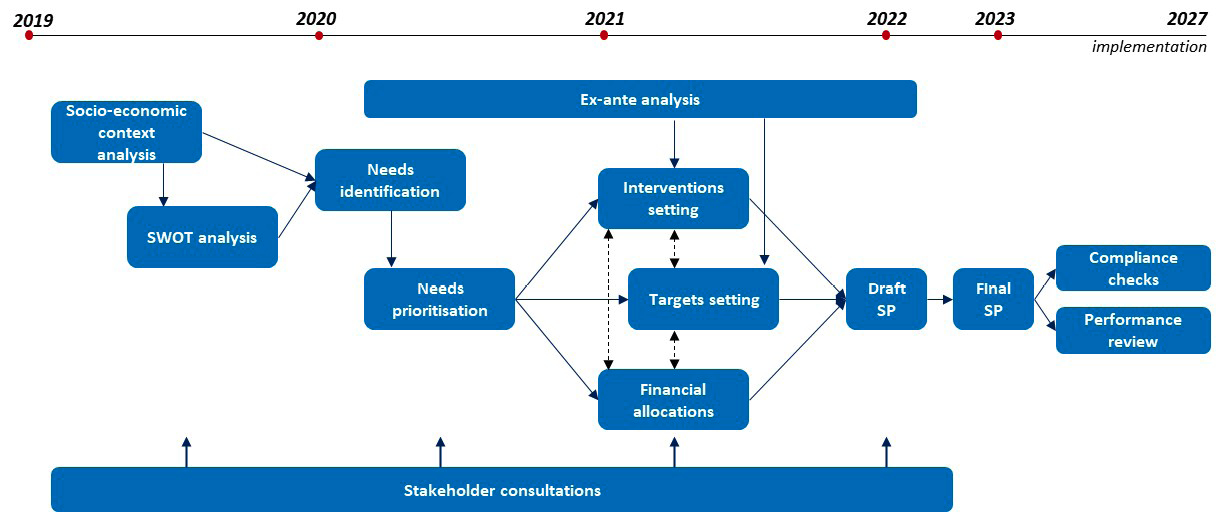
The preparation of CSPs for the current period (2023-2027) was formalised and conducted as an administrative procedure. MSs followed the procedures set out in the regulation and guidelines for individual elements (tasks or design steps) provided by the European Commission (Directorate-General for Agriculture and Rural Development [DG AGRI]). Naturally, MSs differed in organisational styles and the approaches used to complete these elements. Some sources presenting the CSP are already available (Cagliero et al., 2023; European Commission, 2023a; European Court of Auditors, 2024; Folkeson et al., 2024; Mezzacapo, 2024; Munch et al., 2023; Runge et al., 2022). With the help of process analysis and the inclusion of CSP support tools, which was carried out in the Tools4CAP project (Tools4CAP Consortium, 2023a), we can broadly outline the common characteristics of strategic planning that allow for the assessment of deviations from the EBPM ideal.
Needs assessment and priority setting
Socio-economic analyses were very broad in scope and attempted to highlight all elements of sustainability in relation to specific CAP objectives. They mainly summarised previous research and were based on available sources. The SWOT analyses derived from them were generally broad and attempted to highlight the key challenges facing agriculture and the corresponding needs of agricultural policy at the national level (EU CAP Network, 2023). In the next step of needs prioritisation, MSs mainly relied on the specific objectives that emerged from the CAP reform at the EU level.
The comparative analysis among MSs (Tools4CAP Consortium, 2023b) revealed relevant differences in the approaches to needs assessment and prioritisations. While the interviewees considered the conducted exercise generally successful in all MSs, the identification, definition (i.e., level of detail), and method and scale of prioritisation were very different among MSs and, in certain cases, were strongly affected by arbitrary or subjective choices. The interviewees and surveyed stakeholders expressed the most concerns in relation to the representativeness of stakeholder selection, which can have huge impacts on the final outputs (Tools4CAP Consortium, 2024c).
Balanced consideration of sustainability
The balanced consideration of various elements of sustainability was implemented very differently among MSs. Most prioritised economic aspects (Munch et al., 2023), while environmental ambition varied (Runge et al., 2022). The European Commission has encouraged the strengthening of this part of the policy through alignment with the Green Deal, but without significant success (European Court of Auditors, 2024). The CSP analysis clearly revealed that the weakest link is social sustainability, which falls short, not only in the selection of interventions and the allocation of financial resources, but already at the level of conceptualising issues and needs (Organisation for Economic Co-operation and Development, 2024).
As expected, the selection and definition of interventions were the focus of strategic planning. Ring-fencing and path dependency based on previous programming periods were very evident and led to similar policy choices (Cagliero et al., 2023). Only a few countries made more radical changes to their set of measures compared with the CAP for the 2014-2022 period (see, for example, the comprehensive analyses provided in European Commission, 2023b).
The public discussion in the MSs on the CSP was thus primarily a discussion on measures (and later about the allocation of funds). The link between interventions and needs and priorities was often weak. Overarchingly, the selected interventions were linked with the objectives they were meant to pursue, but without detailed analysis on the anticipated strength of the impact, a description of the mechanisms contributing to the objectives, a discussion of possible negative or unanticipated impacts, or coherence between the interventions.
Analysis of the CSPs revealed several inconsistencies between needs prioritisation and intervention- or target-setting, or at least the logical link between the prioritised needs and chosen intervention was not made explicit (European Commission, 2023b). With rare exceptions (e.g. the Netherlands and Germany), tools such as the Intervention-Objective-Impact (IOI) matrix or Eco-Scheme modelling tools were not used to assess the potential contribution of interventions to objectives. Thus, the formulation and application of sound intervention logic, as stipulated by the Regulation (EU) 2021/2115 (Article 109(1)(b)), is certainly a weak link in ensuring coherence and effectiveness in CAP implementation.
In the preparation of strategic plans, the biggest black box is the allocation of financial resources for individual interventions. In fact, when analysing the use of scientific or other methodological tools across the different tasks by MSs (Tools4CAP Consortium, 2023b), we found that almost no MS made use of any tool (including stakeholder engagement tools) between intervention-setting and financial allocation. According to the surveyed stakeholders and focus groups participants, this could be identified as the main site of backroom politics. Proposals were mainly developed in decision-making circles and then negotiated with interest groups, other ministries, and the European Commission. Here, the level of EBPM and participation was probably at its lowest. This is the reality of the political process, which, according to Cairney (2016), cannot be avoided.
While the CSP approach makes it possible to include a precise definition of needs, the exact extent to which individual MSs succeeded in this would require further study. However, to maximise absorption of EU funds, there is a strong incentive for MSs to adapt nationally defined needs to the given “eligible” needs and specific objectives of the EU funding framework (cf. Organisation for Economic Co-ordination and Development [OECD], 2020). This kind of conversion significantly weakens the potential for constructing appropriate intervention logic, making it difficult to fulfil the requirement for “targeted and measurable optimal measures”. Thus, interventions were already largely predefined through regulation and policy lock-in (cf. Popp et al., 2021), related to the path dependency mentality of decision-makers. We can conclude that the deviation from the EBPM is most striking in the criterion “transparent allocation of budgetary resources for individual interventions”. Here, political-economic realities prevailed.
Performance review and empirical evidence
Performance planning, required as part of CAP planning for the first time, remained limited to result and output indicators. Impact indicators will only be assessed after the end of the financial period. “Comprehensive performance measurement and evaluation” were often highlighted during negotiations before the legislation was adopted as something that would jeopardise the implementation of the CAP. However, at least until 2025, it has not gone beyond being necessary solely to comply with the regulation. For example, according to the conducted interviews (Tools4CAP Consortium, 2024c), only a few MSs planned to develop improved monitoring systems.
Apart from a few MSs, consistent “use of empirical evidence and tools” in all phases of planning was not particularly prevalent (Tools4CAP Consortium, 2023a), indicating weak exploitation of the potential of research to support quality strategic planning. The results showed a wide use of various tools but very little direct use of comprehensive EBPM approaches as shown in the proposed theoretical framework. At the time of preparation, based on this analysis, only a few countries (the Netherlands, Slovenia, Ireland, Belgium – Wallonia, and Germany) used quantitative models directly in the preparation of the CSP. In addition, the use of these tools was found to be limited to a few tasks, particularly intervention setting and ex ante analysis. We also found that these quantitative models were not used to comprehensively or jointly address multiple interlinked tasks (e.g. needs prioritisation, intervention setting, and target setting), even though this approach would have ensured more consistency and a stronger intervention logic (Tools4CAP Consortium, 2023b). Thus, the evaluation of applied tools (Tools4CAP Consortium, 2024c) revealed a significant gap between the amount of available quantitative tools (i.e., already applied in science or other policies) and the level of actual implementation for the design of CSPs. This was also widely reported by focus group participants across all MSs (Tools4CAP Consortium, 2024b). Consequently, we found both a need from policymakers and an unexploited potential.
None of the responsible ministries followed the example of the European Commission in conducting a broader impact assessment, commissioning additional quantitative or qualitative studies, let alone more modern approaches to designing measures using experimental economics. However, as noted by some of the interviewed stakeholders, many of the available quantitative models for policy support require a long time for set-up, while the policymaking process usually takes much less time. This fact might signal a need to better adjust the existing models to the needs of the policymaking process and to strengthen capacity to anticipate policy needs at the MS level.
Stakeholder involvement and policy learning
The demand for applying a participatory model was transferred from rural development, where it had already been applied during previous programming periods. MSs reported a relatively high level of stakeholder inclusion during the planning process. Considering that much of the planning occurred during the coronavirus disease 2019 (COVID-19) pandemic and under its associated restrictions, it is likely that participation would have been even higher under normal circumstances. However, the specific level of engagement also depended on the local culture of dialogue between government representatives, interest groups, and industry representatives, and the complement of consulted stakeholders often consisted of the “usual” narrow group of agricultural stakeholders, reflecting a persistent EU-wide need to broaden the policy arena in this sector (cf. de la Rosa, 2010; Hepping et al., 2025; Termeer, Werkman, 2011). Furthermore, many parts of the CSPs were created mainly via interactions between state officials and the European Commission in the form of a largely bureaucratic process.
An example given by the interviewees was the trade-off between open consultation involving civil society as a whole (which would dilute real sectoral needs and inflate very general issues that are not strictly agricultural), and sectoral consultation limited to farmers and a few other stakeholders (which would omit relevant issues related, for example, to environmental impacts, animal welfare, and climate change). According to the mapping and analysis of the strategic plans conducted by the European Commission (2023b), the prioritised needs were hardly comparable among the MSs and often very general or vague. In addition, the focus group participants often indicated a lack of supporting tools to properly analyse the information gathered from stakeholders (Tools4CAP Consortium, 2024b).
It will also be necessary to wait for an assessment of the extent to which the characteristics related to policy learning are actually implemented. Considering the limited quality of EBPM, those who argue that the policy cycle is difficult to implement in real-world settings (Hudson et al., 2019) may be proven correct.
Final assessment of strategic planning quality
To summarise, the CSP preparation included several quality control elements: a formal policy framework with ring-fencing of shares for certain measures, a formal environmental assessment, the involvement of stakeholders in public consultations, and, in particular, the recommendations of the European Commission. Nevertheless, the quality of the implementation of the intervention logic, the weak link between the SWOT analysis and the setting of priorities, and the path dependency logic of distribution of funds among individual measures reveal shortcomings in the quality of strategic planning for the 2023-2027 period. Unfortunately, there are no available evaluations of the final versions of the plans (EU CAP Network, 2023).
We can conclude that the prescribed procedures and a lack of quality control or quality standards for strategic planning (especially of the elaboration of the intervention logic, path dependency, weak incorporation of evidence, and poor impact assessments, if any) limited the quality of CAP strategic planning for the 2023-2027 period. This was conditioned by various political-economy constraints, ranging from the policy lock-in to interest-driven decision-making and the related ideational rigidity of the core policy community (cf. Hepping et al., 2025), as well as all the constraints of the bureaucratic decision-making system. While this is not a surprise, these political-economy dynamics must be addressed if the quality of strategic planning is to be improved in line with EBPM in the future, if this is indeed in anyone’s interest.
3.2. Future CAP strategic planning
The European Commission’s proposal for the future CAP (2028-2034) within the MFF will also involve significant changes in the area of CAP strategic planning. The proposal merges CAP funding into a single National and Regional Partnership Plan (NRPP), which combines other traditional and large policies, such as regional, cohesion, and social policies, where MSs would independently plan measures in accordance with a common policy framework. The CAP would have its own chapter within a unified NRPP, prepared at the level of the entire government (not just agricultural ministries). This may have important implications for the need to provide a strong evidence base to substantiate agricultural policy spending, as well as from the perspective of a broader policymaking community.
The CAP strategic planning and implementation framework is defined by several new proposed regulations, notably proposed NRPF Regulation COM(2025) 565, the CAP Regulation, which determines the conditions for implementation of EU CAP support (COM(2025) 560), and the Performance Regulation, which covers budgetary expenditure tracking and performance (COM(2025) 545).
The key changes are mainly that CAP strategic planning is part of broader and comprehensive national planning and that CAP planning itself is moving towards simplification. A simple logic of strategic planning has been established, based on the setting of priorities, the selection of interventions, and results and output indicators.
Thus, the obligation to conduct a SWOT analysis – an important part of the current CSP that provides at least a minimum evidence base – has been omitted. It will be replaced by a European Commission steering mechanism, under which the European Commission will try to help define the need for intervention and maintain the common EU policy framework. The new proposal introduces a new set of objectives for the CAP, which are outlined less precisely than those in the existing CSP regulation (Regulation (EU) 2021/2115). Moreover, other elements that strengthen EBPM are not highlighted. The text of the proposals for new legislation does not include specification of SMART objectives, “ambitious targets”, or intervention logic. The Performance Regulation is mostly about tracking and monitoring expenditure, but says nothing about how the NRPP (or the CAP subchapter) should be drawn up. The requirement for targets is shifted from result indicators to output indicators, which in turn are linked to intervention areas rather than measures. The evaluation system is changing: no ex ante evaluation is required, but the proposed Performance Regulation (COM(2025) 545) requires that MSs carry out an evaluation of the effects of the measures supported by quantitative tools during the programming period, where appropriate.
As with cohesion policy to date, strategic planning will focus on performance-based budgeting and budgeting for results. Spending must deliver the intended results, and the government must monitor how effectively the EU budget achieves its objectives. Indicators are linked to output and result indicators, but there is no explicit mention of impact or context indicators, which are in use in the current CSPs. Another key change is the governance of CAP strategic planning. The proposals strengthen the emphasis on partnership procedures and harmonise the application of horizontal principles across all funds.
New CAP strategic planning will certainly be simpler in terms of document preparation than under the current regulations. Priorities and interventions are highlighted, as well as their connection through the intervention logic. At the same time, result and output indicators are also key, as is already the case for cohesion policy.
Assessment of the new institutional arrangement from the perspective of EBPM
Can this new system eliminate some of the shortcomings regarding the requirements of EBPM, as presented above? This is certainly not the case from a systemic and regulatory point of view. Impacts must be quantified, but only in the mid-term review. The planning system highlights individual priorities and interventions, which can improve the intervention logic (i.e., a more precise definition of objectives and more result-oriented interventions). However, there will be no requirement to provide a comprehensive view of the CAP in terms of the required definition of long-term goals; ex ante impact assessment (which is also not the case now); a comprehensive system of indicators; or a comprehensive derivation of needs, priorities, and interventions. There is still no systematic requirement for the transparent allocation of funds across measures. It appears unlikely that the logic of the policy cycle will gain greater prominence, or that strategic planning will be characterised by broad and inclusive stakeholder participation.
The notion that MSs should identify reliable indicators is questionable, given that the European Commission has already pre-selected the output and result indicators that must be used. Thus, the new strategic planning system does not seem to bring about major improvements in terms of EBPM; on the contrary, it may lose the comprehensive view of the CAP, which was a requirement of the current regulation. The new regulation does not prescribe this for the time being, and it is possible that it will focus on individual planning priorities rather than on the CAP, undermining comprehensiveness. Similarly, the proposed ring-fencing of most funds for CAP interventions will likely push for partial rather than comprehensive approaches. This is not necessarily a negative development, as it could potentially mean greater achievement of individual societal objectives, at least in environmental and social sustainability, but the needs and interventions for food system and rural areas are so multifaceted and complex that such a simplified approach could reduce the effectiveness and efficiency of the policy.
A change in the governance of strategic planning will also contribute to a change in the overall view of the CAP. Agricultural ministries no longer have sole responsibility for coordinating CAP planning and implementation. Even greater coordination between ministries will be needed, with the ministry leading the preparation of the NRPP playing a key role. This approach has the potential to induce competition for funds at the national level, but it may also stimulate MSs to target their spending better and look for synergies or complementarities in an overall reduced budget. It is also interesting to note that the process for NRPP approval is changing, as the Council of the EU takes the final decision to approve the plans.
As indicated, however, the change in governance arrangements may also contribute indirectly to a greater implementation of evidence-based policymaking. The Ministry of Agriculture will compete with other ministries for funds that are not ring-fenced, which means that it will have to improve its justification for spending, especially in areas that require cross-sectoral cooperation, such as rural development, environmental spending, knowledge transfer, and the integration of agri-food chains. Thus, while the new EU public policy planning system at the MS level brings important procedural changes that do not necessarily strengthen EBPM in regulatory terms, MSs may choose to improve the definition of their needs and interventions. We can expect that the differences in administrative capacity and cross-sectoral cooperation will strongly affect the quality of strategic planning, potentially increasing differences between countries.
It should be noted that this assessment of the CAP strategic planning for the period after 2027 is based on the European Commission’s initial proposals. Various modifications are possible during the negotiations on the future MFF. Changes may occur in terms of ring-fencing for the remaining interventions of the current CAP, such as general rural development measures, and the technical details of strategic planning and the competences of EU institutions regarding the CAP chapter in NRPP may also change.
4.1. How can CAP strategic planning be improved?
Based on our analysis, the actual implementation and quality of CAP strategic planning deviates from the ideal case of EBPM we have defined. No phase of strategic planning is optimally designed in terms of usage of data; the intervention logic is relatively weak; and, above all, the choice of measures and resources for them is often determined based on previous entitlements (path dependency), ring-fencing instruments and funding, and short-sightedly, in pursuit of political interests. This does not mean that CAP planning lacks all strategic thinking, nor can it be denied that it is improving over time. It means that current CAP strategic planning for the 2023-2027 period has a few shortcomings that reduce the effectiveness and efficiency of this public policy.
The main factors contributing to the deviation from ideal CAP strategic planning are the political reality in which it is developed, the need for decision-makers to balance different interests, many of which are entrenched and directly involved in decision-making, and the presence of equally entrenched ideational frameworks. Consequently, evidence is not always at the forefront. As Cairney (2016) points out, policies are often shaped by emotions and stories, as they are created in complex decision-making processes involving many actors, with no guarantee that evidence will reach key decision-makers at the right time.
Decision-makers in institutions such as the EU and MSs can do a lot to improve EBPM. Cairney and Oliver (2017) suggest several concrete steps that institutions can take. It is important to strengthen institutional capacities for systematic collection, evaluation, and interpretation of evidence. It is also necessary to establish mechanisms for ongoing dialogue between researchers and decision-makers, through workshops and advisory committees where scientists, officials, and stakeholders can meet. It may even be possible to develop and use “knowledge brokers”, who could serve as intermediaries between science and politics. It would also help to develop guidelines for the use of evidence in policymaking and to increase transparency by requiring the publication of evidence supporting legislative proposals. This also requires the promotion of open platforms where data are accessible to researchers and the public. Moreover, it is necessary to ensure civil servants have adequate knowledge and education so that they can understand the relevant statistics, methodologies, and research limitations, and critically assess evidence.
This endeavour mainly involves soft measures in terms of investing in science and maintaining a dialogue between scientists and decision-makers. However, it is also necessary to systematically support EBPM in EU and national regulations and implementation guidelines. The EU could prescribe impact assessments for setting priorities and selecting interventions. It could set a minimum level of data and records that a MS must include in the preparation of the CAP-related chapter (and other chapters, for that matter) of the NRPP.
At the MS level, training on strategic planning for civil servants and stakeholders should be developed and supported with public funds. As suggested by our interviewees, peer learning among MSs should also be supported through dedicated platforms, to promote the exchange and replication of best practices. MSs should also conduct or fund research that supports impact assessment and the design of new measures, studies the need for interventions, and assesses farmers’ preferences for adopting the new measures. Attention should be paid to data representing various sustainability issues, especially in the social pillar.
Quantitative analyses are crucial for establishing a causal link between a specific policy intervention and the observed changes. However, when financial resources and available time are limited, qualitative analysis of the contribution can be used to support decision-making. The combination of qualitative and quantitative analyses can significantly improve information and decision-making (Suazo-Galdames et al., 2025). Ex post analysis is a key element of policy learning, as information on the effectiveness of measures in achieving goals can and should feed into the next policy cycle.
The impact of science related to agriculture and food systems does not depend solely on the evidence provided by researchers, but also on the demands of decision-makers and practitioners, as well as on coordination between the two sides (McNie, 2007). Effective EBPM is only possible if there is a sufficient supply of evidence that aligns with the needs and expectations of those demanding it, and if the actors are interested in change. A key aspect of the demand for reliable evidence concerns the quality and availability of scientific research, which is essential for building a robust evidence base to address emerging policy challenges. This dynamic is particularly evident in the types of research questions posed within the agricultural domain.
It is important to note that relatively less involvement of quantitative tools does not mean that ministries do not use evidence-based approaches. Many MSs have commissioned targeted research through tenders or directly to research organisations. State research institutes, which exist in at least half of the MSs (e.g., Germany, France, Italy, Ireland, and most eastern-EU MSs), play a role in expert support and analysis with government services. The real challenge is how research support is systematically and comprehensively used in CAP strategic planning in terms of improving it towards evidence-based support. Strategic planning is often treated as a procedural exercise for allocating public funds, both EU and national, rather than as a meaningful process for defining clear strategies aimed at achieving specific goals based on identified needs. This is partly because such strategic depth is not explicitly required, for example through impact assessments.
4.2. Concluding remarks, limitations, and future research
Strategic planning significantly enhances public policies by introducing structured, evidence-based, and goal-oriented approaches to policy design, implementation, and evaluation. With the introduction of comprehensive strategic planning into the CAP after 2023, the necessary first step has been taken towards shaping EU agricultural policy that is more effective and more in line with social needs. Our comparison with evidence-based policymaking criteria has revealed a wide scope for further improvement in planning and, consequently, in future policy. Therefore, it is necessary to take advantage of the systemic change brought about by the integration of the CAP into single national development policy planning.
However, this is not enough to ensure greater integration of scientific principles (EBPM) and participatory approaches into planning. Decision-makers must strengthen the national and regional research infrastructure for strategic planning and reinforce research-based needs assessment. This research should focus on testing the responsiveness and behaviour of potential users when measures are being designed, developing intervention logics supported by studies, impact assessments, and strengthening monitoring. Stronger integration of different knowledge sources – research-based evidence, policy evaluators’ expertise, and stakeholders’ practical knowledge – can significantly improve strategic planning quality. Importantly, the socially relevant identification of needs and the setting of the policy agenda is a political rather than a technical matter.
There are a few limitations to this paper that must be acknowledged. Our main purpose was to highlight the opportunities for improving the quality of strategic planning that could be brought about by greater consideration of EBPM principles, potentially opening a new area of research in support of agricultural policy decision-making at the EU MS level. Hence, this paper is conceptual, based on desk research and materials from the Tools4CAP research project, which provided a rough picture of the state of strategic planning, but not a more detailed empirical insight into the differences between MSs using developed comparative indicators. New and targeted research is needed to provide more precise and structured direct insights into the quality of CAP strategic planning at the MS level. It is also important to define more precisely the tasks of different scientific disciplines and their integration, policy evaluation and its role, and the contribution of stakeholder participation, with the goal of greater implementation of EBPM in strategic planning. It would be interesting to explore how to systematically – formally and informally – support the role of knowledge and how to further strengthen the dialogue between different social actors in strategic planning.
This work received funding from the EU’s Horizon Europe Research and Innovation Programme under Grant Agreement No. 101086311 (Tools4CAP). However, the views and opinions expressed are those of the authors only and do not necessarily reflect those of the EU or the European Research Executive Agency. Neither the EU nor the granting authority can be held responsible for them.
The authors are solely responsible for the content of the paper. The views expressed are purely those of the authors and may not in any circumstances be regarded as stating an official position of the European Commission.
Conceptualization, E.E.; Methodology, E.E., D.B.C.,; Investigation, E.E., I.R, D.B.C.; Writing - Original Draft, E.E., I.R., D.B.C.; Writing –Review & Editing, I.R, D.B.C.; Funding Acquisition, E.E., I.R, D.B.C.; Resources, E.E., I.R, D.B.C.; Supervision, E.E..
Bryson J., Edwards L.H. (2017). Strategic planning in the public sector. Oxford Research Encyclopedia of Business and Management. DOI: https://doi.org/10.1093/acrefore/9780190224851.013.128.
Bryson J.M. (2018). Strategic Planning for Public and Nonprofit Organizations: A Guide to Strengthening and Sustaining Organizational Achievement (5th edition). John Wiley & Sons, Inc., Hoboken, NJ, USA.
Bryson J.M., Edwards L.H., Van Slyke D.M. (2018). Getting strategic about strategic planning research. Public Management Review, 20(3): 317-339. DOI: https://doi.org/10.1080/14719037.2017.1285111.
Bryson J.M., George B. (2024). Strategic Planning for Public and Nonprofit Organizations: A Guide to Strengthening and Sustaining Organizational Achievement (6th edition). John Wiley & Sons, Hoboken, NJ, USA.
Cagliero R., Mazzocchi G., Monteleone A., Pierangeli F., Manzoni di Chiosca P., Romano E. (2022). A participative methodology for prioritising intervention logic in the design of the Italian CAP Strategic Plan. Italian Review of Agricultural Economics, 77(3): 25-40. DOI: https://doi.org/10.36253/rea-13717.
Cagliero R., Vassallo M., Pierangeli F., Pupo D’Andrea M.R., Monteleone A., Camaione B., Tarangioli S. (2023). The Common Agricultural Policy 2023-2027. How do member states implement the new delivery model? Italian Review of Agricultural Economics, 78(1): 49-66. DOI: https://doi.org/10.36253/rea-14318.
Cairney P. (2016). The Politics of Evidence-Based Policy Making. Palgrave Macmillan UK. DOI: https://doi.org/10.1057/978-1-137-51781-4.
Cairney P. (2019). Understanding Public Policy: Theories and Issues (2nd edition). Bloomsbury Academic, London.
Cairney P., Oliver K. (2017). Evidence-based policymaking is not like evidence-based medicine, so how far should you go to bridge the divide between evidence and policy? Health Research Policy and Systems, 15(1): 35. DOI: https://doi.org/10.1186/s12961-017-0192-x.
De Castro P., Miglietta P.P., Vecchio Y. (2020). The Common Agricultural Policy 2021-2027: a new history for European agriculture. Italian Review of Agricultural Economics, 75(3): 5-12. DOI: https://doi.org/10.13128/rea-12703.
de la Rosa M. (2010). The Common Agricultural Policy: The Future of the CAP and Why Real Reform Will Never Happen, European Union Center of Excellence, Miami, FL, USA. https://aei.pitt.edu/44471/1/deLaRosaJrCAPediEUMA.pdf.
Dicks L.V., Hodge I., Randall N.P., Scharlemann J.P.W., Siriwardena G.M., Smith H.G., Smith R.K., Sutherland W.J. (2014). A transparent process for “evidence-informed” policy making: a process for evidence-informed policy making. Conservation Letters, 7(2): 119-125. https://doi.org/10.1111/conl.12046.
Dwyer J., Ward N., Lowe P., Baldock D. (2007). European rural development under the Common Agricultural Policy’s ‘second pillar’: institutional conservatism and innovation. Regional Studies, 41(7): 873-888. DOI: https://doi.org/10.1080/00343400601142795.
El Benni N., Grovermann C., Finger R. (2023). Towards more evidence-based agricultural and food policies. Q Open, 3(3), qoad003. DOI: https://doi.org/10.1093/qopen/qoad003.
Erjavec E., Rac I. (2023). Improving the quality of CAP strategic planning through enhancing the role of agricultural economics. EuroChoices, 22(2): 71-76. DOI: https://doi.org/10.1111/1746-692X.12393.
EU CAP Network (2023). Synthesis of ex ante evaluations of CAP post 2020, Brussels. https://eu-cap-network.ec.europa.eu/publications/synthesis-ex-ante-evaluations-cap-post-2020_en.
European Commission (2020). Communication from The Commission to the European Parliament, The Council, The European Economic and Social Committee and the Committee of the Regions. Recommendations to the Member States as Regards Their Strategic Plan for the Common Agricultural Policy, COM/2020/846 final (2020), Brussels. https://eur-lex.europa.eu/legal-content/EN/TXT/?uri=celex:52020DC0846.
European Commission (2023a). Report from the Commission to the European Parliament and the Council: Summary of CAP Strategic Plans for 2023-2027: Joint Effort and Collective Ambition, Brussels. https://eur-lex.europa.eu/legal-content/EN/TXT/?uri=celex:52023DC0707.
European Commission (2023b). Mapping and Analysis of CAP Strategic Plans. Assessment of joint efforts for 2023-27, Brussels. https://agriculture.ec.europa.eu/common-agricultural-policy/cap-overview/cmef/regulation-and-simplification/mapping-and-analysis-cap-strategic-plans_en.
European Commission (2025a). Proposal for a REGULATION OF THE EUROPEAN PARLIAMENT AND OF THE COUNCIL establishing a budget expenditure tracking and performance framework and other horizontal rules for the Union programmes and activities, COM/2025/545, Brussels. https://eur-lex.europa.eu/legal-content/EN/TXT/?uri=CELEX%3A52025PC0545&qid=1762364884931.
European Commission (2025b). Proposal for a REGULATION OF THE EUROPEAN PARLIAMENT AND OF THE COUNCIL Establishing the Conditions for the Implementation of the Union Support to the Common Agriculture Policy for the Period from 2028 to 2034, COM/2025/560, Brussels. https://eur-lex.europa.eu/legal-content/EN/TXT/?uri=celex:52025PC0560.
European Commission (2025c). Proposal for a REGULATION OF THE EUROPEAN PARLIAMENT AND OF THE COUNCIL establishing the European Fund for economic, social and territorial cohesion, agriculture and rural, fisheries and maritime, prosperity and security for the period 2028-2034 and amending Regulation (EU) 2023/955 and Regulation (EU, Euratom) 2024/2509, COM/2025/565, Brussels. https://eur-lex.europa.eu/legal-content/EN/TXT/?uri=celex:52025PC0565.
European Court of Auditors (2024). Special report 20/2024: Common Agricultural Policy Plans – Greener, but not matching the EU’s ambitions for the climate and the environment, No. 20/2024, Brussels. https://www.eca.europa.eu/en/publications/sr-2024-20.
Folkeson C., Valli C., Avis K., Rouillard J., Underwood E., Parissaki M., Bertolozzi Caredio D., Devot A. (2024). Mapping and Analysis of CAP Strategic Plans, Publications Office of the European Union, Brussels. DOI: https://doi.org/10.2762/71556.
Hepping S., Breeman G., Vijver M.G. (2025). A CAP on ambitions: Power, fragmentation, and the struggle for transformative policy in the post-2022 common agricultural policy debates. NJAS: Impact in Agricultural and Life Sciences, 97(1), 2521262. DOI: https://doi.org/10.1080/27685241.2025.2521262.
Howlett M. (2018). The contexts and components of policy design: Governance modes and policy regimes. In Howlett M., Mukherjee I. (eds) Routledge Handbook of Policy Design (pp. 20-33). Routledge, London.
Howlett M., Mukherjee I. (2018). Routledge Handbook of Policy Design. Routledge, London.
Hudson B., Hunter D., Peckham S. (2019). Policy failure and the policy-implementation gap: can policy support programs help? Policy Design and Practice, 2(1): 1-14. DOI: https://doi.org/10.1080/25741292.2018.1540378.
Johnsen Å. (2015). Strategic management thinking and practice in the public sector: a strategic planning for all seasons? Financial Accountability & Management, 31(3): 243-268.
Mayne J. (2007). Challenges and lessons in implementing results-based management. Evaluation, 13(1): 87-109. DOI: https://doi.org/10.1177/1356389007073683.
McNie E.C. (2007). Reconciling the supply of scientific information with user demands: an analysis of the problem and review of the literature. Environmental Science & Policy, 10(1): 17-38. DOI: https://doi.org/10.1016/j.envsci.2006.10.004.
Mezzacapo E. (2024). Mind the gap: assessing MSs’ implementation of farm to farm-to-fork targets within the 2023–2027 common agricultural policy. European Journal of Risk Regulation, 15(2): 265-279. DOI: https://doi.org/10.1017/err.2024.44.
Munch A., Badouix M., Gorny H., Messinger I., Schuh B., Brkanovic S., Monika B., Bodart S., Van Bunnen P., Runge T. (2023). Research for AGRI Committee-Comparative analysis of the CAP Strategic Plans and their effective contribution to the achievement of the EU objectives, Publications Office of the European Union, Brussels. https://www.europarl.europa.eu/RegData/etudes/STUD/2023/747255/IPOL_STU(2023)747255_EN.pdf.
Organisation for Economic Co-operation and Development (2020). Strengthening Governance of EU Funds under Cohesion Policy: Administrative Capacity Building Roadmaps, OECD Publishing, Paris. DOI: https://doi.org/10.1787/9b71c8d8-en.
Organisation for Economic Co-ordination and Development (2024). Social issues in agriculture in rural areas, OECD Food, Agriculture and Fisheries Papers No. 212, OECD Publishing, Paris. DOI: https://doi.org/10.1787/fec15b38-en.
Poister T.H. (2010). The future of strategic planning in the public sector: linking strategic management and performance. Public Administration Review, 70(s1). DOI: https://doi.org/10.1111/j.1540-6210.2010.02284.x.
Poister T.H., Streib G.D. (1999). Strategic management in the public sector: concepts, models, and processes. Public Productivity & Management Review, 22(3): 308-325. DOI: https://doi.org/10.2307/3380706.
Popp T.R., Feindt P.H., Daedlow K. (2021). Policy feedback and lock-in effects of new agricultural policy instruments: a qualitative comparative analysis of support for financial risk management tools in OECD countries. Land Use Policy, 103, 105313. DOI: https://doi.org/10.1016/j.landusepol.2021.105313.
Rondinelli D.A. (1976). Public planning and political strategy. Long Range Planning, 9(2): 75-82.
Runge T., Latacz-Lohmann U., Schaller L., Todorova K., Daugbjerg C., Termansen M., Liira J., Le Gloux F., Dupraz P., Leppanen J., Fogarasi J., Vigh E.Z., Bradfield T., Hennessy T., Targetti S., Viaggi D., Berzina I., Schulp C., Majewski E., Bouriaud L., Baciu G., Prokofieva I., Velazquez F.J.B. (2022). Implementation of eco-schemes in fifteen European Union MSs. EuroChoices, 21: 19-27. DOI: https://doi.org/10.1111/1746-692X.12352.
Sanderson I. (2002). Evaluation, policy learning and evidence‐based policy making. Public Administration, 80(1): 1-22. DOI: https://doi.org/10.1111/1467-9299.00292.
Strydom W.F., Funke N., Nienaber S., Nortje K., Steyn M. (2010). Evidence-based policymaking: a review. South African Journal of Science, 106(5/6): 1-8. DOI: https://doi.org/10.4102/sajs.v106i5/6.249.
Suazo-Galdames I.C., Saracostti M., Chaple-Gil A.M. (2025). Scientific evidence and public policy: a systematic review of barriers and enablers for evidence-informed decision. Frontiers in Communication, 10, 1632305. DOI: https://doi.org/10.3389/fcomm.2025.1632305.
Termeer C.J.A.M., Werkman R.A. (2011). Changing closed agricultural policy communities. Critical Policy Studies, 5(3): 283-298. DOI: https://doi.org/10.1080/19460171.2011.606301.
Tools4CAP Consortium (2023a). Deliverable D1.1: Inventory of methods & tools used by MSs, Horizon Europe Project Tools4CAP (Grant Agreement No. 101086311). https://www.tools4cap.eu/wp-content/uploads/2023/10/D1.1-Inventory-of-methods-and-tools.pdf
Tools4CAP Consortium (2023b). Deliverable D1.2: Tools4CAP conceptual framework, Horizon Europe Project Tools4CAP (Grant Agreement No. 101086311). https://www.tools4cap.eu/wp-content/uploads/2023/10/D1.2-Conceptual-framework.pdf.
Tools4CAP Consortium (2024a). Deliverable D1.4: Inventory of methods & tools used by MSs – Extended version, Horizon Europe Project Tools4CAP (Grant Agreement No. 101086311). https://www.tools4cap.eu/wp-content/uploads/2025/03/D1.4-Inventory-of-methods-tools-used-by-MSs-II.pdf.
Tools4CAP Consortium (2024b). Deliverable 6.5: Summary report and analysis of the first-round focus groups, Horizon Europe Project Tools4CAP (Grant Agreement No. 101086311). https://www.tools4cap.eu/wp-content/uploads/2024/03/D6.5-Analysis-of-first-round-focus-groups.pdf.
Tools4CAP Consortium (2024c). Deliverable 1.3: Evaluation of methods and tools, Horizon Europe Project Tools4CAP (Grant Agreement No. 101086311). *Tools4CAP_Evaluation-and-benchmarking-of-methods-and-tools-D1.3.pdf
Weiss C.H. (1998). Evaluation: Methods for Studying Programs and Policies. Prentice Hall, Upper Saddle River, NJ, USA.
1 All MSs except Denmark and Estonia.
2 Specifically, Spain, France, Italy, Germany, the Netherlands, Poland, Czechia, Romania, Bulgaria, Hungary, Slovenia, Lithuania, Latvia, and Ireland. These countries were selected according to the coverage of the consortium’s partners.