Keynote article
Does agricultural abandonment matter? An Italian perspective
DAGRI – University of Florence, Italy
Email: leonardo.casini@unifi.it
Abstract. Farmland abandonment in Italy is closely linked to rural depopulation; however, the current agricultural policies have proven insufficient to counter it. Research has identified its drivers and effects, but their interconnections and societal impacts remain underexplored. It is essential to evaluate ecosystem services and agricultural externalities to make informed decisions, although applying such assessments in practice is still challenging. The main cause of abandonment is low profitability; ensuring fair incomes is necessary but insufficient without considering local living conditions and quality-of-life factors. Integrated approaches, supported by theoretical frameworks such as Sen’s capabilities, can guide context-specific strategies to sustain rural livelihoods. Effective responses require coordinated multi-level governance; territorial zoning; and strategies that combine competitiveness, social well-being, and economic sustainability. Demographic trends, generational turnover, and declining sector appeal heighten the urgency for action. European and national policies increasingly recognise the link between depopulation and agricultural decline, making this a pivotal moment for intervention. Applied and agricultural economists can play a central role, if they are willing to embrace the challenge.
Keywords: land abandonment, depopulation, well-being, profitability, agricultural policy.
JEL codes: R11, R14, R23.
Index
– Farmland abandonment in Italy is tied to rural depopulation; the current policies have failed to stop it.
– Low profitability is a serious problem; ensuring adequate levels is necessary but not sufficient.
– An analysis of the determinants of quality of life in marginal areas is essential to promote genuine development paths.
– Coordinated governance and applied economics are essential to turn awareness into concrete, sustainable rural solutions.
“Europe offers a unique quality of life. From comprehensive social security to first-class regional food products. Rapeseed fields, vineyards and fruit orchards not only mean good food and drink, they are also part of our homeland. And that is why the future of agriculture is such an important and sensitive issue for us in Europe”. The European Commission President Ursula von der Leyen opened her address to the European Parliament on 18 July 2024 with these words, which underline the central role agriculture plays in the European model of development. However, the future of agriculture in Europe is becoming increasingly uncertain, particularly in rural and marginal areas. Over the past decades, the abandonment of agricultural land has become a widespread phenomenon, raising significant economic, environmental, and social concerns (Terres et al., 2015; Lasanta et al., 2017; Dax et al., 2021; Fayet et al., 2022). Entire portions of cultivated land have been progressively abandoned, especially where traditional low-input farming systems are no longer sustainable (Plieninger et al., 2006; Ustaoglu, Collier, 2018; Quintas-Soriano et al., 2022; Cusens et al., 2024). In these areas, depopulation often occurs alongside land abandonment. Agriculture is not replaced by other economic activities, and the territory “dies”. These two phenomena are closely interconnected, although it is not always clear which is the cause and which the effect. This issue will be explored further throughout the article.
According to a report by the European Commission’s Joint Research Centre (JRC), agricultural land abandonment can be defined as “the cessation of agricultural land management, which results in unwanted effects on biodiversity and ecosystem services” (Terres et al., 2013: 22). However, other authors have also highlighted the potential for positive environmental impacts (Van der Zanden et al., 2017). In reality, it is a highly complex phenomenon in terms of its causes and effects, stemming from a multifaceted interaction of economic, environmental, and demographic factors. Although it is a pan-European issue, the causes and implications of agricultural abandonment vary significantly across regions, reflecting local specificities and the political contexts in which they are embedded (Renwick et al., 2013; Pawlewicz, Pawlewicz, 2023).
The growing relevance of the phenomenon has stimulated a rich body of scientific research, ranging from the analysis of future trends (Vacquie et al., 2015; Mouchet et al., 2017), to the effects on ecosystem services (Plieninger et al., 2014; Gabarrón-Galeote et al., 2015), to qualitative and quantitative evaluations of the consequences and policy implications of abandonment (Lasanta et al., 2015; Keesstra et al., 2018). Nevertheless, empirical research has demonstrated the need for a common assessment framework to evaluate impacts and guide policies and land-use planning, while also recognising the need to tailor interventions to specific local realities (Ustaoglu, Collier, 2018).
The strategic importance of the issue is confirmed by the recent vision paper from the European Commission, which anticipates the priorities of the upcoming reform of the Common Agricultural Policy (CAP). The document states: “Agriculture and food are at the heart of the European way of life. Rooted in rich traditions, the ways we produce and consume food have shaped the communities, cultures, and landscapes that define European identity. (…) Rural areas are home to 25% of the EU population and cover 75% of the territory, forming an integral part of Europe’s identity. Vibrant rural and coastal communities are essential to counteract depopulation and safeguard the right to remain” (European Commission, 2021).
The document identifies four fundamental priorities for the future of the European agri-food system:
– An attractive and predictable sector, capable of ensuring adequate income for farmers and attracting younger generations.
– A competitive and resilient system, able to withstand global competition and economic shocks.
– Sustainable agriculture that is aligned with planetary boundaries.
– A sector that values food, promotes decent living and working conditions, and supports vibrant and connected rural areas.
At least two of these four priorities clearly reflect concern for an agricultural sector that is showing strong signs of crisis across vast areas of Europe. The goal of creating connected and vibrant rural areas can be pursued by proposing an agricultural, and more broadly territorial, policy that centres on attractiveness for younger generations, achievable only by ensuring adequate profitability along with decent living and working conditions. In this context, several key questions arise: what is the current state of rural areas in Italy? What theoretical and empirical tools does research provide to analyse and address agricultural land abandonment? What economic, institutional, and political levers can be activated to counter this phenomenon? The aim of this paper is to offer some answers to these questions by analysing the current dynamics affecting agriculture and rural areas in Italy. Particular attention will be paid to two central issues for the resilience of agricultural and territorial systems: the profitability of agricultural activity and the measurement of well-being in rural areas, as achieving adequate levels of both is essential for genuine rural development. Ultimately, the goal is to identify the most promising research paths and the most effective policies to counter agricultural abandonment and foster the sustainable development of rural areas.
The rest of this paper is organised as follows. Section 2 describes the current situation in Italy. Then, Sections 3, 4, and 5 provide an overview of the most relevant scientific contributions on rural abandonment, with a focus on its effects, causes, and possible interventions, respectively. Finally, Section 6 concludes the paper.
The abandonment of agricultural land represents one of the main territorial and economic challenges for Italy and many other European countries, particularly in the Mediterranean area. At the European level, agricultural abandonment has received increasing attention in recent decades, with numerous studies analysing its causes, spatial dynamics, and impacts. Since the 1990s, land use in Europe has followed divergent trajectories: while the North and West have experienced agricultural intensification and growing urbanisation (Plieninger et al., 2016; Levers et al., 2018), Eastern European countries have seen a significant expansion of forested areas. In contrast, in Southern Europe, particularly in Italy, Spain, Greece, and Portugal, agricultural land abandonment has become the dominant land-use change (Kuemmerle et al., 2016).
The quantitative dimensions of the phenomenon are significant: according to Hatna, Bakker (2011), more than 118,000 hectares were abandoned in Southern Europe between 1990 and 2006; Feranec et al. (2010) estimated that 88,000 km² was abandoned between 1990 and 2000. Moreover, Kuemmerle et al. (2016) identified abandonment of approximately 20,500 km² between 2000 and 2012. This process is often accompanied by spontaneous reforestation (Burrascano et al., 2016), which offers ecological benefits but may also result in the loss of traditional agricultural landscapes and cultivated biodiversity.
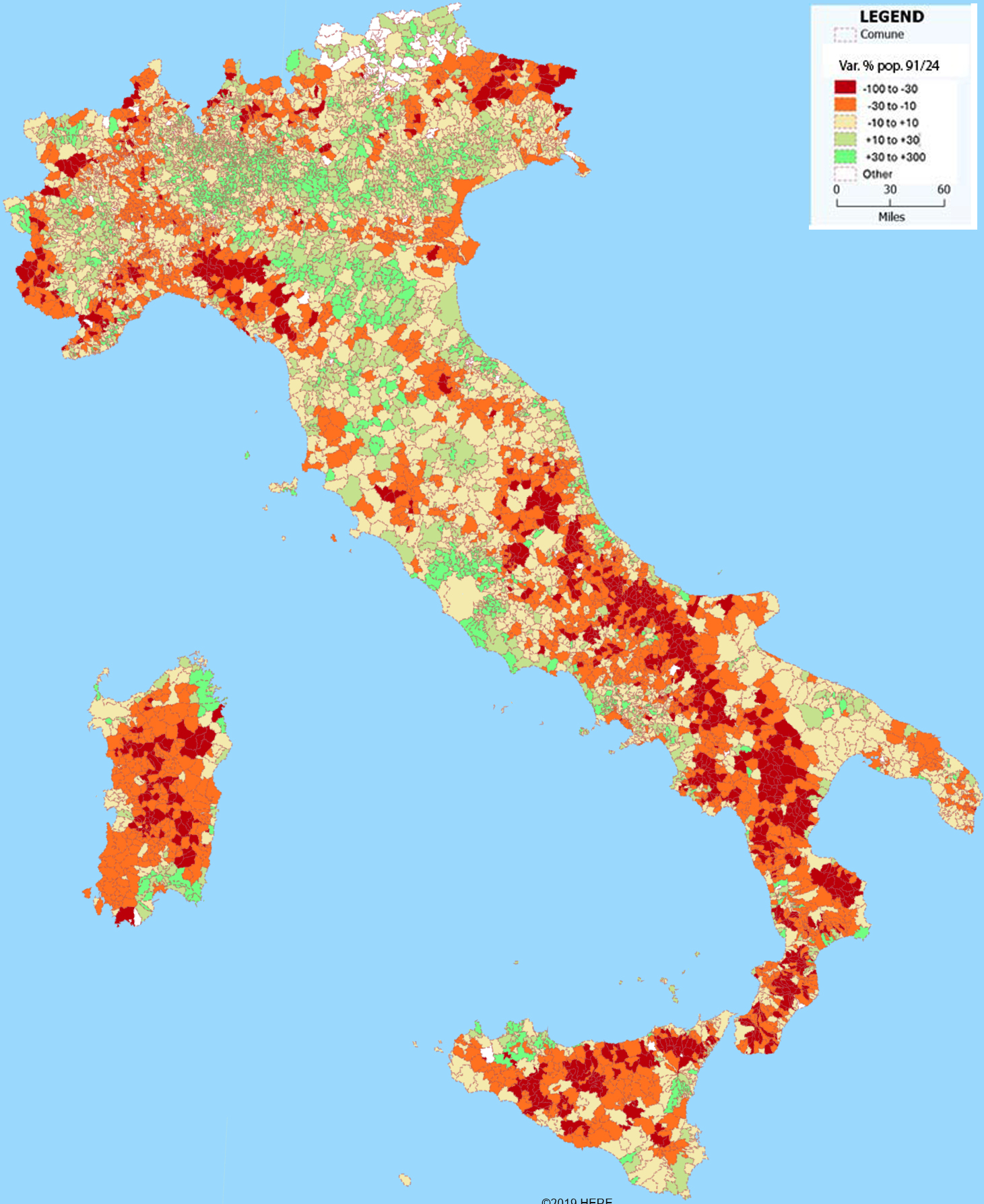
Among European countries, Italy stands out for the severity of the phenomenon, which primarily affects mountainous and hilly areas characterised by extensive, low-profitability agriculture (Cocca et al., 2012; Malavasi et al., 2018; Zavalloni et al., 2021). The result is a gradual decline in agricultural activity and a loss of socio-economic vitality, often followed by depopulation. At the national level, data from the most recent censuses revealed a highly concerning situation: out of 7,896 municipalities, more than 2,000 showed a reduction in utilised agricultural area (UAA) of over 50% between 1990 and 2020, and another 1,550 recorded a reduction of 30-50%. These municipalities are mainly located in inner areas (Figure 1) characterised by complex hilly and mountainous morphology, poor transport connectivity, and limited access to public services (Salvia et al., 2019; Cardillo et al., 2022). Some cases of agricultural land expansion, mainly found in Sardinia, are linked to the increase of extensive crops such as pasture meadows, but they do not reverse the trend of depopulation, as shown in Figure 2. The only significant exceptions are found in North-east Italy, where specific socio-economic conditions support the development and retention of younger generations, even in mountain areas. These cases deserve specific studies aimed at examining all the conditions involved and assessing their transferability to other contexts.
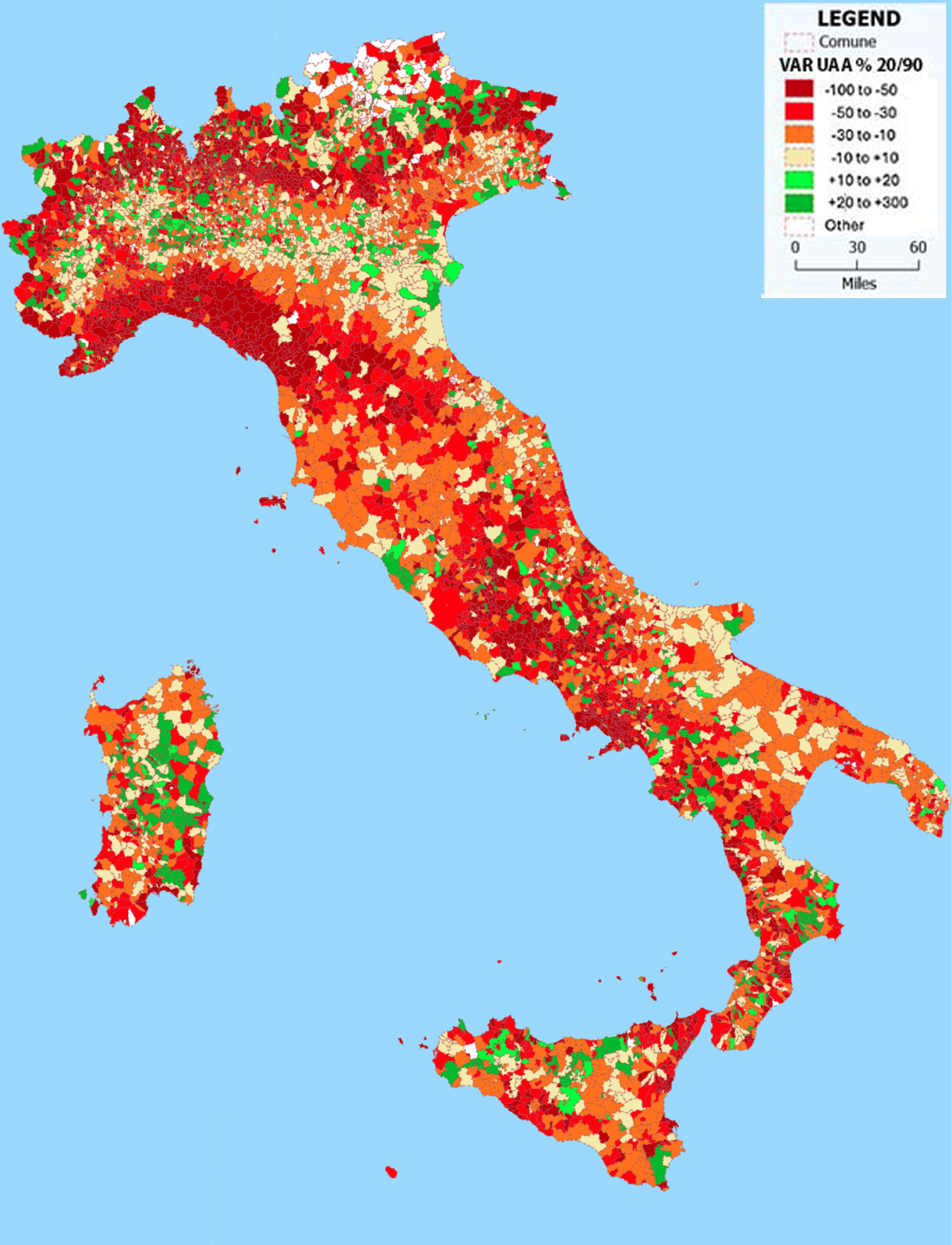
Figure 2 clearly shows the strong interrelation between farmland abandonment and population outmigration. Approximately 2,000 municipalities experienced both a reduction in UAA greater than 30% and a decline in population, with around 1,600 of these located in rural areas. In many inland hilly and mountainous areas, population declines exceeding 10% were recorded between 1991 and 2024. These patterns are particularly evident in Southern Italy, the islands, and Liguria, confirming that depopulation and land abandonment are two facets of the same reality. In many of these territories, agricultural marginality and social marginality coexist, giving rise to a crisis that is difficult to reverse, precisely due to the complexity of its causes and their mutual interactions. As noted by Terres et al. (2015), “the reasons for farmland abandonment are multidimensional, and there is no clear-cut division among drivers as it rather depends on the result of their co-occurrence and interactions”.
Numerous international studies have examined the causes of farmland abandonment and the progressive depopulation of inner areas, with particular attention on the European context. However, Italian economists have made a relatively limited contribution to these topics.
Terres et al. (2015) provided a key contribution at the European level. The authors emphasised that the causes of land abandonment are multidimensional and arise from the interaction of multiple factors, rather than isolated single variables. The authors also stressed the spatial and temporal specificity of the phenomenon: “The causes of farmland abandonment in Europe are manifold, depending on the area and the period under consideration. It is a complex process which can have a wide range of drivers, varying between Member States and sometimes within a single country”.
Scholars have identified numerous potential drivers of abandonment, including natural constraints, environmental degradation, socio-economic conditions, demographic changes, and institutional frameworks (Food and Agricultural Organization of the United Nations [FAO], 2006; Lasanta et al., 2017). In areas with poor soil quality or harsh climatic conditions, agriculture becomes increasingly unsustainable from an economic standpoint, leading to higher rates of abandonment (Varela Pérez et al., 2022). Soil degradation, exacerbated by intensive farming practices and climate change, further undermines the sustainability of agriculture in many regions (Zambon et al., 2018; Lucas-Borja et al., 2019).
Socio-economic factors are equally important: rising production costs, declining agricultural prices, and the pressure of global competition have reduced farm profitability (Osawa, 2016; Ustaoglu, Collier, 2018; Kumm, Hessle, 2020; Zgłobicki et al., 2020), pushing many farmers to seek alternative livelihoods or migrate to urban areas (Munroe et al., 2013; Qianru, Hualin, 2021; Chen et al., 2024). This trend is particularly pronounced in regions with ageing populations and where generational renewal in farming is limited (Sroka et al., 2019; Zhang et al., 2022; Robinson, 2024).
Italy faces particularly complex challenges in line with broader Mediterranean trends. Land abandonment is most severe in mountainous and hilly zones (Cocca et al., 2012; Malavasi et al., 2018; Zavalloni et al., 2021), historically dominated by small-scale subsistence farming. In these areas, competition with farms operating in more productive zones is unfavourable, and the quality of life is often perceived as inadequate, especially by younger generations (Riccioli et al., 2016).
Distinctive Italian features include land fragmentation, which hinders farm modernisation and productivity gains (Romano et al., 2016; Smiraglia et al., 2019; Praticò et al., 2022), as well as infrastructural shortcomings and poor accessibility in many territories (Coppola et al., 2018 Remondino, Zanin, 2022). Additionally, the declining birth rate exacerbates the challenges outlined above and warrants targeted analysis to understand its causes and implications.
Rizzo (2016) recalled Drudy’s (1978) seminal study on the United Kingdon context, which explored the interaction between “push” factors (agricultural unemployment, lack of alternatives) and “pull” factors (job opportunities and better living conditions in industrial cities). Drudy drew on Myrdal’s theory of cumulative causation, whereby agricultural decline triggers a vicious cycle of migration, withdrawal of public services, and rural population ageing, further reducing the attractiveness of inner areas. In his work on Sicily, Rizzo (2016) proposed a classification of rural areas into three categories: slow, transition, and declining territories. The former show slow but resilient growth thanks to development strategies focused on quality food markets and agritourism (Marsden, 1998). In contrast, declining territories have failed to integrate agriculture with complementary activities and suffer from severe depopulation. Transition territories exhibit mixed characteristics, with advanced rural economies hindered by demographic decline. The key differentiating factors include accessibility and proximity to urban centres, industrial zones, or tourist destinations. The model suggests that diversification, multifunctionality, and adequate connectivity are essential to retain population.
The Organisation for Economic Co-ordination and Development (OECD, 2006) has also emphasised the ongoing relevance of Drudy’s theory in explaining contemporary rural depopulation. According to the OECD, the loss of human capital (particularly educated youth) and disinvestment, both public and private in rural areas trigger a regressive spiral that undermines agricultural development prospects.
From an environmental perspective, Antrop (2000, 2004) criticised the CAP for neglecting the specificities of Europe’s diverse rural regions. More recently, scholars have called for the development of a rural landscape taxonomy and the use of appropriate analytical scales to better guide European policies (Van Eetvelde, Antrop, 2004).
Finally, several studies have highlighted the role of agricultural policies in producing “induced” abandonment. Between 1988 and 2008, the CAP promoted temporary (set-aside) or permanent (land retirement) withdrawal of farmland from production in an effort to limit surplus output (García-Ruiz, Lana-Renault, 2011; Lasanta et al., 2015). These schemes excluded up to 15% of agricultural land from use (Tscharntke et al., 2011). Additional policy-related drivers include difficulties in renewing agri-environmental contracts, the introduction of stricter sanitary standards, and the decoupling of direct payments from agricultural production, with significant consequences in Eastern Europe (Pointereau et al., 2008). According to Keenleyside, Tucker (2010), even with the uncertainty about the future evolution of some factors, many are expected to intensify due to their deep integration into global agricultural markets (Ustaoglu, Collier, 2018).
To analyse the risk of farmland abandonment, the focus of a recent study (Fantechi et al., 2026) is on one of the main determinants of the phenomenon: labour productivity/profitability, measured as the value added per full-time worker. The analysis is based on Farm Accountancy Data Network (FADN) data for three of the main types of farming of Italian agriculture – arable crops, vineyards, and olive groves – considering both gross and net values (with and without subsidies), in nominal and real terms. The study examined farms with an economic size above €25,000 (the European size unit), in order to exclude hobby or part-time farms for which profitability is not necessarily a structural constraint. The findings revealed a worrying situation. A significant number of farms, spread across all macro-regions and all three analysed types of farming, showed a level of value added per worker below the risk threshold for abandonment, defined as 60% of Italian per capita gross domestic product (GDP; €33,000 in 2022), in line with the methodology proposed by Terres et al. (2015). For the three types of farming considered, more than one-third of farms are at risk of abandonment, with olive-growing farms reaching a critical threshold of nearly 60%. Even large olive farms are not fully immune, although small and medium-sized farms are significantly more vulnerable. The severity of the issue increases from north to south, with risk levels exceeding 50% in Southern Italy, as already highlighted in the literature (Streifeneder, 2016; Bonelli et al., 2018; Salis et al., 2022). In terms of UAA, although the percentage is lower than the share of farms at risk, the data remain alarming: in some macro-areas, particularly in Central and Southern Italy for type of farming 37, the risk affects nearly half of the agricultural surface.
From a farm-size perspective, the analysis confirms a clear gap between large and medium farms. In many cases, medium-sized farms show productivity levels close to or below the abandonment risk threshold, while larger farms, especially in Northern Italy, demonstrate greater adaptability and resilience. Long-term trends are particularly critical: between 2010 and 2022, labour productivity in real terms declined almost across the board, both gross and net of subsidies. The real-term data paint an even more severe picture than nominal values, with negative trends even among larger farms.
These results reinforce and specify, at subnational level and for particular production orientations, what has emerged in other European studies (Lasanta et al., 2017; Ferreira et al., 2023), underlining the need to place farm profitability at the heart of rural development policies, particularly in marginal areas. They also highlight the urgency of targeted public intervention to rebalance development conditions and promote convergence toward sustainable productivity levels, with specific attention to the economic viability of professional farms.
As stated in the Strategic Dialogue on the Future of EU Agriculture: “Balanced demographic, social, and economic structures are part of the attractiveness of rural areas’ appeal. The lack of opportunities in rural areas leads to ageing and rural exodus, which jeopardises the generational renewal of agriculture. These must be countered with rural proofing policy, understood as a coherent set of political measures to preserve and empower rural communities in their diversity and avoid territorial desertification” (European Commission, 2021). This excerpt clearly shows how professional farm profitability is a central issue in avoiding the vicious cycle of low incomes, youth outmigration, declining entrepreneurial capacity, and so on.
Alongside the well-known economic and productive causes, such as low agricultural profitability, weak competitiveness, and lack of infrastructure, there is a more subtle yet decisive factor: the insufficient quality of life perceived by those living in these areas. Several studies have shown that levels of well-being and rural depopulation are strongly correlated (Peel et al., 2016; Casini et al., 2019, 2021). A “good” quality of life is, in fact, a precondition for the economic and social vitality of a territory. Where living conditions are not perceived as decent or satisfactory, people tend to leave in search of better opportunities elsewhere. Despite the centrality of this issue, policy interventions aimed at improving quality of life in rural contexts have so far been limited, with rather modest results in many regions. One of the main reasons is the difficulty policymakers face in precisely identifying which dimensions of well-being are truly decisive in different territorial contexts. The concept of “well-being” is broad, multidimensional, and relative, meaning that it strongly depends on the specific socio-cultural, environmental, and economic conditions of each area.
The recent National Strategic Plan for Inner Areas (SNAI; Presidenza del Consiglio dei Ministri, 2025) offers some insights into the main components of well-being. The plan aims to “…provide a strategic framework for the support and development of peripheral and ultra-peripheral areas in decline or at demographic risk, where the active presence of communities is crucial to preserving the hydrogeological, landscape, and identity integrity of the territory”. The definition of “inner areas” is primarily based on the classification of Italian municipalities according to access to three categories of public services. Specifically, the key criterion is the travel time required to reach “service centres”, meaning municipalities that can simultaneously provide a comprehensive offer of upper secondary education; a hospital with at least a level I emergency department; and a railway station classified as Platinum, Gold, or Silver.
The importance of public services for quality of life in these areas has been widely demonstrated (Casini et al., 2021), but in this case the analysis has been rather narrow. Although there has been consideration of three critical service categories, it likely fails to capture all the dimensions that constitute everyday quality of life, and thus the real drivers behind the decision to stay in, or leave, a given territory. The risk here is a misdiagnosis of the problems affecting the selected areas, leading to an inefficient allocation of resources. While this classification serves as a starting point for the selection of intervention areas – through a complex process involving cooperation between regions and municipalities – it may already represent a limitation due to its oversimplified portrayal of well-being components.
To address the complexity of a concept such as quality of life, the most promising and still highly relevant theoretical contribution is the capability approach developed by Amartya Sen (1983, 1992, 1993). Unlike traditional economic approaches, such as utilitarian or resource-based models, where well-being is measured in terms of individual utility or material possessions, Sen has proposed a radically different reading: well-being is defined by the real freedoms individuals have to do and to be what they have reason to value.
According to this view, quality of life is not determined solely by access to material resources, but rather by people’s actual ability to access a range of essential opportunities, the so-called capabilities, that allow them to live meaningful lives. Meghnad Desai (1995) has proposed an applied approach to Sen’s theory by defining a list of capabilities that allows for practical evaluation. The main ones include:
– Health and healthcare services;
– Access to education;
– Freedom to work and economic autonomy;
– Freedom of movement;
– Freedom of expression;
– Access to resources such as housing, land, credit, and technologies;
– Absence of discrimination and social recognition;
– A fair balance between work and leisure time.
Clearly, the relevance and assessment of each of these capabilities depends on the specific contexts in which Desai’s approach is applied. Nevertheless, according to the author they will always retain importance in determining well-being. Precisely because of the specificity and relativity of the concept of well-being, participatory approaches involving local inhabitants appear to be the most appropriate way to address the issue of abandonment, as they allow for a real understanding of which capabilities are currently unmet in a given area.
Applied to the context of rural areas, the capability approach allows us to interpret abandonment not only as the result of unfavourable economic dynamics, but as the consequence of a systematic deprivation of opportunities and freedoms. In many rural regions, there has been a progressive deterioration in access to basic services (healthcare, education, and mobility), an erosion of the social and cultural fabric, and an increasing perception of isolation and marginalisation. This “capability deprivation” fosters a sense of social exclusion that further fuels abandonment processes. Casini et al. (2021) empirically explored these dynamics in Tuscany by adopting Sen’s framework to develop a model of community well-being, based on subjective measurements referring not to individuals, but to collective perceptions. With this approach, the authors broke down well-being into several dimensions, including health, income, access to goods and services, cultural and recreational opportunities, and the quality of social relationships. They administered a survey to 228 residents of rural areas to evaluate these dimensions and analysed the results with structural equation modelling. Based on the results, the residents perceived that many aspects of collective well-being are unsatisfactory, particularly those related to civic participation, access to services, and perceived opportunities for younger generations. If left unaddressed, these factors risk entrenching the marginality of rural areas and reinforcing the vicious cycle of depopulation and decline. The capability-based approach has two strengths. First, it allows for an integrated and context-sensitive understanding of well-being, overcoming the divide between subjective and objective indicators. Second, it offers a solid theoretical basis for constructing participatory assessment tools, in which communities are not merely recipients of policy but active agents in defining development goals.
In conclusion, addressing rural abandonment requires a paradigm shift: from policies centred exclusively on productivity or economic incentives to strategies focused on well-being, understood as the capacity of individuals to live in environments that offer meaningful opportunities. Being a farmer today is very different from being a farmer in the past. This leads to several questions: how do younger generations perceive this profession today? What are the positive and negative well-being components associated with being a farmer? Profitability is essential, but what are the other components of well-being that are perceived as positive or negative aspects of being a farmer? These questions should be answered to create the conditions for the future development of our rural areas. The capability approach offers a valuable framework for designing interventions aimed at building “an agri-food sector that values food, fosters fair working and living conditions and vibrant and well-connected rural and coastal areas” (European Commission, 2025).
Farmland abandonment is a structural phenomenon that affects numerous rural areas across Europe, and it is particularly intense in the Mediterranean and mountainous contexts. Its effects are, in large part, highly negative. In many regions, traditional agricultural practices have historically contributed to the creation of landscapes with high ecological and cultural value, maintaining semi-natural habitats and supporting biodiversity tied to open environments such as pastures and extensive crops. The abandonment of these practices, along with the withdrawal from land management, results in the loss of biodiversity and ecosystem services as well as increased risks of soil erosion, forest fires, and hydrogeological instability, leading to serious consequences for territorial safety and the quality of life of local populations (Agnoletti et al., 2019; Marino et al., 2022, Salis et al., 2022).
From a socio-economic perspective, agricultural abandonment is closely intertwined with rural depopulation processes. The crisis of agricultural profitability, infrastructural isolation, and the gradual reduction of public services have driven younger generations towards urban centres, triggering a vicious cycle that deepens the marginalisation of entire regions. Population loss, in turn, weakens social networks, disrupts the intergenerational transmission of farming knowledge, and causes cultural and relational impoverishment, undermining both the sense of belonging and community cohesion (Reynaud, Miccoli, 2016, 2021, 2023; Benassi et al., 2023).
In this light, abandonment is not merely a land-use transformation; it also entails the loss of human, cultural, and social capital. Furthermore, the decline in cultivated land reduces the national agricultural system’s ability to produce essential goods, with consequences for food security and sovereignty. These vulnerabilities were made particularly evident by recent international crises that disrupted global supply chains (FAO, 2017).
Despite these impacts, farmland abandonment is not inherently negative. In some cases, the natural recolonisation of abandoned agricultural areas may produce environmental benefits, such as carbon sequestration, increased forest cover, and the enhancement of ecological processes. However, these benefits are neither automatic nor guaranteed. They depend heavily on the territorial context, the subsequent management of abandoned land, and the capacity of public policies to guide these transitions.
In the absence of active stewardship, abandoned areas risk evolving into ecologically unstable states, characterised by degraded vegetation, high flammability, and low resilience (Chauchard et al., 2007; Marquez Torres et al., 2023). In addition, rewilding often entails the irreversible loss of complex cultural landscapes shaped by centuries of human-nature interaction, landscapes that communities often perceive as integral to their identity.
Given this complexity, it is clear that agricultural abandonment cannot be addressed through sectoral instruments or monodisciplinary approaches. Instead, a systemic and integrated framework is required, one that can assess trade-offs between agriculture, reforestation, and abandonment by considering the multiple ecosystem services involved and their impacts on human well-being (Van der Zanden et al., 2017). In this regard, Zavalloni et al. (2021) have offered a valuable modelling attempt, comparing alternative land-use scenarios based on both private agricultural profitability and collective well-being.
A significant contribution to understanding the implications of abandonment is provided by the theoretical framework of Nature’s Contributions to People (NCP), developed by the Intergovernmental Science-Policy Platform on Biodiversity and Ecosystem Services (IPBES; Pascual et al., 2017). This approach broadens the conventional view of ecosystem services by including non-material dimensions such as landscape aesthetics, collective memory, identity, and perceived well-being. Recent studies have shown that in many rural communities, abandonment is associated with negative emotions, a sense of institutional neglect, and declining quality of life, factors often overlooked in conventional assessments (Van der Zanden et al., 2017; Quintas-Soriano et al., 2022).
In summary, farmland abandonment presents complex challenges but also strategic opportunities. Addressing it requires a fundamental rethinking of the relationship between agriculture, the environment, and society. This means adopting a territorial approach that values the multifunctionality of rural landscapes, promotes community well-being, and integrates economic, environmental, and cultural instruments within a long-term sustainability framework. Only by doing so can abandonment be transformed from a symptom of decline into an opportunity for a new rural agenda, one that combines ecological resilience, social justice, and territorial regeneration.
Public policy instruments aimed at tackling farmland abandonment fall within the broader domain of measures to counter rural depopulation, given the strong interconnections between the two phenomena, as previously discussed.
Karcagi-Kovats, Katona-Kovacs (2012) summarised how National Sustainable Development Strategies (NSDS) and National Rural Development Programmes (NRDP) of European Union (EU) Member States address rural depopulation processes. They provided a systematic overview of the main drivers of demographic decline identified in these strategies and programmes, along with the objectives set and the measures proposed. They found that “although most documents recognize the depopulation process and all view it as a negative trend, there is no commonly accepted set of goals or principles regarding the desired extent of demographic change in rural areas. Objectives vary between ‘reducing,’ ‘halting,’ ‘stabilizing,’ and ‘reversing’ rural depopulation”. According to Karcagi-Kovats, Katona-Kovacs (2012), rural policies require a stronger theoretical foundation to adequately address the wide-ranging, economic, environmental, and social impacts of depopulation. They also call for greater attention to this issue in future national sustainable development strategies.
At the national level, the SNAI represents the most comprehensive framework addressing the challenges of depopulation and poor access to services in Europe. All four European Structural and Investment Funds are combined with national funds to support both local development strategies and innovation in service provision across 72 pilot areas. Approximately €1 billion is being invested through a place-based approach that integrates multiple sectors and levels of governance. Associations of mayors usually lead the process, while LEADER Local Action Groups may support project design or directly implement European Agricultural Fund for Rural Development (EAFRD) measures in the area.
The most recent SNAI (Presidenza del Consiglio dei Ministri, 2025, p. 44-46) for the 2021-2027 period identifies four main strategic goals: (1) reversing population decline; (2) reversing the drop in birth rates; (3) reducing the rate of decline (from sharp to moderate); and (4) managing irreversible depopulation trajectories. Based on these categories, “each municipality must be able to assess which of the four categories it falls into, based on demographic, social, and economic data, and be equipped with appropriate skills and tools to pursue the corresponding specific objectives. Local specificities must be seen as key drivers of endogenous development, capable of producing lasting effects and making these territories attractive for younger generations”.
This model frames the municipality as the smallest unit of intervention, a practical approach in the Italian context, though not without limitations. The structural diversity of municipalities may lead to inefficiencies: either because the territories covered are too large, or because they are too small and lack the necessary administrative capacity. The plan’s aspiration for “the ability of municipalities to build effective participatory strategies involving all stakeholders living and shaping the territory” (Presidenza del Consiglio dei Ministri, 2025) may not always be easy to achieve. Therefore, the development of adequate multi-level governance mechanisms appears to be essential.
Another critical issue is the absence of a clear theoretical framework guiding operational choices. Resource allocation and priority setting can only be effective if grounded in well-defined guidelines and an integrated vision of the abandonment phenomenon. If funds are distributed based solely on arithmetic criteria, as some aspects of the SNAI suggest, or on simplistic definitions of territorial well-being, the expected outcomes are unlikely to materialise. Similarly, if outcome indicators are not embedded within a comprehensive quality-of-life framework, then this approach may not be sufficient to demonstrate the real effectiveness of implemented actions, opening the door to inefficient solutions. The adoption of a theoretical framework such as the one proposed by Sen and operationalised by Desai could provide significant support both for setting objectives and for evaluating results.
Regarding specific instruments to counter farmland abandonment, Renwick et al. (2013) analysed the effects of agricultural and trade reforms on abandonment risk using a modified version of the Common Agricultural Policy Regionalised Impact (CAPRI) model, integrated with the spatial framework Dyna-CLUE. This approach enables a more detailed geographical assessment of policy impacts. One of the study’s key findings is the “spatial heterogeneity” of reform effects, highlighting the inadequacy of the CAP, particularly Pillar I, in addressing diverse environmental objectives across varied agricultural and natural contexts. The authors recommended “developing more targeted and territorially differentiated policies” that can selectively prevent undesirable abandonment while allowing beneficial rewilding in other areas. Consistent with FAO (2006) recommendations, the authors concluded that simply maintaining land in agricultural production is neither an effective nor an efficient strategy for managing abandonment. What is needed is a territorial approach based on in-depth local analysis and societal preferences regarding public goods. Only in this way can the multiple challenges of farmland abandonment be addressed in a way that enhances agricultural sustainability in Europe.
Today, CAP instruments aimed at supporting rural development are implemented mainly through regional development programmes, which attempt to counter farmland abandonment largely through income support and investment aid. Resource allocation and tool selection are typically based on administrative zoning that rarely exceeds four or five territorial categories at the regional level: (1) areas of intensive agriculture; (2) intermediate rural areas in transition; (3) intermediate rural areas in decline; and (4) rural areas facing development challenges.
Historically, Pillar 2 of the CAP has primarily provided farm support, either in the form of investment grants or income support for low-impact practices, without any specific territorial vision. A territorial logic is found primarily in LEADER-related measures, which represent the most relevant component in terms of place-based development. In several regions, bottom-up planning has triggered significant development pathways. Still, LEADER areas are often large, include multiple municipalities, and suffer from substantial internal heterogeneity. Rarely are tools or strategies developed for more granular territories. This approach appears to conflict with the evidence from both research and the SNAI, which emphasise the need for highly localised, targeted interventions.
Recent documents from the European Commission seem to show greater awareness of the themes of abandonment and the attractiveness of inner areas, particularly for younger generations. The challenge now is to ensure that operational instruments are designed in line with these goals. It is important to recall that various studies have also identified certain CAP instruments themselves as among the causes of abandonment.
In any case, to effectively address the multidimensional effects of rural decline, it is necessary to activate multi-level governance frameworks involving coordinated action among European, national, regional, and local institutions, as well as civil society actors. Territorial policies, such as the SNAI, LEADER programmes, or ecosystem services payment schemes, represent examples of integrated approaches that, if properly implemented, can help counter farmland abandonment by enhancing local resources, promoting sustainable agriculture, and strengthening the social fabric of rural communities (Labianca, Navarro, 2019). However, to be effective, such strategies must be built through participatory processes rooted in community needs, tailored to local specificities, and supported by robust theoretical frameworks capable of guiding coherent and sustainable action.
The evidence presented in this paper leads to several final reflections. Farmland abandonment is a highly significant phenomenon in Italy and is strongly correlated with the depopulation of inner areas. It represents a multifaceted phenomenon that poses significant challenges but also opens up strategic opportunities for rethinking the future of rural areas. Addressing it effectively is not just about reclaiming cultivated hectares; it is about rethinking territorial policies in light of a broader concept of rural well-being, one that values the role of communities, local cultures, and intangible ecosystem services as central elements of sustainable rural regeneration. The agricultural policy instruments implemented thus far have not been able to contain this phenomenon across large parts of the country. Research has provided a comprehensive understanding of the drivers behind abandonment and a fairly detailed mapping of its effects. However, these aspects are not always considered in an integrated manner, and the interrelationships between them, and their overall impact on society, remain underexplored.
In this context, the evaluation of ecosystem services and, more broadly, the externalities generated by agricultural activity emerges as a central issue. Whether carried out through direct assessment or negotiated approaches among stakeholders, such evaluation is essential for informed decision-making aimed at enhancing social well-being. Italian agricultural economists have contributed meaningfully to this debate, but the application of these methodologies to real-world cases remains a challenge. It is crucial to bridge this gap to define the appropriate intervention goals.
The European Commission’s new vision for CAP reform underlines the need to invest in making rural areas more attractive and in improving working conditions in agriculture. In some areas, it may already be too late, but it is still worth trying. The multiple causes of abandonment are well understood, but they must be contextualised within local realities, including the availability of life conditions that are today offered almost exclusively by urban environments. We must avoid creating binary or exclusive models: agriculture versus cities. That said, we cannot overlook the principal cause of abandonment: insufficient profitability. As previously discussed, many farming activities fail to generate incomes that are viable in either relative or absolute terms. The current distribution of support payments does not appear adequate to guarantee fair incomes in many situations.
Socially responsible solutions must be based on a comprehensive assessment of the role agriculture plays in different territories and on intervention models that preserve competitiveness while ensuring that agricultural work is satisfying both economically and socially. There are successful examples, especially in Northern Italy, but it is necessary to assess their applicability elsewhere. The path forward must involve ensuring decent income levels wherever agriculture is expected to persist.
As several studies have shown, profitability is a necessary, although not sufficient, condition to address agricultural abandonment and, even more so, depopulation. It is essential to adopt operational tools grounded in theoretical frameworks capable of explaining the specific elements that, in a given time and place, shape quality of life. Only through an integrated understanding of all factors affecting life satisfaction can we develop effective measures to limit, if not reverse, abandonment.
Sen’s capabilities approach can serve as a useful point of reference, although not necessarily the only one. The fundamental capabilities proposed by Desai (1995), among which work and income are key components, may provide an applicable framework to guide development policies in critical areas. These capabilities should be adapted to specific contexts and while they may vary in their basic elements depending on time and place, they must achieve satisfactory levels of well-being as “perceived” by the inhabitants to enable a future for the territories in question. The development of practical tools to assess these perceptions accurately across the various capabilities, as well as the trade-offs between them, remains an underexplored area that deserves greater attention.
The SNAI represents an important tool that provides a set of guidelines for addressing the crises affecting inner areas. However, it has several limitations, such as its reliance on administrative boundaries, issues related to resource allocation criteria (as evidenced by the distribution for the new inner areas), and, finally, shortcomings in the methods used to identify critical factors. It is essential to develop robust theoretical and methodological tools to guide the process of improving living conditions in these areas, but the scientific literature has offered very limited contributions in this area.
The studies cited in this paper also highlight additional themes that applied economists, especially those working on agriculture, food, and territory, can and perhaps must address. Territorial zoning, which has long been a topic of agrarian economic research, now appears to be indispensable for understanding the dynamics of abandonment and depopulation. The development of tools capable of assessing the varying role of farms in relation to the non-market components of well-being – such as monetary valuations of major externalities and benchmark indicators – represents another key issue for the design of effective support policies for the sector. This is particularly relevant for evaluating the contribution of farms to well-being in both environmental and social terms.
We are approaching a pivotal moment for the agricultural areas of Italy’s marginal regions: the majority of the current generation of farmers is nearing retirement; the sector holds little appeal for younger generations; and demographic trends are exacerbating both processes. The risk of widespread depopulation and land abandonment is real.
At both the European and national levels, there is growing awareness of the critical interplay between depopulation and agricultural decline, and vice versa. If we want to ensure a future for the rural world in many of our regions, the time to act is now. To do so successfully, we must ensure that the resources likely to become available are used as effectively as possible, through multi-level governance, a shared and theoretically sound development vision, and in-depth analysis of each territorial context. There is substantial room for applied economists, and agricultural economists in particular, to contribute. The question is whether there is sufficient interest and willingness to take up the challenge.
Agnoletti M., Errico A., Santoro A., Dani A., Preti F. (2019). Terraced landscapes and hydrogeological risk: effects of land abandonment in Cinque Terre (Italy) during severe rainfall events. Sustainability, 11(1): 235. DOI: https://doi.org/10.3390/su11010235.
Antrop M. (2000). Background concepts for integrated landscape analysis. Agriculture, Ecosystems & Environment, 77(1-2): 17-28. DOI: https://doi.org/10.1016/S0167-8809(99)00089-4.
Antrop M. (2004). Landscape change and the urbanization process in Europe. Landscape and Urban Planning, 67(1-4): 9-26. DOI: https://doi.org/10.1016/S0169-2046(03)00026-4.
Benassi F., Naccarato A., Iglesias‐Pascual R., Salvati L., Strozza S. (2023). Measuring residential segregation in multi‐ethnic and unequal European cities. International Migration, 61(2): 341-361. DOI: https://doi.org/10.1111/imig.13018.
Bonelli S., Rovai M., Andreoli M. (2018). A spatial multi-criteria analysis model to identify intervention strategies for the recovery of abandoned olive groves: the case study of Lucca Hills in World heritage and knowledge Representation, Restoration, Redesign, Resilience (pp. 333-342). Gangemi Editore International, Roma.
Burrascano S., Chytrý M., Kuemmerle T., Giarrizzo E., Luyssaert S., Sabatini F.M., Blasi C. (2016). Current European policies are unlikely to jointly foster carbon sequestration and protect biodiversity. Biological Conservation, 201: 370-376. DOI: https://doi.org/10.1016/j.biocon.2016.08.005.
Cardillo C., Cimino O. (2022). Small farms in Italy: what is their impact on the sustainability of rural areas? Land, 11(12), 2142. DOI: https://doi.org/10.3390/land11122142.
Casini L., Boncinelli F., Contini C., Gerini F., Scozzafava G. (2019). A multicriteria approach for well-being assessment in rural areas. Social Indicators Research, 143(1): 411-432. DOI: https://doi.org/10.1007/s11205-018-1978-0.
Casini L., Boncinelli F., Gerini F., Romano C., Scozzafava G., Contini C. (2021). Evaluating rural viability and well-being: Evidence from marginal areas in Tuscany. Journal of Rural Studies, 82: 64-75. DOI: https://doi.org/10.1016/j.jrurstud.2021.01.002.
Chauchard S., Carcaillet C., Guibal F. (2007). Patterns of land-use abandonment control tree recruitment and forest dynamics in Mediterranean mountains. Ecosystems, 10(6): 936-948. DOI: https://doi.org/10.1007/s10021-007-9065-4.
Chen X., Yu L., Li Y., Liu T., Liu J., Peng D., Zhang X., Fang C., Gong P. (2024). China’s ongoing rural to urban transformation benefits the population but is not evenly spread. Communications Earth & Environment, 5(1): 416. DOI: https://doi.org/10.1038/s43247-024-01580-8.
Cocca G., Sturaro E., Gallo L., Ramanzin M. (2012). Is the abandonment of traditional livestock farming systems the main driver of mountain landscape change in Alpine areas? Land Use Policy, 29(4): 878-886. DOI: https://doi.org/10.1016/j.landusepol.2012.01.005.
Coppola A., Ianuario S., Chinnici G., Di Vita G., Pappalardo G., D’Amico M. (2018). Endogenous and exogenous determinants of agricultural productivity: what is the most relevant for the competitiveness of the Italian agricultural systems? AGRIS on-line Papers in Economics and Informatics, 10(2): 33-47. DOI: https://doi.org/10.7160/aol.2018.100204.
Cusens J., Barraclough A.D., Måren I.E. (2024). Socio-cultural values and biophysical supply: How do afforestation and land abandonment impact multiple ecosystem services?. Land Use Policy, 136, 106967. DOI: https://doi.org/10.1016/j.landusepol.2023.106967.
Dax T., Schroll K., Machold I., Derszniak-Noirjean M., Schuh B., Gaupp-Berghausen M. (2021). Land abandonment in mountain areas of the EU: An inevitable side effect of farming modernization and neglected threat to sustainable land use. Land, 10(6), 591. DOI: https://doi.org/10.3390/land10060591.
Desai M. (1995). Poverty and capability: towards an empirically implementable measure. In Poverty, Famine and Economic Development (pp. 185-204). Edward Elgar Publishing, Cheltenham.
Drudy P.J. (1978). Depopulation in a prosperous agricultural sub-region. Regional Studies, 12(1): 49-60. DOI: https://doi.org/10.1080/09595237800185041.
European Commission. (2021). Long-term vision for rural areas: For stronger, connected, resilient, prosperous EU rural areas.
European Commission (2025). A vision for agriculture and food (COM(2025) 75 final).
Fantechi T., Contini C., Casini L. (2026). From productivity to abandonment: Sub-national evidence from the Italian farm sector in the context of EU agricultural policy. Journal of Rural Studies, 121, 103949. DOI: https://doi.org/10.1016/j.jrurstud.2025.103949.
Fayet C.M., Reilly K.H., Van Ham C., Verburg P.H. (2022). What is the future of abandoned agricultural lands? A systematic review of alternative trajectories in Europe. Land Use Policy, 112, 105833. DOI: https://doi.org/10.1016/j.landusepol.2021.105833.
Food and Agricultural Organization of the United Nations (2006). The state of food and agriculture, Food and Agriculture Organization of the United Nations, Rome.
Food and Agricultural Organization of the United Nations (2017). The state of food and agriculture, Food and Agriculture Organization of the United Nations, Rome.
Feranec J., Jaffrain G., Soukup T., Hazeu G. (2010). Determining changes and flows in European landscapes 1990-2000 using CORINE land cover data. Applied Geography, 30(1): 19-35. DOI: https://doi.org/10.1016/j.apgeog.2009.07.003.
Ferreira J., Silvério A.C., Vaz M., Fernandes P.O. (2023). The relationship between rural tourism, sustainable tourism and outdoor activities: a systematic literature review. In Mesquita A., Abreu A., Carvahlo J.V., de Mello C.H.P. (eds) Perspectives and Trends in Education and Technology (pp. 597-608). Springer, Singapore. DOI: https://doi.org/10.1007/978-981-19-6585-2_53.
Gabarron-Galeote M.A., Trigalet S., van Wesemael B. (2015). Effect of land abandonment on soil organic carbon fractions along a Mediterranean precipitation gradient. Geoderma, 249: 69-78. DOI: https://doi.org/10.1016/j.geoderma.2015.03.007.
García-Ruiz J.M., Lana-Renault N. (2011). Hydrological and erosive consequences of farmland abandonment in Europe, with special reference to the Mediterranean region – a review. Agriculture, Ecosystems & Environment, 140(3-4): 317-338. DOI: https://doi.org/10.1016/j.agee.2011.01.003.
Hatna E., Bakker M.M. (2011). Abandonment and expansion of arable land in Europe. Ecosystems, 14(5): 720-731. DOI: https://doi.org/10.1007/s10021-011-9441-y.
Italian National Institute of Statistics (2021). 7° Censimento Generale dell’Agricoltura, Italian National Institutes of Statistics, Rome.
Karcagi-Kovats A., Katona-Kovacs J. (2012). Factors of population decline in rural areas and answers given in EU member states’ strategies. Studies in Agricultural Economics, 114(1): 49-56. DOI: https://doi.org/10.22004/ag.econ.122451 .
Keenleyside C., Tucker G., McConville A. (2010). Farmland abandonment in the EU: An assessment of trends and prospects. Institute for European Environmental Policy, Brussels.
Keesstra S., Nunes J., Novara A., Finger D., Avelar D., Kalantari Z., Cerdà A. (2018). The superior effect of nature-based solutions in land management for enhancing ecosystem services. Science of the Total Environment, 610: 997-1009. DOI: https://doi.org/10.1016/j.scitotenv.2017.08.077.
Kuemmerle T., Levers C., Erb, K.-H., Estel S., Jepsen M., Müller D., Plutzar C., Stürck J., Verkerk H., Verburg P., Reenberg A. (2016). Hotspots of land use change in Europe. Environmental Research Letters, 11(6), 064020. DOI: https://doi.org/10.1088/1748-9326/11/6/064020.
Kumm K.I., Hessle A. (2020). Economic comparison between pasture-based beef production and afforestation of abandoned land in Swedish forest districts. Land, 9(2), 42. DOI: https://doi.org/10.3390/land9020042.
Labianca M., Navarro F. (2019). Depopulation and aging in rural areas in the European Union: practices starting from the LEADER approach. Perspectives on Rural Development, 3: 223-252. DOI: https://doi.org/10.1285/i26113775n3p223.
Lasanta T., Arnáez J., Pascual N., Ruiz-Flaño P., Errea M.P., Lana-Renault N. (2017). Space–time process and drivers of land abandonment in Europe. Catena, 149: 810-823. DOI: https://doi.org/10.1016/j.catena.2016.02.024.
Lasanta T., Nadal-Romero E., Arnáez J. (2015). Managing abandoned farmland to control the impact of re-vegetation on the environment: the state of the art in Europe. Environmental Science & Policy, 52: 99-109. DOI: https://doi.org/10.1016/j.envsci.2015.05.012.
Levers C., Müller D., Erb K.-H., Haberl H., Jepsen M., Meyfroidt P., Plieninger T., Plutzar C., Stürck J., Verburg P., Verkerk H., Kuemmerle T. (2018). Archetypical patterns and trajectories of land systems in Europe. Regional Environmental Change, 18(3): 715-732. DOI: https://doi.org/10.1007/s10113-015-0907-x.
Lucas-Borja M.E., Zema D.A., Plaza-Álvarez P.A., Zupanc V., Baartman J., Sagra J., González-Romero J., Moya D., de las Heras J. (2019). Effects of different land uses (abandoned farmland, intensive agriculture and forest) on soil hydrological properties in Southern Spain. Water, 11(3), 503. DOI: https://doi.org/10.3390/w11030503.
Malavasi M., Carranza M.L., Moravec D., Cutini M. (2018). Reforestation dynamics after land abandonment: A trajectory analysis in Mediterranean mountain landscapes. Regional Environmental Change, 18(8): 2459-2469. DOI: https://doi.org/10.1007/s10113-018-1368-9.
Marino D., Palmieri M., Marucci A., Pili S. (2022). Long-term land cover changes and ecosystem services variation: have anthropogenic transformations degraded human well-being in Italy? Italian Review of Agricultural Economics, 77(1): 7-23. DOI: https://doi.org/10.36253/rea-13448.
Marquez Torres A., Signorello G., Kumar S., Adamo G., Villa F., Balbi S. (2023). Fire risk: an integrated modelling approach applied to Sicily. EGUsphere, 2023: 1-37. DOI: https://doi.org/10.5194/nhess-23-2937-2023.
Marsden T. (1998). New rural territories: regulating the differentiated rural spaces. Journal of Rural Studies, 14(1): 107-117. DOI: https://doi.org/10.1016/S0743-0167(97)00041-7.
Mouchet M.A., Paracchini M.L., Schulp C.J.E., Stürck J., Verkerk P.J., Verburg P.H., Lavorel S. (2017). Bundles of ecosystem (dis)services and multifunctionality across European landscapes. Ecological Indicators, 73: 23-28. DOI: https://doi.org/10.1016/j.ecolind.2016.09.026.
Munroe D.K., van Berkel D.B., Verburg P.H., Olson J.L. (2013). Alternative trajectories of land abandonment: causes, consequences and research challenges. Current Opinion in Environmental Sustainability, 5(5): 471-476. DOI: https://doi.org/10.1016/j.cosust.2013.06.010.
Myrdal, G. (1957). Economic Theory and Under-developed Regions. Gerald Duckworth & Co. Ltd., London.
Organisation for Economic Co-ordination and Development (2006). The new rural paradigm: policies and governance, Organisation for Economic Co-ordination and Development, Paris. DOI: https://doi.org/10.1787/9789264023918-en.
Osawa T., Kohyama K., Mitsuhashi H. (2016). Multiple factors drive regional agricultural abandonment. Science of the Total Environment, 542: 478-483. DOI: https://doi.org/10.1016/j.scitotenv.2015.10.067.
Pascual U., Balvanera P., Diaz S., Pataki G., Roth E., Stenseke M., Watson R., Basak E., Islar M., Kelemen E., Maris V., Quaas M., Subramanian S., Wittmer H., Adlan A., Ahn S.E., Al-Hafedh Y., Amankwah E., Asah S., Yagi N. (2017). Valuing nature’s contributions to people: the IPBES approach. Current Opinion in Environmental Sustainability, 26: 7-16. DOI: https://doi.org/10.1016/j.cosust.2016.12.006.
Pawlewicz A., Pawlewicz K. (2023). The risk of agricultural land abandonment as a socioeconomic challenge for the development of agriculture in the European Union. Sustainability, 15(4), 3233. DOI: https://doi.org/10.3390/su15043233.
Peel D., Berry H.L., Schirmer J. (2016). Farm exit intention and wellbeing: a study of Australian farmers. Journal of Rural Studies, 47: 41-51. DOI: https://doi.org/10.1016/j.jrurstud.2016.07.006.
Plieninger T., Draux H., Fagerholm N., Bieling C., Bürgi M., Kizos T., Kuemmerle T., Primdahl J., Verburg P. (2016). The driving forces of landscape change in Europe: A systematic review of the evidence. Land Use Policy, 57: 204-214. DOI: https://doi.org/10.1016/j.landusepol.2016.04.040.
Plieninger T., Höchtl F., Spek T. (2006). Traditional land-use and nature conservation in European rural landscapes. Environmental Science & Policy, 9(4): 317-321. DOI: https://doi.org/10.1016/j.envsci.2006.03.001.
Plieninger T., Hui C., Gaertner M., Huntsinger L. (2014). The impact of land abandonment on species richness and abundance in the Mediterranean Basin: a meta-analysis. PLOS One, 9(5), e98355. DOI: https://doi.org/10.1371/journal.pone.0098355.
Pointereau P., Bochu J.L., Doublet S. (2008). Characterization and elements for a definition and analysis of low input farming systems. In Proceedings of the JRC Summer University Ranco. Low Input Farming Systems: An Opportunity to Develop Sustainable Agriculture (pp. 28-32). Office for Official Publications of the European Communities, Luxembourg.
Praticò S., Solano F., Di Fazio S., Modica, G. (2022). Historic agricultural landscape characterization: First attempt of historic landscape characterization (HLC) to Costa Viola terraced landscape (Calabria, Italy). In Conference of the Italian Society of Agricultural Engineering (pp. 1193-1201). Springer International Publishing, Cham. DOI: https://doi.org/10.1007/978-3-031-30329-6_123.
Presidenza del Consiglio dei Ministri (2025). Piano Strategico Nazionale delle Aree Interne (PSNAI), Rome.
Qianru C., Hualin X.I.E. (2021). Research progress and discoveries related to cultivated land abandonment. Journal of Resources and Ecology, 12(2): 165-174. DOI: https://doi.org/10.5814/j.issn.1674-764x.2021.02.004.
Quintas-Soriano C., Buerkert A., Plieninger T. (2022). Effects of land abandonment on nature contributions to people and good quality of life components in the Mediterranean region: a review. Land Use Policy, 116, 106053. DOI: https://doi.org/10.1016/j.landusepol.2022.106053.
Remondino M., Zanin A. (2022). Logistics and agri-food: digitization to increase competitive advantage and sustainability. Literature review and the case of Italy. Sustainability, 14(2): 787. DOI: https://doi.org/10.3390/su14020787.
Renwick A., Jansson T., Verburg P.H., Revoredo-Giha C., Britz W., Gocht A., McCracken D. (2013). Policy reform and agricultural land abandonment in the EU. Land Use Policy, 30(1): 446-457. DOI: https://doi.org/10.1016/j.landusepol.2012.04.005.
Reynaud C., Miccoli S. (2016). Spopolamento e invecchiamento: una difficile relazione nelle aree di malessere demografico. In Per una storia della popolazione italiana nel Novecento, 247-258. Forum edizioni, Udine.
Reynaud C., Miccoli, S. (2021). Lo spopolamento in Italia di ieri e di oggi. Giornale di Storia, 35 (2021) ISSN 2036-4938 35.
Reynaud C., Miccoli S. (2023). Demographic sustainability in Italian territories. The link between depopulation and population ageing. Vienna Yearbook of Population Research, 21: 339-360. DOI: https://doi.org/10.1553/p-2n3h-fk5b .
Riccioli F., Fratini R., Boncinelli F., El Asmar T., El Asmar J.P., Casini L. (2016). Spatial analysis of selected biodiversity features in protected areas: a case study in Tuscany region. Land use policy, 57: 540-554. DOI: https://doi.org/10.1016/j.landusepol.2016.06.023.
Rizzo A. (2016). Declining, transition and slow rural territories in southern Italy: characterizing the intra-rural divides. European Planning Studies, 24(2): 231-253. DOI: https://doi.org/10.1080/09654313.2015.1079588.
Robinson G.M. (2024). Transforming Rural China. Edward Elgar Publishing, Cheltenham. DOI: ISBN: 978 1 80392 857 9.
Romano S., Cozzi M., Viccaro M., Persiani G. (2016). A geostatistical multicriteria approach to rural area classification: from the European perspective to the local implementation. Agriculture and Agricultural Science Procedia, 8: 499-508. DOI: https://doi.org/10.1016/j.aaspro.2016.02.055.
Salis M., Del Giudice L., Jahdi R., Alcasena F., Scarpa C., Pellizzaro G., Bacciu V., Schirru M., Ventura A., Casula M., Pedes F., Canu A., Duce P., Arca B. (2022). Spatial Patterns and Intensity of Land Abandonment Drive Wildfire Hazard and Likelihood in Mediterranean Agropastoral Areas. Land, 11(11), 1942. DOI: https://doi.org/10.3390/land11111942.
Salvia A.L., Leal Filho W., Brandli L.L., Griebeler J.S. (2019). Assessing research trends related to Sustainable Development Goals: local and global issues. Journal of Cleaner Production, 208: 841-849. DOI: https://doi.org/10.1016/j.jclepro.2018.09.242.
Sen A. (1983). Liberty and social choice. The Journal of Philosophy, 80(1): 5-28. DOI: https://doi.org/10.2307/2026284.
Sen A. (1992). Inequality Reexamined. Oxford University Press, Oxford.
Sen A. (1993). Capability and well-being. In Nussbaum M., Sen A. (eds) The Quality of Life (pp. 30-53). Oxford Academic, Oxford. DOI: https://doi.org/10.1093/0198287976.003.0003.
Smiraglia D., Tombolini I., Canfora L., Bajocco S., Perini L., Salvati L. (2019). The latent relationship between soil vulnerability to degradation and land fragmentation: a statistical analysis of landscape metrics in Italy, 1960-2010. Environmental Management, 64(2): 154-165. DOI: https://doi.org/10.1007/s00267-019-01175-6.
Sroka W., Dudek M., Wojewodzic T., Król K. (2019). Generational changes in agriculture: the influence of farm characteristics and socio-economic factors. Agriculture, 9(12): 264. DOI: https://doi.org/10.3390/agriculture9120264.
Streifeneder T. (2016). Agriculture first: assessing European policies and scientific typologies to define authentic agritourism and differentiate it from countryside tourism. Tourism Management Perspectives, 20: 251-264. DOI: https://doi.org/10.1016/j.tmp.2016.10.003.
Terres J.M., Scacchiafichi L.N., Wania A., Ambar M., Anguiano E., Buckwell A., Coppola A., Gocht A., Källström H.N., Pointereau P., Strijker D., Visek L., Vranken L., Zobena A. (2015). Farmland abandonment in Europe: identification of drivers and indicators, and development of a composite indicator of risk. Land Use Policy, 49: 20-34. DOI: https://doi.org/10.1016/j.landusepol.2015.06.009.
Terres J., Nisini S.L., Anguiano E. (2013). Assessing the risk of farmland abandonment in the EU, Publications Office of the European Union, Luxembourg. DOI: https://doi.org/10.2788/81337.
Tscharntke T., Batáry P., Dormann C.F. (2011). Set-aside management: How do succession, sowing patterns and landscape context affect biodiversity? Agriculture, Ecosystems & Environment, 143(1) : 37-44. DOI: https://doi.org/10.1016/j.agee.2010.11.025.
Ustaoglu E., Collier M.J. (2018). Farmland abandonment in Europe: an overview of drivers, consequences, and assessment of the sustainability implications. Environmental Reviews, 26(4): 396-416. DOI: https://doi.org/10.1139/er-2018-0001.
Vacquie L.A., Houet T., Sohl T.L., Reker R., Sayler K.L. (2015). Modelling regional land change scenarios to assess land abandonment and reforestation dynamics in the Pyrenees (France). Journal of Mountain Science, 12(4): 905-920. DOI: https://doi.org/10.1007/s11629-014-3405-6.
Van der Zanden E.H., Verburg P.H., Schulp C.J.E., Verkerk P.J. (2017). Trade-offs of European agricultural abandonment. Land Use Policy, 62: 290-301. DOI: https://doi.org/10.1016/j.landusepol.2017.01.003.
Van Eetvelde V., Antrop M. (2004). Analyzing structural and functional changes of traditional landscapes—Two examples from Southern France. Landscape and Urban Planning, 67(1-4): 79-95. DOI: https://doi.org/10.1016/S0169-2046(03)00030-6.
Varela Pérez P., Greiner B.E., von Cossel M. (2022). Socio-economic and environmental implications of bioenergy crop cultivation on marginal African drylands and key principles for a sustainable development. Earth, 3(2): 652-682. DOI: https://doi.org/10.3390/earth3020038.
Zambon I., Benedetti A., Ferrara C., Salvati L. (2018). Soil matters? A multivariate analysis of socioeconomic constraints to urban expansion in Mediterranean Europe. Ecological Economics, 146: 173-183. DOI: https://doi.org/10.1016/j.ecolecon.2017.10.015.
Zgłobicki W., Karczmarczu K., Baran-Zgłobicka B. (2020). Intensity and driving forces of land abandonment in Eastern Poland. Applied Sciences, 10(10), 3500. DOI: https://doi.org/10.3390/app10103500.
Zhang J., Chen M., Huang C., Lai Z. (2022). Labor endowment, cultivated land fragmentation, and ecological farming adoption strategies among farmers in Jiangxi Province, China. Land, 11(5), 679. DOI: https://doi.org/10.3390/land11050679.
Zavalloni M., D’Alberto R., Raggi M., Viaggi D. (2012). Farmland abandonment, public goods and the CAP in a marginal area of Italy. Land Use Policy, 107. DOI: https://doi.org/10.1016/j.landusepol.2019.104365.