Research article
Understanding the role of environmental voluntary sustainability standards in the European beef value chain
Università degli Studi di Milano, Italy
*Corresponding author. E-mail: stella.marschner@unimi.it, stellamarschner@tiscali.it
Abstract. Beef is a ‘deforestation risk’ commodity, and its production is environmentally challenging, given its exceptionally high carbon, water and land footprints. Europe is the world’s third largest beef producer, following Brazil and the United States. Under European Union law, firms operating along the beef value chain are required to disclose their sustainability-related activities by the regulation on due diligence. The aim of this study was to understand the extent and the factors that shape the adoption of environmental sustainability strategies in the European beef value chain. We collected original data on a sample of companies from Orbis and carried out a content analysis of firm websites and sustainability reports. We created an environmental sustainability index based on a list of 23 environmental practices. We also considered the company characteristics related to the disclosure of particularly interesting practices, such as feed methane control and manure management, and to the adoption of sustainability certifications. We performed a negative binomial hurdle regression analysis on a sample of 263 beef firms. We found that the value chain position of economic actors, firm size and risk identification are some of the firm characteristics related to the adoption of sustainability practices and certifications.
Keywords: voluntary sustainability standards, certifications, beef value chain, hurdle model.
JEL codes: Q01, Q13, Q18.
Index
2. Theoretical framework and research hypotheses
– Half of our sample do not adopt any sustainability strategy. The most commonly adopted voluntary sustainability standards concern animal welfare, energy use, waste and genetically modified organisms.
– Producers and processors are the key actors that drive the adoption of environmental voluntary sustainability standards. These segments have the power to influence the entire beef value chain, which entails that there is the potential to scale up their efforts.
– Risk awareness and firm size are significant predictors for the adoption of environmental voluntary sustainability standards adoption.
Food systems are responsible for 34% of global greenhouse gas (GHG) emissions (Crippa et al., 2021), yet significant reductions are necessary across the entire sector. Livestock production largely contributes to total anthropogenic GHG emissions (Angerer et al., 2021; Cusack et al., 2021; Gerber et al., 2013; Putman et al., 2023), and has the highest environmental impact among food products (Clune et al., 2017; Gerber et al., 2015; Kokemohr et al., 2022), which makes it is a key sector in the transition to a more sustainable agrifood system. Based on the literature, the beef value chain (VC) specifically faces severe sustainability challenges (Caccialanza et al., 2023; Pashaei Kamali et al., 2014). Beef production has higher carbon, water and land footprints than any other livestock system and grain cultivation (Gerber et al., 2015). Enteric fermentation, which is linked to the digestive process of ruminant animals, produces methane and is the main cause of beef-related GHG emissions (FAOSTAT, 2025), accounting for 46.5%-62.4% of global warming potential consistently across different beef production systems (Kokemohr et al., 2022). In addition, land use change for feed makes up for 40% of beef-related GHG emissions (zu Ermgassen et al., 2020), and together with leather, cocoa and soy, beef is considered to be a forest-risk commodity, meaning that its production is deeply damaging the provision of forest ecosystem services (Camargo et al., 2019; Parra-Paitan et al., 2023). Specifically, beef production is a major driver of deforestation in Brazil, where it has been responsible for around 17% and 41% of all deforestation in the Cerrado and the Amazon, respectively (zu Ermgassen et al., 2020), and where it jeopardises the protection of indigenous rights (Nepstad et al., 2014).
In Europe, the beef sector holds a prominent position, with a very heterogeneous structure but great relevance in contributing to rural development and shaping gastronomic, social and cultural aspects of European countries (Bernués et al., 2011; Hocquette et al., 2018). In 2018, the European Union (EU) was the third largest producer of beef after the United States and Brazil, with over 88 million head of cattle (FAOSTAT, 2020). However, the past couple of decades have witnessed a reduction in profitability, with variability dependent on international trade agreements and the policy context (Hocquette, Chatellier, 2011).
Researchers have found that companies operating along the beef VC are adopting an increasing number of voluntary sustainability standards (VSS) to tackle such problems (Lambin, Thorlakson, 2018), and they have examined the variety of strategies adopted. According to Naziri and Bennett (2012), VSS developed by Western companies have become a key element in the governance of meat VCs. In this context, VSS are a requirement related to several sustainability metrics and are expected to be followed by the company itself as well as the other actors operating along its VC (Fernandes Martins et al., 2022). VSS can be categorised as collective, if adoption is open to several firms operating on the market, or individual, when its participation is limited to only one firm and its VC (Soregaroli et al., 2022). Collective VSS are either public or private and are issued by third party certifiers or by stakeholder associations. An example of collective standards is the Roundtables for Sustainable Beef, which comprise multi-stakeholder initiatives (Buckley et al., 2019), and include strategies to develop science-based indicators to measure the environmental footprint of beef production, to engage more stakeholders along the VC and to improve transparency (Maia de Souza et al., 2017). Examples of voluntary public standards include the EU organic certification and ISO 14001 from the International Organization for Standardization (ISO) (Gereffi, Lee, 2009). The EU organic label is regulated by the European Commission and is issued to farms that do not use agrochemicals in their production. ISO 14001 is an international standard that sets out a series of requirements regarding environmental management. On the other hand, individual VSS are developed within the companies operating along the beef VC and can either include single sustainability practices or more comprehensive VC programmes (Thorlakson, 2018). Cargill, for example, has demonstrated its commitment towards a 30% reduction in its GHG emissions in North America by 2030 through the BeefUp Sustainability private label. Moreover, retailers are able to influence the entire VC by setting standards thanks to private labels, as in the case of the Italian retailer Coop (Benatti et al., 2013). In addition to industry-led initiatives, legislation is also being implemented to improve the overall sustainability of the agrifood chains. EU Directive 2024/1760 on corporate sustainability due diligence aims to hold private companies accountable for environmental impacts that occur along their VCs.
Even with these efforts, producers still perceive the barriers to a sustainable transition in the beef sector to be very high, and an effective transformation of the sector has failed to emerge (Hübel, Schaltegger, 2022). However, Grzelak et al. (2022) showed that synergies exist, a finding that challenges the well-established idea that environmental and economical sustainability are conflicting concepts. In the beef sector, Castonguay et al. (2023) analysed the trade-offs between climate mitigation and poverty, and estimated that a change in production areas and cattle diets would, together with land regeneration, reduce GHG emissions by 34%-85% annually, while keeping production costs constant. A shift in cattle diets and better manure management have been identified as the practices with the highest potential to improve the overall environmental sustainability of the sector (Lowe, Gereffi, 2009).
Consumer preferences surrounding beef purchasing habits are gradually aligning with the environmental sustainability goals set out by international institutions to reduce the negative impacts of climate change. According to previous studies, if the beef is clearly labelled as environmentally friendly, consumers are likely to change their purchasing behaviour in favour of those products (Stranieri et al., 2023). Animal welfare and traceability are also important drivers in the decision-making process for beef purchase (Burnier et al., 2021). Nevertheless, consumer perceptions can be a barrier for the development of the newest technologies, showing the importance of open and clear communication between companies and their clients (Bullock, van der Ven, 2020; Parmigiani et al., 2011; Spada et al., 2024). Such a result is validated by similar findings in the European context (Verbeke et al., 2010). Therefore, it is essential to consider consumer preferences to identify policy and managerial implications.
Researchers have explored the relationship between firm characteristics and company sustainability (Hahn, Kühnen, 2013; Khaled et al., 2021). In the context of beef production, Di Vita et al. (2024) found that different farm characteristics across European regions are related to different livestock farming management models, which are in turn related to different levels of sustainability across farms. Among the four management models considered, ‘extensive and sustainable livestock farming’ is linked to lower water consumption and higher biodiversity. Broom (2021) developed a comprehensive methodology to assess the sustainability of different beef production systems. It is based on nine sustainability components related to the environment, animal welfare and human welfare dimensions. Kokemohr et al. (2022) performed a life cycle sustainability assessment of three beef farms in Europe and linked the results to different firm characteristics, such as price, geographic location and vertical integration. To our knowledge, no study has yet linked a wider range of firm characteristics, including VC position and risk identification, to a measure of sustainability that encompasses a larger number of environmental sustainability aspects in the European context. Hence, we aimed to fill this gap by creating a model that considers a wider range of both environmental VSS (Bager, Lambin, 2020; Broom, 2021) and firm characteristics (Marschner et al., 2025; Thorlakson et al., 2018), by integrating three different theoretical approaches, namely VC theory, stakeholder theory and resource dependence theory. In addition, we considered the company’s intentional and strategic communication of environmental VSS to the public to identify interesting managerial and policy implications. Specifically, we attempted to quantitatively assess how much the adoption of sustainability-related practices within the beef VC relates to different firm characteristics in Europe. The focus on Europe is particularly interesting considering the potential of EU legislation to address gaps in sustainability commitment in the sector. Even though beef-related emissions are largely due to diet changes and increasing beef and dairy consumption in rapidly developing countries (Li et al., 2023), 15% of methane emissions from enteric fermentation occur in Europe (FAOSTAT, 2025). We constructed an original dataset by matching secondary data on financial characteristics of firms with information on their sustainability strategies collected through a content analysis and then performed hurdle regression analysis.
This paper is organised as follows. The theoretical propositions are presented in section 2. The methodology with data description and the empirical strategy is included in section 3. Section 4 discusses results. Finally, section 5 presents concluding remarks.
2. Theoretical framework and research hypotheses
The factors associated with the adoption of sustainability strategies in agrifood VCs have been studied based on different theoretical approaches. According to global value chain (GVC) theory, which was first developed by Gereffi (1994), decisions by firms are influenced by other participants in the VC, and lead firms are likely to stimulate a sustainable change among the broader VC (Ponte, 2020; Ponte et al., 2019; Sinkovics, Sinkovics, 2019). However, there has been limited research on the relations between VC positions and the adoption of environmental VSS (Groves et al., 2011; Hahn, Kühnen, 2013). Scholars have also employed stakeholder theory, which was initially presented by Freeman (1984), to explain the adoption of sustainability strategies as a response to pressure from stakeholders, including the general public (Darnall et al., 2010; Delmas, Toffel, 2004; Freeman, 2010; Khaled et al., 2021; Schaltegger et al., 2019). Consumer preferences have a great impact on the choices made by firms in terms of sustainability (Bullock, van der Ven, 2020; Parmigiani et al., 2011). Recently, scholars have used both stakeholder theory and GVC theory to create a more comprehensive theoretical foundation (Bager, Lambin, 2020; Thorlakson et al., 2018). According to resource dependence theory, first described by Pfeffer and Salancik (1978), companies depend on the environment for the procurement of raw materials, and therefore are constrained by the availability of natural resources for their survival (Chiang, Chuang, 2024; Hillman et al., 2009; Jiang et al., 2023; Pfeffer, Salancik, 2003). Multiple theoretical perspectives can be integrated to better understand firm behaviour in terms of environmental commitment. For example, resource dependence theory has been integrated with stakeholder theory (Freeman et al., 2021; Lourenço, Branco, 2013; Wolf, 2014).
GVC theory is a tool to analyse VCs in terms of power relation and information asymmetries among their actors (Gereffi, Lee, 2012; Ponte et al., 2019; Vosooghidizaji et al., 2020). Agrifood VCs are often characterised by a high power asymmetry between agricultural producers and the downstream production segments (Abdulsamad et al., 2015; Kano, 2018; Pietrzak et al., 2020), and the beef sector is no exception (Loomis, Oliveira, 2024). According to Ogundeji and Maré (2020), who examined the price transmission mechanisms in the beef market, the retail prices of beef cuts are significantly higher than the producer price of a beef carcass.
The broad distinction introduced by GVC theory is between buyer- and producer-driven chains, depending on whether the retailer or manufacturing segment, respectively, have the highest market concentration (Lee et al., 2012; Ponte et al., 2019). This broad distinction is further integrated with more specific models of VC governance depending on the sector and context (Gibbon, 2001; zu Ermgassen et al., 2020). Lowe and Gereffi (2009) carried out an extensive study on the U.S. beef and dairy industry and described its structure in detail. They claimed that the market segments with the highest potential to enhance environmental and economic sustainability are those able to control and influence manure management and cattle diets, which are identified in the feed manufacturing companies, feedlots, slaughtering companies and retailers. The authors classified the U.S. beef VC as a bilateral oligopoly, because both the processing and retailing segments are highly concentrated. Zu Ermgassen et al. (2020) identified the Brazilian beef VC as buyer-driven when production is export oriented; otherwise, it is a traditional market. They also categorised the Mexican beef VC as a traditional market, meaning that both the manufacturing and retail segments are fragmented.
Based on the existing literature, the EU beef market is considered to be a bilateral oligopoly, with a high concentration in both the manufacturing and retail segments (Maes et al., 2019; Nielsen, Jeppesen, 2001). According to Nielsen and Jeppesen (2001), in the European beef market, a highly fragmented primary production segment is confronted with an increasingly concentrated slaughtering industry. Slaughterhouses are concentrated at the national level, whereas concentration of the slaughtering segment is lower at the European level. Simultaneously, large retail chains have gained enough buying power to influence the activities and decisions taken by upstream companies (Nielsen, Jeppesen, 2001). According to Azzam and Andersson (2008), the concentration of the slaughtering industry in Sweden defines the beef market as an oligopoly. Looking at the adoption rates of environmental VSS by VC segments is useful to assess whether there is potential to upscale the sustainability commitment to the entire sector. Based on these theoretical considerations, we hypothesise that the position of companies along the beef VC is related to their choice to adopt sustainability strategies:
H1. The position along the VC is related to the adoption of environmental VSS in the beef sector.
The positive correlation between firm size and the adoption of sustainability strategies has been widely documented in the literature (Artiach et al., 2010; Delmas et al., 2019; Drempetic et al., 2020; Khaled et al., 2021), after being initially reported by Ullmann (1985). The relation remains significant across different proxies, including revenue (Gallo, Christensen, 2011; Thorlakson et al., 2018), the number of employees (Wolf, 2014), total assets (Khaled et al., 2021) and market type, meaning that firms operating on wider markets are more likely to adopt VSS (Sotorrío, Sánchez, 2010; Thorlakson et al., 2018). Accordingly, firms with greater financial resources are more able to invest in sustainability activities and disclosure (Drempetic et al., 2020). At the same time, according to stakeholder theory, large companies are more exposed to the general public and therefore are more likely to face societal pressure to implement sustainability practices (Artiach et al., 2010). Large corporations are key actors in the sustainability transition (Delmas et al., 2019; Gray, 2008), and larger manufacturers tend to adopt sustainability standards to differentiate themselves from their competitors (Lee et al., 2012). Holley et al. (2020) explored the adoption patterns of pasture management and prescribed grazing practices among cattle farmers. Such practices are able to reduce GHG emissions, soil erosion and nutrient runoff, and therefore mitigate the environmental impacts of livestock production (Conant et al., 2017). Holley et al. (2020) showed that income is a major predictor for adoption of such practices.
In this study, we used turnover and market type as proxies to capture firm size. Based on stakeholder theory and the previous considerations, we propose the following hypothesis:
H2. The likelihood of adopting environmental VSS increases with firm size.
Stakeholder theory predicts that consumers and the general public play a key role in motivating companies to adopt sustainability initiatives. Consumers are effective in positively influencing the adoption of sustainability-oriented innovation (Goodman et al., 2017), and firms respond proactively to consumers’ expectations surrounding their environmental performance (Gong et al., 2019; Murillo-Luna et al., 2008). For example, consumers are powerful stakeholder in driving sustainable management of water resources in the hospitality sector (ElShafei, 2020).
Business orientation has been employed as a proxy to measure consumer pressure. Accordingly, business-to-consumer (B2C) firms have a direct relation with consumers and are therefore more exposed to their pressure (Johnson et al., 2018), whereas business-to-business (B2B) companies are less visible to the general public (Wang, Juslin, 2013). B2C firms are more likely to disclose sustainability activities (Goettsche et al., 2016), to adopt a higher number of VSS (Thorlakson et al., 2018) and to adopt more comprehensive and well-designed environmental VSS (Khanna, Anton, 2002).
Firm ownership is a second proxy that is useful for capturing consumer pressure (Garde Sánchez et al., 2017). Specifically, public companies are required to report their financial information and are therefore exposed to stricter scrutiny by the public (Fernandez-Feijoo et al., 2014), which makes them more likely to disclose their non-financial information (Hahn, Kühnen, 2013) and to make stronger sustainability efforts than private firms (Chakrabarti, 2023; Gallo, Christensen, 2011; Kavadis, Thomsen, 2023).
A third proxy for consumer pressure is customer engagement. According to previous research, firms with high consumer engagement are more likely than others to communicate their environmental sustainability practices (Gong et al., 2019; Haddock, 2005). Moreover, in the coffee VC, there is a positive relationship between the number of social media platforms for which a firm has an active presence and the adoption of VSS (Bager, Lambin, 2020). Based on this examination, we employ business orientation, firm ownership and customer engagement as proxies to capture the effect of consumer pressure, and we propose the following hypothesis:
H3. The likelihood of adopting environmental VSS increases with consumer pressure exerted on the beef firm.
According to resource dependence theory, firms that are aware of their dependence on the environment for their success are more likely to commit to environmental sustainability and report their efforts (Giannakis, Papadopoulos, 2016; Lourenço, Branco, 2013; Marschner et al., 2025; Wolf, 2014). Risk-aware and risk-averse firms implement more VSS (Mayer, Gereffi, 2010) – for example, in the context of sustainable management of water resources (ElShafei, 2020). There has been similar findings from studies on the adoption of VSS across the food, textile and wood VCs (Thorlakson et al., 2018) and in the production of coffee (Bager, Lambin, 2020). Gillespie et al. (2007) surveyed cattle farmers about the adoption of best management practices, including the ones associated with environmental benefits. They found that risk aversion is one of the predictors of whether practices are adopted. Based on these considerations, we propose the following hypothesis:
H4. There is a positive relation between risk identification by firms and the adoption of environmental VSS along the beef VC.
Our target population is European firms operating along the beef VC. To extract a sample of research units, namely European beef firms, from our target population, we operationalised the target population by building as comprehensive of a list of European firms operating along the beef VC as possible (i.e. a sampling frame). We relied on the Orbis database, which contains financial information about over 400 million companies across all continents and economic sectors, covering both publicly listed and private companies (Kalemli-Özcan et al., 2024). In Orbis, we filtered companies to create our sampling frame.
The first filter relates to the NACE Rev.2 codes linked to the production of beef: 0142 (raising of other cattle and buffaloes), 1011 (processing and preserving of meat), 1013 (production of meat and poultry meat products), 1091 (manufacture of prepared feeds for farm animals), 4623 (wholesale of live animals), 4632 (wholesale of meat and meat products) and 4722 (retail sale of meat and meat products in specialised stores). We chose the second filter to include only the businesses operating in the beef industry and excluding the others. Specifically, we selected those firms that reported the term ‘beef’ in their name or in the description of their activities. This procedure allowed us to obtain a list of 265,532 companies, from which we further excluded companies that disclosed financial data for <5 years during the 2012-2021 period, with the aim of reducing the effect of yearly variability and providing a more objective representation of firm size. As a result of these procedures, we obtained a sampling frame consisting of 2,596 units. After building our sampling frame, which included almost all individuals in our target population, namely European beef firms, we applied a simple random strategy and to select a random sample of 1,050 companies. This choice was crucial to ensure that we obtained as representative a sample as possible. We later removed the firms with no website or no functional website (n = 550), the ones not significantly involved in the beef VC (n = 179), duplicates (n = 13) and business organisations only involved in retail operations (n = 4), obtaining a final sample of 263 units. Using power calculations, we calculated that a sample of 263 observations would allow for a 6% margin of error and a >95% confidence level (Daniel, Cross, 2018).
We downloaded from Orbis financial data about the sampled companies and complemented them by extracting information about additional firm characteristics and environmental VSS, summarised in Table 1. To obtain said information, we carried out a content analysis on the company websites and sustainability reports, therefore creating an original dataset. We collected the following company characteristics: turnover, computed as the mean turnover in the available years between 2012 and 2021; market type (local, regional or global), ownership status (public or private); consumer engagement (proxied by social media presence); and business orientation (B2B and B2C). Additional variables included VC positions (feed producers, producers, processers or butcher shops) and risk identification, which measured whether firms explicitly recognised environmental risks in their sustainability disclosures. Apart from turnover, all the explanatory variables are dichotomous.
| Description | Mean | Standard deviation | Min | Max | Source | ||||||||||||||
|---|---|---|---|---|---|---|---|---|---|---|---|---|---|---|---|---|---|---|---|
| Dependent variable | |||||||||||||||||||
| Adoption of voluntary sustainability standards (VSS) | Number of environmental VSS adopted by each firm | 2.350 | 4.107 | 0 | 21 | Firm websites | |||||||||||||
| Cardinal explanatory variables | |||||||||||||||||||
| Turnover (Turnover) | Firm turnover (thousands of EUR), computed as the mean turnover in the available years between 2012 and 2021 (at least five) | 1.910e+08 | 7.610e+08 | 4.326e+03 | 8.010e+09 | Orbis | |||||||||||||
| Consumer engagement (CE) | Number of social media platforms on which the firm is active | 1.323 | 1.638 | 0 | 6 | Firm websites | |||||||||||||
| Gross domestic product per capita (GDP) | GDP per capita of the country where firm is located (thousands of USD) | 36.930 | 17.908 | 1.137 | 100.172 | World Bank | |||||||||||||
| Dichotomous explanatory variables | |||||||||||||||||||
| Feed producers (VC1) | Firm produces feed for cattle | 32 | 10.56% | 0 | 1 | Firm websites | |||||||||||||
| Producers (VC2) | Firm raises cattle | 44 | 14.52% | 0 | 1 | Firm websites | |||||||||||||
| Processers (VC3) | Firm slaughters the animals and processes the meat | 224 | 73.93% | 0 | 1 | Firm websites | |||||||||||||
| Butcher shops (VC4) | Firm runs one or more shops | 59 | 19.47% | 0 | 1 | Firm websites | |||||||||||||
| Market type (M) | Local: firm operates in one country | 202 | 66.67% | 0 | 1 | Firm websites | |||||||||||||
| Regional: firm operates in more than one country within the same continent | 63 | 20.79% | 0 | 1 | Firm websites | ||||||||||||||
| Global: Firm operates in at least two countries in two different continents | 79 | 26.07% | 0 | 1 | Firm websites | ||||||||||||||
| Business orientation (B2B) | Firm is business facing | 247 | 81.52% | 0 | 1 | Firm websites | |||||||||||||
| Business orientation (B2C) | Firm is consumer facing | 162 | 53.47% | 0 | 1 | Firm websites | |||||||||||||
| Public listing (PL) | Company is publicly traded | 10 | 3.30% | 0 | 1 | Orbis | |||||||||||||
| Risk identification (RI) | Firm mentions risk as part of the sustainability activity | 29 | 9.57% | 0 | 1 | Firm websites | |||||||||||||
| Sustainability report (SR) | Company has issued at least one sustainability report | 15 | 4.95% | 0 | 1 | Firm websites | |||||||||||||
| EU organic | Firm adopts the EU organic certification | 35 | 11.55% | 0 | 1 | Firm websites | |||||||||||||
| ISO 14001 | Firm adopts the ISO 14001 certification | 27 | 8.91% | 0 | 1 | Firm websites | |||||||||||||
| Source: Our content analysis, Orbis and World Bank. | |||||||||||||||||||
To obtain a unique measure regarding the adoption of environmental VSS, we created a list of 23 environmental practices based on Broom (2021) and coded them as binary variables, before summing them up (Table 2). We also coded whether companies adopted environmental certifications and found the EU Organic and the ISO 14001 to be the relevant ones.
| Environmental practices | |||||||||||||||||||
|---|---|---|---|---|---|---|---|---|---|---|---|---|---|---|---|---|---|---|---|
| Afforestation Animal welfare programme or policy Antibiotic use policy Biodiversity conservation Building or facility certifications Energy use target or policy Feed agricultural and sustainable practices Feed methane control Food waste reduction Greenhouse gas emissions reduction Genetically modified organism policy Grazing conservation Hormone use policy Life cycle assessment Manure management Mobility target or programme Recycling Renewable energy Soil protection Waste reduction Water pollution reduction Water use reduction Zero deforestation |
|||||||||||||||||||
| Source: Our content analysis. | |||||||||||||||||||
To test our hypotheses, we employed the following equation (1):
(1)
Our dependent variable, y, is the adoption of environmental VSS by firms. The first explanatory variables are the stages of the beef chain in which the firm operates ( ), which, in the context of the beef VC, are feed producer, producer, processer and butcher shop. The independent variables expressing firm size are the firm’s turnover ( ) and the market type ( ). Market type is a set of three mutually exclusive dummy variables expressing whether the market reach of the company is local, regional or global. To avoid perfect multicollinearity, we omitted from the model the dummy with the lowest number of observations, which was regional. The proxies for consumer pressure are the business orientation of the firm ( and , which are not mutually exclusive), the public ownership of the firm ( ) and the degree of customer engagement ( ). Moreover, the firm’s attitude towards risks associated with sustainability-related issues ( ) relates to risk dependence theory. We also inserted several control variables: the gross domestic product (GDP) per capita of the country where the company is located ( ), which helped us capture regional differences across firms, whether the company released a sustainability report ( ), and the sustainability certifications adopted by the firm ( and ).
To estimate equation (1) with the number of environmental VSS as the dependent variable, we performed a hurdle regression model (Cragg, 1971). This model allows one to divide the decision-making process into two steps (Boncinelli et al., 2018). In the first step, we employed logit regression to model whether the firm decided to disclose its environmental sustainability activity. The second step, which is a count model with a truncated component, relates to the number of VSS disclosed by the company only if they are positive. With this approach, we first modelled the choice by companies to adopt at least one environmental VSS, and then the choice to adopt a certain number of said practices. Moreover, the hurdle model is suitable for dependent variables that are nonnegative count variables and take on the value zero in a relevant number of observations (Mullahy, 1986), as in the case of our dependent variable. We performed a regression on the full sample as well as regressions on two parts of the sample, divided along the median turnover (Meemken, 2021), to account for different effects on micro/small and medium/large companies and to discuss more appropriate policy implications. The two subsamples include 131 and 132 observations, respectively, allowing for a statistical power above 90% and a 95% confidence level, based on power calculations (Daniel, Cross, 2018). In all three regressions, we employed the Huber-White estimator to compute robust standard errors.
Concerns about reverse causality could arise regarding the turnover variable. To mitigate them, we used turnover data from the years 2012-2021, which is a previous period with respect to the data collection on sustainability disclosure by companies (i.e. 2022-2024). With this approach, we ensured that our data on sustainability disclosure did not influence our turnover data.
Based on descriptive analysis, 55% of firms in the sample have not adopted any environmental VSS, 23% have adopted 1-3 practices, and the remaining portion have adopted ≥4 practices (Figure 1). The environmental practices that are most likely to be adopted by the firms are animal welfare programmes, energy efficiency targets and waste reduction policies (Figure 2). If we consider the issues that are most impactful in terms of GHG emissions, namely enteric fermentation and land-use change, the adoption of practices by the beef industry is not entirely in line with the most urgent problems identified by the scientific community (Figure 2). The negative impacts of enteric fermentation on the environment can be mitigated by managing cattle diets and manure. Although 26 firms have adopted a feed agricultural and sustainable practice, only 6 have declared a more targeted feed methane control, and 16 have adopted a sustainable manure management policy. Notwithstanding the fact that beef is a ‘deforestation risk’ commodity, only 6 of the companies in our sample have adopted zero deforestation commitments, and only one has declared an afforestation programme. More than 80% of the companies have not adopted any certification; thus, certification adoption is an uncommon strategy among beef firms. Among the 263 companies in our sample, 31 have adopted the organic standard and 26 have adopted the ISO 14001 certification; of these, 7 have adopted both. Figure 3 shows that firms with no sustainability certification perform worse in terms of environmental sustainability disclosure, with few exceptions. Companies adopting either the organic standard or ISO 14001 perform similarly, with a median of 4.5 and 6 VSS, respectively (Figure 3). Several firms that have adopted either of the standards have disclosed only a small number of environmental VSS or have not disclosed any, and are therefore at risk of greenwashing (Figure 3). Figure 3 displays that the seven companies that have adopted both standards have adopted a higher number of environmental VSS (a minimum of eight) than the other firms in the sample.
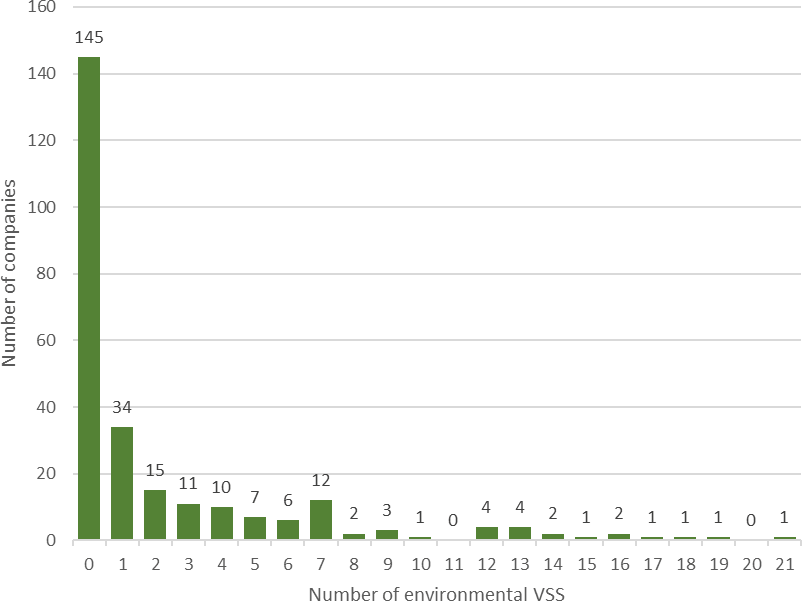
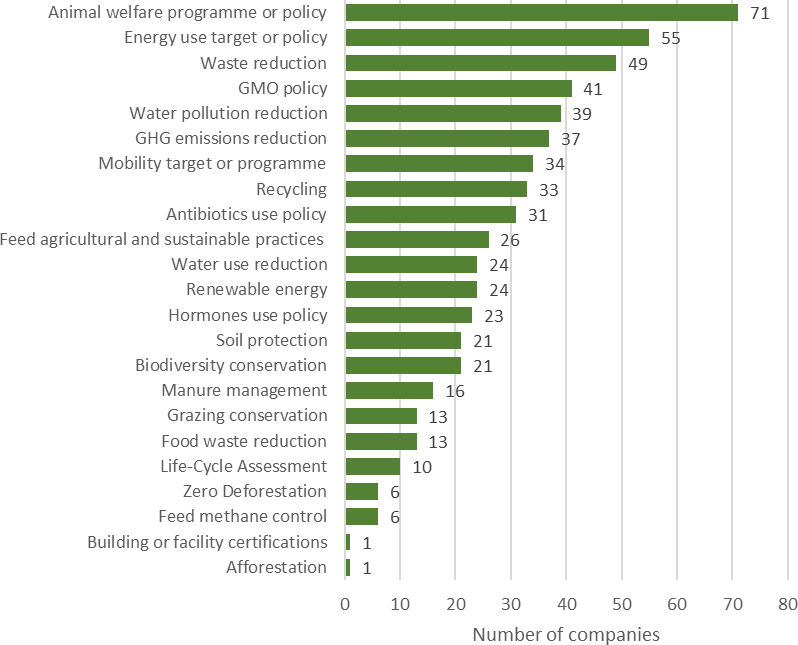
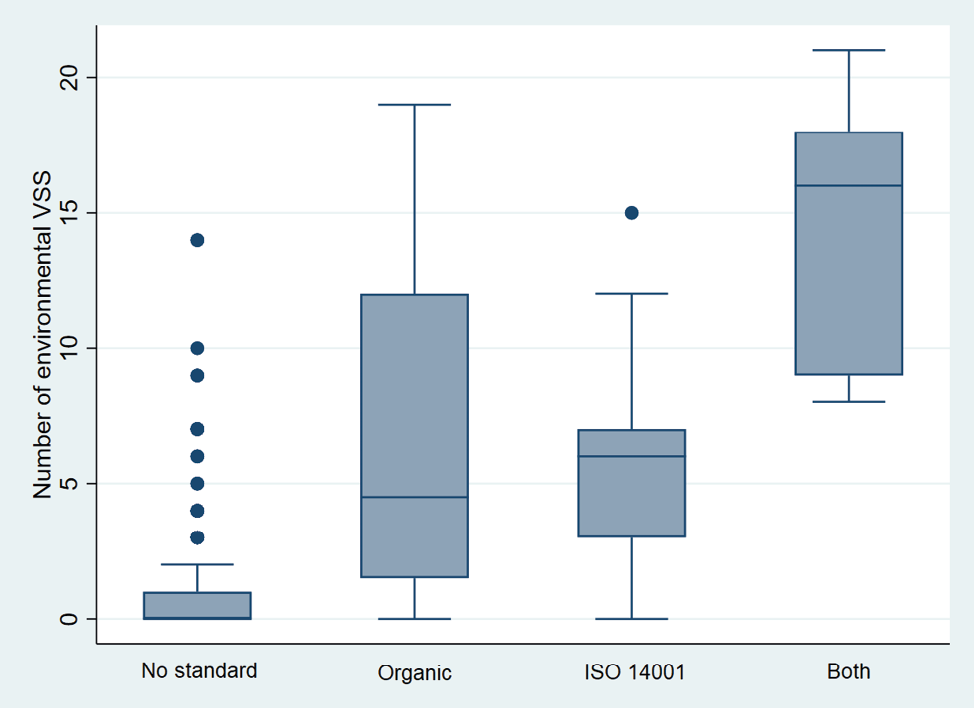
Table 3 shows the results of the regression models. Model 1 includes the entire sample, model 2 includes the subsample corresponding to the lowest half of the sample in terms of turnover and model 3 includes the subsample with the highest turnover. In model 1, the binary hurdle equation shows that producer, processer, turnover and the organic and ISO 14001 standards are strongly and positively correlated with the adoption of VSS. Based on the count model equation, producer; risk identification; and the control variables GDP per capita, sustainability report and the organic and ISO 14001 standards are strongly and positively correlated with the adoption of VSS. Public listing is weakly and positively correlated with the adoption of VSS, whereas butcher shop and local market have a negative and significant coefficient. Model 2 presents a positive coefficient related to consumer engagement and the organic standard in the binary equation. In the count model, producer, processer, risk identification and the organic and ISO 14001 standards are all strongly positive and significant, whereas feed producer is slightly significant and positive. For model 3, processer, turnover and the ISO 14001 standard are also positively correlated with the adoption of VSS in the binary equation. Looking at the corresponding count model, producer, processer, B2B orientation, B2C orientation, public listing, GDP per capita, sustainability report and the ISO 14001 standard all have positive and significant coefficients, whereas butcher shop and the local and global market types show negative and significant coefficients.
| Adoption of environmental voluntary sustainability standards | |||||||||||||||||||
|---|---|---|---|---|---|---|---|---|---|---|---|---|---|---|---|---|---|---|---|
| Model 1 | Model 2 | Model 3 | |||||||||||||||||
| Coefficient | Standard error | Coefficient | Standard error | Coefficient | Standard error | ||||||||||||||
| Parameters of the binary hurdle equation | |||||||||||||||||||
| Constant | -7.193*** | (1.969) | -2.403 | (2.909) | -10.888*** | (3.976) | |||||||||||||
| Value chain position Feed producer |
0.451 | (0.419) | -0.151 | (0.730) | 0.662 | (0.587) | |||||||||||||
| Producer | 0.653*** | (0.317) | 0.655 | (0.540) | 0.608 | (0.421) | |||||||||||||
| Processer | 0.725** | (0.290) | 0.739 | (0.465) | 0.911* | (0.421) | |||||||||||||
| Butcher shop | -0.156 | (0.301) | -0.570 | (0.459) | -0.181 | (0.461) | |||||||||||||
| Turnover | 0.214*** | (0.075) | -0.069 | (0.111) | 0.450** | (0.190) | |||||||||||||
| Market type Local |
-0.008 | (0.261) | -0.030 | (0.421) | 0.139 | (0.355) | |||||||||||||
| Global | 0.091 | (0.315) | 0.167 | (0.534) | -0.070 | (0.425) | |||||||||||||
| Business orientation B2B |
0.074 | (0.313) | -0.041 | (0.481) | 0.199 | (0.454) | |||||||||||||
| B2C | -0.258 | (0.239) | -0.291 | (0.347) | -0.245 | (0.353) | |||||||||||||
| Public listing | -4.630 | (181.954) | 0.000 | (omitted) | -4.963 | (149.647) | |||||||||||||
| Consumer engagement | 0.381 | (0.236) | 0.761** | (0.364) | 0.224 | (0.365) | |||||||||||||
| Risk identification | 8.694 | (265.708) | 6.394 | (293.123) | 7.966 | (232.428) | |||||||||||||
| Gross domestic product per capita | 0.233 | (0.171) | 0.201 | (0.256) | 0.171 | (0.251) | |||||||||||||
| Sustainability report | 8.857 | (399.937) | 0.000 | (omitted) | 8.291 | (275.644) | |||||||||||||
| Organic standard | 1.703*** | (0.448) | 1.558*** | (0.573) | 5.646 | (228.252) | |||||||||||||
| ISO14001 standard | 1.841*** | (0.520) | 6.662 | (330.545) | 1.151* | (0.625) | |||||||||||||
| Parameters of the count model equation | |||||||||||||||||||
| Constant | -33.541 | (10.327) | -31.199 | (22.807) | -38.662 | (12.464) | |||||||||||||
| Value chain position Feed producer |
0.636 | (1.562) | 8.737* | (5.053) | 1.618 | (1.924) | |||||||||||||
| Producer | 5.533*** | (1.226) | 7.058*** | (1.583) | 2.762* | (1.517) | |||||||||||||
| Processer | 2.258 | (1.505) | 3.732*** | (1.451) | 5.050** | (2.384) | |||||||||||||
| Butcher shop | -6.482*** | (1.875) | -2.904 | (1.917) | -6.110*** | (2.110) | |||||||||||||
| Turnover | -0.104 | (0.266) | 0.787 | (0.898) | 0.349 | (0.384) | |||||||||||||
| Market type Local |
-2.509** | (1.201) | 0.250 | (1.886) | -3.708*** | (1.377) | |||||||||||||
| Global | -1.971 | (1.301) | -0.489 | (1.830) | -2.513* | (1.487) | |||||||||||||
| Business orientation B2B |
2.448 | (1.541) | 3.089 | (2.118) | 2.924* | (1.762) | |||||||||||||
| B2C | 0.454 | (1.019) | -0.535 | (1.359) | 2.601*** | (1.265) | |||||||||||||
| Public listing | 3.790* | (2.108) | 2.804 | (omitted) | 4.143* | (2.165) | |||||||||||||
| Consumer engagement | 1.025 | (1.038) | 1.913 | (1.282) | 0.385 | (1.288) | |||||||||||||
| Risk identification | 2.640** | (1.096) | 6.161*** | (1.440) | 0.018 | (1.326) | |||||||||||||
| GDP per capita | 3.139*** | (0.959) | 1.005 | (1.611) | 2.671** | (1.081) | |||||||||||||
| Sustainability report | 4.761*** | (1.542) | 3.857 | (omitted) | 4.659*** | (1.541) | |||||||||||||
| Organic standard | 3.620*** | (0.979) | 6.351*** | (1.592) | 1.541 | (1.1787) | |||||||||||||
| ISO 14001 standard | 4.780*** | (1.104) | 8.579*** | (2.251) | 5.234*** | (1.272) | |||||||||||||
| Observations | 263 | 131 | 132 | ||||||||||||||||
| Log likelihood | -367.054 | -113.458 | -227.209 | ||||||||||||||||
| Note: Model 1 includes the entire sample. Model 2 includes the subsample corresponding to the lowest half of the sample in terms of turnover. Model 3 includes the subsample with the higher turnover. Robust standard errors are presented in parentheses. ‘Regional’ is the reference level for market type and was omitted from the models. *p < 0.1; **p < 0.05; ***p < 0.01. | |||||||||||||||||||
According to our results, VC position seems to have a role in the decision to adopt VSS, which supports H1 and is consistent with the literature (Marschner et al., 2025; Ponte et al., 2019). Specifically, being a feed producer, producer or processer increases the likelihood of adopting VSS. These results suggest that feed producers, animal farmers and manufacturers drive the sustainability transition in the beef VC. Lowe and Gereffi (2009) considered three segments to have a high potential in enhancing environmental sustainability along the VC, because they control manure management and cattle diets. Therefore, according to our results there is an interesting potential for a green transition in the European beef sector.
We identified a positive relationship between firm size and the adoption of environmental VSS, supporting H2. This suggests that as a company’s profitability increases, so does its likelihood of implementing individual sustainability standards (Artiach et al., 2010; Drempetic et al., 2020; Khaled et al., 2021). Consistently, larger firms are more likely to disclose their sustainability activities than smaller firms (Bager, Lambin, 2020; Holley et al., 2020). The results regarding market type show that both local companies operating in the national markets and global companies are likely to adopt fewer VSS than others, suggesting that regional firms are the most likely to adopt a higher number of VSS. This finding is in line with Di Vita et al. (2024), who found that medium-sized enterprises show great responsiveness to internal or external changes and are therefore more able to adopt sustainability practices than other actors. Our findings partially support H3. Business orientation, public listing and consumer engagement have a role in explaining the variability in VSS adoption, which demonstrates that stakeholder pressure has a consequence in terms of sustainability disclosures by companies (Chakrabarti, 2023; Gallo, Christensen, 2011; Goettsche et al., 2016; Gong et al., 2019; Kavadis, Thomsen, 2023; Murillo-Luna et al., 2008).
According to our models, the firms that identify a sustainability-related risk tend to adopt a higher number of environmental VSS. This finding supports H4 and suggests that firms with a risk-aware attitude perceive the adoption of VSS as a strategic opportunity rather than just a compliance cost (Bager, Lambin, 2020; ElShafei, 2020; Thorlakson et al., 2018). This result aligns with the findings by Swaim et al. (2016) and Williams and Schaefer (2013), who highlighted the importance of firms’ attitudes, values and environmental concerns in driving their commitment to sustainability practices and certifications. Indeed, having well-developed risk awareness related to existing environmental uncertainty can help firms be more sensitive towards the management of uncertainties that could possibly hinder business activities. For example, the adoption of VSS could allow businesses to anticipate future regulations rather than having to comply with mandatory policies when they are implemented. This is especially important for firms that may encounter difficulties in adapting to new regulatory frameworks and market rules due to their limited financial availability. In these cases, the adoption of standards can help such firms to progressively adapt to changing regulatory conditions and to be updated about new market trends.
Beef firms tend to adopt a higher number of VSS when they are in countries with a high GDP per capita and when they issue a sustainability report. It is interesting to note the results about the certifications implemented by firms, suggesting a sort of path dependency in the firms’ attitude towards the adoption of sustainable practices. Specifically, the higher the structural dimension of the firms, the higher the probability to adopt different types of sustainability practices (Drempetic et al., 2020). There are several reasons for this phenomenon. First, large firms have the financial possibility to invest in sustainable programmes for their business. Second, larger firm is affected by a higher risk of reputation loss compared with smaller firms. Consequently, the need to implement sustainability-certified activities becomes strategic. Third, the implementation of sustainability practices often creates interdependencies between certification and practice adoption. Once a firm has invested in one sustainability certification, it incurs fixed costs related to compliance, reporting and monitoring. These investments can lower the marginal cost of adopting additional VSS. Fourth, in buyer-driven supply chains, large corporations and retailers often require multiple certifications from suppliers. Consequently, the larger the firms are, the higher the number of sustainability-related requests by large retailers.
We explored the mechanisms driving beef companies to adopt different sustainability strategies, emphasising the role of firm characteristics and VC positions. We found that a large proportion of beef firms have not adopted any sustainability strategies. The most commonly adopted VSS concern animal welfare, energy use, waste and genetically modified organisms (GMOs), which are notable topics in the public discourse. These policies do not align entirely with the priorities identified by the scientific community in terms of GHG emissions (Caccialanza et al., 2023; Putman et al., 2023). Manure management, cattle diet practices and feed methane control are more urgent and relevant to mitigate beef production’s negative impact on the environment (Kokemohr et al., 2022; Lowe, Gereffi, 2009), but those are not among the most commonly adopted in our sample of European companies. The regression analysis results demonstrate that GVC theory, stakeholder theory and resource dependence theory complement each other in explaining the pattern of the adoption of environmental VSS by European beef firms. Specifically, producers and processers tend to communicate their sustainability efforts more than other firms. Firm size and stakeholder pressure are also partially relevant in explaining the adoption of VSS. We found a positive correlation between risk identification and environmental disclosure, which implies that risk-aware firms adopt VSS strategically to improve the business.
These results can provide both policymakers and companies with information about how the beef sector addresses environmental issues, and inform their policy choices. Overall, our results should stimulate policymakers to implement stronger regulation to give beef firms incentives to act more sustainably. We identified producers and processors as key actors driving the adoption of environmental VSS. These two segments have the power to influence the entire beef VC and to control manure management and cattle diets, which are two of the most impactful practices in terms of reducing GHG emissions (Lowe, Gereffi, 2009). This entails the potential to scale up their efforts. Policymakers should focus on regulations and incentives on these segments to strengthen sustainability impacts across the VC. This could involve, for example, mandatory reporting requirements for large processors or targeted methane-reduction standards in feed and manure practices. According to Lowe and Gereffi (2009), feed producers also have the potential to drive the environmental sustainability transition along the beef VC because they can influence cattle diets, but our results show that this potential is only exploited in the small and medium-sized enterprises (SMEs). This result highlights the importance of putting feed manufacturers under the spotlight and targeting that VC segment with awareness campaigns and tailored policy, which could effectively lower the methane emissions from enteric fermentation.
We found that firm size is a significant predictor for environmental-sustainability-related strategies, and SMEs are less likely to commit to sustainability. A potential policy implication of this finding is the need for policymakers to focus on SMEs, and to provide them with a normative path to reduce the barriers they face by introducing, for example, specific technical assistance programmes to implement practices and certifications, or easing the access to sustainability consultants. The results also show that firms with high awareness towards environmental risks tend to adopt more VSS. Policies could provide effective communication strategies to increase environmental risk literacy, to share industry best practices and to increase the availability of sector-specific tools, such as environmental risk assessment templates.
Our data collection revealed that there are not many beef-specific third-party sustainability certifications. However, there are inconsistencies in the literature regarding the actual effectiveness of sustainability activities by third-party certifiers in agri-food VCs (Meemken et al., 2021). Therefore, the lack of beef-specific ones creates a somewhat favourable opportunity for policymakers to focus their efforts on regulating beef firms directly, which could allow for a direct sustainability effort scale-up along the beef VC.
From a managerial perspective, our results provide a framework to help firms select suitable sustainability strategies and to understand their competitors’ approaches. Larger firms and those operating in regional markets tend to adopt more VSS, both for reputational benefits and differentiation. Therefore, adopting and communicating sustainability strategies and environmental VSS offers an opportunity for beef producers and actors along the VC to strengthen their reputation of their brands and firms, and therefore to improve their market positioning and competitive advantage. In addition, the positive role of consumer engagement in the sustainability path of firms reveals that investments in transparent communication channels and traceability systems that align with consumer values can be effective solutions to leverage consumer engagement. Moreover, our analysis revealed a sustainability path dependency. Hence, firms should consider initial investments in sustainability as a useful step to lower the marginal cost of future compliance.
It is essential to acknowledge that our methodology presents some limitations and carries risks of selection bias, information loss and coverage gaps. First, our reliance on Orbis data implies potential data gaps, especially concerning small and micro firms. Nevertheless, we decided to rely on Orbis because it includes financial information of both private and public companies, differently from other databases (Kalemli-Özcan et al., 2024). The presence of the word ‘beef’ in the company name or activity description as one of our criteria to filter companies may have excluded from the sample actors operating in the beef VC that do not report the word ‘beef’ explicitly, such as vertically or horizontally integrated food firms, or multinational processors. Moreover, our study design required an online presence by firms to build our database, which may have led to an underrepresentation of small and micro firms that do not have the means to maintain a website. These limitations create a risk of overrepresenting larger and more formalised firms, and thus only partially replicating the actual European beef VC structure, in which the presence of SMEs is important. Additionally, the reliance on voluntary sustainability reporting raises concerns about greenwashing and data accuracy. In this regard, we decided to focus on sustainability disclosure rather than effectiveness and factual impact of the sustainability initiatives we considered. Another challenge is the potential endogeneity between firm turnover and environmental VSS adoption. Whether financial success enables sustainability efforts or vice versa remains unclear, but we mitigated this issue by employing turnover data referring to a previous point in time rather than the sustainability disclosure data. Similarly, measuring consumer engagement through social media activity may conflate sustainability communication with actual consumer interaction.
The scientific implications of this study include the effectiveness of integrating different research approaches. Future studies should consider the generalisability of our findings by investigating other agrifood VCs. An additional indication for future research is to develop a methodology to identify possibly misleading information on firm websites and sustainability reports, and to address potential greenwashing in firms’ sustainability disclosures. This would enrich the literature by allowing for an even deeper comprehension of the adoption patterns of sustainability strategies along the agrifood VC.
Conceptualization: S.M., S.S.; Methodology: S.M., L.O., S.S.; Writing - Original draft preparation: S.M.; Writing - Reviewing and Editing: S.M., S.S.
Abdulsamad A., Frederick S., Guinn A., Gereffi G. (2015). Pro-Poor Development and Power Asymmetries in Global Value Chains. DOI: https://doi.org/10.13140/RG.2.2.32872.88323
Angerer V., Sabia E., König von Borstel U., Gauly M. (2021). Environmental and biodiversity effects of different beef production systems. Journal of Environmental Management, 289, 112523. DOI: https://doi.org/10.1016/j.jenvman.2021.112523
Artiach T., Lee D., Nelson D., Walker J. (2010). The determinants of corporate sustainability performance. Accounting & Finance, 50(1): 31-51. DOI: https://doi.org/10.1111/j.1467-629X.2009.00315.x
Azzam A., Andersson H. (2008). Measuring Price effects of concentration in mixed oligopoly: an application to the Swedish beef-slaughter industry. Journal of Industry, Competition and Trade, 8(1): 21-31. DOI: https://doi.org/10.1007/s10842-007-0006-x
Bager S.L., Lambin E.F. (2020). Sustainability strategies by companies in the global coffee sector. Business Strategy and the Environment, 29(8): 3555-3570. DOI: https://doi.org/10.1002/bse.2596
Benatti L., Biolatti B., Cinotti S., Federici C., Montanari C., de Roest K., Rama D. (2013). La sostenibilità delle carni bovine a marchio Coop: Gli impatti economici, sociali e ambientali della filiera delle carni. Coop. https://carnisostenibili.it/wp-content/uploads/2018/01/La-Sostenibilit%C3%A0-delle-carni-bovine-a-marchio-Coop-%E2%80%93-Gli-impatti-economici-sociali-ed-ambientali-della-filiera-delle-carni.pdf
Bernués A., Ruiz R., Olaizola A., Villalba D., Casasús I. (2011). Sustainability of pasture-based livestock farming systems in the European Mediterranean context: synergies and trade-offs. Livestock Science, 139(1): 44-57. DOI: https://doi.org/10.1016/j.livsci.2011.03.018
Boncinelli F., Bartolini F., Casini L. (2018). Structural factors of labour allocation for farm diversification activities. Land Use Policy, 71: 204-212. DOI: https://doi.org/10.1016/j.landusepol.2017.11.058
Broom D.M. (2021). A method for assessing sustainability, with beef production as an example. Biological Reviews, 96(5): 1836-1853. DOI: https://doi.org/10.1111/brv.12726
Buckley K.J., Newton P., Gibbs H.K., McConnel I., Ehrmann J. (2019). Pursuing sustainability through multi-stakeholder collaboration: a description of the governance, actions, and perceived impacts of the roundtables for sustainable beef. World Development, 121: 203-217. DOI: https://doi.org/10.1016/j.worlddev.2018.07.019
Bullock G., van der Ven H. (2020). The shadow of the consumer: analyzing the importance of consumers to the uptake and sophistication of ratings, certifications, and eco-labels. Organization & Environment, 33(1): 75-95. DOI: https://doi.org/10.1177/1086026618803748
Burnier P.C., Spers E.E., Barcellos M.D. (2021). Role of sustainability attributes and occasion matters in determining consumers’ beef choice. Food Quality and Preference, 88, 104075. DOI: https://doi.org/10.1016/j.foodqual.2020.104075
Caccialanza A., Cerrato D., Galli D. (2023). Sustainability practices and challenges in the meat supply chain: A systematic literature review. British Food Journal, 125(12): 4470-4497. DOI: https://doi.org/10.1108/BFJ-10-2022-0866
Camargo M.C., Hogarth N.J., Pacheco P., Nhantumbo I., Kanninen M. (2019). Greening the dark side of chocolate: a qualitative assessment to inform sustainable supply chains. Environmental Conservation, 46(1): 9-16. DOI: https://doi.org/10.1017/S0376892918000243
Castonguay A.C., Polasky S., Holden M.H., Herrero M., Mason-D’Croz D., Godde C., Chang J., Gerber J., Witt G.B., Game E.T., Bryan B.A., Wintle B., Lee K., Bal P., McDonald-Madden E. (2023). Navigating sustainability trade-offs in global beef production. Nature Sustainability, 6(3): 284-294. DOI: https://doi.org/10.1038/s41893-022-01017-0
Chakrabarti A.B. (2023). Mind your own business: ownership and its influence on sustainability. Safety Science, 157, 105926. DOI: https://doi.org/10.1016/j.ssci.2022.105926
Chiang C., Chuang M.C. (2024). Effect of sustainable supply chain management on procurement environmental performance: a perspective on resource dependence theory. Sustainability, 16(2): 2. DOI: https://doi.org/10.3390/su16020586
Clune S., Crossin E., Verghese K. (2017). Systematic review of greenhouse gas emissions for different fresh food categories. Journal of Cleaner Production, 140: 766-783. DOI: https://doi.org/10.1016/j.jclepro.2016.04.082
Conant R.T., Cerri C.E.P., Osborne B.B., Paustian K. (2017). Grassland management impacts on soil carbon stocks: a new synthesis. Ecological Applications, 27(2): 662-668. DOI: https://doi.org/10.1002/eap.1473
Cragg J.G. (1971). Some statistical models for limited dependent variables with application to the demand for durable goods. Econometrica, 39(5): 829-844. DOI: https://doi.org/10.2307/1909582
Crippa M., Solazzo E., Guizzardi D., Monforti-Ferrario F., Tubiello F.N., Leip A. (2021). Food systems are responsible for a third of global anthropogenic GHG emissions. Nature Food, 2(3): 198-209. DOI: https://doi.org/10.1038/s43016-021-00225-9
Cusack D.F., Kazanski C.E., Hedgpeth A., Chow K., Cordeiro A.L., Karpman J., Ryals R. (2021). Reducing climate impacts of beef production: A synthesis of life cycle assessments across management systems and global regions. Global Change Biology, 27(9): 1721-1736. DOI: https://doi.org/10.1111/gcb.15509
Daniel W.W., Cross C.L. (2018). Biostatistics: A Foundation for Analysis in the Health Sciences. John Wiley & Sons, Hoboken, NJ.
Darnall N., Henriques I., Sadorsky P. (2010). Adopting proactive environmental strategy: the influence of stakeholders and firm size. Journal of Management Studies, 47: 1072-1094. https://doi.org/10.1111/j.1467-6486.2009.00873.x
Delmas M.A., Lyon T.P., Maxwell J.W. (2019). Understanding the role of the corporation in sustainability transitions. Organization & Environment, 32(2): 87-97. DOI: https://doi.org/10.1177/1086026619848255
Delmas M.A., Toffel M.W. (2004). Stakeholders and environmental management practices: an institutional framework. Business Strategy and the Environment, 13(4): 209-222. DOI: https://doi.org/10.1002/bse.409
Di Vita G., Zanchini R., De Cianni R., Pippinato L., Mancuso T., Brun F. (2024). Sustainable livestock farming in the European Union: a study on beef farms in NUTS 2 regions. Sustainability, 16(3): 3. DOI: https://doi.org/10.3390/su16031098
Drempetic S., Klein C., Zwergel B. (2020). The influence of firm size on the ESG Score: corporate sustainability ratings under review. Journal of Business Ethics, 167(2): 333-360. DOI: https://doi.org/10.1007/s10551-019-04164-1
ElShafei R. (2020). Managers’ risk perception and the adoption of sustainable consumption strategies in the hospitality sector: the moderating role of stakeholder salience attributes. Smart and Sustainable Built Environment, 11(1): 1-18. DOI: https://doi.org/10.1108/SASBE-03-2020-0024
FAOSTAT. (2020). Food and Agricultural Organization Statistics Database on Livestock Primary. Food and Agriculture Organization of the United Nations, Rome.
FAOSTAT. (2025). Emissions from Livestock [Dataset]. Food and Agriculture Organization of the United Nations, Rome. https://www.fao.org/faostat/en/#data/GLE
Fernandes Martins K., Teixeira D., de Oliveira Corrêa R. (2022). Gains in sustainability using Voluntary Sustainability Standards: A systematic review. Cleaner Logistics and Supply Chain, 5, 100084. DOI: https://doi.org/10.1016/j.clscn.2022.100084
Fernandez-Feijoo B., Romero S., Ruiz S. (2014). Effect of stakeholders’ pressure on transparency of sustainability reports within the GRI framework. Journal of Business Ethics, 122(1): 53-63. DOI: https://doi.org/10.1007/s10551-013-1748-5
Freeman R.E. (1984). Strategic Management: A Stakeholder Approach. Cambridge University Press, Cambridge.
Freeman R.E. (2010). Strategic Management: A Stakeholder Approach. Cambridge University Press. Cambridge.
Freeman R.E., Dmytriyev S.D., Phillips R.A. (2021). Stakeholder theory and the resource-based view of the firm. Journal of Management, 47(7): 1757-1770. DOI: https://doi.org/10.1177/0149206321993576
Gallo P.J., Christensen L.J. (2011). Firm Size matters: an empirical investigation of organizational size and ownership on sustainability-related behaviors. Business & Society, 50(2): 315-349. DOI: https://doi.org/10.1177/0007650311398784
Garde Sánchez R., Rodríguez Bolívar M.P., López Hernández A.M. (2017). Perceptions of stakeholder pressure for supply-chain social responsibility and information disclosure by state-owned enterprises. The International Journal of Logistics Management, 28(4): 1027-1053. DOI: https://doi.org/10.1108/IJLM-05-2016-0118
Gerber P.J., Mottet A., Opio C.I., Falcucci A., Teillard F. (2015). Environmental impacts of beef production: Review of challenges and perspectives for durability. Meat Science, 109: 2-12. DOI: https://doi.org/10.1016/j.meatsci.2015.05.013
Gerber P.J., Steinfeld H., Henderson B., Mottet A., Opio C. (2013). Tackling Climate Change Through Livestock: A Global Assessment of Emissions and Mitigation Opportunities. Food and Agriculture Organization of the United Nations, Rome.
Gereffi G. (1994). The organisation of buyer-driven global commodity chains: how U.S. Retailers shape overseas production networks. In Gereffi G., Korzeniewicz M. (eds), Commodity Chains and Global Capitalism (pp. 95-122). Praeger, Westport, CT. https://hdl.handle.net/10161/11457
Gereffi G., Lee J. (2009). A Global Value Chain Approach to Food Safety and Quality Standards. https://www.researchgate.net/publication/237280872_A_GLOBAL_VALUE_CHAIN_APPROACH_TO_FOOD_SAFETY_AND_QUALITY_STANDARDS
Gereffi G., Lee J. (2012). Why the world suddenly cares about global supply chains. Journal of Supply Chain Management, 48(3): 24-32. DOI: https://doi.org/10.1111/j.1745-493X.2012.03271.x
Giannakis M., Papadopoulos T. (2016). Supply chain sustainability: a risk management approach. International Journal of Production Economics, 171: 455-470. DOI: https://doi.org/10.1016/j.ijpe.2015.06.032
Gibbon P. (2001). Upgrading primary production: a global commodity chain approach. World Development, 29(2): 345-363. DOI: https://doi.org/10.1016/S0305-750X(00)00093-0
Gillespie J., Kim S.A., Paudel K. (2007). Why don’t producers adopt best management practices? An analysis of the beef cattle industry. Agricultural Economics, 36(1): 89-102. DOI: https://doi.org/10.1111/j.1574-0862.2007.00179.x
Goettsche M., Steindl T., Gietl S. (2016). Do customers affect the value relevance of sustainability reporting? Empirical evidence on stakeholder interdependence. Business Strategy and the Environment, 25(3): 149-164. DOI: https://doi.org/10.1002/bse.1856
Gong M., Gao Y., Koh L., Sutcliffe C., Cullen J. (2019). The role of customer awareness in promoting firm sustainability and sustainable supply chain management. International Journal of Production Economics, 217: 88-96. DOI: https://doi.org/10.1016/j.ijpe.2019.01.033
Goodman J., Korsunova A., Halme M. (2017). Our collaborative future: activities and roles of stakeholders in sustainability-oriented innovation. Business Strategy and the Environment, 26(6): 731-753. DOI: https://doi.org/10.1002/bse.1941
Gray R. (2008). Review essay: envisioning sustainability and re‐envisioning the large corporation: A short review essay on business and sustainable development. Social and Environmental Accountability Journal, 28(1): 45-48. DOI: https://doi.org/10.1080/0969160X.2008.9651790
Groves C., Frater L., Lee R., Stokes E. (2011). Is there room at the bottom for CSR? Corporate social responsibility and nanotechnology in the UK. Journal of Business Ethics, 101(4): 525-552. DOI: https://doi.org/10.1007/s10551-010-0731-7
Grzelak A., Borychowski M., Staniszewski J. (2022). Economic, environmental, and social dimensions of farming sustainability – trade-off or synergy? Technological and Economic Development of Economy, 28(3): 3. DOI: https://doi.org/10.3846/tede.2022.16463
Haddock J. (2005). Consumer influence on internet‐based corporate communication of environmental activities: the UK food sector. British Food Journal, 107(10): 792-805. DOI: https://doi.org/10.1108/00070700510623559
Hahn R., Kühnen M. (2013). Determinants of sustainability reporting: a review of results, trends, theory, and opportunities in an expanding field of research. Journal of Cleaner Production, 59: 5-21. DOI: https://doi.org/10.1016/j.jclepro.2013.07.005
Hillman A.J., Withers M.C., Collins B.J. (2009). Resource dependence theory: a review. Journal of Management, 35(6): 1404-1427. DOI: https://doi.org/10.1177/0149206309343469
Hocquette J.F., Chatellier V. (2011). Prospects for the European beef sector over the next 30 years. Animal Frontiers, 1(2): 20-28. DOI: https://doi.org/10.2527/af.2011-0014
Hocquette J.F., Ellies-Oury M.P., Lherm M., Pineau C., Deblitz C., Farmer L. (2018). Current situation and future prospects for beef production in Europe—a review. Asian-Australasian Journal of Animal Sciences, 31(7): 1017-1035. DOI: https://doi.org/10.5713/ajas.18.0196
Holley K., Jensen K.L., Lambert D.M., Clark C.D. (2020). Bivariate MIMIC analysis of pasture management and prescribed grazing practices used by beef cattle producers. Journal of Agricultural and Resource Economics, 45(1): 56-77.
Hübel C., Schaltegger S. (2022). Barriers to a sustainability transformation of meat production practices—an industry actor perspective. Sustainable Production and Consumption, 29: 128-140. DOI: https://doi.org/10.1016/j.spc.2021.10.004
Jiang H., Luo Y., Xia J., Hitt M., Shen J. (2023). Resource dependence theory in international business: progress and prospects. Global Strategy Journal, 13(1): 3-57. DOI: https://doi.org/10.1002/gsj.1467
Johnson M., Redlbacher F., Schaltegger S. (2018). Stakeholder engagement for corporate sustainability: a comparative analysis of B2C and B2B companies. Corporate Social Responsibility and Environmental Management, 25(4): 659-673. DOI: https://doi.org/10.1002/csr.1484
Kalemli-Özcan Ş., Sørensen B.E., Villegas-Sanchez C., Volosovych V., Yeşiltaş S. (2024). How to construct nationally representative firm-level data from the Orbis Global Database: new facts on SMEs and aggregate implications for industry concentration. American Economic Journal: Macroeconomics, 16(2): 353-374. DOI: https://doi.org/10.1257/mac.20220036
Kano L. (2018). Global value chain governance: a relational perspective. Journal of International Business Studies, 49(6): 684-705. DOI: https://doi.org/10.1057/s41267-017-0086-8
Kavadis N., Thomsen S. (2023). Sustainable corporate governance: a review of research on long-term corporate ownership and sustainability. Corporate Governance: An International Review, 31(1): 198-226. DOI: https://doi.org/10.1111/corg.12486
Khaled R., Ali H., Mohamed E.K.A. (2021). The Sustainable Development Goals and corporate sustainability performance: mapping, extent and determinants. Journal of Cleaner Production, 311: 127599. DOI: https://doi.org/10.1016/j.jclepro.2021.127599
Khanna M., Anton W.R.Q. (2002). Corporate environmental management: regulatory and market-based incentives. Land Economics, 78(4): 539-558. DOI: https://doi.org/10.2307/3146852
Kokemohr L., Escobar N., Mertens A., Mosnier C., Pirlo G., Veysset P., Kuhn T. (2022). Life cycle sustainability assessment of European beef production systems based on a farm-level optimization model. Journal of Cleaner Production, 379, 134552. DOI: https://doi.org/10.1016/j.jclepro.2022.134552
Lambin E.F., Thorlakson T. (2018). Sustainability standards: interactions between private actors, civil society, and governments. Annual Review of Environment and Resources, 43(1): 369-393. DOI: https://doi.org/10.1146/annurev-environ-102017-025931
Lee J., Gereffi G., Beauvais J. (2012). Global value chains and agrifood standards: challenges and possibilities for smallholders in developing countries. Proceedings of the National Academy of Sciences, 109(31): 12326-12331. DOI: https://doi.org/10.1073/pnas.0913714108
Li Y., Zhong H., Shan Y., Hang Y., Wang D., Zhou Y., Hubacek K. (2023). Changes in global food consumption increase GHG emissions despite efficiency gains along global supply chains. Nature Food, 4(6): 483-495. DOI: https://doi.org/10.1038/s43016-023-00768-z
Loomis J.J., de Oliveira J.A.P. (2024). Understanding dynamics between public policy and global value chains (GVCs): governance for sustainability in the Brazilian Amazon beef cattle GVC. The International Journal of Logistics Management. DOI: https://doi.org/10.1108/IJLM-03-2024-0139
Lourenço I.C., Branco M.C. (2013). Determinants of corporate sustainability performance in emerging markets: the Brazilian case. Journal of Cleaner Production, 57: 134-141. DOI: https://doi.org/10.1016/j.jclepro.2013.06.013
Lowe M., Gereffi G. (2009). A Value Chain Analysis of the U.S. Beef and Dairy Industries. Center of Globalization, Governance and Competitiveness, Duke University, Durham, NC.
Maes D., Vancauteren M., Van Passel S. (2019). Investigating market power in the Belgian pork production chain. Review of Agricultural, Food and Environmental Studies, 100(1): 93-117. DOI: https://doi.org/10.1007/s41130-019-00096-6
Maia de Souza D., Petre R., Jackson F., Hadarits M., Pogue S., Carlyle C.N., Bork E., McAllister T. (2017). A Review of sustainability enhancements in the beef value chain: state-of-the-art and recommendations for future improvements. Animals, 7(3): 3. DOI: https://doi.org/10.3390/ani7030026
Marschner S., Orsi L., Olper A., Stranieri S. (2025). Sustainability strategies in the cocoa-chocolate value chain: an analysis using stakeholder theory, global value chain theory, and resource dependence theory. Agribusiness. DOI: https://doi.org/10.1002/agr.22044
Mayer F., Gereffi G. (2010). Regulation and Economic globalization: prospects and limits of private governance. Business and Politics, 12(3): 1-25. DOI: https://doi.org/10.2202/1469-3569.1325
Meemken E.M. (2021). Large farms, large benefits? Sustainability certification among family farms and agro-industrial producers in Peru. World Development, 145, 105520. https://doi.org/10.1016/j.worlddev.2021.105520
Meemken E.M., Barrett C.B., Michelson H.C., Qaim M., Reardon T., Sellare J. (2021). Sustainability standards in global agrifood supply chains. Nature Food, 2(10): 10. DOI: https://doi.org/10.1038/s43016-021-00360-3
Mullahy J. (1986). Specification and testing of some modified count data models. Journal of Econometrics, 33(3): 341-365. DOI: https://doi.org/10.1016/0304-4076(86)90002-3
Murillo-Luna J.L., Garcés-Ayerbe C., Rivera-Torres P. (2008). Why do patterns of environmental response differ? A stakeholders’ pressure approach. Strategic Management Journal, 29(11): 1225-1240. DOI: https://doi.org/10.1002/smj.711
Naziri D., Bennett B. (2012). Private voluntary standards in livestock and meat sectors: implications for developing countries. Food Chain, 2(1): 64-85. DOI: https://doi.org/10.3362/2046-1887.2012.006
Nepstad D., McGrath D., Stickler C., Alencar A., Azevedo A., Swette B., Bezerra T., DiGiano M., Shimada J., Seroa da Motta R., Armijo E., Castello L., Brando P., Hansen M.C., McGrath-Horn M., Carvalho O., Hess L. (2014). Slowing Amazon deforestation through public policy and interventions in beef and soy supply chains. Science, 344(6188): 1118-1123. DOI: https://doi.org/10.1126/science.1248525
Nielsen N.A., Jeppesen L.F. (2001). The Beef Market in the European Union. The Aarhus School of Business, Aarhus.
Ogundeji A., Maré F. (2020). Analysis of price transmission in the beef value chain using a calculated retail carcass price. Agrekon, 59(2): 144-155. DOI: https://doi.org/10.1080/03031853.2019.1700808
Parmigiani A., Klassen R.D., Russo M.V. (2011). Efficiency meets accountability: performance implications of supply chain configuration, control, and capabilities. Journal of Operations Management, 29(3): 212-223. DOI: https://doi.org/10.1016/j.jom.2011.01.001
Parra-Paitan C., zu Ermgassen E.K.H.J., Meyfroidt P., Verburg P.H. (2023). Large gaps in voluntary sustainability commitments covering the global cocoa trade. Global Environmental Change, 81, 102696. DOI: https://doi.org/10.1016/j.gloenvcha.2023.102696
Pashaei Kamali F., Meuwissen M.P.M., De Boer I.J.M., Stolz H., Jahrl I., Garibay S.V., Jacobsen R., Driesen T., Oude Lansink A.G.J.M. (2014). Identifying Sustainability issues for soymeal and beef production chains. Journal of Agricultural and Environmental Ethics, 27(6): 949-965. DOI: https://doi.org/10.1007/s10806-014-9510-2
Pfeffer J., Salancik G.R. (1978). The External Control of Organizations: A Resource Dependence Perspective. Stanford University Press, Stanford, CA.
Pfeffer J., Salancik G.R. (2003). The External Control of Organizations: A Resource Dependence Perspective. Stanford University Press, Stanford, CA.
Pietrzak M., Chlebicka A., Kraciński P., Malak-Rawlikowska A. (2020). Information asymmetry as a barrier in upgrading the position of local producers in the global value chain—evidence from the apple sector in Poland. Sustainability, 12(19): 19. DOI: https://doi.org/10.3390/su12197857
Ponte S. (2020). Green capital accumulation: business and sustainability management in a world of global value chains. New Political Economy, 25(1): 72-84. DOI: https://doi.org/10.1080/13563467.2019.1581152
Ponte S., Gereffi G., Raj-Reichert G. (2019). Introduction to the Handbook on Global Value Chains. In Ponte S., Gereffi G., Raj-Recihert G. (eds) Handbook on Global Value Chains (pp. 1-27). Edward Elgar Publishing, Cheltenham. DOI: https://doi.org/10.4337/9781788113779.00005
Putman B., Rotz C.A., Thoma G. (2023). A comprehensive environmental assessment of beef production and consumption in the United States. Journal of Cleaner Production, 402, 136766. DOI: https://doi.org/10.1016/j.jclepro.2023.136766
Schaltegger S., Hörisch J., Freeman R.E. (2019). Business cases for sustainability: a stakeholder theory perspective. Organization & Environment, 32(3): 191-212. DOI: https://doi.org/10.1177/1086026617722882
Sinkovics N., Sinkovics R.R. (2019). International business and global value chains. In Ponte S., Gereffi G., Raj-Reichert G. (eds) Handbook on Global Value Chains (pp. 417-431). Edward Elgar Publishing, Cheltenham. DOI: https://doi.org/10.4337/9781788113779
Soregaroli C., Varacca A., Ricci E.C., Platoni S., Tillie P., Stranieri S. (2022). Voluntary standards as meso-institutions: A Bayesian investigation of their relationships with transaction governance and risks. Applied Economic Perspectives and Policy, 44(4): 1660-1681. DOI: https://doi.org/10.1002/aepp.13252
Sotorrío L.L., Sánchez J.L.F. (2010). Corporate social reporting for different audiences: the case of multinational corporations in Spain. Corporate Social Responsibility and Environmental Management, 17(5): 272-283. DOI: https://doi.org/10.1002/csr.215
Spada E., De Cianni R., Di Vita G., Mancuso T. (2024). Balancing freshness and sustainability: charting a course for meat industry innovation and consumer acceptance. Foods, 13(7): 7. DOI: https://doi.org/10.3390/foods13071092
Stranieri S., Ricci E.C., Stiletto A., Trestini S. (2023). How about choosing environmentally friendly beef? Exploring purchase intentions among Italian consumers. Renewable Agriculture and Food Systems, 38: e2. DOI: https://doi.org/10.1017/S1742170522000357
Swaim J.A., Maloni M.J., Henley A., Campbell S. (2016). Motivational influences on supply manager environmental sustainability behavior. Supply Chain Management: An International Journal, 21(3): 305-320. DOI: https://doi.org/10.1108/SCM-07-2015-0283
Thorlakson T. (2018). A move beyond sustainability certification: the evolution of the chocolate industry’s sustainable sourcing practices. Business Strategy and the Environment, 27(8): 1653-1665. DOI: https://doi.org/10.1002/bse.2230
Thorlakson T., de Zegher J.F., Lambin E.F. (2018). Companies’ contribution to sustainability through global supply chains. Proceedings of the National Academy of Sciences, 115(9): 2072-2077. DOI: https://doi.org/10.1073/pnas.1716695115
Ullmann A.A. (1985). Data in search of a theory: a critical examination of the relationships among social performance, social disclosure, and economic performance of U.S. firms. Academy of Management Review, 10(3): 540-557. DOI: https://doi.org/10.5465/amr.1985.4278989
Verbeke W., Pérez-Cueto F.J.A., Barcellos M.D., Krystallis A., Grunert K.G. (2010). European citizen and consumer attitudes and preferences regarding beef and pork. Meat Science, 84(2): 284-292. DOI: https://doi.org/10.1016/j.meatsci.2009.05.001
Vosooghidizaji M., Taghipour A., Canel-Depitre B. (2020). Supply chain coordination under information asymmetry: a review. International Journal of Production Research, 58(6): 1805-1834. DOI: https://doi.org/10.1080/00207543.2019.1685702
Wang L., Juslin H. (2013). Corporate social responsibility in the chinese forest industry: understanding multiple stakeholder perceptions. Corporate Social Responsibility and Environmental Management, 20(3): 129-145. DOI: https://doi.org/10.1002/csr.286
Williams S., Schaefer A. (2013). Small and medium-sized enterprises and sustainability: managers’ values and engagement with environmental and climate change issues. Business Strategy and the Environment, 22(3): 173-186. DOI: https://doi.org/10.1002/bse.1740
Wolf J. (2014). The relationship between sustainable supply chain management, stakeholder pressure and corporate sustainability performance. Journal of Business Ethics, 119(3): 317-328. DOI: https://doi.org/10.1007/s10551-012-1603-0
Zu Ermgassen E.K.H.J., Godar J., Lathuillière M.J., Löfgren P., Gardner T., Vasconcelos A., Meyfroidt, P. (2020). The origin, supply chain, and deforestation risk of Brazil’s beef exports. Proceedings of the National Academy of Sciences, 117(50): 31770-31779. DOI: https://doi.org/10.1073/pnas.2003270117