Keynote article
Transdisciplinary perspectives to investigate sustainable food system transitions
Professor in Sustainability and Circular Economy, University of Exeter Business School, United Kingdom
Visiting Professor in Sustainable Business, University of Auckland Business School, New Zealand
Visiting Researcher, Business Management and Organization, Wageningen University, The Netherlands
Email: s.pascucci@exeter.ac.uk
Abstract. The Anthropocene is an unprecedented geological period characterised by large-scale socio-ecological crises, including biodiversity loss, climate change, ocean acidification and irreversible deterioration of soil health, among others. These crises have created concerns among scientists, who are now openly discussing scenarios in which humanity will not be able to inhabit this planet and challenging how they can respond to these mounting challenges. Given this dramatic and contested context, in this essay we pose the following questions: what are the fields of knowledge we need (to collectively create) to solve the crises of a planet in chaos? What (type of) knowledge do we need? From whom and for whom? We tackle these questions by looking at the opportunity to collectively develop transdisciplinary knowledge that would help investigate sustainability transitions as ways in which humanity can respond to the socio-ecological challenges of the Anthropocene and to design systemic change. Among these transitions, we focus on circular and regenerative principles and look at the case of protein transitions as well as agroecology and circular food systems. This informs our discussion on the emergence of transdisciplinary pathways in which agricultural economists can and should have a key role.
Keywords: anthropocene, socio-ecological transitions, transdiciplinarity, sustainability, food futures.
JEL codes: Q56, Q54.
Index
2. Sustainability transitions and food futures
3. Future-making from desirable to actionable food futures
4. Investigating circular and regenerative food systems as sustainable futures
4.1. Imagining a circular food economy based on industrial ecology
4.2. Imagining a circular food economy based on agroecology
5. A transdisciplinary field to investigate food futures in the Anthropocene
– The crises of the Anthropocene require transdisciplinary science
– Agricultural economists can play a significant role in developing transdisciplinary knowledge
– Investigating food system transitions represents an example of transdisciplinary knowledge
– Circular food economies represent ways of food future-making
Do agricultural economists have a role in researching sustainable transitions of food systems, or are they losing their relevance and significance? Fresco et al. (2021) posed this thought-provoking question by considering the fast-evolving and multidimensional crises our planet is facing, and the rapid realisation that we need to change our approach to problem solving and academic inquiry in the era of the Anthropocene. Food systems are deeply entangled with the causes and effects of the Anthropocene, and as such they deserve to be analysed, investigated and conceptualised through different and multiple lenses (Rockström et al., 2023). Differently from the Holocene, the Anthropocene marks the beginning of an unprecedented geological period for which anthropic actions have irreversible consequences on Earth’s systems (Steffen et al., 2018). This era has been characterised by large-scale crises including biodiversity loss, climate change, ocean acidification and irreversible deterioration of soil health, among others (Rockström et al., 2023). It is the multiplicity of these crises that has created serious concerns among scientists, who are now openly discussing scenarios in which humanity will not be able to inhabit this planet, or at large social and economic costs (Whiteman et al., 2013; Whiteman, Williams, 2018; Williams et al., 2025). Those scenarios, such as the Shared Socioeconomic Pathways (SSPs) and Representative Concentration Pathways (RCPs) developed by the Intergovernmental Panel on Climate Change (IPCC) research community, investigate how the acceleration of climate change impacts and extreme events, like prolonged droughts, floods or unpredictable weather patterns, define adaptation and vulnerabilities of anthropic communities in different geographical regions (Pedde et al., 2021). They define and discuss alternative plausible futures, as pathways of societal development, based on the best current data availability, and related assumptions, and hypotheses about ‘which societal elements are the most important determinants of challenges to climate change mitigation and adaptation’ (Pedde et al., 2021: 2). Beyond scenario-building, scientists have been exploring more attentively the root causes of the large-scale crises of the Anthropocene and have converged on the idea that waves of colonisation, large-scale industrialisation and urban population growth have accelerated the capacity of ‘Homo sapiens’, as a species, to act as a disruptive geological force (Costanza et al., 2007).
What this body of research and knowledge indicates is that the Anthropocene has presented ‘timescale’ imbalances: in a few generations, humans have been able to use non-renewable fossil-based resources that had accumulated for thousand or millions of years while, in parallel, agriculture, forestry and fibre and food production have altered vast ecosystems now dominate the way we use land on planet Earth (Rockström et al., 2009). The globalisation of industrial production, distribution and consumption, and the dominance of market-based economic relations can be considered as the ‘great acceleration’ of the Anthropocene (Costanza et al., 2007). This acceleration reflects an exponential increase in the complexity and interconnectedness of social and ecological systems (Gunderson, Holling 2001), which is of great concern for scientists because crises tend to spread from one system to another very quickly, creating (plausible) scenarios of socio-ecological collapse (Costanza et al., 2007).
The broadening of our knowledge on both the complexity and interconnectedness of socio-ecological crises of the Anthropocene, and the emergence of new forms of inter- and transdisciplinary knowledge to investigate the how food systems interrelate with planetary systems (Dentoni et al., 2021), seems to further corroborate the critique proposed by Fresco et al. (2021): should agricultural economists depart the comfort of applied economics and start more courageously pioneering the co-creation of more transdisciplinary knowledge co-creation? The stronghold of agricultural economists has been a robust and innovative approach to develop and apply methods to generate impact and to influence policy (Fresco et al., 2021). Our ‘sciences’ require this rigour and innovativeness, as our dependence on reliable (and plausible) scenario-building and pathways will increase over time. However, can agricultural economists also re-imagine their contribution to the emergence of novel fields of knowledge needed to tackle the multiple crises of the Anthropocene? Other social scientists, for example, have already been stimulated to explore new forms of scholarship devoted to inter-transdisciplinary work through the use of systemic thinking and holistic frameworks (Dentoni et al., 2021), with an aim to understand the intended and unintended consequences of the Anthropocene. In particular, in the social sciences, organisation and management scholars have recently started to debate the (social and political) role of researchers and research institutions in tackling societal issues and grand challenges such as climate change, biodiversity loss, and global externalities such as waste and toxicity (Wright et al., 2013; Biggart, 2016; Williams et al., 2025; Lobbedez et al., 2025). According to this debate, impactful research should produce ‘socially valuable knowledge’ (Alvesson et al., 2017: 27) and engage multiple actors (Ergene et al., 2021). This scholarship calls for more engaged approaches (Banerjee, 2003; Ergene et al., 2021), which can further and more forcefully investigate how to enable ‘a massive and rapid retooling of our economy and society’ (Adler, 2022: 1) and find solutions to the crises of the Anthropocene.
Therefore, engaged and inter- or transdisciplinary scholarship is necessary to reorient how to investigate the socio-ecological foundations of the Anthropocene and to understand how new institutions and governance systems should emerge, morph and be established. This investigation is starting to focus on the wider social and environmental impacts of business economic activities (Wickert, 2021), while developing a holistic approach to design novel forms of socio-ecological governance (Dentoni et al., 2021). For these reasons, the Anthropocene and its crises are challenging how scientists respond to it and help society to tackle these mounting challenges. Given this dramatic and contested setting, in this essay we pose the following questions: what are the fields of knowledge that we need (to collectively create) to solve the crises of a planet in chaos? What (type of) knowledge do we need? From whom and for whom?
We believe agricultural economists play a crucial role in understanding sustainability and how social and natural systems work and change over time, particularly through their focus on investigating the governance of food systems, from production to consumption, from regulatory processes to welfare implications. We therefore tackle these questions by looking at sustainability transitions in food systems, a field of inquiry well explored and investigated by agricultural economists, and as examples of ways in which humanity can respond to the socio-ecological challenges of the Anthropocene to design systemic change (Ambikapathi et al., 2022; Barrett, 2021). We particularly focus on the protein transitions since they represent compelling examples of socio-ecological transitions in which significant changes in the food systems are aiming at creating sustainable and desirable futures in a general sense (Haas et al., 2020; Borrello et al., 2020; Pascucci, 2020; Webster, Pascucci 2024). Among these transitions, we focus on the case of protein transitions because they represent compelling examples of socio-ecological transitions aiming at creating sustainable and desirable futures (Haas et al., 2020; Peeters et al., 2024). Drawing inspiration from the narratives and examples of circular and regenerative food economies, in this paper we discuss the potentials of designing diverse sustainability transitions to achieve desirable and actionable (food) futures (Wright et al., 2013; De Cock et al., 2021; Gümüsay and Reinecke, 2022). Focusing on desirable and actionable futures is different from the current focus on plausible futures, as in the case of scenario-building strategies and related transition pathways. Scenarios are ‘plausible and often simplified descriptions of how the future may develop based on a coherent and internally consistent set of assumptions about key driving forces and relationships’ (Pedde et al., 2022: 2). Instead, desirable futures refer to ‘how things should be’ and ‘by imagining or helping others imagine them in the first place’ (Gümüsay and Reinecke, 2024: 3), ‘which involves bringing about a desired future reality through practising it in the present’ (Gümüsay and Reinecke, 2024: 5). This means a different positionality for researchers in the process of co-creation of knowledge with other actors in society and eventually the consideration of non-humans in their work as well. This approach departs substantially from the idea of future-making through forecasting and projecting the past and the present in a plausible future. It is about understanding and investigating how the future can be different and more desirable. Moreover, it calls for pragmatic actions and to bridge the imaginative capacity of human beings with concrete actions, where change is enacted, not only imagined. We claim that this type of future-orientation and values-based exploration (Gümüsay and Reinecke, 2024) challenges the nature and aims of the more traditional and predominantly positivist-empiricist tradition of scenario-building and forecasting of agricultural economists. Instead, a transdisciplinary field of knowledge can emerge and be co-created to define desired and actionable futures by adopting a pragmatist, preparatory and prefigurative orientation (Gümüsay and Reinecke, 2024). It is pragmatic because it helps sciences to be repositioned as ‘a technique for coping with a complex and uncertain world’, and ‘help humans find their place in a hectic, complex, and often dangerous world’ (Gümüsay and Reinecke, 2024: 4). It is preparatory because instead of ‘simply’ predicting, it helps actors involved and concerned about the future to prepare for it, to contemplate alternatives, to challenge the given-for-granted, to explore different possibilities. Finally it is prefigurative because aims at changing the future through actions, and to mobilize the potential of science to shape the meaning systems of the society and thus [its] common activities’ (Gümüsay and Reinecke, 2024: 4).
In this essay we use this approach and focus on how to re-design food systems considering the crises of the Anthropocene and using collective imagination for future-making strategies related to new sources of proteins and nutrient-rich and affordable diets. This eventually informs how to co-create forms of knowledge that go beyond current disciplinary boundaries and forge novel fields of inquiry, in which agricultural economists would be actively engaged in re-thinking (desirable) (food) futures (Pascucci, 2020).
We start by asking two questions: (i) what is future and how do we create it collectively? Subsequently, (ii) what are the methodologies, ontologies and epistemologies we need as scholars (social and natural scientists – agricultural economists) to investigate sustainable and desirable (food) futures?
We will use protein transitions in food systems as an opportunity to address these questions and to illustrate processes of transdiciplinarity related to future-making, particularly regarding how our collective imagination can be engaged by the principles of regenerative agriculture1 and circularity to redesign food systems (Truffer et al., 2022). Looking at these ‘imaginaries’ as ‘ontologies’ – and thus future realities that we can investigate – we have developed reflections on how these imaginaries can contribute to the development of a transdisciplinary research agenda for social and natural scientists, where agricultural economists can thrive and find new academic identities and practices, inspired by a regenerative and circular economy to redesign food systems. Indeed, this will inform our discussion on the emergence of transdisciplinary pathways in which agricultural economists can have a key role.
2. Sustainability transitions and food futures
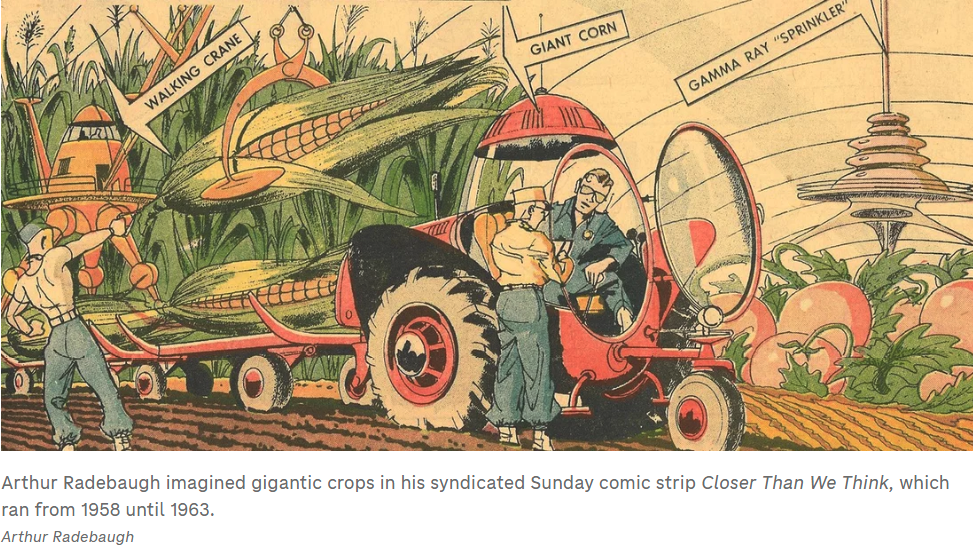
Futures and future-making are currently at the core of the debate around and about sustainability transitions (Truffer et al., 2022). This scholarship is widely engaged in finding (feasible) solutions to tackle the mounting crises of the Anthropocene by investigating pathways leading to alternative socio-ecological configurations (e.g. sustainable futures created by rethinking and redesigning systems of extraction, production, distribution and consumption). This includes investigating transitions in energy, food, water, mobility, building, infrastructure, health services and provisioning systems (Markard et al., 2012; Köhler et al., 2019). In sustainability transitions, scholarship addressing the governance of socio-ecological challenges of the Anthropocene is also becoming more and more prominent (Geels, 2018; Köhler et al., 2019). These transitions tend to be challenging for the social sciences because they involve multiple stakeholders and are long-term, disruptive, contested and nonlinear processes (Geels, 2018; Weituschat et al., 2022). Food system transitions are largely debated – and key – because agriculture and food production, distribution and consumption are central in defining the root causes, impacts and interrelatedness of the crises of the Anthropocene (Willett et al., 2019). Hence, given the prominent role of food systems in defining the crises of the Anthropocene, it is not surprising that redesigning food systems is becoming an urgent discussion and equally a contested arena for scholars, social activists and policymakers (Reisman, Fairbairn, 2020). Moreover, food system transitions and the future of food in more general terms have always stimulated imaginaries, particularly in the techno-ecological sphere (Figure 1). A more recent example is provided by the fierce discussion around resilience and sustainable food systems (Fresco et al., 2021), and particularly regenerative agriculture and food system transitions.
In his bestselling book Regenesis, George Monbiot (2022) calls for redesigning food systems at a large scale. This approach could mobilise ideas and actions to define a sustainable food future characterised by highly productive food systems that can minimise land, energy and water use, to support re-wilding and ‘giving back to nature’. It would help make the best of the potentials of soil regeneration biodiversity in a climate-sensitive way based on advancements in food technologies and supporting exclusively plant-based diets. At the same time, it would ensure affordable food for everyone. In his vision of the future of food systems, farmers are not squeezed by rapacious big-food retailers. Feedstock to produce meat or dairy is relegated to the history books. In presenting this food future, Monbiot is also future-making, specifically a communicative and political agenda. In fact, Monbiot has no problem in defining his investigative journalism as a sign of political activism. However, what if we want to investigate this process through (social) scientific lenses? In other words, what if we take future-making seriously, as Monbiot does, while we debate the (social) science(s), and its methods, for future-making?
Food system transitions give us a very stimulating playground from which we can begin. Let’s start from what we define as the ‘Monbiot paradox’: as he describes it, a good place to start to redesign food systems to enhance their sustainability would be to investigate how we, as humans, get proteins in our diets. Proteins are the gold nugget of anthropic diets, because they are a core building block of human metabolism (Aiking, de Boer, 2020). Monbiot poses a paradox by looking at the evolutionary and historical patterns of how humanity has collectively ‘designed’ a food system in which proteins have been progressively sourced from mammals, in the form of livestock and animal husbandry. He is particularly pungent when highlighting the contradiction of ‘spending thousands of years’ to domesticate and manipulate the ecology and physiology of just a few species to dedicate a large amount of labour, capital, energy, water and land to mammal-based protein sources, and to select animals whose protein conversion rate is very low, and largely inefficient. We have designed this system of protein sourcing by inflicting immense pain on these animals and driving to extinction, or close to it, other species whose habitats and food we have altered and used just to get our protein demand sorted. His point is that from a system design thinking perspective, our protein sourcing strategies are questionable. There are also ethical implications, but if we stick to the system design perspective, the Monbiot paradox offers a very powerful space for collective and scholarly reflections. The protein transition, in fact, is a hot topic in policy and science (Aiking, de Boer, 2020; Tziva et al., 2020). Humanity needs better and planet-friendly proteins, which can be accessed at an affordable cost and without disrupting food economies and cultures (Tziva et al., 2020). Proteins from fungi, insects, algae, microbes, legumes and various related food technologies are just a few examples of food futures in which proteins are no longer sourced from mammals, but rather from other types of living organisms (Aiking, de Boer, 2020). So, the Monbiot paradox is not just metaphorical, philosophical or thought provoking. It is part of a context where concrete, tangible and actionable food futures are discussed and enacted. This paradox brings us to ask the following questions: if producing, distributing and consuming proteins from mammals is so detrimental for the planet, and highly inefficient in terms of resource use, why is it so challenging to remove cows, pigs, sheep and goats from our food systems? Moreover, why is it so challenging to introduce ‘alternative’ sources of proteins? Why is future-making so hard?
To answer these questions, we suggest moving beyond a mechanistic view of sustainability and socio-ecological transitions. Instead, we should investigate ‘future-making’ as a more contested domain, as a place where we can build inter- and transdisciplinary knowledge. Futures become the unit of inquiry and future-making the set of socio-ecological processes that lead to alternative futures. In our view, this shift implies the need to tackle the issue of how to move from desirable to actionable futures, and the wickedness and complexity that these dimensions of future-making bring with them. In the next section, we focus on future-making and food futures, in particular.
3. Future-making from desirable to actionable food futures
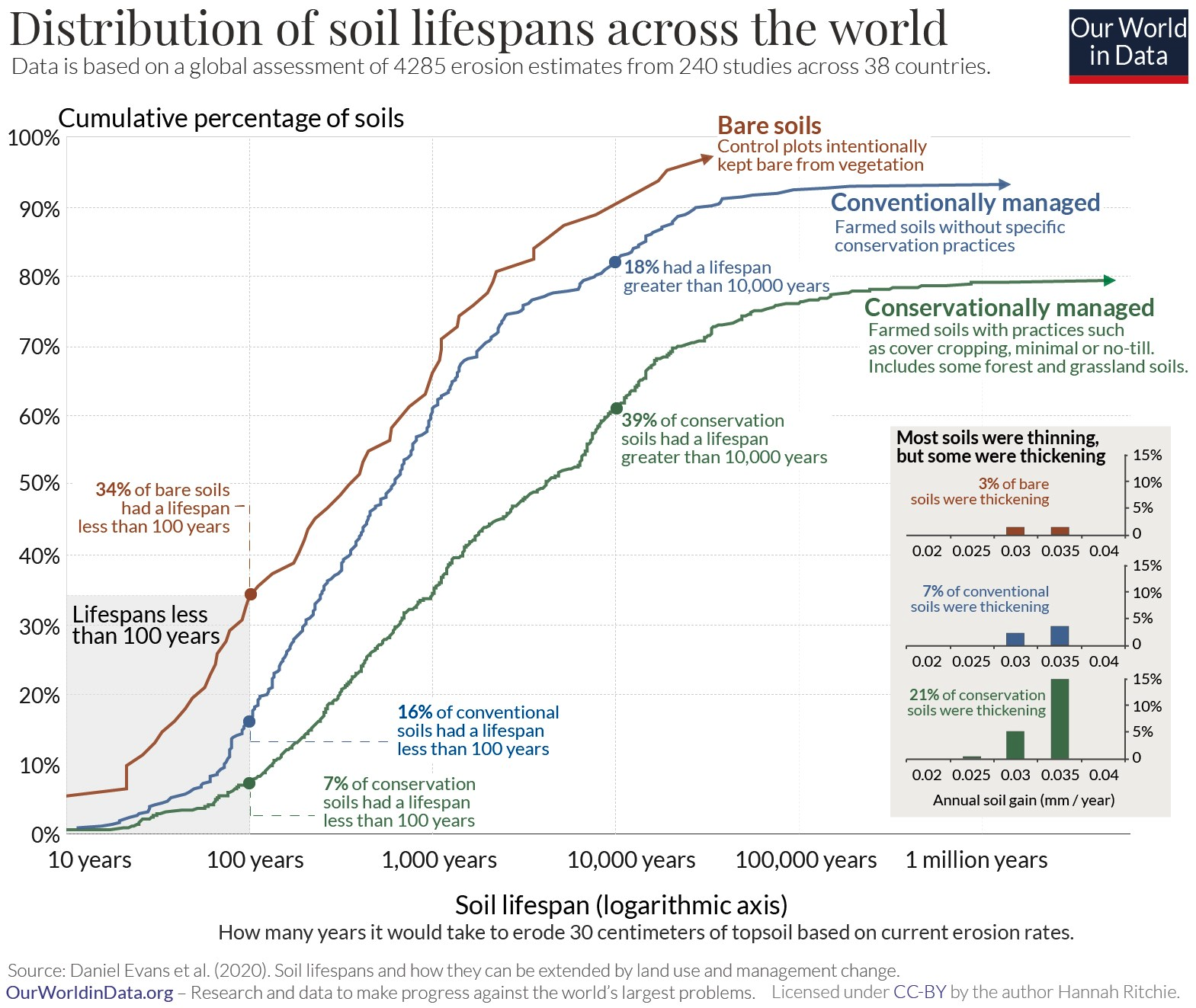
Understanding and investigating future-making strategies, such as protein transitions, is a counterintuitive process. In fact, ‘future poses a peculiar problem – by definition, it is not present yet […] empirical social science deals primarily with the social world as it exists and came to be. Its methodological tools are centred around data sourced from observable events that have already occurred’ (Gümüsay, Reinecke, 2024: 2). As such, (social) sciences aiming at investigating future(s) will need to engage with collective imagination to rethink (desirable) futures, as contested and situated fields of inquiry that have not yet materialised in a given reality. These sciences will then have to deal with how collectives move from desirable to actionable futures. This poses a dilemma. Future activities are already a concern for several scientists – for example, in terms of predictions and forecasting. Think about the ‘60-harvest left’ theory (Ritchie, Roser, 2024): according to this framework, soil degradation is so extreme that we, as humanity, are left with no more than 60-100 cycles of agricultural production. Scientific evidence cannot support this claim, and in fact it does not. Instead, it indicates that the lifespans of soil degradation (as well as regeneration) vary in terms of timescales and landscapes (Figure 2). However, this type of scientific approach can underestimate the non-linearity and systemic nature of these phenomena. Forecasting soil degradation in isolation – similarly to climate change or biodiversity loss, core manifestations of the Anthropocene – can be an unforgivable mistake, because it misses the point to realise in which ‘future’ this degradation (or regeneration) is taking place. Moreover, utilising data from the past or present to predict the future is also not the point. Rather, ‘the goal is not to enable better predictions or forecasting of a likely future but […] to cultivate the creation of desirable futures by imagining, or helping others imagine them in the first place’ (Gümüsay, Reinecke, 2024: 2).
What is a future where soil is healthy? How do we make it? Is it sustainable and desirable for everyone? In a scientific future-oriented approach, sustainability transitions help to achieve socio-ecological orders that need to be imagined in the first place. The goal for social scientists is to conceptualise the (un)likelihood of the emergence of these futures, assuming a prospective and not just prescriptive way of theorising (Gümüsay, Reinecke, 2024), by using novel methodologies – for example, by combining the logics of collective sensemaking (Mills et al., 2010; Whiteman, Cooper, 2011) with the collective identity work process methods (Langley, 1999).
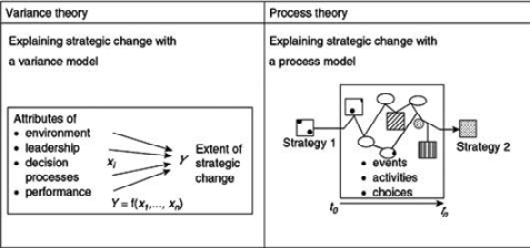
Inquiring with sensemaking and process data, in fact, implies the need to investigate a phenomenon through the relationship between events, from a temporal, multilevel and multiagency perspective (Figure 3). In most cases, transitions relate to ‘events’ that have not yet happened, so they cannot be fully sensed, assessed or measured, and are future-facing and still imaginary in many aspects. Thus, an idea is to extend sensemaking and process methodological approaches to imaginaries, for example, utopian considerations, in which process data are ‘sensed’ not in relation to the past or the ‘existing’, but to ‘imaginary’ events. To illustrate the shift to ‘future’ as a ‘strategic resource’, and ‘future-making’ as a ‘strategic sensemaking process’, we suggest looking at food futures as an example of ‘making’ desirable futures through socio-ecological transitions utopias (Stock et al., 2015). In particular, we present the case of food futures as originated through the narratives of a circular economy, and specifically food systems that are configured as industrial symbioses, or food systems configured as multiple agroecological systems (Pascucci, 2020).
4. Investigating circular and regenerative food systems as sustainable futures
A circular economy can be seen as a framework for collective actions and sensemaking, and from that perspective as a rather powerful and evocative ‘future-making’ heuristic (Borrello et al., 2020). An example is the so-called ‘butterfly’ diagram, which depicts, graphically, the transition from a linear (the central part of Figure 4) to a circular economy, through restorative cycles of legacy and technical materials and regenerative cycles of biological/bio-based materials (the green wing in Figure 4). The metabolic symbolism of this narrative is coupled with the opportunity that the butterfly diagram, the underpinning framework, provides for the cyclical flows of materials. These carefully assessed, selected, designed and managed materials can be applied to a single product, thus following the logic approach of cradle-to-cradle design thinking, as well as to an industrial sector, thus following the logic of industrial ecology (i.e. an event to a global complex economy) (Webster, Pascucci, 2024). This ductility makes this heuristic so powerful: it makes sense, it has a low cognitive load, it is challenging but not contentious, inclusive and evocative, business and policy friendly, incremental with a flavour of radicalism, and scientifically sound (Alexander et al., 2023). Hence, it is not surprising that it has worked as a powerful and generative tool for future-making, with the explicit agenda of reforming and retooling capitalistic economies from within, without challenging its foundations (e.g. growth), and to bring these economies back ‘within the planetary boundaries’ and a ‘safe space for humanity’ (Webster, Pascucci, 2024). While the emphasis on legacy and technical materials has prevailed in these future-making processes, food futures and transitions into bio-based economies have lately become especially important and prominent.
We consider two main future-making pathways, following the analytical and conceptual approach developed by Pascucci (2020) in a previous inquiry. We focus on two food futures stemming from circular imaginaries: a circular food economy that resembles the features of industrial ecology, and a circular food economy that resembles the features of agroecology. In particular, we focus on the implications of these pathways for food future-making and then use them to reflect on a wider process of future-making, namely how it can be linked to the emergence of a transdisciplinary field of knowledge co-creation to study and tackle the socio-ecological crises of the Anthropocene.
4.1. Imagining a circular food economy based on industrial ecology
The first food future is based on a circular food economy designed based on industrial ecology, emerging from the principles and practices to rethink industrial food systems, also defined as ‘linear’ or ‘extractive’ (Pascucci, 2020). The starting point of this imaginary is the identification of regenerative agriculture and a circular economy as an opportunity to identify ‘socio-technological fixes at system level’ (Webster, 2013). In this imaginary (Figure 4), food producers, distributors and consumers develop relations which ensure that key natural resources are used safely and returned into the biosphere. This approach generates (new or improved) ecosystem services and protects (and possibly enhances) biodiversity, guided by the principles of sustainable intensification (Tittonell et al., 2022; Cassman, Grassini, 2020).
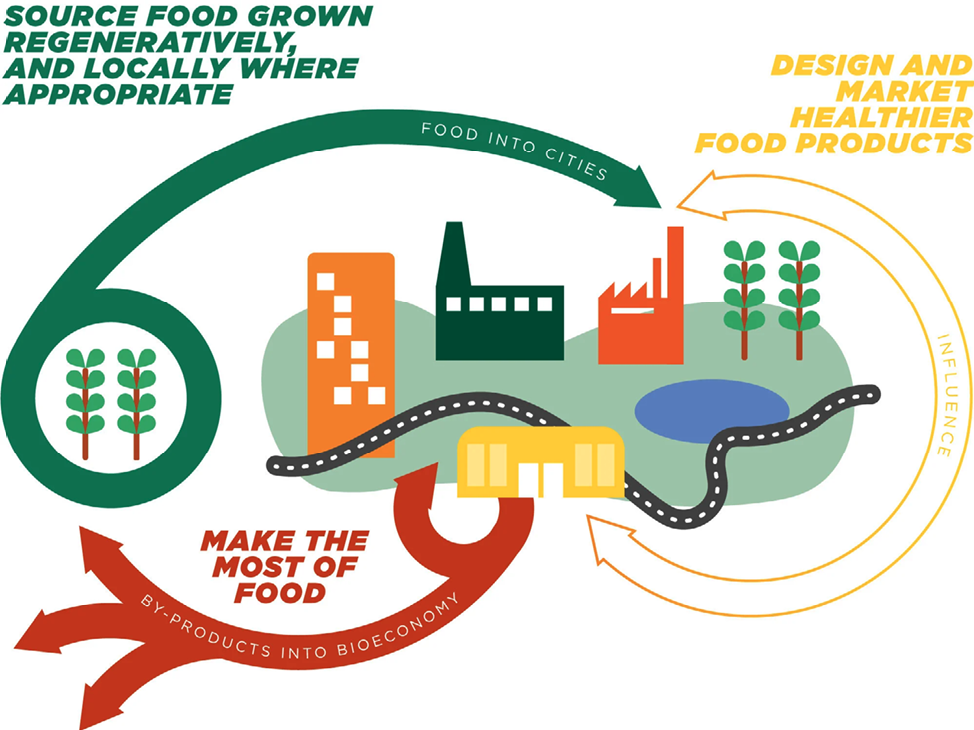
In this imaginary, nutrients are recovered after feed or food consumption – for example, by extracting phosphorus, nitrogen and water from food waste, urine and manure through bio-based technology, bio-composting or anaerobic digestion (Figure 5) (Pascucci, 2020). Material reutilisation supports the development of a bio-based economy in which bio-based products can substitute for technical nutrients, such as plastics. Moreover, this economy is designed to use renewable energy along the food supply chains – from farming to food consumption (Figure 5). This circular food economy further upscales the ‘green revolution’ in which a set of bio-based technological practices and related social and institutional infrastructures are designed to increase the ‘productivity and resource use efficiency’ of food provisioning systems.
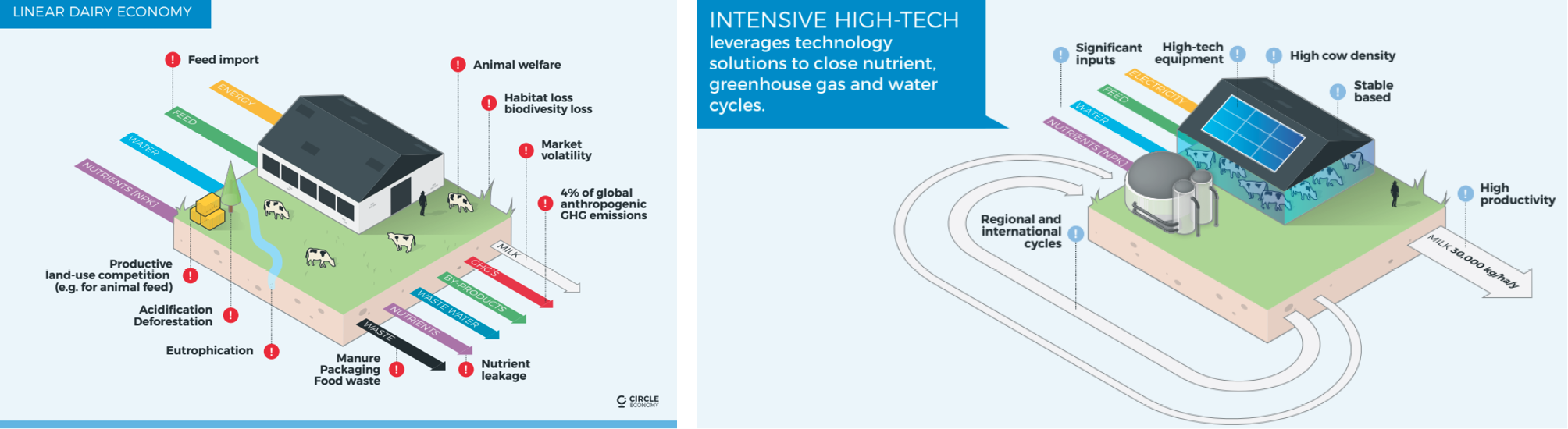
In this imaginary, large agribusiness conglomerates and multinational corporations are dominant in regulating the relations between food production, distribution and consumption. Moreover, while food provisioning is coupled with a renewed capacity of the food economy to (re-)generate (rather than exploit) ecosystem services, thus designing an economy aligned with ecological values, food products remain commodities whose values are prevailingly defined by markets and trading relations.
4.2. Imagining a circular food economy based on agroecology
This food future is based on the perspective of considering soil fertility, biodiversity and ecosystem services as the key pillars to design any food economy. In this imaginary, circularity is linked to designing food systems as living systems, keeping the use of natural resources in food-provisioning systems within planetary boundaries. It also identifies agricultural and food-related practices as inherently embedded in connected with social practices (Pascucci, Duncan, 2017). They are in fact part of agrarian food cultures, embedded in specific socio-ecological contexts. They are ‘place based’ and ‘community oriented’ (Figure 6).
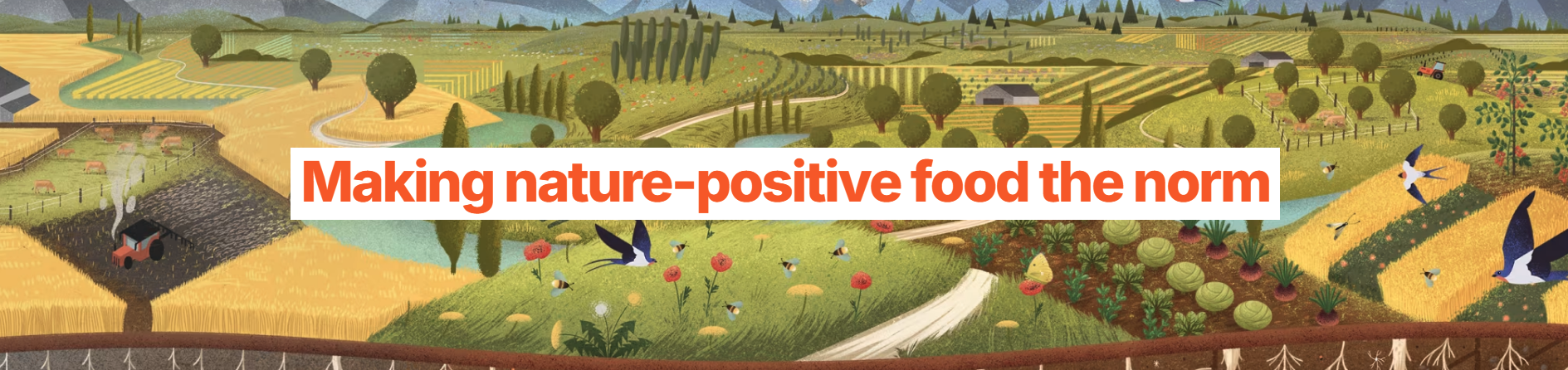
In this imaginary, the regenerative capacity of an ecosystem is a key aspect to design food systems coupled with agricultural practices that consider the need to maintain restoration cycles of key nutrients, using the minimum amount of external inputs. The aim is to maximise diversity within the systems by adopting synergic mutualistic relations rather than forcing the system to be maintained at an ‘imposed simplified order’ against the natural tendency toward entropy, diversity, stability (Tittonell, 2014; Pascucci, 2020). There is a dominant biomimetic and ecological worldview in this vision, complemented by a social justice perspective (Rhodes, 2012). Increasing productivity is not subordinate to achieve just, fair and safe access to food for everyone. These practises often imply that farming and food provisioning are part of a wider network of social and political relations between food producers and consumers, and between human and non-human beings (Pascucci et al., 2021). A circular food economy in this imaginary is based on agroecology. As such, balance between the biophysical, technological and socio-economic components of the economy is maintained. For example, productivity is seen as the capacity of an agricultural system to sustain yields and to optimise the use of local resources while minimising any negative environmental and socio-economic impacts of agricultural practices (Tittonell, 2014). In fact, this imaginary is centred on the concept of regenerative agriculture as an approach to food and farming systems that regenerates topsoil and increases biodiversity now and long into the future (Pascucci, 2020). Regenerative practices carefully manage cycles of nutrients and enhance their availability and quality, enhance ecosystem services, increase resilience to climate fluctuation, and strengthen the health and vitality of farming communities (Rhodes, 2012). This type of circular food economy is based on communities rather than corporations and market-based relations. It relies on small-scale processes and adaptation to local conditions instead of designing large-scale and ‘easy-to-standardise’ processes. In fact, a key design principle is the restoration and regeneration of the ‘ecological health’ of food systems to realise a safe, just, resilient and sustainable food economy (Rhodes, 2012).
5. A transdisciplinary field to investigate food futures in the Anthropocene
What can we learn from the investigation of food future-making through a regenerative and circular economy? Moreover, how can this exercise be used to co-create an interdisciplinary field to investigate future-making processes in the Anthropocene? Food system redesign pathways seem to indicate that how we define food futures and exercise for both desirable and actionable futures is becoming more relevant among scholars and practitioners. What seems to be undisputed is that the multiple crises of the Anthropocene demand unusual and radical responses, and urgent actions. As Gümüsay and Reinecke (2024: 2) highlight, reflecting on what is happening in management organisation scholarship, ‘[…] there is a growing demand for impact-driven management organization theory (Wickert et al., 2021) engaged scholarship (Sharma, Bansal, 2020; Ergene et al., 2021) to address societal grand challenges (George et al., 2016; Gümüsay et al., 2022)’. Put more provocatively, social scientists are not entitled to get a free pass in this process. Rather, they are asked to explore new forms of inquiry and contribute to, and thus help to co-create, desirable and sustainable food futures. As we have seen, food systems are at the core of the necessary socio-ecological transitions to tackle the crises of the Anthropocene. However, tackling these transitions with old, past-facing approaches may not be a ‘good enough’ strategy, given the urgency of these crises. What if we really had only 60 harvests left? To answer this question, we would need a future-oriented scientific line of inquiry, which we claim we still have not fully developed. There are three core aspects that an interdisciplinary field of inquiry focused on future-making should consider and debate: (i) moving from prescriptive to prospective conceptualisation/theory building, particularly to resolve the tensions and ambiguities between desirable and actionable futures; (ii) embracing temporal processes and temporality as a key ontology for investigating alternative and desirable and actionable futures; and (iii) the (risk of) commodification of futures. We will briefly present these aspects and use them to define a collective research agenda on this topic.
(i) Prospective theory-building involves the move from perspective to prospective ways of conceptualising and theorising. Prospective theorising regards the co-creation of futures ‘by fostering imaginative capacity about what the future could be’ and not by developing prescriptive interventions based on a positivist worldview (Gümüsay, Reinecke, 2024: 4). More specifically, prospective theorising embraces a pragmatist philosophy, meaning that it does not seek truth as a fixed and objective property of beliefs or propositions, but rather is concerned with the practical consequences of theorising and its usefulness in solving problems and achieving desired outcomes. Prospective theorising is about preparing for diverse futures, not predicting them. It deals with changing the future through prefiguring desirable and actionable futures. Similarly to prefigurative organising, which involves bringing about a desired future reality through practising it in the present (Reinecke, 2018), theorising can be prefigurative by bringing about a desired future reality through theorising into the present.
(ii) Future-making and its relation to the definition and investigation of desirable and actionable futures bring time and temporality to the fore (Gümüsay, Reinecke, 2022). While there is growing interest in understanding the role of time and temporality in strategic actions and transition pathways, this line of inquiry remains an overlooked topic. Assuming temporal lenses is crucial for the emergence of an interdisciplinary field of inquiry devoted to the socio-ecological crises of the Anthropocene and, in particular, to define alternative approaches and worldviews to better understand the socio-ecological relations and to provide new ways for organisations to innovate for desirable and actionable futures (Gümüsay, Reinecke, 2022). There is a better understanding of the presence of multiple temporal issues that generate challenges for navigating transitions to sustainable futures. For example, when looking at materials and technologies needed in the future-making processes, there are relevant differences in terms of temporal rhythms or structures, which leads to asynchrony and diachrony (Garud, Gehman, 2012). Moreover, moving from desirable to actionable futures may require solutions such as technologies and production methods that are unknown or have yet to be developed. Desirable futures may require connecting processes with different temporal perspectives, such as the short and long term (Slawinski, Bansal, 2015) or the past, present and future (Kim et al., 2019). For example, organisations may use the past as a generative resource to co-create forward, thereby making imagined futures actionable in the present (Garud et al., 2010). Finally, moving from desirable to actionable futures may require organisations to engage in new forms of collaboration between entities with different temporal frames (George et al., 2016), including across companies, universities, startups and even competitors (Bowen et al., 2018).
(iii) Regarding commodification of the future, the way we facilitate, control and manipulate future-making has implications for exploiting futures as assets and commodities. Alterative futures create different sets of ‘losers and winners’ and actively engage and morph future-making, so it becomes more and more relevant to define these sets. Futures can be commodified and exploited as any other resource, and how actors engage with future-making should be understood as not being value neutral or unrelated to political and economic agendas. For example, defining futures through food policies (e.g. the European Union Green Deal) is a form of altering future-making so that it is suitable for some and less for others. Understanding this process will help to design business and policy strategies that are more attentive to inclusion and exclusion criteria and eventually help scholars to interrogate policy and strategy-making through more critical lenses.
Our final point refers to future research agendas. The debate on sustainability transitions, a circular bio-based economy and regenerative agriculture have brought to light the relevance of food systems and economies and the sciences that are engaged to understand them. In this short essay, we have offered a perspective that embraces future-making as a possibility to expand existing scientific fields, and particularly applied social sciences such as agricultural and food economics. We believe that a conversation about the future of food is needed in this space, and we hope that our essay provides a catalyst for it.
Given the dramatic and contested reality of the Anthropocene, and the urgency to investigate and mobilise scientists for sustainable and desirable food system transitions, in this essay we have asked the following questions: what are the sciences, and fields of knowledge, that we need (to collectively create) to solve the crises of a planet in chaos? What (type of) knowledge do we need? From whom and for whom? Our response to these questions has emphasised the opportunity of investigating sustainability transitions in food systems as a example of how humanity can respond to the socio-ecological challenges of the Anthropocene and design systemic change (Alexander et al., 2023). We have focused on circular and regenerative principles and looked at the case of protein transitions. These principles have already inspired several food transitions, framed as desirable and actionable futures (Webster, Pascucci, 2024). A few concluding remarks can be drawn from our approach.
First, the role of scientists traditionally engaged in investigating the relationships between nature, society and economy will become more relevant in the future, where we argue a transdisciplinary science will become necessary to tackle the challenges of the Anthropocene. By rethinking and redesigning food systems using transdisciplinary knowledge, these scientists will co-create and increase our capacity to investigate and assess future-making strategies, and explore the tensions between desirable and actionable (food) futures (Pascucci, 2020).
Second, transdisciplinary knowledge will emerge, in our view, through collective co-creation. Subsequently, new methodologies, ontologies and epistemologies will emerge to help scientists to investigate desirable and sustainable futures. The core of this new form of knowledge co-creation will be research on and analysis of sustainability transitions. This endeavour will provide an opportunity to illustrate future-making processes, and how collective action in science can produce projects that attempt to redesign socio-ecological systems such as food systems. A transdisciplinary science of future-making will look at food futures and imaginaries of desirable food systems as ‘ontologies’, something that can and should be investigated through the lenses, principles and rules of scientific practice. We have briefly discussed some of these imaginaries and how they can contribute to the development of regenerative and circular food futures. We believe that agricultural economists are particularly well suited in this space, and their role and contribution to co-create such a transdisciplinary knowledge is essential.
This essay is based on an earlier draft used to inform an invited speech at the LX Conference of the Societa’ Italiana di Economia Agraria, Italian Society of Agricultural Economics, held in Anacapri, Italy 15th – 17th of September 2024. The author is grateful to comments and feedback provided to an early version of this paper by prof. Luigi Cembalo, and Dr. Massimiliano Borrello. Some of the content presented in 4.1. and 4.2 has been previously published in Pascucci (2020).
Adler P.S. (2022). Capitalism, socialism, and the climate crisis. Organization Theory, 3(1), 26317877221084713. DOI: https://doi.org/10.1177/26317877221084713.
Aiking H., de Boer J. (2020). The next protein transition. Trends in Food Science and Technology, 105: 515-522. DOI: https://doi.org/10.1016/j.tifs.2018.07.008.
Alexander A., Pascucci S., Charnley F. (eds). (2023). Handbook of the circular economy: Transitions and transformation. Walter de Gruyter GmbH & Co KG. DOI: https://doi.org/10.21637/GT.2024.1.08.
Alvesson M., Gabriel Y., Paulsen R. (2017). Return to Meaning. A Social Science With Something to Say. Oxford University Press, Oxford. DOI: https://doi.org/10.1093/oso/9780198787099.001.0001.
Ambikapathi R., Schneider K.R., Davis B., Herrero M., Winters P., Fanzo J.C. (2022). Global food systems transitions have enabled affordable diets but had less favourable outcomes for nutrition, environmental health, inclusion and equity. Nature Food, 3(9): 764-779. DOI: https://doi.org/10.1038/s43016-022-00588-7.
Banerjee S.B. (2003). Who sustains whose development? Sustainable development the reinvention of nature. Organization Studies, 24(1): 143-180. DOI: https://doi.org/10.1177/0170840603024001341.
Barrett C.B. (2021). Overcoming global food security challenges through science and solidarity. American Journal of Agricultural Economics, 103(2): 422-447. DOI: https://doi.org/10.1111/ajae.12160.
Biggart N.W. (2016). Biggart’s lament, or getting out of the theory cave. Journal of Management Studies, 53: 1381-1387. DOI: https://doi.org/10.1111/joms.12185.
Borrello M., Pascucci S., Cembalo L. (2020). Three propositions to unify circular economy research: A review. Sustainability, 12(10), 4069. DOI: https://doi.org/10.3390/su12104069.
Bowen F.E., Bansal P., Slawinski N. (2018). Scale matters: The scale of environmental issues in corporate collective actions. Strategic Management Journal, 39(5): 1411-1436. DOI: https://doi.org/10.1002/smj.2764
Cassman K.G., Grassini P. (2020). A global perspective on sustainable intensification research. Nature Sustainability, 3(4): 262-268. DOI: https://doi.org/10.1038/s41893-020-0507-8
Circle Economy (2016). The circular dairy economy. Available at: https://www.circle-economy.com/resources/the-circular-dairy-economy (last accessed 15/06/2025)
Costanza R., Graumlich L.J., Steffen W. (2007). Sustainability or collapse. Ambio, 36(7): 522-527. DOI: https://doi.org/10.1579/0044-7447(2007)36[522:SOCWCW]2.0.CO;2.
De Cock C., Nyberg D., Wright C. (2021). Disrupting climate change futures: Conceptual tools for lost histories. Organization, 28(3): 468-482. DOI: https://doi.org/10.1177/1350508419883377.
Dentoni D., Pinkse J., Lubberink R. (2021). Linking sustainable business models to socio-ecological resilience through cross-sector partnerships: A complex adaptive systems view. Business and Society, 60(5): 1216-1252. DOI: https://doi.org/10.1177/0007650320935015.
EMF (2023). Big Food Redesign Challenge: It’s time to redesign food. https://www.ellenmacarthurfoundation.org/the-big-food-redesign-challenge/overview.
Ergene S., Banerjee S.B., Hoffman A.J. (2021). (Un)sustainability organization studies: Towards a radical engagement. Organization Studies, 42(8): 1319-1335. DOI: https://doi.org/10.1177/0170840620937892.
Fresco L.O., Geerling-Eiff F., Hoes A.C., van Wassenaer L., Poppe K.J., van der Vorst J.G. (2021). Sustainable food systems: do agricultural economists have a role? European Review of Agricultural Economics, 48(4): 694-718. DOI: https://doi.org/10.1093/erae/jbab026.
Feuls M., Hernes T., Schultz M. (2025). Putting distant futures into action: How actors sustain a course of action toward distant-future goals through path enactment. Academy of Management Journal, 68(2), 297-325. DOI: https://doi.org/10.5465/amj.2022.0257.
Garud R., Gehman J. (2012). Metatheoretical perspectives on sustainability journeys: Evolutionary, relational durational. Research Policy, 41(6): 980-995. DOI: https://doi.org/10.1016/j.respol.2011.07.009.
Garud R., Kumaraswamy A., Karnøe P. (2010). Path dependence or path creation? Journal of Management Studies, 47(4): 760-774. DOI: https://doi.org/10.1111/j.1467-6486.2009.00914.x.
Geels F.W. (2018). Disruption and low-carbon system transformation: Progress and new challenges in socio-technical transitions research and the Multi-Level Perspective. Energy Research & Social Science, 37: 224-231. DOI: https://doi.org/10.1016/j.erss.2017.10.010.
George G., Howard-Grenville J., Joshi A., Tihanyi L. (2016). Understanding tackling societal gr challenges through management research. Academy of Management Journal, 59(6): 1880-1895. DOI: https://doi.org/10.5465/amj.2016.4007.
Gümüsay A.A., Marti E., Trittin-Ulbrich H., Wickert C. (2022). How organizing matters for societal gr challenges. In Gümüsay A.A., Marti E., Trittin-Ulbrich H., Wickert C. (eds) Organizing for Societal Grand Challenges (pp. 1-14). Emerald Publishing Limited, Leeds. DOI: https://doi.org/10.1108/S0733-558X20220000079002.
Gümüsay A.A., Reinecke J. (2022). Researching for desirable futures: From real utopias to imagining alternatives. Journal of Management Studies, 59(1): 236-242. DOI: https://doi.org/10.1111/joms.12709.
Gümüsay A.A., Reinecke J. (2024). Imagining desirable futures: A call for prospective theorizing with speculative rigour. Organization Theory, 5(1), 26317877241235939. https://doi.org/10.1177/26317877241235939.
Gunderson L., Holling C.S. (2001). Panarchy: Understanding Transformations in Human Natural Systems. Island Press, New York.
Haas W., Krausmann F., Wiedenhofer D., Lauk C., Mayer A. (2020). Spaceship earth’s odyssey to a circular economy – A century long perspective. Resources, Conservation and Recycling, 163, 105076. https://doi.org/10.1016/j.resconrec.2020.105076.
Kim A., Bansal P., Haugh H. (2019). No time like the present: How a present time perspective can foster sustainable development. Academy of Management Journal, 62(2): 607-634. DOI: https://doi.org/10.5465/amj.2015.1295.
Köhler J., Geels F.W., Kern F., Markard J., Onsongo E., Wieczorek A., Alkemade F., Avelino F., Bergek A., Boons F., Fünfschilling L., Hess D., Holtz G., Hyysalo S., Jenkins K., Kivimaa P., Martiskainen M., McMeekin A., Mühlemeier M.S., Nykvist B., Pel B., Raven R., Rohracher H., Sandén B., Schot J., Sovacool B., Turnheim B., Welch D., Wells P. (2019). An agenda for sustainability transitions research: State of the art future directions. Environmental Innovation Societal Transitions, 31: 1-32. DOI: https://doi.org/10.1016/j.eist.2019.01.004.
Langley A. (1999). Strategies for theorizing from process data. Academy of Management Review, 24(4): 691-710. DOI: https://doi.org/10.2307/259349.
Lobbedez E., Pascucci S., Panico T. (2025). Theorizing Waste as a Technique of Power in Capitalistic Stakeholder Relations. Journal of Management Studies. DOI: https://doi.org/10.1111/joms.13190.
Markard J., Raven R., Truffer B. (2012). Sustainability transitions: An emerging field of research its prospects. Research Policy, 41(6): 955-967. DOI: https://doi.org/10.1016/j.respol.2012.02.013.
Mills J., Thurlow A., Mills A.J. (2010). Making sense of sensemaking: The critical sensemaking approach. Qualitative Research in Organizations Management, 5(2): 182-195. DOI: https://doi.org/10.1108/17465641011068857.
Monbiot G. (2022). Regenesis: Feeding the World Without Devouring the Planet. Penguin, London.
Pascucci S. (2020). Circular food economies. In Duncan J., Carolan M., Wiskerke J.S.C. (eds) Routledge Handbook of Sustainable Regenerative Food Systems (pp. 318-335). Routledge, London. DOI: https://doi.org/10.4324/9780429466823.
Pascucci S., Duncan J. (2017). From pirate islands to communities of hope. In Duncan J., Bailey M. (eds) Sustainable Food Futures: Multidisciplinary Solutions. Routledge, London. DOI: https://doi.org/10.4324/9781315463131-14.
Pascucci S., Dentoni D., Clements J., Poldner K., Gartner W.B. (2021). Forging forms of authority through the sociomateriality of food in partial organizations. Organization Studies, 42(2): 301-326. DOI: https://doi.org/10.1177/0170840620980232.
Peeters A.L., Tromp N., Bulah B.M., van der Meer M., van den Boom L., Hekkert P.P. (2024). Framing for the protein transition: Eight pathways to foster plant-based diets through design. Environmental Innovation Societal Transitions, 52, 100848. DOI: https://doi.org/10.1016/j.eist.2024.100848.
Radebaugh A. (1953). Closer than we think. Available at: https://www.npr.org/sections/thesalt/2015/12/07/458164082/the-past-is-littered-with-foods-of-the-future (last accessed 14/06/2025).
Reinecke J. (2018). Social movements and prefigurative organizing: Confronting entrenched inequalities in Occupy London. Organization Studies, 39(9): 1299-1321. DOI: https://doi.org/10.1177/0170840618759815.
Reisman E., Fairbairn M. (2020). Agri-food systems and the Anthropocene. Annals of the American Association of Geographers, 111(3): 687-697. DOI: https://doi.org/10.1080/24694452.2020.1828025.
Rhodes C.J. (2012). Feeding healing the world: Through regenerative agriculture permaculture. Science Progress, 95(4): 345-446. DOI: https://doi.org/10.3184/003685012X13504990668392.
Ritchie H., Roser M. (2024). Do we only have 60 harvests left? OurWorldInData.org. Available at: https://ourworldindata.org/soil-lifespans.
Rockström J., Gupta J., Qin D., Lade S.J., Abrams J.F., Anderersen L.S., Armstrong McKay D.I., Bai X., Bala G., Bunn S.E., Ciobanu D., DeClerck F., Ebi K., Gifford L., Gordon C., Hasan S., Kanie N., Lenton T.M., Loriani S., Liverman D.M., Mohamed A., Nakicenovic N., Obura D., Ospina D., Prodani K., Rammelt C., Sakschewski B., Scholtens J., Stewart-Koster B., Tharammal T., van Vuuren D., Verburg P.H., Winkelmann R., Zimm C., Bennett E.M., Bringezu S., Broadgate W., Green P.A., Huang L., Jacobson L., Ndehedehe C., Pedde S., Rocha J., Scheffer M., Schulte-Uebbing L., de Vries W., Xiao C., Xu C., Xu X., Zafra-Calvo N., Zhang X. (2023). Safe just Earth system boundaries. Nature, 619(7968): 102-111. DOI: https://doi.org/10.1038/s41586-023-06083-8.
Rockström J., Steffen W., Noone K., Persson Å., Chapin III F.S., Lambin, E., Lenton T.M., Scheffer M., Folke C., Schellnhuber H.J., Nykvist B., de Wit C.A., Hughes T., van der Leeuw S., Rodhe H., Sörlin S., Snyder P.K., Costanza R., Svedin U., Falkenmark M., Karlberg L., Corell R.W., Fabry V.J., Hansen J., Walker B., Liverman D., Richardson K., Crutzen P., Foley J. (2009). Planetary boundaries: Exploring the safe operating space for humanity. Ecology and Society, 14(2). http://www.jstor.org/stable/26268316.
Sharma G., Bansal T. (2020). Cocreating rigorous relevant knowledge. Academy of Management Journal, 63(2): 386-410. DOI: https://doi.org/10.5465/amj.2016.0487.
Steffen W., Rockström J., Richardson K., Lenton T.M., Folke C., Liverman D., Summerhayes C.P., Barnosky A.D., Cornell S.E., Crucifix M., Donges J.F., Fetzer I., Lade S.J., Scheffer M., Winkelmann R., Schellnhuber H.J. (2018). Trajectories of the Earth System in the Anthropocene. Proceedings of the National Academy of Sciences of the United States of America, 115(33): 8252-8259. DOI: https://doi.org/10.1073/pnas.1810141115.
Slawinski N., Bansal P. (2015). Short on time: Intertemporal tensions in business sustainability. Organization Science, 26(2): 531-549. DOI: https://doi.org/10.1287/orsc.2014.0960.
Stock P.V., Carolan M., Rosin C. (2015). Food utopias: Hoping the future of agriculture. In Stock P.V., Carolan M., Rosin C. (eds) Food Utopias: Reimagining Citizenship, Ethics and Community (pp. 3-13). Routledge, London. DOI: https://doi.org/10.4324/9781315765532.
Tittonell P. (2014). Ecological intensification of agriculture - Sustainable by nature. Current Opinion in Environmental Sustainability, 8: 53-61. DOI: https://doi.org/10.1016/j.cosust.2014.08.006.
Tittonell P., El Mujtar V., Felix G., Kebede Y., Laborda L., Luján Soto R., de Vente J. (2022). Regenerative agriculture - Agroecology without politics? Frontiers in Sustainable Food Systems, 6, 844261. DOI: https://doi.org/10.3389/fsufs.2022.844261.
Truffer B., Rohracher H., Kivimaa P., Raven R., Alkemade F., Carvalho L., Feola G. (2022). A perspective on the future of sustainability transitions research. Environmental Innovation and Societal Transitions, 42: 331-339. DOI: https://doi.org/10.1016/j.eist.2022.01.006.
Tziva M., Negro S.O., Kalfagianni A., Hekkert M.P. (2020). Understanding the protein transition: The rise of plant-based meat substitutes. Environmental Innovation Societal Transitions, 35: 217-231. DOI: https://doi.org/10.1016/j.eist.2019.09.004.
Webster K. (2013). What might we say about a circular economy? Some temptations to avoid if possible. World Futures, 69(7-8): 542-554. DOI: https://doi.org/10.1080/02604027.2013.835977
Webster K. (2021). A circular economy is about the economy. Circular Economy Sustainability, 1: 115-126. DOI: https://doi.org/10.1007/s43615-021-00034-z.
Webster K., Pascucci S. (2024). From socio-technical innovations to ecological transitions: A multilevel perspective on circular economy. In Ometto A.R., Sarkis, J., Evans S. (eds) A Systemic Transition to Circular Economy: Business Technology Perspectives. Springer, Cham (pp. 111-134). DOI: https://doi.org/10.1007/978-3-031-55036-2_6.
Weituschat C.S., Pascucci S., Materia V.C., Tamas P., de Jong R., Trienekens J. (2022). Goal frames sustainability transitions: How cognitive lock-ins can impede crop diversification. Sustainability Science, 17(6): 2203-2219. DOI: https://doi.org/10.1007/s11625-022-01156-5.
Whiteman G., Cooper W.H. (2011). Ecological sensemaking. Academy of Management Journal, 54(5): 889-911. DOI: https://doi.org/10.5465/amj.2008.0843.
Whiteman G., Walker B., Perego P. (2013). Planetary boundaries: Ecological foundations for corporate sustainability. Journal of Management Studies, 50(2): 307-336. DOI: https://doi.org/10.1111/j.1467-6486.2012.01073.x.
Whiteman G., Williams A. (2018). Systemic planetary risks. The Routledge Companion to Risk, Crisis Emergency Management. Routledge, New York. DOI: https://doi.org/10.4324/9781315458175.
Wickert C., Post C., Doh J.P., Prescott J.E., Prencipe A. (2021). Management research that makes a difference: Broadening the meaning of impact. Journal of Management Studies, 58(2): 297-320. DOI: https://doi.org/10.1111/joms.12666.
Willett W., Rockström J., Loken B., Springmann M., Lang T., Vermeulen S., Garnett T., Tilman D., DeClerck F., Wood A., Jonell M., Clark M., Gordon L.J., Fanzo J., Hawkes C., Zurayk R., A Rivera J., De Vries W., Sibanda L.M., Afshin A., Chaudhary A., Herrero M., Agustina R., Branca F., Lartey A., Fan S., Crona B., Fox E., Bignet V., Troell M., Lindahl T., Singh S., Cornell S.E., Reddy K.S., Narain S., Nishtar S., Murray C.J.L. (2019). Food in the Anthropocene: The EAT–Lancet Commission on healthy diets from sustainable food systems. The Lancet, 393(10170): 447-492. DOI: https://doi.org/10.1016/S0140-6736(18)31788-4.
Williams A., Perego P., Whiteman G. (2025). Boundary conditions for organizations in the Anthropocene: A review of the planetary boundaries framework 10 years on. Journal of Management Studies, 62(4): 1811-1846. DOI: https://doi.org/10.1111/joms.13150.
Wright C., Nyberg D., De Cock C., Whiteman G. (2013). Future imaginings: Organizing in response to climate change. Organization, 20(5): 647-658. DOI: https://doi.org/10.1177/1350508413489821.
1 The term regenerative agriculture (RA) in this paper largely builds on recent literature and particularly on Tittonell et al. (2022: 4) in which RA is presented as a system of farming principles and practices that increases biodiversity, enriches soils, improves watersheds, and enhances ecosystem services, aiming to capture carbon in soil and aboveground biomass, reversing current global trends of atmospheric accumulation, and offers, at the same time increased yields, resilience to climate instability, and higher health and vitality for farming and ranching communities. RA draws from decades of scientific and applied research by the global communities of organic farming, agroecology, holistic management, and agroforestry.