Research article
Silent salesmen: the past, present and future of vending machines
1 Department of Agrifood, Environmental and Animal Sciences, University of Udine, Italy
2 Department of Economics and Statistics, University of Udine, Italy
*Corresponding author. E-mail: alberto.bertossi@uniud.it
Abstract. This article presents a historical analysis of the evolution of the vending machine industry and its impact on consumer eating habits in Italy and the United States. Specifically, this paper traces its origins from an initial vision of an automatic age in which machines would replace traditional sales channels to their position as a significant auxiliary service in the present day. The vending industry is now predominantly associated with ‘junk food’ and impulse purchases, but this work opens new avenues for additional studies and suggests that this narrative is about to change. Driven by greater consumer awareness of issues such as sustainability and well-being, the industry is currently moving towards more social and health-conscious aspects. The integration of technologies such as artificial intelligence and the emergence of micromarkets have the potential to transform machines from ‘silent salesmen’ into ‘smart salesmen’.
Keywords: vending machines, food habits, artificial intelligence, welfare, micromarkets.
JEL codes: L1, L81.
Index
2. Historical evolution of the vending sector and consumption in the United States and Italy
2.2. A quick look into the future in the United States
Attention to well-being and environmental sustainability
2.4. A quick look into the future in Italy
Attention to well-being and environmental sustainability
– Since their creation, vending machines have been regarded as the future of food retailing.
– Until now, vending machines have never been a viable alternative to food shops, both in United States and Italy.
– Greater focus on welfare, artificial intelligence and micro-markets will transform vending machines from ‘silent’ to ‘smart’ salesmen.
According to Euromonitor International, the term ‘vending’ refers to ‘the sale of products at an unattended point of sale through a machine operated by introducing coins, bank notes, payment cards, tokens or other means of cashless payment’. Currently, regardless of our location, a vending machine is almost always nearby, ready to satisfy one or more needs. Although buying food from a vending machine is a daily and almost mechanical part of our ‘modern’ eating behaviours, little is known about vending history, how it has influenced people’s food habits and how it is changing. This study contributes to this knowledge gap by offering a historical overview of how the vending industry has evolved from 1900 to the present day, as well as its role in shaping new consumer habits in an increasingly industrialised society.
This paper is based on an analysis of how the vending industry has evolved in two of the most important global markets: the United States and Italy. The choice of these regions is based on source accessibility and a shared history of innovation in this industry. First, automated vending in its present form originated and was initially developed in the United States (Segrave, 2002), thus ensuring a sufficient amount of and access to the market data, industry news and academic literature required to create a comprehensive historical profile. Second, the Italian vending sector has descended from that developed in the United States and shares industrial and sociocultural evolutionary dynamics (Fumi, 2023). Accordingly, a comparison of the two markets facilitates an understanding of the developments that occurred in Italy in the second half of the twentieth century and those to come. Finally, the Italian sector is currently acknowledged as globally significant in terms of its cutting-edge supply chain, which is capable of responding to social changes (Henke, Sardone, 2020).
Published studies regarding the history and evolution of the vending sector are rather fragmented in both the U.S. and Italian contexts. Certainly, the literature on the topic is not extensive. Thus, to augment the existing literature on vending services in the U.S. market (Huppatz, 2022; Palmer, 1983; Rasmussen, 2001; Segrave, 2002; Shocket, 1955), primary sources, namely articles published in The New York Times, were consulted to assess the economic and sociocultural impacts that vending machines were having in the United States from 1950 to the early 2000s. Despite its non-scientific nature, The New York Times facilitated the creation of a logical thread that united the various themes discussed by the authors cited above. Historical and economic studies are even scarcer for the Italian market. Accordingly, the same approach was adopted to augment the small body of extant literature in Italy (Fontana, 2015; Fumi, 2023; Henke, Sardone, 2020) with data provided by Confida, the Italian vending association. This situation is different from more recent academic studies, particularly on consumer behaviour and the types of foods sold in vending machines. These studies have been used to support the narrative and highlight the current problems facing the vending industry as well as potential future opportunities. In this regard, this paper also compares the two markets on three key issues related to the latter aspect, namely: (1) welfare and environmental sustainability, (2) artificial intelligence (AI) and (3) micro-markets.
As a commercial sector, vending has often attempted to establish itself as a viable alternative to traditional grocery stores but has not yet achieved this goal. This failure is the result of several intersecting technological and sociocultural factors. However, the same factors that once created barriers may now be the driving force behind the sector’s evolution towards a truly person- and community-oriented service according to a new narrative aligned with the future.
2. Historical evolution of the vending sector and consumption in the United States and Italy
Vending has a history that is older than one might imagine. Heron of Alexandria is credited with the development of the first vending machine, designed around 220 BC, to offer holy water in temples in exchange for a drachma (Henke, Sardone, 2020; Higuchi, 2007; Segrave, 2002). There is no further relevant evidence of the use of vending machines in society between that period and the second half of the nineteenth century, excluding machines that dispensed stamps, postcards and tobacco. In 1888, the (perhaps) first and most famous prototype for offering a food product (TuttiFrutti gum) was patented and presented to the public in 1888 (Fumi, 2023; Higuchi, 2007; Segrave, 2002; Smith, 2006).
In the early twentieth century, vending machines quickly became a symbol of what has been called the ‘automatic age’ (Huppatz, 2022; Rasmussen, 2001) – that is, a ‘current of thought’ among entrepreneurs who imagined a future of consumption that was totally automated and facilitated without any human intervention. In this view, which was widely supported by the media and the business world of the time, vending machines were proposed as the perfect substitute for traditional groceries and as a means of selling anything anywhere at more affordable prices (Segrave, 2002). This vision spread rapidly in large urban centres due in part to more frequent, intense urbanisation and various sociocultural changes, which saw the birth of a food system geared more towards the production, marketing and consumption of industrial, standardised and high-nutritional-value food (so-called scientific eating; Levenstein, 2003b). The result was the widespread appearance of vending machines in numerous public places (e.g. theatres, bus stops and underground stations) and increasingly varied food offerings (e.g. chocolate, sweets and peanuts; Segrave, 2002). The strong enthusiasm of the time prompted several entrepreneurs to use vending machines to sell more complex foods. One of the most emblematic examples of ‘automatic consumption’ that emerged at the time was the Philadelphia Automat, a restaurant founded in 1902 and run by Horn & Hardart that combined fast food with vending machines (Diehl, Hardart, 2002; Epple, 2009; Fumi, 2023; Karmarkar, 2021; Segrave, 2002; Smith, 2006). Although it was a replica of a German model and employed human labour behind the scenes (Epple, 2009; Huppatz, 2022; Smith, 2006), the Philadelphia Automat was (perhaps) the first example of vending machines located in private venues and perhaps the first attempt at an automatic restaurant in the United States capable of offering buyers a complete meal (e.g. sandwiches, salads and cakes) rather than prepackaged snacks.
Despite the enthusiasm generated by vending machines and the futuristic visions of the business world, the sector’s growth was anything but linear or exponential, at least until the Second World War and the years that followed. In fact, between 1910 and 1940, the vending sector experienced several periods of stagnation alternated with moments of controlled growth; however, it never reached the popularity it had between 1890 and 1910 (Segrave, 2002). This stagnation is attributable to technical issues (e.g. vandalism and malfunction), health-related concerns (i.e. food perishability) and, above all, social attitudes (i.e. consumer resistance to abandoning traditional sales channels). According to Segrave (2002), the idea of ‘automatic consumption’ clashed with a reality where the only food products that people bought from vending machines were widely known, simple, standardised and purchased impulsively without much thought about sampling them first: sweets, chewing gum and soft drinks. This behaviour was influenced by attitudes towards food linked to tradition, conviviality and fresh food, which viewed fast, industrial ‘scientific food’ with suspicion or disgust (Levenstein, 2003b). The consequence was the failure of countless attempts to make vending a viable alternative to traditional sales channels and its consolidation as a support service (Segrave, 2002). However, American society was slowly changing, with lifestyles becoming faster-paced and women considered no longer as solely responsible for the home and kitchen; they also started to work in offices or factories (Levenstein, 2003a, 2003b).
During and following the Second World War, the vending sector experienced a decisive revival (Fumi, 2023; Segrave, 2002; Shocket, 1955), a revolution that led to an exponential increase in factory work, which required more labourers than during the prewar period (including women), and the establishment of day and night shifts to facilitate uninterrupted production (Shocket, 1955). An emerging challenge was feeding workers at all hours of the day during specific staff shortages. The flexibility of vending machines made them an elegant and practical solution, and the vending industry seized this opportunity to significantly expand its food offerings, such as sandwiches and frozen foods, while improving food quality (Shocket, 1955). In a short time, vending machines became complements and alternatives to the traditional cafés, canteens and grocery stores that served nearby factories (Shocket, 1955), which contributed to and reinforced the concept of ‘industrial feeding’ and, above all, coffee breaks, which emerged in response to the coffee vending machine in 1947 (New York Times, 1947). The introduction of vending machines also led to an increase in productivity because workers no longer had to leave the factory to go to the nearest café for coffee or lunch, thereby saving precious time (New York Times, 1956). With the introduction of coffee vending machines, the American vending industry entered its ‘golden age’, with about 2 million vending machines in operation across the country and a turnover of almost $1 billion in 1950 (New York Times, 1950). Although cigarettes were the biggest selling commodity, major future growth was forecast for food and beverages, which initially accounted for just a small share of the market (New York Times, 1950). In fact, according to Shocket (1955), from 1952 to 1955, cigarette sales declined by 11%, while cold and hot cup beverages increased by 4.8% and 6.16%, respectively.
The impact of vending machines on the collective imagination in the 1950s and 1960s was even stronger than it had been half a century earlier, so much so that it revived the old vision advocated by proponents of the ‘automatic age’ (Huppatz, 2022; Rasmussen, 2001; Segrave, 2002). Indeed, in the United States, at the height of an economic boom and immersed in a consumerist and convenient culture (Levenstein, 2003a), it was common to refer to vending machines as ‘monstrous robots’ or ‘silent salesmen’ (Hecht, 1956) capable of replacing traditional figures, such as the milkman (New York Times, 1953), and selling anything and everything at cheaper prices than the traditional market (Rasmussen, 2001). This latter aspect, combined with the machines’ versatility and ability to immediately satiate consumers’ impulsive buying desires, contributed to their rapid adoption practically everywhere, especially in workplaces (Table 1; New York Times, 1958; Shocket, 1955).
| Location | 1964 | 1970 | 1983 | 1991 | 1999 | ||||||||||||||
|---|---|---|---|---|---|---|---|---|---|---|---|---|---|---|---|---|---|---|---|
| $ vol | % | $ vol | % | $ vol | % | $ vol | % | $ vol | % | ||||||||||
| Plant and factories | 1,118 | 32.00 | 2,178 | 35.00 | 5,410 | 36.40 | 7,550 | 29.00 | 6,000 | 17.10 | |||||||||
| Public locations | 1,328 | 38.00 | 1,618 | 26.00 | 3,002 | 20.20 | 6,740 | 25.90 | 10,000 | 28.50 | |||||||||
| Primary and secondary schools | n/a | n/a | 249 | 4.00 | 624 | 4.20 | 590 | 2.30 | 700 | 2.00 | |||||||||
| Colleges and universities | 384 | 11.00 | 622 | 10.00 | 1,218 | 8.20 | 2,400 | 9.20 | 4,000 | 11.40 | |||||||||
| Offices | 140 | 4.00 | 435 | 7.00 | 1,441 | 9.70 | 5,680 | 21.80 | 8,500 | 24.20 | |||||||||
| Hospitals and nursing homes | 70 | 2.00 | 218 | 3.5 | 802 | 5.40 | 900 | 3.50 | 2,400 | 6.80 | |||||||||
| Government and military | n/a | n/a | 156 | 2.5 | 966 | 6.50 | 1,000 | 3.80 | 1,350 | 3.80 | |||||||||
| All other | 454 | 13.00 | 747 | 12.00 | 1,397 | 9.40 | 1,139 | 4.40 | 2,150 | 6.10 | |||||||||
| Source: data taken from Segrave (2002). | |||||||||||||||||||
Even with these new trends of consumers increasingly choosing processed and fast foods – favoured by an increasingly industrialised food sector, changes in family dynamics and intense marketing campaigns by food companies (Levenstein, 2003a; Recordati, 2015) – the vending sector never managed to completely convince consumers to rely on vending machines when purchasing foods more complex than simple snacks (Segrave, 2002). In fact, excluding cigarettes, which accounted for just over 40% of sales, approximately $1.6 billion of sales in 1964 was attributed to foods intended for immediate consumption, especially coffee, soft drinks and packaged confections (37.68% of the total). Conversely, more complex foods traditionally consumed as part of a complete meal either at home or in other private locations, such as milk, ice cream and prepared and hot canned foods, constituted a niche market whose sales amounted to approximately $290,000 (8.29% of the total; Table 2; Figure 1). This trend remained virtually unchanged in the subsequent decades, with soft drinks dominating the market (53.98% of sales in 1999; Table 2; Figure 1). In other words, the dream of automatic stores and restaurants never quite materialised, largely because vending machines could not replicate the human shopping experience (Segrave, 2002). Moreover, the industry did not expand into new markets, but rather further penetrated existing ones, particularly factories, public places, universities and offices (Table 1).
| Food category | Data | 1960 | 1964 | 1970 | 1983 | 1991 | 1999 | ||||||||||||
|---|---|---|---|---|---|---|---|---|---|---|---|---|---|---|---|---|---|---|---|
| Packaged confections | Sales volume | 304,647 | 11.78% | 392,205 | 1.22% | 671,314 | 10.79% | 2,235,000 | 15.04% | 4,561,000 | 17.54% | 7,200,000 | 19.67% | ||||||
| Machines | 585,400 | 15.58% | 688,110 | 16.57% | 843,021 | 16.85% | 850,000 | 15.11% | 950,000 | 15.22% | 1,140,000 | 16.17% | |||||||
| Bulk confections | Sales volume | 54,880 | 2.12% | 64,922 | 1.86% | 305,416 | 4.91% | 174,300 | 1.17% | 254,579 | 0.98% | 347,450 | 0.95% | ||||||
| Machines | 1,120,000 | 29.81% | 1,135,000 | 27.33% | 1,286,000 | 25.70% | 1,400,000 | 24.88% | 1,585,500 | 25.40% | 2,003,000 | 28.41% | |||||||
| Soft drinks | Sales volume | 438,619 | 16.96% | 655,646 | 18.76% | 1,496,878 | 24.05% | 5,967,500 | 40.15% | 12,675,000 | 48.75% | 19,755,000 | 53.98% | ||||||
| Machines | 947,300 | 25.21% | 1,049,900 | 25.28% | 1,301,093 | 26.01% | 1,910,000 | 33.94% | 2,407,000 | 38.56% | 3,100,000 | 43.97% | |||||||
| Coffee | Sales volume | 142,940 | 5.53% | 268,920 | 7.70% | n/a | n/a | n/a | n/a | n/a | n/a | n/a | n/a | ||||||
| Machines | 149,800 | 3.99% | 199,200 | 4.80% | n/a | n/a | n/a | n/a | n/a | n/a | n/a | n/a | |||||||
| Hot drinks (including coffee) | Sales volume | n/a | n/a | n/a | n/a | 451,795 | 7.26% | 1,214,000 | 8.17% | 2,085,440 | 8.02% | 2,910,000 | 7.95% | ||||||
| Machines | n/a | n/a | n/a | n/a | 245,081 | 4.90% | 264,600 | 4.70% | 286,000 | 4.58% | 320,000 | 4.54% | |||||||
| Ice cream | Sales volume | 25,555 | 0.99% | 29,694 | 0.85% | 50,513 | 0.81% | 70,800 | 0.48% | 182,582 | 0.70% | 470,000 | 1.28% | ||||||
| Machines | 36,500 | 0.97% | 42,300 | 1.02% | 50,226 | 1.00% | 41,000 | 0.73% | 47,500 | 0.76% | 75,000 | 1.06% | |||||||
| Milk | Sales volume | 61,630 | 2.38% | 81,900 | 2.34% | 152,567 | 2.45% | 343,000 | 2.31% | 477,000 | 1.83% | 408,000 | 1.11% | ||||||
| Machines | 52,500 | 1.40% | 63,000 | 1.52% | 84,606 | 1.69% | 91,500 | 1.63% | 94,500 | 1.51% | 84,000 | 1.19% | |||||||
| Hot canned foods | Sales volume | 22,121 | 0.86% | 28,564 | 0.82% | 73,678 | 1.18% | 144,000 | 0.97% | 128,000 | 0.49% | 110,600 | 0.30% | ||||||
| Machines | 22,900 | 0.61% | 31,300 | 0.75% | 45,607 | 0.91% | 54,700 | 0.97% | 44,000 | 0.70% | 28,000 | 0.40% | |||||||
| Prepared foods | Sales volume | n/a | n/a | 149,700 | 4.28% | 223,923 | 3.60% | 812,000 | 5.46% | 1,376,000 | 5.29% | 2,520,000 | 6.89% | ||||||
| Machines | n/a | n/a | 67,150 | 1.62% | 66,525 | 1.33% | 102,850 | 1.83% | 118,000 | 1.89% | 150,000 | 2.13% | |||||||
| Pastries | Sales volume | n/a | n/a | n/a | n/a | 79,679 | 1.28% | 289,000 | 1.94% | 322,450 | 1.24% | 210,000 | 0.57% | ||||||
| Machines | n/a | n/a | n/a | n/a | 78,096 | 1.56% | 90,500 | 1.61% | 78,000 | 1.25% | 48,000 | 0.68% | |||||||
| Juice | Sales volume | n/a | n/a | n/a | n/a | n/a | n/a | n/a | n/a | 361,700 | 1.39% | 668,600 | 1.83% | ||||||
| Machines | n/a | n/a | n/a | n/a | n/a | n/a | n/a | n/a | 72,000 | 1.15% | 103,000 | 1.46% | |||||||
| Total (foods and beverages) | Sales volume | 1,050,392 | 1,671,551 | 3,505,763 | 11,249,600 | 13,486,672 | 34,599,650 | ||||||||||||
| Machines | 2,914,400 | 3,275,960 | 4,000,255 | 4,805,150 | 5,682,500 | 7,051,000 | |||||||||||||
| Other (cigarettes) | Sales volume | 1,141,920 | 44.16% | 1,399,780 | 40.05% | 2,116,506 | 34.01% | 2,926,000 | 19.69% | 2,882,000 | 11.09% | 1,200,000 | 3.28% | ||||||
| Machines | 793,000 | 21.10% | 883,700 | 21.28% | 946,030 | 18.91% | 785,000 | 13.95% | 560,000 | 8.97% | n/a | n/a | |||||||
| Other (cigars) | Sales volume | 8,785 | 0.34% | 12,348 | 0.35% | 18,208 | 0.29% | 21,500 | 0.14% | n/a | n/a | n/a | n/a | ||||||
| Machines | 50,200 | 1.34% | 59,800 | 1.44% | 56,900 | 1.14% | 37,000 | 0.66% | n/a | n/a | n/a | n/a | |||||||
| Other (unspecified) | Sales volume | 385,000 | 14.89% | 411,000 | 11.76% | 582,531 | 9.36% | 664,500 | 4.47% | 692,750 | 2.66% | 800,450 | 2.19% | ||||||
| Machines | n/a | n/a | n/a | n/a | n/a | n/a | n/a | n/a | n/a | n/a | n/a | n/a | |||||||
| Total (foods, beverages and all others) | Sales volume | 2,586,097 | 100.00% | 3,494,679 | 100.00% | 6,223,008 | 100.00% | 14,861,600 | 100.00% | 25,998,501 | 100.00% | 36,600,100 | 100.00% | ||||||
| Machines | 3,757,600 | 100.00% | 4,152,310 | 100.00% | 5,003,185 | 100.00% | 5,627,150 | 100.00% | 6,242,500 | 100.00% | 7,051,000 | 100.00% | |||||||
| Note: The percentage values are relative to total products sold, including cigarettes. | |||||||||||||||||||
| Source: data taken from Segrave (2002). | |||||||||||||||||||
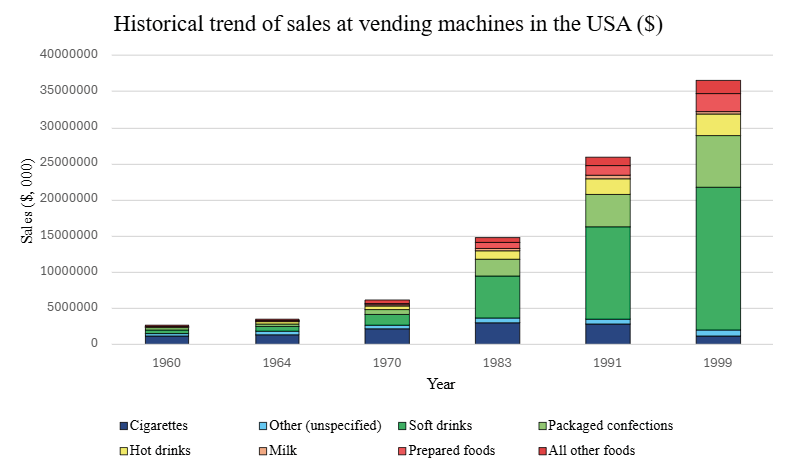
Between the late 1960s and early 2000s, although the vending sector did not undergo major changes concerning the types of food sold and consumed, the perceptions of citizens and the federal government experienced a radical shift. As consumption increased, so did complaints from schools and families about the poor nutritional quality of the foods sold in vending machines, which were considered to be among the primary causes of rampant youth obesity in those years, competing with federal programmes (e.g. the National Lunch School Act) and family nutrition education (New York Times, 1973, 1976; Segrave, 2002). In response, numerous policies were proposed (and sometimes undertaken) to remove (or at least significantly reduce) the presence of such junk food (especially soda and snacks) from vending machines in schools (New York Times, 2001; Salinsky, 2009). One example is the Community Transformation Grants (CTG) programme, created under the Affordable Care Act and funded by the Prevention and Public Health Fund with the aim of intervening systematically (i.e. at the policy and environmental levels) to create new, healthier consumption habits (Lillehoj et al., 2015). However, this was met with strong opposition from the beverage industry and, consequently, the vending sector, so much so that vending machines and the ultraprocessed foods they offered were never completely eliminated from schools or healthcare facilities (Byrd-Bredbenner et al., 2012; Kann et al., 2005; Kibblewithe et al., 2010; Lawrence et al., 2009; Pasch et al., 2011; Salinsky, 2009). The vending industry attempted to meet federal and family demands by increasing the amount of healthy foods and beverages in their machines, but this strategy proved ineffective because of the overwhelming popularity of traditional products compared with the less attractive, less appealing and costlier healthy options (Segrave, 2002). These challenges persist to the present day, and finding effective ways to incentivise the consumption of such products is complex due to psychological factors, sales locations, marketing techniques and the fact that vending machine purchases have always been based almost entirely on instinct and impulsive needs (Bertossi, 2024; Fiske et al., 2004; French et al., 1997, 2001; Gorton et al., 2010; Hoerr et al., 1993; Kocken et al., 2012).
2.2. A quick look into the future in the United States
Attention to well-being and environmental sustainability
Although, in the past, the U.S. vending industry has often been trapped in the image of a channel for high-calorie snacks, with public policies that have not always been consistent and market resistance that has hampered its results, this stalemate appears to be nearing an end. Indeed, the literature offers several examples of proactive and fruitful collaborations in making vending a means for consumers to eat properly (Bertossi, 2024). For example, a study conducted in Los Angeles County evaluated the impact of a vending machine policy requiring 100% of products to meet healthy nutrition standards (Wickramasekaran et al., 2018). Following implementation of the policy, the average number of calories and sodium and sugar contents per snack purchased decreased by approximately 39%, 30%, and over 50%, respectively. For beverages, the average number of calories and sugar content decreased by 90%, and the sodium content decreased by 25%. Despite these nutritional improvements, the average revenue per vending machine declined by 37% for snacks and 34% for beverages. The authors concluded that while 100% healthy vending policies can substantially improve the nutritional quality of products sold, it is important to anticipate and plan for potential short-term revenue losses during implementation. Viana et al. (2018) adopted a similar approach combined with other types of intervention, such as clearer labelling and price increases for unhealthy foods. The results are comparable to those of Wickramasekaran et al. (2018), but with the difference that, in the case of Viana et al. (2018), this strategy allowed turnover to be maintained.
There is also a growing commitment from an environmental impact perspective. For example, companies such as Coca-Cola, PepsiCo and Mars are leading the transformation of food products sold through vending machines in the United States. The primary focus is on packaging circularity. Coca-Cola, with its ‘World Without Waste’ strategy (Coca-Cola Company, 2025), is increasing the use of recycled polyethylene terephthalate (rPET) bottles and has made Sprite bottles transparent to facilitate recycling. The goal is to collect and recycle a volume of packaging equivalent to that sold by 2030. PepsiCo, through its ‘pep+’ programme (PepsiCo, 2025), is focusing on reducing greenhouse gas emissions in its value chain by 40% by 2030, promoting the use of ingredients produced through sustainable agriculture and increasing the recycled content in snack and beverage packaging. Finally, Mars, by investing in its supply chain, integrates sustainable agriculture, which is crucial for ingredients such as cocoa, and ensures that the production of its snacks is powered by renewable energy, reducing the carbon footprint of the final products (Mars, 2025). These initiatives aim to meet growing consumer demand for more responsible choices and will be enhanced by AI.
Alongside sustainability, AI is becoming crucial across retail, especially vending, given its unique relationship with machines, supporting their evolution and encouraging progress. The industry has never looked back with nostalgia and has always turned towards the future, carefully following societal changes and adapting accordingly. For example, the industry has moved from mechanical to electronic systems, from mechanical keys to touchscreens and from coins to keys and modern apps. Until recently, however, vending has been rather static, anonymous and ‘one-way’. In other words, machines and consumers have not engaged in real interactions, an ‘exchanges of views’ or negotiated offers customised to the buyer’s needs in the moment. AI will be able to do this and is expected to completely change the sales and consumption experience, thereby realising the dream of the Automatic Age that began in the 1920s and 1930s. In this way, vending machines will be more human than they have ever been, able to accomplish the following tasks: (1) actively interact with people by responding to their requests for clarification about the characteristics of a product (e.g. the protein content, origin of the food or environmental impact); (2) understand what shoppers need at a certain time of day (e.g. an energetic coffee in the morning); and (3) adapt the offer according to their emotional state (e.g. a hot chocolate or a sweet snack to lift their spirits), their lifestyle (e.g. a protein snack following a workout) or the presence of intolerances (e.g. gluten-free foods for those with coeliac disease). Retailers will transition from simple, anonymous, ‘silent’ salesmen to ‘smart’ salesmen able to assist us in our daily lives. Consumers, for their part, will be able to leave feedback on the vending machines’ performance so that the machine can learn and ensure the provision of high-quality service that meets the expectations of subsequent consumers.
Automatic 24-hour shops (micromarkets) belong to the so-called public vending category and are intended to function as fully automatic neighbourhood shops that are open 24 hours a day. The machines take on a hybrid format that blends the benefits of an automatic bar and a small market by providing snacks, water and classic hot and cold drinks alongside ready-made meals and fresh products. In the United States, this category is recognised in the Food and Drug Administration (FDA) Food Code and supported by guidelines and regulatory clarifications promoted by the industry association. According to the National Automatic Merchandising Association (2024), in 2023 the convenience services sector (which also includes vending machines) reached $26.6 billion, with micromarkets accounting for about one-fifth ($5.4 billion; 20%), making them the main driver of growth in the sector. Within a few years, the number of active locations has grown from ~23,700 (2017) to ~42,900 (2023), reaching ~55,770 in 2024, driven by offices, manufacturing, campuses and healthcare. For the end user, this means more visible assortment, access to fresh/ready-to-eat food and a more informed and faster shopping experience, which explains why micromarkets are gaining ground even over traditional vending. These micromarkets, however, will differ from traditional points of sale not only because they are completely automated, but also because AI enhancements will permit them to adapt their offers in ways that entice consumers to enter by choice rather than because of a lack of alternatives. In other words, micromarkets represent an evolution of the old automats dreamed of by Americans in New York and Philadelphia in the early twentieth century.
During the American ‘Renaissance’ (1950s–60s), the concept of automatic distribution was exported to other regions, including Japan (Higuchi, 2007) and Europe. Because of the First and Second World Wars in the first half of the century, the European vending industry could not progress and develop as it did in the United States. Moreover, in the early postwar period, a specialised organisation of the sector was absent, as was a ‘food culture’ that favoured the use of technological devices for purchasing food (New York Times, 1962). Nevertheless, the Italian market developed because of its close commercial relationship with the U.S. market, especially with big food and beverage companies, such as Coca-Cola (Fumi, 2023). The first vending machines for cold drinks appeared in the 1950s, although they were confined to industrial workplaces (Fumi, 2023).
The real birth of the Italian vending industry took place in the early 1960s (Fumi, 2023). This decade was marked by the invention of the E61 vending machine, which was capable of serving one of the most important and well-known symbols of Made in Italy in the world: espresso coffee (Fontana, 2015). Similarly to what had occurred in the United States a few years earlier, this helped the industry revolutionise the concept of the coffee break in the workplace, thanks also to the cultural movement and trade union protests of 1968 (Fontana, 2015). Precisely for this reason, over the next 40 years, much attention was paid to designing refreshment areas that made the coffee break even more enjoyable (Fontana, 2015). In 1968, the first completely Italian snack vending machine was invented in response to a market characterised by new consumption trends and habits. While Italy had been synonymous with the ‘Mediterranean diet’ a few years earlier, American culinary hallmarks such as fast food, sugary drinks and prepackaged foods were increasingly imported from the 1960s through the 1980s (Fumi, 2023; Porru, 2017). Just like all industrialised countries, Italy underwent a profound, although slow, culinary and dietary transformation during those years, defined by the following processes: (1) de-concentration (i.e. replacement of full meals with frequent snacks throughout the day), (2) de-scheduling (i.e. widening of the time slot for meal consumption), (3) de-synchronisation (i.e. non-alignment of mealtimes with those of other members of a group, reducing opportunities for meeting and exchanges), (4) de-localisation (i.e. consumption of a meal no longer in a precise room, but where it happens) and (5) de-ritualisation (i.e. reduction of the traditional rules governing a full meal; Porru, 2017). Although this cultural transformation had the potential to accelerate the sector’s development, it did not spread rapidly, and many people remained attached to consuming traditional fresh meals in company, rather than eating industrial meals alone (Fumi, 2023). Much like in the United States, the vending sector failed to establish itself as a valid alternative to traditional food sales and consumption channels, eventually becoming classified as an ancillary sector useful more during a quick break than as a replacement for a complete meal. In 1975, as Fumi (2023) described, only 12,500 vending machines (4.9%) sold snacks or meals, while there are no data regarding the sale of canned food. Conversely, the consumption of coffee and cold drinks was significant, with 157,000 vending machines serving the former (61.4%) and 86,000 serving the latter (33.7%). The development of the vending sector certainly was (and continues to be) driven above all by the coffee culture created during the economic boom (Fumi, 2023).
Although the sector in Italy lagged behind its American counterpart, it experienced constant growth in the following decades and reached an annual turnover of €350 million in 1999 (Vending Magazine, 2013) and the consolidation of Made in Italy on a global level. Today, Italy boasts the most extensive vending machine network in Europe, with 831,000 vending machines scattered throughout the country, followed by France (633,000), Germany (617,000) and England (405,000; Confida, 2024a). By 2023, consumption in both public and private places was close to 4 billion (€1.6 billion), of which 66% was coffee, 18% cold drinks, 16% snacks and the remaining 0.07% ice cream (Confida, 2024a). Turnover in public places alone (i.e. hotels, transport networks, recreational centres and shopping centres/malls), however, amounted to €505 million (Table 3). In this regard, Italy is the only European country whose turnover is derived primarily from the sale of cold drinks (63.6%); in other countries, sales tend to be more balanced among the various product categories (Table 3).
| Geography | Category | Million of euros | % | ||||||||||||||||
|---|---|---|---|---|---|---|---|---|---|---|---|---|---|---|---|---|---|---|---|
| Europe | Total | 4.440 | 100 | ||||||||||||||||
| Hot drinks | 1.250 | 28.2 | |||||||||||||||||
| Soft drinks | 1.601 | 36.1 | |||||||||||||||||
| Foods | 1.588 | 35.8 | |||||||||||||||||
| United Kingdom | Total | 543 | 100 | ||||||||||||||||
| Hot drinks | 134 | 24.7 | |||||||||||||||||
| Soft drinks | 198 | 36.5 | |||||||||||||||||
| Foods | 211 | 38.9 | |||||||||||||||||
| France | Total | 539 | 100 | ||||||||||||||||
| Hot drinks | 174 | 32.3 | |||||||||||||||||
| Soft drinks | 148 | 27.5 | |||||||||||||||||
| Foods | 217 | 40.3 | |||||||||||||||||
| Italy | Total | 506 | 100 | ||||||||||||||||
| Hot drinks | 31 | 6.1 | |||||||||||||||||
| Soft drinks | 322 | 63.6 | |||||||||||||||||
| Foods | 153 | 30.2 | |||||||||||||||||
| Spain | Total | 543 | 100 | ||||||||||||||||
| Hot drinks | 134 | 24.7 | |||||||||||||||||
| Soft drinks | 198 | 36.5 | |||||||||||||||||
| Foods | 211 | 38.9 | |||||||||||||||||
| Germany | Total | 385 | 100 | ||||||||||||||||
| Hot drinks | 98 | 25.5 | |||||||||||||||||
| Soft drinks | 123 | 31.9 | |||||||||||||||||
| Foods | 164 | 42.6 | |||||||||||||||||
| Note: Sales considered at the end price to the consumer (sales taxes and inflation excluded) in public and semicaptive environments only (i.e. hotels, transport networks, recreational centres and shopping centres/malls). | |||||||||||||||||||
| Source: Euromonitor International. | |||||||||||||||||||
These figures represent only the tip of the iceberg of a larger, more complex sector that operates mainly in the backwaters. Henke, Sardone (2020) identified six key players that constitute the vending sector’s supply chain: (1) the reference market (i.e. public and private places that, through contracts or tenders, determine the type of supply, sales prices and service arrangements); (2) vending managers (i.e. the more than 3,000 companies that deal with the vending service in the reference market, optimising processes and maintaining the quality of the food supply); (3) vending machine manufacturers (companies that deal with the construction and sale/rental of the electronic and mechanical end units dedicated to the distribution of food and beverages); (4) food and beverage producers (food companies dedicated to the production of foodstuffs suitable for sale through vending machines); (5) wholesalers; and (6) companies for services. The design and construction of vending machines further exemplify Italian excellence, and almost 70% of this production is exported abroad, representing Made in Italy at a global level (Henke, Sardone, 2020).
2.4. A quick look into the future in Italy
The importance of the Italian market is not only measured in turnover and consumption. Since 1998, Italy has hosted one of the most important international vending events: VendItalia. At this expo, exhibitors from all over the world preview their products and innovative technologies. VendItalia – through an increasing number of debates, international talk shows and panels on hot market topics – serves as a benchmark for the global industry. At the most recent event, held in Milan in 2024, three trending topics were discussed widely, which suggests their importance in creating and satisfying new consumer habits: welfare and sustainability, AI and 24-hour automated shops.
Attention to well-being and environmental sustainability
Echoing evidence from the United States on healthier vending policies, the Italian trajectory operationalises ‘assisted choice’ through labelled assortments and price/placement nudges. Examples of such initiatives in Italy include ‘Fresco benessere’, ‘Percorso salute’ and ‘Vending Zone’, all of which offer shoppers a selection of healthy, fresh products and communicate their characteristics through labels and advertising (Henke, Sardone, 2020). Careful strategic planning is required to support these efforts. According to Perfetti et al. (2025), placing such products in the top rows or on the right side increases the likelihood that consumers will see and, therefore, choose them. Setting an appropriate price and working on their familiarity among consumers are also important (Perfetti et al., 2025). The sector is increasingly embracing environmental sustainability as part of a holistic approach to welfare. Indeed, initiatives aimed at promoting local products or those obtained through short supply chains are increasingly common and include ‘Clementime’ (Henke, Sardone, 2020), ‘Consumi o scegli?’ (Confida, 2024b), ‘Pausa consapevole’ (Confida, 2024c), ‘Squisit’ (Bertossi et al., 2023; Confida, 2024d) and ‘EquoSolDA’ (Confida, 2025).
In Italian vending machines, AI is beginning to affect the quality of breaks. A prime example is the mOphas management system developed by Alturas Sistemi, which uses image recognition and telemetry to ‘see’ what is actually in the vending machine, report when items are out of stock, align prices and layouts, and remotely check supplies. For users, this translates into fewer empty shelves, correct prices and more relevant promotions – that is, a more timely and predictable service. SECO – Clea Vend responds to the same service logic through real-time monitoring with automatic alerts and predictive functions, which reduce machine downtime and guarantee the continuous availability of the desired product, ensuring a smooth user experience even during peak times. Finally, on the interaction front, the Breasy app from Newis/Evoca integrates voice commands that allow users to select and pay from their phone without touching the vending machine, which is useful for hygiene and accessibility. In short, these applications move AI from ‘behind the scenes’ to perceived benefits: availability, simplicity and trust throughout a break.
Following consolidation in the United States, adoption has also accelerated in Europe, with more than 10,000 points located across the various member states in 2024 (a 38% increase compared with 2023; European Vending & Coffee Service Association, 2024). Of these 10,000 points, almost 3,000 were located in Italy. This expansion is attributable to changes in people’s lifestyles and consumption methods, with more and more meals consumed outside the home and less time spent between one meal and the next. This has introduced the need for quick access to fresh food that is ready for consumption during times when traditional shops are closed. This new market segment requires high standards of quality management to ensure that the service meets consumer expectations. For this reason, in 2024 Confida presented its ‘Top Quality 24-hour Automatic Shops Protocol’, which requires compliance with the regulatory prerequisites governing the sector, in addition to requirements relating to hygiene, food safety, customer care, point of sale security and sustainability (Confida, 2024e). Attention to these aspects is essential in this regard, as it allows for the continuous provision of a high-quality service, avoiding the historical problems that have characterised the sector in the past century, including ‘food perishability’ and ‘malfunctions’.
The evolution of the vending machine industry offers fascinating insights that go beyond its simple history. Vending machines have long been silent salesmen, unable to establish themselves as a complete alternative to traditional sales channels despite their potential to fulfil the futuristic visions that originated during the automatic age. This failure not only highlights historical technical problems and limited market demand, but also profound social and psychological dynamics related to consumption. The act of purchasing food from a machine was perceived as impulsive and impersonal, an act that lacked the conscious choice, social interaction and familiarity that characterises traditional dining or food shopping.
Today, the vending industry’s narrative is in flux and provides a starting point from which future studies might explore pathways to evolution. The forces that limited the industry in the past – speed, convenience and automation – may now become its greatest strengths. As the industry focuses on well-being and sustainability, combined with technological innovations such as AI, it has the potential to redefine the role of vending in society. How will the perception of the silent salesman change when it becomes a smart salesman capable of interacting with customers, suggesting products based on their preferences and even measuring their mood? Vending machines might transform from simple dispensers into personal nutrition and well-being assistants integrated within an ecosystem that supports more conscious consumption. This could be particularly relevant in highly industrialised societies such as the United States and Italy, where we often see a food paradox, with people having unlimited access to healthy food but less and less time to cook a full meal or enjoy it with company. Furthermore, the spread of micromarkets, which combine the convenience of vending with the fresh and healthy products offered in traditional markets, suggests that the sector is finally finding a way to overcome its historical limitations. More specifically, micromarkets could play a key role in providing access to more traditional and local foods in rural areas, avoiding the need to travel to urban centres and contributing to the creation of shorter supply chains with a reduced environmental impact.
This study serves as a basis for future research focused not only on sales data, but also on the psychological and social impact of this new ‘automatic era’. Future investigations might explore how AI personalisation influences consumers’ purchasing decisions or whether the presence of micromarkets in urban contexts impacts eating habits and the local sense of community. Another promising area of research concerns the potential for the vending industry to combat food poverty. Vending machines have the potential to become a vital channel for introducing healthy, affordable food to remote areas or neighbourhoods considered ‘food deserts’ or ‘food swamps’: areas without access to supermarkets that sell fresh produce. In an era during which food security has become a global priority, vending might play a significant role in ensuring equitable access to quality food. To realise this potential, industry and public policy must work synergistically to overcome the obstacles that have historically prevented the vending of more complex foods, such as perishability and a lack of commercial appeal, compared with traditional snacks. Structured interventions are essential to encourage the choice of healthy and sustainable products by making them more accessible and affordable. Analysing vending as a social laboratory to understand the evolution of our relationship with food, technology and the environment will open up new avenues for research and reveal a sector that, after a century of attempts, may finally be ready to rewrite its history.
A.B.: Conceptualization, Formal analysis, Writing- Original draft preparation.
S.T.: Writing –Review & Editing.
F.M.: Supervision.
Bertossi A., Marangon F., Troiano S. (2023). Financing for sustainable food systems: the role of the vending sector. Economia Agro-alimentare, 25(2): 115-134. DOI: https://doi.org/10.3280/ecag2023oa14828.
Bertossi A. (2024). Pathways towards food sector sustainability: the case of vending. Agricultural and Food Economics, 12(1): 13. DOI 10.1186/s40100-024-00305-x.
Byrd-Bredbenner C., Johnson M., Quick V.M., Walsh J., Greene G.W., Hoerr S., Colby S.M., Kattelmann K.K., Phillips B.W., Kidd T., Horacek T.M. (2012). Sweet and salty. An assessment of the snacks and beverages sold in vending machines on US post-secondary institution campuses. Appetite, 58(3): 1143-1151. DOI: https://doi.org/10.1016/j.appet.2012.02.055.
Coca-Cola Company (2025). Sustainable packaging: world without waste. https://www.coca-cola.com/it/it/sustainability/sustainable-packaging.
Confida (2024a). Dati di settore. https://www.confida.com/dati-di-settore/
Confida (2024b). Consumi o scegli. https://www.confida.com/progetti-soci/consumi-o-scegli/
Confida (2024c). La pausa consapevole. https://www.confida.com/progetti-soci/la-pausa-consapevole/
Confida (2024d). Merenda friulana. https://www.confida.com/progetti-soci/merenda-friulana/
Confida (2024e). Negozi automatici H24. http://www.negoziautomaticih24.it/
Confida (2025). EquosolDA – la pausa caffè equo e solidale. https://www.confida.com/progetti-soci/equosolda/
Diehl L., Hardart M. (2002). The Automat: The History, Recipes, and Allure of Horn & Hardart’s Masterpiece. Clarkson Potter, New York.
Epple A. (2009). The “Automat”. A history of technological transfer and the process of global standardization in modern fast food around 1900. Food and History, 7(2): 97-118. DOI: https://doi.org/10.1484/J.FOOD.1.100652.
European Vending & Coffee Service Association (2024). EVA publishes its new market report on vending & OCS. https://www.vending-europe.eu/eva-publishes-its-new-market-report-on-vending-ocs/
Fiske A., Cullen K.W. (2004). Effects of promotional materials on vending sales of low-fat items in teachers’ lounges. Journal of the American Dietetic Association, 104(1): 90-93. DOI: https://doi.org/10.1016/j.jada.2003.10.011
Fontana A. (2015). Mezzo secolo di vending: storia della distribuzione italiana dal 1963 al 2013. AIS/Design Journal: Storia e Ricerche, 3(5): 110-131.
French S.A., Jeffery R.W., Story M., Breitlow K.K., Baxter J.S., Hannan P., Snyder M.P. (2001). Pricing and promotion effects on low-fat vending snack purchases: the CHIPS Study. American Journal of Public Health, 91(1): 112. DOI: https://doi.org/10.2105/ajph.91.1.112.
French S.A., Jeffery R.W., Story M., Hannan P., Snyder M.P. (1997). A pricing strategy to promote low-fat snack choices through vending machines. American Journal of Public Health, 87(5): 849-851. DOI: https://doi.org/10.2105/AJPH.87.5.849.
Fumi G. (2023). The coin-operated food selling and the machine-vending industry in 20th-century Italy. In d’Errico R., Magagnoli S., Scholliers P., Atkins P.J. (eds) Eating on the Move from the Eighteenth Century to the Present (pp. 92-107). Routledge, London. DOI: https://doi.org/10.4324/9781003327820.
Gorton D., Carter J., Cvjetan B., Ni Mhurchu C. (2010). Healthier vending machines in workplaces: both possible and effective. The New Zealand Medical Journal, 123(1311): 43-52.
Hecht A. (1956). Robots ... at your service. The American Mercury. https://www.unz.com/print/AmMercury-1956nov-00051/
Henke R., Sardone R. (2020). Innovation in the Italian sector of vending machines. Between growth and search for sustainability. Italian Review of Agricultural Economics, 75(2): 13-23. DOI: https://doi.org/10.13128/rea-12067.
Higuchi Y. (2007). History of the development of beverage vending machine technology in Japan. National Museum of Nature and Science: Survey Reports on the Systemization of Technologies, 7(2): 1-69.
Hoerr S.M., Louden V.A. (1993). Can nutrition information increase sales of healthful vended snacks? Journal of School Health, 63(9): 386-390. DOI: https://doi.org/10.1111/j.1746-1561.1993.tb06167.x.
Huppatz D.J. (2022). Robot salesmen: automated food retailing in the United States, 1925-39. History of Retailing and Consumption, 7(3): 261-276. DOI: https://doi.org/10.1080/2373518X.2022.2044196.
Kann L., Grunbaum J., McKenna M.L., Wechsler H., Galuska D.A. (2005). Competitive foods and beverages available for purchase in secondary schools‐selected sites, United States, 2004. Journal of School Health, 75(10): 370-374. DOI: https://doi.org/10.1111/j.1746-1561.2005.00058.x.
Karmarkar U. (2021). Service industrialization, convergence, and digital transformation–II. Management and Business Review, 1(3): 42-52. DOI: https://doi.org/10.1177/2694105820210103005.
Kibblewhite S., Bowker S., Jenkins H.R. (2010). Vending machines in hospitals–are they healthy? Nutrition & Food Science, 40(1): 26-28. DOI: https://doi.org/10.1108/00346651011015881.
Kocken P.L., Eeuwijk J., Van Kesteren N.M., Dusseldorp E., Buijs G., Bassa‐Dafesh Z., Snel J. (2012). Promoting the purchase of low‐calorie foods from school vending machines: a cluster‐randomized controlled study. Journal of School Health, 82(3): 115-122. DOI: https://doi.org/10.1111/j.1746-1561.2011.00674.x.
Lawrence S., Boyle M., Craypo L., Samuels S. (2009). The food and beverage vending environment in health care facilities participating in the healthy eating, active communities program. Pediatrics, 123(Supplement_5): S287-S292. DOI: https://doi.org/10.1542/peds.2008-2780G.
Levenstein H. (2003a). Revolution at the Table: The Transformation of the American Diet. University of California Press, Oakland, CA, USA.
Levenstein H. (2003b). Paradox of Plenty: A Social History of Eating in Modern America. University of California Press, Oakland, CA, USA.
Lillehoj C.J., Nothwehr F., Shipley K., Voss C. (2015). Vending assessment and program implementation in four Iowa worksites. Health Promotion Practice, 16(6): 814-825.
Mars (2025). Net Zero Roadmap. https://www.mars.com/sites/g/files/dfsbuz106/files/2023-09/Mars%20Net%20Zero%20Roadmap%202050_2.pdf.
National Automatic Merchandising Association (2024). The State of Convenience Services: A 2022-2023 Industry Census. https://namanow.org/wp-content/uploads/NAMA-Census-FINAL.pdf.
New York Times (1947). Machine to serve hot coffee shown. https://www.nytimes.com/1947/09/25/archives/machine-to-serve-hot-coffee-shown-developed-by-ruddmelikian-big.html.
New York Times (1950). Coin in the slot: new vending machines are harvesting millions, and the end is not yet. https://www.nytimes.com/1950/12/03/archives/coinintheslot-new-vending-machines-are-harvesting-millionsand-the.html.
New York Times (1953). Even the milkman is automatic now. https://www.nytimes.com/1953/02/06/archives/even-the-milkman-is-automatic-now-devices-selling-quart-cartons-at.html.
New York Times (1956). Machines shrink the coffee break.https://www.nytimes.com/1956/11/23/archives/machines-shrink-the-coffee-break-make-a-brew-more-palatable-to-boss.html.
New York Times (1958). Vending machine hot as a seller. https://www.nytimes.com/1958/01/06/archives/vending-machine-hot-as-a-seller-industry-tops-2-billion-for-the.html.
New York Times (1962). U.S. Vending Machines Go Abroad.
New York Times (1973). School vending machines assailed for junk food. https://www.nytimes.com/1973/04/18/archives/school-vending-machines-assailed-for-junk-food-nutrition-seen.html.
New York Times (1976). Parents Close Tap on Sodas In Westchester School Menu. https://www.nytimes.com/1976/02/03/archives/parents-close-tap-on-sodas-in-westchester-school-menu.html.
New York Times (2001). States Try to Limit Sales of Junk Food In School Buildings. https://www.nytimes.com/2001/09/09/business/states-try-to-limit-sales-of-junk-food-in-school-buildings.html.
Palmer J. (1983). Automatic food service: the meal of the future? Cornell Hotel and Restaurant Administration Quarterly, 24(1): 63-70: DOI: https://doi.org/10.1177/001088048302400111.
Pasch K.E., Lytle L.A., Samuelson A.C., Farbakhsh K., Kubik M.Y., Patnode C.D. (2011). Are school vending machines loaded with calories and fat: an assessment of 106 middle and high schools. Journal of School Health, 81(4): 212-218. DOI: https://doi.org/10.1111/j.1746-1561.2010.00581.x.
PepsiCo (2025). Pepsico Positive. https://www.pepsico.com/pepsico-positive.
Perfetti A., Pietrini R., Scarpi D., Gistri G. (2025). Snack dilemma: how vending machines influence choice of virtue and vice foods. Journal of Retailing and Consumer Services, 87, 104369. DOI: https://doi.org/10.1016/j.jretconser.2025.104369.
Porru E. (2017). Come cambiano le abitudini alimentari: cibo e processi di trasformazione socioeconomica. https://iris.uniss.it/handle/11388/250258.
Rasmussen C. (2001) Jobs galore for robots, rethinking history. The Journal of Theory and Practice, 5(1): 149-162. DOI: https://doi.org/10.1080/13642520010024217.
Recordati G.B.P. (2015). The food industry: history, evolution and current trends. https://tesi.luiss.it/15698/1/177941.pdf.
Salinsky E. (2009). Got Junk? The Federal Role in Regulating “Competitive” Foods, Issues Brief, No. 835, National Health Policy Forum, Washington, D.C., USA.
Segrave K. (2002) Vending Machines: An American Social History. McFarland, Jefferson, NC, USA.
Smith A.F. (2006). Encyclopedia of Junk Food and Fast Food. Greenwood, Westport, CT, USA.
Shocket M.G. (1955). Vending machines. Doctoral dissertation, Boston University, https://open.bu.edu/bitstream/handle/2144/8106/Shocket_Murray_1957_web.pdf?sequence=1.
Vending Magazine (2013). Stabili i ricavi delle TOP 100 del vending italiano nel 2013. https://www.leanus.it/wp-content/uploads/2020/12/Top-100-vending-magazine_DIC_2014.pdf.
Viana J., Leonard S.A., Kitay B., Ansel D., Angelis P., Slusser W. (2018). Healthier vending machines in a university setting: effective and financially sustainable. Appetite, 121: 263-267. DOI: https://doi.org/10.1016/j.appet.2017.11.094.
Wickramasekaran R.N., Robles B., Dewey G., Kuo T. (2018). Evaluating the potential health and revenue outcomes of a 100% healthy vending machine nutrition policy at a large agency in Los Angeles County, 2013-2015. Journal of Public Health Management and Practice, 24(3): 215-224. DOI: https://doi.org/10.1097/PHH.0000000000000702.