Research article
Assessing costs and benefits of agricultural digitalisation: the case of data collection support tools in agricultural-pastoral farms
1 Department of Agriculture, Food and Environment (DAFE), University of Pisa, Pisa, Italy
2 Agricultural Economics Research Institute (AGRERI), Athens, Greece
*Corresponding author. E-mail: fabio.lepore@agr.unipi.it
Abstract. The digitalisation of agriculture is transforming production models, offering advanced tools for data management and operational efficiency. This study examines the impact of digital technologies, focusing on agricultural-pastoral farms as a case study, with particular attention to the social, economic, and environmental costs and benefits perceived by stakeholders. A living lab approach was used, involving farmers, technicians, animal science and ICT experts, and supply chain representatives to make a participatory evaluation of a co-designed Farm Management Information System. This study contributes to the literature by offering an insightful analysis of stakeholder-driven digitalisation processes in the agricultural sector. Results indicate no negative social or environmental externalities. Costs are classified as transition for user training, transaction for collaboratively developing the data-sharing and governance infrastructure, and operational for maintenance expenses and return on the public investment that funded its development. Social benefits include improved farmer well-being, reduced administrative burdens, and greater appeal for young farmers. Economic benefits involve increased productivity, enhanced management efficiency, cost reductions, and a higher market value. Environmental benefits arise from optimised resource use, less waste, and reduced antibiotic resistance. These findings highlight the potential of digitalisation to enhance production quality, animal welfare, and farm management, laying the foundation for broader benefits along the supply chain, aligned with the principles of sustainable digitalisation.
Keywords: digital technology, livestock farming, costs and benefits, sustainable digitalisation, living lab.
JEL codes: O13, O33, Q16.
Index
1.1. Digital transformation of agriculture and animal husbandry issues
1.2. Presentation of the case study
1.3. Leveraging digitalisation to address critical issues
1.4. Aim of the study and research context
2.1. Breeding management based on technology
2.2. The basics of sustainable digital transformation of animal husbandry
2.3. A classification of costs and benefits of digitalisation
3.1. Description of the living lab, application scenario, and related research question
3.2. Setting up of data collection activity
4.1. Data management in the farming process under study
4.2. Stakeholders’ perceptions of costs and benefits
– The living lab facilitated stakeholders’ involvement in assessing the costs and benefits of digitalisation.
– Digitalisation is perceived as an opportunity to prevent the decline of some agricultural supply chains and strengthen the competitiveness of farms.
– The transition, transaction, and operational costs for implementing a Farm Management Information System are considered affordable, given the expected benefits.
– Co-designing a technology involves understanding the costs and benefits perceived by users, with implementation depending on demonstrating a favourable ratio between the two.
Implementing technologies in livestock farming can help address the issues that threaten the sustainability of agricultural practices. An understanding of their transformative role can emerge by examining their broader impacts, potential for innovation, and relevance to a specific supply chain.
1.1. Digital transformation of agriculture and animal husbandry issues
Digital transformation is significantly impacting the global agricultural system (Trendov et al., 2019) and farm-level production (Wolfert et al., 2017), including livestock agriculture (Klerkx et al., 2019). However, despite its potential, challenges remain in adopting sustainable practices that ensure animal well-being and meet the growing demand for agricultural products. Climate change intensifies these challenges by negatively affecting animal health and productivity (Neethiraja, Kemp, 2021), and emerging ethical issues such as privacy, data ownership, labour, and social justice add complexity to the debate on digital agriculture (Neethirajan, 2023).
Precision livestock farming (PLF) presents a promising solution in addressing sustainability and food security requirements in animal production (Norton et al., 2018). Some solutions allow farmers to remotely monitor animal health and well-being by processing data from sensors, enabling early detection of diseases or pregnancies through wearable biosensors (Neethirajan et al., 2018; Benjamin, Yik, 2019).
In Italy, digitalisation is advancing in livestock farms, with 38.5% of farms using computerised herd management (ISTAT, 2020). However, access to digital tools varies by farm size and region, with northern regions and larger farms showing higher adoption rates. While Italy has improved its overall digital transformation (DESI, 2023)1, livestock farms show a low propensity to use social platforms and a reduced penetration of cloud computing. Nevertheless, the adoption of PLF tools is significant, including IT systems for herd management (47.8%), production and reproduction monitoring (41%), remote animal identification (29.9%), and milking robots (21.4%) (ISTAT, 2020).
1.2. Presentation of the case study
Cheese production is an important part of the diversified Italian food sector, known nationally and internationally for the typicality of its products (ISMEA, 2023). Pecorino Toscano PDO, a sheep milk cheese with a protected designation of origin status granted by the EU, exemplifies this. Given this status, its production adheres to rigorous standards, overseen by a regulatory body accredited by the Italian Ministry of Agriculture.
Established in 1985, the Consortium for the Protection of Pecorino Toscano PDO (CPT) ensures compliance with the regulations for the cheese produced under this denomination2, promotes initiatives to safeguard its identity, encourages scientific research, supervises its trade, and counteracts misuse, counterfeiting, and other illegal practices3.
Although sheep and goat production is marginal in the national agricultural economy (RRN-ISMEA, 2018), their supply chain constitutes one of the main sectors of Italian animal husbandry (Macciotta et al., 2020), with semi-extensive herds primarily relying on natural pastures seasonally: winter-spring in the south and lowlands, and autumn-late spring in the north and high plains. The milking season spans 150 to 250 days (Pulina et al., 2018). As of 2021, Italy produced approximately 4.5 million quintals of sheep’s milk annually (ISTAT, 2021), of which (according to CPT data for the same year) more than 195,000 (4.3%) were processed into Pecorino Toscano PDO, yielding more than 3.3 million kg. Currently, 79% of this cheese is sold in Italy (consumer turnover of 39 million euros), while 21% is exported (12 million euros), primarily to the USA (33%), Germany (14%), and France (13%).
Sheep farming in Tuscany faces ongoing challenges that threaten its stability (Bonari, Mantino, 2015). The Pecorino Toscano PDO supply chain includes 744 certified farms with around 1,200 employees, mostly in family-run businesses. Their number has decreased over time, with fewer animals and an average farmer age of around 60. This has reduced the milk supply for cheese production despite rising demand both domestically and from abroad.
The availability of sheep milk is also at risk due to low innovation levels on farms, which lack modern breeding facilities and technology, leading to low competitiveness and a gradual decline. Consequently, productivity varies widely, with average yields ranging from 75 to 350 litres per animal per year. A lack of structured technical support further impacts productivity, both in terms of quantity and quality, and impedes progress toward reducing environmental impact (Georgofili, 2015).
1.3. Leveraging digitalisation to address critical issues
Smartphones have become a fully embedded element of people’s daily lives (Wang et al., 2016), and digital technology is increasingly integrated into contexts such as rural life, agriculture, and forestry, which are undergoing significant technological transformation (Trendov et al., 2019). This transition involves a multitude of solutions (Bacco et al., 2019) that can generate social, economic, and environmental impacts (Rolandi et al., 2021) along with open challenges and opportunities (Ferrari et al., 2022).
Within this evolving landscape, farming stands out as a sector where advanced decision support systems (DSSs) benefit stakeholders throughout the agri-food supply chain, allowing them to make informed decisions (Fountas et al., 2015). The technological solution introduced in this study is a Farm Management Information System (FMIS) app, designed to collect, process, store, and disseminate data as information essential for the operational functions of a farm (Sørensen et al., 2010). This tool emerged from an ongoing collaboration between academia and the Pecorino Toscano PDO ecosystem players through various research and innovation projects that explore digitalisation within this supply chain. Among these is the Precision Sheep4 operational group, which addressed precision agriculture in sheep farming and technical support for milk production (Mantino et al., 2019), laying the foundations for the participatory development of this tool.
The FMIS (called Poderi) is available online (in Italian) in a prototypical version5. It provides key functionalities, including tracking herd size with animal IDs, managing health records and monitoring pregnancies via ultrasounds, and evaluating animal performance through milk quality metrics with trend visualisation. It also has a digital field notebook, a DSS for optimising fodder production, synchronous communication with agronomists and veterinarians, and a web dashboard. The extensive co-design process made it possible to focus on key user priorities, including data security, interoperability, and usability. The tool employs encrypted storage and access control to protect sensitive information, and it integrates with national databases. In addition, its user-friendly interface is intended to promote its adoption, particularly among users with limited digital skills.
The objective of this digital solution is twofold. On the one hand, it aims to improve the production efficiency of the agricultural-pastoral farms that produce milk for Pecorino Toscano PDO. On the other hand, it seeks to extend this improvement to the entire supply chain of this cheese. This study aligns with key EU initiatives promoting digitalisation and data governance in agriculture, such as the Common European Agricultural Data Space and Data Act (2024) and the CAP Strategic Plans (2023–2027). The discussed technology contributes to these goals by improving agricultural data management and decision-making, thus supporting the transition towards data-driven agricultural systems.
1.4. Aim of the study and research context
As part of the Horizon Europe CODECS project (Maximising the CO-benefits of agricultural Digitalisation through conducive digital ECoSystems), a study is underway focusing on the digitalisation of agriculture. The research presented here specifically aims to identify the perceptions of the costs and benefits of digitalisation, establishing a foundation for evaluating how technology can help resolve challenges within the Pecorino Toscano PDO supply chain, from sheep breeding to cheese marketing.
After an introduction to the context and relevant issues, the paper proceeds with a theoretical framework underlying this research (Section 2); the methodological approach adopted (3); the results as an overview of the current state of task management, how digitalisation can support it, and the outputs of the participatory assessment of the costs and benefits (4). A discussion and final remarks conclude the document (5, 6).
2.1. Breeding management based on technology
This research focuses on the digitalisation of agricultural-pastoral farms. Nowadays, technology offers management tools that enhance farm competitiveness while meeting societal, market, and institutional needs (Berckmans, 2016). Precision livestock farming applies engineering principles and technology to manage animal production, viewing animal husbandry as an interconnected network of processes (Wathes et al., 2008). At the farm level, it enhances efficiency and promotes animal and human well-being through technological innovation, resource optimisation, and precise process control (Banhazi et al., 2012).
While PLF systems are widespread, the field is moving toward digital livestock farming (DLF), representing digital agriculture tailored to livestock (Neethirajan, 2023). Digital farming uses ICT within the cyber-physical cycle of farm management (Wolfert et al., 2017), leveraging digital data to inform decision-making across the agricultural value chain and generate exploitable knowledge through big data (Shepherd et al., 2020). It connects information from farmers and stakeholders, allowing consumers, for instance, to base purchasing decisions on farm information and enabling farmers to make informed choices based on consumer behaviour (Wolfert et al., 2017). Thus, the impact of digital transformation extends beyond the farm or production unit to the entire value chain, highlighting the potential to connect producers and consumers directly (Shepherd et al., 2020).
2.2. The basics of sustainable digital transformation of animal husbandry
In discussing digital transformation, a distinction should be drawn between digitisation and digitalisation (Bumann, Peter, 2016). The former refers to technical conversion of analogue information into digital formats (Bockshecker et al., 2018) and involves the development of digital infrastructure, including a worldwide network of computers, mobile devices, network connections, and advanced application platforms (Bley et al., 2016). This process, described as the third industrial revolution, has driven advancements in digital systems, communication, and computing power, enabling innovations in data processing and sharing (Davis, 2016). Decision support tools and autonomous agronomic systems largely operate at the farm level (Klerkx et al., 2019); however, with the Internet, it has been possible to integrate different activities (Porter, Heppelmann, 2014), initiating the fourth industrial revolution, where cyber-physical systems enable enhanced interaction between people and machines, embedding third-revolution technologies into society in a transformative way (Davis, 2016). Increased connectivity and data exchange have allowed these technologies to communicate, moving beyond mere technical conversion (Alm et al., 2016).
In contrast, digitalisation addresses both social and technical aspects, reflecting an organisation or society’s digital progress and ICT use (Bockshecker et al., 2018). This term refers to socio-technical processes of using digital technologies that impact social contexts that rely increasingly on them (Tilson et al., 2010). Unlike digitisation, digitalisation transcends individual farms, extending to multiple entities, as in the case of platforms connecting different actors and creating interactive spaces (Wolfert et al., 2014; Rose, Chilvers, 2018).
Together, digitisation and digitalisation drive digital transformation (Rijswijk et al., 2021), a larger process involving organisational and social changes driven by technological innovation. This process influences business models, processes, products, and structures, while also affecting agriculture, forestry, and rural areas (Bockshecker et al., 2018; Poppe et al., 2013).
Sustainable development seeks to meet the needs of the present without compromising the ability of future generations to meet their own needs (Brundtland, 1987). This process emphasizes the interconnectedness and harmony between economic and social progress, including technological advancement, and the environmental dimension, thereby enhancing humanity’s potential in both the present and the future (Johnston et al., 2007). From the above, sustainable digitalisation can emerge as a goal, where technology development actively contributes to sustainability (Sacco et al., 2021). It is important from the perspective of digitalisation as an enabler factor of a transition towards achieving the UN Sustainable Development Goals (SDGs) (Mondejar et al., 2021).
2.3. A classification of costs and benefits of digitalisation
Innovation enables farms to gain long-term competitive advantages that can be measured in terms of performance by considering the Input-Process-Output-Outcome framework (Brown, Svenson, 1988). With this model, digital technology adoption in farming transforms inputs (e.g. land, labour, capital) into outputs (e.g. higher yields), which in turn lead to measurable outcomes, i.e. impact elements that can be viewed as costs or benefits.
To assess digitalisation comprehensively, social costs must be considered. These costs arise because actors do not solely bear all costs or receive all benefits. They combine private costs that fall on individuals directly involved and external costs that fall on other people or companies (De V. Graaff, 2018). The latter is particularly significant, as they include environmental degradation and negative impacts on human beings, their property, and well-being (Dascalu et al., 2010), prompting consideration of economic, social, and environmental dimensions of sustainability in public costs and benefits.
Looking at private costs, we can see the following tripartition. First, we have the transition component. From the perspective of measures to contrast the effects of climate change, this refers to “the costs of planning, preparing, facilitating and implementing adaptation measures” or – in terms of benefits – to “the costs of avoided damage or benefits gained as a result of adopting and implementing adaptation measures” (IPCC, 2007). Thus, transition costs and benefits can be considered adaptation costs and benefits. More practically, costs are the total expenditure devoted to adaptation, while benefits are assessed by considering avoided losses, which include direct and indirect damage to property, lives saved, and welfare preserved. In addition, impacts on the local economy and positive side effects, such as reduced future risks, increased productivity of resources and unaffected people, stimulation of innovation, and improved environmental benefits and ecosystem services, can be assessed (EEA, 2023).
Transaction costs are defined as the costs of research, negotiation and validation, and registration and execution of a contract (Williamson, 1975). This grouping looks at the costs of information procurement and purchasing, as well as regulation monitoring and enforcement (Fazeli et al., 2020; Dahlman, 1979).
Operating costs occur if an asset is used and are proportional to the degree of its utilisation (Edwards, Duffy, 2013). They are continuous cash outlays required to maintain production, so they are assumed to be incurred during production. Before the startup, they are considered an investment (Collarini et al., 2021).
Transition, transaction, and operating costs are evaluated financially and by the human effort required to implement a technological solution. Cost-benefit analysis, as a tool with a long-standing role in the decision-making process of allocating financial resources (Jiang, Marggraf, 2021), systematically categorises impacts as benefits or costs, monetises them, and compares them to a status quo based on net benefits or benefit-cost ratio (Boardman et al., 2018). This tool supports social decision-making, helping allocate scarce resources by quantifying policy or investment project impacts on society (Hanley, Barbier, 2009). In this article, the above categories are used to label the perceived costs and benefits associated with farm digitalisation, which have been elicited and described following a qualitative approach.
For sustainable digitalisation, the costs and benefits assessment will include economic, social, and environmental aspects of sustainable development (CODECS, 2022).
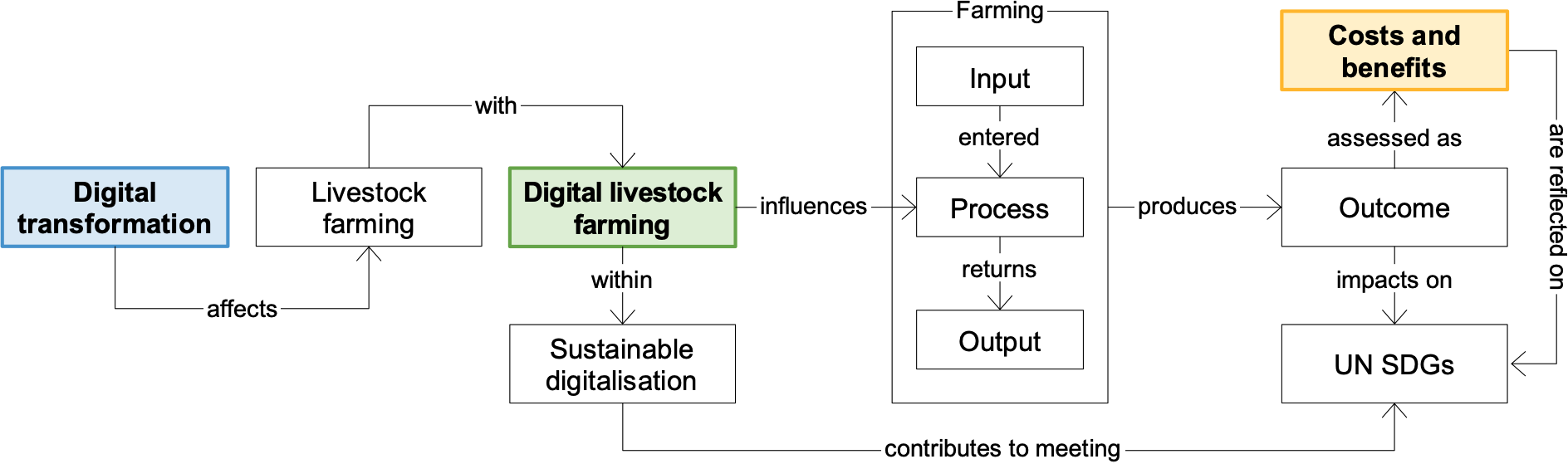
Figure 1 illustrates the theoretical framework of this article. Digital transformation affects livestock farming with digital livestock farming (DLF). Adopting the associated technological solutions influences the farming process by acting on the inputs that are entered and the outputs that are returned, producing outcomes that are assessed as costs and benefits of the digitalisation of this process. DLF should be implemented within sustainable digitalisation, which aims to contribute to meeting the UN SDGs, on the achievement of which the outcomes of the digitalised process can have an impact, and which at the same time are a reflection of the costs and benefits assessed on a social, economic, and environmental level.
Building on the above, the methodology presented in the following section aims to address key elements, focusing on the perceived costs and benefits of digitalisation. A participatory approach will explore the stakeholders’ perspectives in the process under study.
3.1. Description of the living lab, application scenario, and related research question
All research activities were conducted within a living lab, a user-centred open innovation ecosystem based on a systematic user co-creation approach that integrates research and innovation processes in real communities to create a sustainable impact (García Robles et al., 2015). The interest in this research approach is growing, and experiences are sufficient to identify its challenges and opportunities (Hossain et al., 2019). We define it as a network of farmers, knowledge brokers, stakeholders, and policymakers gathered around an emerging problem in a given application scenario and willing to develop solutions through collaboration (CODECS, 2022).
In the technology domain, an application scenario is defined as the context in which a goal can be achieved using digital tools. It considers the technical requirements that a digital tool must address and defines the intended goal (Rolandi et al., 2021). For this study, the application scenario is the farming and livestock management activities carried out on the farm, within the agricultural domain, which is defined as the practice of cultivating the soil, growing crops, or raising livestock for human use, including producing food, feed, fibre, fuel, or other useful products6.
In the first stage of the project, we aim to discuss with stakeholders the potential implementation of a technological solution based on the Farm Management Information System (FMIS) for decision support, designed to simplify the milk collection process from associated farmers. This purpose aligns with Leminen et al. (2012), who define living labs as physical regions or virtual realities where stakeholders collaborate to create, prototype, and validate new technologies in real contexts.
Once the application scenario had been defined, the living lab set up its work around the following focal question: How can digital technology assist farmers in collecting data on business processes, and how can these data be used to improve production quality, farmers’ work and life quality, farm visibility, and animal health and well-being? Within it and more specifically, this study aims to address the following research question: What are stakeholders’ perceptions regarding the social, economic, and environmental costs and benefits resulting from farm digitalisation?
3.2. Setting up of data collection activity
The overall goal of the CODECS project is to collect information regarding the perceptions of farmers, policymakers, and practitioners about the social, economic, and environmental costs and benefits associated with the digitalisation of farms. Identifying and analysing these aspects is crucial to understanding how costs and benefits are generated and, therefore, to supporting the design and proposal of specific policies (CODECS, 2022).
All research activities have been conducted within the Italian living lab of the CODECS project. The protocol and guidelines for its setting were defined internally and are common to all the living labs of the European consortium. Data collection was carried out in two phases: a preliminary meeting with CPT managers to identify the problem to be addressed, and a focus group attended by 14 participants, where a tailor-made FMIS technology solution was presented and discussed with potential users. The methodological approach involved collecting qualitative data from stakeholders concerning the social, economic, and environmental dimensions of the perceived costs and benefits associated with implementing this solution (Iliopoulos et al., 2024).
To this end, participants were asked to answer the following ten questions:
Q1: What comes to your mind when you hear the term “farm digitalisation”?
Q2: Do you think the proposed tool/service might work? Why? Under what conditions?
Q3: How do you think the innovation would change farming activities (operations, organisation, relations in the supply chain, relations with advisers, relations with suppliers)?
Q4: How would the innovation contribute to environmental sustainability? Under what conditions?
Q5: How would it contribute to farmers’ incomes and well-being, quality of work, and gender equality? Under what conditions?
Q6: What do you think are the economic, social, and environmental costs associated with introducing the proposed digitalisation innovation, and who will incur each type of cost?
Q7: Would you be willing to pay the associated costs? How much would you be willing to pay?
Q8: What kinds of problems do you expect to face as more and more farms become digitalised in the future?
Q9: What kinds of benefits (economic, social, and environmental) do you expect from digitalisation? Please provide some examples.
Q10: Is there anything else you want to share with us regarding farm digitalisation that you have not mentioned so far?
The focus group questions were designed to capture stakeholders’ perceptions of the costs and benefits of digitalisation within the Pecorino Toscano PDO supply chain. Q1–Q5 establish the context for understanding their views. Q1 introduces the discussion by inviting participants to share their immediate thoughts on farm digitalisation, helping us to understand pre-existing notions and attitudes. Q2 and Q3 focus on expectations regarding specific digital tools, their feasibility, and their potential impacts on farm operations and supply chain relationships. Q4 and Q5 explore the contributions of digitalisation to environmental sustainability, farm incomes, well-being, and gender equality, capturing perspectives on broader socio-economic and ecological outcomes. Q6 and Q7 focus on cost perceptions, prompting participants to reflect on economic, social, and environmental costs, their distribution across the supply chain, and stakeholders’ willingness to pay – all key factors for assessing financial feasibility and adoption. Q8 identifies anticipated challenges in an increasingly digitalised agricultural landscape, helping to uncover potential barriers and unintended consequences. Q9 explores expected economic, social, and environmental benefits, providing insights into stakeholder expectations and contextual factors shaping digitalisation outcomes. Finally, Q10 serves as an open-ended prompt, allowing participants to share additional perspectives not captured by the previous questions. This ensures that the focus group discussions remain flexible and responsive to emerging themes, enriching the dataset with stakeholder-driven insights beyond the structured framework.
The focus group was held in person in November 2023 at the CPT premises (Grosseto, Italy). This exercise followed a double moderator format (Krueger, Casey, 2000). Two researchers supervised the research and data collection activities. The first managed the audio and video support equipment and took notes, while the second moderated the discussion, steering it in accordance with the guidelines (Iliopoulos et al., 2024).
The event was recorded and transcribed by hand to elicit its contents through thematic analysis (Vaismoradi et al., 2013). Participants’ privacy was respected through anonymisation with attribute coding (Saldana, 2013). Specifically, we adopted an alphanumeric coding [XXX#Y], where the first three letters referred to the stakeholders’ category, and a number distinguishes attendees within the same category. No preference was given to participants; the numbers were assigned based on the order of their first contribution (they were free to position themselves as they wished). They arranged themselves in a circle around a microphone, while a camera filmed the meeting from outside the group. Two representatives from the University of Pisa were provided with a blackboard and a projector. The meeting began with the CODECS project coordinator outlining the project, followed by a second representative (an expert in animal science) who introduced the digital tool submitted for discussion.
4.1. Data management in the farming process under study
When examining how the task is currently performed and looking at the importance of the technological solution, the role of data as a resource and product of the farming process becomes evident. This aligns with the broader research within this living lab. In the context of the production of Pecorino Toscano PDO, the data generated at the farm level are extremely valuable. Preliminary discussions indicate that they are collected across several contexts. Furthermore, the process involves numerous sub-phases and actors, leading to a substantial flow of information that increases as we progress along the supply chain.
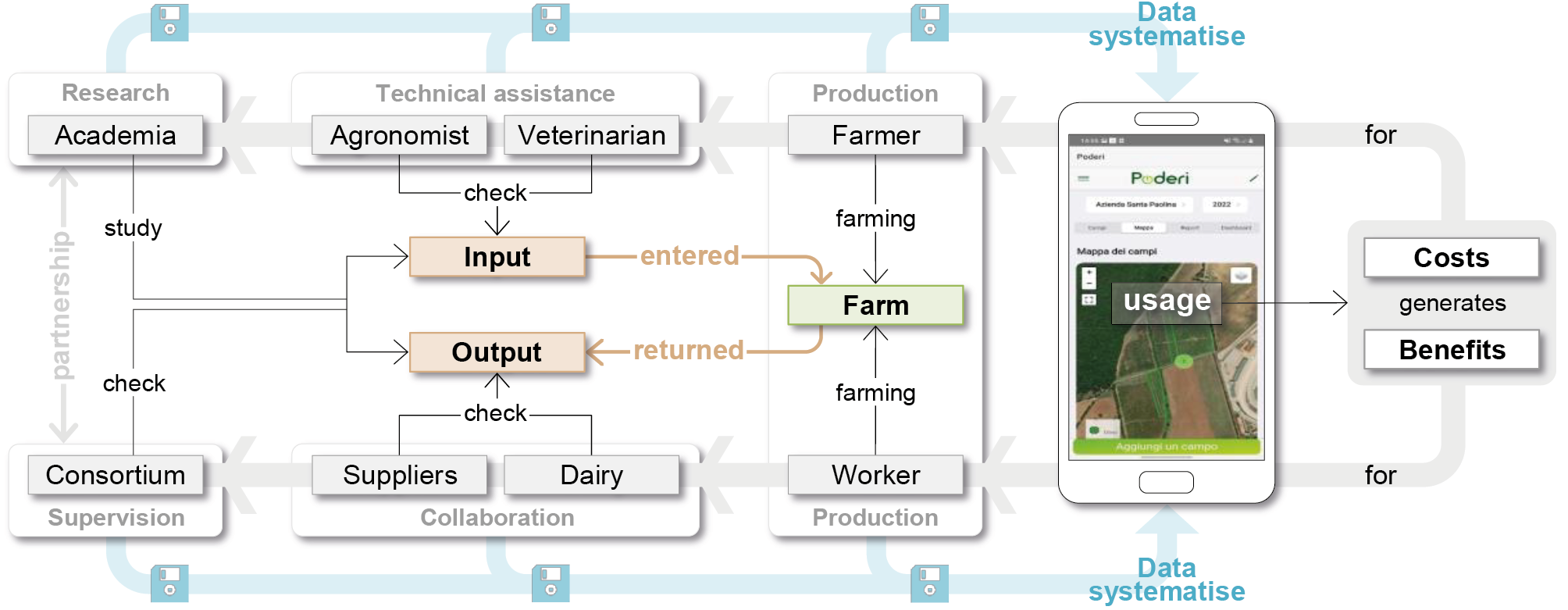
At the centre is the farm, the physical place of production, where farmers and their employees (workers) generate data through various agricultural and animal husbandry practices. From recording the quantities of fodder and milk produced to tracking livestock sales, births, and financial transactions, farmers document essential information daily. In less digitalised farms, these data are often managed manually, using paper records, which serve both for business planning and legal compliance.
Beyond farmers, other key actors contribute as data producers and users, structured around inputs with milk as the primary output. For instance, animal feeding and health care often involve support from agronomists and veterinarians, who provide technical assistance. Information collected from farmers can facilitate these professionals’ work, while additional data generated directly by them are returned to the farmer as verbal or written documentation.
Being part of a protected supply chain also necessitates collaboration with specific actors. For instance, dairy companies that receive milk for cheese making conduct a series of incoming checks and share the results with farmers. Further along the supply chain, the level of digitalisation increases, as dairies usually keep telematic systems for data storage and control, allowing them to be stored for a long time. This data exchange – often paper-based, or electronic under specific requests – typically occurs only between farmers and processors for accounting and product valuation purposes. Furthermore, productivity data from the herd may be shared with other entities, such as animal feed suppliers, who often tailor feed formulations to meet a farmer’s specific needs. This requires extensive data regarding the quality of the output to manage production at the feed mill and coordinate supplies.
The Consortium plays a relevant role in supervision, overseeing both inputs and outputs. Data are also produced, analysed, and stored by academia, which is equally interested in acquiring this information for its research activity. Their long-standing partnership has fostered an innovation ecosystem, with the Consortium for the Protection of Pecorino Toscano PDO involved in various Italian and European research projects.
Figure 2 shows how the activity of the actors within the five contexts mentioned above (production, technical assistance, collaboration, supervision, and research) contributes to data generation, often managed in analogue mode. The idea behind the design of this technology is to digitise and systematise these data, making them accessible to all relevant stakeholders. In this specific context, the assumption is that data should not remain the exclusive property of those who generated them, but should be shared across the supply chain, enhancing their usefulness. Implementing this solution may generate costs and benefits for those interacting with it, even in different roles.
The above highlights the potential of digitalisation in managing data within the process under study. This context provides a foundation for understanding how stakeholders evaluate its social, economic, and environmental implications in terms of perceived costs and benefits.
4.2. Stakeholders’ perceptions of costs and benefits
The focus group participants were selected to ensure representation across five key areas of data generation and use within the agricultural phase. The groups comprised farmers [FRM] for production, professionals [PRO] for technical assistance, academia [ACD] for research, collaborators [CLB] for collaboration, and the Consortium for the Protection of Pecorino Toscano PDO [CPT] for supervision. Technology providers [ITC] also joined the discussion, bringing their expertise as experts in the subject and developers of the app.
The participants shared a variety of perspectives on what the digitalisation of farms means for them (Q1). According to one professional, it implies “novelty and facilitation” because it is something innovative that makes life easier. ITC#3 emphasised “cost reduction”, explaining that technology should ideally reduce both financial expenditures and time losses on the farm, which would enhance productivity, provide farmers with more free time, and potentially attract younger generations to this work. For FRM#2, digitalisation means “future” as technology increasingly shapes the future of agriculture, and without it, farming might face decline, as noted by FRM#3. A feed company representative highlighted its utility when integrated into farm growth, suggesting that it can streamline farm operations. FRM#1 further noted that digitalisation offers income growth and attractiveness, two crucial factors as the sector lacks a generational transition. ITC#1 echoed this feeling, linking digitalisation to modernisation, which could make farming more attractive to young people. Finally, another professional remarked that with digitalisation comes “improvement and growth”, underscoring the danger that without technological tools for collecting, processing, and using data, livestock farming as a job will disappear.
With regard to the possible effectiveness of the proposed technological solution and the necessary conditions for it (Q2), FRM#1 expressed confidence that the app, whose design takes into consideration the main functions of the farm, would be effective, adding that “…it must work!” This idea aligns with the belief, shared by CLB#1, that digital solutions can revitalise this sector and prevent further decline. FRM#2 proposed additional features to enhance herd management and support work with groups of animals. Other participants emphasised data sharing, underlining its potential value for the entire supply chain, particularly in facilitating product traceability. In this regard, ITC#2 mentioned blockchain as a potential technology for these functionalities, highlighting its relevance in securing shared data.
In regard to the change that this innovation would bring (Q3), participants discussed how the proposed app, which collects farm-level data, could foster greater involvement among supply chain actors when integrated with other processing-level technologies. CPT#1, representing the Consortium, noted their commitment to innovation, supported by a long-standing collaboration with ACD#2’s research group. This collaboration includes a project to establish a “digital footprint” for each farm in the Pecorino Toscano PDO supply chain, implementing technologies such as blockchain. The goal is to enable traceability from field to consumer, collecting data at all levels and sharing them with authorised monitoring bodies, thereby adding value to the raw material, as well as the semi-finished and finished product, including in the eyes of the end consumer.
With respect to environmental sustainability (Q4), PRO#2 observed that the app could optimise the use of resources on farms, particularly in feed management, reducing waste and directing it to animals that need them most. More efficient agronomic practices could further benefit the environment. The app could allow better health monitoring and careful use of drugs, as well as mitigating the risks of antibiotic resistance, which is particularly challenging on larger farms but could be effectively managed with technological support.
The discussion on how this tool could contribute to farmers’ income and well-being, quality of work, and gender equality was very insightful (Q5). In terms of economic impacts, participants agreed that technology could improve income through increased productivity, better farm management, and cost reduction. One farmer stated that many notes need to be made and that this is often done in the evening and sometimes postponed due to tiredness, so a tool that facilitates quick data entry could be handy. CLB#1 mentioned time constraints in customised feed production, explaining that a whole day can be spent setting up data, which could be streamlined through this app. The farmer also complained that pastoral life has changed little over the past 50 years, or may even have worsened due to the number of bureaucratic tasks required, and expressed optimism that digital tools could improve quality of life by saving time. As regards gender equality, he pointed out that his wife works with him on the farm, commenting that automating manual tasks, such as making annotations and keeping stock accounts, could ease workload pressures and encourage more family and female involvement in farm management.
While no significant concerns were raised regarding potential social or environmental costs of this innovation, the discussion on economic costs was more extensive (Q6). A representative from academia noted that these costs could be measured in hours worked by technicians or farmers. Development costs include design, creation, updates, and improvements, which, supported by public funding, represent an investment that must be remunerated so that it does not remain at the expense of the community. Therefore, the app might be offered as a subscription-based service. Initial estimates suggest a subscription fee of 100–250 euros/year per farmer within the Consortium. Participants also discussed the European Rural Development Policy, which could subsidise precision farming costs, including digital applications. RES#2 added that training costs for end-users, which are crucial for including less digitally advanced stakeholders, would also need to be considered.
When discussing the willingness to pay for these costs (Q7), RES#2 noted that training costs would likely be acceptable, especially as co-design is integral to the living lab process of CODECS, bearing in mind that some farmers were already involved in similar projects. There was consensus that if the Consortium covered the subscription, more farmers would likely use the app. Its manager confirmed that it is prepared to fund this cost to support the primary sector, which is crucial for the future of the Pecorino Toscano PDO supply chain. FRM#1 added that the subscription cost seemed reasonable, given the returns in milk pricing, but underscored the importance of a clear cost-benefit demonstration for farmers.
Looking toward a future with increasingly digitalised farms (Q8), participants raised no objections. FRM#1 expressed a willingness to share data as long as they remain anonymous, referring to the importance of collective, rather than individual, health alerts. The technology expert intervened on this point, reassuring everyone that data can be anonymised and selectively shared as needed. ACD#2 explained that while farm data sharing is limited to dairy entities and does not occur among farmers, data generally appear in aggregate form, and access can be provided to authorised parties.
Finally, the expected benefits from digitalisation were examined across economic, social, and environmental dimensions (Q9). Economically, digital tools could significantly enhance time management, thereby improving operational efficiency. In a hypothetical scenario, participants compared digitalised and manual inventory operations and controlling the number of animals in the herd, noting how digital solutions could save time. On the social side, the well-being of farmers could be improved by reducing paperwork, which often takes until the evening. Additionally, technology could facilitate generational change, which is currently too closely linked to father-son succession but could be extended to new young workers who are attracted by a working environment where digital can offer new stimuli. Participants also considered consumer confidence, as the Consortium’s traceability efforts could strengthen the identity of each supply chain actor, fostering a sense of shared value. Finally, environmental impacts are linked to a more efficient management of inputs, both in the part of the farm dedicated to fodder production and in the drugs used in herd management.
Table 1 summarises the results of the discussion within the focus group. The contents are presented as keywords related to the answers to each question concerning the proposed digital solution (PDS).
| Investigated issues | Emerged themes and insights |
|---|---|
| Stakeholders’ perspectives on digitalisation. | Novelty, facilitation, cost reduction, future, business growth, farm control, income growth, attractiveness, keeping up with the times, improvement. |
| What the PDS looks at. | Effectiveness, being promising, farm operations, confidence, revamping, improvement, additional features, data sharing, traceability. |
| Transformative changes introduced by the PDS. | Integration, involvement, innovation, food digital footprint, traceability, added value. |
| PDS influence on environmental sustainability. | Impacts, input optimisation, waste reduction, better agronomic management, reduced antibiotic resistance, caution in using drugs. |
| Potential contributions of the PDS. | Increased productivity, farm management efficiency, cost reduction (to farmers’ income), convenience, usefulness, speed, quality of work, simplification (to farmers’ welfare), work relief (to gender equality). |
| Economic cost components associated with the PDS. | Development costs, improvement costs, public funding, investments, subscription charges, training costs. |
| Additional cost-related issues of the PDS. | Subscription, willingness to pay, bearing the costs, awareness of benefits, cost-benefit evaluation. |
| Processes and implications of farm digitalisation. | Taking advantage, data anonymisation, data sharing, data flow, trust issues. |
| Expected benefits of agricultural digitalisation. | Time management, business efficiency, control, final product value (economic), farmer’s well-being, generational change, consumer confidence, sense of belonging (social), management of agronomic and livestock inputs (environmental). |
Despite being renowned within Italian agri-food traditions and appreciated both domestically and internationally, Pecorino Toscano PDO cheese faces production risks due to long-standing issues. These challenges, notwithstanding advances in knowledge and the opportunities offered by digital transformation, are not being solved. Through a living lab, the Horizon Europe CODECS project has begun exploring these issues, initially engaging stakeholders in discussions on implementing an FMIS solution. It aims to foster sustainable innovation at the farm level (SDG 9 – Target 9.c) and address the barriers that threaten its survival. To this end, key data generation and data use actors from the farming phase were questioned, as these contexts represent viable areas for technological intervention. Although digital tools are effective for dairy farm management (Kassahun et al., 2021), obstacles to adoption can limit their implementation (Giua et al., 2021).
Participants largely showed a positive approach to innovation, expressing openness to digitalisation without technological resistance. According to potential users, the proposed app meets the essential functions for on-farm use, and farmers place significant trust in its potential to address the ongoing crisis in sheep farming, which they see as backward and without a future. Despite the optimism, we know that the decision to adopt technological support in animal husbandry can vary due to factors such as farm size, specialisation, and tool usability (Groher et al., 2019) – aspects that require further exploration within this study.
The innovation proposed here involves integrating stakeholders, with a focus on producers and technicians, to enhance the farming experience through improved technical assistance (SDG 2 – Targets 2.3, 2.4, 2.5, 2.a), identified as a critical area in sheep farming (Bonari, Mantino, 2015). Digital technology can impact the value chain (Rolandi et al., 2021), and in this case, its positive effects would involve all actors. In particular, integration between farming and processing stages is expected to boost the perceived value of raw, semi-finished, and finished products for end consumers (Islam, Cullen, 2021).
Participants expressed no concerns about increased digitalisation in sheep farming. The importance of data as a factor in production was widely acknowledged, and farmers exhibited a willingness to share their own, recognising their value across the supply chain. This reflects the broader trend in agriculture toward enhanced data collection and utilisation to support smart farming (Pham, Stack, 2017), though the large data volumes needed lead to considerations around governance (Wolfert et al., 2017). While information sharing is already common in this context, trust between actors along the agri-food value chain is crucial, particularly in selecting reliable partners with whom to share information (Van der Burg et al., 2019). Technologies like blockchain, which is planned to be implemented by the CPT, aim to address this need for trust (Zhao et al., 2019). Anonymisation could also alleviate ethical concerns linked to digitalisation, a topic broadly discussed in the literature (Royakkers et al., 2018). However, its adoption in agriculture presents key technical and social challenges (Torky, Hassanein, 2020), which match the concerns raised within stakeholder discussions. In particular, issues related to privacy and unclear governance frameworks on data ownership contextualise these aspects among sociocultural barriers to digitalisation (Ferrari et al., 2022; Neethirajan, 2023).
For environmental sustainability, optimising input use is key. Technology can support wiser decision-making (Fountas et al., 2015) in areas like feed and drug use, reducing waste, and resistance to antibiotics. In particular, the effects would be proportional to the size of the farms, and this is very important because it emerged that extension in this sector brings with it management complexity. In 2019, the EU approved the European Green Deal, aiming for climate neutrality by 2050 through substantial commitments and funding. This is especially important for this animal husbandry sector, where there is a risk of not finding private investors willing to finance the design and development of these tools. Development partner institutions are important, especially in some low-income countries (Causevic et al., 2022), but they require a commitment to environmental sustainability. This aligns with the Tuscany region’s conditionalities, which the functionalities of this app aim to meet.
Participants believe technology can improve farmers’ economic conditions through increased productivity, management efficiency, and cost reduction, as confirmed in Rolandi et al. (2021). As regards farmer well-being, it is pointed out that there is a lot of work to be done on the farm and that technology may reduce the amount of work brought home, which currently encroaches on free time, a key factor deterring new generations of potential workers from entering this sector. Additionally, digital tools could alleviate the administrative burden on farmers by enabling institutions to take over some responsibilities for data by integrating this app into institutional channels.
With respect to gender equality, participants indicated that women already participate in this work without discrimination. However, from our perspective – and bearing in mind that the app is still an unimplemented prototype – the stakeholders’ perceptions are not sufficient to conclude that this tool will actually increase female involvement in this specific context. Although there is no quantification of women’s employment in this supply chain, this aspect cannot be overlooked, given their significant presence within agri-food systems (FAO, 2023). Our findings suggest that reducing workload is a leverage point for enhancing female participation. It aligns with existing literature – primarily focused on emerging contexts – which underscores the potential of technology to improve women’s involvement in agriculture (Ball, 2020; Vemireddy, Choudhary, 2021) and their overall employment conditions (Nguyen-Phung et al., 2024). Furthermore, our data reveal that they tend to perform tasks more akin to administrative roles rather than manual labour. In this regard, the FMIS could promote their engagement by enhancing their autonomy in farm management; however, the absence of female farm leaders and the predominance of family-run businesses in our sample prevent us from comprehensively assessing female empowerment in this direction – a debate that remains active, with some suggesting that ICT holds significant potential to foster it (Mackey, Petrucka, 2021). While technology can narrow the gender gap, many women currently lack access to it (OECD, 2018), and although our study only marginally addresses this matter, we do not expect our app to affect this issue negatively (SDG 5 – Target 5.b).
In terms of costs, no adverse social or environmental externalities were mentioned. For private costs, development and prototyping expenses are considered investments, currently borne by the community. The beneficiary users should bear this monetary outlay in the form of operating costs that remunerate the public investment and support the improvement it will require. These costs would fall mainly on farmers, who appear willing to bear them, while professionals and collaborators could recover them by offering services. It is worth mentioning that it is possible to offer this service to farmers by charging the Consortium entirely for this cost. It views the integration of the supply chain as a strength, demonstrating the perception of a higher benefit than the cost of implementing the technology. Transition costs include training expenses for end-users to understand the working of the app, while transaction costs involve time and financial resources invested by academia, researchers, and the CPT in developing and improving this solution. They also include the opportunity costs for farmers, professionals, and collaborators who dedicated time to this research, especially given the digitalisation gap among Pecorino Toscano PDO supply chain actors.
In terms of benefits, participants stressed the need to communicate the potential of technology and analyse the costs and benefits of innovation, which is a challenging task when introducing new tools to farmers. However, digitalisation offers economic opportunities beyond private gains, such as improved productivity and resource efficiency, supporting economic growth decoupled from environmental degradation (SDG 8 – Targets 8.1, 8.2, 8.4) and sustainable production and consumption (SDG 12 – Target 12.2). Externally, benefits include enhanced consumer confidence through traceability, with blockchain (which this app aims to integrate) recognised as a game-changer that promotes greater trust and transparency in the food sector (Yiannas, 2018). Participants also acknowledged social benefits, such as improved farmer well-being and generational turnover, and environmental benefits in reducing the impact of livestock farming on water (SDG 6 – Targets 6.3, 6.6), water ecosystems (SDG 14 – Target 14.1), and land (SDG 15 – Target 15.1), to contrast climate change and its impacts by controlling emissions (SDG 13 – Target 13.3).
Limitations of this research include emphasising a specific supply chain, which may constrain the generalisability of the findings. Also, although the focus group approach captured stakeholder perceptions effectively, the sample, while representative of key stakeholders, may not fully reflect the complexity of the ecosystem. Additionally, group discussions may have biased the viewpoints expressed.
Future research may advance these findings by extending the analysis to different supply chains, providing a comparative perspective on the digitalisation of this sector, and incorporating further gender analyses to assess their impact on equality outcomes. In addition, quantitative analyses could further clarify the cost-benefit dynamics of adopting technology, offering more robust evidence to support stakeholders’ and policymakers’ decisions.
In conclusion, within the context of digital transformation in livestock farming, the discussed technological solution is part of a significant innovation process aimed at strengthening, through technology, the weakest link in the Pecorino Toscano PDO supply chain: the farming level. Here, the FMIS app can influence the production process by optimising inputs and aiming to maximise outputs. Beyond what is already known in the literature, looking at the current process allowed us to contextualise the needs and propose a valid solution, starting with identifying weak points. The outcomes resulting from the improved process were evaluated positively, and while the perceived benefits appear to outweigh the costs, expectations regarding the contribution to the SDGs touch on all three dimensions of sustainability. This leads us to affirm that implementing this tool can act as an enabling factor for improving the agricultural phase of milk production and aligns with the principles of sustainable digitalisation.
In providing an initial answer to the living lab’s general research question, we can state that various contexts for data generation and use exist within farming activities and that digital technology can assist farmers (or close stakeholders) in collecting and managing them more efficiently. These data can be leveraged to enhance production quality, as the primary goal is to improve the technical assistance available to farmers and act on animal health and welfare. The benefit for the quality of work on the farm and farmers’ well-being is also considerable. However, in the subsequent stages of the research within this living lab, the value of these benefits will be demonstrated for the rest of the supply chain as well, intervening on objective quality through process control and the relative quality perceived by consumers, who are increasingly concerned with food traceability, thus also enhancing the farm’s visibility.
This work was supported by the European Union’s Horizon Europe research and innovation programme under grant agreement no. 101060179.
F.L.: Conceptualisation, Investigation, Formal analysis, Visualization, Writing – original draft, Writing – review & editing. L.O.: Investigation, Writing – review & editing. C.I.: Methodology, Writing – review & editing. D.V.: Writing – review & editing. G.B.: Conceptualisation, Writing – review & editing, Supervision, Funding acquisition.
Alm E., Colliander N., Lind F., Stohne V., Sundström O., Wilms M., Smits M. (2016). Digitising the Netherlands: How the Netherlands Can Drive and Benefit from an Accelerated Digitized Economy in Europe. Boston Consulting Group.
Bacco F.M., Barsocchi P., Ferro E., Gotta A., Ruggeri M. (2019). The Digitisation of Agriculture: A Survey of Research Activities on Smart Farming. Array: 3-4, 100009. DOI: https://doi.org/10.1016/j.array.2019.100009.
Ball J.A. (2020). Women farmers in developed countries: a literature review. Agriculture and Human Values, 37: 147-160. DOI: https://doi.org/10.1007/s10460-019-09978-3.
Banhazi T.M., Lehr H., Black J.L., Crabtree H., Schofield P., Tscharke M., Berckmans D. (2012). Precision Livestock Farming: An international review of scientific and commercial aspects. International Journal of Agricultural and Biological Engineering, 5(3): 1-9. DOI: https://doi.org/10.3965/j.ijabe.20120503.001.
Benjamin M., Yik S. (2019). Precision Livestock Farming in Swine Welfare: A Review for Swine Practitioners. Animals, 9(4), 133. DOI: https://doi.org/10.3390/ani9040133.
Berckmans D. (2016). General introduction to precision livestock farming. Animal Frontiers, 7(1): 6-11. DOI: https://doi.org/10.2527/af.2017.0102.
Bley K., Leyh C., Schäffer T. (2016). Digitization of German Enterprises in the Production Sector - Do they know how “digitised” they are? In: Proceedings of the 22nd Americas Conference on Information Systems (AMCIS 2016). august 11-13. San Diego, California, USA.
Boardman A.E., Greenberg D.H., Vining A.R., Weimer D.L. (2018). Cost-benefit analysis: Concepts and practice. Cambridge University Press.
Bockshecker A., Hackstein S., Baumöl U. (2018). Systematization of the term digital transformation and its phenomena from a socio-technical perspective – A literature review. Research Papers. 43. https://aisel.aisnet.org/ecis2018_rp/43.
Bonari E., Mantino A. (2015). Sistemi foraggeri, ovinicoltura razionale e conservazione del territorio nelle aree interne della Toscana. In: La ricerca e l’innovazione nel Pecorino Toscano DOP: i risultati ottenuti e le sfide per il futuro, 65-82. I Georgofili, Quaderni 2015-I, Accademia dei Georgofili – Firenze.
Brown M.G., Svenson R.A. (1988). Measuring R&D productivity. Research Technology Management, 31(4): 11-15. DOI: https://doi.org/10.1080/08956308.1988.11670531.
Brundtland, G.H. (1987). Our Common Future: Report of the World Commission on Environment and Development. Geneva, UN-Dokument A/42/427. http://www.un-documents.net/ocf-ov.htm.
Bumann J., Peter M.K. (2016). Action Fields of Digital Transformation - A Review and Comparative Analysis of Digital Transformation Maturity Models and Frameworks. Digitalisierung und andere Innovationsformen im Management. 2019; 2:13-40. Edition Gesowip, Basel/Schweiz.
Causevic A., Avdic S., Padegimas B., Macura B. (2022). Analysis of international public funding flows for the environment, climate change, and sustainability: the case of Bosnia and Herzegovina. Energ Sustain Soc, 12, 34. DOI: https://doi.org/10.1186/s13705-022-00359-z.
CODECS (2022). Maximising the CO-benefits of agricultural Digitalisation through conducive digital ECoSystems. Grant agreement ID: 101060179. DOI: https://doi.org/10.3030/101060179.
Collarini C.R., Pettingill H.S., Stires J.L. (2021). Economic considerations and market condition effects in deepwater. Deepwater Sedimentary Systems, 693-722. DOI: https://doi.org/10.1016/B978-0-323-91918-0.00005-0.
Dahlman C.J. (1979). The Problem of Externality. The Journal of Law & Economics, 22(1): 141-162. http://www.jstor.org/stable/725216.
Dascalu C., Caraiani C., Iuliana Lungu C., Colceag F., Raluca Guse G. (2010). The externalities in social environmental accounting. International Journal of Accounting & Information Management, 18(1): 19-30. DOI: https://doi.org/10.1108/18347641011023252.
Davis N. (2016). What is the fourth industrial revolution? World Economic Forum. Vol. 19. 2016. https://www.weforum.org/agenda/2016/01/what-is-the-fourth-industrial-revolution.
De V. Graaff J. (2018). Social Cost. In: The New Palgrave Dictionary of Economics. Palgrave Macmillan, London. DOI: https://doi.org/10.1057/978-1-349-95189-5_1459.
Edwards W., Duffy P. (2013). Farm Management. Encyclopedia of Agriculture and Food Systems, 100-112. DOI: https://doi.org/10.1016/B978-0-444-52512-3.00111-X.
EEA (2023). Assessing the costs and benefits of climate change adaptation. European Environment Agency. Retrieved at: https://www.eea.europa.eu/publications/assesing-the-costs-and-benefits-of.
FAO (2023). The status of women in agrifood systems. Rome. DOI: https://doi.org/10.4060/cc5343en.
Fazeli S., Bozorg-Haddad O., Budds J., Berrens R.P. (2020). Water markets. Economical, Political, and Social Issues in Water Resources, 61-83. DOI: https://doi.org/10.1016/B978-0-323-90567-1.00003-6.
Ferrari A., Bacco F.M., Gaber K., Jedlitschka A., Hess S., Kaipainen J., Koltsida P., Toli E., Brunori G. (2022). Drivers, barriers and impacts of digitalisation in rural areas from the viewpoint of experts. Information and Software Technology, 145, 106816. DOI: https://doi.org/10.1016/j.infsof.2021.106816.
Fountas S., Carli G., Sørensen C.G., Tsiropoulos Z., Cavalaris C., Vatsanidou A., Liakos B., Canavari M., Wiebensohn J., Tisserye B. (2015). Farm management information systems: current situation and future perspectives. Computers and Electronics in Agriculture, 115: 40-50. DOI: https://doi.org/10.1016/j.compag.2015.05.011.
García Robles A., Hirvikoski T., Schuurman D., Stokes L. (2015). Introducing ENoLL and its Living Lab community. European Network of Living Labs: Brussels, Belgium. https://issuu.com/enoll/docs/enoll-print?e=23453591/33195876.
Georgofili (2015). La ricerca e l’innovazione nel Pecorino Toscano DOP: i risultati ottenuti e le sfide per il futuro. Vol. 12, No. Supplemento 1, 25. Accademia dei Georgofili - Firenze.
Giua C., Materia V.C., Camanzi L. (2021). Management information system adoption at the farm level: evidence from the literature. British Food Journal, 123(3): 884-909. DOI: https://doi.org/10.1108/BFJ-05-2020-0420.
Groher T., Heitkämper K., Umstätter C. (2019). Digital technology adoption in livestock production with a special focus on ruminant farming. Animal, 14(11): 2404-2413. DOI: https://doi.org/10.1017/S1751731120001391.
Hanley N., Barbier E.B. (2009). Pricing Nature: Cost-Benefit Analysis and Environmental Policy. Edward Elgar Publishing.
Hossain M., Leminen S., Westerlund M. (2019). A systematic review of living lab literature. Journal of Cleaner Production, 213: 976-988, ISSN 0959-6526. DOI: https://doi.org/10.1016/j.jclepro.2018.12.257.
Iliopoulos C., Theodorakopoulou I., Giotis T. (2024). Stakeholder perceptions of cost and benefits of digitalisation in agriculture. In: D4.1 Synthesis report on Environmental, Economic, and Social C&B of farm digitalisation WP4 Deliverable. H.E. CODECS.
IPCC (2007). Climate Change 2007: Impacts, Adaptation and Vulnerability. Contribution of Working Group II to the Fourth Assessment Report of the Intergovernmental Panel on Climate Change, M.L. Parry, O.F. Canziani, J.P. Palutikof, P.J. van der Linden and C.E. Hanson (eds.), Cambridge University Press, Cambridge, UK, 976 pp.
Islam S., Cullen J.M. (2021). Food traceability: A generic theoretical framework. Food Control, 123, 107848. DOI: https://doi.org/10.1016/j.foodcont.2020.107848.
ISMEA (2023). Rapporto 2023 sull’agroalimentare italiano. Istituto di Servizi per il Mercato Agricolo Alimentare ISMEA. Roma, Italia.
ISTAT (2020). La diffusione delle tecnologie nelle aziende zootecniche - Anno 2020. Istituto nazionale di statistica. Italia. Retrieved at: https://www.istat.it/it/files/2021/05/Report-tecnologie-aziende-zootecniche_2020.pdf.
ISTAT (2021). Latte e prodotti lattiero caseari. Retrieved at: http://dati.istat.it/Index.aspx?DataSetCode=DCSP_CONSISTENZE#. Accessed 5th March 2024.
Jiang W., Marggraf R. (2021). The origin of cost-benefit analysis: a comparative view of France and the United States. Cost Effectiveness and Resource Allocation, 19(1): 1-11. DOI: https://doi.org/10.1186/s12962-021-00330-3.
Johnston P., Everard M., Santillo D., Robèrt K.H. (2007). Reclaiming the definition of sustainability. Environmental Science and Pollution Research International, 14(1): 60-66. DOI: 10.1065/espr2007.01.375.
Kassahun A., Bloo R., Catal C., Mishra A. (2021). Dairy Farm Management Information Systems. Electronics, 11(2), 239. DOI: https://doi.org/10.3390/electronics11020239.
Klerkx L., Jakku E., Labarthe P. (2019). A review of social science on digital agriculture, smart farming and agriculture 4.0: New contributions and a future research agenda. NJAS - Wageningen Journal of Life Sciences, 100315. DOI: https://doi.org/10.1016/j.njas.2019.100315.
Krueger R.A., Casey M.A. (2000). Focus groups: A practical guide for applied research. 4th ed. Thousand Oaks, CA: Sage Publications Inc.
Leminen S., Westerlund M., Nyström A.G. (2012). Living Labs as Open-Innovation Networks. Technology Innovation Management Review, 2(9): 6-11. DOI: http://doi.org/10.22215/timreview/602.
Macciotta N.P.P., Barbari M., Tassinari P., Falsone G., Roggero P.P., Urgeghe P.P. (2020). Intensificazione sostenibile nella filiera ovina e caprina. In Atti del XVII Convegno AISSA (pp. 37-45). Italian Association of the Agricultural Science Societies.
Mackey A., Petrucka P. (2021). Technology as the key to women’s empowerment: a scoping review. BMC Women’s Health, 21, 78. DOI: https://doi.org/10.1186/s12905-021-01225-4.
Mantino A., Volpi I., Cappucci A., Guidotti D., Ragaglini G., Santarelli C., Putgioni P., Nucci L., Lauri M., Bonari E., Righini A., Mele M. (2019). Precision Sheep: EIP-Agri Operational Group For Precision Farming In Semi-Intensive Dairy Sheep Farming Systems. In Proceedings of XLVIII Conference of Italian Society for Agronomy. Società Italiana di Agronomia.
Millock K. (2012). Clean Development Mechanism. Encyclopedia of Energy, Natural Resource, and Environmental Economics, 15-21. DOI: https://doi.org/10.1016/B978-0-12-375067-9.00127-3.
Mondejar M.E., Avtar R., Diaz H.L.B., Dubey R.K., Esteban J., Gómez-Morales A., Hallam B., Mbungu N.T., Okolo C.C., Prasad K.A., She Q., Garcia-Segura S. (2021). Digitalization to achieve sustainable development goals: Steps towards a Smart Green Planet. Science of The Total Environment, 794, 148539. DOI: https://doi.org/10.1016/j.scitotenv.2021.148539.
Neethirajan S. (2023). The Significance and Ethics of Digital Livestock Farming. AgriEngineering, 5(1): 488-505. DOI: https://doi.org/10.3390/agriengineering5010032.
Neethirajan S., Kemp B. (2021). Digital Livestock Farming. Sensing and Bio-Sensing Research, 32, 100408. DOI: https://doi.org/10.1016/j.sbsr.2021.100408.
Neethirajan S., Ragavan K., Weng X. (2018). Agro-defense: Biosensors for food from healthy crops and animals. Trends in Food Science & Technology, 73: 25-44. DOI: https://doi.org/10.1016/j.tifs.2017.12.005.
Nguyen-Phung H.T., Kohara M., Er S. (2024). The impact of ICT development on female employment and household’s well-being in Vietnam. JER, 75: 951-978. DOI: https://doi.org/10.1007/s42973-024-00180-7.
Norton T., Chen C., Larsen M., Berckmans D. (2018). Review: Precision livestock farming: Building ‘digital representations’ to bring the animals closer to the farmer. Animal, 13(12): 3009-3017. DOI: https://doi.org/10.1017/S175173111900199X.
OECD (2018). Bridging the digital gender divide: Include, upskill, innovate. Organisation for Economic Co-operation and Development. Retrieved at: https://www.oecd.org/digital/bridging-the-digital-gender-divide.pdf.
Pham X., Stack M. (2017). How data analytics is transforming agriculture. Business Horizons, 61(1): 125-133. DOI: https://doi.org/10.1016/j.bushor.2017.09.011.
Poppe K.J., Wolfert S., Verdouw C., Verwaart T. (2013). Information and Communication Technology as a Driver for Change in Agri-food Chains. EuroChoices, 12(1): 60-65. DOI: https://doi.org/10.1111/euch.2013.12.issue-1.
Porter M.E., Heppelmann J.E. (2014). How Smart, Connected Products Are Transforming Competition. Harvard Business Review, 92(11): 64-88.
Pulina G., Milán M., Lavín M., Theodoridis A., Morin E., Capote J., Thomas D., Francesconi A., Caja G. (2018). Invited review: Current production trends, farm structures, and economics of the dairy sheep and goat sectors. Journal of Dairy Science, 101(8): 6715-6729. DOI: https://doi.org/10.3168/jds.2017-14015.
Rijswijk K., Klerkx L., Bacco F.M., Bartolini F., Bulten E., Debruyne L., Dessein J., Scotti I., Brunori G. (2021). Digital transformation of agriculture and rural areas: A socio-cyber-physical system framework to support responsibilisation. Journal of Rural Studies, 85: 79-90. DOI: https://doi.org/10.1016/j.jrurstud.2021.05.003.
Rolandi S., Brunori G., Bacco M., Scotti I. (2021). The Digitalization of Agriculture and Rural Areas: Towards a Taxonomy of the Impacts. Sustainability, 13(9), 5172. DOI: https://doi.org/10.3390/su13095172.
Rose D.C., Chilvers J. (2018). Agriculture 4.0: Broadening Responsible Innovation in an Era of Smart Farming. Frontiers in Sustainable Food Systems. 2, 87. DOI: https://doi.org/10.3389/fsufs.2018.00087
Royakkers L., Timmer J., Kool L., Van Est R. (2018). Societal and ethical issues of digitisation. Ethics and Information Technology, 20: 127-142. DOI: https://doi.org/10.1007/s10676-018-9452-x.
RRN-ISMEA (2018). La competitività della filiera ovina in Italia. Rete Rurale Nazionale RRN e Istituto di Servizi per il Mercato Agricolo Alimentare ISMEA. Roma, Italia.
Sacco P., Gargano E.R., Cornella A. (2021). Sustainable Digitalization: A Systematic Literature Review to Identify How to Make Digitalization More Sustainable. In: Borgianni Y., Brad S., Cavallucci D., Livotov P. (eds), Creative Solutions for a Sustainable Development. TFC 2021. IFIP Advances in Information and Communication Technology, vol 635. Springer, Cham. DOI: https://doi.org/10.1007/978-3-030-86614-3_2.
Saldana J. (2013). The Coding Manual for Qualitative Researchers (2nd ed.). London: Sage.
Shepherd M., Turner J.A., Small B., Wheeler D. (2020). Priorities for science to overcome hurdles thwarting the full promise of the ‘digital agriculture’ revolution. Journal of the Science of Food and Agriculture, 100(14): 5083-5092. DOI: https://doi.org/10.1002/jsfa.9346.
Sørensen C.G., Fountas S., Nash E., Pesonen L., Bochtis D., Pedersen S.M., Basso B., Blackmore S.B. (2010). Conceptual model of a future farm management information system. Computers and Electronics in Agriculture, 72(1): 37-47. DOI: https://doi.org/10.1016/j.compag.2010.02.003.
Tilson D., Lyytinen K., Sorensen C. (2010). Research Commentary - Digital Infrastructures: The Missing Is Research Agenda. Information Systems Research, 21: 748-759. https://doi.org/10.1287/isre.1100.0318.
Torky M., Hassanein A.E. (2020). Integrating blockchain and the internet of things in precision agriculture: Analysis, opportunities, and challenges. Computers and Electronics in Agriculture, 178, 105476. DOI: https://doi.org/10.1016/j.compag.2020.105476.
Trendov N.M., Varas S., Zeng M. (2019). Digital Technologies in Agriculture and Rural Areas - Status Report. Food and Agricultural Organization of the United Nations, Rome.
Vaismoradi M., Turunen H., Bondas T. (2013). Content analysis and thematic analysis: Implications for conducting a qualitative descriptive study. Nursing & Health Sciences, 15(3): 398-405. DOI: https://doi.org/10.1111/nhs.12048.
Van der Burg S., Bogaardt M., Wolfert S. (2019). Ethics of smart farming: Current questions and directions for responsible innovation towards the future. NJAS - Wageningen Journal of Life Sciences, 90-91, 100289. DOI: https://doi.org/10.1016/j.njas.2019.01.001.
Vemireddy V., Choudhary A. (2021). A systematic review of labor-saving technologies: Implications for women in agriculture. Global Food Security, 29, 100541. DOI: https://doi.org/10.1016/j.gfs.2021.100541.
Wang D., Xiang Z., Fesenmaier D.R. (2016). Smartphone Use in Everyday Life and Travel. Journal of Travel Research, 55(1): 52-63. DOI: https://doi.org/10.1177/0047287514535847.
Wathes C., Kristensen H., Aerts J., Berckmans D. (2008). Is precision livestock farming an engineer’s daydream or nightmare, an animal’s friend or foe, and a farmer’s panacea or pitfall? Computers and Electronics in Agriculture, 64(1): 2-10. DOI: https://doi.org/10.1016/j.compag.2008.05.005.
Williamson O.E. (1975). Markets and hierarchies: analysis and antitrust implications: a study in the economics of internal organization. University of Illinois at Urbana-Champaign’s Academy for Entrepreneurial Leadership Historical Research Reference in Entrepreneurship.
Wolfert S., Ge L., Verdouw C., Bogaardt M.J. (2017). Big Data in Smart Farming - A review. Agricultural Systems, 153: 69-80. DOI: https://doi.org/10.1016/j.agsy.2017.01.023.
Wolfert S., Goense D., Sorensen C.A.G. (2014). A future internet collaboration platform for safe and healthy food from farm to fork. In 2014 Annual SRII Global Conference (pp. 266-273). (Annual SRII Global Conference, SRII). IEEE Xplore. DOI: https://doi.org/10.1109/SRII.2014.47.
Yiannas F. (2018). A New Era of Food Transparency Powered by Blockchain. Innovations: Technology, Governance, Globalization, 12(1-2): 46-56. DOI: https://doi.org/10.1162/inov_a_00266.
Zhao G., Liu S., Lopez C., Lu H., Elgueta S., Chen H., Boshkoska B.M. (2019). Blockchain technology in agri-food value chain management: A synthesis of applications, challenges and future research directions. Computers in Industry, 109: 83-99. DOI: https://doi.org/10.1016/j.compind.2019.04.002.
1 From 2014 to 2022, the Digital Economy and Society Index (DESI) summarised indicators on Europe’s digital performance and tracked the progress of EU countries. Retrieved at: https://digital-strategy.ec.europa.eu/en/policies/desi
2 The code of practice for Pecorino Toscano PDO is a document whose fundamentals guarantee the product that follows them all the requirements to obtain the PDO mark. Only cheese produced, matured, packaged, and distributed according to these rules can be defined in this way. Retrieved at: https://www.pecorinotoscanodop.it/wp-content/uploads/2017/08/DisciplinarePecorinoToscano.pdf
3 The Statute of the Consortium for the Protection of Pecorino Toscano PDO defines the tasks and aims of this body, along with the composition and functions of its corporate bodies, together with the rules that establish how members and producers can access it, and their rights and duties. Retrieved at: https://www.pecorinotoscanodop.it/wp-content/uploads/2017/08/pecorino_toscano_dop_statuto_2017.pdf
4 The Precision Sheep strategic plan aims to increase the efficiency of the sheep milk production chain through the introduction of precision farming practices and the use of innovative tools. Retrieved at: https://precisionsheep.it/
6 Definition provided by the Oxford Reference dictionary. Retrieved at: https://www.oxfordreference.com/display/10.1093/oi/authority.20110803095356555