Review article
The role and challenges of women in agriculture: a bibliometric review
Faculty of Economics, Technical University of Košice, Slovak Republic
Email: nikola.subova@tuke.sk
Abstract. This paper presents a bibliometric analysis of women’s role in agriculture from a global perspective, with a particular focus on the Global South, emphasising the challenges women face. It identifies key research trends and thematic developments by analysing 3,304 records from the Web of Science database from 1991 to 2024 with the Biblioshiny app and the VOSviewer software. The findings reveal a notable increase in publications between 2022 and 2023, particularly in the Journal of Rural Studies and World Development. Influential authors, such as C. Leukefeld, R. Meinzen-Dick, and A. Quisumbing, are identified based on citation metrics (H-index and G-index). In the last decade, researchers from India and China have notably increased their focus in this field. Thematic mapping highlights core areas, including food security, rural development, and women’s empowerment, with emerging topics such as gender equity, climate change resilience, and agricultural productivity. The co-occurrence keyword network analysis underscores an intense research focus on women’s empowerment, particularly in the Global South. Additionally, analysis of the 50 most cited studies in the field reveals that regression analysis is the predominant research method used to explore complex relationships between variables, especially in the context of women’s empowerment and food security.
Keywords: women, agriculture, Global South, co-occurrence analysis, Thematic Map.
JEL codes: C89, J16, Q10.
Index
3.2 The main topics researched in the literature on women position in agriculture
– The analysis underscores growing research on women’s role in agriculture, highlighting barriers such as limited access to resources, land ownership, and decision-making power.
– A stronger focus on women’s empowerment, food security, and climate change emphasises the need to address gender inequalities in agriculture.
– Overcoming barriers faced by women in agriculture is important for enhancing livelihoods, promoting food security, and advancing sustainable development.
Agriculture is important in sustaining the global population. Nearly 45% of the world’s population, or 3.1 billion people, live in rural areas, and approximately 2.5 billion people rely on agriculture for their livelihoods. Women, who constitute a significant portion of rural dwellers, make up 43% of the agricultural workforce in the Global South, contributing substantially to food security, particularly in regions such as sub-Saharan Africa (Food and Agriculture Organization of the United Nations [FAO], 2012). Despite being vital resources in agriculture and the rural economy, statistics indicate that less than 15% of all landholders are women; they typically hold smaller shares of total land, are less likely to possess legal documentation proving ownership than men, and own fewer agricultural assets (FAO, 2024). Empowerment of rural women is essential for achieving the Sustainable Development Goals (SDGs), particularly in areas such as gender equality and poverty reduction (Pérez-Escamilla, 2017).
In the Global North, women’s participation in agriculture has steadily increased, with policy reforms contributing to greater gender inclusion. By 2016, women managed approximately 30% of farms in the European Union, with even higher representation in Eastern European countries. Similarly, women account for 28% of farmers in Canada and comprise 32% of the agricultural workforce in Australia (European Commission, 2019; FAO, 2024; Statistics Canada, 2025). Despite these advancements, gender disparities persist, particularly in wages, career opportunities, and cultural norms that limit women’s full participation in farming (Fisher et al., 2022).
According to Timu and Kramer (2023), women worldwide face social, institutional, and economic constraints that exacerbate their vulnerability to climate-related production or income shocks. The existing literature also highlights that women control fewer productive assets (Doss et al., 2020), have fewer opportunities, and perform more unpaid domestic work (Dinkelman and Ngai, 2022).
The role of women in agriculture varies depending on a country’s stage of economic development. In developed nations, most tasks are performed by men. In contrast, in developing countries, women often handle tasks that involve less physical labour alongside their primary homemaker roles. Although women may not engage in heavy physical work, they typically work longer hours and manage more tasks than men. Japan is an exception, as women also operate mechanised agricultural equipment there. In India, agricultural modernisation has had mixed effects on women. Approximately 74% of the female workforce in India is engaged in agriculture, but their roles and levels of participation differ significantly across regions. Additionally, while male farm workers enjoy more free time during the off-season, women continue to work during these periods (Satyavathi et al., 2010).
Boserup (1970) suggests that gender disparities in roles originated in pre-industrial times and became entrenched social norms. In the agricultural sector, activities such as ploughing have led to significant gender gaps in the labour market. Societies with plough agriculture and a gender-based division of labour have reinforced the idea that women’s natural place is in the home. These cultural beliefs persist even as economies transition from agriculture, affecting women’s participation in market employment, entrepreneurship, and political engagement (Nunn, 2012).
In many communities, farming is regarded as the responsibility of men, while women are primarily expected to focus on household duties such as childcare and livestock management. Men are often perceived as more knowledgeable and capable of adopting new agricultural technologies. In contrast, women’s roles tend to be confined to less labour-intensive tasks such as seed distribution and weeding. Technologies that require more excellent land or financial investment, such as irrigation systems or cereal farming, are typically deemed unsuitable for women, who are more frequently assigned tasks within the homestead. Furthermore, cultural restrictions on women’s mobility hinder their ability to attend agricultural training or meetings, limiting their participation in agricultural activities (Choudhry et al., 2019).
Despite continuous institutional efforts to support women in agriculture, gender disparities persist, underscoring the need for sustained research and targeted interventions. This study provides a comprehensive bibliometric analysis of global research on the role of women in agriculture, identifying key trends and emerging topics that influence the discourse in this field. It includes four research questions:
– Research Question 1: Which authors, journals, and geographic areas dominate the literature on the role of women in agriculture?
– Research Question 2: What are the primary topics investigated in the literature concerning the role of women in agriculture?
– Research Question 3: How has the literature on women’s role in agriculture evolved?
– Research Question 4: What are the predominant research methods used to assess the status of women in agriculture in the most cited documents?
The rest of this paper is structured as follows: Section 2 delineates the data and methodology employed in our study. Then, Section 3 presents the analysis. Finally, Section 4 summarises the findings and concludes the paper.
This study systematically reviewed the global academic literature on the roles and challenges faced by women in agriculture. The earliest identified research dates back to 1991, so the analysis covers the period from 1991 to 2024. Data for this study was sourced from the Web of Science database. The search criteria included articles with the keywords (“gender” OR “women”) AND (“agricultur*” OR ”rural*”). The asterisk (*) serves as a truncation symbol, capturing all variations of words beginning with “agriculture*” (e.g. “agriculture”, “agricultural research”) and “rural” (e.g. “rural areas”). A comprehensive search conducted on 2 September 2024 identified 3,902 relevant documents on the research topic worldwide, following the Preferred Reporting Items for Systematic Reviews and Meta-Analyses (PRISMA) approach illustrated in Figure 1.
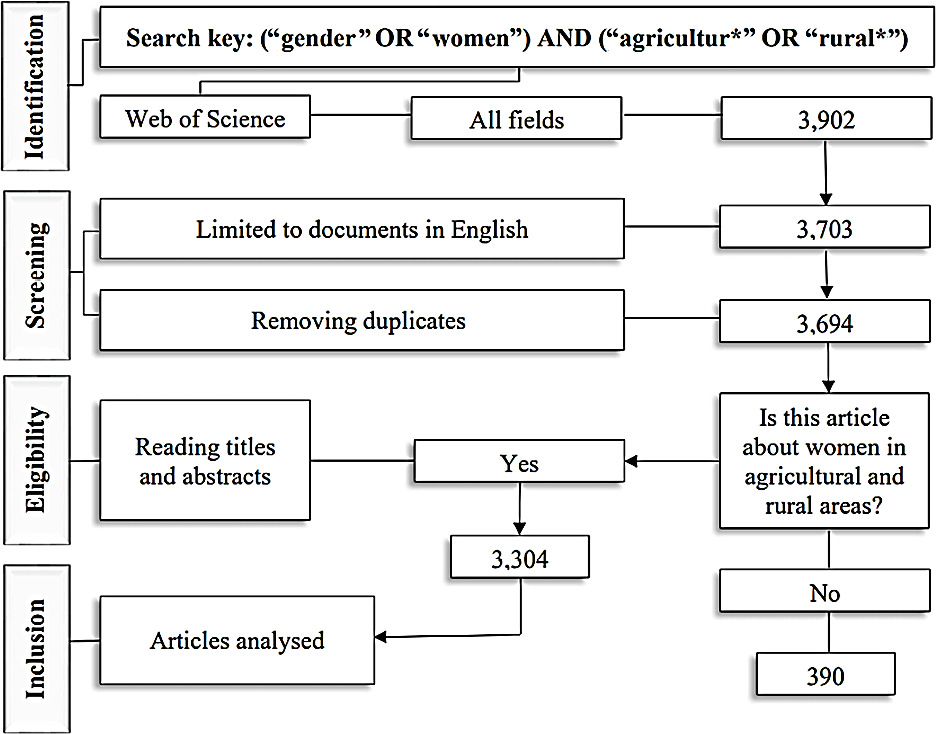
The PRISMA guidelines were followed, in accordance with the Guidelines for Systematic Reviews and Meta-Analyses (Hutton et al., 2016; Page et al., 2021). The PRISMA approach comprises four stages – identification, screening, eligibility, and inclusion – to ensure the reliability of the data.
The raw data underwent bibliometric analysis using the “Analyse Results” tool within the Web of Science platform. Further, the frequency analysis was employed to examine the distribution of the top 10 authors’ keywords, track the cumulative growth in the number of publications, and assess annual scientific production.
This study used the Biblioshiny app, supported by the Bibliometrix package in R Studio, to identify future research pathways and to map potential author collaborations. The Bibliometrix package offers extensive tools for bibliometric analysis, enabling comprehensive science mapping of scientific literature (Aria and Cuccurullo, 2017).
Co-occurrence network analysis was conducted using the VOSviewer software (Van Eck and Waltman, 2010), which provides various types of visualisations. Network and overlay visualisations were utilised for this study. Network analysis was performed to examine keyword co-occurrence, while overlay analysis was used to illustrate the evolution of the research focus based on the frequency of keywords in recent studies.
VOSviewer and Bibliometrix rely on a similarity matrix for visualisations and map construction. Both tools use association strength, a proximity index, to measure similarity. This matrix is derived from a co-occurrence matrix through normalisation, adjusting for occurrence variations (Van Eck and Waltman, 2007; Aria and Cuccurullo, 2017). It quantifies how often two keywords or authors appear together and accounts for their co-occurrence probability under independent assumptions. This method helps identify keyword patterns, author collaborations, and future research directions.
The similarity sij between two items i and j based on the association strength is given by the following general equation:
(1)
where cij represents the number of co-occurrences of items (keywords or authors) i and j, and wi and wj denote the total number of occurrences of items i and j, respectively, or the total number of co-occurrences of these items.
A mapping technique is provided based on the similarity matrix. Let n denote the total number of items (keywords or authors) that should be mapped. The result of the mapping technique is a two-dimensional map, in which all items ranging from 1,…,n are located on this map reflecting the similarity between two items i and j. The VOS mapping technique aims to minimise a weighted sum of squared Euclidean distances between all item pairs, with the weight of their squared distance increasing based on their similarity. The minimised function is given by the general equation 2, while the minimisation is provided under the constraint represented by equation 3 (Van Eck and Waltman, 2010).
(2)
where the vector xi = (xi1, xi2) represents the location of the item i in a two-dimensional map and ||•|| denotes the Euclidean norm.
(3)
The software positions similar items (keywords or authors) closer together while placing less similar ones farther apart. This arrangement reflects the strength of relationships, with more frequent co-occurrences given greater weight. By minimising the Euclidean distance based on co-occurrence frequency, the mapping technique visually represents relationship structures, providing insight into author collaborations and the evolution of research topics over time.
Finally, a thorough analysis of the 50 most cited documents relevant to the subject matter is conducted.
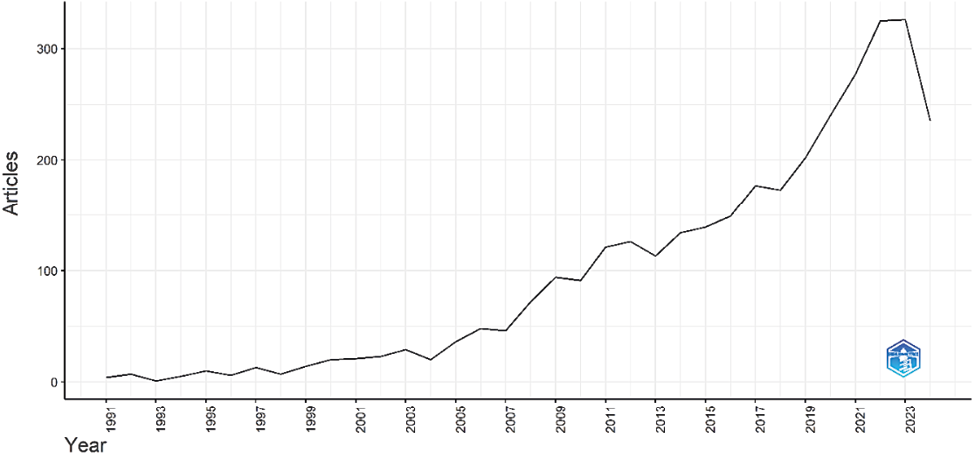
First, to provide insights into the development of the analysed scientific research, Figure 2 illustrates the annual scientific production.
The use of keywords such as “gender”, “women”, and “rural” is reflected in the notable increase in annual scientific output, particularly over the last two decades. The annual growth rate of scientific production is measured by the average number of articles published during the analysed period. The annual growth rate of the analysed dataset was 13.14%. The most significant volume of submitted papers to date was recorded in 2023, with 326 papers, followed by 325 papers in 2022. The increasing number of publications indicates a rising interest from both academia and industry in the challenges and issues related to women’s role and challenges in agriculture.
3.1 The dominant authors, journals, and geographic areas in the literature on the role of women in agriculture
The annual growth of publications can vary across different sources. Analysing the cumulative growth of documents in the top 5 related sources in the dataset, as displayed in Figure 3, shows the greatest number of publications in the Journal of Rural Studies (60 papers), World Development (48 papers), and Sustainability (38 papers). Notably, since 2019, the Journal of Rural Studies has been the leading publication in this research area, followed closely by World Development. All other sources have published 29 or fewer articles throughout the entire study period.
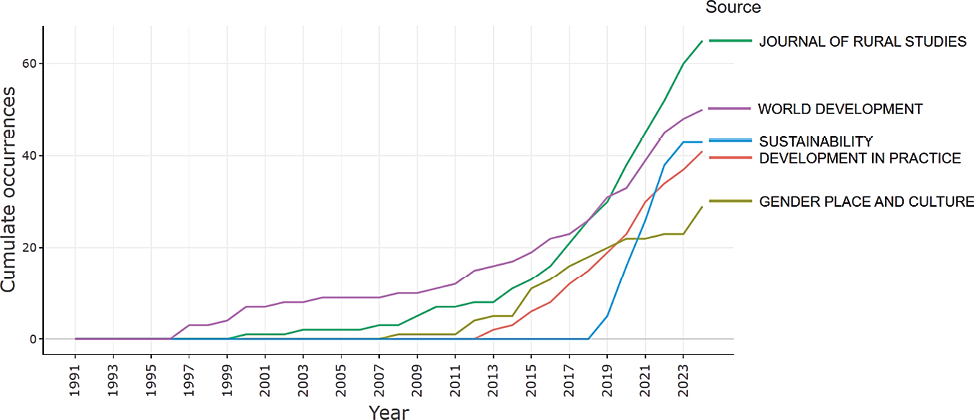
As stated, the analysed dataset comprised 3,304 documents. Among these, the top 10 pertinent sources accounted for 10.87% of the total, equal to 359 documents, which suggests that there is greater diversity among the sources of publications rather than the concentration.
In addition to publication volume, a variety of metrics allows for a comprehensive assessment of source impact and productivity within the field of women in agriculture. Table 1 presents five distinct metrics for the most pertinent journals, encompassing the H-index, the G-index, the number of publications (NP), total citations (TC), and the inaugural publication year (PY start). Notably, while the Journal of Rural Studies exhibits the most substantial cumulative growth in publication numbers, it commenced its growth trajectory in 2000, in contrast to the second most prolific journal, World Development, which began its publication history in 1997.
| Source | H-index | G-index | NP | TC | PY start | ||||||||||||||
|---|---|---|---|---|---|---|---|---|---|---|---|---|---|---|---|---|---|---|---|
| Journal of Rural Studies | 24 | 35 | 65 | 1,374 | 2000 | ||||||||||||||
| World Development | 24 | 50 | 50 | 2,949 | 1997 | ||||||||||||||
| Food Policy | 17 | 17 | 17 | 1,233 | 1995 | ||||||||||||||
| Social Science & Medicine | 16 | 21 | 21 | 1,071 | 1994 | ||||||||||||||
| Agricultural Economics | 13 | 18 | 18 | 545 | 2002 | ||||||||||||||
| Source: Prepared by author. Data compiled from the Web of Science database. | |||||||||||||||||||
The most significant sources, as discerned from the analysed metrics, are those with the highest publication rates. These journals exhibit remarkably similar values across the analysed metrics. While the Journal of Rural Studies leads in publication volume within the specified timeframe, World Development stands out with the highest G-index. This index is derived from the distribution of citations received by an author’s publications and the total citation count. The H-index, which represents an author’s productivity and impact in terms of both paper output and citation count, is the same for the Journal of Rural Studies and World Development. Although some sources have a longer publication history, they register considerably lower values across all indices.
In the subsequent analysis, we identified the top contributing authors, institutions, and countries. Around 92.29% of authors (9,443 out of 10,232) displayed an article fractionalisation of less than 1, questioning the extent of individual contributions versus collaborative efforts.
The analysis of the top authors in women’s role in agriculture utilised metrics such as H-index, G-index, TC, and PY start. C. Leukefeld stands out with the longest publication history among the top 10 authors; it began in 2003. However, author rankings vary based on specific indicators. While C. Leukefeld has the highest H-index (8), J. Zhang leads in the G-index (12). R. Meinzen-Dick has the most citations (1,114), followed closely by A. Quisumbing (1,077). The results are presented in Table 2.
| Author | H-index | G-index | TC | PY start | |||||||||||||||
|---|---|---|---|---|---|---|---|---|---|---|---|---|---|---|---|---|---|---|---|
| C. Leukefeld | 8 | 8 | 260 | 2003 | |||||||||||||||
| R. Meinzen-Dick | 8 | 9 | 1,114 | 2013 | |||||||||||||||
| A. Quisumbing | 8 | 10 | 1077 | 2010 | |||||||||||||||
| L. Badstue | 7 | 7 | 243 | 2013 | |||||||||||||||
| L.A. Simmons | 7 | 8 | 242 | 2007 | |||||||||||||||
| Source: Prepared by author. Data compiled from the Web of Science database. | |||||||||||||||||||
Notably, among the most relevant authors ranked by the H-index, more than half (specifically, 55 out of 100) are women, highlighting a significant trend of increasing participation and a growing commitment among women to enhance their impact and influence within the field.
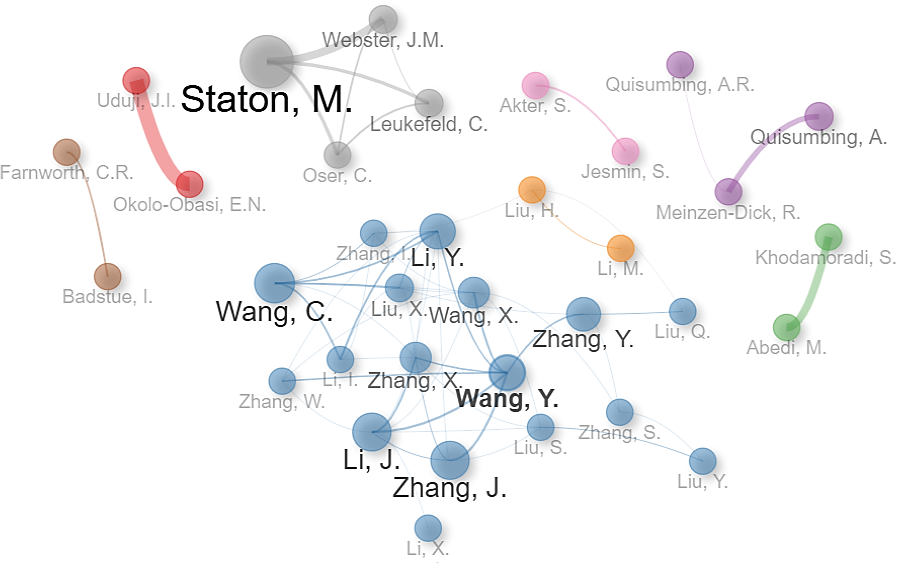
Although the lowest fractionalisation values indicate low collaboration between authors, the analysis of scientific collaboration depicted in Figure 4 presents the authors who collaborate most frequently. The nodes represent authors in the collaboration network, while the links indicate co-authorships. The size of the node represents the number of publications. The blue cluster, displaying the highest betweenness centrality values ranging from 28.16 for X. Wang to 0.18 for W. Zhang, highlights the most collaborative authors. According to the results, X. Wang plays a crucial role in connecting different groups or clusters of authors. The orange cluster follows, also with significant betweenness centrality values. Additionally, two authors in the red cluster exhibit the highest closeness centrality, signifying efficient access to resources from others in the network.
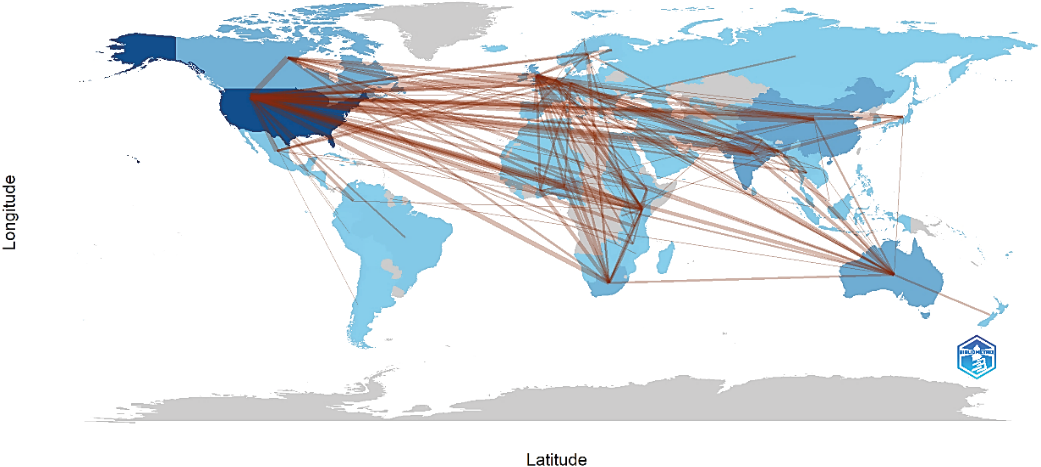
Throughout the analysed period, most authors have originated from the United States, underscoring its leading role in research output. Meanwhile, both India and China have increasingly focused on gender equality and women’s empowerment in agriculture. In China, the 2003 Rural Land Contracting Law (RLCL) was introduced to safeguard rural land rights and to ensure equitable distribution for women. Other programmes aimed at supporting women’s income security and resilience have also been implemented, attracting scholarly interest in their impact on women’s roles in agriculture (Gong et al., 2022; Shi et al., 2024). Similarly, India has launched several initiatives to enhance women’s participation in agriculture, including the Mahila Kisan Sashaktikaran Pariyojana (Women Farmer Empowerment Program), a centrally funded scheme to strengthen women’s roles in agricultural activities. Other programmes further promote women’s representation and engagement in farming (Barooah et al., 2023).
From the standpoint of collaboration between countries shown in Figure 5, the most extensive collaboration is between the United States and China, with 52 published documents. Additionally, the United States collaborates significantly with India (41 papers), the United Kingdom (40 papers), Kenya (31 papers), and Canada (27 papers). Other collaborations have resulted in 20 or fewer papers. Collaborations usually involve a country with a robust research base on one side and a country addressing the examined problem on the other.
3.2 The main topics researched in the literature on women position in agriculture
Two metrics are utilised for displaying the analysis of authors’ keywords: keyword frequency visualisation and co-occurrence network analysis.
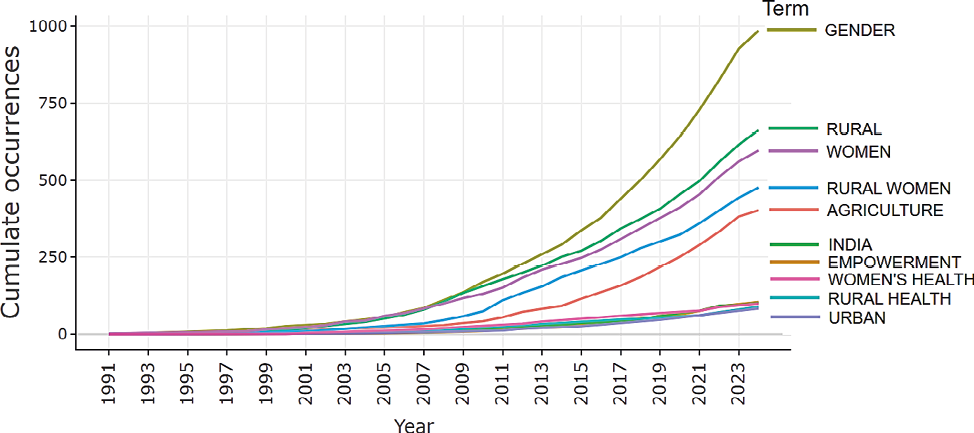
As shown in Figure 6, among the top 25 most frequently used keywords, those with the highest occurrences include “gender” (985 occurrences), “rural” (662 occurrences), “women” (597 occurrences), “rural women” (476 occurrences), “agriculture” (402 occurrences), “India” (104 occurrences), and “empowerment” (101 occurrences). Other keywords have 99 or fewer occurrences. Additionally, the frequency of the top 10 authors’ keywords has not significantly changed over the analysed period.
The thematic analysis illustrated in Figure 7 leverages clusters of authors’ keywords and their interrelationships to identify key themes, which are then visualised on a thematic map with vertical and horizontal axes.
The upper left quadrant contains specialised yet isolated topics such as women’s health and depression. The large node size indicates extensive research, but their peripheral position suggests a limited connection to broader themes. Chandra et al. (2020) note that rural women face unique health challenges, gender discrimination, poverty, and inadequate healthcare, emphasising the need for further study. Despite their comprehensive exploration, these topics could benefit from greater integration with mainstream research to increase their relevance and impact.
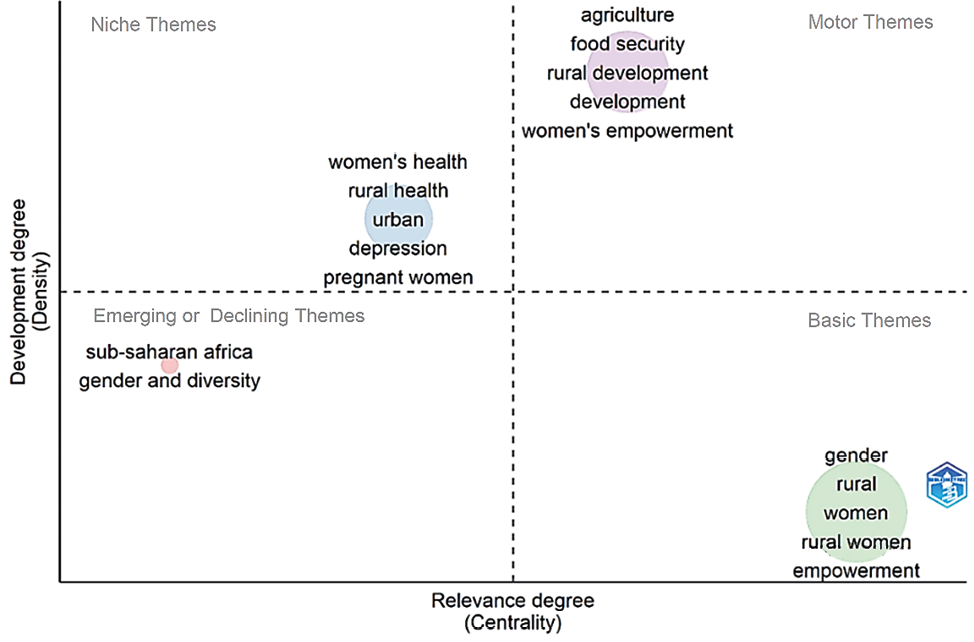
In contrast, the upper right quadrant highlights well-developed and critical themes such as food security, rural development, and women’s empowerment. These issues have been the focus of numerous studies exploring the intersection of food insecurity and gender disparities, with an emphasis on empowering women in agricultural production to improve food and nutrition outcomes (Rahman and Islam, 2014; Pandey et al., 2016; Jones et al., 2017; Johnston et al., 2018). The thematic mapping and existing literature reflect the centrality and density of this topic, indicating its strong connections with other themes and the sustained interest it garners among researchers.
The lower left quadrant, characterised by low density and centrality, includes topics such as gender, diversity, and Sub-Saharan Africa. The small node size indicates that these themes are either emerging research areas with limited scholarly traction or declining topics. While various organisations have made efforts to improve the quality of life for women in Sub-Saharan Africa, significant challenges persist, including vulnerable employment, gender disparities in education, and the gender gap in agricultural productivity. Given the underdeveloped nature of this research area, further academic exploration of women’s economic empowerment in Sub-Saharan Africa is crucial. Strengthening their economic position could enhance household dietary diversity, increase income levels, and contribute to poverty reduction (World Bank Group, 2023).
The lower right quadrant highlights key yet emerging themes, such as the empowerment of rural women within the agricultural sector. The large node size reflects significant academic interest and a growing body of research in this area. Although these themes are gaining prominence they remain underdeveloped, underscoring the need for further research and integration with established fields to unlock their full potential. Empowering rural women enhances their social and economic roles, contributing to societal development. Research indicates that empowering women improves decision-making power, increases household income, and strengthens community resilience (Doss, 2006; Akter and Chindarkar, 2020), highlighting the importance of further analysis.
The co-occurrence analysis of keywords was conducted using the VOSviewer software; it provides insights into the interconnections and relationships between individual terms associated with the position of women in agriculture. Figure 8 displays the results of the keyword analysis: 1,047 keywords met the threshold of a minimum of five occurrences. These keywords were divided into nine clusters and formed 42,543 links, with a total link strength of 79,824. In the subsequent analysis, the size of the circles indicates keyword frequency, and the thickness of the lines indicates the strength of co-occurrence within and between clusters.
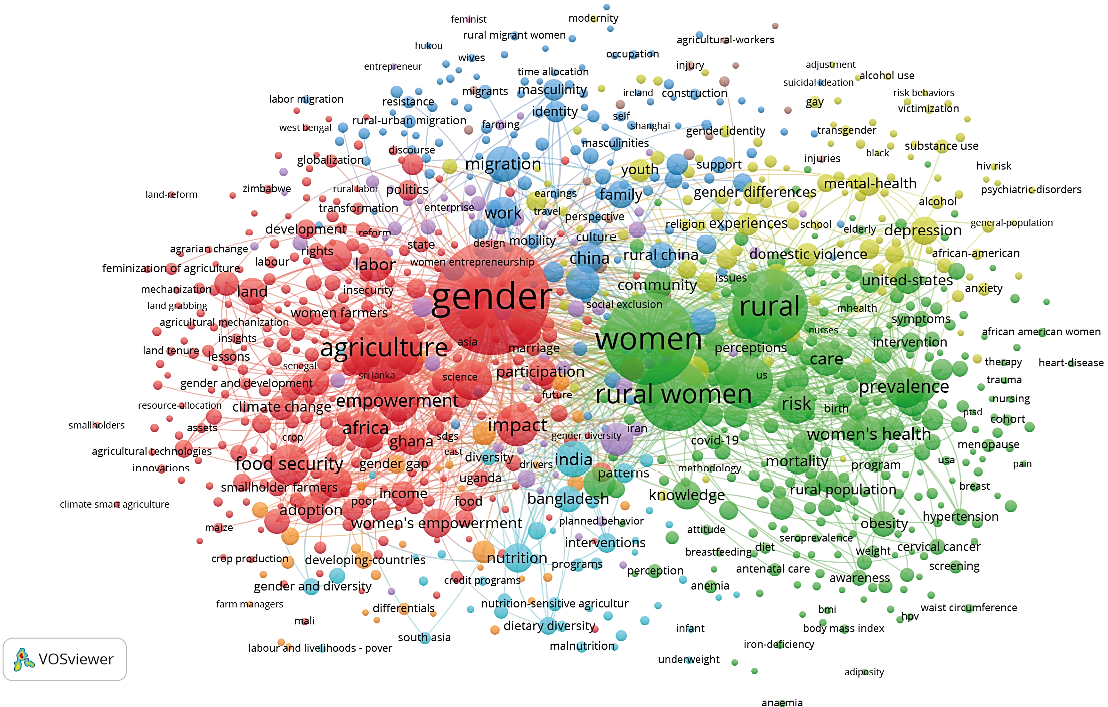
The largest red cluster, consisting of 296 items, prominently features the terms “gender” (907 links, link strength 8,279) and “agriculture” (633 links, link strength 3,325), underscoring the importance of gender-related issues in agriculture. Additionally, terms such as “food security”, “empowerment”, and “poverty” frequently co-occur within the same cluster, highlighting their interconnectedness.
Women’s empowerment is vital, as empowered women drive social change, amplify marginalised voices, and improve overall well-being (Akter and Chindarkar, 2020; Hossain et al., 2019). However, there are significant differences across countries. In the Global North, policy reforms have contributed to progress in women’s empowerment, yet gender disparities persist in wages, farm incomes, and work identities, particularly within the agricultural sector (Fisher et al., 2022). While some countries, such as Lithuania, offer more equitable opportunities, marginalised groups, such as Latina farmworkers in the United States, still face barriers due to social and economic inequalities (Quandt et al., 2020).
The co-occurrence network analysis emphasises the more significant gender gap in agriculture in the Global South, where women face deep-rooted economic, political, and social inequalities. Despite their key role in agriculture, women encounter barriers such as land and livestock ownership discrimination, unequal pay, and limited access to credit and decision-making. Studies show that women hold a small share of land, often without legal ownership, and own fewer assets (FAO, 2024). Empowering women in the Global South is important for improving food security and achieving the SDGs which link sustainable agriculture, small farmer empowerment, and gender equality (Pérez-Escamilla, 2017). Gender equality and women’s empowerment also support eliminating poverty and promoting health and well-being (Olumakaiye et al., 2019).
The second cluster, shown in green, highlights 272 key terms related to “women” (891 links and 5,568 link strength), “rural” (717 links), and “rural women” (608 links), underscoring the importance of health issues affecting rural women. The co-occurrence network analysis further confirms a strong association between women’s health and empowerment. Empowering women in agriculture enhances health outcomes by addressing gender disparities in resource access and mitigating risks specific to women, such as age, time constraints, and social expectations (Anderson et al., 2019).
Health risks and challenges increase as income levels decline, disproportionately impacting rural women. Financial barriers, especially gaps in health insurance, force many to pay their expenses out-of-pocket, deterring them from seeking essential care (Onah and Govender, 2014). This issue is especially prominent in the Global South, where rural women struggle to access basic healthcare. A 2015 International Labour Organization (ILO) report found that 83% of Africa’s rural population lacks adequate healthcare access. Similarly, recent data from 174 countries highlight significant disparities, with the most severe gaps found in developing nations (ILO, 2015).
Rural women face significant health challenges, including high rates of malaria, malnutrition, anaemia, and reproductive health issues. These are exacerbated by inadequate health education, cultural dietary habits, frequent pregnancies, and lack of rest (Houdegbe, 1985). Such factors contribute to high mortality rates in the Global South, where preventable conditions such as maternal complications and infectious diseases remain deadly due to delayed or inaccessible care. Maternal mortality in low-income countries is nearly 40 times higher than in high-income nations, highlighting the urgent need for healthcare improvements (McCauley et al., 2020). However, rural health disparities persist globally. In the United States, rural women experience higher rates of chronic diseases and maternal complications due to provider shortages in their areas (Kozhimannil et al., 2019). Indigenous and rural populations in Australia and Canada face similar barriers (Bourke et al., 2012). Meanwhile, rising obesity rates throughout the world, increasing diabetes and cardiovascular diseases, further strain rural healthcare systems (Harrington et al., 2020).
The blue cluster of 135 keywords explores the connections between “migration”, “gender”, “agriculture”, “education”, and “work”, a critical issue impacting rural women worldwide. In China, migration significantly shapes agricultural responsibilities to women, altering labour patterns and gendered economic impacts (Tong et al., 2018). Rural-to-urban migration also promotes more egalitarian gender attitudes, as exposure to modern workplaces boosts women’s skills, economic status, and confidence, fostering gender equality (Yuan and Zhang, 2023). However, young, educated rural women face institutional barriers such as limited social security and career opportunities (Luo, 2006), while female migrant workers often take low-paying jobs and return to rural areas after marriage, limiting their economic mobility (Kocabicak, 2021).
Leder (2022) connects rural migration in Africa and South Asia to the “Feminization of Agriculture”, emphasising how it reshapes gender norms and power structures. Migration impacts women’s roles in accessing resources and decision-making, yet deep-rooted inequalities linked to caste, class, and social norms often limit their empowerment. In Europe, rural depopulation often leads young women to migrate for education and employment (García and Sánchez, 2005), although recent trends show more educated women choosing to stay or return to rural areas for career opportunities (Carbó et al., 2013). In Spain, gender-sensitive policies are crucial for retaining young women and supporting their professional goals, especially in areas with improving infrastructure (Bayona and Gil, 2013). There are similar trends across Europe, where such strategies aim to empower women and combat regional depopulation (Bock, 2004).
The fourth cluster, highlighted in yellow, contains 131 authors’ keywords centred on mental health topics, highlighting women’s mental health challenges in agricultural and rural settings. The prevalence of mental disorders varies geographically, differing not only between countries but also within them, with notable distinctions between urban and rural areas (Yoshioka et al., 2021).
Rural areas often face poverty and limited resources, which significantly impact women’s mental health. The lack of mental health services exacerbates this issue, leading to higher rates of depression and other mental disorders. Poverty affects women differently throughout their lives, with challenges such as underpaid labour, early marriage, sexual abuse, and discrimination. Women in rural communities of the Global South often live in extreme poverty, lacking essentials like food, water, shelter, and healthcare (Marandure, 2024). In rural parts of the United States, women also experience health disparities due to limited access to primary and mental health services, resulting in delayed diagnoses and inadequate treatment. Cultural factors, including self-reliance and stoicism, influence healthcare-seeking behaviour, leading many rural women to rely on self-care or delay professional help until conditions worsen (Simmons et al., 2014). Furthermore, women with severe mental illnesses experience greater physical and social isolation compared with men, with cultural norms often reinforcing these gender-specific challenges (Ghebrehiwet et al., 2020).
The fifth cluster, marked in purple, focuses on economic empowerment and financial opportunities for women, particularly in rural or agricultural settings. Women’s entrepreneurial behaviour is influenced by institutions, which play a significant role regardless of whether the women entrepreneurs reside in developed, emerging, or underdeveloped economies. The highest concentration of female participation in the business environment is found in emerging and developing economies, where women often establish businesses to balance work and family responsibilities or due to limited opportunities in the formal labour market. In Latin America, for example, women tend to close their businesses and transition to the traditional labour market as the economy improves (Giménez et al., 2018). Merrett and Gruidl (2004) find that rural female entrepreneurs face more obstacles to business success than their male or urban female counterparts.
Women’s empowerment is closely linked to access to credit, as Hashemi et al. (1996) emphasise. Microcredit programmes have helped women gain financial independence, expand their social networks, strengthen decision-making power, and increase mobility (Pitt et al., 2006). Despite these benefits, significant formal barriers still hinder women’s entrepreneurial efforts. Organisations such as the World Bank, United Nations, and Organisation for Economic Co-ordination and Development (OECD) collect data on gender wage inequality and economic participation (Lee et al., 2011), yet these obstacles persist. Moreover, gender roles shape formal and informal institutions, embedding biases that discourage women from starting businesses (Giménez et al., 2012).
The sixth light blue cluster highlights “food security”, “nutrition”, and “dietary diversity” with a focus on India and Bangladesh. Despite economic growth, India has the highest burden of child undernutrition (43% of children under 5 years of age) and lags behind sub-Saharan Africa in human development indicators. Investments, including the $2.4 billion Integrated Child Development Scheme, failed to meet the 2015 hunger reduction goal, leaving 33% of children undernourished (Sinha et al., 2017). Bangladesh also faces high undernutrition rates despite progress in food production. Women, comprising 46% of the farming population, play a key role but face gender-based discrimination that limits their economic participation and access to food (Talukder and Anik, 2016). To address these issues, national and international efforts focus on nutrition improvement, including the Adivasi Fisheries Project and programmes like “One House, One Farm” (Rahman and Islam, 2014).
Urban food insecurity is also a significant issue in the Global North, where urban and peri-urban agriculture are increasingly recognised as key to food security. While urban agriculture mainly meets household food needs, peri-urban agriculture provides larger quantities and broader distribution pathways, making it more impactful. Both face challenges from urbanisation, underscoring the need for targeted urban food planning to unlock their full potential (Opitz et al., 2016).
Clusters 7-9 provide focused insights into distinct themes within the field. The seventh cluster, in orange, highlights strategies for addressing gender gaps in agriculture, with key terms such as “strategies” (237 links) and “Nigeria” (135 links) taking precedence. The eighth cluster, shown in brown, features 16 keywords, including “farm,” “exposure,” and “safety”, with link counts of 129, 121, and 81, respectively. Lastly, the ninth cluster centres around the term “feminist”, which has 26 links. Due to the relatively small size of these clusters, they will not be examined in further detail.
The overlay visualisation of co-occurrence analysis in Figure 9 highlights the evolution of the research focus, with the more recent keywords in yellow and earlier ones in purple. Recent research emphasises keywords including “food security”, “empowerment”, “climate change”, “productivity”, and “gender equality”, underlining the growing recognition of climate change’s impact on food security and the empowerment of women in agriculture. In contrast, terms such as “women’s health”, “rural population”, and “prevention” have become less common, indicating a shift in research priorities. The increasing use of keywords such as “food security”, “climate change”, and “gender equality” shows that climate change is now one of agriculture’s most pressing challenges.
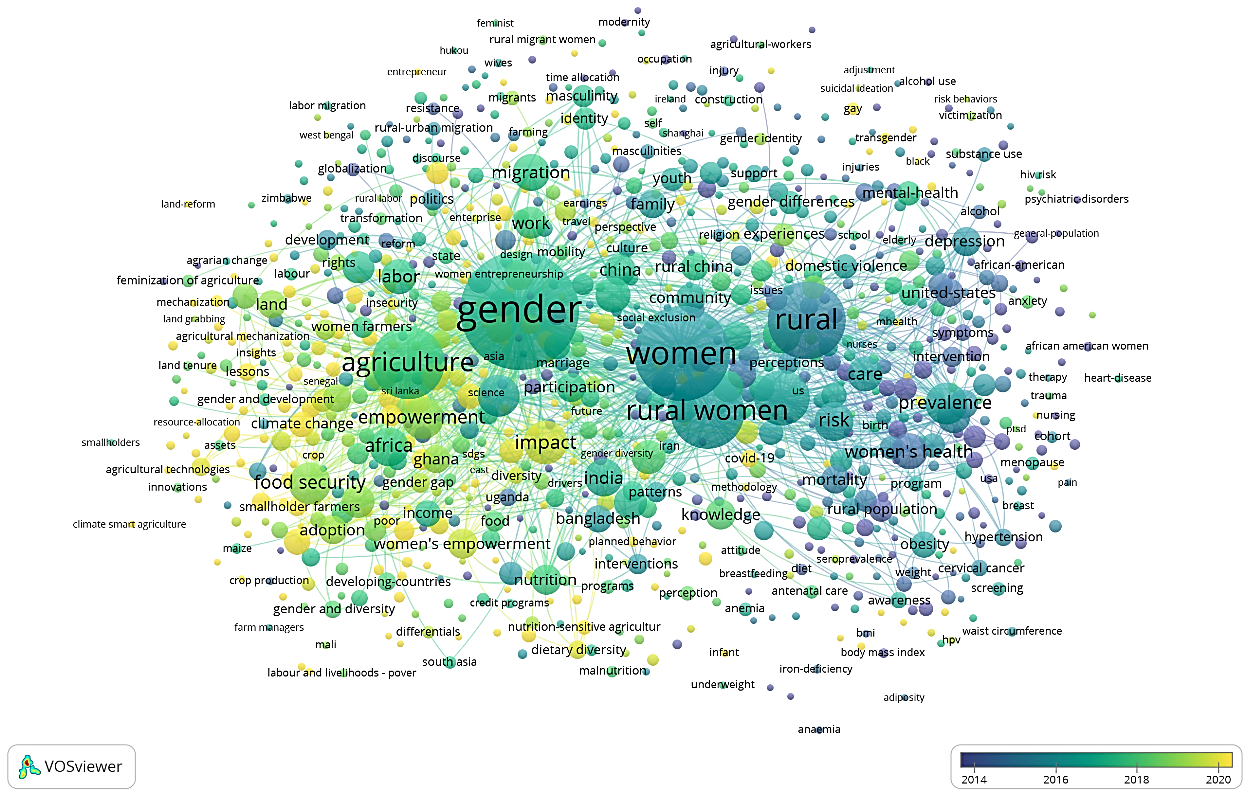
Climate change significantly impacts food security, with women in both the Global South and North bearing a disproportionate burden. In the Global South, particularly in Sub-Saharan Africa, women make up 55%-87% of agricultural production but face barriers such as limited access to land, technology, and financial resources, heightened by climate impacts like droughts and floods (International Monetary Fund, 2003). Climate change, including irregular rainfall and extreme weather events, leads to crop losses and increases hunger, with women at higher risk of malnutrition than men (Agarwal, 2018).
In the Global North, there are significant climate impacts on agriculture, with changing weather patterns affecting crop yields. For example, Australia saw a 27% decline in water-limited yield potential from 1990 to 2015, worsened by rising temperatures and reduced rainfall. In Europe, wheat and barley yields have decreased by 2.5% and 3.8% since 1989, with Italy facing the worst declines due to a drying trend (Mbow et al., 2019). Despite having more resources to mitigate climate effects, farmers in the Global North, particularly women, still face challenges adapting to these changes. In contrast, subsistence farmers in the Global South, lacking resources, often rely on community-based adaptation which, while helpful, can reinforce existing gender biases.
The keyword analysis and thematic mapping highlight a shift towards central themes such as food security, climate change, and women’s empowerment in agriculture, emphasising their growing relevance. Research indicates that female farmers often adapt more effectively to climate-related challenges than their male counterparts (Quisumbing et al., 2017).
3.3 The predominant research methods used to assess the status of women in agriculture in the most cited documents
This section synthesises the predominant research methods employed in the 50 most cited documents, highlighting their methodological trends and implications for understanding women’s roles in agriculture. Most of these studies employed various types of regression analysis to explore complex relationships between variables. Regression analysis is favoured for its ability to handle large, representative datasets, often drawn from national or cross-country surveys. Key themes identified through keyword analysis – such as gender, agriculture, health, and empowerment – are essential for evidence-based policy formulation, with regression analysis revealing significant patterns and relationships. For example, Sraboni et al. (2014) used regression analysis to examine the link between women’s empowerment and food security in Bangladesh, finding that higher empowerment scores corresponded with increased calorie availability and household dietary diversity. Conversely, Malapit and Quisumbing (2015) investigated women’s agricultural empowerment in northern Ghana, noting that while empowerment is linked to improved dietary diversity, it does not consistently correlate with broader nutritional indicators like body mass index. These differing findings can likely be attributed to national contextual factors, such as Bangladesh’s recent growth in female employment and reduction in the gender wage gap.
Some studies have combined thematic approaches, such as qualitative interviews paired with regression analysis. For instance, Savy et al. (2005) utilised both qualitative and quantitative methods, revealing inadequate overall dietary quality through a domestic survey that included questionnaires and anthropometric measurements. They identified significant relationships between food variety scores, dietary diversity scores, and key nutritional indices. Similarly, Alkire et al. (2013) integrated interviews and decomposition methods to analyse women’s empowerment across different regions. The analysis revealed regional differences in empowerment: wealth influences empowerment in Bangladesh and Uganda but not in Guatemala, while education has a variable effect across countries. Age also plays a role in Bangladesh and Guatemala, with middle-aged women showing greater empowerment, whereas age has no significant impact in Uganda.
Other studies have solely relied on interviews. For example, Logan et al. (2005) used six focus groups conducted in rural and urban areas to gather insights into individual motivations and barriers related to community-supported agriculture. In contrast, Meiselman et al. (2010) employed a commercially available internet system for data collection to gain personal insights into survivors’ experiences accessing services.
Literature reviews and comparative analyses are the third most frequently used methods. Ruel et al. (2018) summarise current research on how agriculture can influence nutritional outcomes, while Quisumbing and Pandolfelli (2010) provide a critical review of interventions and policy changes aimed at increasing women farmers’ access to resources in South Asia and Sub-Saharan Africa. They note that, in contrast to interventions aimed at enhancing human capital investment, only a minority of initiatives or policy changes aimed at increasing female farmers’ access to productive resources have undergone rigorous evaluation. Pandey et al. (2016) show that agricultural interventions, such as producing nutrition-rich crops, establishing homestead gardens, and diversifying systems with fruits, vegetables, and aquaculture, can improve nutritional outcomes in South Asia. They also emphasise the importance of women’s empowerment and nutritional knowledge in enhancing these results.
Among the comparative analyses, Doss (2006) explores crops in Ghana through the lens of gender roles, finding minimal distinctions between “men’s” and “women’s” crops. Maharjan et al. (2012) examine agricultural interventions, revealing that while both genders benefit, a persistent gender-asset gap highlights ongoing gendered barriers. Meiselman et al. (2010) focus on food neophobia and demographic trends, demonstrating the varying impacts of age, education, and income. Lastly, Carr (2008) contrasts mainstream and feminist post-structuralist approaches in Ghana, illustrating how theoretical differences influence practical outcomes in gender development.
Other analytical approaches, such as longitudinal survey analysis, content analysis, case studies, ethnographic research, and cost-benefit analysis, were utilised infrequently in the 50 most cited documents. Table 3 shows a summary of the predominant research methods.
| Methods | Sources | ||||||||||||||||||
|---|---|---|---|---|---|---|---|---|---|---|---|---|---|---|---|---|---|---|---|
| Surveys (questionnaire, interviews) | Rahman (1999), Cone and Myhre (2000), Conway et al. (2003), Logan et al. (2005), Savy et al. (2005), Meiselman et al. (2010), Maharjan et al. (2012), Alkire et al. (2013), Liu (2016), Akter et al. (2017) | ||||||||||||||||||
| Regression analysis | Udry et al. (1995), Wawer et al. (1997), Martorell et al. (2000), Wingood et al. (2000), Sellen and Smay (2001), Bentley and Griffith (2003), Wilson et al. (2003), Ekici et al. (2005), Savy et al. (2005), Yip et al. (2005), Deininger and Castagnini (2006), Hannum et al. (2009), Vyavaharkar et al. (2010), Ragasa et al. (2013), Takagi et al. (2013), Ali et al. (2014), Sraboni et al. (2014), Malapit and Quisumbing (2015), Johnson et al. (2016) | ||||||||||||||||||
| Structural equation modelling | Huddleston et al. (2009), Berkel et al. (2009) | ||||||||||||||||||
| Decomposition methods | Alkire et al. (2013), Kilic et al. (2015) | ||||||||||||||||||
| Reviews | Hilson et al. (1997), Bryld et al. (2003), Deininger and Castagnini (2006), Ruel et al. (2018), Quisumbing and Pandolfelli (2010), Pandey et al. (2016) | ||||||||||||||||||
| Longitudinal survey analysis | Hannum et al. (2009), Perez et al. (2015) | ||||||||||||||||||
| Comparative analysis | Doss (2006), Carr (2008), Meiselman et al. (2010), Maharjan et al. (2012), Quisumbing et al. (2015), Doss (2017) | ||||||||||||||||||
| Content analysis | Bryld (2003) | ||||||||||||||||||
| Case studies | Rahman (1999), Cone and Myhre (2000), Liu (2014) | ||||||||||||||||||
| Other | Yip et al. (2000), Ambrose et al. (2003), Jost et al. (2015) | ||||||||||||||||||
| Source: Prepared by author. Data compiled from the Web of Science database. | |||||||||||||||||||
A bibliometric analysis was conducted of the role of women in agriculture worldwide. After filtering out duplicates, non-English records, and irrelevant articles, the final dataset comprised 3,304 records. The analysis offered valuable insights into the research questions. Notably, the most significant increase in publications occurred between 2022 and 2023, reflecting heightened interest from academia and industry. Over the past two decades, the number of publications has surged, with the Journal of Rural Studies and World Development leading the growth. The analysis shows that top-ranking authors (C. Leukefeld, R. Meinzen-Dick and A. Quisumbing) are central to collaboration networks, aiding researchers in identifying key experts. Moreover, both India and China have shown growing attention to gender equality and women’s empowerment in agriculture, further enriching the global discourse. Strengthening author collaboration could further advance research on women’s roles in agriculture.
Thematic mapping reveals well-established topics such as food security, rural development, and women’s empowerment, which were prominently discussed between 2014 and 2018 and continue to be central to research and policy dialogues. Based on the co-occurrence network analysis of authors’ keywords, climate change has emerged as a critical issue, reflecting its increasing impact on agricultural productivity and gender disparities. The growing frequency of keywords such as “food security”, “climate change”, and “gender equality” in recent years underscores the urgency of addressing climate-related challenges in agriculture, particularly their disproportionate effects on women. Conversely, emerging topics such as gender diversity, Sub-Saharan Africa, and rural women’s empowerment are gaining attention but remain underexplored. Expanding research in these areas is essential for their integration into broader agricultural and gender studies, enabling more effective policy interventions.
The co-occurrence network analysis of author keywords shows that while some clusters address global issues, others are more region-specific, highlighting their significance in specific contexts. While the literature indicates that women in the Global North face deep-rooted economic, political, and social inequalities, migration and health disparities remain persistent challenges for rural women worldwide, albeit with varying regional patterns.
The most common approach involves collecting primary data through surveys or interviews and applying regression analysis to explore complex relationships. This method has provided more profound insights into women’s agricultural roles, leading to more targeted policy recommendations. Comparative analysis highlights contextual differences, such as the impact of wealth, education, and age on empowerment. Although less frequent, integrating diverse analytical approaches offers a valuable perspective on gender and agriculture, enhancing evidence-based policy development.
While this study provides insights into the role of women in agriculture, it has several limitations that future research could address. Expanding the scope to include publications from national institutions and policy reports may provide a more comprehensive understanding of efforts to improve women’s positions in agriculture. Additionally, although the findings offer a global perspective, specific topics – such as the empowerment of rural women in Africa or the nutrition of rural women in Bangladesh and India – are analysed more frequently, reflecting regional research priorities. Given these patterns, segmenting the analysis and comparing the results could yield more profound insights. A comparative approach between the Global North and South could further illuminate regional differences and identify effective policies that may be adapted across contexts. Future research could also place greater emphasis on the economic empowerment of rural women, particularly regarding access to land, technology, and financial resources. Moreover, linking research findings to practical policy recommendations aimed at promoting gender equality and improving living conditions in agriculture would contribute to the broader global effort to empower women in the sector.
Agarwal B. (2018). Gender equality, food security and the sustainable development goals. Current Opinion in Environmental Sustainability, 34(2018): 26-32. DOI: https://doi.org/10.1016/j.cosust.2018.07.002.
Akter S., Chindarkar N. (2017). An empirical examination of sustainability of women’s empowerment using panel data from India. Journal of Development Studies, 56(5): 890-906. DOI: https://doi.org/10.1080/00220388.2019.1605054.
Ali D.A., Deininger K., Goldstein M. (2014). Environmental and gender impacts of land tenure regularization in Africa: Pilot evidence from Rwanda. Journal of Development Economics, 110: 262-275. DOI: http://dx.doi.org/10.1016/j.jdeveco.2013.12.009.
Alkire S., Meinzen-Dick R., Peterman A., Quisumbing A., Seymour G., Vaz A. (2013). The Women’s Empowerment in Agriculture Index. World Development, 52: 71-91. DOI: https://doi.org/10.1016/j.worlddev.2013.06.
Ambrose S.H., Bistar J., Krueger H.W. (2003). Status and gender differences in diet at Mound 72, Cahokia, revealed by isotopic analysis of bone. Journal of Anthropological Archaeology, 22(3): 217-226. DOI: https://doi.org/10.1016/S0278-4165(03)00036-9.
Anderson C.L., Reynolds T.W., Biscaye P., Patwardhan V., Carly Schmidt C. (2019). Economic benefits of empowering women in agriculture: Assumptions and evidence. The Journal of Development Studies, 57(2): 193-208. DOI: https://doi.org/10.1080/00220388.2020.1769071.
Aria M., Cuccurullo C. (2017). An R-tool for comprehensive science mapping analysis. Journal of Informetric, 11(4): 959-975. DOI: https://doi.org/10.1016/j.joi.2017.08.007.
Barooah P., Akvu M., Ringler C., Pathak V. (2023). Gender, agriculture policies, and climate-smart agriculture in India. Agricultural Systems, 212 (2023): 1-12. DOI: https://doi.org/10.1016/j.agsy.2023.103751.
Bayona J., Gil F. (2013). Is foreign immigration the solution to rural depopulation? The case of Catalonia (1996–2009). Sociologic Ruralis, 53(1): 26-50. DOI: https://doi.org/10.1111/j.1467-9523.2012.00577.x.
Bentley M.E., Griffiths P.L. (2003). The burden of anaemia among women in India. European Journal of Clinical Nutrition, 57: 57-60. DOI: https://doi.org/10.1038/sj.ejcn.1601504.
Berkel C., Murry V.M., Hurt T.R., Chen Y., Brody G.H., Simons R.L., Cutrona C., Gibbons F.X. (2008). It Takes a Village: Protecting Rural African American Youth in the Context of Racism. Journal of Youth and Adolescence, 38: 175-188. DOI: https://doi.org/10.1007/s10964-008-9346-z.
Bock B.B. (2004). Fitting in and multi-tasking: Dutch farm women’s strategies in rural entrepreneurship. Sociologic Ruralis, 44(3): 245-260. DOI: https://doi.org/10.1111/j.1467-9523.2004.00274.x.
Boserup E. (1970). Woman’s Role in Economic Development. George Allen and Unwin Ltd, London.
Bourke L., Humphreys J.S., Wakerman J., Taylor J. (2012). Understanding rural and remote health: A framework for analysis in Australia. Health & Place, 18(3): 496-503. DOI: https//doi.org/10.1016/j.healthplace.2012.02.009.
Bryld E. (2003). Potentials, problems, and policy implications for urban agriculture in developing countries. Agriculture and Human Values, 20: 79-86. DOI: https://doi.org/10.1023/A:1022464607153.
Carbó M., Baylina M., Garcia Ramon M.D. (2013). Women’s ventures in a rural context: Livelihood and identity, Hagar. Studies in Culture, Polities and Identities, 11(1): 100-120.
Carr E.R. (2008). Men’s crops and women’s crops: The importance of gender to the understanding of agricultural and development outcomes in Ghana’s Central Region. World Development, 36(5): 900-915. DOI: https://doi.org/10.1016/j.worlddev.2007.05.009.
Chandra P.S., Ross D., Agarwal P. (2020). Mental health of rural women. In: Chaturvedi S. (eds.), Mental Health and Illness in the Rural World. Springer, Singapore.
Choudhry A.N., Mutalib R.A., Isamil N.S.A. (2019). Socio-cultural factors affecting women economic empowerment in Pakistan: A situation analysis. International Journal of Academic Research in Business and Social Sciences, 9(5): 90-102. DOI: http://dx.doi.org/10.6007/IJARBSS/v9-i5/5842.
Cone A.A., Myhre A. (2000). Community-Supported Agriculture: A Sustainable Alternative to Industrial Agriculture? Human Organization, 59(2): 187-197. DOI: https://doi.org/10.17730/humo.59.2.715203t206g2j153.
Conway J.M., Ingwersen L.A., Vinyard B.T., Moshe, A.J. (2003). Effectiveness of the US Department of Agriculture 5-step multiple-pass method in assessing food intake in obese and nonobese women. The American Journal of Clinical Nutrition, 77(5): 1171-1178. DOI: https://doi.org/10.1093/ajcn/77.5.1171.
Deininger K., Castagnini R. (2006). Incidence and impact of land conflict in Uganda. Journal of Economic Behavior & Organization, 60: 321-345. DOI: https://doi.org/10.1016/j.jebo.2004.04.008.
Dinkelman T., Ngai R.L. (2022). Time use and gender in Africa in times of structural transformation. The Journal of Economic Perspectives, 36: 57-80. DOI: https://doi.org/10.1080/13545701.2019.1681591.
Doss C. (2006). The effects of intrahousehold property ownership on expenditure patterns in Ghana. Journal of African Economies, 15(1): 149-180. https://doi.org/10.1093/jae/eji025.
Doss CH.R. (2017). Women and agricultural productivity: Reframing the Issues. Development Policy Review, 36(1): 35-50. DOI: https://doi.org/10.1111/dpr.12243.
Doss C., Kieran C., Kilic T. (2020). Measuring ownership, control, and use of assets. Feminist Economies, 26: 144-168. DOI: https://doi.org/10.1080/13545701.2019.1681591.
Ekici A., Ekici M., Kurtipek E., Akin A., Arslan M., Kara T., Apaydin Z., Demir S. (2005). Obstructive airway diseases in women exposed to biomass smoke. Environmental Research, 99(1): 93-98. DOI: https://doi.org/10.1016/j.envres.2005.01.004.
European Commission (2019). The Professional Status of Rural Women in the EU. Policy Department for Citizens’ Rights and Constitutional Affairs, Brussels.
Fisher M., Lewin P.A., Borchers A. (2022). Gender differences in the financial performance of U.S. farm businesses: A decomposition analysis using the Census of Agriculture. Applied Economic Perspectives and Policy, 45(2): 1233-1253. DOI: https://doi.org/10.1002/aepp.13331.
Food and Agriculture Organization of the United Nations. (2012). Gender Inequalities in Rural Employment in Ghana: An Overview. Food and Agriculture Organization of the United Nations, Rome.
Food and Agriculture Organization of the United Nations (FAO). (2024). Reduce Rural Poverty. Food and Agriculture Organization of the United Nations, Rome.
García A., Sanchez D. (2005). La población rural en Catalunya: entre el declive y la revitalización. Cuadernos Geográficos, 36: 387-407.
Ghebrehiwet S., Baul T., Restivo J.L., Kelkile T.S., Stevenson A., Gelaye B., Fekadu A., Hailemariam M., Girma E., Teferra S., Canelos V., Henderson D.C., Borba C.P.C. (2020). Gender-specific experiences of serious mental illness in rural Ethiopia: A qualitative study. Global Public Health, 15(2): 185-199. DOI: https://doi.org/10.1080/17441692.2019.1680723.
Giménez D., Calabrò A. (2018). The salient role of institutions in women’s entrepreneurship: A critical review and agenda for future research. International Entrepreneurship and Management Journal, 14: 857-882. DOI: https://doi.org/10.1007/s11365-017-0480-5.
Gong M., Li H., Elahi E. (2022). Three Rights Separation reform and its impact over farm’s productivity: A case study of China. Land Use Policy, 22(2022): 1-11. DOI: https://doi.org/10.1016/j.landusepol.2022.106393.
Hannum E., Kong P., Zhang Y. (2009). Family sources of educational gender inequality in rural China: A critical assessment. International Journal of Educational Development, 29(5): 474-486. DOI: https://doi.org/10.1016/j.ijedudev.2009.04.007.
Harrington A.R., Califf R., Balamurugan A., Bown N., Benjamin R.M., Braund W.E., Hipp, J., Konig M., Sanchez E., Maddox K.E.J. (2020). Call to Action: Rural health: A presidential advisory from the American Heart Association and American Stroke Association. Circulation, 141(10): 615-644. DOI: https://doi.org/10.1161/CIR.0000000000000753.
Hashemi S.M., Schuler S.R., Riley A.P. (1996). Rural credit programs and women’s empowerment in Bangladesh. World Development, 24(4): 635-653. DOI: https://doi.org/10.1016/0305-750X(95)00159-A.
Hilson J.A., Rasmussen K.M., Kjolhede C.L. (1997). Maternal obesity and breast-feeding success in a rural population of white women. The American Journal of Clinical Nutrition, 66: 371-378. DOI: https://doi.org/10.1093/ajcn/66.6.1371.
Hossain M., Asadullah N., Kambhampati U. (2019). Empowerment and life satisfaction: Evidence from Bangladesh. World Development, 122: 170-183. DOI: https://doi.org/10.1016/j.worlddev.2019.05.013.
Houdegbe A. (1985). Health problems facing rural women. Child Trop, 159: 57-61.
Huddleston-Casas C., Charnigo R., Simmons L.A. (2009). Food insecurity and maternal depression in rural, low-income families: a longitudinal investigation. Public Health Nutrition, 12(8):1133-1140. DOI: https://doi.org/10.1017/S1368980008003650.
Hutton B., Catalá-López F., Moher D. (2016). The PRISMA statement extension for systematic reviews incorporating network meta-analysis: PRISMA-NMA. Medicina Clínica, 147: 262-266. DOI: https://doi.org/10.1016/j.medcli.2016.02.025.
International Labour Organization (ILO) (2015). More Than Half of the Global Rural Population Excluded From Health Care. International Labour Organization, Philippines.
International Monetary Fund (2003). Republic of Ghana, Ghana Poverty Reduction Strategy: 2003-05. International Monetary Fund, Geneva.
Jones N., Holmes R., Presler-Marshall E., Stavropoulou M. (2017). Transforming gender constraints in the agricultural sector: The potential of social protection programmes. Global Food Security, 12: 89-95. DOI: https://doi.org/10.1016/j.gfs.2016.09.004.
Johnson N.L., Kovarik CH., Meinzen-Dick R., Njuki J., Quisumbing A. (2016). Gender, assets, and agricultural development: lessons from eight projects. World Development, 83: 295-311. DOI: https://doi.org/10.1016/j.worlddev.2016.01.009.
Johnston D., Stevano S., Malapit H. J., Hull E., Kadiyala S. (2018). Time use as an explanation for the agri-nutrition disconnect: Evidence from rural areas in low and middle-income countries. Food Policy, 76: 8-18. DOI: https://doi.org/10.1016/j.foodpol.2017.12.011.
Jost CH., Kyazze F., Naab J., Neelormi S., Kinyangi J., Zougmore R., Aggarwal P., Bhatta G., Chaudhury M., Tapio-Bistrom M.M., Nelson S., Kristjanson P. (2015). Understanding gender dimensions of agriculture and climate change in smallholder farming communities. Climate and Development, 8(2): 133-144. DOI: https://doi.org/10.1080/17565529.2015.1050978.
Kocabicak E. (2021). Gendered property and labour relations in agriculture: Implications for social change in Turkey. Oxford Development Studies, 50(2): 91-113. DOI: https://doi.org/10.1080/13600818.2021.1929914.
Kozhimannil K.B., Interrante J.D., Henning-Smith C., Admon L.K. (2019). Rural-urban differences in severe maternal morbidity and mortality in the US, 2007–15. Health Affairs, 38(12): 2077-2085. DOI: https://doi.org/10.1377/hlthaff.2019.00805.
Leder S. (2022). Beyond the ‘Feminization of Agriculture’: Rural out-migration, shifting gender relations and emerging spaces in natural resource management. Journal of Rural Studies, 91(2022): 157-169. DOI: https://doi.org/10.1016/j.jrurstud.2022.02.009.
Lee J.H., Sohn S.Y., Ju Y.H. (2011). How effective is government support for Korean women entrepreneurs in small and medium enterprises? Journal of Small Business Management, 49(4): 599-616. DOI: https://doi.org/10.1111/j.1540-627X.2011.00338.x.
Liu J. (2014). Ageing, migration and familial support in rural China. Geoforum, 51: 305-312. DOI: https://doi.org/10.1016/j.geoforum.2013.04.013.
Liu J. (2016). Ageing in rural China: migration and care circulation. The Journal of Chinese Sociology, (2016): 3-9. DOI: https://doi.org/10.1186/s40711-016-0030-5.
Logan T., Evans L., Stevenson E., Jordan C.E. (2005). Barriers to services for rural and urban survivors of rape. Journal of Interpersonal Violence, 20(5): 591-616. DOI: https://doi.org/ https://doi.org/10.1177/0886260504272899.
Luo G. (2006). China’s rural-urban migration: The structure and gender attributes of the floating rural labour force. Finnish Yearbook of Population Research, 42(2006): 65-92. DOI: https://doi.org/10.23979/fypr.45027.
Maharjan A., Bauer S., Knerr B. (2012). Do rural women who stay behind benefit from male out-migration? A case study in the hills of Nepal. Gender, Technology and Development, 16(1): 95-123. DOI: https://doi.org/10.1177/097185241101600105.
Malapit H.J.L., Quisumbing A.R. (2015). What dimensions of women’s empowerment in agriculture matter for nutrition in Ghana? Food Policy, 52: 54-63. DOI: https://doi.org/10.1016/j.foodpol.2015.02.003.
Marandure S. (2024). The impact of poverty on mental health among rural women: A case of Sadza Community, Zimbabwe. Psychology, 8(11): 2278-2286. DOI: https://doi.org/10.47772/IJRISS.2024.8110181.
Martorell R., Khan L.K., Hughes M.L., Gummer-Strawn, L.M. (2000). Obesity in women from developing countries. European Journal of Clinical Nutrition, 54(3): 247-252. DOI: https://doi.org/10.1038/sj.ejcn.1600931.
Mbow C., Rosenzweig C., Barioni L.G., Benton T.G., Herrero M., Krishnapillai M., Liwenga E., Pradhan P., Rivera-Ferre M.G., Sapkota T., Tubiello F.N., Blanchard J. (2019). Food security. University of Tasmania, Hobart. https://hdl.handle.net/102.100.100/494856.
Meiselman H.L., King S.C., Gillette M. (2010). The demographics of neophobia in a large commercial US sample. Food Quality and Preference, 21(7): 893-897. DOI: https://doi.org/10.1016/j.foodqual.2010.05.
Merrett C.D., Gruidl J.J. (2004). Small business ownership in Illinois: The effect of gender and location on entrepreneurial success. The Professional Geographer, 52(3), 425-436. DOI: https://doi.org/10.1111/0033-0124.00236.
McCauley M., Zafar S., Van Den Broek N. (2020). Maternal multimorbidity during pregnancy and after childbirth in women in low- and middle-income countries: A systematic literature review. BMC Pregnancy and Childbirth, 20(1): 637. DOI: https://doi.org/10.1186/s12884-020-03303-1.
Nunn N. (2012). Culture and the historical process. Economic History of Developing Regions, 27: 108-126. DOI: https://doi.org/10.1080/20780389.2012.664864.
Olumakaiye M.F., Popoola B.R., Abioye B. (2019). Influence of women’s empowerment on household food security. International Journal of Home Economics, 12(1): 45-54. DOI: https://doi.org/10.3316/informit.685699047118346.
Onah M.N., Govender V. (2014). Out-of-pocket payments, health care access and utilisation in South-Eastern Nigeria: A gender perspective. PLOS One, 9(4), e93887. DOI: https://doi.org/10.1371/journal.pone.0093887.
Opitz I., Berges R., Piorr A., Krisker T. (2016). Contributing to food security in urban areas: Differences between urban agriculture and peri-urban agriculture in the Global North. Agriculture and Human Values, 33(4): 341-358. DOI: https://doi.org/10.1007/s10460-015-9610-2.
Page M.J., McKenzie J.E., Bossuyt P.M., Boutron I., Hoffmann T.C., Mulrow C.D., Shamseer L., Tetzlaff J.M., Akl E.A., Brennan S.E., Chou R., Glanville J., Grimshaw J.M., Hróbjartsson A., Llalu M.M., Li T., Loder E.W., Mayo-Wilson E., McDonald S., McGuiness L.A., Thomas J., Tricco A.C., Welch V.A., Whiting P., Moher D. (2021). The PRISMA 2020 statement: An updated guideline for reporting systematic reviews. BMJ, 372, n71. DOI: https://doi.org/10.1136/bmj.n71.
Pandey V.L., Mahendra Dev S., Jayachandran U. (2016). Impact of agricultural interventions on the nutritional status in South Asia: A review, Food Policy, 62(11): 28-40. DOI: https://doi.org/ https://doi.org/10.1016/j.foodpol.2016.05.002.
Perez C., Jones E.M., Crame L., Thornton P.K., Barahona C. (2015). Howresilient are farming households and communities to a changing climate in Africa? A gender-based perspective. Global Environmental Change, 34: 95-107. DOI: https://doi.org/10.1016/j.gloenvcha.2015.06.003.
Pérez-Escamilla R. (2017). Food security and the 2015–2030 Sustainable Development Goals: From human to planetary health: Perspectives and opinions. Current Developments in Nutrition, 1(7), e000513. DOI: https://doi.org/10.3945/cdn.117.000513.
Pitt M.M., Khandker S.R., Cartwright J. (2006). Empowering women with micro finance: Evidence from Bangladesh. Economic Development and Cultural Change, 54(4): 791-831. DOI: https://doi.org/10.1086/503580.
Quandt S.A., Kinzer H.T., Trejo G., Mora D.C., Sandberg, J.C. (2020). The health of women farmworkers and women in farmworker families in the Eastern United States. In Arcury T., Quandt S. (eds.), Latinx Farmworkers in the Eastern United States. Springer, Cham, Switzerland.
Quisumbing A.R., Kumar N., Behrman J.A. (2017). Do shocks affect men’s and women’s assets differently? Evidence from Bangladesh and Uganda. Development Policy Review, 36(3): 3-34. DOI: https://doi.org/10.1111/dpr.12235.
Quisumbing A.R., Pandolfelli L. (2010). Promising approaches to address the needs of poor female farmers: Resources, constraints, and interventions. World Development, 38(4): 581-592. DOI: https://doi.org/10.1016/j.worlddev.2009.10.006.
Ragasa C., Berhane G., Tadesse F., Taffesse A.S. (2013). gender differences in access to extension services and agricultural productivity. The Journal of Agricultural Education and Extension, 19(5): 437-468. DOI: https://doi.org/10.1080/1389224X.2013.817343.
Rahman A. (1999). Micro-credit initiatives for equitable and sustainable development: Who pays? World Development, 27(1): 67-82. DOI: https://doi.org/10.1016/S0305-750X(98)00105-3.
Rahman K.M.M., Islam M.A. (2014). Nutrition-sensitive agriculture in Bangladesh: A review. Food Security, 6: 671-683. DOI: https://doi.org/10.1007/s12571-014-0380-2.
Ruel M.T., Quisumbing A.R., Balagamwala M. (2018). Nutrition-sensitive agriculture: What have we learned so far? Global Food Security, 17: 128-153. DOI: https://doi.org/10.1016/j.gfs.2018.01.002.
Satyavathi C.T., Bharadwaj C., Brahmanand P.S. (2010). Role of farm women in agriculture. Gender, Technology and Development, 14(3): 441-449. DOI: https://doi.org/10.1177/097185241001400308.
Savy M., Martin-Prével Y., Sawadogo P., Kameli Y., Delpeuch F. (2005). Use of variety/diversity scores for diet quality measurement: Relation with nutritional status of women in a rural area in Burkina Faso. European Journal of Clinical Nutrition, 59(5): 703-716. DOI: https://doi.org/10.1038/sj.ejcn.1602135.
Sellen D.W., Smay D.B. (2001). Relationship between subsistence and age at weaning in “preindustrial” societies. Human Nature, 12(1): 47-87. DOI: https://doi.org/10.1007/s12110-001-1013-y.
Shi X., Huangfu B., Jin S., Gao X. (2024). Property rights, labour reallocation, and gender inequality in rural China. Journal of Economic Behavior and Organization, 220: 325-342. DOI: https://doi.org/10.1016/j.jebo.2024.02.020.
Simmons L.A., Wu Q., Yang N., Bush H.M., Crofford L.J. (2015). Sources of health information among rural women in Western Kentucky. Public Health Nursing, 32(1): 3-14. DOI: https://doi.org/10.1111/phn.12134.
Sinha A., McRoy R.G., Berkman B., Sutherland M. (2017). Drivers of change: Examining the effects of gender equality on child nutrition. Children and Youth Services Review, 76(2017): 203-212. DOI: https://doi.org/10.1016/j.childyouth.2017.03.007.
Sraboni E., Malapit H.J., Quisumbing A.R., Ahmed A.U. (2014). Women’s Empowerment in Agriculture: What Role for Food Security in Bangladesh? World Development, 61: 11-52. DOI: https://doi.org/10.1016/j.worlddev.2014.03.
Statistics Canada (2025). Gender, Diversity and Inclusion Statistics Hub. Government of Canada. https://www.statcan.gc.ca/hub-carrefour/gdis-sgdi/index-eng.htm.
Takagi D., Kondo K., Kawachi I. (2013). Social participation and mental health: moderating effects of gender, social role and rurality. BMC Public Health, 13: 1-8. DOI: https://doi.org/10.1186/1471-2458-13-701.
Talukder R.K., Anik R. (2016). Food Security and Nutrition Sensitive Agriculture in Bangladesh: Challenges and Opportunities. BARC Auditorium, Farmgate, Dhaka.
Timu A.G., Kramer B. (2023). Gender-inclusive, -responsive, and -transformative agricultural insurance: A literature review. Global Food Security, 36, 100672. DOI: https://doi.org/10.1016/j.gfs.2023.100672.
Tong Y., Shu B., Piotrowski M. (2018). Migration, livelihood strategies, and agricultural outcomes: A gender study in rural China. Rural Sociology, 84(3): 591-621. DOI: https://doi.org/10.1111/ruso.12255.
Udry CH., Hoddinott J., Alderman H., Haddad L. (1995). Gender differentials in farm productivity: implications for household efficiency and agricultural policy. Food Policy, 20(5): 407-423. DOI: https://doi.org/10.1016/0306-9192(95)00035-D.
Van Eck N.J., Waltman L. (2007). Bibliometric mapping of the computational intelligence field. International Journal of Uncertainty, Fuzziness and Knowledge-Based Systems, 15(5): 625-645. DOI: https://doi.org/10.1142/S0218488507004911.
Van Eck N.J., Waltman L. (2010). Software survey: VOSviewer, a computer program for bibliometric mapping. Scientometrics, 84(2): 523-538. DOI: https://doi.org/10.1007/s11192-009-0146-3.
Vyavaharkar M., Moneyham L., Corwin S., Saunders R., Annang L., Tavakoli A. (2010). Relationships between stigma, social support, and depression in HIV-infected African American women living in the rural Southeastern United States. Journal of the Association of Nurses in AIDS Care, 21(2): 144-52. DOI: https://doi.org/10.1016/j.jana.2009.07.008.
Wawer M.J., Serwadda D., Gray R.H., Sewankambo C.N.K., Li C., Nalugoda F., Lutalo T., Konde-Lule J.K. (2023). Trends in HIV-1 prevalence may not reflect trends in incidence in mature epidemics: data from the Rakai population-based cohort, Uganda. AIDS, 11(8): 1023-1030. DOI: https://doi.org/ 10.1097/00002030-199708000-00011.
Wilson K.R., Wallin J.S., Reiser CH. (2003). Social stratification and the digital divide. Social Science Computer Review, 21(2): 133-143. DOI: https://doi.org/10.1177/0894439303021002001.
Wingood G.M., DiClemente R.J., Raj A. (2000). Adverse consequences of intimate partner abuse among women in non-urban domestic violence shelters. American Journal of Preventive Medicine, 19(4): 270-275. DOI: https://doi.org/10.1016/S0749-3797(00)00228-2.
World Bank Group. (2023). What Works to Narrow Gender Gaps and Empower Women in Sub-Saharan Africa? The World Bank, Washington, D.C., USA.
Yip P.S.F., Callanan CH. Yuen H.P. (2000). Urban/rural and gender differentials in suicide rates: East and West. Journal of Affective Disorders, 57(1-3): 99-106. DOI: https://doi.org/10.1016/S0165-0327(99)00058-0.
Yoshioka E., Hanley S.J.B., Sato Y., Saijo Y. (2021). Geography of suicide in Japan: Spatial patterning and rural–urban differences. Social Psychiatry and Psychiatric Epidemiology, 56(2021): 731-746. DOI: https://dpo.org/10.1007/s00127-020-01978-7.
Yuan CH., Zhang D. (2023). Moving towards gender equality in China: The influence of migration experiences on rural migrants’ gender role attitudes. Demographic Research, 49(14): 355-384. DOI: https://doi.org/10.4054/DemRes.2023.49.14.