The contributions of Rural Districts to the Long-Term Vision for Rural Areas: the case of the Tuscany Region
University of Pisa, Department of Agricultural, Food and Agri-environmental Sciences, Pisa, Italy
*Corresponding author. Email: fabiana.stortini@phd.unipi.it
Abstract. The Long-Term Vision for Rural Areas (LTVRA) pointed out that rural areas require an appropriate form of governance to avoid fragmentation and ensure the integration of rural policies. Recently, Italian law stressed the importance of Food Districts (FDs), including Rural Districts (RDs), to cope with rural challenges. Under the network governance perspective, this article explores internal and external barriers and the contribution of RDs to the LTVRA in the Tuscany Region. Following a desk analysis, the findings provide an overview of the main interventions contributing to the ten goals set by the LTVRA through different paths. The case study exhibits the flexibility of RDs in terms of geographical areas, predominant specialisations, actors involved, and fields of action, which characterise a clear ambition to promote a network-based and inclusive approach to rural development. The article suggests further investigation into the development of monitoring frameworks capable of optimising the structure of RDs and decision-making processes, capitalising on the inclusive capability network governance models to account for the needs and development visions of local actors.
Keywords: network governance, Rural District, LTVRA, rural areas.
JEL codes: R58, Q10, Q18.
Index
2.1 From government to governance
2.2 Governance and network governance
2.3 Forms of governance and network in rural areas
2.4 Italian districts: a short overview of the legislation
2.5 The Rural Districts in Tuscany
4. Insights from Rural Districts in Tuscany
4.1 Heterogeneity of territorial scale
4.2 Composition and process of institutionalisation
4.3 Characteristics of initiatives
– Territorial and institutional fragmentation leads to the need for coordination with institutions and territorial actors in rural areas.
– Network governance is a framework for supporting the Rural Districts as an alternative form of governance contributing to the Long-Term Vision of Rural Areas.
– The article showcases the different processes and efforts of Rural Districts to make their actions effective in defining their structure, actions, and strategies.
Rural areas are considered crucial for the European Union’s transition towards an environmentally sustainable society and food security (Joint Research Centre, 2021). As recently pointed out by the European Commission (2024), given the multisectoral nature of the challenges and opportunities to be addressed in rural areas (European Network for Rural Areas [ENRA] 2022), there is a need to target these issues through locally adapted strategies (Ahlmeyer, Volgmann, 2023). Revitalising1 European rural areas require effective governance to guide the transition, prevent fragmentation in investment and impact, and coordinate policy instruments and actors at different levels (EC, 2021; ENRA, 2022).
These considerations raise the question of what the best ways are to address them, in terms of appropriate level of territory, and effective policy instruments to ensure institutional, governance, and integrated support for rural areas to contribute to the Long-Term Vision for Rural Areas (LTVRA). The LTVRA, set out by the European Commission in 2021 (European Commission, 2021, 2024), represents a common strategy outlining the multidimensional nature of rural development, based on the considerations of two main drivers: demographic change and different governance patterns. Indeed, the strategy recognises that the success of rural development is not just a matter of European policies but requires cooperation with national, regional, and local governments using a place-based approach (Territorial Agenda, 2030). As stated by Morrison (2014), rural governance is changed due to economic and social factors, but also as a result of privatised resource rights and networked management approaches that require, besides the involvement of institutions on several levels, a strong engagement on the part of the private sector and civil society in contributing to multilevel mechanisms (OECD, 2020; EC, 2021) and alternative forms of governance.
In Italy, an example of this process is defined Food Districts (FDs). The role of districts in the agricultural sector has been recently re-emphasised by National Law No. 205/20172 and the renewed attention of academia to the concept of FDs (Toccaceli, Pacciani, 2024; Tarangioli, 2024; La Sala, 2024). Nationally, Milan EXPO 2015 and Agenda 2030 positioned FDs as a strategic tool for revitalising rural territories3. To account for existing initiatives and territorial specificities, FDs represent a new macro-category aimed at: i) promoting territorial development, cohesion, and social inclusion; ii) fostering the integration of proximity-based activities; iii) ensuring food safety; iv) reducing environmental impacts; v) minimising food waste; and vi) preserving rural landscapes through agricultural and agri-food activities.
Among the eight recognised types, a specific form of FD is the Rural District (RD), which is recognised in Article 499 (National Law No. 205/2017) “as local production systems referred to in Article 36, paragraph 1, of the Law of 5 October 1991, n. 317, characterised by a homogeneous historical and territorial identity resulting from the integration of agricultural and other activities’, as well as from the production of goods or services of a particular nature, consistent with the natural and territorial traditions and vocations”.
The concept of RDs emerged in the 1990s from rich theoretical debate and the pivotal experience of the “Rural District” in Maremma and the “Wine District” in Piedmont (Toccaceli, 2012, 2015). However, RDs were officially recognised through Legislative Decree No. 228/20014 together with the “Quality agri-food districts” for the interest in the territorial relocation of agricultural production and endogenous development dynamics (Brunori, Rossi, 2007). In this regard, the territory appears to be a fundamental element for the agri-food system but also for the general dynamics of rural development (Lamine et al., 2023).
The new law has maintained an explicit link – through the notion of local production systems – with the devices already provided for Industrial Districts through Law No. 317/1991 (Toccaceli, 2013). Unlike the “Quality agri-food districts”, characterised by interrelations and productive interdependencies between agricultural and agri-food enterprises, the qualification of “rural” emphasises the role of the context in terms of landscape, social and cultural character, despecialisation of the local production system, and integration of a plurality of economic activities and different uses of the territory, grafted on a set of specificities of that same territory (Meloni, Farinella, 2013; Zecca et al., 2015). Therefore, the territory becomes the space of interaction between rural development (as the integrated development of rural areas) and multifunctionality. On this basis, the concept of RDs allows the promotion and organisation of a new meso level of governance that includes different actors and territories.
Given the nature and mission of RDs and based on Murdoch’s (2000) definition of horizontal networks, RDs can be described as a “horizontal network that explicates their process through the integration of non-agricultural rural economies into a set of processes that span both rural and urban spaces”. This definition allows RDs to be included in the dynamics of the network governance perspective as regards the interaction between formal and informal actors and their capacity to implement actions. Therefore, it becomes crucial to understand which factors and areas of intervention RDs are pursuing, which processes and actions5 are to be put in place by local actors to address their governance challenges, and finally whether RDs can contribute to the revitalisation of European rural areas according to the common goals of the LTVRA.
This study describes the changes in governance models and systematically analyses the initiatives implemented by RDs in the Tuscany Region to collect detailed information on the existing governance structures. Sections 3 and 4 describe the research methodologies applied and insights for the analysis of RDs in the Tuscany Region focusing on territory, the process of institutionalisation, and their potential contribution to the LTVRA. Finally, Sections 5 and 6 discuss the main findings and provide final considerations, respectively.
2.1 From government to governance
In recent years, governments have become more dependent on societal actors to achieve their goals due to the increasing complexity of the challenges that they face. This suggests that no single actor has the knowledge, resources, and capabilities to govern alone due to the nature of contemporary society and societal problems (Kooiman, 1993; Ansell, Torfing, 2022). Within this process, the shift from government to governance has become central in analysing the changes in the role of the nation state as the sole authority (Broto, 2017) and the processes of governing (Stoker, 1998). In accounting for the different strands of literature (Ansell, Torfing, 2022), the concept of “governance” can be defined as the process of guiding society and the economy through collective action in accordance with common goals (Torfing et al., 2012) to solve societal problems (Klijn, 2008). It includes the process where civil society (Goodwin, 1998) and business are involved and collaborate in a “diffused power context” (Shucksmith, 2010), making the boundaries between public and private sectors blurred (Stoker, 1998).
2.2 Governance and network governance
In considering the process of change in governance models (understood as markets or hierarchies) and its environment (Lewis, 2011), a rapid rise of distinct organisational forms identified in network governance is highlighted (Powell, 1990). This governance model is also called societal governance due to the effort to compensate the limits and failures of state and market regulations through the formation of formal and informal networks such as public-private partnerships, strategic alliances, dialogue groups, consultative committees, and interorganisational networks (Sørensen, Torfing, 2007). Network governance recognises that policies emerge from governing processes beyond government control, offering an alternative to hierarchies and markets (Sørensen, Torfing, 2005), and it relies on formal and informal institutions to allocate resources and coordinate joint actions across organisations, addressing the limitations of sectoral policies (Kapucu, Hu, 2020; Müller, 2024).
The flexibility of network governance allows it to be applied across various fields and policy areas, European neighbourhood policy (Lavenex, 2008), energy transition (Termeer, Dewulf, 2012), transit stations (Müller, 2024), incident command systems (Moynihan, 2009), disaster relief (Pheungpha et al., 2019), national parks (Kluvánková-Oravská, Chobotová, 2006), sustainability (Romão, Najberg, 2023), democracy levels (Navdeep, Skelcher, 2007), and rural-urban synergies (Ovaska et al., 2021). In rural development, network governance promotes local empowerment and cross-sectoral collaboration through flexible, trust-based partnerships between governments, businesses, and civil society, enabling rural communities to shape decision-making and develop context-specific solutions.
2.3 Forms of governance and network in rural areas
The need for alternative governance and integration in rural policies is long-standing (EC, 2001; OECD, 2006). More integrated approaches enable decentralised decision-making and partnerships, addressing the limitations of sectoral policies. Locally, rural governance has evolved into a multilevel system involving diverse agencies and institutions (Goodwin, 1998). Alongside decentralisation and territorial reforms (OECD, 2017), this fragmentation underscores the need for greater coordination to prevent sectorisation and strengthen ties with local, national, and international authorities. As pointed out by Del Giudice (2024), the endorsement of some entities such as Districts represents an opportunity for integrating economic sectors and development paths. Within these processes, network governance provides valid support in addressing the complexity of cross-scale interactions and relations between formal and informal actors.
The focus on rural vitality is particularly evident in the LTVRA, which emphasizes the involvement of diverse actors, networks, and governance levels to foster collective action tailored to territory-specific needs (Tarangioli et al., 2024). As Pertoldi et al. (2022) highlight, regional and local players play a key role in linking their strategic efforts to broader policy agendas.
The current European vision is aligned with the concept of RDs. According to Berti et al. (2023), the concept emerged in the rural development, supported by the idea that a better territorial governance in rural areas can foster the design of development strategies based on: i) local resources, ii) integration between different dimensions of rurality, iii) the implementation of local actions, and iv) pushing the territory and local actors towards new forms of organisation.
2.4 Italian districts: a short overview of the legislation
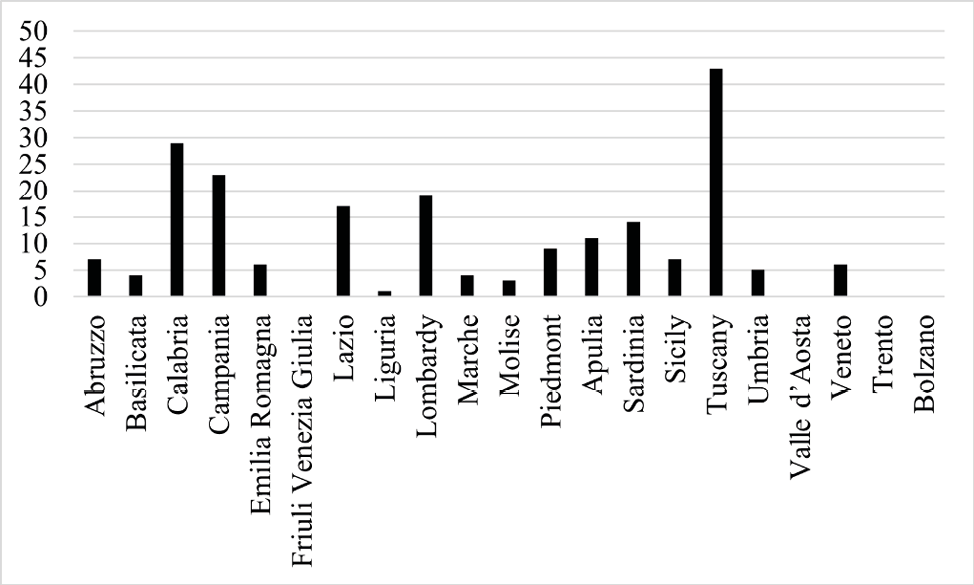
The history of “Italian Districts” started with the introduction of the Industrial District by Law No. 317/19916, while in the field of agriculture, the district (Rural District and Quality Agri-food District) was recognised through Legislative Decree No. 228/2001 “Orientamento e modernizzazione del settore agricolo” with the aim of increasing the level of competitiveness of the primary sector in line with the Agenda 2000 reform of the Common Agricultural Policy (Toccaceli, 2013). Regions and Autonomous Provinces identified different typologies of district according to their territorial characteristics (especially for RDs) and production specialisation (Toccaceli, 2012). The same approach was also maintained in the new National Law. To cope with territorial challenges and to give new opportunities and resources to rural areas (Mazzocchi et al., 2021), the new National Law has recognised eight typologies of districts under the macro-definition of “Food Districts” (Art. 499 co. 2), namely Organic Districts, Rural Districts, Agri-food Districts, Districts with small and medium-sized enterprises, Interregional Districts, Urban and Peri-urban Districts, Proximity Districts, and “Sustainable Districts” (Fanfani et al., 2018). Moreover, it has assigned to the Regions and Autonomous Provinces the task of the identification and subsequent communication of FDs to the Ministry of Agriculture of Food Sovereignty and Forests (MASAF) where the National Register of FDs is established. Figure 1 shows the number of FDs (no. = 208) recognised at the national level as of 12/02/2024, with the Tuscany region as the first region for a number of FDs (no. = 43).
2.5 The Rural Districts in Tuscany
Tuscany has the highest number of RDs in Italy, totalling 12. In 2014, the Delrio Law (No. 56/2014) redefined the role of Provinces, altering the national and regional institutional framework. Under this new institutional setting, the Tuscany Region emphasised territorial self-organisation by revising Regional Law No. 21/2004, which assigned the role of organising and leading RDs to the Provinces, to better align with the socio-economic and normative context, thereby enhancing agricultural and rural opportunities (Regional Law No. 17/2017). Network governance helps highlight actions and connections among different actors, both formal and informal, to enable a better understanding of RD processes.
Based on the National Register of FDs7, a desk analysis was developed on the specific case study of Tuscany RDs to identify the initiatives that can contribute to the rural development goals set by the LTVRA. We used a case study approach to capture and understand complex social phenomena and support to generalise findings (Yin, 2003). Indeed, the large number of Districts and RDs and the opportunity to recognise RDs on different territorial scales (no minimum territorial limits were set) made the Tuscany Region a compelling case in understanding the complex synergies between RDs and the LTVRA.
To identify and describe the dynamics of RDs in Tuscany, the official annual reports, available for each RD and for the years 2019, 2020, 2021, and 2022 in the regional database8, were used. In addition, to integrate some information, annual RD reports were consulted in the period January–February 2024. According to Regional Regulation No. 14/20189, each RD must report annually on: (i) the actual participation of each member in the activities of the RD, (ii) a description of the activities carried out and the objectives achieved according to the Territorial Economic Plan (TEP), (iii) problems concerning the implementation of the TEP, and (iv) the updated action programme. The annual RD reports were preferred to the TEPs10, since they represent the main operative tool for monitoring the concrete actions of the RDs.
Under the network governance perspective, in line with the structure of the annual reports, the analysis also included three elements: territory, actors, and synergies. Based on the annual reports, the territorial scale, the preliminary governance structure, and internal and external actors (e.g. universities and technical actors) are identified. Moreover, 55 RD initiatives, their levels of action, and funding sources are highlighted (Supplementary Material, Table A.1).
To identify the potential contribution of the RD initiatives to the LTVRA, the analysis involved examining annual reports, which were systematically classified into 15 main categories11 to gain a deeper understanding of the content of each initiative. These categories were derived through an inductive and deductive path (Saldaña, 2013), taking into consideration both the themes and scopes of RD initiatives and the goals of the LTVRA. In the second stage of the research, each initiative was mapped against the ten shared goals of the LTVRA to explore their alignment and contribution, as Table 1 shows. In some cases, the same categories may be part of different goals of the LTVRA, while the initiatives refer to a predominant goal of the European strategy. Additionally, the material was also analysed to identify the limitations in the scope of action of the RDs and their strategies to address these challenges.
| Initiatives | Categories | LTVRA goals | |||||||||||||||||
|---|---|---|---|---|---|---|---|---|---|---|---|---|---|---|---|---|---|---|---|
| LIFE Subsed project | Knowledge exchange | ||||||||||||||||||
| Exchange with Rural District of Val di Cecina | Knowledge exchange, networking | ||||||||||||||||||
| “Pole for the economy of the mountain” in Campo Tizzoro | Territorial integration | ||||||||||||||||||
| Joint proposal of contract with Rural Forestry District of Pistoia Mountain | Territorial integration, sustainability | Attractive spaces | |||||||||||||||||
| Research project on GIAHS1 | Landscape | ||||||||||||||||||
| Proposal for “Vivaismo per un futuro sostenibile” | Sustainability | ||||||||||||||||||
| “Piccoli Borghi storici” | Cultural regeneration and tourism | ||||||||||||||||||
| Networking with Vivaistic Ornamental District of Pistoia | Networking | ||||||||||||||||||
| Action for consistency of administrative acts | Harmonization | ||||||||||||||||||
| Joint proposal of contract of District with ornamental nursery of Pistoia for overlap and territorial contiguity | Territorial integration | Engagement in multilevel governance | |||||||||||||||||
| Interest in Forest calls and SNAI2 | Natural resources management | ||||||||||||||||||
| “A tavola con i prodotti della Val di Cecina” project | Food valorisation | ||||||||||||||||||
| “Regional Food Roundtable of Tuscany” | Food valorisation | ||||||||||||||||||
| “Competence Centre of Traditional Agri-Food Products” | Food valorisation | ||||||||||||||||||
| Path of realization of the brand “Eccellenze di Montalcino” | Food valorisation | ||||||||||||||||||
| Virtual experiential path through “Patto territoriale Interregionale VATO” | Food valorisation | ||||||||||||||||||
| Promotion of events and festivals on food | Food valorisation | ||||||||||||||||||
| Memorandum of understanding to promote organic production | Organic production | ||||||||||||||||||
| Interest in calls like MASAF (District contract), Region (IDP and ICP3) | Supply chains | ||||||||||||||||||
| Proposal submitted for IDP 2019 Southern Tuscany | Territorial integration | Provision of food security | |||||||||||||||||
| District Contract Agreement Southern Tuscany | Territorial integration | ||||||||||||||||||
| Participation in a study on the role of RD and food as subjects capable of organising the demand for investment and use of public resources | Territorial integration | ||||||||||||||||||
| Proposal submitted for IDP 2019 “Vino e territorio” | Territorial integration | ||||||||||||||||||
| Proposal submitted for IDP 2019 “M.A.W. (Montalcino: Also, of Wine)” | Territorial integration | ||||||||||||||||||
| Support activities for the enhancement of local livestock | Supply chains | ||||||||||||||||||
| Memorandum of understanding for collective catering | Supply chains | ||||||||||||||||||
| “E-food community” project | Supply chains | ||||||||||||||||||
| Interest in supply chain and district contracts (IDP and ICP) | Supply chains | ||||||||||||||||||
| “ProValCecina” project | Supply chains | ||||||||||||||||||
| Mercatale’s and Mercatale Figline Valdarno renovation | Supply chains | ||||||||||||||||||
| “Le Terre PIsano LIvornesi, un territorio da assaporare lentamente” | Supply chains | ||||||||||||||||||
| District as “technical” (prevention) through activities | Prevention (workplace) | Dynamic communities and well-being | |||||||||||||||||
| “Conosciamoci meglio: il vivaismo pistoiese per il benessere dei cittadini, spiegato ai giovani” initiative | (Nursery) education | ||||||||||||||||||
| Contratto di Fiume | Natural resources management | ||||||||||||||||||
| “Green Community Lunigiana” | Natural resources management | ||||||||||||||||||
| Table for integrated design (agro-irrigation system) and experimentation activities for wastewater reuse | Natural resources management | ||||||||||||||||||
| IBIS project | Sustainability | ||||||||||||||||||
| Various collaborations with research centre | Sustainability | Flourishing sources of nature | |||||||||||||||||
| Project “Actions in support of the Circular Economy” | Sustainability | ||||||||||||||||||
| Cycle of meetings to analyse European objectives and future strategies | Knowledge exchange, networking | ||||||||||||||||||
| “HUB for the marketing of flowers and plants grown within the district according to compatible methods” | Sustainability, supply chain | ||||||||||||||||||
| “Vivaismo per un futuro sostenibile” | Sustainability | ||||||||||||||||||
| Protocol of understanding for the introduction of good practices in nursery cultivation | Sustainability, education | ||||||||||||||||||
| Initiative to create a “self-control laboratory” | Sustainability, prevention | ||||||||||||||||||
| Survey on the Digital Divide and analysis of the territory | Research (territorial needs) | Benefiting from digital innovation | |||||||||||||||||
| Project for the Citadel of the training of agri-food | (Agri-food) Education | Entrepreneurial and innovative people | |||||||||||||||||
| Partnerships | Knowledge exchange, networking | ||||||||||||||||||
| Meetings with other subjects by setting up an RD in Bolzano | Knowledge exchange, networking | ||||||||||||||||||
| GRANULAR4 project | Governance | Places equipped with services | |||||||||||||||||
| Notes: To avoid repeating the same initiatives promoted by various RDs, only 49 are listed here. | |||||||||||||||||||
| The goals “Inclusive Communities” and “Places of diversity” are not included since no initiatives were implemented by the RDs. | |||||||||||||||||||
| Source: Authors’ elaboration from Rural Districts Annual Reports and the LTVRA | |||||||||||||||||||
| 1 Globally Important Agricultural Heritage Systems. | |||||||||||||||||||
| 2 National Strategy for Inner Areas. | |||||||||||||||||||
| 3 Respectively Integrated District Projects and Integrated Contract Projects (supply chain). | |||||||||||||||||||
| 4 Giving Rural Actors Novel data and re-Useable tools to Lead public Action in Rural areas, hereinafter GRANULAR. | |||||||||||||||||||
4. Insights from Rural Districts in Tuscany
The initiatives implemented by the Tuscany RDs are influenced by the territory, the composition of the network of actors (e.g. local government bodies, community organisations, educational and research institutions, etc.), and the process of RD institutionalisation.
4.1 Heterogeneity of territorial scale
As a result of the autonomy that the Tuscany Region left to the territories in terms of self-organisation, RDs differ due to geographical areas and portions of territory involved in terms of numbers of Municipalities (Figure 212). The territory of some RDs matches that of a single municipality (e.g. the RD of Montalcino-San Giovanni d’Asso), while for other districts it extends over large territories (e.g. the RD of Southern Tuscany).
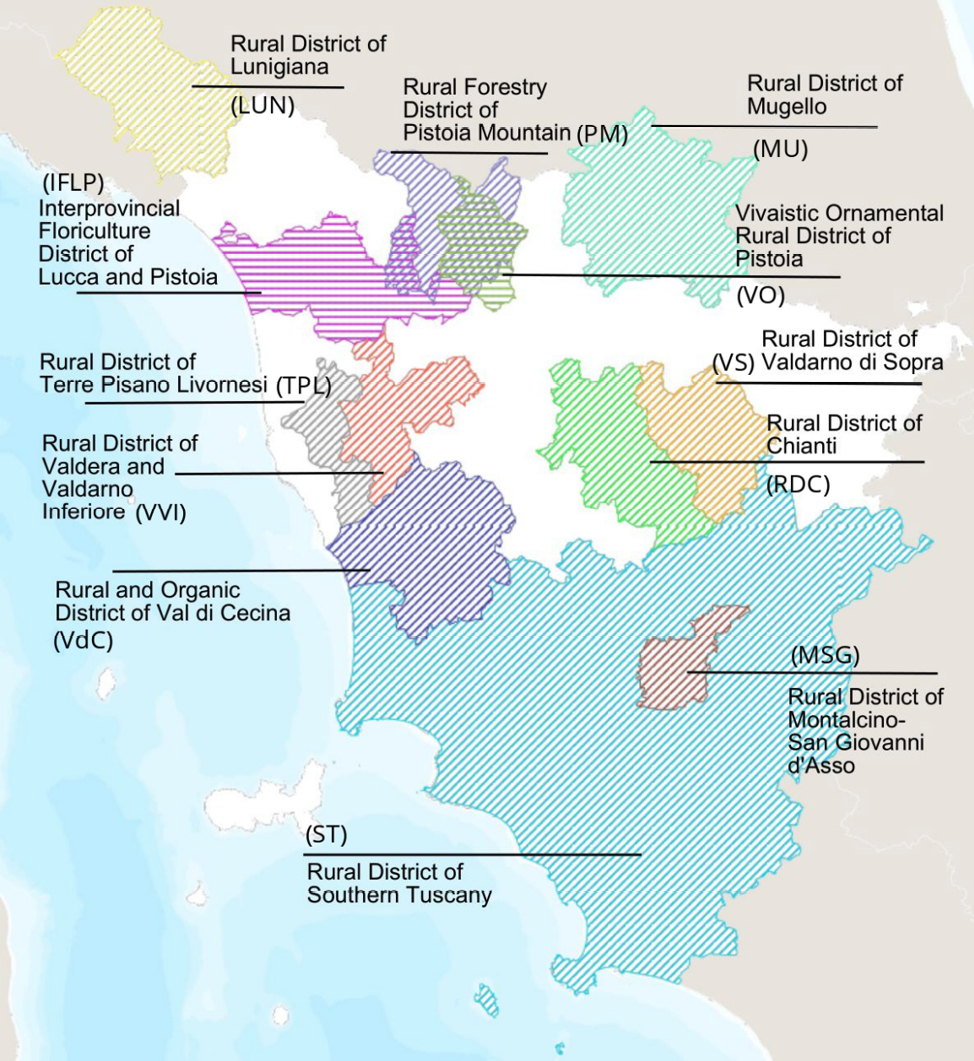
This diversification generates territorial overlapping, enclaves, or proximity among RDs. For example, the RD of Southern Tuscany embeds the RD of Montalcino-San Giovanni d’Asso, vocationally specialised in wine production (Brunello di Montalcino) and therefore capable of implementing territorial development strategies independently from the surrounding territory13. In other cases, the territorial vocation allowed some territories to belong to multiple RDs. Examples include the Interprovincial Floriculture District of Lucca and Pistoia; the Rural Forestry District of the Pistoia Mountain, covering Uzzano, Pieve a Nievole, and Pescia; and the Vivaistic Ornamental Rural District of Pistoia, which includes the municipalities of Pistoia, Montale, and Serravalle P.se.
4.2 Composition and process of institutionalisation
Depending on the territorial characteristics and the respective TEPs14, RDs define integrated territorial strategies pursuing socio-economic development and resources valorisation consistent with the protection of the environment, landscape, historical-cultural traditions, and agricultural policies in the territory. The scope and the effectiveness – the ability to generate tangible impacts on the territory – of the RD strategies and actions are mainly influenced by the composition of the members, the skills and influence of RD actors (e.g. expertise, network, and technical expertise), and governance structures (Table 2). In this regard, the compositions of the actors of Tuscany RDs in terms of the presence of local government bodies, a community organisation, a Local Action Group (LAG), and other district typologies exhibit substantial differences, starting from the District’s leaders (soggetto referente). Indeed, District leaders, who, according to Art. 6 (Law No. 17/2017), must prepare and implement the TEP, and organise and report on the district’s activities, encompass ad hoc created associations (four cases), public authorities (four cases), LAGs (two cases), and private entities (two cases) (Table 2). This echoes the regional choice of granting full freedom of typologies and legal form to RD leaders, even if it can affect the possibility of accessing funding opportunities. Moreover, among the RD members, the most represented actors are Municipalities and Municipality unions, LAGs, consortia, Food Districts and Organic Districts, and agri-food and farmers’ associations. Four RDs consider crucial the presence of scientific committees, advisory boards, universities, and specific working groups to support the leaders in the planning and management of the initiatives, and for fundraising activities.
| Tuscany RDs | Leader (referent) | Members | Governance | Technical and scientific support | |||||||||||||||
|---|---|---|---|---|---|---|---|---|---|---|---|---|---|---|---|---|---|---|---|
| Rural and Organic District of Val di Cecina (VdC) | Association of Rural and Organic District of Val di Cecina | Municipalities, Unions of Municipalities, agricultural associations, private entities, LAG | Assembly, President, Board of directors, Supervisory board | - | |||||||||||||||
| Rural District of Southern Tuscany (ST) | Chamber of Commerce Maremma and Tirreno | Municipalities, Unions of Municipalities, agricultural associations, private entities, LAG, Food District | Assembly | Internal working group to support the activity of the District and Fondazione del Polo Universitario Grossetano with technical assistance | |||||||||||||||
| Rural District of Chianti (RDC) | Ad hoc Association established | Municipalities, private entities | Assembly, Board of directors | - | |||||||||||||||
| Interprovincial floriculture district of Lucca and Pistoia (IFLP) | Interprovincial floriculture association | Municipalities, private entities | Assembly, Steering committee | Scientific Committee as an Advisory Body of the Steering Committee | |||||||||||||||
| Rural District of Montalcino-San Giovanni d’Asso (MSG) | Foundation of Brunello Montalcino | Municipality,private entities | Assembly | - | |||||||||||||||
| Rural District of Valdarno di Sopra (VS) | Bucine Municipality | Municipalities | Assembly, Board of Directors (public and private actors), Assembly | Technical Committee, Scientific Committee (presence of University of Florence), mixed public-private working groups | |||||||||||||||
| Rural District of Lunigiana(LUN) | Union of Municipalities Montana Lunigiana | Municipalities, Unions of Municipalities, agricultural associations, private entities, LAG | Assembly, Supporting group for the Referent subject, Operational secretariat | - | |||||||||||||||
| Rural Forestry District of the Pistoia Mountain (PM) | LAG Montagnappennino | Municipalities, LAG | Assembly | - | |||||||||||||||
| Vivaistic Ornamental Rural District of Pistoia (VO) | Association of Vivaisti Italiani | Municipalities, Unions of Municipalities, agricultural associations, private entities | Assembly, Committee, Secretariat | Working groups | |||||||||||||||
| Rural District of Mugello (MU) | LAG Start srl | Municipalities, LAG | Assembly | - | |||||||||||||||
| Rural District of Valdera and Valdarno Inferiore (VVI) | Union of Municipalities Valdera | Municipalities, Unions of Municipalities, agricultural associations, Organic District | Assembly | - | |||||||||||||||
| Rural District of Terre Pisano Livornesi (TPL) | Association of Rural District of Terre Pisano Livornesi | Municipalities, agricultural associations | Assembly | - | |||||||||||||||
| Source: Authors’ elaboration from Annual Reports and Regional Law. | |||||||||||||||||||
The activities of RDs have mostly focused on: i) the integration of the TEP, ii) direct actors’ participation and awareness-raising actions in the territory, and iii) the structuring of a formal dialogue process with regional authorities. These three main actions allow RDs to better identify challenges, set priorities, distinguish strategies to achieve them, and start the institutionalisation process.
In this regard, the Tuscany Region not only recognises, controls, and funds RDs but also supports their activities through the Regional Table of Rural Districts. This platform gathers needs, serves as an interlocutor with MASAF and the State-Regions Conference, and provides a networking space for RDs. Additionally, the Tuscany Region facilitates RD participation in regional initiatives to promote food valorisation through the Competence Centre of Traditional Agri-Food Products. Another key external actor is the National Council of Food Districts, established in 2021 at MASAF with the objectives of: (i) addressing local challenges and optimising resource management, (ii) connecting with institutions and economic and social bodies to call for laws and funding, (iii) fostering synergies with academia, and (iv) promoting sustainable territorial growth (La Sala et al., 2023). Finally, MASAF plays a crucial role by allocating financial resources to Food Districts through instruments such as “District Contracts” and “Integrated District Plans”.
4.3 Characteristics of initiatives
Most of the identified initiatives are aimed at improving the capacity to identify and mobilise economic resources and promote partnerships and networking activities. For initiatives targeting the involvement, or awareness raising, of local actors (public, private, and civil society) in RD activities, the most frequently used tools are specific collaborations, territorial actions (Contratto di Fiume), regional actions (Regional Food Roundtable of Tuscany), or the “Memorandum of understandings”, usually with Municipalities and other public authorities (e.g. Municipalities’ unions). Frequently, RD interests and project proposals are associated with specific funding schemes at the regional (e.g. Rural Development Plan [RDP] or Development and Cohesion Fund [DCF]) and national levels (e.g. National Recovery and Resilience Plan [NRRP], District Contract Agreement or Integrated District Projects).
RD initiatives cover different topics ranging from (short) supply chain, food and landscape valorisation, encompassing the promotion of organic production, and sustainable resources management to actions on cultural regeneration, tourism, and governance. Also, education (agri-food or nursery), networking and knowledge exchange, (research on) territorial needs, (administrative) harmonisation and prevention (on workplace) are involved in RD activities. The RD actions related to (short) supply chains include supporting actions for the valorisation and promotion of local food products in collective catering (e.g. RD of Val di Cecina), or the renovation of market areas such as in the case of Mercatale (e.g. RD of Valdarno di Sopra). Cultural regeneration and tourism activities are mostly arranged around the “Piccoli borghi storici” initiative (NRRP, M1C3 – Investment 2.1 “Attractiveness of villages”) based on an integrated local project to improve the attractiveness of the “borghi”. Moreover, sustainable resources management activities are often promoted through integrated territorial planning instruments such as the “Contratto di Fiume”, which targets the sustainable management of water resources and the reduction of hydrological risks. Several collaborations within a single RD, between RDs, and with external actors are established to optimise RD activities on local, district, interdistrict, regional, interregional, European, and international scales. These collaborations are more structured among RDs that are geographically close and that share the same challenges (e.g. RD of Pistoia Mountain and the Interprovincial Floriculture District of Lucca and Pistoia). In other cases, cooperation became a mandatory strategy to access financial resources (e.g. the RD of Southern Tuscany and the RD of Montalcino-San Giovanni d’Asso). An example of these collaborations is the “E-food community” project, promoted by three different RDs (the RDs of Val di Cecina, Lunigiana15, and Terre Pisano Livornesi), the Wine Street of Colline Pisane, and the Food Community of Crinale, with the aim of creating an agri-food marketing digital platform to connect local producers from different districts to new markets across the whole Region.
This heterogeneous situation allowed local communities (e.g. municipalities, local institutions, enterprises, associations, etc.) to design different pathways of actions – elaborated in the TEPs – capitalising on potentialities and overcoming barriers to ensure actions that contribute to the LTVRA. Table 3 shows that almost all RDs focused their initiatives on four goals of the LTVRA, namely “attractive spaces”, “engagement in multilevel governance”, “provision of food security”, and “flourishing of nature”, while the remaining categories of the LTVRA are partially or not covered in the RD actions.
| RDs | Attractive spaces |
Engagement in multilevel governance | Provision of food security | Dynamic communities and well-being | Flourishing sources of nature | Benefiting from digital innovation | Entrepreneurial and innovative people | Places equipped with services | |||||||||||
|---|---|---|---|---|---|---|---|---|---|---|---|---|---|---|---|---|---|---|---|
| VdC | x | x | x | x | |||||||||||||||
| ST | x | x | x | ||||||||||||||||
| RDC | x | x | |||||||||||||||||
| IFLP | x | x | x | ||||||||||||||||
| MSG | x | x | |||||||||||||||||
| VS | x | x | x | ||||||||||||||||
| LUN | x | x | x | ||||||||||||||||
| PM | x | x | x | ||||||||||||||||
| VO | x | x | x | x | |||||||||||||||
| MU | x | x | |||||||||||||||||
| TPL | x | ||||||||||||||||||
| Notes: No RD initiatives have been recorded for the LTVRA goals “Place for diversities” and “Inclusive communities”. The Rural District of Valdera and Valdarno Inferiore (VVI) is not included since it was formed in 2023. | |||||||||||||||||||
| Source: Authors’ elaboration from Rural Districts Annual Reports and the LTVRA. | |||||||||||||||||||
RDs contribute to the objectives of the LTVRA through the implementation of various initiatives covering a wide range of objectives in different fields (e.g. from supply chain and food valorisation to water management and cultural regeneration) and territorial levels and involving various local and external actors. Detailed information on the initiatives and the actors are provided in Table A1 as supplementary material.
To achieve RDs’ objectives, the capacity of each territory to design and enforce actions and synergies for the development of the territory beyond specific sectors needs to be considered. This capacity characterizes the RD of Montalcino-San Giovanni d’Asso, which promotes various actions aimed at the valorisation of food products (e.g. truffles, oil, honey, pecorino cheese, saffron, and wheat) through the new brand Eccellenze di Montalcino, and of the entire territory through, for example, the IDP project M.A.W. Montalcino. In addition, this RD is promoting an educational project in the agri-food sector (Cittadella di formazione per l’Agri-food in San Giovanni d’Asso) and several town twinning projects both at the European and international level.
Moreover, the analysis reveals the intention of RDs to connect their activities with other territorial development strategies, such as the National Strategy for Inner Areas (e.g. RD of Pistoia Mountain), and the need to align them with environmental protection interventions, as in the IDP proposal “Vivaismo per un future sostenibile”, focusing on the introduction of good practices to reduce the use of glyphosate, enforced by the Vivaistic Ornamental RD of Pistoia.
The analysis captures the territorial heterogeneity, institutionalisation process, and key initiatives of RDs in Tuscany. As part of FDs, RDs promote multilevel, place-based governance by fostering integrated development strategies. Addressing local needs through multiscale actions, RDs serve as a platform for: developing flexible and inclusive network governance models for sustainable resources management, enhancing integration along the (short) supply chain, guaranteeing attractive spaces, and improving access to public and private services. RD initiatives are aligned with LTVRA objectives, supporting food security, rural attractiveness, multilevel governance, natural resources valorisation, innovations, and rural well-being.
Territorial diversity results in overlapping, enclaves, or proximity among RDs, reflecting Tuscany’s self-organisation vitality. This heterogeneity spans production, history, society, and culture but does not hinder collective actions linked to the need to strengthen networks for collaborative funding (e.g. the case of the E-Food Community project), create territorial synergies (e.g. the Vivaistic Ornamental RD of Pistoia and the Interprovincial Floriculture District of Lucca and Pistoia), and integrate broader development strategies (e.g. the RD of Pistoia Mountain). Additionally, RDs must structure internal governance models by regional law, sometimes involving technical and scientific actors in the implementation of their activities. At the same time, a broader process of institutionalisation and governance needed to address the barriers and needs that RDs and FDs may face has been outlined at the regional and national level.
In this context, RDs encounter several internal and external barriers that could impact the development of their networks, activities, and network governance perspective. These are mainly represented by the difficulties in finding the necessary financial resources for the start-up phase and thus promote a network-based governance model, which requires the engagement of different actors. Examples of internal limitations are represented by the lack of interest of actors – especially private companies – in participating in planned initiatives (e.g. in the RD of Southern Tuscany), or internal governance arrangements that can delay the District actions (e.g. Rural Forestry District of the Pistoia Mountain). This highlights the importance of the members, especially the capacity of the Soggetto referente to organise the internal action, including the need for technical support, involve stakeholders, and establish external relations.
Additionally, acquiring financial resources for the preliminary design and initiation of actions is also recognised as a significant hurdle. The main sources of financial support that RDs use are represented by “Integrated District Projects” (IDP) and, at the regional level, “Measure 16.4” of the RDP. At the national level, instruments borrowed from “Supply Chain Agreements” and “Integrated Supply Chain Plans” – “District Contracts” and “Integrated District Plans” – are established to align agricultural and rural development in a traditional set of sectorial policy tools16 (Toccaceli, Pacciani, 2024). Limited access to funds can be mitigated, as stated by Hertting and Vedung (2012), through the support of Regions, the National Council of Food Districts, and MASAF. Moreover, the participation in projects under other European funding schemes such as Horizon Europe (e.g. the RD of Val di Cecina’s participation in the GRANULAR project) represents a potential solution to overcome these barriers, and a useful means to engage local actors and reinforce collaborations with academia and research institutions.
Finally, the screening of the main activities promoted by RDs in Tuscany made it possible to outline some trends in relation to the ten goals of the LTVRA and revealed the heterogeneity of RDs, in terms of geographical areas and the predominant specialisation, but also the typology of actors involved and fields of action. These factors reveal the high degree of flexibility of the RD model to accommodate the complexity of local actors’ (public, private, and non-profit entities) needs and visions, and thus facilitate an approach to resource management and territorial (rural) development based on networks and inclusive governance models. However, not all RD initiatives cover the full range of objectives, especially those related to the management of resources, an integrated strategy (e.g. “attractive spaces” and “engagement in multilevel governance”), and social innovation aspects (e.g. “inclusive communities” and “place of diversity”), with the exception of the “entrepreneurial” dimension. Despite this apparent limitation, it seems encouraging that RDs are active on issues aimed at revitalising rural areas. This aspect could support future discussions and stimulate reflection within the recent debate on the role of social innovation in rural areas (Bock, 2016; Del Giudice, 2024) and their governance (Georgios, Barraí, 2023).
The LTVRA outlines the European ambition for a multidimensional nature of rural development (EC, 2021). The success of this vision requires cooperation at all different governance levels and implies the involvement of different actors in order to overcome the “New Rural Paradigm” in favour of “Rural Well-being: Geography of Opportunities” (OECD, 2020). This ambition requires coherent and effective policies developed according to place-based and territorial cooperation approaches (Territorial Agenda, 2030). FDs are one of the main approaches identified in Italy to cope with the need for integration and territorial cooperation.
Through the analysis of annual reports, this article showcases the characteristics in terms of territory, actors, and initiatives of RDs in Tuscany. Based on the premise that this analysis is not exhaustive, due to the limited content available in the annual reports and the recent recognition of the RDs, this study represents a starting point for further investigating the governance arrangement models capable of supporting effective place-based and participatory approaches to rural development in line with the strategic ambitions of the LTVRA. In this regard, a robust network governance approach can contribute to consolidating relationships both within and outside the RDs, strengthening the ties among agricultural enterprises, institutions, associations, and other actors operating in different sectors, and aligning distinct visions and initiatives in different fields.
Beyond the annual reports, it is valuable to assess the processes and impacts of RDs, accounting for their contribution to the development of the rural territory and the integration of economic and territorial policies. Further research is necessary to better design RD activity monitoring and evaluating tools – for example, by reshaping and applying the four indicators proposed by Morrison (2014) in the context of regional governance and accounting for the contextual factors reproposed by Wegner and Verschoore (2022) – but also to understand whether RDs can be an effective reference point for the development of the territory.
The authors thank Sabrina Arcuri for her valuable guidance on methods. They are also grateful for the comments and suggestions of the reviewers. This research received no specific grant from any funding agency in the public, commercial, or not-for-profit sectors.
Conceptualization, Methodology, Original draft preparation, Writing – Reviewing and Editing, F.S. and M.M.; Methodology, Supervision, G.B.
Ahlmeyer F., Volgmann K. (2023). What Can We Expect for the Development of Rural Areas in Europe? — Trends of the Last Decade and Their Opportunities for Rural Regeneration. Sustainability, 15(6), 5485. DOI: https://doi.org/10.3390/su15065485.
Ansell C., Torfing J. (2022). Handbook on theories of governance. Edward Elgar Publishing. Cheltenham UK and Northampton MA USA. DOI: https://doi.org/10.4337/9781800371972.
Berti G., Belletti G., Toccaceli D., Arcuri S. (2023). Territorial food governance in the making: towards the Food Roundtable of Tuscany Region. Italian Review of Agricultural Economics, 78(3): 51-67. DOI: https://doi.org/10.36253/rea-14776.
Bock B. (2016). Rural marginalisation and the role of social innovation; a turn towards endogenous development and rural reconnection. Sociologia Ruralis, 56(4): 552-573. DOI: https://doi.org/10.1111/soru.12119.
Brunori G., Rossi A. (2007). Differentiating countryside: Social representations and governance patterns in rural areas with high social density: The case of Chianti, Italy. Journal of Rural Studies, 23(2): 183-205. DOI: https://doi.org/10.1016/j.jrurstud.2006.10.001.
Broto V.C. (2017). Urban governance and the politics of climate change. World Development, 93: 1-15. DOI: https://doi.org/10.1016/j.worlddev.2016.12.031.
Chobotova V., Kluvankova-Oravska T. (2006). Shifting Governance in Slovensky Raj National Park. Institutional Change in Agriculture and Natural Resources. Discussion Papers 15. DOI: https://doi.org/10.22004/ag.econ.18834.
Del Giudice T. (2024). The new challenges of agricultural policy: new actors and redefined development paradigms. Italian Review of Agricultural Economics, 79/(2): 3-17. DOI: https://doi.org/10.36253/rea-15365.
European Commission (2021). Communication from the Commission to the European Parliament, the Council, the European Economic and Social Committee and the Committee of the Regions a Long-Term Vision for the EU’s Rural Areas - Towards stronger, connected, resilient and prosperous rural areas by 2040. COM (2021) 345 final, Brussels. https://eur-lex.europa.eu.
European Commission (2024). The Long-Term Vision for the EU’s Rural Areas: key achievements and ways forward. COM (2024) 450 final, Brussels. https://eur-lex.europa.eu.
Joint Research Centre (2021). Scenarios for EU Rural Areas 2040: Contribution to European Commission’s Long-Term Vision for Rural Areas. Publications Office of the European Union, Luxembourg. DOI: https://data.europa.eu/doi/10.2760/29388.
European Network for Rural Development Thematic Group on Rural Revitalisation (2022). Enabling factors for rural revitalisation & a self-assessment tool for policy design. https://ec.europa.eu.
Fanfani R., Montresor E., Pecci F. (2018). Dai distretti rurali e agroalimentari di qualità ai distretti del cibo. Rete Rurale Magazine, (5): 42-43. https://www.reterurale.it.
Georgios C., Barraí H. (2023). Social innovation in rural governance: A comparative case study across the marginalised rural EU. Journal of Rural Studies, 99: 193-203. DOI: https://doi.org/10.1016/j.jrurstud.2021.06.004.
Goodwin M. (1998). The governance of rural areas: Some emerging research issues and agendas. Journal of Rural Studies, 14 (1): 5-12. DOI: https://doi.org/10.1016/S0743-0167(97)00043-0.
Hertting N., Vedung E. (2012). Purposes and criteria in network governance evaluation: How far does standard evaluation vocabulary takes us?. Evaluation, 18(1): 27-46. DOI: https://doi.org/10.1177/1356389011431021.
Kapucu N., Hu Q. (2020). Network governance: concepts, theories and applications. Routledge. New York and London. DOI: https://doi.org/10.4324/9781351056540.
Klijn E.H. (2008). Governance and governance network in Europe: an assessment of 10 years of research on the theme. Public Management Review, 10 (4): 505-525. DOI: https://doi.org/10.1080/14719030802263954.
Kooiman J. (1993). Modern Governance: New Government-Society Interactions. Sage, Newbury Park.
Lamine C., Pugliese P., Barataud F., Berti G., Rossi A. (2023). Italian biodistricts and French territorial food projects: how science-policy experience interplays shape the framings of transitions towards sustainable territorial food systems. Frontiers Sustainable Food Systems, 7, 1223270. DOI: https://doi.org/10.3389/fsufs.2023.1223270.
La Sala P., Tarangioli S., Briamonte L., Tomassini S. (2023). La Rete Rurale per il cibo italiano: i Distretti. Creafuturo. https://creafuturo.crea.gov.it/10664/.
La Sala P. (2024). Fabbisogni di intervento e prospettive di sviluppo dei Distretti del Cibo. Proceedings of the Conference “Territories that nourish”. Turin. https://www.visitpiemonte
Lavenex S. (2008). A governance perspective on the European neighbourhood policy: integration beyond conditionality? Journal of European Public Policy, 15(6): 938-955. DOI: https://doi.org/10.1080/13501760802196879.
Lewis J.M. (2011). The future of network governance research: strength in diversity and synthesis. Public Administration, 89(4): 1221-1234. DOI: https://doi.org/10.1111/j.1467-9299.2010.01876.x.
Mazzocchi C., Orsi L., Bergamelli C., Sturla A. (2021). Bio-districts and the territory: evidence from a regression approach. AESTIMUM, (79): 5-23. DOI: https://dx.doi.org/10.36253/aestim-12163.
Meloni B., Farinella D. (2013). Sviluppo rurale alla prova. Dal territorio alle politiche. Rosenberg & Sellier.
Morrison T.H. (2014). Developing a regional governance index: the institutional potential of rural regiones. Journal of Rural Studies (35): 101-111. DOI: https://doi.org/10.1016/j.jrurstud.2014.04.004.
Moynihan D.P. (2009). The Network Governance of Crisis Response: Case Studies of Incident Command Systems. Journal of Public Administration Research and Theory, 19(4): 895-915. DOI: https://doi.org/10.1093/jopart/mun033.
Müller S.M. (2024). Two qualitative case studies on network governance in Swiss transit station district development. Transportation Research Interdisciplinary Perspectives, 26, 101155. DOI: https://doi.org/10.1016/j.trip.2024.101155.
Murdoch J. (2000). Networks – a new paradigm of rural development?. Journal of Rural Studies, 16(4): 407-419. DOI: https://doi.org/10.1016/S0743-0167(00)00022-X.
Navdeep M., Skelcher C. (2007). Evaluating democratic performance: methodologies for assessing the relationship between network governance and citizens. Public Administration Review, 67(2): 228-237. DOI: https://doi.org/10.1111/j.1540-6210.2007.00709.x.
Organization for Economic Co-operation and Development (2006). The New Rural Paradigm: Policies and Governance. OECD Rural Policy Reviews, OECD Publishing, Paris. DOI: https://doi.org/10.1787/9789264023918-en.
Organization for Economic Co-operation and Development (2017). Multi-level Governance Reforms: Overview of OECD Country Experiences. OECD Multi-level Governance Studies, OECD Publishing, Paris. DOI https://doi.org/10.1787/9789264272866-en.
Organization for Economic Co-operation and Development (2020). Rural Well-being: Geography of Opportunities. DOI: https://doi.org/10.1787/d25cef80-en.
Ovaska U., Vihinen H., Oostindie H., Farinós J., Hrabar M., Kilis E., Kobal J., Tisenkopfs T., Vulto H. (2021). Network Governance Arrangements and Rural-Urban Synergy. Sustainability, 13(5), 2952. DOI: https://doi.org/10.3390/su13052952.
Powell W.W. (1990). Neither market nor hierarchy: network forms of organization. In: Staw B.M., Cummings L.L. (eds.), Research in Organizational Behavior. 12: 295-336. Greenwich, CT: JAI Press.
Pertoldi M., Fioretti C., Guzzo F., Testori G., De Bruijn M., Ferry M., Kah S., Servillo L.A., Windisch S. (2022). Handbook of Territorial and Local Development Strategies. Publications Office of the European Union, Luxembourg. DOI: https://doi.org/10.2760/57919.
Pheungpha N., Supriyono B., Wijaya A.F., Sujarwoto S. (2019). Modes of Network Governance in Disaster Reliefs: Case of Bangkok Flood Relief 2011. Public Administration, 6: 77-93. DOI: https://doi.org/10.17323/1999-5431-2019-0-6-77-93.
Romão G.A., Najberg E. (2023). Governança de redes e políticas públicas de sustentabilidade. REUNIR Revista de Administração Contabilidade e Sustentabilidade, 13(3): 216-235. DOI: https://doi.org/10.18696/reunir.v13i3.1486.
Saldaña J. (2013). The coding manual for qualitative researchers. Sage Publications, London.
Shucksmith M. (2010). Disintegrated Rural Development? Neo-endogenous rural development, planning and place-shaping in diffused power contexts. Sociologia Ruralis, 50: 1-14. DOI: https://doi.org/10.1111/j.1467-9523.2009.00497.x.
Sørensen E., Torfing J. (2005). The democratic anchorage of governance networks. Scandinavian Political Science, 28(3): 195-218. DOI: https://doi.org/10.1111/j.1467-9477.2005.00129.x.
Sørensen E., Torfing J. (2007). Theories of democratic network governance. Palgrave Macmillan. Basingstoke. DOI: https://doi.org/10.1057/9780230625006.
Stoker G. (1998). Governance as Theory: Five Propositions. International Social Science Journal, 50: 17-28. DOI: https://doi.org/10.1111/1468-2451.00106.
Tarangioli S. (2024). Distretti del cibo: una prima analisi. Proceedings of the Conference “Territories that nourish”, Turin, https://www.visitpiemonte.
Tarangioli S., Henke R., Mazzocchi G., Cisilino F., Licciardo F. (2024). From needs to policy action: Italian agri-food districts as a case of territorial cooperation. Journal of Infrastructure, Policy and Development, 8(10), 5914. DOI: https://doi.org/10.24294/jipd.v8i10.5914.
Territorial Agenda 2030 (2020). A future for all places. https://territorialagenda.eu
Termeer C.J.A.M., Dewulf A. (2012). Towards theoretical multiplicity for the governance of transitions: The energy-producing greenhouse case. International Journal of Sustainable Development, 15(1/2): 37-53. DOI: https://doi.org/10.1504/IJSD.2012.044033.
Toccaceli D. (2012). “Dai distretti alle reti? I distretti in agricoltura nell’interpretazione delle Regioni e le prospettive verso il 2020”, Rete Rurale Nazionale 2007-2013. ISBN: 978-88-8145-235-4
Toccaceli D. (2013). I distretti in agricoltura: un’analisi comparata dell’approccio delle regioni italiane nella prospettiva della riforma delle politiche europee. In: Percorsi di governance per la valorizzazione delle aree rurali nella prospettiva di riforma delle politiche europee. “Quaderni dei Georgofili” Serie VIII - Vol. 10. Società Editrice Fiorentina. https://www.georgofili.net/articoli/percorsi-di-governance-per-la-valorizzazione-delle-aree-rurali-nella-prospettiva-di-riforma-delle-po/3656.
Toccaceli D. (2015). Agricultural districts in the Italian regions: looking toward 2020. Agricultural and food economics, 3(1). DOI: https://doi.org/10.1186/s40100-014-0019-9.
Toccaceli D., Pacciani A. (2024). Dear old (and misunderstood) districts let’s look ahead. Italian Review of Agricultural Economics (REA), 78(3): 3-15. DOI: https://doi.org/10.36253/rea-15062.
Torfing J., Guy Peters B., Pierre J., Sørensen E. (2012). Interactive Governance: advancing the paradigm. Oxford University Press, Oxford. DOI: https://doi.org/10.1093/acprof:oso/9780199596751.001.0001.
Wegner D., Verschoore J. (2022). Network Governance in Action: Functions and Practices to Foster Collaborative Environments. Administration & Society, 54 (3): 479-499. DOI: https://doi.org/10.1177/00953997211024580.
Yin R.K. (2003). Case study research: design and methods. Sage Publications, Thousand Oaks.
Zecca F., Am A., Capocchi E. (2015). Dai distretti alle reti d’impresa: soluzioni chiave per lo sviluppo territoriale. Italian Review of Agricultural Economics. 69(2-3): 227-243. DOI: https://doi.org/10.13128/REA-16924.
1 The term refers to the process of moving from a poor and declining situation to a better state of rural areas (European Network for Rural Areas, 2022).
2 National Law No. 205/2017, “Bilancio di previsione dello Stato per l’anno finanziario 2018 e bilancio pluriennale per il triennio 2018-2020”, Art. 499.
3 Text available at https://www.masaf.gov.it/flex/cm/pages/ServeBLOB.php/L/IT/IDPagina/14159#:~:text=I%20Distretti%20del%20cibo%2C%20istituiti,dei%20territori%20nel%20loro%20complesso.
4 Legislative Decree No. 228/2001, “Orientamento e modernizzazione del settore agricolo”, available at https://www.normattiva.it/uri-res/N2Ls?urn:nir:stato:decreto.legislativo:2001-05-18;228.
5 By the term “action” the paper means all the different initiatives (projects, partnerships, etc.) that RDs organise.
6 As described by Toccaceli (2013), the first definition of an industrial district offered by L. 317/1991 was modified with L. 140/1999, which, by introducing the notion of a Local Production System, paved the way for the extension of the district to different fields, such as rural, agri-food, and fisheries, as was already the case in those years with the extension of negotiated programming tools to agriculture and fisheries, services, and tourism. Similarly, as described by Toccaceli (2015), negotiated planning instruments were being used to cover these sectors.
7 Available on the official website of MASAF (https://www.politicheagricole.it).
8 Available at: https://www.regione.toscana.it/ricerca-atti#/searchAttiGiunta.
9 “Regolamento di attuazione della legge regionale 5 aprile 2017, n. 17”, Art. 6, “Contenuti necessari della relazione annuale”.
10 The Tuscany Region called the District Plan the “Territorial Economic Plan”; Art. 7 (RL No. 17/2017) establishes the main aim and elements.
11 The categories identified below: (1) Cultural regeneration and tourism; (2) Knowledge exchange; (3) Landscape; (4) Territorial integration; (5) Governance; (6) Sustainability; (7) Natural resources management; (8) Research (territorial needs); (9) Networking; (10) Harmonization; (11) Food valorisation; (12) Organic production; (13) Supply chains; (14) Prevention (workplace); (15) Education.
12 Rural District with high organic vocation of Fiesole (2019) was ended and recognised as an Organic District in 2021 with Decree No. 13483 by the Region.
13 Camera di Commercio Maremma e Tirreno, “Istanza di riconoscimento del Distretto Rurale della Toscana del Sud”, 2017. Available at https://www.lg.camcom.it/sites/default/files/media/5859_Progetto%202017-2022.pdf.
14 As stated by RL No. 17/2017, the TEP is “the instrument by which the district defines the integrated territorial strategies. The project pursues objectives of socio-economic development and valorisation of local resources consistent with the protection of the environment, the landscape, the historical and cultural tradition and with the agricultural policies operating in the territory”.
15 Also, in this case, the report (2022) highlighted the problem of identifying firms available to create the “business network” (Rete d’impresa).
16 The National Law 2002 No. 289, Art. 66 co. 1, establishes the Supply chain and District Contracts, and the subsequent implementation and changes led to the Decree of 22 December 2021 published in General Series No. 61/2022 (available at the following link) with the definition of criteria and procedures for the implementation of supply chain contracts provided for by the supplementary fund to the NRRP (Mission no. 2 Green revolution and ecological transition, component 2.1, Sustainable agriculture and circular economy) and subsequent call for Bando IV and V (for further info check https://www.masaf.gov.it/flex/cm/pages/ServeBLOB.php/L/IT/IDPagina/17917).