Research article
Should I stay or should I go? Tie stalls or loose housing to improve dairy cow welfare
1 Department of Agricultural and Environmental Science, Production, Territory, Agroenergy, University of Milan, Italy
2 Department of Environmental Science and Policy, University of Milan, Italy
*Corresponding author. Email: chiara.mazzocchi1@unimi.it
Abstract. Consumers consider the housing system to be a key factor that influences farm animal welfare (FAW). The European Food Safety Authority’s unfavourable assessment of tie-stall systems may encourage a shift towards adopting loose-housing practices. Several factors impact the likelihood of implementing practices aimed at improving FAW. This study evaluates some variables that affect the adoption of loose housing in Italian dairy farming, where the tie-stall system remains diffuse. We assessed socio-demographic, farm-related, and opinion variables that influence the intention to move from tie-stall to loose-housing system by means of a direct survey of 98 farmers who currently use the tie-stall system. The results indicate that gender, age, and financial considerations significantly influence the intention to adopt a loose-housing system. Additionally, the findings underscore the importance of farmers’ perceptions of improvements in animal welfare. The conclusions highlight the importance of the farmers’ sensitivity to FAW and their demand for subsidies to support structural changes.
Keywords: sustainable livestock practices, farmers’ perception, animal husbandry, tie-stall housing, loose housing
JEL codes: Q18, Q16, D60.
Index
2. Review of the literature on farmers’ perception of animal welfare
4.2 Model results and discussion
5. Conclusions and limitations
– This study assesses the environmental, social, and economic viability of the transitioning from tie-stalls to a loose-housing system in dairy farming.
– The data were collected from interviews with 98 farms in Northern Italy.
– The main findings suggest the importance of the economic aspect in the decision to change the livestock system.
– Young and female farmers seem to be more inclined towards the adoption of a loose-housing system.
Farm animal welfare (FAW) is a significant concern when evaluating agricultural systems. As the concept of sustainability continues to evolve, agricultural systems are now expected to balance increased productivity with the stewardship of natural resources, in order to meet new consumer expectations at both environmental and ethical levels (Balzani, Hanlon, 2020; Irico et al., 2018). FAW is a multidimensional concept that is intrinsically tied to the changing sensitivities and daily choices of both consumers and producers (Buddle et al., 2021; Gaworski, Bockowski, 2018).
Within the broader debate, stakeholders recognise that housing systems are a key factor that affects FAW (Ochs, 2019; Perttu et al., 2020; von Keyserlingk, Hotzel, 2014; Zuliani et al., 2017). Several studies have investigated how consumer’s preferences and willingness to pay are influenced by their sensitivity to FAW, often leading them to favour welfare-friendly products (Alonso et al., 2020; Cornish et al., 2020; Gorton et al., 2023; Kühl et al., 2019; Mazzocchi, Sali, 2022; Mazzocchi et al., 2022; Ortega, Wolf, 2018). According to Zuliani et al. (2017), people have identified adequate housing space for cattle as one of the most important factors for animal welfare. Specifically, Mazzocchi, Sali (2022) confirmed that consumers prefer dairy products with a label that indicates the cattle have access to grazing areas, meadows, or external paddocks. In fact, consumers tend to prefer systems that allow animals to roam freely and to exhibit natural social behaviours (Beaver et al., 2021; Biasato et al., 2019; Cardoso et al., 2016; Robbins et al., 2019; You et al., 2014; Yunes et al., 2017). Farmers, on the other hand, are aware that implementing the correct housing system can improve farm profitability by enhancing animal productivity, efficiency, and product quality (Ahmed et al., 2021; Biasato et al., 2019; Buddle et al., 2021; Tarantola et al., 2016).
In the dairy sector, the tie-stall system has been debated for years, yet it remains used in traditional Italian production contexts, particularly in mountainous areas (Irico et al., 2018; Tarantola et al., 2016; Zuliani et al., 2017). In tie-stall barns, cows are tethered at the neck in individual stalls for at least 180 days a year, where they are fed and milked. Although tie-stalls can help farmers monitor injuries and individual feed consumption (Zuliani et al., 2017), research indicates that the incidence of diseases such as mastitis, ketosis, hock injuries, and ocular discharge is higher in tie-stall systems than in loose-housing systems (Hultgren, 2002; Popescu et al., 2014; Regula et al., 2004; Tarantola et al., 2016). Additionally, cattle reared in loose-housing systems generally exhibit lower cortisol levels, suggesting that this approach to housing is less stressful for animals compared to tie-stalls (Irico et al., 2018; Starvaggi Cucuzza et al., 2014; Tarantola et al., 2016).
Although the perception of FAW among farmers has traditionally received less attention than that of other stakeholders (Buddle et al., 2021; Neave et al., 2022; Ortega, Wolf, 2018), research shows that farmers typically feel an ethical obligation towards FAW (Croyle et al., 2019; Schuppli et al., 2023). However, the implementation of new technologies intended to improve animal welfare is influenced by various technical, financial, cultural, and individual factors, which can affect farmers’ willingness to adopt best management practices (Araujo et al., 2022; Bechini et al., 2020; Groher et al., 2020; Hyland et al., 2018; Nguyen, Drakou, 2021). In relation to FAW, studies suggest that the financial viability of implementing animal-friendly facilities and husbandry systems (Ahmed et al., 2021), individual vocation and education (Nadlucnik et al., 2022). Moreover, the manner in which FAW advice is given to farmers (Croyle et al., 2019) can influence the adoption of new technologies and, consequently, the welfare of livestock. Improving the well-being of farm workers could be an important prerequisite for enhancing FAW on farms (Anneberg, Sandøe, 2019; Kauppinen et al., 2010; Neave et al., 2022; Ortega, Wolf, 2018; Spigarelli et al., 2021). Understanding farmers’ perceptions of animal welfare and the factors that influence technology adoption is thus crucial for designing effective and enforceable FAW policies that can also be applied to housing systems (Balzani, Hanlon, 2020; Kauppinen et al., 2010).
The existing legislation on the protection of animals in farming (Directive 98/58/EC) is currently being reassessed within the context of the European ‘Farm to Fork’ strategy, part of the ‘European Green Deal’. While some European countries, such as Denmark and Norway, have already implemented stringent policies setting deadlines for the transition to loose-housing systems (Hansen et al., 2022; Retsinformation, 2017), there is still no specific regulation at the European Union level governing the welfare of dairy cattle. However, the negative opinion of the Panel on Animal Health and Welfare of the European Food Safety Authority (EFSA) on tie stalls could influence the development of new directives. According to the EFSA (2023), ‘dairy cows should not be permanently housed in tie-stalls because of the continuous and severe restriction of movement and social behaviour, and the risk of thwarting of lying down and rising up movements as well as prevention of comfortable resting postures. While from a welfare perspective, housing in tie-stalls should in general not be practiced, in a transition period, housing in tie-stalls with regular access to a loafing area, or access to summer pasture, could be used to reduce the impact on restriction of movement, resting, and social behaviour’.
Given these considerations, we might witness a growing transformation of tie-stall housing barns into free housing for livestock in the coming years. However, this transition requires significant adaptation by the animals to the new social context as well as the adaptation to the new milking system. This could result in a temporary decline in milk yield and negative effects on udder health (Brouček et al., 2013; Hovinen et al., 2009). A significant effort is also required by farmers, who must be supported through a satisfactory transition in terms of both welfare and productivity over the long term. To date, few studies have explored the environmental and economic sustainability of shifting from tie-stall to loose housing and its effects on productive, behavioural and health parameters in cattle (Broucek et al., 2017; Brouček et al., 2013; Hovinen et al., 2009; Tarantola et al., 2016).
The goal of this study is to assess the ethical and socio-economic factors that may impact the maintenance of tie-stall systems in Italian dairy farming. This research uses a direct survey conducted among dairy farmers who currently employ the tie-stall system. This paper is organised as follows: Section 2 introduces relevant literature related to studies on FAW and farmers’ perception of it. Section 3 describes the methodology and data collection. Section 4 presents the results and discussion, while Section 5 offers the conclusions and addresses limitations.
2. Review of the literature on farmers’ perception of animal welfare
As farmers’ and consumers’ interests may differ, research on FAW has increasingly focused on understanding farmers’ perspectives, a viewpoint that has historically received less attention compared to that of other stakeholders (Buddle et al., 2021; Neave et al., 2022; Ortega, Wolf, 2018). In a semi-systematic review of the existing studies on FAW perception among farmers, Balzani, Hanlon (2020) highlighted the research that has been dedicated to identifying the factors that shape farmers’ attitudes towards FAW. Studies indicate that farmers view knowledge, education, attitude, experience, and the ethics of care as key factors that shape their understanding of FAW, with these variables often influencing one another (Adler et al., 2018; Anneberg, Sandøe, 2019; Balzani, Hanlon, 2020; Beaver et al., 2020; Bock, von Huik, 2007; Schuppli et al., 2023; Spooner et al., 2014).
Another important factor is farmers’ perception of the economic advantages and disadvantages associated with implementing FAW practices, such as the impact of space rearrangement on farm profit margins (Ahmed et al., 2021). In their study involving Slovenian cattle farmers, Benedicic et al. (2022) demonstrated that many participants adopt environmentally friendly housing systems primarily to qualify for full direct payments, suggesting that their actions are often driven by economic considerations or, similarly, by social expectations. The influence of social norms on farmers’ perceptions of FAW has also been noted by other authors (Balzani, Hanlon, 2020; Bock, Huik, 2007; Buddle et al., 2021). Moreover, Buddle et al. (2021) highlighted producers’ concerns about negative public perception of their behaviour regarding FAW.
The relationship between farmers and other stakeholders, such as advisors, veterinarians, and researchers, is another crucial factor (Balzani, Hanlon, 2020; Croyle et al., 2019). Discussions within focus groups of dairy farmers in Ontario, Canada, revealed that producers consider communication with experts to be vital to their receptiveness to FAW advice (Croyle et al., 2019).
The conceptualisation of FAW itself has been explored in several studies. There is broad agreement among producers in defining FAW primarily in terms of biological functioning and health (Balzani, Hanlon, 2020; Beaver et al., 2020; Bock, Huik, 2007; Buddle et al., 2021; Cardoso et al., 2016; Kauppinen et al., 2010; Schuppli et al., 2023; Spooner et al., 2014; Te Velde et al., 2002; Vanhonacker et al., 2008). While the physical dimension of FAW has been most studied, the affective state of animals also plays a critical role in determining overall welfare (Balzani, Hanlon, 2020; Beaver et al., 2020; Schuppli et al., 2023). The bond between farmers and their animals is essential for allowing livestock to engage in natural behaviour. FAW is closely linked to affective states and highly valued by consumers concerned with the sustainability of food production (Buddle et al., 2021; Neave et al., 2022; Ortega, Wolf, 2018). However, studies by Kauppinen et al. (2010) in Finland and Schuppli et al. (2023) in Canada have demonstrated that naturalness is an important characteristic of the FAW concept. In contrast, based on interviews conducted by Anneberg, Sandøe (2019) in Denmark, this aspect is sometimes viewed as ‘negotiable’ when compared with physical health and production. This perception is also evident based on interviews with producers in Ontario: the participants appeared hesitant to implement practices such as access to pasture or outdoor grazing, which would allow animals to engage in natural behaviours but might also reduce productivity (Schuppli et al., 2023).
In line with the literature discussed in Section 2, this study examines the relationship between explanatory factors and farmers’ intentions to adopt a loose-housing system. The dependent variable is a categorical variable derived from a request for the respondents to define how much they agree with the statement: ‘I will not implement a loose-housing system until it is mandatory’, on a scale from 1 to 10 (Table 1). As shown in Table 1, the potential explanatory variables are categorised into three groups: 1) socio-demographic variables, 2) farm-related variables, and 3) opinion variables.
| Variables | Group description | Description | Measurement | ||||||||||||||||
|---|---|---|---|---|---|---|---|---|---|---|---|---|---|---|---|---|---|---|---|
| DEP | Dependent | ‘I will not implement a loose-housing system until it is mandatory’ | Likert scale (from 1 = totally disagree to 10 = totally agree) | ||||||||||||||||
| DEM_SEX | Socio-demographic | Sex | Dummy (0 = male; 1 = female) | ||||||||||||||||
| DEM_AGE | Socio-demographic | Age | Number of years | ||||||||||||||||
| DEM_EDU | Socio-demographic | Education (STEM) | Dummy (0 = no STEM studies; 1 = STEM studies) | ||||||||||||||||
| DEM_EXP | Socio-demographic | Farmer’s experience in breeding (class) | Class (1 = less than 10 years; 2 = between 10 and 30 years; 3 = more than 30 years) | ||||||||||||||||
| DEM_FAM | Socio-demographic | Farmer belongs to a family of farmers | Dummy (0 = no; 1 = yes) | ||||||||||||||||
| FARM_COW | Farm-related | Number of lactating cows per farm | Number | ||||||||||||||||
| FARM_MILK | Farm-related | Average daily milk yield per cow | Litres | ||||||||||||||||
| FARM_UAA | Farm-related | Utilised agricultural area (class) | Class (0 = no utilised agricultural area or less than 2 ha; 1 = from 2 to 9.9 ha; 2 = from 10 to 29.99 ha; 3 = from 30 to 49.99 ha; 4 = from 50 to 99.99 ha; 5 = more than 100 ha) | ||||||||||||||||
| FARM_RENT | Farm-related | (Surface on lease / total surface) × 100 | Percentage | ||||||||||||||||
| FARM_ORG | Farm-related | Certified organic farming | Dummy (0 = no; 1 = yes) | ||||||||||||||||
| FARM_OWNER | Farm-related | Full-time owner | Dummy (0 = part-time employee; 1 = full-time) | ||||||||||||||||
| FARM_EMPL | Farm-related | Number of employees | Number | ||||||||||||||||
| FARM_PASTURE | Farm-related | Summer pasture practices | Dummy (0 = no; 1 = yes) | ||||||||||||||||
| FARM_ALT | Farm-related | Altimetric area | Class (1 = plain; 2 = hill; 3 = mountain) | ||||||||||||||||
| OPIN_AN_WEL | Opinion | Compared to tie-stall, loose-housing allows greater welfare for cattle | Likert scale (from 1 = totally disagree to 10 = totally agree) | ||||||||||||||||
| OPIN_QUA | Opinion | The quality of milk produced in loose-housing farms is better than that produced in tie-stall farms | Likert scale (from 1 = totally disagree to 10 = totally agree) | ||||||||||||||||
| OPIN_CAL | Opinion | The identification of oestrus is easier in a loose-housing system than in tie-stalls | Likert scale (from 1 = totally disagree to 10 = totally agree) | ||||||||||||||||
| OPIN_DIS | Opinion | Loose housing stimulates the immune system and reduces the incidence of diseases | Likert scale (from 1 = totally disagree to 10 = totally agree) | ||||||||||||||||
| OPIN_WORK | Opinion | Compared with tie-stalls, loose housing requires less labour in herd management | Likert scale (from 1 = totally disagree to 10 = totally agree) | ||||||||||||||||
| OPIN_MAN | Opinion | Compared with tie-stalls, loose housing requires a greater management effort | Likert scale (from 1 = totally disagree to 10 = totally agree) | ||||||||||||||||
| OPIN_TIME | Opinion | Compared with tie-stalls, loose-housing management takes less time | Likert scale (from 1 = totally disagree to 10 = totally agree) | ||||||||||||||||
| OPIN_KNOW | Opinion | It is easy to gain the skills required to implement a loose-housing system | Likert scale (from 1 = totally disagree to 10 = totally agree) | ||||||||||||||||
| OPIN_SOC | Opinion | It is worth listening to other farmers’ opinions on technical issues and business choices | Likert scale (from 1 = totally disagree to 10 = totally agree) | ||||||||||||||||
| OPIN_SUBS | Opinion | Starting a loose-housing system requires subsidies | Likert scale (from 1 = totally disagree to 10 = totally agree) | ||||||||||||||||
| OPIN_COST | Opinion | The upfront costs needed to implement a loose-housing system are too high | Likert scale (from 1 = totally disagree to 10 = totally agree) | ||||||||||||||||
| OPIN_DIFF | Opinion | Compared with tie-stalls, loose housing is more difficult to manage | Likert scale (from 1 = totally disagree to 10 = totally agree) | ||||||||||||||||
| OPIN_SMALL | Opinion | An undersized herd prevents me from implementing loose housing | Likert scale (from 1 = totally disagree to 10 = totally agree) | ||||||||||||||||
| OPIN_ECON | Opinion | Implementing a loose-housing system is not economically viable | Likert scale (from 1 = totally disagree to 10 = totally agree) | ||||||||||||||||
| OPIN_SPACE | Opinion | Implementing a loose-housing system requires too much space in the barn | Likert scale (from 1 = totally disagree to 10 = totally agree) | ||||||||||||||||
| Note: STEM = science, technology, engineering, and mathematics. | |||||||||||||||||||
The variables are grouped considering that the behavioural aspect of humans plays a crucial role in the adoption of new technologies (Venkatesh, Davis, 2000). Behavioural intentions are the most effective predictors of an individual’s actions; thus, the stronger a person’s intention to engage in a particular behaviour, the more likely they are to adopt it (Li et al., 2023). The three groups of variables are consistent with authors who have affirmed that the adoption of new technologies designed to enhance animal welfare is influenced by a range of technical, financial, cultural, and individual factors (Araujo et al., 2022; Bechini et al., 2020; Groher et al., 2020; Hyland et al., 2018; Nguyen, Drakou, 2021).
The socio-demographic variables include factors such as gender, age, and education. In addition, variables related to the farmer’s experience in livestock breeding are included to assess how experience influences the decision to implement a loose-housing system.
The farm-related variables consist of factors that describe farm characteristics, such as farm size. This choice follows previous studies that have explored how herd size affects farmers’ perceptions of FAW (Balzani, Hanlon, 2020; Schuppli et al., 2023). Within this group, the average daily milk yield is considered to be an indicator of livestock system intensification, while the utilised agricultural area serves as a proxy for the farm’s business dimension. Access to pasture is also included; it is considered to be important for farmers’ perceptions of animal welfare (Zuliani et al., 2017). In addition, the farm’s altimetric area (FARM_ALT) is included to assess the influence of farm location, given that tie-stall systems are still prevalent in mountainous regions (Irico et al., 2018; Zuliani et al., 2017).
The opinion variables capture the respondents’ views on FAW, particularly in terms of animal health, labour, economic viability, and the potential abandonment of tie-stall systems (Table 1). These variables gather farmers’ opinions on FAW issues, focusing specifically on the logistical aspects of the husbandry system (tie-stall versus loose-housing systems). These factors are presented as statements, with the respondents indicating their level of agreement on a Likert scale from 1 (total disagreement) to 10 (total agreement).
Because approximately 60% of Italian milk production from dairy cattle is concentrated in Northern Italy, the respondents for this study were selected from dairy farmers in the Lombardy, Emilia-Romagna, Piedmont, and Veneto regions. However, the majority of the farms are located in Lombardy and Emilia-Romagna. According to Unioncamere Lombardia (2023), 46% of the milk produced in Italy in the second half of 2022 came from farms in Lombardy, and 16% came from farms in Emilia-Romagna.
In Italy, tie-stall systems are more common in mountainous areas, where available space is limited, but they are also present to some extent in the Po Valley. Up to 10 years ago, approximately 20% of dairy farms in Lombardy used tie-stall housing (Tangorra, Zanini, 2014). Additionally, according to the Quality Control Body of Regulated Productions, in 2018, 58% of farms in the Parmigiano Reggiano Consortium area utilised tie stalls.
With the valuable support of several cooperatives and milk producer associations (Cooperativa Santangiolina, Consorzio Parmigiano Reggiano, Confcooperative Lombardia, ASL Biella, and ANABoRaRe), dairy cattle breeders using tie-stall barns were contacted by phone, following prearranged agreements with producer associations and with the farmers’ prior consent. Experienced interviewers conducted face-to-face interviews to facilitate the inquiry, to clarify its purpose, and to ensure confidentiality. Data collection was carried out using surveys created with the Qualtrics Software between April and July 2023. This process resulted in 87 completed questionnaires out of 98 recruited farmers, yielding an 89% response rate. On average, the respondents took about 17 minutes to complete the survey.
To investigate the factors that influence Italian dairy farmers’ intentions to transition from tie-stalls to a loose-housing system, we employed a comprehensive econometric approach. This section details the rationale behind the model selection, specification of the variables, and the robustness checks we performed to ensure the validity of our findings.
Given that our dependent variable is ordinal, representing the intention to adopt a loose-housing system rated on a Likert scale from 1 (totally disagree) to 10 (totally agree), it was imperative to select a model that appropriately handles this type of data. The dependent variable ‘I will not implement a loose-housing system until it is mandatory’ was reversed to enhance the clarity of interpretation in the regression outcomes, where higher values indicate a stronger intention to adopt a loose-housing system. We considered the following econometric models:
– Negative binomial regression model: We chose this as the primary model due to the presence of overdispersion in our dataset, where the variance of the dependent variable exceeds its mean. The negative binomial model is an extension of the Poisson model, introducing an additional parameter to account for this overdispersion. This makes it particularly suitable for count data or discrete outcomes that exhibit greater variability than what the Poisson distribution can capture.
– The Poisson pseudo-maximum likelihood (PPML) estimator: The PPML estimator is robust against misspecification of the distribution and remains efficient under various forms of heteroskedasticity. It is often used when dealing with non-negative dependent variables, providing consistent estimates even when the true distribution deviates from the Poisson distribution. The PPML estimator is particularly useful in dealing with heteroskedasticity, a common issue in survey data where variability in responses can differ across observations.
– Ordered logit model: Because our dependent variable is ordinal, with natural ordering but unknown distances between categories, we also considered the order logit model. This model is appropriate for cases where the outcome variable represents ordered categories, allowing us to estimate the probability of a respondent falling into a higher or lower category based on their characteristics. In addition, because the ordered logit model is explicitly designed for ordered outcomes, it captures the structure of ordinal data while not assuming a constant difference between levels. This flexibility is advantageous over simpler models that might ignore the ordered structure. Moreover, this model uses thresholds to distinguish between outcome categories. The probability of each category depends on where a particular score linked to predictors falls relative to these thresholds. This approach allows for flexibility in accommodating the non-linear nature of ordinal data and provides a unique probability for each category.
After comparing these models, we selected the negative binomial model as the main model (Model 1 in Table 3) due to its ability to handle overdispersed data effectively. We ensured the robustness of the results by comparing them with those obtained from the PPML estimator (Model 2 in Table 3) and the ordered logit model (Model 3 in Table 3), both of which produced consistent outcomes and qualitatively similar results.
The model can be formally expressed as:
exp(yi = α + βiSDVi + βiFVi + βiOVi + εi)
where yi is the dependent variable, α denotes the constant term, βiSDVi is the vector of coefficients corresponding to the socio-demographic variables, βiFVi represents the coefficients associated with the farm variables, βiOVi pertains to the coefficients of the opinion variables, and εi is the error term.
To ensure the robustness of findings and to validate the assumptions underlying the negative binomial model, we also explored alternative model specifications. First, we incorporated the PPML estimator, which is recognised for its robustness against distributional anomalies and its preservation of efficiency, as underscored by Santos Silva, Tenreyro (2006). Additionally, we integrated an ordered logit model to cater to ordinal variables. Across these diverse econometric approaches, we found no significant differences.
To evaluate model fit, we performed several checks, including testing for multicollinearity by computing the variance inflation factor (VIF). The VIF consistently remained below the threshold of 5 (Hair et al., 2014; O’Brien, 2007), indicating no multicollinearity issues. We also employed the Akaike information criterion (AIC), log-likelihood, and pseudo R-squared to assess the model fit. We implemented the AIC and log-likelihood for the negative binomial and ordered logit models, and the pseudo R-squared for the PPML estimator.
Furthermore, to simplify the interpretation of results given the large number of questions in the survey, we applied a backward stepwise elimination method to refine the model by including only statistically significant regressors with a significance level of at least 80%. This process resulted in a final sample of 73 observations, starting from the original 98 respondents. The reduction in the sample size was due to the exclusion of incomplete responses and missing values, retaining only those respondents who answered all questions completely. This approach ensured the robustness and reliability of the econometric analysis, as shown in Table 3. For regression analyses, we used the ‘glm.nb’, ‘glm’, and ‘polr’ functions available in the MASS package of the R software (version 4.3.1).
Table 2 shows the descriptive statistics of the variables included in the analysis.
Regarding the socio-demographic variables, the majority of the respondents (79%) are male (based on DEM_SEX). The respondents are 23-77 years old (based on DEM_AGE), and most of them (87%) have over 30 years of experience as farmers (based on DEM_EXP).
For the farm-related variables, the majority of the interviewed farmers (92%) work full-time on their farms (based on FARM_OWNER). The high variability in average daily milk production per cow (FARM_MILK) reflects the inherently different productive performance of breeds, which is typically higher on farms located in the plains compared with those located in mountainous areas.
There is an interesting relationship between the FARM_UAA and OPIN_AN_WEL variables. Across all utilised agricultural area classes, the farms generally associate greater animal welfare with the use of a loose-housing system. Notably, small and medium-sized farms, with utilised agricultural area extensions up to 50 ha (classes 0-3), tend to have a more favourable opinion of a loose-housing system in terms of its perceived improvement in animal welfare.
| Variables | Group description | Observation | Mean | Min | Max | ||||||||||||||
|---|---|---|---|---|---|---|---|---|---|---|---|---|---|---|---|---|---|---|---|
| DEP | Dependent | 86 | 4.67 | 1 | 10 | ||||||||||||||
| DEM_SEX | Socio-demographic | 86 | 0.21 | 0 | 1 | ||||||||||||||
| DEM_AGE | Socio-demographic | 85 | 48.13 | 23 | 77 | ||||||||||||||
| DEM_EXP | Socio-demographic | 86 | 2.86 | 1 | 3 | ||||||||||||||
| FARM_MILK | Farm-related | 81 | 22.73 | 10 | 60 | ||||||||||||||
| FARM_UAA | Farm-related | 86 | 2.38 | 0 | 5 | ||||||||||||||
| FARM_OWNER | Farm-related | 86 | 0.92 | 0 | 1 | ||||||||||||||
| OPIN_AN_WEL | Opinion | 86 | 6.69 | 1 | 10 | ||||||||||||||
| OPIN_QUA | Opinion | 86 | 4.37 | 1 | 10 | ||||||||||||||
| OPIN_CAL | Opinion | 86 | 6.74 | 1 | 10 | ||||||||||||||
| OPIN_MAN | Opinion | 85 | 4.32 | 1 | 10 | ||||||||||||||
| OPIN_TIME | Opinion | 86 | 6.10 | 1 | 10 | ||||||||||||||
| OPIN_KNOW | Opinion | 86 | 7.42 | 1 | 10 | ||||||||||||||
| OPIN_SUBS | Opinion | 86 | 8.19 | 1 | 10 | ||||||||||||||
| OPIN_COST | Opinion | 86 | 7.87 | 1 | 10 | ||||||||||||||
| Note: See Table 1 for the details on each variable. “Obs.” defines the number of observations in the dataset. | |||||||||||||||||||
Regarding the opinion variables, shown in Figure 1, the high mean OPIN_SUBS score (8.19) indicates a general consensus among the respondents on the importance of financial subsidies as a key prerequisite for the successful adoption of a loose-housing system on their farms. This view is supported by the high mean OPIN_COST score (7.87), which reflects the common perception that the upfront costs required to establish the necessary facilities and equipment are substantial.
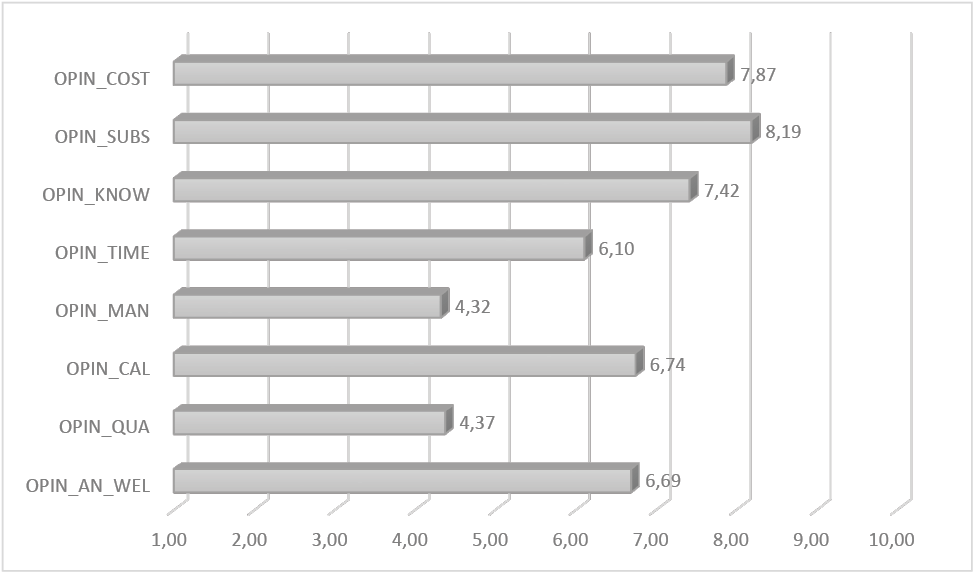
The mean OPIN_KNOW score (7.42) suggests that the respondents generally believe they possess the necessary skills to implement a loose-housing system on their farms. Additionally, the majority of the respondents think that transitioning from a tie-stall to a loose-housing system would have a positive impact on timesaving and overall management effort. The mean OPIN_CAL (6.74) and OPIN_MAN (4.32) scores indicate that most of the respondents believe loose housing would make identifying animals in oestrus easier, thus requiring less management effort compared with a tie-stall system. Overall, 59% of the respondents somewhat or strongly agree with the statement that managing a loose-housing system would be less time-consuming than managing a tie-stall system (denoted by the mean OPIN_TIME score of 6.10).
Regarding the perceived impact of loose housing on FAW, the mean OPN_AN_WEL score (6.69) shows that most of respondents (70%) perceive this system as beneficial for cattle welfare. However, there is general disagreement with the statement that loose housing improves the quality of the milk produced (denoted by the mean OPIN_QUA score of 4.37).
4.2 Model results and discussion
The correlations among the variables did not indicate any issues with multicollinearity. However, to ensure the robustness of our analysis, we conducted additional tests to identify potential multicollinearity. This assessment involved calculating the VIF for each model. The results confirmed that multicollinearity was not a concern, as the VIF consistently remained below the threshold of 5, as recommended by Hair et al. (2014). Additionally, we utilised the AIC, log likelihood, and R-squared tests to assess the goodness of fit for the models. The stability of coefficients and the signs for the control variables across the different models demonstrated robust results, further confirming that multicollinearity is not a notable issue in these regressions (Table 3). The discussion of the results focuses on the negative binomial model due to the absence of significant differences among the three distinct models we analysed.
| Variables | Dependent variable (DEP) | ||||||||||||||||||
|---|---|---|---|---|---|---|---|---|---|---|---|---|---|---|---|---|---|---|---|
| Negative binomial (Model 1) |
Poisson pseudo-maximum likelihood estimator (Model 2) |
Ordered logit (Model 3) |
|||||||||||||||||
| Coefficients (standard errors) | |||||||||||||||||||
| Constant | 3.441*** | 3.441*** | - | ||||||||||||||||
| (0.662) | (0.634) | - | |||||||||||||||||
| DEM_SEX | 0.387*** | 0.387*** | 1.788*** | ||||||||||||||||
| (0.123) | (0.118) | (0.630) | |||||||||||||||||
| DEM_AGE | -0.009* | -0.009* | -0.043** | ||||||||||||||||
| (0.005) | (0.005) | (0.022) | |||||||||||||||||
| DEM_EXP | -0.717* | -0.717** | -15.820*** | ||||||||||||||||
| (0.370) | (0.354) | (1.444) | |||||||||||||||||
| FARM_MILK | -0.003* | -0.003* | 0.017 | ||||||||||||||||
| (0.002) | (0.001) | (0.029) | |||||||||||||||||
| FARM_UAA | 0.085** | 0.085** | 0.447** | ||||||||||||||||
| (0.042) | (0.040) | (0.200) | |||||||||||||||||
| FARM_OWNER | -0.737*** | -0.737*** | -3.042*** | ||||||||||||||||
| (0.177) | (0.169) | (0.899) | |||||||||||||||||
| OPIN_AN_WEL | 0.187*** | 0.187*** | 0.795*** | ||||||||||||||||
| (0.028) | (0.027) | (0.147) | |||||||||||||||||
| OPIN_QUA | -0.039* | -0.039* | -0.136 | ||||||||||||||||
| (0.021) | (0.020) | (0.108) | |||||||||||||||||
| OPIN_CAL | -0.046** | -0.046** | -0.270** | ||||||||||||||||
| (0.022) | (0.021) | (0.128) | |||||||||||||||||
| OPIN_MAN | -0.061** | -0.061** | -0.386*** | ||||||||||||||||
| (0.026) | (0.025) | (0.141) | |||||||||||||||||
| OPIN_TIME | -0.051** | -0.051** | -0.350*** | ||||||||||||||||
| (0.022) | (0.021) | (0.121) | |||||||||||||||||
| OPIN_KNOW | -0.040 | -0.040 | -0.163 | ||||||||||||||||
| (0.026) | (0.025) | (0.128) | |||||||||||||||||
| OPIN_SUBS | 0.061* | 0.061* | 0.279* | ||||||||||||||||
| (0.034) | (0.032) | (0.157) | |||||||||||||||||
| OPIN_COST | -0.061** | -0.061** | -0.329** | ||||||||||||||||
| (0.029) | (0.028) | (0.148) | |||||||||||||||||
| VIF max | 3.44 | 3.44 | 3.44 | ||||||||||||||||
| VIF mean | 1.87 | 1.87 | 1.87 | ||||||||||||||||
| Pseudo R squared | N.A. | 0.55 | N.A. | ||||||||||||||||
| Log-Lik. | -160.78 | N.A. | -125.32 | ||||||||||||||||
| Akaike information criterion | 351.57 | N.A. | 296.64 | ||||||||||||||||
| Observations | 73 | 73 | 73 | ||||||||||||||||
| Note: See Table 1 for the details on each variable. The asterisks indicate statistical significance (*** p < 0.01. ** p < 0.05. * p < 0.1). | |||||||||||||||||||
Among the socio-demographic variables, we found that DEM_SEX is significant. Specifically, women are more inclined to adopt loose housing compared with males. Various authors, including Jackson (1993) and Mazzocchi, Sali (2022), have noted that women often possess a unique and intimate connection with nature. Additionally, women tend to have a higher animal welfare attitudes than men (Randler et al., 2021) and are more likely to reject livestock production systems that do not prioritise animal welfare (Jinjing, 2023). The protection of animal welfare is also considered to be slightly more important by women than by men (European Commission, 2023). To our knowledge, this study is the first to identify this female inclination towards FAW issues among farmers using this approach, which confirms the general trend of women being more concerned about FAW.
Older farmers are less likely to choose loose housing (DEM_AGE: coefficient = -0.009), possibly because they are more accustomed to using tie-stalls and have fewer years of work ahead, making them less interested in adopting new innovations compared to younger farmers (Mazzocchi et al., 2019). The negative sign of the DEM_EXP coefficient supports this finding, as those with more than 30 years of experience generally do not consider loose housing to be a viable option for improving FAW. This resistance to change may be related to the cognitive ‘status quo bias’, which leads individuals to prefer maintaining the current situation rather than embracing change (Kahneman, 2011). Despite many actions under the Common Agricultural Policy (CAP) aimed at subsidising farmers to encourage FAW practices, the tie-stall system has not yet been prohibited and its use is not actively discouraged.
Among the farm-related variables, we found that FARM_MILK, FARM_UAA, and FARM_OWNER are statistically significant. Farmers with high milk production (FARM_MILK) are unlikely to adopt a loose-housing system, likely because those benefiting from high production may not feel the need to change their current farming system. On the other hand, farmers with large agricultural areas (FARM_UAA) are more willing to switch to loose housing, as they likely do not face the spatial constraints that could hinder the transition. Moreover, loose housing may allow for less labour-intensive practices, giving farmers more time to dedicate to other agricultural activities, such as cultivation, which could be more manageable on larger farms.
The FARM_OWNER results suggests that full-time farmers are less likely to choose a loose-housing system. In our sample, 92% of the respondents are full-time farmers, which created a bias in the results due to the sample structure. This finding indicates that part-time owners, who are more akin to hobbyists than professionals, are more likely to adopt a loose-housing system. These farmers may be interested in making their farm management more efficient through the adoption of such systems. Conversely, the large number of full-time farmers in the sample introduces variability, making it harder to generalise the findings within this group.
Among the opinion variables, OPIN_AN_WEL is strongly significant and positively related to the dependent variable (coefficient = 0.187). Farmers who firmly believe that loose housing positively influences the welfare of their herds are more likely to implement this system. This finding aligns with a qualitative analysis of Canadian farmers by Croyle et al. (2019), who found that farmers perceived an ethical duty to uphold high animal welfare standards, driven by ‘pride’ and a sense of ‘self-responsibility of care’. There were similar sentiments in a previous study conducted in the United Kingdom (Leach et al., 2010). Additionally, EFSA (2023) experts have recommended that cattle should not be continuously housed in tie-stalls. Although tie-stalls are still permitted in Italy, there is ongoing debate within the European Union regarding the legitimacy of this practice. Thus, the positive sign of the OPIN_AN_WEL coefficient reflects farmers’ sensitivity to these issues, which is also supported by the emphasis on FAW actions in the new CAP for 2023-2027.
While some of the respondents believe that milk quality improves in a loose-housing system, those who hold this opinion do not necessarily adopt the technology (OPIN_QUA: coefficient = -0.039). This suggests that factors other than product quality, such as the need for subsidies and financial considerations, are more critical in the decision to adopt a different housing system.
We found that OPIN_CAL (coefficient = -0.046) and OPIN_TIME (coefficient = -0.051) are negatively related to the dependent variable, indicating that farmers who believe a loose-housing system allows for better detection of animals in oestrus and saves time compared with tie-stalls do not necessarily choose to adopt loose housing. This result suggests that the ability to recognise cows in oestrus is not a crucial factor in deciding to adopt loose housing, possibly because farmers can already identify oestrus in animals using tie-stall systems. Similarly, the time-saving aspect is not seen as a priority in adopting the technology. Our results indicate that other factors, such as management effort (OPIN_MAN), play a more significant role in the decision to adopt loose housing. The negative relationship between the dependent variable and OPIN_MAN (Table 3) indicates that farmers perceive a loose-housing system as requiring more management effort than tie-stalls, leading them to avoid this option to prevent increased workload.
Farmers who believe the upfront costs of implementing a loose-housing system are too high are less likely to adopt this system (OPIN_COST: coefficient = -0.061). The mean OPIN_COST score (7.87) is among the highest in Table 3, highlighting that economic constraints are a major barrier to adopting loose housing in our sample. The importance of economic viability has also been emphasised by Hansen et al. (2022), who found that, regardless of herd size, it is often more financially advantageous to continue using an upgraded tie-stall system rather than investing in a new loose-housing system. This is particularly true for farms with fewer than 30 cows, where investing in a new loose-housing system is typically not profitable.
The OPIN_SUBS result further underscores the economic aspect. With a mean score of 8.19 (Table 3), the highest among the explanatory variables, there is a strong level of agreement with the statement ‘pursuing a loose-housing system requires subsidies’ among the respondents. Thus, farmers who express a need for subsidies to support the investment in a loose-housing system are also more likely to adopt this technology (coefficient = 0.061), probably due to their confidence in receiving public financial support for this type of agricultural investment.
5. Conclusions and limitations
We have assessed the factors that influence the continuation of tie-stall systems in Italian dairy farms, considering both socio-economic and ethical aspects. The findings provide the foundation for outlining several theoretical implications regarding the relationship between the adoption of a loose-housing system and farmers’ specific characteristics and opinions.
Certain variables related to farmers’ opinions about their inclination to adopt a loose-housing system are notably significant. Specifically, the economic aspect is crucial, both in terms of the initial capital required for investment and the costs associated with transitioning from a tie-stall to a loose-housing system. The perception of improved animal welfare is also important. This sensitivity to FAW, coupled with the request for subsidies to support farm transitions, should be considered within the framework of the next CAP. In this context, specific measures focused on FAW have already been implemented, particularly through the inclusion of eco-schemes, albeit on a voluntary basis. Moreover, the issue of a mandatory shift from a tie-stall to a loose-housing system is on the national political agenda in several European Union countries, such as Denmark, indicating that this is a trending topic.
Another critical factor that influences the decision to adopt a loose-housing system is related to the demographic characteristics of the sample. Women, in particular, tend to be more receptive and predisposed to adopt this technology, while older, more experienced farmers exhibit less inclination towards innovation. In this regard, policies should encourage young farmers to adopt new animal welfare management practices, especially considering the greater propensity of women working in agriculture towards these issues. The CAP can play a role in addressing this, with policy instruments related to rural development that provide dedicated funding for young individuals and women.
However, as some authors have argued (Hansen et al., 2023), it is crucial to proceed with caution and to avoid imposing change. For small farms, particularly in mountainous regions, pushing for the adoption of a loose-housing system could potentially lead to the abandonment of agricultural activities due to geographic constraints and limited space, which may hinder the transition. In specific contexts, especially in rural and mountainous areas, it is essential to maintain the production of small farms to contribute to agricultural resilience and the generation of various ecosystem services. Nonetheless, recommendations from the EFSA (2023), such as providing daily opportunities for free movement, should be implemented to enhance the welfare of dairy cows kept in tie-stalls while preserving traditional farming practices.
The limitations of this study primarily relate to the sample, which is representative of farms located only in Northern Italy and may not necessarily reflect a broader situation. However, many of the conditions faced by the interviewed farmers are common to other European regions. Additionally, qualitative research can raise concerns about the reliability of participants. Even when the data are meticulously collected and analysed by skilled experts, the construction of the survey can influence the results. Moreover, to consider temporal dynamics on this topic, the study could be repeated for several years to reach a wide understanding on this issue. Another limitation is related to the fact that the present study did not include broader control variables, such as local policies, government incentives, or even market conditions, which could be collected in future studies with an improved questionnaire. Future research could also involve additional investigations with farmers on other animal welfare practices, a highly debated topic with many facets. There are various practices for improving animal welfare on dairy farms, such as extending contact between the cow and calf at birth or implementing extensive cattle farming, which is funded by the CAP for 2023-2027. There are different analytical models available to investigate barriers to innovation acceptance, and they could also be applied to the context of improving animal welfare practices in farming.
This work was supported by the University of Milan (Piano di Sostegno alla Ricerca 2021 – Linea 2).
Conceptualization, Methodology, Writing – Review & Editing, Supervision, C.M.; Data collection, Data curation, Writing – Original draft preparation, L.Z.; Data curation, Software, Validation, L.O.; Supervision, S.M.; Data collection, Funding Acquisition, Supervision, M.B.
Adler F., Christley R., Campe A. (2019). Invited review: Examining farmers’ personalities and attitudes as possible risk factors for dairy cattle health, welfare, productivity, and farm management: A systematic scoping review. Journal of Dairy Science, 102(5): 3805-3824. DOI: https://doi.org/10.3168/jds.2018-15037.
Ahmed H., Alvåsen K., Berg C., Hansson H., Hultgren J., Röcklinsberg H., Emanuelson U. (2021). Assessing animal welfare and farm profitability in cow-calf operations with stochastic partial budgeting. Animals, 11(2): 1-12. DOI: https://doi.org/10.3390/ani11020382.
Ajzen I., Fishbein M. (1980). Undestanding attitudes and predicting social behavoir. Prentice hall, Englewood Cliffs, New York.
Alonso M.E., González-Montaña J.R., Lomillos J.M. (2020). Consumers’ concerns and perceptions of farm animal welfare. Animals, 10(3). MDPI AG. DOI: https://doi.org/10.3390/ani10030385.
Anneberg I., Sandøe P. (2019). When the Working Environment is Bad, you Take it out on the Animals – How Employees on Danish Farms Perceive Animal Welfare. Food Ethics, 4(1): 21-34. DOI: https://doi.org/10.1007/s41055-019-00044-6.
Araujo F.S.M., Fantucci H., de Oliveira Lima S.H., de Abreu M.C.S., Santos R.M. (2022). Modeling Canadian farmer’s intention to adopt eco-friendly agricultural inputs and practices. Regional Environmental Change, 22(2): 44. DOI: https://doi.org/10.1007/s10113-022-01901-7.
Balzani A., Hanlon A. (2020). Factors that influence farmers’ views on farm animal welfare: A semi-systematic review and thematic analysis. Animals, 10(9): 1-25. MDPI AG. DOI: https://doi.org/10.3390/ani10091524.
Beaver A., Proudfoot K.L., von Keyserlingk M.A.G. (2020). Symposium review: Considerations for the future of dairy cattle housing: An animal welfare perspective. Journal of Dairy Science, 103(6): 5746-5758. Elsevier Inc. DOI: https://doi.org/10.3168/jds.2019-17804.
Beaver A., Weary D.M., von Keyserlingk M.A.G. (2021). Invited review: The welfare of dairy cattle housed in tiestalls compared to less-restrictive housing types: A systematic review. Journal of Dairy Science, 104(9): 9383-9417). Elsevier Inc. DOI: https://doi.org/10.3168/jds.2020-19609.
Bechini L., Costamagna C., Zavattaro L., Grignani C., Bijttebier J., Ruysschaert G. (2020). Drivers and barriers to adopt best management practices. Survey among Italian dairy farmers. Journal of Cleaner Production, 245, 118825. DOI: https://doi.org/10.1016/j.jclepro.2019.118825.
Benedičič J., Erjavec K., Klopčič M. (2022). Environmental sustainability: farmers’ views of housing systems for cattle. Italian Journal of Animal Science, 21(1): 18-30. DOI: https://doi.org/10.1080/1828051X.2021.2005470.
Biasato I., D’Angelo A., Bertone I., Odore R., Bellino C. (2019). Compost bedded-pack barn as an alternative housing system for dairy cattle in Italy: effects on animal health and welfare and milk and milk product quality. Italian Journal of Animal Science, 18(1): 1142-1153. DOI: https://doi.org/10.1080/1828051X.2019.1623095.
Bock B.B., Van Huik M.M. (2007). Animal welfare: The attitudes and behaviour of European pig farmers. British Food Journal, 109(11): 931-944. DOI: https://doi.org/10.1108/00070700710835732.
Brouček J., Uhrincat M., Mihina S., Soch M., Mrekajova A., Hanus A. (2017). Dairy cows produce less milk and modify their behaviour during the transition between tie-stall to free-stall. Animals, 7: 1-13. DOI: https://doi.org/10.3390/ani7030016.
Brouček J., Uhrinčat M., Tančin V., Hanus A., Tongel P., Botto L., Bôžik I. (2013). Performance and behaviour at milking after relocation and housing change of dairy cows. Czech Journal of Animal Science, 58: 389-395. DOI: https://doi.org/10.17221/6938-cjas.
Buddle E.A., Bray H.J., Ankeny R.A. (2021). “Of course we care!”: A qualitative exploration of Australian livestock producers’ understandings of farm animal welfare issues. Journal of Rural Studies, 83: 50-59. DOI: https://doi.org/10.1016/j.jrurstud.2021.02.024.
Cardoso C.S., Von Keyserlingk M.A.G., Hötzel M.J., Robbins J., Weary D.M. (2018). Hot and bothered: Public attitudes towards heat stress and outdoor access for dairy cows. PLoS ONE, 13(10). DOI: https://doi.org/10.1371/journal.pone.0205352.
Cembalo L., Caracciolo F., Lombardi A., Del Giudice T., Grunert K.G., Cicia G. (2016). Determinants of Individual Attitudes Toward Animal Welfare-Friendly Food Products. Journal of Agricultural and Environmental Ethics, 29(2): 237-254. DOI: https://doi.org/10.1007/s10806-015-9598-z.
Cornish A.R., Briley D., Wilson B.J., Raubenheimer D., Schlosberg D., McGreevy P.D. (2020). The price of good welfare: Does informing consumers about what on-package labels mean for animal welfare influence their purchase intentions? Appetite, 148. DOI: https://doi.org/10.1016/j.appet.2019.104577.
Croyle S.L., Belage E., Khosa D.K., LeBlanc S.J., Haley D.B., Kelton D.F. (2019). Dairy farmers’ expectations and receptivity regarding animal welfare advice: A focus group study. Journal of Dairy Science, 102(8): 7385-7397. DOI: https://doi.org/10.3168/jds.2018-15821.
European Commission (2023). Special Eurobarometer 533 on Animal Welfare – Report. DOI: https://doi.org/10.2875/872312. European Union.
European Food Safety Authority (EFSA) (2023). EFSA Journal published by Wiley-VCH GmbH on behalf of European Food Safety Authority. DOI: https://doi.org/10.2903/j.efsa.2023.7993open_in_new.
Gaworski M., Boćkowski M. (2018). Method for comparing current versus recommended housing conditions in dairy cattle production. Agricultural and Food Science, 27(1). DOI: https://doi.org/10.23986/afsci.65429.
Gorton M., Yeh C.H., Chatzopoulou E., White J., Tocco B., Hubbard C., Hallam F. (2023). Consumers’ willingness to pay for an animal welfare food label. Ecological Economics, 209. DOI: https://doi.org/10.1016/j.ecolecon.2023.107852.
Groher T., Heitkämper K., Umstätter C. (2020). Digital technology adoption in livestock production with a special focus on ruminant farming. Animal, 14(11): 2404-2413. DOI: https://doi.org/10.1017/S1751731120001391.
Hansen B.G., Langseth E., Berge C. (2023). Animal welfare and cow-calf contact-farmers’ attitudes, experiences and adoption barriers. Journal of Rural Studies, 97: 34-46. DOI: https://doi.org/10.1016/j.jrurstud.2022.11.013.
Hovinen M., Rasmussen M.D., Pyörälä S.P. (2009). Udder health of cows changing from tie stalls or free stalls with conventional milking to free stalls with either conventional or automatic milking. Journal of Dairy Science, 92: 3696-3703. DOI: https://doi.org/10.3168/jds.2008-1962.
Hultgren J. (2002). Foot/leg and udder health in relation to housing changes in Swedish dairy herds. Preventive Veterinary Medicine, 53(3): 167-189. DOI: https://doi.org/10.1016/S0167-5877(01)00279-3.
Hair Jr J.F., Sarstedt M., Hopkins L., Kuppelwieser V.G. (2014). Partial least squares structural equation modeling (PLS-SEM) An emerging tool in business research. European business review, 26(2): 106-121. DOI: https://doi.org/10.1108/EBR-10-2013-0128.
Hyland J.J., Heanue K., McKillop J., Micha E. (2018). Factors underlying farmers’ intentions to adopt best practices: The case of paddock based grazing systems. Agricultural Systems, 162: 97-106. DOI: https://doi.org/10.1016/j.agsy.2018.01.023.
Irico L., Tomassone L., Martano G., Gottardo F., Tarantola M. (2018). Animal welfare and reproductive performance in two Piemontese housing systems. Italian Journal of Animal Science, 17(2): 499-504. DOI: https://doi.org/10.1080/1828051X.2017.1369181.
Jingjing L., Sghaier C., Moïse K., Santinello M., Bertelli Pflanzer S., Hocquette E., Ellies-Oury M.P., Hocquette J.F. (2023). Consumer perception of the challenges facing livestock production and meat consumption. Meat Science, 200, 109144, ISSN 0309-1740. DOI: https://doi.org/10.1016/j.meatsci.2023.109144.
Kahneman D. (2011). Thinking, fast and slow. Eds. Penguin Psycology, UK.
Katzenberger K., Rauch E., Erhard M., Reese S., Gauly M. (2020). Evaluating the need for an animal welfare assurance programme in South Tyrolean dairy farming. Italian Journal of Animal Science, 19(1): 1147-1157. DOI: https://doi.org/10.1080/1828051X.2020.1823897.
Kauppinen T., Vainio A., Valros A., Rita H., Vesala K.M. (2010). Improving animal welfare: Qualitative and quantitative methodology in the study of farmers’ attitudes. Animal Welfare, 19(4): 523-536. DOI: https://doi.org/10.1017/s0962728600001998.
Kühl S., Gauly S., Spiller A. (2019). Analysing public acceptance of four common husbandry systems for dairy cattle using a picture-based approach. Livestock Science, 220: 196-204. DOI: https://doi.org/10.1016/j.livsci.2018.12.022
Leach K.A., Dippel S., Huber J., March S., Winckler C., Whay H.R. (2009). Assessing lameness in cows kept in tie-stalls. Journal of Dairy Science, 92(4): 1567-1574. DOI: https://doi.org/10.3168/jds.2008-1648.
Li Z., Ding Y., Chen J., Zhao M. (2023). How far are green products from the Chinese dinner table? — Chinese farmers’ acceptance of green planting technology. Journal of Cleaner Production, 410, 137141. DOI: https://doi.org/10.1016/j.jclepro.2023.137141.
Mattiello S., Arduino D., Tosi M.V., Carenzi C. (2005). Survey on housing, management and welfare of dairy cattle in tie-stalls in western Italian Alps. Acta Agriculturae Scandinavica - Section A: Animal Science, 55(1): 31-39. DOI: https://doi.org/10.1080/09064700510009270.
Mazzocchi C., Borghi A., Monaco F., Gaviglio A., Filippini R., Demartini E., Sali G. (2019). Land rent values determinants: a Hedonic Pricing approach at local scale. Aestimum, 75: 235-255. DOI: https://doi.org/10.13128/aestim-8152.
Mazzocchi C., Orsi L., Zilia F., Costantini M., Bacenetti J. (2022). Consumer awareness of sustainable supply chains: A choice experiment on Parma ham PDO. Science of the Total Environment, 836. DOI: https://doi.org/10.1016/j.scitotenv.2022.155602.
Mazzocchi C., Sali G. (2022). Supporting mountain agriculture through “mountain product” label: a choice experiment approach. Environment, Development and Sustainability, 24(1): 701-723. DOI: https://doi.org/10.1007/s10668-021-01464-3.
Nadlučnik E., Golinar Oven I., Tomažič I., Plut J., Dovč A., Štukelj M. (2022). Discrepancies between farmers’ perceptions and actual animal welfare conditions on commercial pig farms. Frontiers in Veterinary Science, 9. DOI: https://doi.org/10.3389/fvets.2022.1010791.
Neave H.W., Sumner C.L., Henwood R.J.T., Zobel G., Saunders K., Thoday H., Watson T., Webster J.R. (2022). Dairy farmers’ perspectives on providing cow-calf contact in the pasture-based systems of New Zealand. Journal of Dairy Science, 105(1): 453-467. DOI: https://doi.org/10.3168/jds.2021-21047.
Nguyen N., Drakou E.G. (2021). Farmers intention to adopt sustainable agriculture hinges on climate awareness: The case of Vietnamese coffee. Journal of Cleaner Production, 303, 126828. DOI: https://doi.org/10.1016/j.jclepro.2021.126828.
O’Brien R.M. (2007). A caution regarding rules of thumb for variance inflation factors. Quality & Quantity, 41: 673-690. DOI: https://doi.org/10.1007/s11135-006-9018-6.
Ortega D.L., Wolf C.A. (2018). Demand for farm animal welfare and producer implications: Results from a field experiment in Michigan. Food Policy, 74: 74-81. DOI: https://doi.org/10.1016/j.foodpol.2017.11.006.
Perttu R.K., Ventura B.A., Endres M.I. (2020). Youth and adult public views of dairy calf housing options. Journal of Dairy Science, 103(9): 8507-8517. DOI: https://doi.org/10.3168/jds.2019-17727.
Popescu S., Borda C., Diugan E.A., Niculae M., Stefan R., Sandru C.D. (2014). The effect of the housing system on the welfare quality of dairy cow. Italian Journal of Animal Science, 13(1): 15-22. DOI: https://doi.org/10.4081/ijas.2014.2940.
Regula G., Danuser J., Spycher B., Wechsler B. (2004). Health and welfare of dairy cows in different husbandry systems in Switzerland. Preventive Veterinary Medicine, 66(1-4): 247-264. DOI: https://doi.org/10.1016/j.prevetmed.2004.09.004.
Retsinformation (2017). Bekendtgørelse af lov om hold af malkekvæg og afkom af malkekvæg. https://www.retsinformation.dk/
Robbins J.A., Roberts C., Weary D.M., Franks B., von Keyserlingk M.A.G. (2019). Factors influencing public support for dairy tie stall housing in the U.S. PLoS ONE, 14(5). DOI: https://doi.org/10.1371/JOURNAL.PONE.0216544.
Silva J.S., Tenreyro S. (2006). The log of gravity. The Review of Economics and statistics, 88(4): 641-658.
Schuppli C.A., Spooner J.M., von Keyserlingk M.A.G. (2023). Canadian dairy farmer views about animal welfare. Animal Welfare, 32. DOI: https://doi.org/10.1017/awf.2023.32.
Spigarelli C., Berton M., Corazzin M., Gallo L., Pinterits S., Ramanzin M., Ressi W., Sturaro E., Zuliani A., Bovolenta S. (2021). Animal Welfare and Farmers’ Satisfaction in Small-Scale Dairy Farms in the Eastern Alps: A “One Welfare” Approach. Frontiers in Veterinary Science, 8. DOI: https://doi.org/10.3389/fvets.2021.741497.
Spooner J.M., Schuppli C.A., Fraser D. (2014). Attitudes of Canadian citizens toward farm animal welfare: A qualitative study. Livestock Science, 163(1): 150-158. DOI: https://doi.org/10.1016/j.livsci.2014.02.011.
Starvaggi Cucuzza L., Riondato F., Macchi E., Bellino C., Franco G., Biolatti B., Cannizzo F.T. (2014). Haematological and physiological responses of Piemontese beef cattle to different housing conditions. Research in Veterinary Science, 97(2): 464-469. DOI: https://doi.org/10.1016/j.rvsc.2014.08.002.
Tangorra F.M, Zanini L. (2014). I sistemi di mungitura in Lombardia. Supplemento a L’Informatore Agrario. 36/2014.
Tarantola M., Valle E., De Marco M., Bergagna S., Dezzutto D., Gennero M.S., Bergero D., Schiavone A., Prola L. (2016). Effects of abrupt housing changes on the welfare of Piedmontese cows. Italian Journal of Animal Science, 15(1): 103-109. DOI: https://doi.org/10.1080/1828051X.2015.1128691.
Te Velde H., Aarts N., Van Woerkum C. (2002). Dealing with ambivalence: Farmers’ and consumers’ perceptions of animal welfare in livestock breeding. Journal of Agricultural and Environmental Ethics, 15(2): 203-219. DOI: https://doi.org/10.1023/A:1015012403331.
Unioncamere Lombardia (2023). Analisi congiunturale sull’agricoltura lombarda. L’andamento del settore nel 2° semestre 2022. Milano.
Vanhonacker F., Verbeke W., Van Poucke E., Tuyttens F.A.M. (2008). Do citizens and farmers interpret the concept of farm animal welfare differently? Livestock Science, 116(1-3): 126-136. DOI: https://doi.org/10.1016/j.livsci.2007.09.017.
Venkatesh V., Davis F.D. (2000). Theoretical extension of the Technology Acceptance Model: Four longitudinal field studies. Management Science, 46(2): 186-204. DOI: https://doi.org/10.1287/mnsc.46.2.186.11926.
von Keyserlingk M.A.G., Hötzel M.J. (2015). The Ticking Clock: Addressing Farm Animal Welfare in Emerging Countries. Journal of Agricultural and Environmental Ethics, 28(1): 179-195. Kluwer Academic Publishers. DOI: https://doi.org/10.1007/s10806-014-9518-7.
Yunes M.C., Von Keyserlingk M.A.G., Hötzel M.J. (2017). Brazilian citizens’ opinions and attitudes about farm animal production systems. Animals, 7(10). DOI: https://doi.org/10.3390/ani7100075.
Zuliani A., Romanzin A., Corazzin M., Salvador S., Abrahantes J.C., Bovolenta S. (2017). Welfare assessment in traditional mountain dairy farms: Above and beyond resource-based measures. Animal Welfare, 26(2), 203–211. https://doi.org/10.7120/09627286.26.2.203