https://doi.org/10.36253/ijae-16799
Metamodal proprioceptive intervention to improve sensorimotor control in visually impaired adults: a preliminary study
1 Section of Anatomy and Histology, Department of Experimental and Clinical Medicine, University of Florence, Florence, Italy
2 A.S.D. Polisportiva Fiorentina Silvano Dani A.P.S, c/o Unione Italiana Ciechi e Ipovedenti (UICI), Florence, Italy
*Corresponding author. E-mail: mirca.marini@unifi.it
Abstract. Visual impairment jeopardizes body kinematics and environmental interactions progressively leading to postural instability, coordinative deficits, and quality of life reduction. Although vision plays a key role in motor function, sensorimotor control mostly relies on proprioceptive inputs provided while dynamically interacting with gravity, and its efficiency is frequency dependent. Therefore, targeted proprioceptive training is necessary to counteract the disability-related deficits. The present preliminary study investigated the effects of an adapted proprioceptive intervention on sensorimotor control of blind adults aiming to improve postural stability, body awareness, coordination, and daily functionality. Twenty legally blind adults aged 18-60 voluntarily adhered to the study. Before and after taking part in the targeted 8-week proprioceptive training intervention, sensorimotor control was evaluated by Brief BESTest and a biofeedback-based device (Libra Easytech) able to adapt multimodal high-frequency stimulation to the specific needs of blind subjects. Psychological well-being and quality of life were also assessed using the 18-item Psychological Well-being and 12 item-Short Form questionnaires, respectively. Post-intervention evaluation revealed a statistically significant improvement in ankle stability/mobility and orthostatic postural control/reactivity in micro and macro instability conditions. Our findings suggest that a targeted metamodal sensorimotor protocol conceived, led, and monitored by a specialized kinesiologist may effectively improve proprioceptive control in visually impaired individuals. The present research might also offer innovative methodological hints to apply in further studies aimed at boosting sensorimotor efficiency and daily functionality in this still under investigated population.
Keywords: proprioception, postural re-education, blindness, adapted kinesiology, functionality, biofeedback.
Contents
Methodologies and measurements
Adapted proprioceptive training
Introduction
Physical inactivity, increasingly prevalent and identified as the fourth risk factor for global mortality, negatively impacts psychophysical well-being and functionality, causing a dangerous decline in the general health of population in all age groups (Stamatakis et al., 2019). Posture is an important health indicator, consequently, any alterations caused by sedentariness, aging or vulnerable health conditions are often associated with psychophysical disorders that jeopardize autonomy, self-esteem, socioemotional functioning, and quality of life (Harvey et al., 2020). Since humankind assumed upright stance, the postural tonic system is responsible for neuromuscular modulation to actively counteract atmospheric pressure and gravity allowing to maintain verticality. In a broad sense, two macro-components contribute to postural control, namely the musculoskeletal and the neuromotor system. The latter includes sensory (proprioceptive, visual, and vestibular systems), cognitive (adaptive and anticipatory) and motor (finalized motor gesture realization) processes. Concerning the somatosensory aspect, postural control is based on the coordinated and synergistic intervention of three stabilizers, namely proprioceptive, visual, and vestibular systems (Forbes, Chen & Blouin, 2018; Aspell, Lenggenhager & Blanke, 2012). Specifically, the former makes use of a peripheral network of sensors distributed in every muscle-tendon-articular district able to inform at high speed the more archaic structures of the nervous system. It is simultaneously involved in the effector response since the fine muscle tone modulation depends on some of the receptors. Given all these peculiarities, it is referred to as the primary stabilizer because the most precocious postural responses are activated by its afferents. The second one can be likened to a pointing system that allows body anchoring to fixed environment points by integrating and improving the accuracy of archeoproprioceptive postural control; precisely because it prioritizes accuracy over speed, it is termed the secondary stabilizer. Finally, the last one registers linear and angular accelerations of the head and, owing to a higher activation threshold, is the belated stabilizer; a kind of emergency system capable of overriding the previous two only if head movements exceed a certain amplitude and speed (Forbes, Chen & Blouin, 2018; Aspell, Lenggenhager & Blanke, 2012). The abovementioned hierarchical order is generally respected in physiological conditions while in conflicting situations known as sensory mismatch, or in case of deficits, each system is able to compensate for the inefficiency of the others by becoming the primary stabilizer, despite its inherent peculiarities and purposes (Block & Liu, 2023). Optimal functionality can only be ensured if all systems are used according to their potential, and if they are constantly and specifically stimulated and educated for selective integration.
Although the visual system represents the most specialized tool in processing details and environmental topographical aspects and in providing postural anchorage, an efficient and effective sensorimotor control requires the cooperation of all sensory channels in respect of the multimodal nature of reality (Aspell, Lenggenhager & Blanke, 2012). At the functional level, visual apparatus enables the evaluation and processing of information about body position in space, adjusting posture accordingly and ensuring gestures accuracy and a correct motor reaction timing. Therefore, a partial or total sight deficit generates inadequate interaction with the surrounding environment with consequent deficiencies in global and segmental coordination and postural control, ultimately altering gait and balance patterns (Alotaibi et al., 2016). In addition, visual deprivation results in negatively altered global and segmental kinematics, head-trunk-pelvis coordination, and core muscle recruitment, further challenging the safety, autonomy, and mobility of the affected individuals, both in daily and recreational and/or sports activities (West et al., 2002).
In everyday life, human beings maintain upright posture in a dynamic environment that continuously and rapidly changes, globally entailing the sensorimotor sphere in a multimodal way. Hence, in order to investigate postural control in a real setting, it is important to inquire stability in orthostatic position by applying variegated environmental conditions, especially those characterized by perturbations (Chagdes et al., 2013). Since sight crucially contributes to anticipatory and reactive postural control, orientation, and accuracy of motor execution, in case of visual disability, the dynamic interaction with the spatiotemporal dimension is strongly altered (Alghadir, Alotaibi & Iqbal, 2019; Bell et al., 2019). Despite such disability-related deficits, it is crucial to remember that the most efficient and reliable contribution to maintaining static and dynamic balance comes from the proprioceptive stabilizer and from the inputs provided by the foot sole interacting with gravity and the support surface. Under physiological conditions and in the absence of sensorimotor deficits, the nervous system places greater weight on somatosensory inputs, but in the process of learning new motor patterns, prolonged immobility, sedentariness, or disability, reliance on this privileged source may progressively fail until a total inhibition (Canu et al., 2019). Postural control and neuromuscular efficiency are structured and refined throughout life conforming to the psychophysical development degree, the acquired motor background and, above all, the utilization level. As widely demonstrated, the only effective way to stimulate and reinstruct the archeoproprioceptive system is to make it regularly experience disequilibrium and instability with the highest number of biomechanical situations to handle in time unit, hence providing a high-frequency proprioceptive input flow (Riva et al., 2016, 2019). Therefore, the real challenge is to re-educate functional capacities phylogenetically deputed to sensorimotor control that progress or certain health conditions may relegate to a dangerous disuse hibernation. It has been shown that proprioceptive system efficacy is stimulus- and frequency-specific, and the best motor efficiency predictor is represented by orthostatic monopodalic stability (Riva et al., 2013). For this reason, re-educating the aforementioned stabilizer requires the application of technological tools purposely designed for high-frequency proprioceptive evaluation and training (Riva et al., 2019). Though still poorly applied in scientific research, technological devices to investigate and quantify postural control efficiency have been recently introduced. Specifically, such innovative tools embody sensorized proprioceptive boards provided with a biofeedback-based digital interface designed to assess and train functional stability taking into account the multimodal complex nature of reality (Bronstein, 2016; Cheung & Schmuckler, 2021; Carretti et al., 2023). From an operational perspective, biofeedback technology transduces the micro and macro postural adjustments into real-time multisensory signals consequently bringing undetectable input to a conscious level, thus optimizing sensorimotor control and motor learning timing (Francesconi & Gandini, 2015). The importance of integrating proprioceptive exercises into any type of workout program has long been recognized (Winter et al., 2022). In adults, especially those affected by sensory impairments, proprioceptive re-education assumes a fundamental role in the preservation of functionality, autonomy, and quality of life. However, despite the well-known benefits of regular physical activity in disabled individuals, no specific guidelines are still available for visually impaired, and a substantial percentage of them do not even meet the minimum levels of practice globally established for the general population (Carty et al., 2021). At the same time, increasingly strong evidence can be found in the literature regarding the close link between motor performance, function, and physical activity levels in this target population. In fact, if the vestibular and proprioceptive stabilizers are systematically stimulated through adapted and targeted motor proposals based on these vicarious senses, visually impaired subjects can become as efficient as sighted peers, not only in daily life activities but also in recreational and sport ones (Rogge et al., 2021). Consequently, regular involvement in proprioceptive training protocols can benefit first and foremost those individuals but, in a broader and longer-term perspective, also the community in which they live and which they relate with (Rogge et al., 2021).
On this basis, the purpose of this preliminary study was to investigate and deepen the effects of an adapted proprioceptive training (APT) intervention on balance and sensorimotor control of blind adults to improve their function and perceived quality of life. By applying, for the first time in blind subjects, a biofeedback-based device and a metamodal approach, both for testing and training, our study also provides methodological-didactic hints to be applied in future research concerning this growing but still under investigated target population.
Materials and methods
Participants
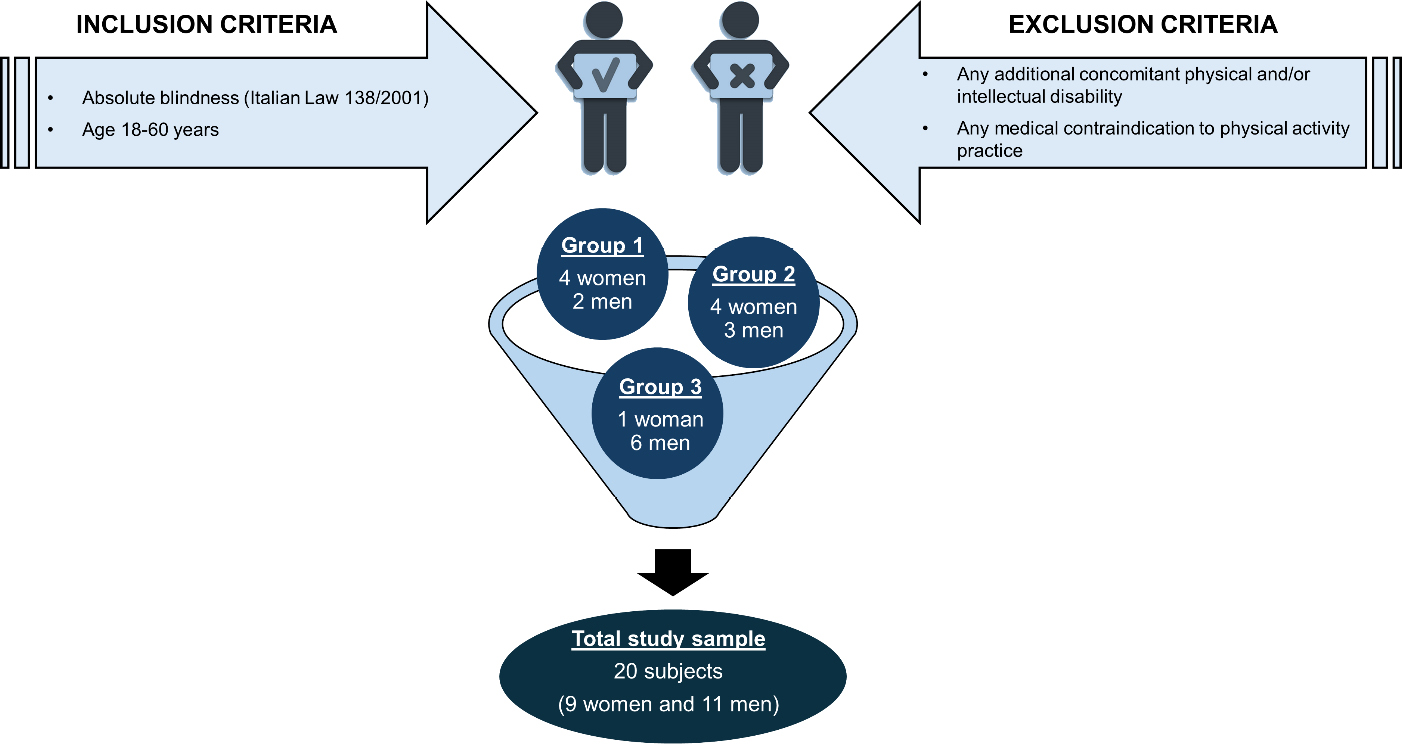
The study enrolled 20 subjects who provided their signed informed consent and voluntarily adhered to the training intervention and related assessment procedures. Specifically, the sample comprised 9 women and 11 men aged 19 to 56 years, all acknowledged as totally blind according to the Italian Law n.138/April 3, 2001. Inclusion criteria were age between 18-60 years and the legal certification of absolute blindness, while the presence of any additional concomitant physical and/or intellectual disability constituted exclusion criteria. The request for participation in the study was promoted using the official communication channels made available by some associations specialized in adapted physical/sport activity for visually impaired individuals, specifically, Italian Blind Baseball Association (AIBXC), A.S.D. Polisportiva Fiorentina Silvano Dani A.P.S. and A.S.D. Blind Fighters of Florence and A.S.D. Virtus Tennis of Bologna. The proposed sensorimotor training was carried out in the venues of these associations as a temporary replacement of the activities regularly practiced by the members but suspended due to the COVID-19 restrictions in force in Italy during the adherence to the study. On this basis, the overall study sample of 20 subjects was set up by pooling three groups: two in the Florentine metropolitan area and one in the city of Bologna. Concerning any possible physical risk, all the subjects were in possession of a mandatory valid medical certificate for motor and/or noncompetitive sport practice issued by a sports doctor. Therefore, the study participants could be considered as physically active individuals but not athletes. Figure 1 provides a schematic representation of participant recruitment and inclusion/exclusion criteria.
As commonly provided for Italian sport associations, in the act of renewing the annual membership, each member signed up an informed consent and agreed to participate in the training and testing activities promoted by the technical staff during the whole sport season. According to the Italian Legislative Decree 36/2021, our adapted training protocol was designed, proposed, supervised, and carried out, in a non-medicalized context, by a legally acknowledged and staff-integrated kinesiologist. Given the double affiliation, both in the kinesiological and research field, such a professional figure personally managed the protocol administration and data evaluation/collection strictly following the regulations provided and agreed by the management of each sport association adhering to the study. Specifically, since they are private institutions owing long-term expertise in testing and training visually impaired individuals, not comparable to academic or healthcare ones, the study design was carefully examined and approved by the internal review board of each involved sport association constituted by legal and technical experts. All study procedures were conducted following the rules of the Declaration of Helsinki of 1975 (https://www.wma.net/what-we-do/medical-ethics/declaration-of-helsinki/), revised in 2013, and reviewed and approved by the Review Board of A.S.D. Polisportiva Fiorentina Silvano Dani A.P.S, c/o Unione Italiana Ciechi e Ipovedenti, Florence, Italy (approval number 2021/09.09). As clearly reported in the informed consent form signed by all participants, in the act of adhering to the study they deliberately and consciously gave their consent not only to participate in the study procedures but also to data collection, storage, and utilization for scientific publications. In agreement with the abovementioned form, data was treated, processed, and stored in a completely anonymous way for the purposes of this study. In particular, the obtained information was entered into an electronic datasheet identifying each participant by a unique alphanumeric ID, not mentioning or making any sensitive data accessible.
Methodologies and measurements
The present investigation was conceived as a pre-post study on 20 totally blind adults all performing the same tailored proprioceptive training. Before and after taking part in the adapted protocol, all study participants filled out a structured questionnaire purposely designed using the Google Forms platform and sent by e-mail in the form of a direct access link to the form. Given the visual impairment of the investigated sample, survey compilation was carried out using specific assistive speech synthesis technologies. The first section of the self-administered baseline questionnaire was aimed at collecting sociodemographic data regarding age, gender, educational status, occupation, and visual impairment classification. In addition, to assess the motor background of each participant, the above section also collected information regarding current and previous motor/sport practice. The second and final section of the questionnaire comprised the 18-item Italian version of the Psychological Well-Being Scale (PWB-18) (Ruini et al., 2003) and the 12-item version of the Short Form questionnaire (SF-12) (Apolone et al., 2001) to investigate psychological well-being and perceived quality of life, respectively. Both these validated and widely applied qualitative tools have been already administered and described in our previous studies addressing visually impaired individuals (Carretti et al., 2022). Moreover, the post-protocol questionnaire also investigated the level of satisfaction concerning the proposed motor contents, the applied leading methodology, and the competence of the adapted physical activity kinesiologist.
Similarly, all the anatomo-functional and sensorimotor assessments were also performed at baseline and post-intervention. Bilateral ankle active range of motion (AROM) was measured, unloading, in the movements of flexion-extension and inversion-eversion using digital postural goniometer and placing the subject in supine and prone decubitus position (Clarkson, 2023). The Knee to wall Test, also referred to as Lunge Test, was also administered, strictly following the official guidelines available in literature (Clanton et al., 2012), to assess the tibio-tarsal joint mobility in dorsiflexion and loading conditions. The Brief BESTest, a shortened version of the original Balance Evaluation Systems Test (BESTest), which involves 8 items assessing postural control in orthostatic position and during walking, was administered to the whole sample. An evaluative scale ranging from 0 to 3 points is applied to each item so the total score ranges between 0 and 24 points, with higher values corresponding to a better static and dynamic postural control (Padgett, Jacobs & Kasser, 2012). Finally, the efficiency of proprioceptive stabilizer in dynamic postural control was tested by making use of the Libra sensorized proprioceptive board (Easytech s.r.l., Borgo San Lorenzo, Florence, Italy), an innovative device capable of providing accurate and reliable quantitative data (Tchórzewski, Jaworski & Bujas, 2010). Specifically, it consists of a sensorized tilting board equipped with interchangeable rolling wedges that allow variable oscillation degrees. Such a tool has been validated for balance assessment, calculation of global stability index in relation to visual anchorage, and ankle sprain risk index. Libra can be connected, via USB, to any computer and the software interface, equipped with biofeedback, allows to set different path patterns which can be displayed on the computer screen as a roadway laterally bounded by two parallel lines. During the board swing, whenever these limits are approached or exceeded, a special graphical and acoustic feedback is played to signal the departure from the equilibrium position (Tchórzewski, Jaworski & Bujas, 2010). The digital interface also offers two validated preset tests, specifically, Spielman-De Gunsch (SDG) Test and Cauquil-De Gunsch (CDG) Test. In both tasks, the subject is asked to stand up in orthostatic position on Libra while trying to control oscillations by keeping it as parallel to the floor as possible, as generally required during balance exercises on traditional proprioceptive board (https://www.easytechitalia.com/prodotti/libra/). The SDG Test allows the assessment of global postural stability and the subsequent fall risk in orthostatic bipodalic support, in relation to three different conditions of visual anchorage: visual feedback with no head coordination constraints, gaze on frontal fixed point, and closed eyes (Adamo, Pociask & Goldberg, 2013). At the end of the entire execution, the software calculates and records in the database the performance index obtained in the different visual conditions applied. According to the reference cut-offs, the stability index ranges from 0 to 100 with lower values corresponding to more efficient postural control. Taking into account the visual impairment of the investigated sample and the associated head-trunk separation deficits, head coordinative constraints only were applied in performing the SDG Test (West et al., 2002; Adamo, Pociask & Goldberg, 2013). The CDG Test allows to assess ankle stability and the related sprain risk during dynamic balance. Specifically, the subject is evaluated in bipodalic and monopodalic stance and at the end of the overall test, the recovery ratio, expressed as a percentage, can be considered a significant predictor of tibio-tarsal stability (Tchórzewski, Jaworski & Bujas, 2010; Riva et al., 2016) with lower values corresponding to a lower risk of ankle sprain. Despite the absolute blindness condition of the study participants, the test performance was possible thanks to the auditory feedback provided by the Libra digital interface.
Adapted proprioceptive training
The targeted 8-week intervention was organized at each of the three locations of the sport associations (i.e. two in the Florentine metropolitan area and one in the city of Bologna) adhering to the study thus avoiding their members any disability-related logistical and mobility difficulties or barriers. Advisably, adapted training interventions for visually impaired individuals must be led in small groups to grant collective/individual support, assistance, and safety. Specifically, it was administered in two 60-min sessions per week performed on non-consecutive days. The main objectives of the APT were set in the sensorimotor re-education, and the postural control, global/segmental coordination and balance improvement, thus positively impacting daily functionality, fall prevention, and quality of life in this particularly vulnerable target population. The whole training protocol was conceived in three progressive macro-phases according to the re-educational focuses and the specific goals set, always avoiding inducing psycho-physical and cognitive overload. Regarding the applied equipment, the main unstable surfaces used were Freeman boards, foampads, skimmies, proprioceptive cushions and wedges, foam rollers, Gibbon Slackrack (https://www.gibbon-slacklines.com/pages/slackline-therapie-landing-page), and Libra Easytech sensorized board. The workout load was progressively increased by varying the instability degree, the exercise performing position, adding coordinative constraints and dual-task assignments, as well as using small fitness tools. To respect the pandemic context in which the intervention was conducted and to grant the best safety and management of participants during the protocol, the circuit training methodology was applied to all training sessions. In general, each of them included an initial phase of respiratory education, total-body activation and consciousness, a middle phase characterized by exercises with proprioceptive focus, and a final phase of cooldown, stretching and conscious listening/internalizing of post-workout sensorimotor sensations. To promote and maximize the perception of proprioceptive inputs arising from the plantar sole interacting with gravity and perturbations, the workout sessions were performed barefoot. In detail, the central phase of the session involved the execution of two distinct circuits, one consisting of monopodalic exercises, therefore repeated twice, changing sides at each turn, and the other comprising exercises with predominantly bipodalic or alternating execution, therefore performed once. The working time on each station was 2 min, with no recovery in the transition between consecutive stations and, in each circuit, one station always involved the Libra board. Given the large number and variety of proprioceptive exercises proposed, the main methodological/motor contents of each protocol phase are represented in synthetic graphic form in Figure 2.
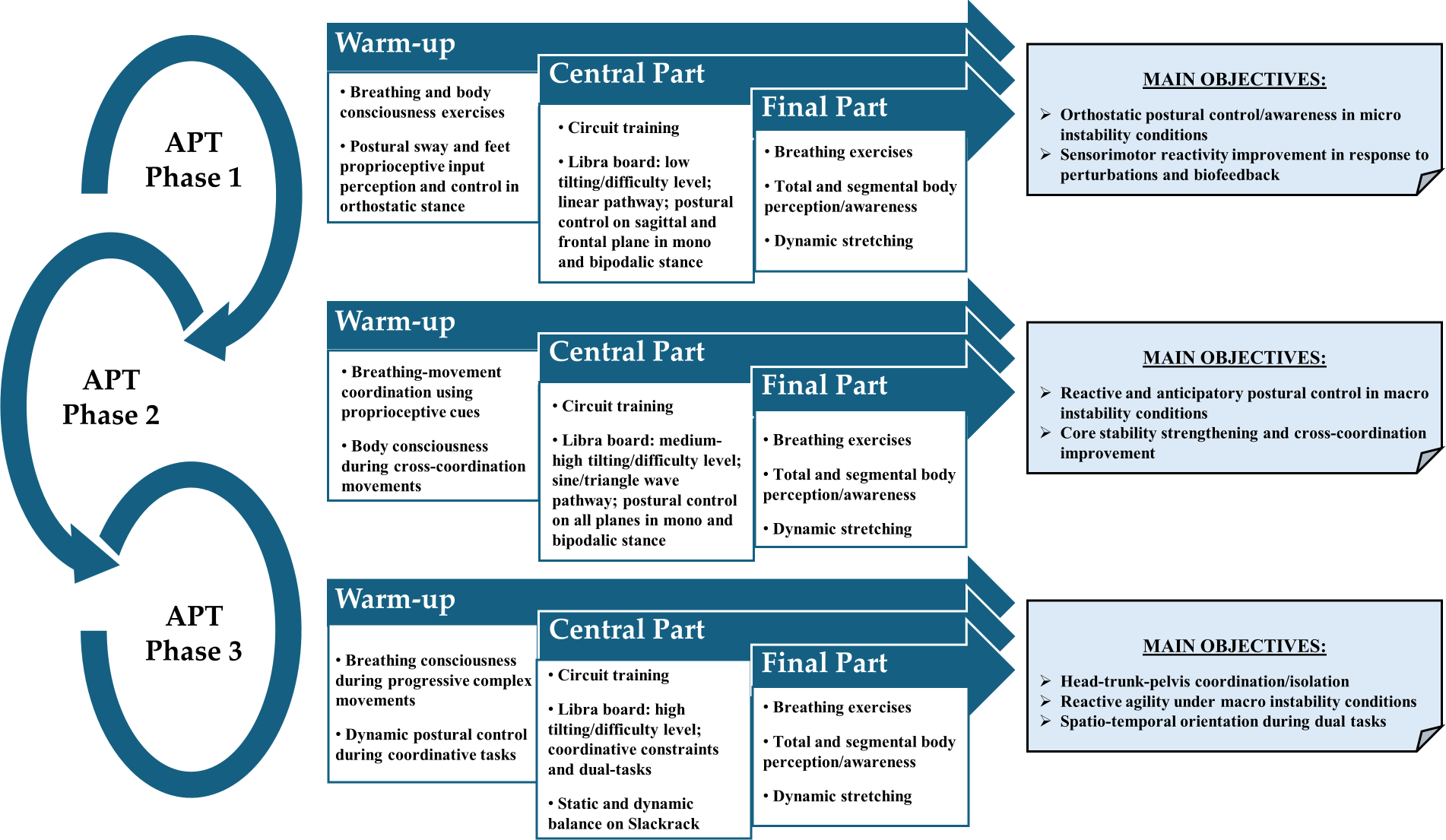
To ease and promote motor contents reproducibility, an exemplifying circuit training schedule is detailed and provided as Supporting Information files, with figures specifically showing the digital interface and exercise settings of the sensorized Libra board.
Statistical analysis
Statistical analysis was performed using SPSS 28.0.1 (Statistical Package for the Social Sciences, Chicago, IL, USA). Data were expressed as mean ± standard error of the mean (SEM), mean ± standard deviation (SD), or number and percentage of subjects participating in the study. Student’s t-test for paired data was used to compare the baseline vs. post-APT outcomes after verifying the normality of data with a Shapiro–Wilk test. Values of p < 0.05 were considered statistically significant.
Results
A sample of 20 totally blind subjects [11 (55.0%) male; mean ± SD age, 45.5 ± 10.64 years] voluntarily took part in this study. The collected data regarding sociodemographic characteristics and visual disability features of the study participants are detailed in Table 1.
| Variables | Blind subjects (n = 20) |
|---|---|
| Age (years), mean ± SD (range) | 45.5 ± 10.64 (19–56) |
| Sex, n (%) | |
| Male | 11(55.0) |
| Female | 9 (45.0) |
| Blindness, n (%) | |
| Congenital | 10 (50.0) |
| Acquired | 10 (50.0) |
| Educational level, n (%) | |
| Middle school degree | 2 (10.0) |
| High school degree | 8 (40.0) |
| University | 9 (45.0) |
| None | 1 (5.0) |
| Employment status, n (%) | |
| Employee | 13 (65.0) |
| Freelance | 2 (10.0) |
| Health profession | 2 (10.0) |
| Retiree | 2 (10.0) |
| Current physical/sport activity, n (%) | |
| Yes | 20 (100) |
| No | 0 (0) |
| Previous physical/sport activity, n (%) | |
| Yes | 19 (95.0) |
| No | 1 (5.0) |
Regarding past and current motor/sport activity practice, almost all participants reported consistent adherence over time (Table 1).
Results concerning the investigated anatomo-functional parameters and sensorimotor control assessment at baseline and after ending the structured APT are reported in Table 2.
| Variables | Baseline Mean ± SD (SEM) |
Post-APT Mean ± SD (SEM) |
p* | ||||||||||||||||
|---|---|---|---|---|---|---|---|---|---|---|---|---|---|---|---|---|---|---|---|
| Ankle AROM, degrees | |||||||||||||||||||
| Right dorsal flexion | 14.30 ± 2.65 (0.59) | 17.20 ± 1.70 (0.38) | < 0.001 | ||||||||||||||||
| Leftt dorsal flexion | 14.20 ± 2.94 (0.65) | 17.55 ± 1.87 (0.41) | < 0.001 | ||||||||||||||||
| Right plantar flexion | 43.45 ± 5.85 (1.33) | 47.85 ± 3.78 (0.84) | < 0.001 | ||||||||||||||||
| Left plantar flexion | 43.15 ± 6.53 (1.46) | 48.55 ± 3.77 (0.84) | < 0.001 | ||||||||||||||||
| Right inversion | 20.65 ± 5.66 (1.26) | 18.00 ± 2.55 (0.57) | 0.005 | ||||||||||||||||
| Left inversion | 19.90 ± 6.47 (1.44) | 17.65 ± 2.34 (0.52) | 0.046 | ||||||||||||||||
| Right eversion | 10.25 ± 1.97 (0.44) | 10.00 ± 1.21 (0.27) | NS | ||||||||||||||||
| Left eversion | 10.10 ± 2.26 (0.50) | 9.85 ± 1.08 (0.24) | NS | ||||||||||||||||
| Knee to wall Test, cm | |||||||||||||||||||
| Right | 10.65 ± 2.32 (0.51) | 12.65 ± 1.66 (0.37) | < 0.001 | ||||||||||||||||
| Left | 9.95 ± 2.16 (0.48) | 12.35 ± 1.56 (0.35) | < 0.001 | ||||||||||||||||
| Brief BESTest, score | |||||||||||||||||||
| Total score | 16.10 ± 2.75 (0.61) | 20.75 ± 1.83 (0.40) | < 0.001 | ||||||||||||||||
| Libra | |||||||||||||||||||
| CDG, recovery ratio | |||||||||||||||||||
| Bipodalic stance | 106.60 ± 18.62 (3.22) | 89.75 ± 14.84 (3.18) | < 0.001 | ||||||||||||||||
| Right monopodalic stance | 79.31 ± 9.63 (2.97) | 71.38 ± 10.10 (2.55) | 0.002 | ||||||||||||||||
| Left monopodalic stance | 84.06 ± 4.90 (1.93) | 76.48 ± 4.51 (1,91) | 0.004 | ||||||||||||||||
| SDG, performance index | |||||||||||||||||||
| No constraint | 13.20 ± 0.96 (0.21) | 11.93 ± 0.90 (0.20) | < 0.001 | ||||||||||||||||
| Straight head | 13.64 ± 1.08 (0.24) | 12.36 ± 0.80 (0.17) | < 0.001 | ||||||||||||||||
| Closed eyes | 14.97 ± 0.54 (0.12) | 14.03 ± 0.52 (0.11) | < 0.001 | ||||||||||||||||
| APT, adapted proprioceptive training; SD, standard deviation; SEM, standard error of the mean; AROM, active range of motion; CDG, Cauquil De Gunsch; SDG, Spielman-De Gunsch; NS, not significant. * Paired Student’s t-test. | |||||||||||||||||||
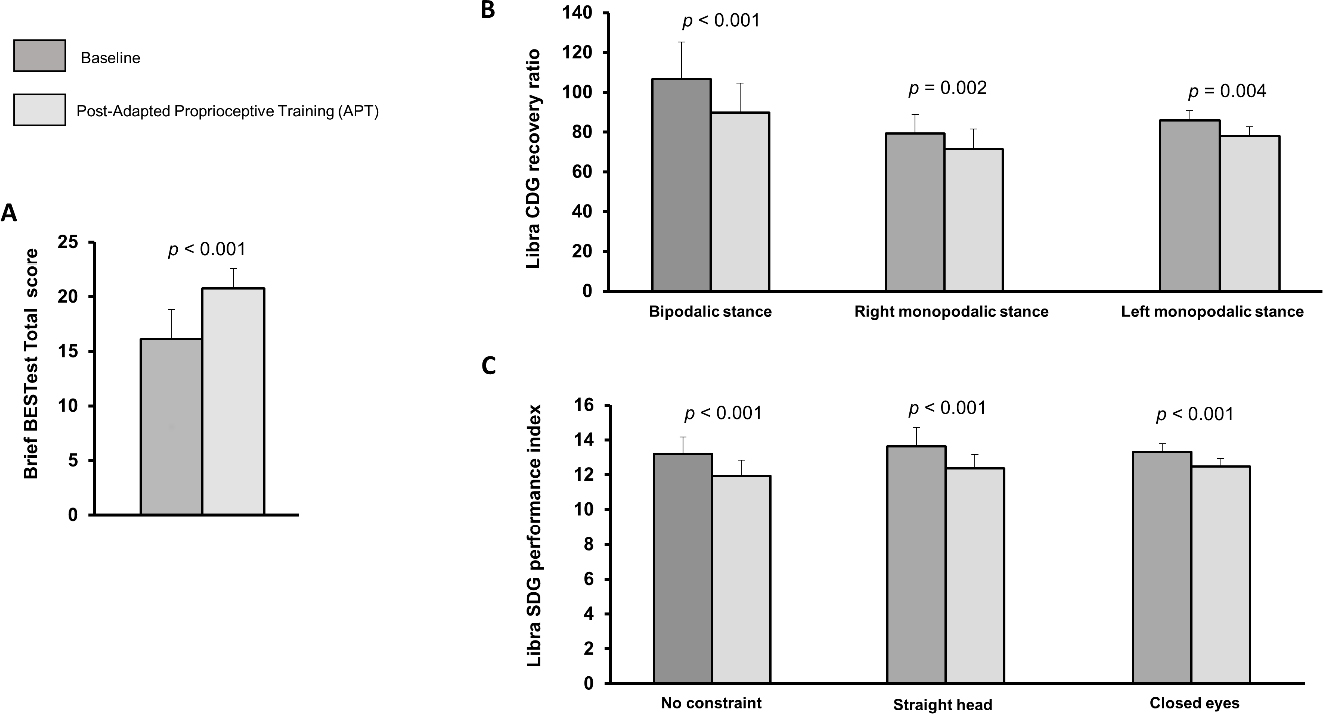
In detail, ankle AROM values showed a statistically significant post-protocol increase in dorsal/plantar flexion movements, as well as a decrease in bilateral inversion (Table 2). Likewise, the bilateral eversion AROM values, though not statistically significant, revealed a trend toward a decrease post-APT (Table 2). Moreover, bilateral tibio-tarsal joint mobility in loading, measured by the Knee to wall Test, was significantly improved following the APT (Table 2). With respect to the sensorimotor component, a statistically significant increase in the Brief BESTest total score was found after the APT respect to baseline (Table 2). Table 2 also shows the results obtained in the CDG and SDG Test performed on Libra Easytech proprioceptive board. All the parameters (i.e. bipodalic and monopodalic stance), assessed by Libra CDG Test and strongly correlated with ankle stability index, displayed a statistically significant improvement (Table 2). Besides, outcomes regarding postural control, evaluated by Libra SDG Test, also showed a statistically significant improvement in all the prevised stability constraints post-APT compared to baseline (Table 2).
Figure 3 displays the key significant results related to sensorimotor control.
The PWB-18 scale and SF-12 questionnaire score comparison at baseline and post-APT highlighted no statistically significant difference as shown in Table 3.
| Variables | Baseline Mean ± SD (SEM) |
Post-APT Mean ± SD (SEM) |
p* | ||||||||||||||||
|---|---|---|---|---|---|---|---|---|---|---|---|---|---|---|---|---|---|---|---|
| Psychological well-being (PWB-18) | |||||||||||||||||||
| Self-acceptance | 11.40 ± 1.66 (0.37) | 11.60 ± 1.46 (0.32) | NS | ||||||||||||||||
| Autonomy | 12.00 ± 1.91 (0.42) | 11,65 ± 2.23 (0.49) | NS | ||||||||||||||||
| Environmental mastery | 10.70 ± 2.10 (0.47) | 11.50 ± 1.96 (0.43) | NS | ||||||||||||||||
| Personal growth | 12.30 ± 2.17 (0.48) | 12.65 ± 1.87 (0.41) | NS | ||||||||||||||||
| Purpose in life | 9.15 ± 1.69 (0.37) | 8.85 ± 2.64 (0.59) | NS | ||||||||||||||||
| Positive relations with others | 8.65 ± 2.43 (0.54) | 8.35 ± 1.66 (0.37) | NS | ||||||||||||||||
| Total score | 64.20 ± 5.74 (1.28) | 64.60 ± 4.27 (0.95) | NS | ||||||||||||||||
| Quality of life (SF-12) | |||||||||||||||||||
| Physical component | 51.26 ± 7.65 (1.71) | 52.76 ± 5.24 (1.17) | NS | ||||||||||||||||
| Mental component | 49.47 ± 9.42 (2.10) | 52.77 ± 6.81 (1.52) | NS | ||||||||||||||||
| APT, adapted proprioceptive training; PWB-18, 18-item Psychological Well-Being; SF-12, 12-item Short Form; SD, standard deviation; SEM, standard error of the mean; NS, not significant. * Paired Student’s t-test. | |||||||||||||||||||
Of note, a trend toward a mild improvement in PWB-18 environmental mastery subscale and mental component of SF-12 questionnaire was observed (Table 3).
As far as the assessment of training experience satisfaction is concerned, post-APT data showed that 100% of the enrolled sample was satisfied with the protocol practice and the competence of the adapted physical activity kinesiologist. Although 65% of participants considered the APT as strenuous, 100% of them reported that they would willingly continue performing on a regular basis the proposed adapted training. The same percentage of subjects also reported that the practice of this specific protocol provided psychophysical benefits in their daily life. Finally, the experience fully satisfied the expectations of the whole sample.
Discussion
As far as available in literature, the present study was the first to investigate the use of a biofeedback-based sensorized proprioceptive board, specifically Libra Easytech, for high-frequency proprioceptive training in blind adults. Specifically, it was intentionally used both as testing and training tool since it has been demonstrated that a high-frequency input flow is needed to re-educate and reliably evaluate sensorimotor control in a real frame perspective (Riva et al., 2013, 2016). Of note, Libra settings applied during the training sessions did not recall the ones provided by SDG and CDG test, therefore such dual-purpose use simply reinforced methodological consistency without risking any task-specific adaptation. By designing a circuit training workout that integrates both traditional tools and such an innovative device and using auditory feedback provided by the digital interface, we obtained encouraging results to apply in future studies addressing this poorly investigated target population. Given the key role of the tibio-tarsal joint in orthostatic postural control, the proposed motor protocol evaluated this district in both unloading and loading, as well as on stable and unstable surfaces. This multimodal approach allowed us to detect district deficits/potentialities, both structural and functional, in several settings recalling the multimodal complex nature of reality. The statistically significant bilateral improvement of AROM in unloading dorsal/plantar flexion and in loading dorsal flexion, detectable by comparing baseline and post-APT evaluation, endorsed the benefits of high-frequency proprioceptive training on structure and function of this district (Riva et al., 2016). Contemporarily, the post-intervention bilateral AROM decrease in ankle inversion/eversion indicated an increased joint stability thus reducing ankle sprain risk. This positive correlation has also been confirmed by the outcomes obtained through the validated Libra CDG Test. The use of Libra proved to be effective in improving tibio-tarsal stability, both in mono and bipodalic perturbed supports, a condition frequently experienced in everyday life strongly correlated with traumatic distortion events (Riva et al., 2016; Ha, Han & Sung, 2018). The administration of exercises predominantly performed in orthostatic position on unstable surfaces, widely varied in material, shape, and progressive degree of instability, allowed to train foot proprioceptive sensitivity and responsiveness to perturbations in a wide range of environmental contexts always in interaction with gravity (Riva et al., 2019). Specifically referring to the target group investigated, the risk of lower limb injuries is much higher than in sighted peers, both during motor/sports practice and in daily life activities (Alghadir, Alotaibi & Iqbal, 2019; Magno e Silva et al., 2013). Therefore, the results obtained at the end of the APT have not only a training but also a preventive value. Such a result can be traced back to the inclusion in the APT of progressive exercises on Libra board and Slackrack which were specifically designed to stimulate the anatomo-functional components of sensorimotor control under unstable conditions (Dordevic et al., 2020; Donath et al., 2016). Of note, slacklining, although still poorly applied in research settings, has also been shown to be effective in increasing vestibular-dependent spatial orientation skills (Dordevic et al., 2017). The present intervention has been the first to use Slackrack in blind adults, a target population particularly relying on vestibular channel for dynamic postural control (Tomomitsu et al., 2013). Introducing this tool in the final phase of the APT, according to a didactic progression culminated in the performance of dual-task assignments while moving on the line, generated an improvement in vestibular-related orientation skills. This finding was also corroborated by post-training improvements shown in the SDG Test in all the prevised constraints. These statistically significant results also suggest a reduction in disability-related deficits affecting head-trunk coordination/isolation and auditory-dependent orientation. Such improvements can be attributed to the progressive administration of specific exercises, on traditional unstable surfaces, on Libra, and on Slackrack, purposely involving cross coordinative patterns which are crucial but not naturally acquired during sensorimotor development in visually impaired subjects (Rogge et al., 2021; Haibach, Wagner & Lieberman, 2014). Considering the metamodal and mutable nature of reality, the adapted protocol was peculiarly designed to stimulate postural control in both its anticipatory and reactive functions, in static and dynamic, in stable and unstable conditions, with and without global or segmental coordinative constraints. The benefits achievable through such a methodological-didactic approach are also evidenced by the statistically significant results obtained in the Brief BESTest, recording a post-intervention average score close to the maximum predicted by the validated cut-off. Given the specific sensory disability investigated, it is noteworthy the statistically significant bilateral improvement in the items related to monopodalic stability and postural responsiveness to external perturbations (Riva et al., 2013; Padgett, Jacobs & Kasser, 2012). Since re-educating proprioceptive sensorimotor control initially involves prevalent cortical management of high-frequency inputs, considerable attentional skills were required to participants. This might have triggered central fatigue processes able to explain why 65% of subjects referred to the APT as physically strenuous. Nevertheless, the entire sample stated that they would willingly continue to regularly perform this kind of adapted training and that they perceived psychophysical benefits in everyday life as a direct result of participating in this study. Although slight trends toward an improvement have been detected in some of the qualitative parameters investigated, they were not supported by statistically significant results in the post-intervention scores obtained in the SF-12 questionnaire and the PWB-18 scale. Interestingly, the increased outcome in the PWB-18 subscale was related to environmental mastery, thus proving that targeted sensorimotor training recalling dynamic reality conditions can positively affect the interaction with the surrounding environment. Regarding the lack of post-APT improvement in the psychological parameters assessed through qualitative instruments, it should be mentioned that the entire intervention took place in a pandemic context characterized by heavy restrictions on motor activity and social interactions. Indeed, the recent scientific literature has widely demonstrated that such anti-contagion measures have heavily impacted the psychological well-being and quality of life of the general population and, to a greater extent, of the most vulnerable social groups such as visually impaired individuals (Bubbico et al., 2021). On this evidence, the trend toward an improvement registered in the SF-12 questionnaire mental index, following participation in the protocol, is worthy of mention.
The main limitations of the present research mostly concern the shortness of the proposed APT protocol, peculiarly due to the pandemic frame in which it was conducted, the lack of a control group, and the small sample size investigated. Nevertheless, we should consider that it is recommendable to lead tailored training interventions addressing visually impaired people in small classes in order to properly manage the disability-related needs while granting individual and collective safety (Carretti et al., 2024). Indeed, if examined in a target-specific perspective, this potential limitation simply reflects the demographic peculiarities and the complex safety needs of blind individuals thus remarking the necessity of real-frame research. In line with such research perspective, a control group was not provided since it has been widely demonstrated that motor efficiency is strongly linked to regular physical activity practice in visually impaired individuals, even more than in sighted peers (Alghadir, Alotaibi & Iqbal, 2019; Rogge et al., 2021). In fact, it is well-known that visual disability deeply affects sensorimotor control, especially if combined with a sedentary lifestyle (Carty et al., 2021; Carretti, Manetti & Marini, 2023). Therefore, studies comparing physically active and sedentary individuals within this target population have been progressively relegated only to clinical contexts or elderly individuals. Given that the present study is the first applying the high-frequency biofeedback-based technology to test and train sensorimotor control in blind adults, and there are almost no validated guidelines or experimental research specifically focusing on this topic, our encouraging short-term results may represent a promising methodological and research approach to effectively investigate and improve such skills in this target population. For such a reason, from a methodological perspective, it can be considered a preliminary research approach that needs to be deepened, hence making available further kinesiological hints and tailored protocols to be compared in future studies. In fact, our findings, though encouraging, highlight the necessity of further research involving larger samples and longer adapted training protocols, also monitoring over time the obtained benefits to detect and evaluate detraining timing. In addition, given the crucial role of movement in the overall harmonious development of the individual, which is deeply jeopardized by a sight lack, large-scale sensorimotor interventions addressing visually impaired children and adolescents should be planned globally (Rogge et al., 2021; Greguol, Gobbi & Carraro, 2015). This kind of initiative could provide them concrete opportunities of being regularly involved in ludic and sport activities designed, managed, leaded, and monitored by highly specialized kinesiologists, thus promptly preventing and counteracting disability-related deficits (Houwen, Hartman & Visscher, 2009; Columna et al., 2019).
Conclusions
In conclusion, given the multimodal complex nature of sensorimotor control, targeted high frequency proprioceptive interventions are needed to effectively counteract eventual disuse- or disability-related deficits and re-educate/improve the primary postural stabilizer recruitment. A biofeedback-based proprioceptive device such as Libra Easytech may allow to provide multimodal stimuli tailored to the peculiar needs of blind subjects, thus safely and effectively promoting sensorimotor efficiency. The present study is the first to investigate sensorimotor control in blind adults using both validated and innovative evaluation and training tools to improve daily life functionality and motor efficiency, hence offering pioneering methodological hints to be applied in future research in this field. Finally, our tailored proprioceptive training conceived, led, and monitored by an adapted physical activity kinesiologist highlights the crucial role of such a professional figure in the global management of this vulnerable and still under investigated target population.
Acknowledgments
The authors are most grateful to all the visually impaired participants who took part in the study. The authors also wish to thank the sport associations which contributed to the logistical and communication aspects of this research.
Author contributions
GC: Conceptualization, Methodology, Formal analysis, Data curation, Investigation, Visualization, Writing – original draft, Writing – review & editing. MM (Mirko Manetti): Writing – original draft, Writing – review & editing. MM (Mirca Marini): Conceptualization, Methodology, Formal analysis, Data curation, Investigation, Supervision, Visualization, Writing – original draft, Writing – review & editing.
References
Adamo, D.E., Pociask, F.D. & Goldberg, A. (2013) The contribution of head position, standing surface and vision to postural control in young adults. Journal of Vestibular Research: Equilibrium & Orientation. 23 (1), 33–40. https://doi.org/10.3233/VES-130473.
Alghadir, A.H., Alotaibi, A.Z. & Iqbal, Z.A. (2019) Postural stability in people with visual impairment. Brain and Behavior. 9 (11), e01436. https://doi.org/10.1002/brb3.1436.
Alotaibi, A.Z., Alghadir, A., Iqbal, Z.A. & Anwer, S. (2016) Effect of absence of vision on posture. Journal of Physical Therapy Science. 28 (4), 1374–1377. https://doi.org/10.1589/jpts.28.1374.
Apolone, G., Mosconi, P., Quattrociocchi, L., Gianicolo, E., Groth, N. & Ware, J. (2001) Questionario sullo stato di salute SF-12. Versione italiana.
Aspell, J.E., Lenggenhager, B. & Blanke, O. (2012) Multisensory Perception and Bodily Self-Consciousness: From Out-of-Body to Inside-Body Experience. In: M.M. Murray & M.T. Wallace (eds). The Neural Bases of Multisensory Processes. Frontiers in Neuroscience. Boca Raton (FL), CRC Press/Taylor & Francis. p. http://www.ncbi.nlm.nih.gov/books/NBK92870/.
Bell, L., Wagels, L., Neuschaefer-Rube, C., Fels, J., Gur, R.E. & Konrad, K. (2019) The Cross-Modal Effects of Sensory Deprivation on Spatial and Temporal Processes in Vision and Audition: A Systematic Review on Behavioral and Neuroimaging Research since 2000. Neural Plasticity. 2019, 9603469. https://doi.org/10.1155/2019/9603469.
Block, H.J. & Liu, Y. (2023) Visuo-proprioceptive recalibration and the sensorimotor map. Journal of Neurophysiology. 129 (5), 1249–1258. https://doi.org/10.1152/jn.00493.2022.
Bronstein, A.M. (2016) Chapter 4 - Multisensory integration in balance control. In: J.M. Furman & T. Lempert (eds). Handbook of Clinical Neurology. Neuro-Otology. Elsevier. pp. 57–66. https://doi.org/10.1016/B978-0-444-63437-5.00004-2.
Bubbico, L., Bellizzi, S., Ferlito, S., Maniaci, A., Leone Guglielmotti, R., Antonelli, G., Mastrangelo, G. & Cegolon, L. (2021) The Impact of COVID-19 on Individuals with Hearing and Visual Disabilities during the First Pandemic Wave in Italy. International Journal of Environmental Research and Public Health. 18 (19), 10208. https://doi.org/10.3390/ijerph181910208.
Canu, M.-H., Fourneau, J., Coq, J.-O., Dannhoffer, L., Cieniewski-Bernard, C., Stevens, L., Bastide, B. & Dupont, E. (2019) Interplay between hypoactivity, muscle properties and motor command: How to escape the vicious deconditioning circle? Annals of Physical and Rehabilitation Medicine. 62 (2), 122–127. https://doi.org/10.1016/j.rehab.2018.09.009.
Carretti, G., Bianco, R., Sgambati, E., Manetti, M. & Marini, M. (2023) Reactive Agility and Pitching Performance Improvement in Visually Impaired Competitive Italian Baseball Players: An Innovative Training and Evaluation Proposal. International Journal of Environmental Research and Public Health. 20 (12), 6166. https://doi.org/10.3390/ijerph20126166.
Carretti, G., Manetti, M. & Marini, M. (2023) Physical activity and sport practice to improve balance control of visually impaired individuals: a narrative review with future perspectives. Frontiers in Sports and Active Living. 5, 1260942. https://doi.org/10.3389/fspor.2023.1260942.
Carretti, G., Mirandola, D., Sgambati, E., Manetti, M. & Marini, M. (2022) Survey on Psychological Well-Being and Quality of Life in Visually Impaired Individuals: Dancesport vs. Other Sound Input-Based Sports. International Journal of Environmental Research and Public Health. 19 (8), 4438. https://doi.org/10.3390/ijerph19084438.
Carretti, G., Spano, F., Sgambati, E., Manetti, M. & Marini, M. (2024) Adapted Training to Boost Upper Body Sensorimotor Control and Daily Living Functionality in Visually Impaired Baseball Players. Medicina (Kaunas, Lithuania). 60 (7), 1136. https://doi.org/10.3390/medicina60071136.
Carty, C., Ploeg, H.P. van der, Biddle, S.J.H., Bull, F., Willumsen, J., Lee, L., Kamenov, K. & Milton, K. (2021) The First Global Physical Activity and Sedentary Behavior Guidelines for People Living With Disability. Journal of Physical Activity and Health. 18 (1), 86–93. https://doi.org/10.1123/jpah.2020-0629.
Chagdes, J.R., Rietdyk, S., Jeffrey, M.H., Howard, N.Z. & Raman, A. (2013) Dynamic stability of a human standing on a balance board. Journal of Biomechanics. 46 (15), 2593–2602. https://doi.org/10.1016/j.jbiomech.2013.08.012.
Cheung, T.C.K. & Schmuckler, M.A. (2021) Multisensory postural control in adults: Variation in visual, haptic, and proprioceptive inputs. Human Movement Science. 79, 102845. https://doi.org/10.1016/j.humov.2021.102845.
Clanton, T.O., Matheny, L.M., Jarvis, H.C. & Jeronimus, A.B. (2012) Return to Play in Athletes Following Ankle Injuries. Sports Health. 4 (6), 471–474. https://doi.org/10.1177/1941738112463347.
Clarkson, H.M. (2023) Valutazione cinesiologica. Articolarità, test muscolari e valutazione funzionale. Piccin-Nuova Libraria.
Columna, L., Dillon, S.R., Dolphin, M., Streete, D.A., Hodge, S.R., Myers, B., Norris, M.L., McCabe, L., Barreira, T.V. & Heffernan, K.S. (2019) Physical activity participation among families of children with visual impairments and blindness. Disability and Rehabilitation. 41 (3), 357–365. https://doi.org/10.1080/09638288.2017.1390698.
Donath, L., Roth, R., Zahner, L. & Faude, O. (2016) Slackline training and neuromuscular performance in seniors: A randomized controlled trial. Scandinavian Journal of Medicine & Science in Sports. 26 (3), 275–283. https://doi.org/10.1111/sms.12423.
Dordevic, M., Hökelmann, A., Müller, P., Rehfeld, K. & Müller, N.G. (2017) Improvements in Orientation and Balancing Abilities in Response to One Month of Intensive Slackline-Training. A Randomized Controlled Feasibility Study. Frontiers in Human Neuroscience. 11, 55. https://doi.org/10.3389/fnhum.2017.00055.
Dordevic, M., Taubert, M., Müller, P., Riemer, M., Kaufmann, J., Hökelmann, A. & Müller, N.G. (2020) Which Effects on Neuroanatomy and Path-Integration Survive? Results of a Randomized Controlled Study on Intensive Balance Training. Brain Sciences. 10 (4), 210. https://doi.org/10.3390/brainsci10040210.
Forbes, P.A., Chen, A. & Blouin, J.-S. (2018) Sensorimotor control of standing balance. Handbook of Clinical Neurology. 159, 61–83. https://doi.org/10.1016/B978-0-444-63916-5.00004-5.
Francesconi, K. & Gandini, G. (2015) L’intelligenza nel movimento. Percezione, propriocezione, controllo posturale. Edi. Ermes.
Greguol, M., Gobbi, E. & Carraro, A. (2015) Physical activity practice among children and adolescents with visual impairment--influence of parental support and perceived barriers. Disability and Rehabilitation. 37 (4), 327–330. https://doi.org/10.3109/09638288.2014.918194.
Ha, S.-Y., Han, J.-H. & Sung, Y.-H. (2018) Effects of ankle strengthening exercise program on an unstable supporting surface on proprioception and balance in adults with functional ankle instability. Journal of Exercise Rehabilitation. 14 (2), 301–305. https://doi.org/10.12965/jer.1836082.041.
Haibach, P.S., Wagner, M.O. & Lieberman, L.J. (2014) Determinants of gross motor skill performance in children with visual impairments. Research in Developmental Disabilities. 35 (10), 2577–2584. https://doi.org/10.1016/j.ridd.2014.05.030.
Harvey, R.H., Peper, E., Mason, L. & Joy, M. (2020) Effect of Posture Feedback Training on Health. Applied Psychophysiology and Biofeedback. 45 (2), 59–65. https://doi.org/10.1007/s10484-020-09457-0.
Houwen, S., Hartman, E. & Visscher, C. (2009) Physical activity and motor skills in children with and without visual impairments. Medicine and Science in Sports and Exercise. 41 (1), 103–109. https://doi.org/10.1249/MSS.0b013e318183389d.
Magno e Silva, M.P., Morato, M.P., Bilzon, J.L.J. & Duarte, E. (2013) Sports injuries in Brazilian blind footballers. International Journal of Sports Medicine. 34 (3), 239–243. https://doi.org/10.1055/s-0032-1316358.
Padgett, P.K., Jacobs, J.V. & Kasser, S.L. (2012) Is the BESTest at Its Best? A Suggested Brief Version Based on Interrater Reliability, Validity, Internal Consistency, and Theoretical Construct. Physical Therapy. 92 (9), 1197–1207. https://doi.org/10.2522/ptj.20120056.
Riva, D., Bianchi, R., Rocca, F. & Mamo, C. (2016) Proprioceptive Training and Injury Prevention in a Professional Men’s Basketball Team: A Six-Year Prospective Study. Journal of Strength and Conditioning Research. 30 (2), 461–475. https://doi.org/10.1519/JSC.0000000000001097.
Riva, D., Fani, M., Benedetti, M.G., Scarsini, A., Rocca, F. & Mamo, C. (2019) Effects of High-Frequency Proprioceptive Training on Single Stance Stability in Older Adults: Implications for Fall Prevention. BioMed Research International. 2019, 2382747. https://doi.org/10.1155/2019/2382747.
Riva, D., Mamo, C., Fanì, M., Saccavino, P., Rocca, F., Momenté, M. & Fratta, M. (2013) Single stance stability and proprioceptive control in older adults living at home: gender and age differences. Journal of Aging Research. 2013, 561695. https://doi.org/10.1155/2013/561695.
Rogge, A.-K., Hamacher, D., Cappagli, G., Kuhne, L., Hötting, K., Zech, A., Gori, M. & Röder, B. (2021) Balance, gait, and navigation performance are related to physical exercise in blind and visually impaired children and adolescents. Experimental Brain Research. 239 (4), 1111–1123. https://doi.org/10.1007/s00221-021-06038-3.
Ruini, C., Ottolini, F., Rafanelli, C., Ryff, C. & Fava, G. (2003) Italian validation of Psychological Well-Being Scales (PWB). Rivista di Psichiatria. 38, 117–130.
Stamatakis, E., Gale, J., Bauman, A., Ekelund, U., Hamer, M. & Ding, D. (2019) Sitting Time, Physical Activity, and Risk of Mortality in Adults. Journal of the American College of Cardiology. 73 (16), 2062–2072. https://doi.org/10.1016/j.jacc.2019.02.031.
Tchórzewski, D., Jaworski, J. & Bujas, P. (2010) Influence of Long-Lasting Balancing on Unstable Surface on Changes in Balance. Human Movement. 11. https://doi.org/10.2478/v10038-010-0022-2.
Tomomitsu, M.S.V., Alonso, A.C., Morimoto, E., Bobbio, T.G. & Greve, J.M.D. (2013) Static and dynamic postural control in low-vision and normal-vision adults. Clinics (Sao Paulo, Brazil). 68 (4), 517–521. https://doi.org/10.6061/clinics/2013(04)13.
West, S.K., Rubin, G.S., Broman, A.T., Muñoz, B., Bandeen-Roche, K. & Turano, K. (2002) How does visual impairment affect performance on tasks of everyday life? The SEE Project. Salisbury Eye Evaluation. Archives of Ophthalmology (Chicago, Ill.: 1960). 120 (6), 774–780. https://doi.org/10.1001/archopht.120.6.774.
Winter, L., Huang, Q., Sertic, J.V.L. & Konczak, J. (2022) The Effectiveness of Proprioceptive Training for Improving Motor Performance and Motor Dysfunction: A Systematic Review. Frontiers in Rehabilitation Sciences. 3, 830166. https://doi.org/10.3389/fresc.2022.830166.