https://doi.org/10.36253/ijae-16623
An anatomical interpretation of Pesellino’s Miracle of St. Anthony of Padua
1 Department of History, Archaeology, Geography, Fine and Performing Art, University of Florence, Florence, Italy
2 Department of Translational Biomedicine and Neuroscience, University of Bari Medical School, Bari, Ital.
3 Department of Experimental and Clinical Medicine, University of Florence, Florence, Italy
4 Department of Psychology and Health Sciences, Telematic University Pegaso, Naples, Italy
*Corresponding author. E-mail: ferdinando.paternostro@unifi.it
Abstract. Background: The research takes inspiration from field trips at the Uffizi Gallery organized by the Department of Medicine of the University of Florence, in which professors encourage students to discuss medical aspects of artworks, and the participation of an art historian fosters interdisciplinary dialogue. Methods: The research started with the historical contextualisation and stylistic and iconographic analysis of the painting. Then, it dealt with the evaluation of Renaissance medical sources and the bibliography about the painting. Lastly, it compared the painting with contemporary texts and images. Results: The research evidenced that Pesellino meant to represent an anatomy lesson as it used to be carried out in Medieval universities, under the guise of a miracle of saint Anthony of Padua. Conclusions: The paper could contribute to the investigation of anatomical knowledge of artists and iconographic documentation of medical practice in the fifteenth century.
Keywords: art and medicine, history of anatomy, anatomical dissection, Uffizi, Vesalius.
Contents
Introduction
The predella of the Madonna and Child Enthroned with Saints Francis of Assisi, Cosmas and Damian, Anthony of Padua (Novitiate Altarpiece) by Fra Filippo Lippi is the only painting by Francesco di Stefano, known as Pesellino, cited by Vasari in his Lives of the Artists. [1]
Lippi’s altarpiece was commissioned by Cosimo de’ Medici for the Novitiate Chapel in S. Croce in Florence, and it is dated between 1442 and 1450, as Pesellino, born in 1422, could not have painted the predella before that date. Furthermore, the Novitiate Chapel, designed by Michelozzo at the behest of Cosimo de’ Medici, was completed in 1445 [2,3].
The predella was probably painted in conjunction with the altarpiece. In 1813, it was removed from the Accademia Gallery in Florence; subsequently, it was taken to France and divided into two parts. The left one, with the Stigmata of St. Francis and the Miracle of Saints Cosmas and Damian, remained at the Louvre, but it was copied. The copies are now at the Uffizi with the rest of the predella, depicting the Nativity, the Martyrdom of Saints Cosmas and Damian, the Miracle of the Miser’s Heart of St. Anthony of Padua [4].
Pesellino’s biography seems to confirm his collaboration with Filippo Lippi approximately between 1445 and 1450; in fact, Pesellino’s works in this period are similar to Lippi’s, while maintaining echoes of Fra Angelico, his probable teacher [5].
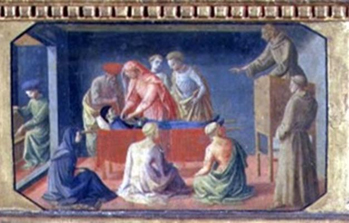
The panel representing the Miracle of the Miser’s Heart, one of the best-known miracles of Saint Anthony of Padua, is an important testimony to the diffusion of anatomical dissection (Figure 1).
Description
Arnaldo da Serrano drew the subject of chapter fifty-two of the Liber Miraculorum (written circa 1370) from the biography of Saint Anthony of Padua written at the beginning of the fourteenth century by the Franciscan Giovanni Rigaldi, who had heard it from Brother Pietro di Raimondo, the author of an anthology of miracles attributed to the intercession of Saint Anthony [6]. According to the hagiographies dedicated to the saint (especially Sancti Antonii Vita by Sicco Polentone), during the funeral of a very rich and greedy man in Tuscany Saint Anthony shouted that the deceased should not be buried in consecrated ground, because his soul was damned to hell and his body heartless, according to the saying of Jesus: “For where your treasure is, there also will your heart be” (Luke 12, 34). The shocked bystanders called some doctors, who opened the deceased’s chest and did not find the heart, which was found in the safe, among the money that the miser had loved above everything else, instead [7].
Pesellino – perhaps to extol the art of medicine, consequently the Medici family, patron of the Novitiate Chapel – focused the scene on the physician performing the dissection, who inspects the visibly empty opening of the ribcage, to the amazement of his colleagues, while three women listen to the saint speaking from a wooden pulpit. In another room, on the left, a young man opens the strongbox of the deceased to look for the heart.
Some critics see Cosimo’s imprint in the choice of the story, which can be interpreted both as a model of Franciscan preaching virtue for novices and as a warning against avarice, since, according to Vespasiano da Bisticci, Cosimo tried to atone for his sin of usury through religious patronage [8].
Discussion
The scene depicts a ‘testimonial’ autopsy, almost an expert opinion [9].
The man wearing a red lucco (a long hooded surcoat) can be identified with the physician intent on dissecting the miser’s body.
Details such as the coins in the strongbox, the physician’s robe, and the hat are painted accurately; everything converges everything converges toward the vanishing point, located at the anatomist’s position, in order to give credibility to the miraculous, visibly significant event.
The central figure of the young doctor, assisted by an older male figure with a red cap, fits in the typical Renaissance iconography of doctors, the only ones able to wear a lucco as a symbol of their rank, according to Florentine sumptuary laws [10].
In fact, the physician saints Cosmas and Damian are usually represented with this clothing.
In Pesellino’s painting, St. Anthony encourages the opening of the body, documenting a practice that had already partially established itself but was still far from the High Renaissance revolution, which would be spearheaded by Jacopo Berengario da Carpi and Andreas Vesalius in the sixteenth century [11].
Dissection of the human body as a teaching tool to show its anatomy to medical students began to be practiced in the Christian West between the late thirteenth and early fourteenth centuries. Mondino de’ Liuzzi performed the first public autopsy in Bologna in 1315: he opened the corpses of two women fifteen years after the promulgation of Boniface VIII’s bull Detestandae feritatis, published in 1299 [12]. This bull has often been interpreted as an explicit ban by the Church on the dismemberment of corpses and, therefore, on dissection. Actually, it was directed against the custom of separating the bones from the soft parts of corpses to bring back the remains of people who had died abroad to their homeland.
Anatomical dissection represented a sector in which different attitudes clashed, from prohibition to regulation and institutional control of anatomical practice, from rhetorical procedures to the norms with which the manipulation and opening of cadavers was progressively authorized [13]. Only thanks to the decision of Pope Sixtus IV, who authorized anatomical practice in 1472 because it was useful for medicine and art, it was possible to begin the systematic study of the human body.
In the late Middle Ages, dissection involved three people: the reader (lector), a custodian of knowledge, who read Galen’s texts; the anathomist (dissector) who cut the corpse; and the commentator (ostensor) who indicated the bodily parts as the reader mentioned them.
The reader, however, was far from the corpse and restricted himself to explaining what Galen had written without verifying the truthfulness of Galen’s words.
In fact, Galen had conducted animal anatomies, managing to build a system that brought medicine and religion together, remaining valid until well into the Renaissance [14].
In this scene, St. Anthony represents the lector, who preaches from the height of his role and his seat.
The opening of the corpse of the miser painted by Pesellino is far from the dramatic depiction of the same subject by Donatello by Donatello in the altar of the Basilica del Santo in Padua, but it looks like the ‘unbuttoning of a doublet’ [9].
The precision and specificity of the gesture leave no doubt about the fact that the painter wanted to represent an anatomical dissection, according to a well-known compositional scheme, with the aligned and foreshortened disposition of the bystanders and the chest with the miser’s heart above the pile of coins on the left, almost modestly preserved in another room.
The exploration is exclusively aimed at identifying the heart in situ and avoids the first part of the canonical dissection, which, in this period, would have started from the abdominal cavity, which contained less noble and more easily deteriorated organs, and was dissected first, followed by the thorax, head, and extremities.
A true revolution only took place thanks to Vesalius, because Vesalius came down from the lector’s throne and no longer needed a dissector and an ostensor, as he carried out all the three functions himself. At that point, he saw Galen’s mistakes and he was able to correct them.
But by now, times had changed.
References
[1] G, Vasari, Le Vite de’ Più Eccellenti Architetti, Pittori e Scultori Italiani, da Cimabue insino a’ Tempi Nostri. Nell’ Edizione per i Tipi di Lorenzo Torrentino, eds. L. Bellosi, A. Rossi, Turin, Einaudi, 1991, p. 400.
[2] M. Pittaluga, Filippo Lippi, Florence, Del Turco, 1949) 176.
[3] G. Marchini, Filippo Lippi, Milan, Electa, 1975, p. 204 No. 21.
[4] A. Uguccioni, Francesco di Stefano, detto Pesellino, in: Dizionario Biografico degli Italiani, Vol. 50, 1998. https://www.treccani.it/enciclopedia/francesco-di-stefano-detto-pesellino_(Dizionario-Biografico)/ (accessed 27 February 2025).
[5] A, Tartuferi, Omaggio a Filippo Lippi, Florence, Centro Di, 2010.
6. Vite Raymundina e Rigaldina, ed. V. Gamboso, Padua, Edizioni Messaggero, 1992.
[7] Libro dei Miracoli di Sant’Antonio, ed. V. Gamboso, Padua, Edizioni Messaggero, 2012.
[8] M. Holmes, Fra Filippo Lippi the Carmelite Painter, New Haven – London, Yale University Press, 1999, pp. 191-204.
[9] G. Weber, Mal d’Arte. Patologo fra gli Artisti, Florence, Pagliai, 2012.
[10] A. Corsini, Il Costume del Medico nelle Pitture Fiorentine del Rinascimento, Florence, Istituto Micrografico Italiano, 1912.
[11] O. Habbal, The Science of Anatomy: A Historical Timeline, Sultan Qaboos Univ. Med. J. 17(2017), 18-22. https://doi.org/10.18295/squmj.2016.17.01.004
[12] P. Charlier, I. Huynh-Charlier, J. Poupon, E. Lancelot, P. F. Campos, D. Favier et al., A Glimpse into the Early Origins of Medieval Anatomy through the Oldest Conserved Human Dissection (Western Europe, 13th c. A. D.), Arch. Med. Sci. 10 (2014), 366-73. https://doi.org/10.5114/aoms.2013.33331
[13] K. Park, The Life of the Corpse: Division and Dissection in Late Medieval Europe, J. Hist. Med. Allied Sci., 50(1995), 111-32. https://doi.org/10.1093/jhmas/50.1.111
[14] K. Park, The Criminal and the Saintly Body: Autopsy and Dissection in Renaissance Italy, Renaiss. Q., 47 (1994), 1-33. https://doi.org/10.2307/2863109