https://doi.org/10.36253/ijae-16064
An anatomical drawing by Leonardo as the matrix for the landscape of his Monna Lisa? An anatomical analysis
Department of Physical Medicine, University Hospital Hôtel-Dieu de Paris, France
E-mail: maigne@wanadoo.fr
Abstract. The landscape behind the Monna Lisa has always intrigued art historians. It is difficult to understand it and there are great differences of interpretation among Leonardo scholars. In this study, we suggest that the source of inspiration for this landscape could be an anatomical drawing by Leonardo himself, entitled the Coition of a Hemisectioned Man and Woman. Far beyond a simple coitus, it illustrates the anatomy of the mechanisms of human generation as they were understood at that time. To test this hypothesis, we compared different elements in the anatomical drawing with the landscape in the painting: respectively the left part of the drawing (female side) with the left part of the landscape and the right part of the drawing (male side) with the right part of the landscape. Indeed, the anatomical elements involved in the reproduction process and appearing in the drawing can be found in the painting as well and with the same arrangement, with more or less marked camouflage. We conclude that the landscape behind the Monna Lisa is a composite landscape with a double meaning, natural and anatomical. This stratagem may have allowed Leonardo to have his drawing admired by those who admire the portrait of a Florentine lady, without anyone knowing.
Keywords: Monna Lisa, Mona Lisa, Joconde, Leonardo Da Vinci.
Contents
Second organ: the cervix and cervical canal of the uterus
Fourth organ: the male’s base of the skull
Fifth and 6 [th] organs: the river and the rocks
Introduction
The Monna Lisa (ML) by Leonardo da Vinci is the most famous painting in the world. The portrait was commissioned by Francesco del Giocondo in 1503 to represent his spouse and to celebrate the birth of two healthy children. The painting was never delivered to its sponsor, for unknown reasons, and remained in Leonardo’s hands until his death in 1519.
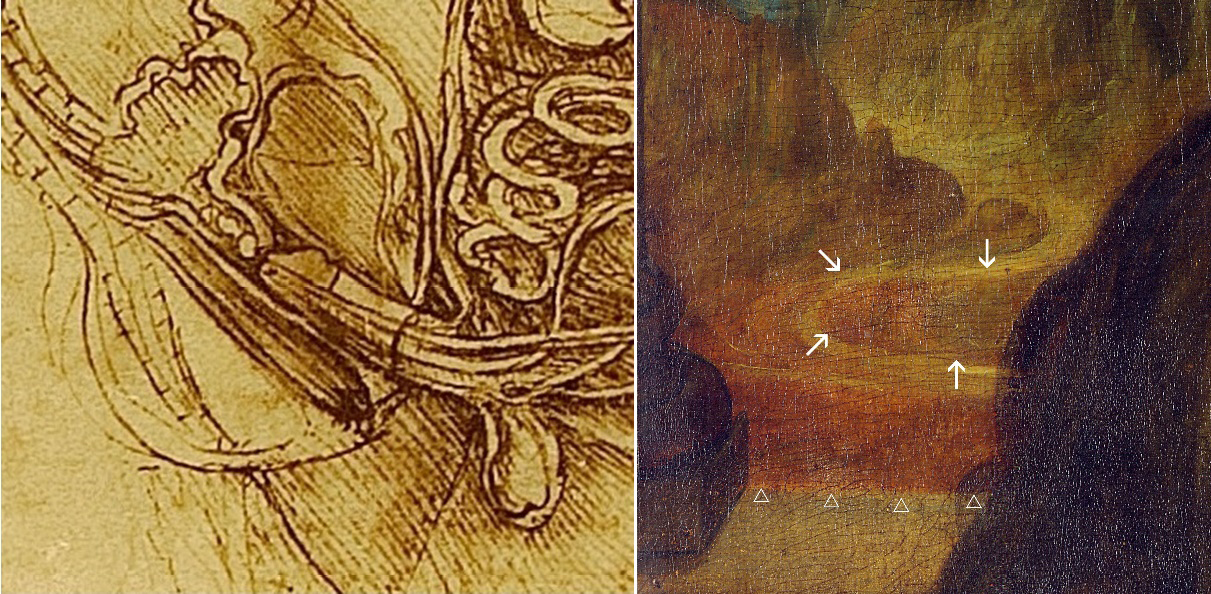
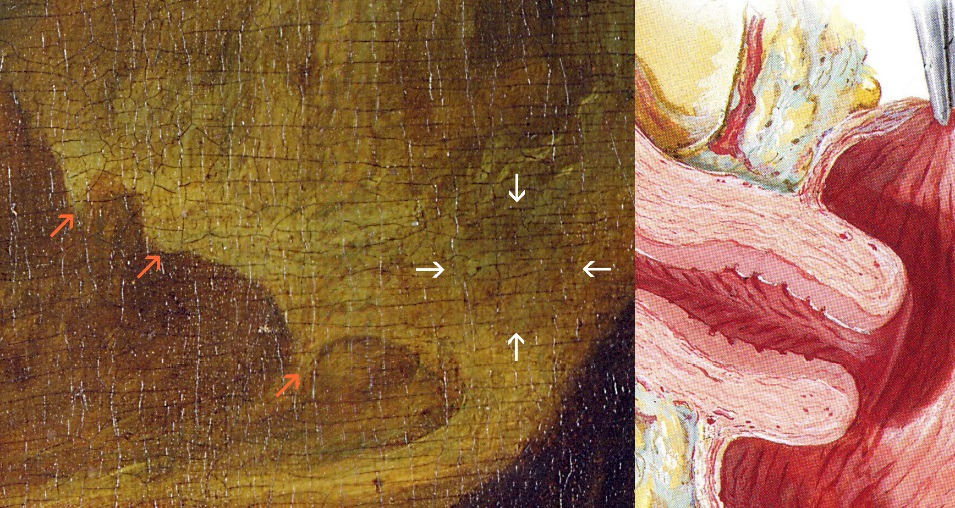
Beside the famous mysterious smile, the landscape appearing in the background of the painting has always remained intriguing for art historians (fig. 1). It is described as a chaotic landscape of desolation, without human presence [1,11]. The right and left parts do not match because the horizon is not at the same level on both sides and the features of the landscape are independent although very similar (mountains, lakes, rivers). The right side is in a dominant position. There is no perspective [3,8]. The lake on the left does not flow into the valley, despite the presence of a communication point (see fig. 4) [15 ]. The lake on the right appears slightly inclined below the horizontal. Just next to the right shoulder, there is a half hidden, perfectly spherical shaped rock, incongruous in this environment of high mountains (see fig. 3). Finally, a reddish rectangle at the bottom left (fig. 2) and a double rock at the bottom right (see fig. 7) are not understood [8]. No explanation for these anomalies has ever been given. Most art historians note that they are “not clear” [15], that they are maybe unfinished parts [8,13] or that the landscape does not obey the rules of traditional perspective [8]. They refer to the traditional explanation that Monna Lisa represents the human microcosm and embodies the macrocosm-landscape [7,12] or that it is an evocation of the passing of time [1,11].
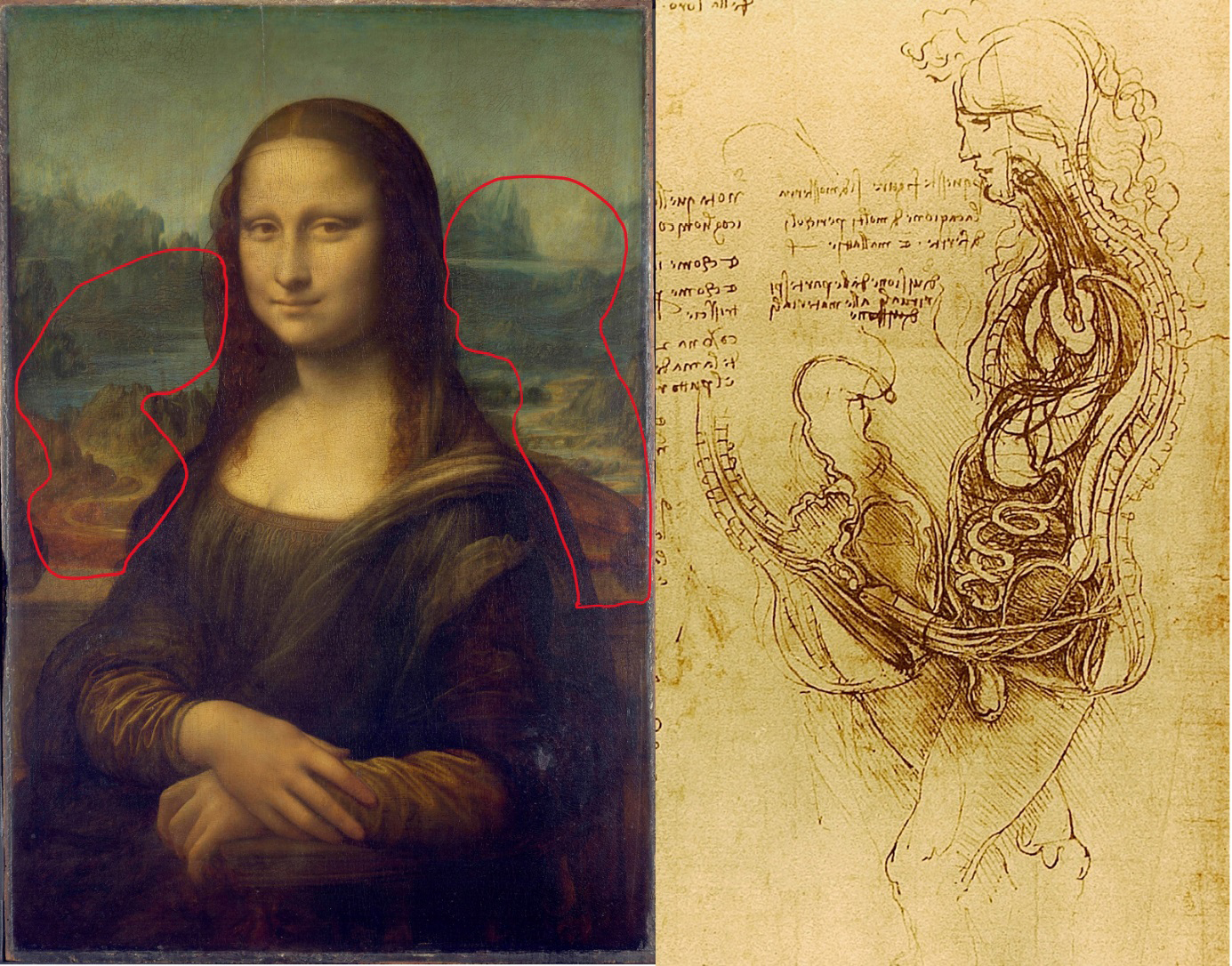
A careful examination of the painting allows us to present a new analysis. In this paper, we bring evidence that the landscape behind the ML might be based on a famous anatomical drawing by Leonardo, entitled “Coition of a Hemisected Man and Woman” (1492) which represents the carnal union of a man and a woman (Fig. 1). [4]
This drawing goes much further than just sexual intercourse. It illustrates the classical doctrine of Hippocrates and Galen that semen consisted of a mixture of white matter and CSF that collected and mixed at the base of the skull (“the fundamental bone of the brain” [14], according to Leonardo). Then, it followed the flow of CSF along the spinal cord where it gradually concentrated. Arriving at the very bottom of the thecal sac, it reached the testicles via hypothetical canals (which in fact were nerves) [4,9]. The female brain played no role in this process, hence probably the absence of a woman’s head and trunk in the drawing. This theory persisted until the end of the 16th century.
Methods
In order to demonstrate the presence of correspondences between the drawing and the painting, we compared point by point the different elements of the left part of the drawing, representing the female reproductive organs, with the left part of the landscape. We did the same with the right part of the drawing representing the male reproductive organs, comparing it with the right part of the landscape. The male reproductive organs include, according to the beliefs of the time, the base of the skull (where white matter and CSF mix together to make semen), the spine where the CSF (and the semen) flows in the thecal sac, the testicles, and the penis.
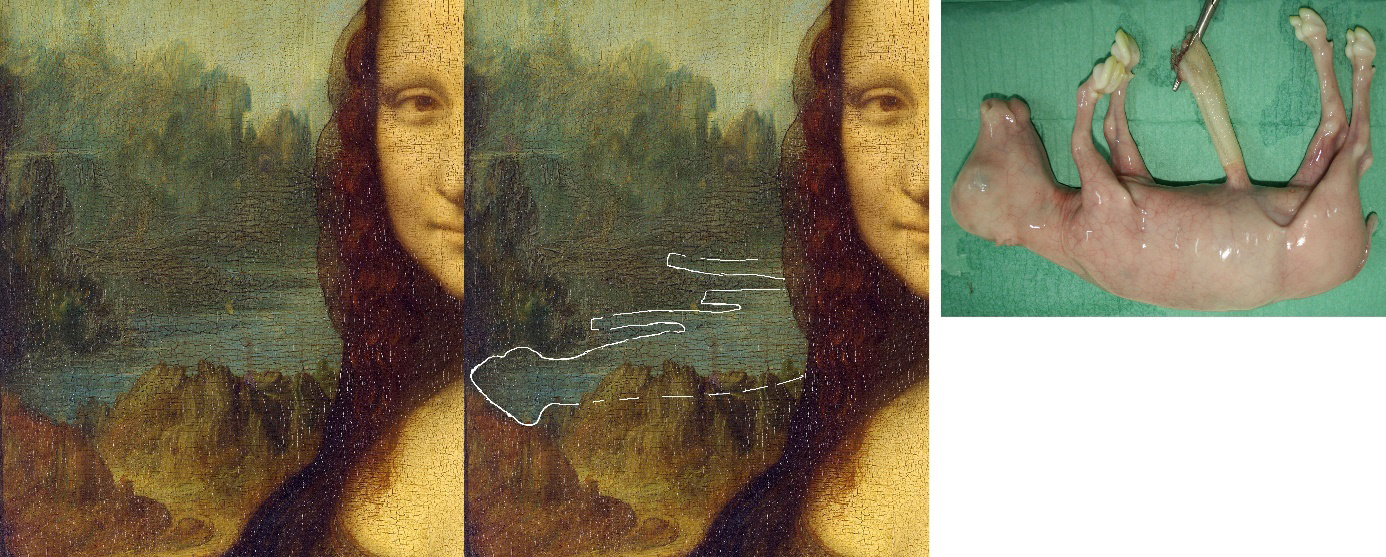
It should be remembered that Leonardo, when he painted the ML, could not have dissected women’s bodies but only bovine material, gravid or not. His uterus drawings were cow uteruses and his fetus drawings were calf fetuses until 1510.
Results
The anatomical drawing illustrates three key organs of the generation on the female side (1-the penis in a situation of carnal union, 2-the cervix and cervical canal and 3-the body of the uterus) and three on the male side (1-base of the skull, 2-the spine with a flow of CSF and 3-the testicles). If we carefully examine the landscape of the painting in its left and then right part, we will find these key organs (more or less camouflaged), in the same order and with the same arrangement.
First organ: the penis
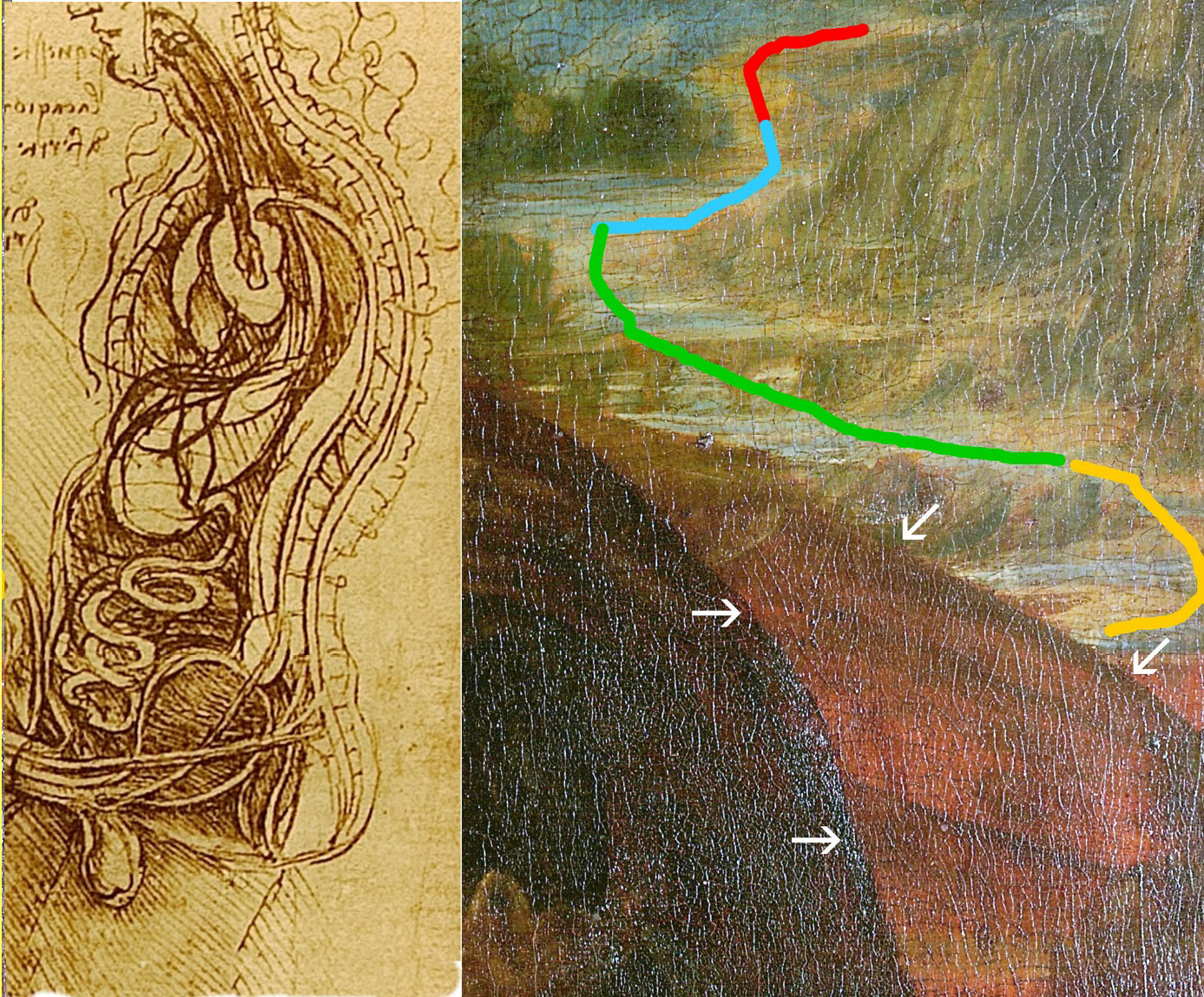
There is clearly a rock looking like a penis, located to the left of the painting, halfway up. It is directed to the left as in the drawing. Its proportions and colors are accurate. One can hardly imagine another interpretation. Below is a reddish rectangular band which, in the painting, does not represent any natural element. But if we look at the anatomical drawing, we find that it is in the place occupied by the female rectum. Its representation is symbolic. These anatomical elements, arranged as in the drawing, cannot be there by chance or by a mere coincidence. Note that the sandy path that delineates this rock is very narrow and its color blends in with the surroundings. As it goes away, it widens and becomes brighter. This stratagem, against the laws of perspective, allows for camouflage because attention is drawn into the distance and not in the foreground (Fig. 2).
Second organ: the cervix and cervical canal of the uterus
Above the penis, we note the presence of a perfectly spherical rock, which has not been reported by art historians. It is barely visible, which probably means that Leonardo needed it to represent what he had in mind, but that its unnatural shape required to be camouflaged. This spherical rock mirrors another rock, of a more natural rounded shape, with which it forms a pair. These two rocks seem to represent the cervix of the uterus, and the valley behind (which widens as it goes away) would represent the cervical canal. The lateral outgrowths would symbolize the circular folds he observed in the bovine uterus and which correspond to the palmate folds in humans, although bigger (Fig. 3).
Third organ: a gravid uterus
Beyond the cervical canal, there is a lake whose longitudinal axis makes an angle of 65° with that of the valley (which represents the cervical canal); this angle is characteristic of an anteverted uterus. But a careful examination of the outline of this lake shows that it corresponds to the contours of a fetus. A fetal calf indeed, because Leonardo had never had the opportunity to dissect a human fetus, an opportunity he would have much later (circa 1510) (Fig. 4).
Fourth organ: the male’s base of the skull
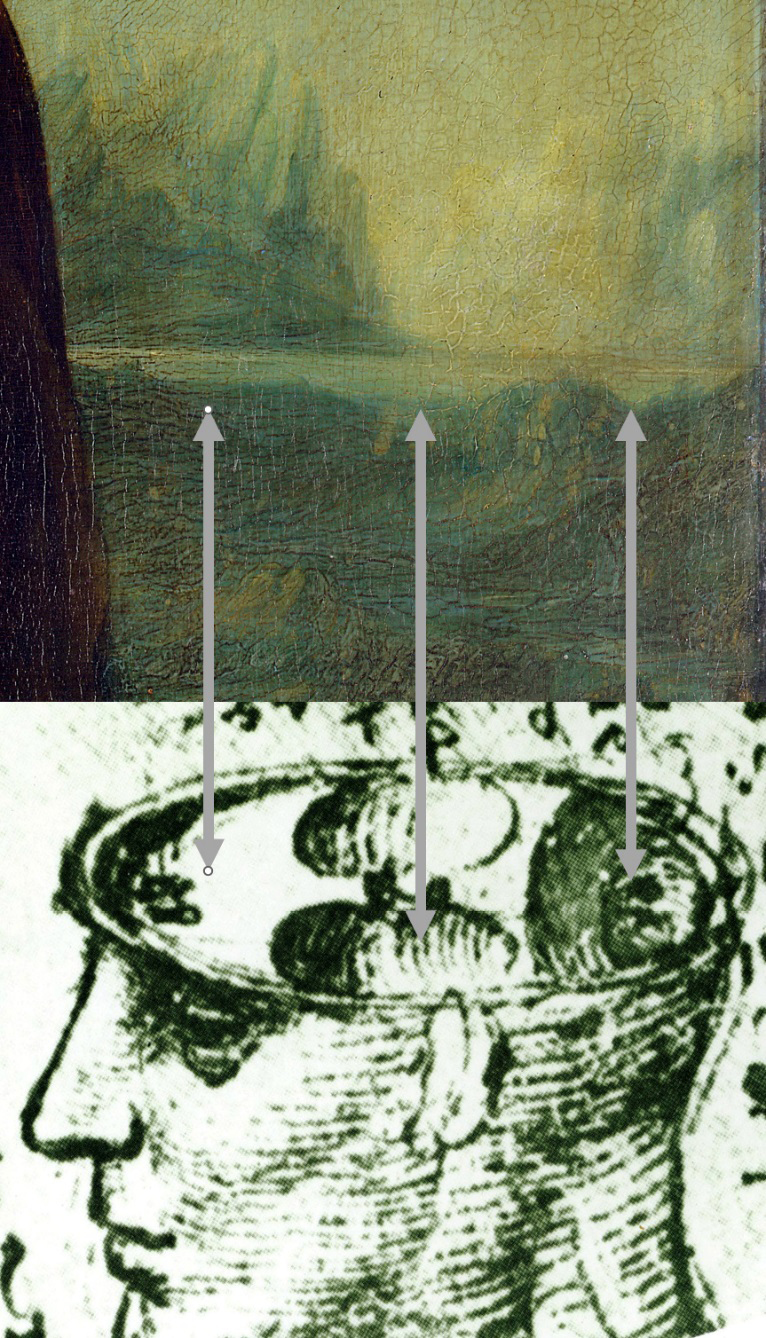
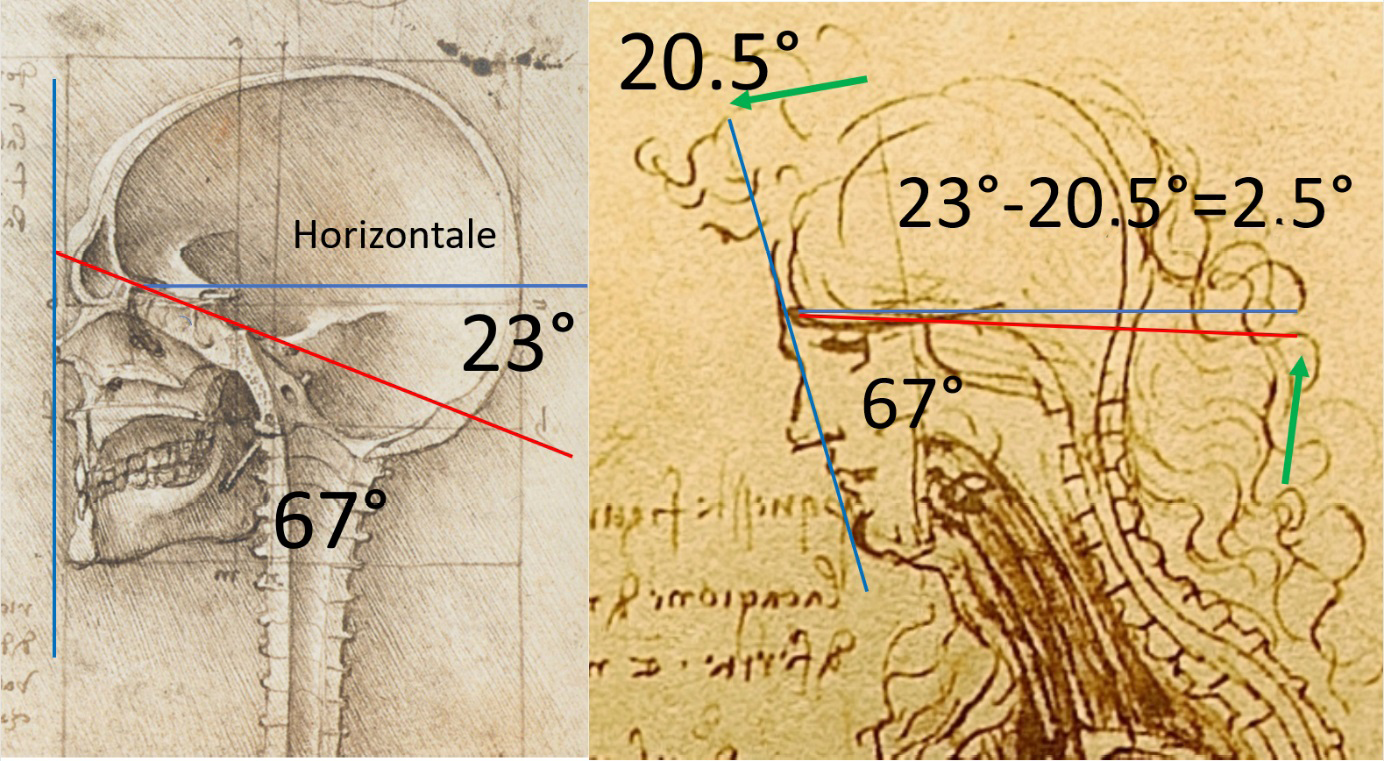
On the drawing, the man’s head is at the top right. It is therefore by observing the upper lake that it is possible to recognize an analogy between the lake and the base of the human skull. According to the beliefs of the time, this structure was of major importance for reproduction since the CSF and white matter collected and mixed here to make semen (Fig. 5). On the painting, the nearest shore consists of a flat part on the left and two depressions, one in the middle, the other on the right, which are in match with a profile view of the base of the skull with the anterior (which is flat), middle, and posterior fossae. The far shore draws a straight line that looks like the horizon (which means that the observer’s eye is very close to the surface and in this case the lake should look horizontal), but is inclined 2.5° below the horizontal. Why? Our analysis of the drawing and the painting could explain this value (Fig. 6). Let us first look at the skulls drawn by Leonardo. He measured the obliquity of the base by drawing a line joining the junction of the vertical and the horizontal parts of the frontal bone with the internal occipital crest, thus following the base. This line does exist on some drawings of skulls that he left us. If the gaze is horizontal, this line makes an angle of 23° with the horizontal, corresponding to the anatomical obliquity of the base of the skull. If the head flexes, this angle decreases. In the drawing, the man bends his head by 20.5°. His skull base tends to become horizontal and the angle it makes with the horizontal goes from 23° to (23°-20.5°=) 2.5°, i.e. the value of the inclination of the lake. This provides further evidence for our hypothesis.
Fifth and 6 [th] organs: the river and the rocks
Like other elements of the landscape, the river can be read in two ways: as a river or as a symbol of the CSF flowing slowly from the base of the skull towards the bottom of the dural sac, and carrying the semen which concentrates before reaching the testicles. In favor of this interpretation, the curves of the river evoke the four curvatures of the spine as seen on the drawing.
The last element which offers a double reading is the set of two brown rocks located in the bottom right of the landscape. They are located on a line passing through the axis of the penis. This cannot be due to chance. We think that it is a scrotum that Leonardo represented. It is similar to the one in the drawing. Leonardo rotated it 70° counterclockwise, making it less identifiable than if it were in a natural position (Fig. 7).
Discussion
Our results show that a famous anatomical drawing could well be the matrix of the painted landscape in the ML. If so, they could give a better understanding of the painting.
One could criticize the “subjectivity” of our description, otherwise called pareidolia. However, this word applies to forms created randomly by nature, and not by the will of a painter. Here, the realism of the penis is perfect, like that of the fetus, among others. The lake is indeed leaning by 2.5°, as predicted by our hypothesis. All this goes beyond mere subjectivity. Since there is not one but six organs represented, the probability of a resemblance due to chance becomes practically zero. Furthermore, the arrangement on the painting follows exactly that of the drawing. There is therefore a clear will from Leonardo at the origin of this composite landscape.
It is not surprising that the anatomical drawing of Coition constitutes the matrix of the landscape of the Monna Lisa. For Lisa Gherardini and her husband, the painting was about celebrating two motherhoods [2]. For Leonardo, it could have been also about celebrating human generation, a field that fascinated him. He was a person who disregarded conventions, as his biographers describe him [2]. Freud remarked: “The great Leonardo remained infantile all his life, in many aspects. It is said that all great men must retain something infantile. He continued to play even into adulthood, which sometimes made him strange and incomprehensible to his contemporaries.” [5] The second reason could be that an anatomical drawing is destined to end up forgotten in a drawing folder. Leonardo was proud of his drawings. Paolo Giovio, an early biographer (1527), reports that he had the intention that “his work […] would later be published in the form of engravings as an anatomy for the use of artists”. [6] These engravings were not made during his lifetime. Therefore, Leonardo, choosing another way, could have wanted to discreetly incorporate his drawing into a painting, as a testimony to the mastery of his art so that it could, without the viewer knowing, be admired as long as the painting was hanging on a wall…
Conclusion
The results of our study shed new light on the landscape of the Monna Lisa. An anatomical drawing by Leonardo, illustrating human generation, may have served as a matrix for the landscape, in a hidden way. We should not be surprised. Several art historians have already noted how this painting evokes the transmission of Life. In fact, our analysis extends, by deepening it, the judgments of Mohen et al: “It is the portrait of life” [7], that of Arasse [8], according to which it is one of Leonard’s most personal paintings, because “he painted for him the portrait of the fertile woman” and that of Martin Kemp [9]: “Anatomy, for Leonardo, illuminated the great issues of generation, birth, life and death”.
The Monna Lisa may not just be a portrait of a woman her husband wants to honor for the two children she gave him. It could also be a celebration of human generation. And the painter’s stratagem could well explain the half smile of Lisa, like a secret between the two of them, showing complicity but also slight embarrassment.
Reference
[1] Arasse D. (2019) Leonard de Vinci. Hazan, Paris. p305.
[2] Bramly S. (2019) Léonard de Vinci. Une biographie. Lattès, Paris. p534.
[3] Carbon C., Hesslinger V. (2015) On the nature of the background behind Mona Lisa. Leonardo. 48: 182-184.
[4] Clayton M., Philo R. (2012) Leonardo da Vinci anatomist. Royal Collection Enterprises Limited, Windsor. Pp. 35.
[5] Freud S. (1910) Un souvenir d’enfance de Léonard de Vinci. <www.lacan-universite.fr/autour-dun-souvenir-denfance-de-leonard-de-vinci>, accessed 26 March 2024.
[6] Giovio P. (1527) The life of Leonardo Da Vinci <https://nicofranz.art/en/leonardo-da-vinci/paolo-giovio-the-life-of-leonardo-da-vinci-1527>, accessed 12 December 2024.
[7] Kemp M., Pallanti G. (2017) Mona Lisa. Oxford University Press, Oxford. p188.
[8] Mottin B. (2006) Une lecture de l’image. In: Au cœur de la Joconde. Léonard de Vinci décodé. Gallimard, Paris. Pp. 68-70.
[9] Megaloudi F., Huyghe E. (2004) L’andrologie dans la médecine hippocratique. Andrologie. 14 : 343-346.
[10] Mohen J.P. et al. (2006) La Joconde, Léonard de Vinci et le visiteur : une rencontre exceptionnelle. In: Au cœur de la Joconde. Léonard de Vinci décodé. Gallimard, Paris. Pp. 119.
[11] Pedretti C. (1973) Leonardo. A study in chronology and style. University of California press, Los Angeles.
[12] Smith W. (1985) Observations on the Mona Lisa Landscape. The Art Bulletin. 67 (2): 183-199.
[13] Vasari G. (2018) Vie des peintres, sculpteurs et architectes. Espaces&signes, Paris. Pp. 48.
[14] Vinci L. (2019) Léonard de Vinci Carnets. Gallimard, Paris. Pp. 256.
[15] Zöllner F. (2005) Léonard de Vinci. Taschen. Köln.