https://doi.org/10.36253/ds-17019
Imagining the Enlightenment: triumph or exploration? The frontispiece of the Encyclopédie and other programmatic images
Martin-Luther-Universität Halle-Wittenberg, Germany
Abstract. How can the concept of ‘Enlightenment’ and its achievements be visualised? This question is worth asking both in relation to our present day and with regard to the protagonists of the historical Enlightenment. The article identifies two ideal types of images of the Enlightenment: one triumphant and one exploratory. As contradictory as they may seem, on closer inspection they prove to be closely related, because both stage the ‘power’ of light and in doing so never appear to be entirely free from the perspective of the other type. What both types demonstrate is the Enlightenment self-image that thinkers and artists of the 18th century already cultivated. From the perspective of historical sources, there is no reason to abandon the historiographical term ‘Enlightenment’, as has recently been called for.
Keywords: triumph of light, the Enlightenment’s self-image, social imagining, the concept of ‘Enlightenment’.
Contents
I. Enlightenment in/out of crises
1. Criticism of theology as the product of a crisis
2. Another consequence of the crisis: Cochin’s revaluation of the imagination
3. Artistic means of triumph that are simultaneously ironic
III. Exploratory Enlightenment
3. Increased caution in the revolutionary crisis of the Enlightenment
I. Enlightenment in/out of crises
As the guiding concept of the 2025 annual meeting of the Italian Society for Eighteenth-Century Studies, ‘crisis’ allows us to focus on the role of the Enlightenment in the 18th century as well as the conditions under which we study it today. As far as the historical perspective is concerned, in 1935 Paul Hazard interpreted the Enlightenment for the first time as a reaction to a crisis, more precisely to La Crise de la conscience européenne (by ‘consciousness’ he meant the previously unquestioned systems of order in terms of faith, knowledge and political rule1). Today, it is no less useful to understand the ideas and struggles of the Enlightenment as characterised by crises, and, more precisely, in a dual sense that initially might appear contradictory: On the one hand, as an attempt to institute new orders of faith, knowledge and political rule to replace those that had fallen into crisis; on the other hand, as the deliberate instigation of crises, since Enlightenment critique is never satisfied («ne se contente jamais», writes Hazard2) and always produces only the provisional.
Today, Western societies find themselves in deep crisis, for example with regard to climate change or internal and external threats to liberal democracy. Enlightenment studies can be seen to be suffering a crisis too, insofar as we can no longer be sure that our subject is perceived as the foundation of the modern world and its freedoms in a positive sense. From a post-colonial perspective, the Enlightenment brought a major boost to European dominance – and exploitation to the rest of the world, by intensifying transatlantic economic relations (including slavery in America) and by hierarchising anthropologies and ideas of history that enabled Europeans to see themselves as the pinnacle of civilisation while racially devaluing others3. The Enlightenment and its study are also under attack from a completely different political direction. The historian Jonathan C. D. Clark considers the Enlightenment to be nothing more than a later invention by its researchers4. In his view, the idea that there was a reform movement in the 18th century that could be labelled ‘the Enlightenment’ in the singular only became publicly established after the Second World War, when Western democracies no longer demanded a simply national prehistory. Bearing the image of the shattered glass of a conventional light bulb, the cover of Clark’s recently published book might be intended to tell us precisely this: the Enlightenment is merely an artificial source of light, produced only since the late 19th century, and is anachronistic as a concept; with Clark’s arguments, it can be shot to pieces like the delicate glass of a light bulb. However, his arguments themselves generate more heat than light. After all, conceptual history perfectly shows that the key words Aufklärung, lumières or to enlighten were already in use in the early 18th century and that the Enlightenment thinkers were aware that they were participating in a reform project that transcended national borders5. The fact that ‘the Enlightenment’ only became a key term in research at a late stage – even ‘Lumières’ is only mentioned in passing by Hazard, for example – does not preclude that our Enlightenment vocabulary or something similar – in Italian, for example, i lumi instead of illuminismo6 – was already playing its part in the 18th century.
Clark’s cover offers a suggestion as to how we can imagine the Enlightenment, albeit a misleading one that we need not accept. Yet we may take up his suggestion not in terms of its content, but rather methodologically and shift towards the images in which people of the 18th century imagined the Enlightenment. If, as suggested, we can conceive of the Enlightenment as a response to experiences of crisis – or more precisely as a conglomerate of responses – we can also assume that these images reveal different ways of dealing with crises. As the title of this article indicates, I propose an idealised distinction between images of triumphant Enlightenment and those that appear more cautious and depict Enlightenment as an exploration, as a step-by-step progression. When we look at a number of such images in a moment, everyone can ask themselves which type of imaging and imagining corresponds better to their own idea of the Enlightenment7. However, it is not necessary to decide in favour of just one of these images, as both seem to be characteristic and indeed indispensable for the historical actors: In images of the triumphant Enlightenment, the enlighteners convinced themselves and others that their endeavour would, indeed must, be successful. The triumph of the Enlightenment, which some of the pictures visualise, was psychologically important so not to despair of the gigantic attempt to improve in knowledge and living conditions that they had set themselves. What appears to distant observers as blatant overconfidence may have served as self-motivation during the struggles of the 18th century. In images of the exploratory Enlightenment, on the other hand, that grand récit of universal improvement was reduced to what was feasible here and now. This was necessary as well because no matter how far-reaching the goals, they can only be achieved by taking concrete paths.
II. Triumphant Enlightenment
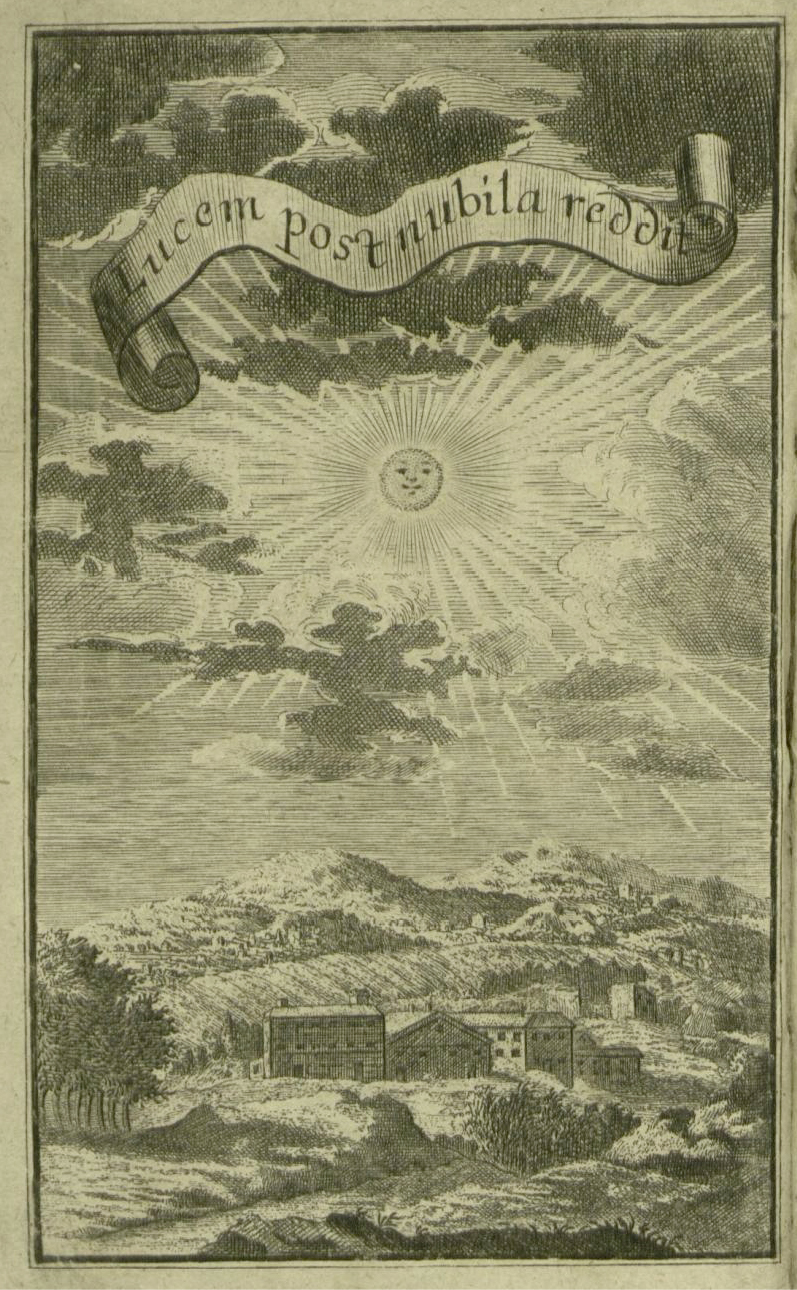
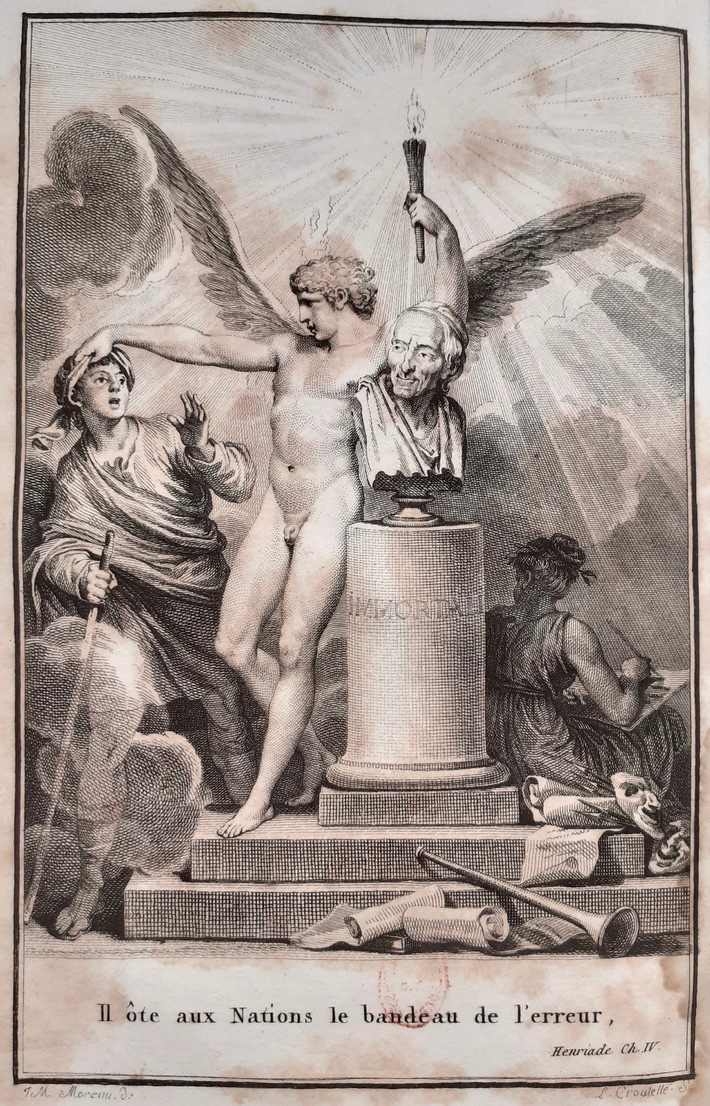
Let us first look at three pictures of the triumphant type. They all show a strong source of light in the upper third of the picture, fully or nearly in the vertical centre. This light prevails against obstructing clouds. The situation depicted is to be understood as the assertion, indeed the victory, of truth, knowledge or even Enlightenment.
The first picture, which was included as a frontispiece to Christian Wolff’s (1679–1754) main philosophical work, is to be understood this way because it visualises the primary meaning of the German word Aufklärung at the time, for Aufklärung originally meant nothing other than the clearing of the sky from clouds or fog8 (fig. 1). The two French pictures add a number of pictorial motifs to the central light source in order to clarify that Christianity – in which the metaphor of light also plays a prominent role – is not being glorified here. In the frontispiece with the torch-bearing genius (fig. 2), the bust of Voltaire (1694–1778) positioned in the centre clarifies that the message conveyed is one of critical Enlightenment. It is presented here as human emancipation, as the small scene on the left edge of the picture and the caption – a line from Voltaire’s Henriade (1723) – suggest: «Il ôte aux nations le bandeau de l’erreur» (He frees the nations from the blindfold of error). The engraving conveys the caption’s reference to the author and what he achieved through his criticism of prejudice in enabling humanity to progress independently9. This article will examine only one further image of the triumphant type in greater detail: the frontispiece of the Encyclopédie (fig. 3), which is undoubtedly one of the most prominent ‘images of the Enlightenment’. As just one example, see the cover of Vincenzo Ferrone’s book on the reflections of philosophers and historians about the Enlightenment10.
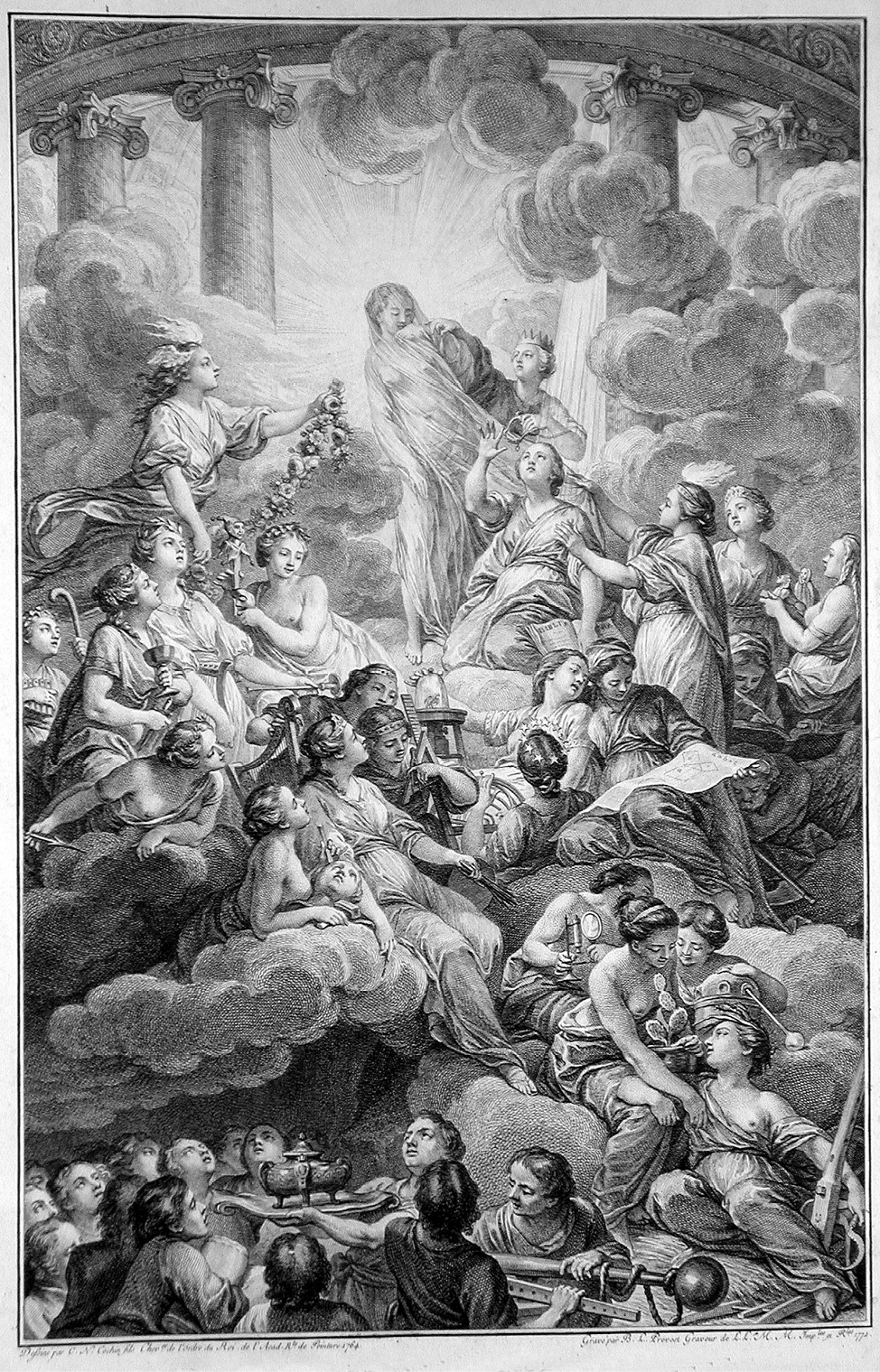
The engraving drawn by Charles-Nicolas Cochin le Jeune (1715–1790) arranges numerous personifications: of the human mental faculties (raison, mémoire, imagination; in the upper part of the picture), of the sciences and humanities (in a descending sinuous line: theology, philosophy, ancient and modern history with Chronos, geometry, physics, astronomy, optics, chemistry, biology or botany), of the fine arts (nine in total, including speaking, forming, and sounding in the left part of the picture) as well as agriculture as a practical skill (at the bottom right) and some crafts and professions (métiers), whose coequal treatment with the sciences and the arts is announced by the subtitle of the Encyclopédie. They are all positioned below an elevated central figure, namely Truth, as its hardly-veiled nudity reveals, or rather at its feet. The attributes associated with the (so far) twenty-five allegorical figures make them easily recognisable. Moreover, the lower margin of the picture shows a human ‘audience’, which observes the hierarchical order and (inter-)action of the allegorical figures. The geometrical middle of the picture depicts a physical instrument, a vacuum pump, thus assigning to the empirical understanding of nature a central role in the expansion of knowledge. Noticeably, Statesmanship and warfare do not receive a place in this constellation.
Truth stands with its feet in the optical centre which is located slightly above the exact middle of the picture. It appears to have just stepped out of a round temple, its residence and sanctuary, for the latter emits a strong light which is easily identifiable as the proverbial ‘light of truth’ (lux veritatis) and reminds the viewer simultaneously of the lumières – that is, critically minded and reformist intellectuals. Some dark clouds seem to give way to the Truth; they are to be understood, equally metaphorically, as the visualisation of the errors and prejudices that should be discarded. On the whole, the tableau depicts what the Encyclopédie wants to document and to promote: an enlightened approach to the truth. This approach may occur by ‘unveiling’ Truth, as Reason and Philosophy tangibly do by trying to lift or pull away the veil of truth, or by having the light of truth illuminate more or less brightly the different sciences, arts and crafts.
There is no doubt: It is a triumphalist understanding of Enlightenment that is being staged here, perfectly matching the punchline that the authors of the great work created by ensuring that the very last word of the final article was none other than «triomphe»11. However, celebrating an illuminated allegory of truth was in itself rather pointless. The frontispiece of the Encyclopédie was only provocative in the context in which it appeared, as well as in its depiction of Theology and its relationship to Truth. Going into more detail, we will see that this figurative triumph of truth and Enlightenment is a reaction to a serious crisis in the Encyclopédie.
1. Criticism of theology as the product of a crisis
A frontispiece belongs at the very beginning of a book, because its task is to give even the casual spectator an impression of the ambition and content of the work that follows12. However, when the Encyclopédie started to be published in 1752, Cochin’s frontispiece was by no means prefixed to the first volume. It was not before 1765 that an exhibition at the Louvre presented a sanguine sketch of it13. The frontispiece was engraved in 1769, and delivered even only in 1772, along with the two last (of eleven) volumes of plates, as a «free supplement» for subscribers14. When exactly the editors of the Encyclopédie had the idea of a frontispiece can only be broadly reconstructed. There are equally limited reliable sources for the reasons why they decided to include such an ‘introductory but in fact subsequent statement’. The programme of the Encyclopédie was – one should think – sufficiently explained by Diderot’s «Prospectus» as well as d’Alembert’s «Discours préliminaire», which preceded the first volume15. Furthermore, this contained a diagram that illustrated the underlying classification of mental faculties as well as the sciences and the arts – including the crafts: a «Systême figuré des connoissances humaines».
This raises the question of the purpose of a figural scene which had a similar function, and, even more so, of the purpose of an allegorical picture, whose mode of representation Diderot considered as antiquated16. An answer can be traced to the difficult publication history of the Encyclopédie, which was repeatedly interrupted by governmental bans due to its criticism of religion and the monarchy: After the publication of the seventh volume in 1757, the issuing of further volumes was prohibited. In 1759, the Encyclopédie was put on the index librorum prohibitorum of the Catholic church. Bankruptcy of the whole enterprise could only be prevented by publishing, starting in 1762, the volumes containing the illustrations deemed to be less offensive. In 1765, however, the ban on the textual volumes was loosened. With the help of a false publisher address, the remaining ten volumes could appear17.
Whether the «Frontispice de l’Encyclopédie» owes its origin and its design to this specific crisis is far from certain. However, it certainly matches the sketched situation between an oppression which was argued religiously and its own clever liberation thereof. This applies to the choice of the pictorial medium as much as to the affirmation of the Encyclopédie’s programme of Enlightenment, which the frontispiece claims to be independent from religious beliefs, as shall be shown now.
The frontispiece responds to the pressure exerted on the Encyclopédie by the Church and the royal censor with a depiction of theology that, at first glance, appears highly respectful, but on closer inspection reveals a radical devaluation. Very much in accordance with traditional hierarchy, theology appears as the discipline positioned on top and, moreover, as the figure closest to truth. Although theology is kneeling – deferential towards God – it still has a more elevated point of view than philosophy which is next to it. The gaze directed upwards is more ambivalent: ‘Raised up towards Heaven’ would be a positive description conforming to traditional expectations; ‘without contact to the other figures’ – which are all linked by relationships of glances – or even ‘isolated’ would be an expression, however, which stresses the element criticising theology which is inherent in its depiction18. In the upper part of the picture, theology, next to comedy or satire, is the only figure which does not direct its gaze towards truth. In this constellation, the reverentially raised hand of theology can even be read as resistance against truth. Theology does not exploit the privileged position it assumes towards truth, but turns its back on it. It does not participate, as reason and philosophy do, in the unveiling of truth. Rather, it disturbs philosophy in this undertaking.
To an observer who is aware of the context, theology’s prominent placing represents a position of power that is problematic for gaining knowledge. Moreover, the exclusion of theology from the circle of disciplines aligned to, or profiting from, truth is underlined by the lighting. «[L]a Théologie agenouillée reçoit sa lumiere d’en-haut», Diderot writes in his «explication du frontispice» (‘theology on its knees receives its light from above’)19. He might have the light of revelation in mind; this would correspond to the respectful reading. As it is not the light of truth, whose source is not at the top, but in the depths of the pictorial space, the light emitted on theology contains another fundamental criticism. In this point, the picture is even more polemic than Diderot’s «explication» and, at the same time, ironic because it shows a ray of light emerging from directly above, which not only does not enlighten anything – it does not even come into theology’s view20. Its rays fall behind theology’s back – and possibly only touches the soles of its feet.
2. Another consequence of the crisis: Cochin’s revaluation of the imagination
Another unconventional hierarchy is created by aligning the three mental faculties of reason, imagination and memory. These constitute an irregular triangle whose centre is occupied by truth. In this relationship, memory has the lowest position that is farthest from truth. This conforms to the depreciation of memoria as a merely reproductive, but hardly innovative, capacity which is typical for the Enlightenment. The highest position, which is closest to truth, is assigned to reason, thus conforming to the privileged treatment of this mental faculty in d’Alembert’s «Discours préliminaire». Yet Cochin places the figure of imagination only marginally lower than reason. The former is the more prominent figure, simply because it is less hidden by the other figures – theology is kneeling before reason – because imagination is much more illuminated and also because it seems to be caught in a dynamic movement: It approaches truth to adorn it with a flower garland. Among all the allegorical figures, imagination is the only one that moves in space. Cochin stages a triumph of imagination as much as of reason.
This was a provocation too – this time aimed at the editors of the Encyclopédie – which could be due to the crisis in which it was created. In Diderot’s «explication du frontispice», imagination had only the capacity, and function, to embellish. D’Alembert’s «Discours préliminaire» assigned to imagination the last place in the order of human mental faculties – even below memory21. Accordingly, the illustrations of the Encyclopédie – consisting of no less than 2,885 plates (the famous planches – had didactic motives; the volumes of plates were mainly supposed to make techniques more easily accessible and learnable22. This conformed to the traditional rhetorical assumption that the arts were capable of communicating knowledge to a wider audience by ornamenting it in an attractive way. In contrast, the blatant revaluation of the imagination and the arts in the frontispiece corresponded to the critical situation of the Encyclopédie in the 1760s. More particularly, the entire enterprise was only able to survive due to the volumes of plates, and the exclusion of theology from the circle of the arts and sciences indebted to truth could only be effected in a piece of art. Cochin’s frontispiece exposed the obstructive nature of the theological prerogatives evident in the difficulties involved in the publication of the Encyclopédie. And it did so in a manner that was sufficiently clear, but nevertheless artistically indirect and implicit which left it less exposed to attacks. In other words: The arts arrive at truth, or can express it more freely, because their representational style is allusive rather than explicative. Significantly, Imagination has the largest range and scope among all the figures in Cochin’s frontispiece; Theology does not prevent its approach to Truth. Of course, the appreciation of the arts conveyed here simultaneously functions as argument pro domo in favour of the artist. Significantly, the arts or, more particularly, the poetic genre, which is placed closest to Truth, is Comedy or Satire. We could also say: masked criticism – its allegorical representative holds a mask in her hand.
3. Artistic means of triumph that are simultaneously ironic
If Cochin valorises the arts in this way, the question arises all the more urgently as to what artistic means he resorts to in order to convince the viewer of the triumph of truth. A number of pictorial elements and their arrangement are in the tradition of Baroque triumphal stagings, which, piquantly enough, often have religious origins. The combination of columns and beams of a monopteros, of a ray of light emerging from above, of clouds functioning as seating furniture and, at the same time, as an indicator of a «hiérophanie, c’est-à-dire d’objet qui manifeste le sacré»23, and of a religiously moved figure reveals strong similarities with a most famous example of seventeenth-century sculpture, the «Ecstasy of Saint Theresa», which Gian Lorenzo Bernini (1598–1680) created for Santa Maria della Vittoria in Rome between 1645 and 1652 (fig. 4).
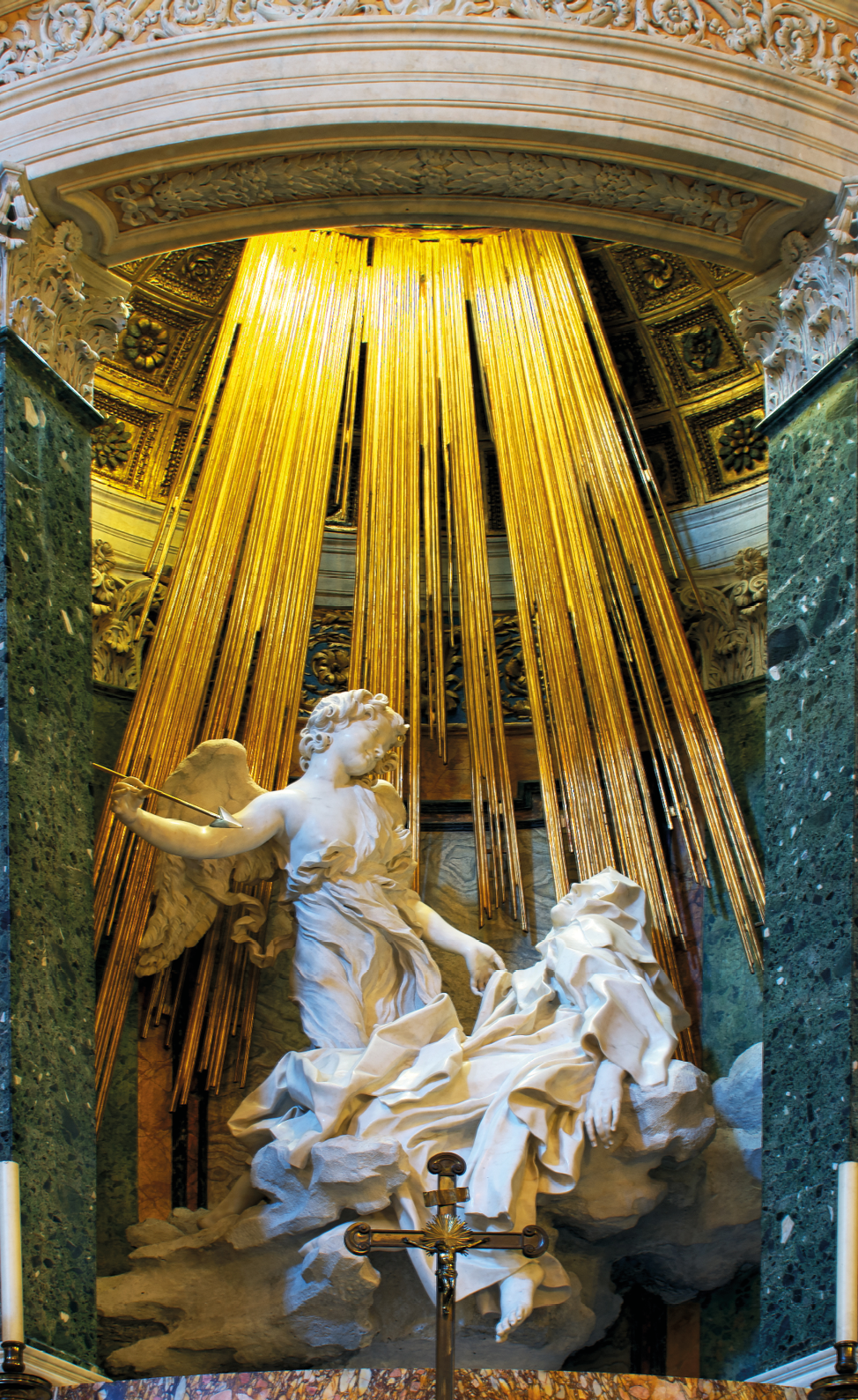
Cochin admired Bernini and made a drawing of the central scene in 1750, incidentally using the same red chalk technique in which his design for the frontispiece was executed some fifteen years later (fig. 5). A later etching of the drawing is laterally reversed, for technical reasons. As far as I know, scholars have not yet traced a connection between the two drawings. In my view, the similarities between Cochin’s Bernini drawing and his frontispiece are striking enough, though they are selective. Even the half-stripped youth holding an arrow in his right hand – an angel in Bernini’s version – returns in the frontispiece, viz. on the left-hand side of the picture in a figure to be decoded as love poetry24. Which would mean: Love of God is replaced by desire among human beings. Since Cochin valued the Roman Baroque25, the adaptation of an architectural and sculptural model of Bernini did not run counter to his aesthetic principles. Rather, it was capable of continuing this game of ambiguities on a stylistic level. By using aesthetic forms which were usually associated with the Catholic Church for a purpose that was critical of theology, he was able to make another ironic turn.
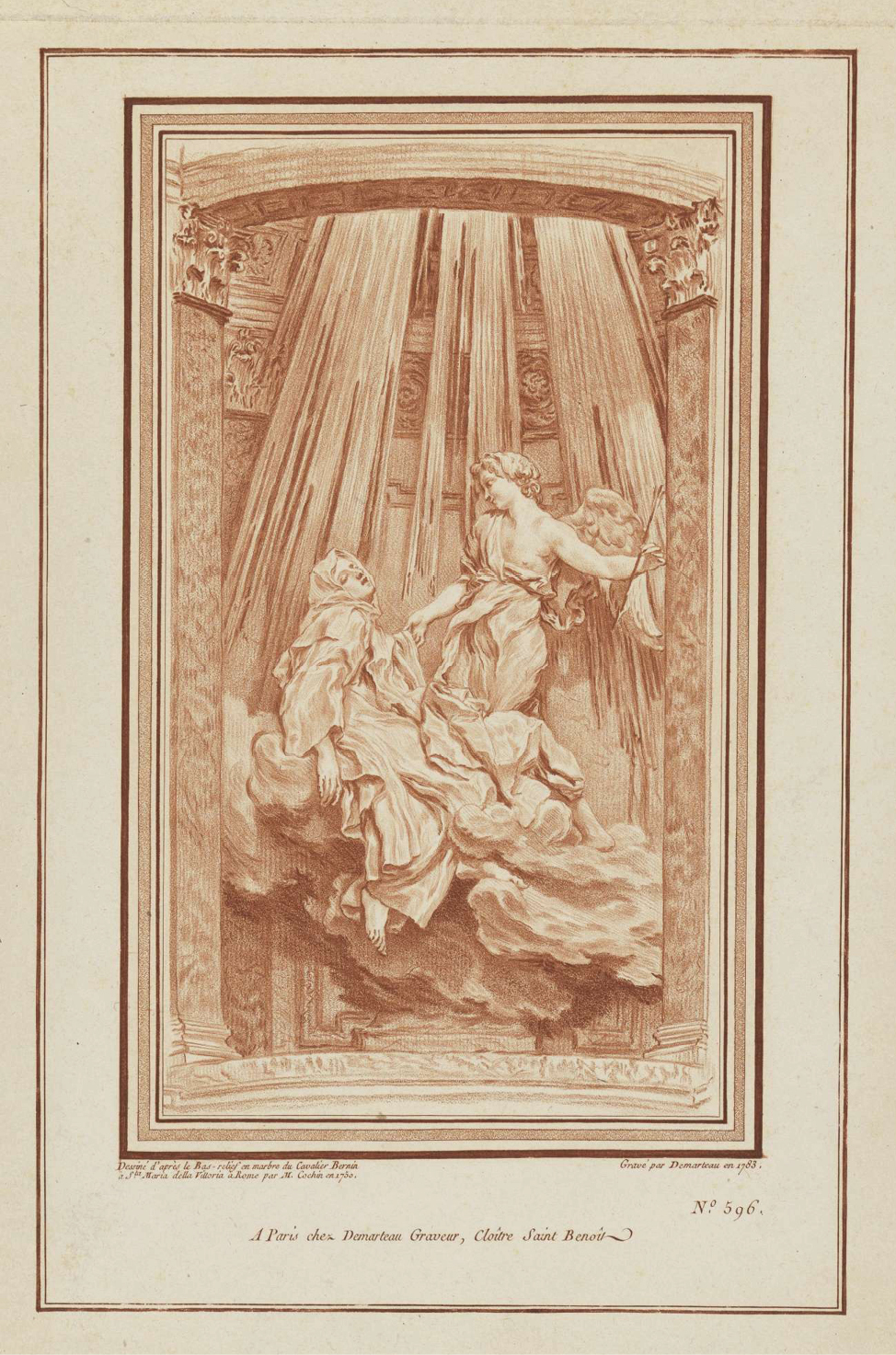
To use a term coined by Aby Warburg, the comparison between Bernini’s and Cochin’s ‘stagings of light’ reveals an «“energetic transformation” of traditional iconographic patterns»26. We might further ask if the aesthetic overpowering of the viewer, which is characteristic of Baroque art, is passed on to Cochin’s decidedly ‘enlightened’ representation of the performance of Truth. This reading is suggested by the strictly hierarchical structure as well as the light emanating from behind Truth, which does not completely dazzle the viewer simply because personified Truth is situated in front of it. Cochin’s picture has traits of religious triumphalism – not in its meaning, but in its representational techniques.
Significantly, central pictorial elements of the Encyclopédie frontispiece, which were Cochin’s invention, return again in Catholic church art: A ceiling fresco from the Upper Bavarian monastery Polling, created in 1778, virtually copies Cochin’s central set of figures with Truth to be unveiled in the centre, flanked by Imagination and Reason (fig. 6). The only significant change in the central constellation of figures is the posture and activity of the figure sitting at the feet of Truth: it does not turn away from Truth, but plays the largest part in unveiling it. The flame above her head identifies the seated figure as a representative of sharp intellectual acumen. This could refer to both source-critical historiography and philosophy itself (the latter would correspond to traditional iconography)27; in any case, Baader’s seated figure has taken the place of Theology in the Encyclopédie’s frontispiece. In the context of a monastic library, this means that there is no contradiction between religiously revealed and critically discovered truth. The figures placed further down all have to do with historiography, because the fresco glorifies history – which shall act, of course, in the service of the theological truth. The fresco artist from Polling and his patron – Johann Baptist Baader (1717–1780) and Provost Franziskus Töpsl (1711–1796), who was familiar with Mabillon’s critical research in historical sources28 – must have identified in the structure of Cochin’s frontispiece an essentially religious pictorial language that was easy to re-catholicise. Undoubtedly, it was intended to remain recognisable so that the fresco would modify the frontispiece of the Encyclopédie, presumably in order to promote something like ‘religious enlightenment’29 or a critical approach to history that was understood as underpinning religious convictions.
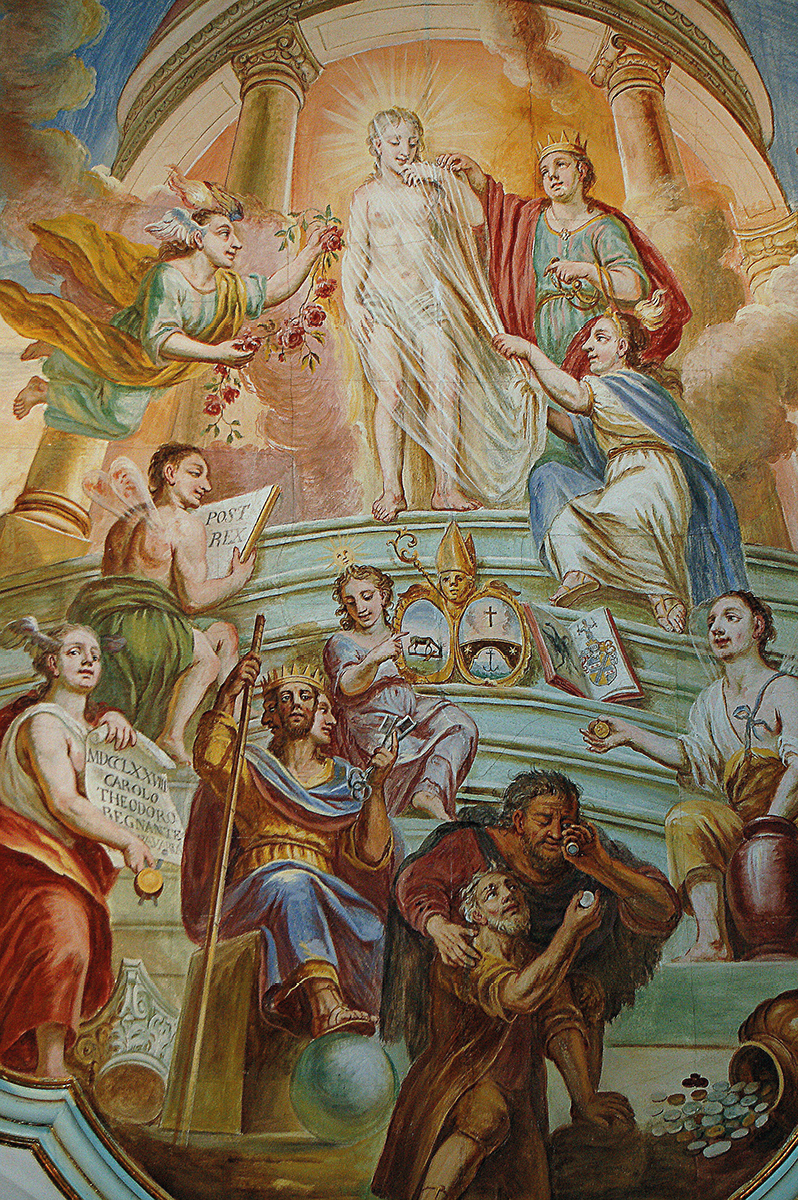
What we can conclude from our examination of the Encyclopédie frontispiece is that the distinction between triumphalist images and the more cautious ones is merely an idealization, while in the concrete image both types are mixed. Cochin presents Enlightenment as both something necessary and as something that asserts itself independently of certain situations. However, it stages the devaluation of theology only in a hidden, tactically cautious way, as well as the valorisation of imagination over reason. And this is precisely where it shows its dependence on the specific crisis in which the Encyclopédie found itself for many years.
III. Exploratory Enlightenment
The less triumphant, but more exploratory images of the Enlightenment typically do not show such a powerful source of light, but rather a small lamp or candle. One which is not able to dispel masses of clouds, but merely to illuminate the next part of the path. I will now discuss several examples but at lesser length than the frontispiece of the Encyclopédie. Once again, we will see that the triumphant and exploratory moments of the Enlightenment’s imaginary of light are not absolute opposites, but often refer to each other.
1. Diogenes
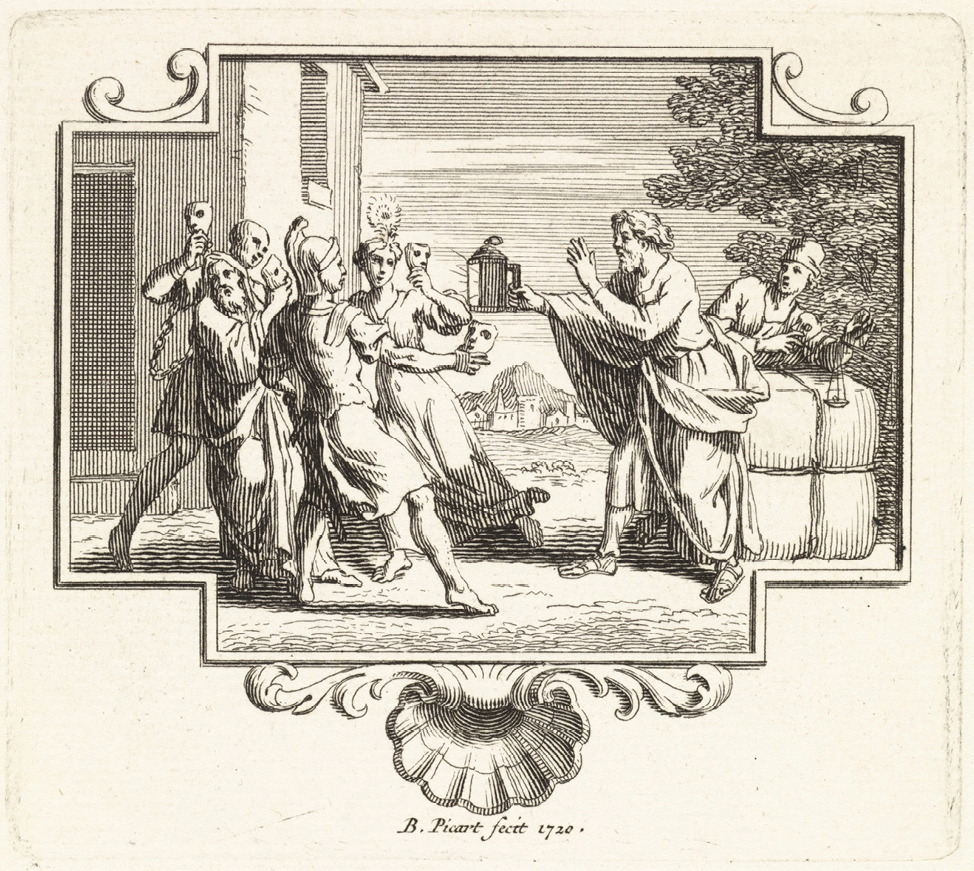
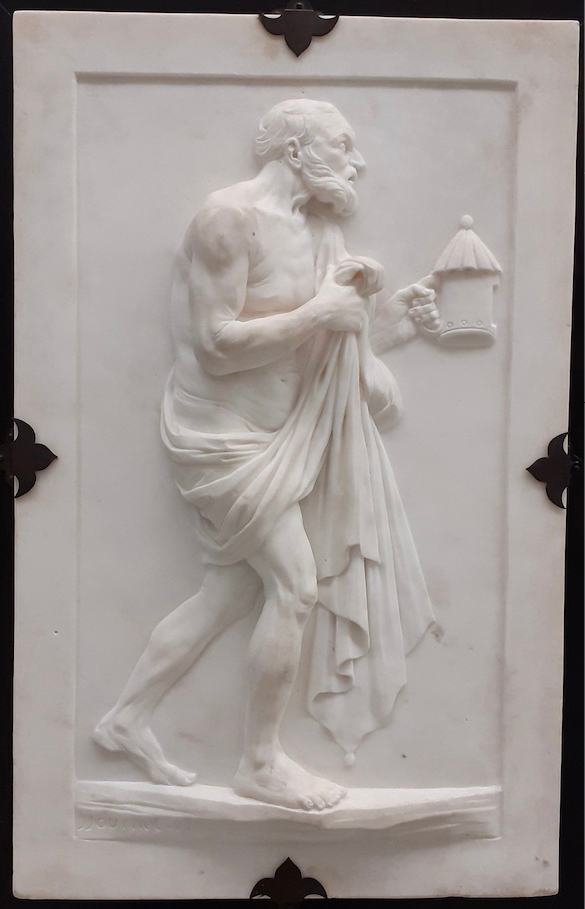
In the 18th century, the ancient Greek philosopher Diogenes was the very personification of a modestly appearing Enlightenment. His modesty characterises his lifestyle to an almost provocative degree, as his home is said to have been a barrel. Diogenes was ideally suited to be seen as an enlightener because of the well-known anecdote told about him that he used to walk around the city holding a lantern in broad daylight and, when asked by his irritated fellow citizens what this was all about, replied that he was looking for a human being (fig. 7 and 8). Of course, this was not a modest intention, but a fundamental diagnosis of deficits – the existing people were not ‘proper’ human beings – and a high normative standard. In their criticism of the status quo and their endeavours to educate ‘new people’, many Enlightenment thinkers could identify with this stance30. To appear in the role of the humble seeker was, as we shall see, not synonymous with a humility in the goals pursued.
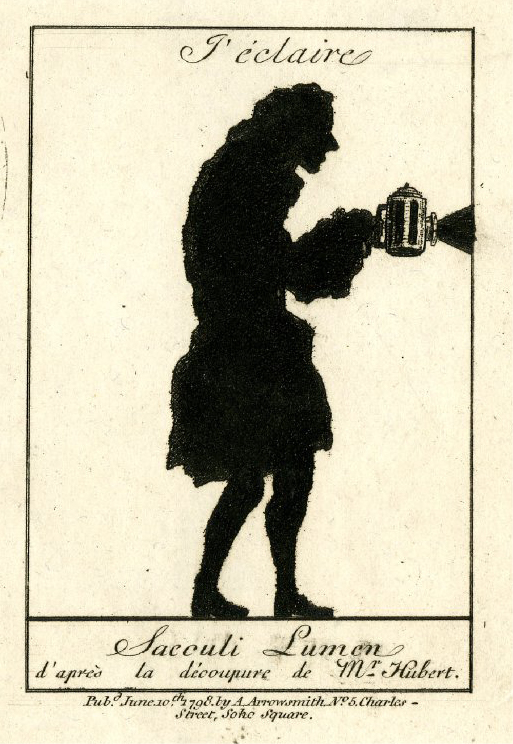
One of the many Voltaire silhouettes created by Jean Huber (1721–1786) is based on this model of Diogenes (fig. 9). In accordance with the silhouette technique, the full-body figure of Europe’s most famous Enlightenment philosopher and the beam of light from his lamp are all in black. The lamp itself, however, is not completely black, which I interpret as a self-deprecating play on the copperplate engraving technique – not in fact but in appearance. What is ironic above all, of course, is that Voltaire’s lamp radiates a black light, which contradicts both the motto «J’éclaire» and the caption «Saeculi Lumen». This irony should not be understood as a diminution of the great author or a limitation of the claim to enlighten that Voltaire embodies, but rather as a tactical step back in order to elevate him all the higher. With reference to his portraits of Voltaire, which often veer into caricature, Huber wrote to the author he admired: «il faut des ombres à votre portrait, []il faut des contrastes à une lumière que personne ne pourrait soutenir»31. (‘you need shadows in your portrait, []you need contrasts in a light that no one could sustain’.) The above engraving works with this principle of contrast on several levels: in terms of representation, through this contradiction between the black of the silhouette style and the claimed emission of light; in relation to the represented person, i.e. Voltaire, through the fact that a single author – even one bent by age – is glorified as the bringer of light for an entire century. By sketching a tentatively exploratory Enlightenment of comprehensive scope, the engraving made after Huber’s silhouette is a small masterpiece of contrasting – but not contradictory – signals.
2. Experiment with spectators
In 17th and 18th century painting, lamps, candles, torches and other short-range sources of light gave rise to a genre of its own, which, in the tradition of Caravaggio, emphasised strong contrasts of light and darkness in predominantly dark rooms. Initially, the subjects were often religious, while in the 18th century scenes with scientific experiments and scholarly studies of a secular-humanistic nature began to gain ground. An outstanding representative of this more modern candlelight painting is Joseph Wright of Derby (1734–1797). An Experiment on a Bird in the Air Pump was created in 1768, soon presented at the Society of Artists Exhibition in London, was «immediately applauded by critics as an extraordinary picture» and disseminated throughout Europe by engravings32 (fig. 10).
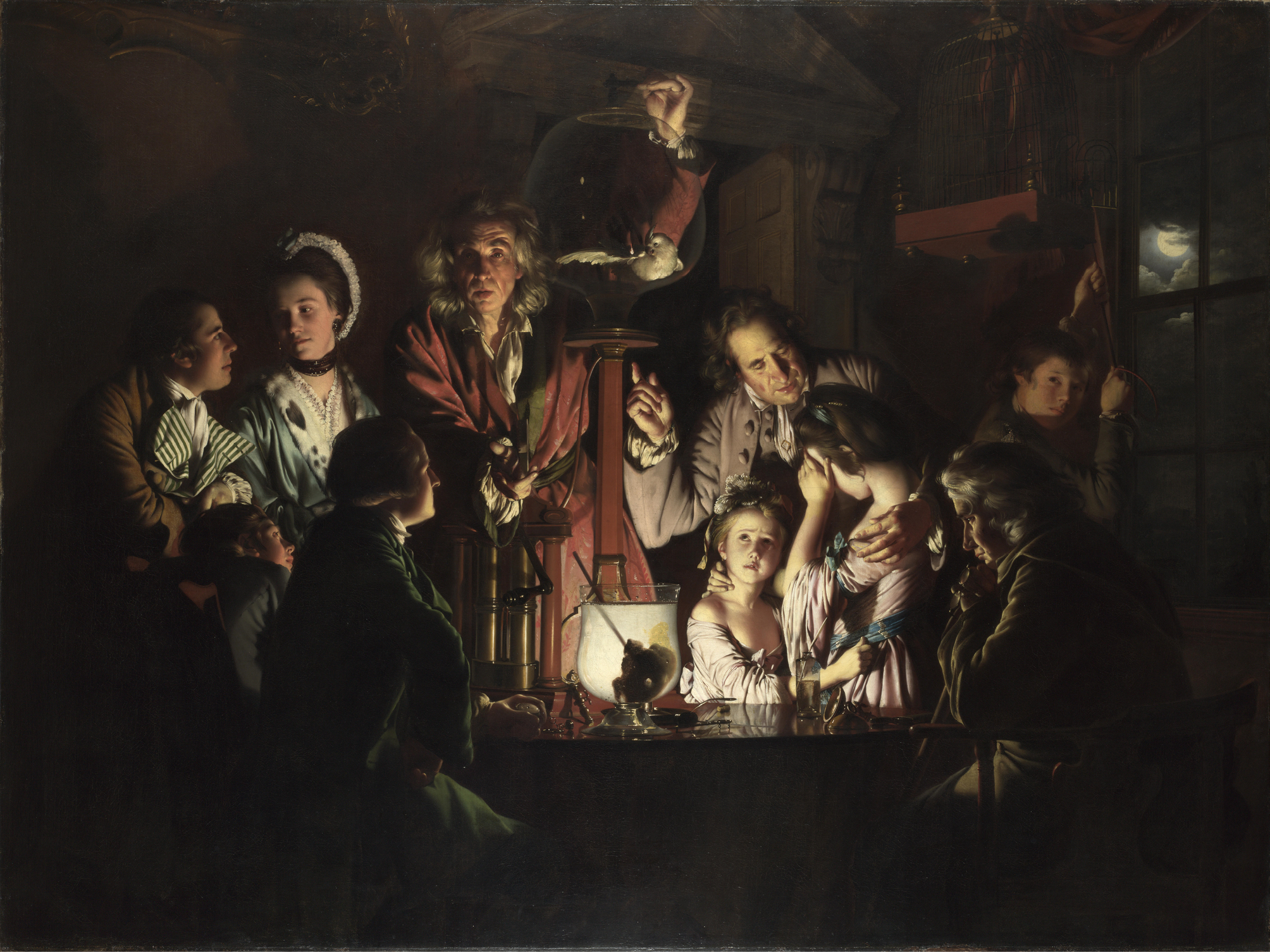
The painting is first about exploration in the more specific sense of a scientific experiment. Secondly, however, Wright does not only show the experiment – namely how a bird behaves in a vacuum – but also the reactions of an eight-people audience consisting of different ages and genders (additionally, there is the experimenter and, on the far right, his assistant). The titular air pump and bird – which is deprived of breathing – are in the centre of the picture with the central axis cutting right through the bird, which is moreover at the same height in the picture as the origin of light in the frontispiece of the Encyclopédie. However, the better-lit viewers grouped around them attract at least as much attention. They exemplify a broad spectrum of reactions: from the wonder and fear of the two girls to the attentive curiosity of the boy on the left, which contrasts with the amorous fixation of the young woman standing beside him on her companion. The friendly explanation with which the presumed father tries to reassure his daughters, and the musings of the two men in the foreground, one young with a raised head and one old, who is not looking at the bird but at the light source. Unlike the bird experiment, this exploration in affects is not merely shown by Wright, but he also conducts it with his own artistic means himself. His painting can be understood as a demonstration of the different preconditions that Enlightenment meets within those being enlightened and how different effects are its result. Furthermore, the gazes that the experimenter and his assistant on the far right direct at the viewer of the picture can be understood as a request for the viewers to recognise themselves as the addressees of the experiment and ask themselves how they would receive the ‘enlightenment’ offered. As we see, the exploratory attitude involves carefully considering what reactions enlightenment will encounter in specific cases with specific people. Therefore, it seems impossible that Enlightenment could take place solely as an ‘act of transmission’ or the sending of a message by the more knowledgeable person.
Although Wright makes it unusually clear how important the reception side is for any enlightenment, he also provides the production side with highly ambitious attributions. In his painting, the experimenter is a «magus-like figure»33 and the master of life and death. The bird in the vacuum pump can only live if the experimenter opens the air supply – just as God breathed life into man with his pneuma and will take it away again (Psalm 104,29, King James version: «thou takest away their breath, they die, and return to their dust»). Art historians see further allusions to Christian beliefs: to the Holy Spirit, conventionally depicted as a dove (although not as a white cockatoo), to the Trinity (for which one must include the assistant in the son’s age) or to the globe, which could be represented by the glass sphere, or to vanitas, the finiteness of all earthly life, to which the object interpreted as a skull in the illuminated liquid of the large glass vessel on the table refers34. What this means for the painting’s message would have to be discussed: an apotheosis of the scientific experiment? A sacralisation of the Enlightenment? Or do the religious allusions mark a framework that is to be confirmed rather than inherited by the scientific experiment35?
An Experiment on a Bird in the Air Pump is thus also relevant to the subject of crisis. From the Latin meaning of the word in Galen, which dominated until modern times, crisis is the point at which it is decided whether a patient recovers or dies36. The bird, which is on the verge of suffocation, is precisely in crisis in this literal sense. Wright implies that the bird will live because the experimenter wants it to live, as the assistant is already working on the cage again, which is only needed for this ‘happy ending’37. The painting conveys confidence in good outcome, which is both Christian and in the spirit of the Enlightenment.
3. Increased caution in the revolutionary crisis of the Enlightenment
The last image I will analyse here shows almost nothing but a small oil lamp. Its modest size can be measured in comparison with the herbs and grasses in the foreground. The engraving (fig. 11), which is not large anyway, depicts a very small section of the world with a narrow angle of view, as can be seen from the strong depth gradation. The positioning on a slight elevation free of vegetation nevertheless lends the lamp dignity, and the strong white-black contrast around the flame accentuates the difference that a light, however small, makes when it is dark all around. Overall, the illuminating effect may not be overwhelming – at least it is a far cry from Cochin’s vision of the epiphanic truth – but it is significant. The picture serves as the cover vignette of the first volume of the journal Neues Patriotisches Archiv, published by the former Hessian minister Friedrich Carl von Moser (1723–1798) in 1792–94. The caption explains: «To illuminate, not to ignite» – meaning that the Enlightenment the journal represents increases knowledge, eliminates errors – perhaps also exposes grievances – but does not endanger the social order.
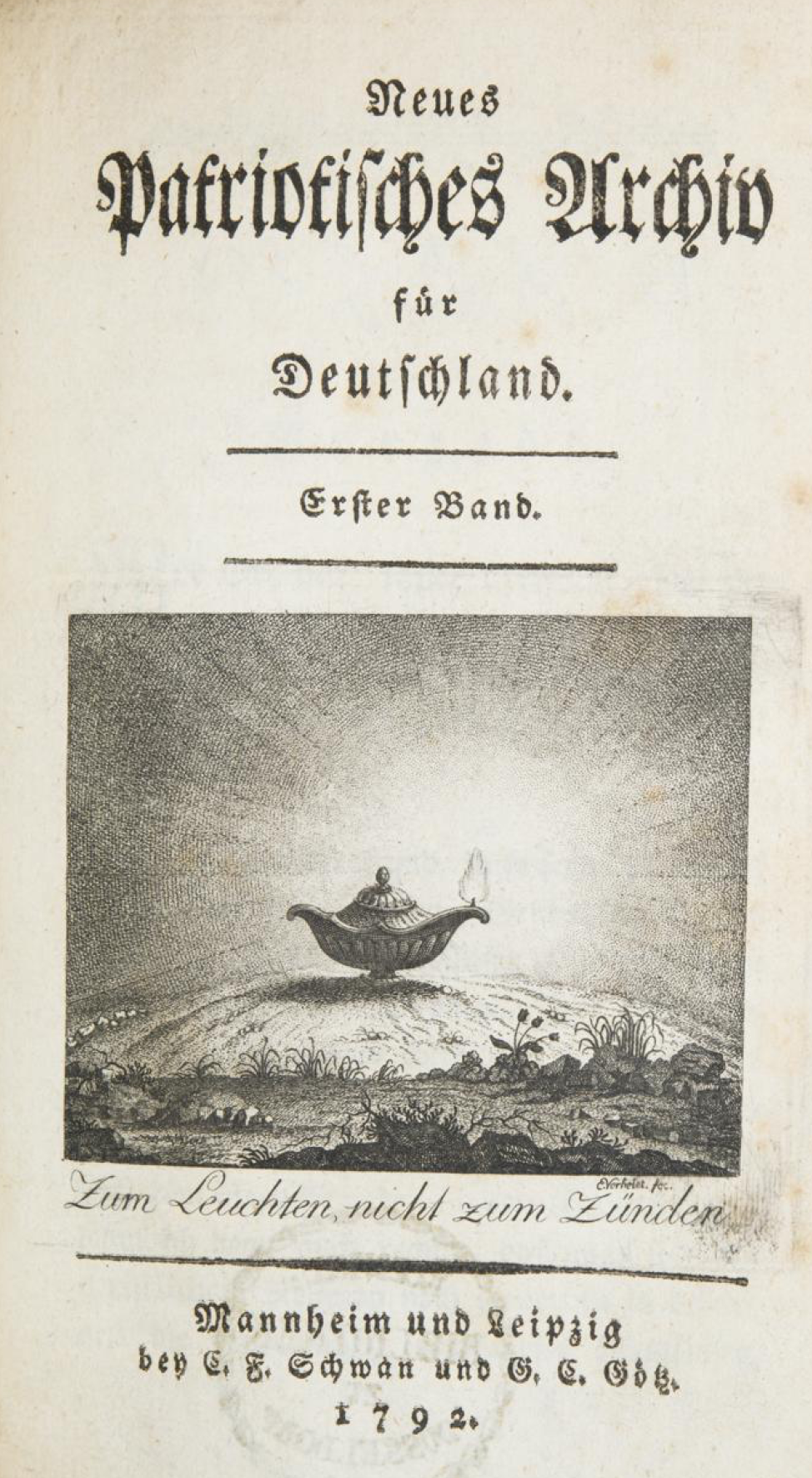
Metaphorically posing the alternative ‘shine or burn?’, pre-revolutionary Enlightenment thinkers had already discussed the question of where the Enlightenment ceases to be beneficial and it becomes harmful due to the undermining character of its criticism38. The Berlin clergyman Johann Friedrich Zöllner (1753–1804), who first formulated the question «Was ist Aufklärung?», to which Kant gave his famous answer, published a satirical animal fable in verse in the same magazine, the Berlinische Monatsschrift, which can be understood as a plea against playing with fire: The monkey ‘Hans’, meaning the simple-minded ordinary citizen, «once set fire to a grove / of cedars at night» («stekt’ einst einen Hain / Von Zedern Nachts in Brand») and rejoices in the luminous fire39. The fact that his brothers applaud him does not make the situation any better, while Zöllner makes explicit reference to the Enlightenment: «Hans Monkey is worthy of posthumous fame, / he has enlightened the area.» («Hans Affe ist des Nachruhms werth, / Er hat die Gegend aufgeklärt.»)
After 1789, most Germans wanted even less to “set anything on fire”. Instead, the title vignette of the Neues Patriotisches Archiv is intended to show that even a small, harmless lamp can provide a powerful light and enable better vision. It defends the Enlightenment against both those alarmed by the revolution in the neighbouring country, who want to keep the social status quo, and against the hotheads in its own camp who want to progress from intellectual to social reforms. Once again, we encounter a figuratively programmatic reaction to a situation of crisis, which, in this case, affected, threatened and challenged the Enlightenment as a whole. In Germany, only very few Aufklärer were prepared to follow the radical path of the French revolutionaries40. At best, the majority called for the social situation of the disadvantaged to be improved through reforms from above, but certainly not through an expansion of political participation. However, the limitation of Enlightenment for the educated, which Moser and most Enlightenment authors took for granted, was criticised as well. As Friedrich Nathanael Volkmar (1750–1794) sarcastically commented on the image and the motto «To illuminate, not to ignite»: In the weak light of such a small lamp, «the truth should only be illuminated to a certain degree»41. With such a light, «you put a handful of truths on display that, in your opinion, the audience is allowed to buy […]; the remaining truths must not be circulated». The message of the title vignette is that the people should be denied complete Enlightenment, Volkmar criticises. Enlighteners like Moser «paint themselves with a love of freedom», but draw «lines of demarcation in popular Enlightenment» (in German: Volksaufklärung).
IV. Conclusion
The pictures we examined are very diverse in terms of their choice of motif but are united in the way they emphasise the radiance of the light they depict. However, how they depict it, its size and its illuminating power, varies widely. The ‘attitude’ of the various pictures is also not uniform: they are partly offensive, partly defensive, partly exemplary, partly principled, partly propagandistic, partly ironic, partly anecdotal, partly encyclopaedic, partly monumentalising, partly mocking (at least at first glance) – contrasting attitudes which are sometimes even mixed within one picture.
Pictures summarise what contemporary texts express in a much more expansive way. However, such manifest images also generate mental images, which they can solidify or set back in motion. This happens when we interact with them: when we design, produce and view them, when we buy, sell or give them away, when we reproduce, modify and parody them, when we contemplate them reverently or when we vigorously publicise them. Especially when large quantities of images are involved and certain ways of dealing with them are repeatedly practised by many people, we can assume that manifest images correspond to collective mental images. When it comes to serial products rather than individual works, images – like other media – imply collectivity simply by virtue of the fact that they are designed for use by many and that those who deal with them are also aware of this42: The gaze of the many is directed toward, and coordinated by, reproduced images.
The pictures under consideration do not create a uniform image of Enlightenment, but it is one and the same Enlightenment whose profile they are working on. The idealised distinction between triumphant and exploratory Enlightenment that we started from is not sufficient to grasp the diversity of the images created. However, this distinction can help us to categorise how Enlightenment thinkers have been dealing with challenging crises.
What I don’t see in crisis is the concept of Enlightenment itself. The criticism mentioned at the beginning – that we are only analysing a construct that scholars have created retrospectively – is wrong. As the images we have looked at show, the historical actors of the Enlightenment were already concerned with the question of what is Enlightenment, what it can, and should, be, which is by no means only true of Kant and his famous essay from 1784 «Beantwortung der Frage: Was ist Aufklärung?»43. The multitude of answers given to this question makes the Enlightenment a much stronger topic than a uniform understanding – which some people miss – ever could.
1 P. Hazard, La Crise de la conscience européenne (1680–1715), Boivin, Paris 1935.
2 Idem, p. 465.
3 Cf. N. Dhawan, Rescuing the Enlightenment from the Europeans: Critical Theories of Decolonization, Duke University Press, Durham, NC 2026.
4 J.C.D. Clark, The Enlightenment: An Idea and its History, Oxford University Press, Oxford 2024.
5 Cf. R. Mortier, «Lumière» et «Lumières», histoire d’une image et d’une idée, in Idem, Clartés et ombres du siècle des Lumières: Etudes sur le XVIIIe siècle littéraire, Droz, Geneva 1969, pp. 13-59; M. Delon, Enlightenment, Representations of, in Encyclopedia of the Enlightenment, ed. by Idem, Fitzroy Dearborn, Chicago 2001, vol. I, pp. 457-462; D. Fulda, Die Erfindung der Aufklärung: Eine Begriffs-, Bild- und Metapherngeschichte aus der ‘Sattelzeit’ um 1700. «Archiv für Begriffsgeschichte», 64, 2022, 1, pp. 7-100.
6 Cf. C. Rosso, Inventing «illuminismo» (and «enlightenment»): The emergence of a word and of a concept, in Historiographie et usages des Lumières, ed. by G. Ricuperati, Spitz, Berlin 2002, pp. 123-132.
7 On the correlation between imaging and the imagining of the Enlightenment see D. Fulda, Identity in Diversity: Programmatic Pictures of the Enlightenment, «Journal for Eighteenth-Century Studies», 45, 2022, 1, pp. 43-62, open access: https://onlinelibrary.wiley.com/doi/full/10.1111/1754-0208.12781.
8 K. Stieler, Der Deutschen Sprache Stammbaum und Fortwachs, oder Teutscher Sprachschatz […], Hofmann, Nürnberg 1691, c. 968f.
9 More about the frontispieces to Wolff’s and Voltaire’s books and their respective context at Fulda, Identity in Diversity, cit., pp. 45-54.
10 V. Ferrone, The Enlightenment: The History of an Idea. Updated edition with a new afterword by the autor, Princeton University Press, Princeton 2015.
11 Jaucourt, s.v. «Zzuéné», in Encyclopédie, ou Dictionnaire raisonné des sciences, des arts et des métiers, éd. par J. le Rond d’Alembert and D. Diderot, Briasson-D.-le Breton-Durand, Paris 1751–1772, vol. XVII, p. 751; G. Stenger, Le Triomphe des Lumières. L’Encyclopédie de Diderot et d’Alembert (Paris 2024), p. 286, 338. Surprisingly, the frontispiece is not discussed by Stenger.
12 See A. Fowler, The Mind of the Book: Pictorial Title Pages, Oxford University Press, Oxford 2017.
13 We do not know exactly when the commission for the frontispiece was made. G. May, Observations of an Allegory: The Frontispiece of the Encyclopédie, «Diderot Studies», 16, 1972, pp. 159-174, here p. 163, assumes that Diderot only had the idea of adding a frontispiece to the Encyclopédie after meeting Cochin, and «conjecture[s] that the frontispiece was ordered around 1763» (p. 164).
14 A. Perrig, Das Frontispiz der Encyclopédie oder die hohe Kunst der Verblümung, «Idea», 9, 1990, pp. 67-92, here p. 74.
15 D. Diderot, Prospectus 1751 [i.e. 1750], in Encyclopédie, cit., I; J. Le Rond d’Alembert, Discours préliminaire, in Idem, vol. I, pp. i–[lii].
16 D. Diderot, Œuvres completes, vol. 16, Beaux-arts I: Salon de 1767. Essais sur la peinture, présentée par E.M. Bukdahl, M. Delon, A. Lorenceau, Hermann, Paris 1990, p. 501: «la ressource d’une tête stérile, faible, incapable de tirer parti de la réalité et appellant l’hiéroglyphe à son secours».
17 R. Darnton, The Business of Enlightenment. A Publishing History of the Encyclopédie, 1775–1800, Belknap of Harvard University Press, Cambridge, Mass. 1979, pp. 12f.
18 Perrig, Das Frontispiz der Encyclopédie, cit., p. 77.
19 The «explication du frontispice de l’Encyclopédie» first appeared in 1772 together with the frontispiece and is now bound into many copies of the first volume of the complete work, usually at the beginning, without pagination.
20 Perrig, Das Frontispiz der Encyclopédie, cit., p. 76.
21 D’Alembert, Discours Préliminaire, cit., p. xvj.
22 Diderot, Prospectus, cit., p. 4: «Un coup d’œil sur l’objet ou sur sa représentation en dit plus qu’une page de discours».
23 H. Damisch, Théorie du / nuage /: Pour une histoire de la peinture, Seuil, Paris 1972, pp. 67f.
24 Perrig, Das Frontispiz der Encyclopédie, cit., p. 81.
25 On Cochin’s estimation on Bernini, see C. Michel, Charles-Nicolas Cochin et l’art des lumières, École Française de Rome, Rome 1993, p. 260, 374; E.M. Bukdahl, Baroque, in Encyclopedia of the Enlightenment, cit., vol. I, pp. 164-169, here p. 164.
26 A. Warbung, Allgemeine Ideen, in Idem, Notizbuch, 1927, p. 20, London, Warburg Institute Archive, cited by M. Schieder, «Aufklärung», in Handbuch der politischen Ikonographie, hrsg. von M. Warnke, U. Fleckner, H. Ziegler, Beck, Munich 2011, vol. I, pp. 95-102, here p. 96.
27 Cf. R. van Dülmen, Propst Franziskus Töpsl (1711–1796) und das Augustiner Chorherrnstift Polling: Ein Beitrag zur Geschichte der katholischen Aufklärung in Bayern, Laßleben, Kallmünz 1967, p. 58, who writes: «Reason kneels before the throne of Truth. […] History shows her the way and unveils the truth» However, Reason is the figure standing next to Truth wearing a crown. Van Dülmen does not seem to have had the actual painting in mind; he bases his interpretation on the instructions to the painter documented in a letter from Steigenberger to Töpsl (29 January 1778) (quoted by van Dülmen in note 39).
28 Cf. H. Fuhrmann, Franziskus Töpsl über Paul von Bernried, in Land und Reich, Stamm und Nation: Probleme und Perspektiven bayerischer Geschichte, Festgabe für Max Spindler zum 90. Geb., hrsg. von A. Kraus, Beck, München 1984, pp. 340-353, here p. 351.
29 More generally, see D. Sorkin, The religious enlightenment: Protestants, Jews, and Catholics from London to Vienna, Princeton University Press, Princeton–Oxford 2008, p. 220 with reference to Töpsl.
30 The frequently political appropriation of the motif of Diogenes looking for a human being with his lamp until the revolutionary period is analysed by K. Herding, Diogenes als Bürgerheld, «Boreas», 5, 1982, pp. 232-254.
31 Correspondance littéraire, philosophique et critique par Grimm, Diderot, Raynal, Meister etc., éd. par M. Tourneux, Paris 1877–1882, vol. X, p. 98. Quote from a letter from Huber to Voltaire dated 30 October 1772.
32 S. Daniels, Joseph Wright, Tate Gallery, London 1999, p. 42.
33 Idem, p. 41.
34 W. Busch, Joseph Wright of Derby, Das Experiment mit der Luftpumpe: Eine Heilige Allianz zwischen Wissenschaft und Religion, Fischer, Frankfurt am Main 1986, pp. 29-49; J. Egerton, Wright of Derby, Tate Gallery, London 1990, p. 60. Busch considers the object in the liquid to be a lung, which refers to the theme of air and breathing (cf. p. 16).
35 Cf. Busch, Joseph Wright of Derby, cit., p. 56.
36 R. Koselleck, Krise, in Geschichtliche Grundbegriffe: Historisches Lexikon zur politisch-sozialen Sprache in Deutschland, hrsg. von O. Brunner, W. Conze, R. Koselleck, Klett-Cotta, Stuttgart 1982, vol. III, pp. 617-650, here p. 619.
37 Busch, Joseph Wright of Derby, cit., p. 16 and A. Hosseini, Die Experimentalkultur in einer Seifenblase. Das epistemische Potenzial in Chardins Malerei, Fink, Paderborn 2017, p. 132; against it Egerton, Wright of Derby, cit., p. 60.
38 See C. Streb, Radical writers and the media revolution in the late Enlightenment, Liverpool University Press, Liverpool 2024. The dissertation from which Streb’s book originated was entitled Light or Fire?
39 [J.F.] Z[öllner], Der Affe. Ein Fabelchen, «Berlinische Monatsschrift», 2, 1784, 2, p. 480. Zöllner’s fable occupies the last page of the November issue. Kant’s essay on the Enlightenment begins on the first page of the December issue. Ibidem the following quotation.
40 See Die Französische Revolution in Deutschland: Zeitgenössische Texte deutscher Autoren. Augenzeugen, Pamphletisten, Publizisten, Dichter und Philosophen, hrsg. von F. Eberle, T. Stammen, Reclam, Stuttgart 1989.
41 F.N. Volkmar, Abhandlungen über ursprüngliche Menschen-Rechte, Freyheit und Gleichheit. Nebst einigen rhapsodistischen Bemerkungen über demokratische und monarchische Regierungsform [Treatises on original human rights, freedom and equality. In addition to some rhapsodic remarks on democratic and monarchical forms of government], Korn, Breslau 1793, pp. 27f. Ibidem the following quotations.
42 Cf. R. Darnton, The revolutionary temper. Paris, 1748–1789, Allen Lane, London 2023, pp. XXVIf.; theoretically about the «collectivisation of imagination» by images cf. S. Strehle, Kollektivierung der Träume: Eine Kulturtheorie der Bilder, Velbrück, Weilerswist 2019, pp. 105-114.
43 Kant’s question was the subject of extensive debate, both before and after his response. Numerous translations of these texts into English are available at What is Enlightenment? Eighteenth-Century Answers and Twentieth-Century Questions, ed. by. J. Schmidt, University of Berkeley Press, Berkeley–Los Angeles–London 1996, pp. 49-231.