https://doi.org/10.36253/ds-16567
What the ‘Workshops of Nature’ should represent in the Eighteenth century1
a Ca’ Foscari University of Venice, Italy
b Laboratoire “Etudes sur les sciences et les techniques”, Paris-Saclay University, France
c Centre Alexandre-Koyré (CNRS, EHESS, MNHN), Paris, France
Abstract. What happens when we explore the link between working on site and working in workshops? In such a framework, it makes sense to bridge a various set of practices not restricted to science: a local site is the constantly evolving product of the practices, imaginations, and negotiations of the users (scholars, travelers, artists, inhabitants) of a given place. In any case, our idea is that it is the scholar’s task to relate the experience of a site en plein air to the atelier phase of knowledge production, by which nature can be recreated (painters), transformed (laboratories), classified (collectors) etc. Workshops and sites of natural interest are hybrid fields of material and knowledge production, places where materials are often transformed by means of knowledge and where knowledge is transformed by the materials involved in its development. Moreover, this continuous exchange is the means by which borderline scientific disciplines (for example the chemistry, mineralogy and geology of the second half of the 18th century) can be cultivated in a site that is not simply the theatre of these transformations but an active element of transformation too. This essay also aims to provide a review for the Italian public of studies about savoirs opératoires et lieux de savoirs. Our focus on “sites” of knowledge makes it easier to show how the production of material knowledge is represented; but it also allows us to assess how the material (re)production of knowledge in images, literature and collections is constructed and curated.
Keywords: materials, mountains, environment, representation, geographies of knowledge.
Contents
Representation. Socio-material systems (images, stories, objects)
Materiality of knowledge
The material turn in knowledge has profoundly reshaped the disciplines of the history of science, technology, literary and visual studies in recent decades and has made it possible to pay attention to a whole set of practices that construct the investigation and organization of knowledge: observations, collection, classification, transcription, translation and experimentation. By re-evaluating the material conditions of intellectual work and conversely the forms of cognition at work in practical knowledge2, the re-evaluation of “knowledge of the hand”3 has emphasized the role of vernacular and tacit knowledge, while highlighting the forms of artisanal epistemologies from the Renaissance4 to the Age of Enlightenment5. These approaches have initiated several historiographical and methodological re-evaluations. As a result, the relationship between practical knowledge and theory6 has been increasingly called into question, particularly in the field of the history of chemistry where this is a more obvious concern for both practical and theoretical reasons.
From at least the eighteenth century, chemistry has been the preeminent science of materials, and the chemist has been an increasingly significant agent of the constitution of novel objects and their transfer to the wider world far from their apothecary shops and laboratories, and other places of material transformation7. This is one of the focuses that we aimed to bring to the monographic section. Materials regularly circulated between academic institutions as privileged sites of their production and consumption, each cycle having the potential to produce new knowledge. We see this by studying the techniques through which a material transformation is obtained as well as by studying the natural processes of material transformation. As Marcelin Berthelot astutely remarked, chemistry is the science which creates its own object8. It has done so by both analytical study of the natural processes of material transformation, and synthetic techniques for obtaining new transformations.
Historians of chemistry, but also of science in general, have proposed approaches pertaining to the production of knowledge that consider both the contributions of the history of material culture and that of experimentation, taking into account the historicity of our perceptions and categories in order to better understand the material operations of past times9.
Questioning the history of the investigation of nature by the method of practical experimental replication10, Lawrence Principe, for example, reproduced the experiment with the “Bologna stone”11: the undertaking here required reconstructing the entire cycle from the precise place of collection to the reconstruction of the furnace12. The proliferation of these experimental approaches – for instance on the reconstruction of chemical processes or for the reproduction of recipes13 – has brought to light the spaces, materials and instrumental devices involved. They have encouraged the re-evaluation of a set of practices, know-how and gestures14 interrogating the relationship between the “arts” (from the arts of making to the fine arts) and the sciences, highlighting in the process the tacit knowledge, actions and skills deployed historically by craftsmen and practitioners. Finally, they have made it possible to consider all the sites where work on materials and substances is carried out, whether they are workspaces (workshop, kitchen, back-room, garden) or unique natural sites15.
The idea of replication is complementary to the works published in this monographic section on material production linking in situ analysis, field experiment and workshops. Take as an example the efforts of the painters analyzed by Beck-Saiello who use all their artistic experience, naturalistic observation and technological means to restore the materiality of the eruptions of Vesuvius in painting. The author speaks precisely of a struggle against two-dimensionality, of a continuous search for efficacy, made up of experiments upon experiences and attempts in situ to capture the volcano erupting.
Attention to material systems informs two currents that run through this monographic section. On the one hand, we have the “places of knowledge(s)”, the “conceptual and technical gestures” and the “artefacts” – essential vectors for the construction of knowledge16. They constitute a major dimension of our investigations here into the in situ experience on remarkable sites. On the other hand, we have the restitution of these places, gestures and artefacts by multiple “intermediate objects”17. The mediation produced by these “Early Modern Things”18, such as anatomical models, herbariums or machine models19, has animated networks of scholarly exchanges, transactions and markets since early modernity; in turn producing new measuring instruments, conservation objects, but also new optical, pictorial and graphic techniques. Matter here also means the human body that chemically interacts with materials, their smells, their textures, their reactions. In this case, Faujas Faujas de Saint-Fond testifies to these corporeal interactions, as McCallam illustrates well; but we could equally cite the famous abbot Jean Antoine Nollet (1700-1770) kneeling to “breathe” the mephitic substance that filled the dog’s cave near Naples20. In this holistic experience (physical, intellectual, ethnographic and aesthetic) Faujas tries to revive extinct volcanoes by effecting, as McCallam puts it, an “epistemological extraction”, since “knowledge is mined in this fieldwork experience”.
Knowledge of materiality
It is a question of studying both the conceptual and material dimensions of the way in which human perception evolves in its relationship to the natural world. Performative intellectual tools, such as metaphor and analogy21, active in imagination and common to creativity, have drawn attention to narrative and visual “techniques” and to knowledge construction as narratives22. From the understanding of nature to technical action, theatricality was consubstantial with the way in which early European modernity organized its relationship to the world (“spectacle of nature” or “theatre of natural history”23), staging the ordering of knowledge. So the metaphor of the “workshop of nature”, with which we introduce this monographic section, indicates the emergence of new social sensibilities that emerged during the 18th century. For instance, it invites us to explore knowledge about matter in the multidisciplinary articulation of the social history of naturalist practices, chemical knowledge and craft practices implied in a material approach to painting. A common etymology links the laboratory and the workshop from the Latin verb laborare, meaning the place of work, of industry. Likewise, the space of artisanal knowledge24, in which the exploration and exploitation of the mysteries and “secrets”25 of nature generates its own set of observations and classifications of its products, forges further links between the practical arts and natural philosophy. “The workshop of nature”, referring on the one hand to the workshop, as a place of transformation of matter, and on the other hand to the site of nature itself where transformations occur, makes it possible to capture the various ways of apprehending natural phenomena, their metamorphosis during the modern era, as well as the modalities of their plural restitutions.
When we examine, for instance, a workshop whose operational tools cannot be separated from the landscape where the workshop is set, or a site of natural interest where we attend to the material productions created by geo-chemical conditions not replicable elsewhere, we must take into account a special kind of knowledge production, which deserves a new, broad description in terms of its multidimensional relationship and historical evolution.
Moreover, this continuous exchange is the means by which borderline scientific disciplines can be cultivated in a site that is not simply the theatre of these transformations, but an active element of transformation too.
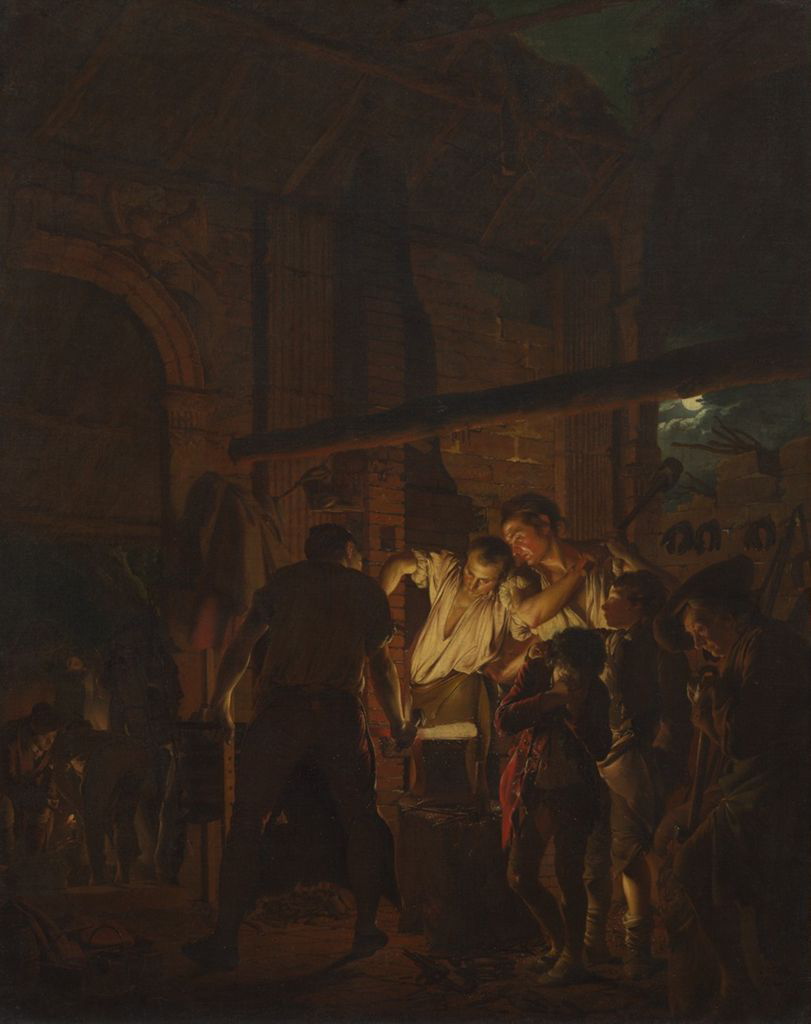
Two pictures can easily summarize the idea of “workshop of nature”:
In fig. 1, it is easy to recognize a workshop where people could produce materials on the basis of their knowledge, sheltering their work from the forces of nature, here represented by the rain.
In fig. 2, there is a volcanic eruption, a force of nature, its productive power framed by a delightful landscape. The painting is an attempt to reproduce this event, but it is also an attempt at something else combining the result of scientific reports and particular the knowledge of the artist. In fact, the right-hand side, where the moon shines on the islands of Capri, Ischia and other isles, does not actually correspond to the geography of the area from this perspective.
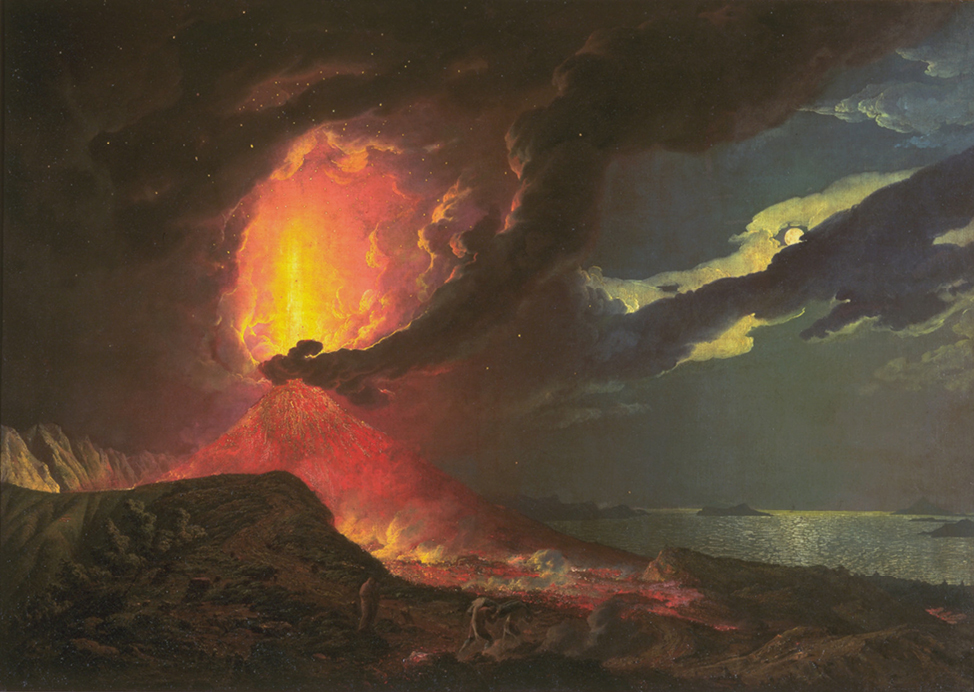
In the case of both images, sites and knowledge as savoirs have a crucial role in investigating and elaborating the transformation of matter. The process is like a loop, where the elements can be moved in order and importance, but they remain defined by their strict relationship with each other.
Initially proceeding from a one-day conference that brought together research papers about forms of operational knowledge on matter (from alchemy to chemistry) as well as the practice of science performed in the open air, our aim was to compare a variety of situations studying the back-and-forth between the construction of knowledge and the engagement with the materials of nature, in situ or back in the workplace26. We started from the premise that a set of diverse activities could not be limited to scientific practices in a strict sense: a local site is the result of a constant evolution of practices, imaginations and negotiations between its various users (scientists, travelers, artists and craftsmen, local inhabitants). The way in which the sites were explored, observed and studied suggested a set of hypotheses for investigators and practitioners of the time: the environment of islands such as the Seychelles in the middle of the Pacific27, with its fauna and flora, or the evidence of the formation of mountains28, the role of fossils as archives of the land29, the record of volcanic events through the curious geological nature of basalt and other minerals, or the properties of the alum production process30. It was a question of carefully reassessing the importance of the physical situation – spatial frames, tactile gestures and sensitive corporeality – in the production of knowledge. From the representation of nature to the recreation of its specific strengths and properties, in each of the case studies, we wanted to examine several types of operations that refer to this co-evolutionary relationship between humans and the environment.
A new relationship with the elements of nature seemed to emerge at the turn of the Enlightenment, modifying the perception of human beings and their action on the natural world. Environmental studies have since focused on the question of the Anthropocene31, resituating the change brought about by industrialization in our modern landscapes and environment32. Considering materiality all around us as a “resource” has changed the way the landscape as a whole has been shaped by humanity, in its analytical production as well as in its “workshops”. Mineralogy was a major dynamic in the useful exploitation of subsoil resources, which intensified during the eighteenth century. In France, for example, the constitution of the Atlas minéralogique de la France by Guettard (and his collaborators)33 aimed to represent «the nature of the substances contained in the interior of the earth», and to provide a geological section of the soils; while during the Revolution a school of mining engineers (as École Polytechnique) was established34, inspired by the knowledge of the Freiberg school35. The exploitation of mineral resources towards the end of the eighteenth century allows us to see economic investment as a driver for the way in which the landscape is transformed into gigantic open-cast industrial workshops, such as those used in the production of alum in Yorkshire and Scotland in the early modern period36. Requests for rocks samples came from scientists from half of Europe to Genevans, who in turn mobilized the networks of the inhabitants of the Alpine slopes and thus encouraged the convergence of academic knowledge and indigenous environmental knowledge37. This workshop of nature, as René Sigrist shows, contributed to the “invention” of the Alps. At the beginning of the nineteenth century, in fact, the Ecole des Mines du Mont-Blanc was founded in Moûtiers in the Tarentaise near the old lead and silver mines of Pesey.
The interest in the transformation of landscapes by extractive activities, and the way in which they have shaped the landscape and its perception, has recently been the subject of new research that shifts the focus from early modernity38 to draw the contours of an Early Modern Anthropocene39. Similarly, the emotional attraction to the mountains, described as an eighteenth-century phenomenon, has been relocated in an older practice of travel40.
Conceiving of nature as a workshop thus refers to the changes that took place in the early modern era concerning the natural elements and the activities of humans, the desire to control and manipulate the elements of nature that fostered the emergence of new forms of production, and opened up potential disconnections between humanity and the natural world, including discordant conceptions of temporality41, history, evolution or change over time, the chronologies of which must be re-examined over long periods.
(Sensitive) Environment
Knowledge of nature, linked to places, is part of a situated geographical approach to knowledge42. By refocusing the analysis here both on the mountains, an object of research in themselves43, and on the last third of the eighteenth century44, the present monographic section – notwithstanding the historiographical renewal of these early modern environmental approaches – revisits a key moment of transformation: that of natural history through the lens of these new disciplines of the time (chemistry, mineralogy, geology, botany) and its multiple material restitutions (artefacts, specimens, literary and artistic production). It examines the way in which the comings and goings between natural sites as places of knowledge, theatres of measuring operations, of collections, of plural sensory experiences, and their aesthetic and scholarly mediations, transform them into economic sites for the production of commodities, inscribed in networks of exchange and in the commercialization of knowledge. In conjunction with the mountains analyzed in the papers collected in this monographic section, the period was marked more broadly by the emergence of the study of volcanism at the very beginning of what we can call today volcanology, even seismology.
Building on existing studies of open-air science in the period, the importance of which has been underlined by the major contributions of Marie-Noëlle Bourguet and Christian Liccoppe45, the aim here is to focus on the multiple operations of capture, measurement, classification, comparison, restitution. The experience of mountain travel highlights the tensions between, on the one hand, sensory approaches as a vector of knowledge produced by experiences in situ and, on the other, the relationship of the latter to laboratory experience. It was through the immense work of field surveys that the young Lavoisier began his scientific research in the company of Guettard, in the Vosges during the summer of 176446, where minerals were screened and substances analyzed on site or in the laboratory. From geology to chemistry, from the understanding of rock formation to mountain panoramas, the juxtaposition of singularities and similarities feeds into multiple delocalized experiments, such as the circulation of representations and travelogues. It is therefore also a question of examining the way in which lived experiences, when confronted with their narrative and visual restitutions, in turn create new knowledge.
The eruptive activity of Vesuvius during this period is both an object of aesthetic fascination and a concrete place for testing scientific and pictorial theories, and thus a space for generating particular working practices on site or on the spot47. Chemical and physical reactions occurred at this time, the origins and effects of which must be understood.
Similarly, the extinct volcanoes of Vivarais and Velay invite us to speculate on the volcanic nature of basalt, following the example of the geologist Barthélemy Faujas de Saint-Fond who initiated a new discursive and pictorial system to this end. For Faujas de Saint-Fond, it was a question of transmitting new knowledge about mineral matter, an integral part of an environment that was – and still is – constantly evolving. This is therefore also historiographically useful to us when we want to study the present age, for if the environment is constantly evolving, as literary and artistic representation convey to us, then via these testimonies we can also reflect on the evolution of our own adaptation to the changing environment.
In order to understand this change, Faujas de Saint-Fond identifies an autonomous agency deploying its own practices of production, as McCallam observes in his essay: «Nature is both the craftsperson and the workshop she works in» – not only a wonderful workshop for human scientific discoveries. These conceptions also raise questions about what it meant to “do geology” in this historical moment, when travelers observed these material testimonies of a volcanic past, which had to be not only understood, but also reshaped and reinvented through multiple transcriptions intended for those unable to go there (in situ).
Representation. Socio-material systems (images, stories, objects)
Aesthetic production, a heuristic means of understanding, establishes direct sensitive epistemologies but it is also mediated by instrumental observations, the collection of curious specimens, and the reproduction of panoramic views such as those of the Alps or of the effects of molten lava flung into a night sky. It confronts the traveler first, then the reader, spectator or art lover with the work of nature, in a dubious game where the latter, through its spectacular mineral arrangements, seems capable of creating forms similar to those made by human engineering. Between the work of art and the production of nature, the work in situ, or the reproduction in the studio, comprise multiple comings and goings that restore the agency of phenomena and hint at causes through experience (sensitive and instrumental) without, however, fully divesting the sites of their persistent mysteries.
This is what happens in Beck-Saiello paper about the rendering of volcanic eruptions in brushstrokes, in Sigrist’s study about understanding the peculiar formation of Alpine mountains, and in McCallam’s article that reconsiders extinct volcanoes as readable rocks.
The three essays, which relate to three sectors of historical investigation, the history of art, the history of literature, and the history of science. All deal with the mountain: the unknown of Mont Blanc, the sublime of the erupting volcano, and the crystalline traces of an extinct volcanic chain. What the authors have in common is that they all work on the eighteenth century; and in all the papers, what is evident is the centrality of this century in coming to terms with the dynamics of their different workshops of nature.
Each contribution in this monographic section therefore insists as much on the modes of material production that situate the open-air experience as on the circulation of the material artefacts it produces, underlining the collaborative and social dimensions of these devices. The recent reconstruction of the barometer experiment of Jean-André de Luc (1727-1817) during his ascent of Mont Buet with Horace Bénédict de Saussure (1740-1799), and its mediation through the engravings of Marc-Théodore Bourrit (1739-1819), has shown the collective dimension of the expedition as well as its mediatization through scientific publications and printed guides48. These landscapes as sites of knowledge production provide new narratives, which involve an exchange of information, between networks of artists, travelers, geologists and chemists49, and the beginning of the tourism of the peaks50. If precise, first-hand travel accounts are published or methodical collections, attractive paintings and curious images are produced – inspiring new chemical processes in the laboratory with the collected samples (then widely disseminated through artefacts, books, articles in scholarly journals, engravings, models, maps) – these same cultural outputs are based on an intense network of invisible collaborations, which also distribute vernacular knowledge, as is the case for both the collection of plants supplying the herbarium markets51 and the trafficking of minerals to amateurs and institutions. The indigenous participation of peasants and the involvement of communities serving as guides interact with that of amateurs and markets, creating, through the circulation of samples, intermediate objects of knowledge52. The new material culture initiated by this culture of travel and in situ experience favors a technical inventiveness of forms and means of restitution, shaping new pictorial representations, engravings, painting and relief plans53. Oscillating between the stabilization of new stereotypical images and precise, informed transcriptions, the chemist’s laboratory or the painter’s and engraver’s workshop participate in the transformations of representations of nature, engaging with the curiosity, taste and wonder aroused by molten lava or the intoxication of mountain summits54, in order to meet the growing demands of new audiences as well as the needs of naturalists. Linguistic representation also entered into this confused milieu, because in the early days of volcanology, its practitioners lacked a technical language, and so they borrowed aesthetic terminology55, such as that relating to the spectacles and wonder of the Alpine peaks or the cratered landscape of the Massif Central. The divide between aesthetic pleasure and scientific production was thus highly porous, allowing sublime expression for remarkable phenomena of nature to coexist with taxonomic analyses of the processes of mineral and geological transformations. In the eighteenth century, this is particularly significant because the art of the painter requires a technical expertise that combines aesthetic and scientific know-how, as is attested by those works of art studied extensively by Beck-Saiello from a time before artistic representation and scientific illustration were seen as separate practices. By taking up three case studies situated in the late European Enlightenment, this dossier brings together considerations of the mountain as a «scientific and sentimental experience» 56, a field of sensitive and intellectual testing, through the journeys of people, images and samples, and the stories and speculations that they generate.
The three essays demonstrate the peculiarity of the 18th century for the construction of this operational concept of the “workshop of nature”, taken in its multifaceted manifestations in the disciplines in which our three authors research and write. This introductory essay was also an opportunity for us to publish a short review for an Italian journal of English-language and French-language literature on the importance of chemical-geological transformation sites, those places where divergent forms of knowledge are intertwined, where socio-technological objects and systems are produced. Our aim is thereby to bring out the specificities that we attribute to what we call the atelier de la nature, and the reasons why we believe in its effectiveness as an operational concept for the study of evolving knowledge, particularly in the eighteenth century, and on which we have invited several colleagues to reflect with us for some years now. In particular, we have tried to dialogue with colleagues who have dedicated themselves to research different from ours – that is, the history of chemistry – from different European countries, precisely to test the validity of the concept outside of the demarcation lines in which we conceived it.
Our objective was therefore to stimulate a multidisciplinary reflection based on these “places” of open-air knowledge construction from the perspective of the history of artistic and scientific practices that allow us to question the techniques of analysis and restitution, of pictorial and literary narratives, of the material conditions of knowledge formation, that these intersecting studies explore.
1 The two authors contributed equally to the conception and writing of the essay. Guerra’s research is part of her activity for the Max Planck Partner Group “The Water City” (Max Planck Institute for the Geoanthropology of Jena and Ca’ Foscari University of Venice) and for the UNESCO Chair “Water Heritage and Sustainable Development”.
2 Lieux de Savoirs, edited by Ch. Jacob, t. 1. Espaces et communautés, Albin Michel, Paris 2007, t. 2. Les mains de l’intellect, Albin Michel, Paris 2011; L’Europe des sciences et des techniques. Un dialogue des savoirs, XVe-XVIIIe siècle, edited by L. Hilaire-Pérez, F. Simon, M. Thébaud-Sorger, Presses Universitaires de Rennes, Rennes 2016.
3 The mindful hand Inquiry and invention from the late Renaissance to early industrialization, edited by L. Roberts, S. Schaffer, P. Dear, Koninklijke Nederlandse Akademie vanWetenschappen, Amsterdam 2007.
4 The Structures of Practical Knowledge, edited by M. Valleriani, Springer, Dordrecht 2017; P.H. Smith, The Body of the Artisan: Art and Experience in the Scientific Revolution, University of Chicago Press, Chicago 2004, P.H. Smith, From Lived Experience to the Written Word: Reconstructing Practical Knowledge in the Early Modern World, University of Chicago Press, Chicago 2022.
5 P. Bertucci, Artisanal Enlightenment: Science and the Mechanical Arts in Old Regime France, Yale University Press, New Haven 2017.
6 «[chemistry] occupies a unique place among the natural sciences—where theory and practice are unusually closely linked, and where experiment has a meaning and goal quite distinct from the largely probatory and exploratory role set out for it in traditional accounts of experiment» L.M. Principe, A Revolution Nobody Noticed? Changes in Early Eighteenth-Century Chemistry, in New Narratives in Eighteenth-Century Chemistry: Contributions from the First Francis Bacon Workshop, 21–23 April 2005, edited by L.M. Principe, Springer, Dordrecht 2007, pp. 1–22: 17; Smith, From Lived Experience, cit.
7 Compound Histories: Materials, Governance and Production, 1760-1840, edited by L. Roberts and S. Werrett, Brill, Leiden-Boston 2018.
8 «La chimie crée son objet. Cette faculté créatrice, semblable à celle de l’art lui-même, la distingue essentiellement des sciences naturelles et historiques.» (M. Berthelot, La Chimie organique fondée sur la synthèse, Mallet Bachelier, Paris 1860).
9 U. Klein and W. Lefèvre, Materials in Eighteenth-Century Science: A Historical Ontology, The MIT Press, Cambridge, MA 2007.
10 From the Library to the Laboratory and Back Again: Experiment as a Tool for the History of Science, edited by L. Principe and O. Sibum, «Ambix», 63, 2016, 2; M.M.A. Hendriksen and R.E. Verwaal, Boerhaave’s Furnace. Exploring Early Modern Chemistry through Working Models, Berichte zur Wissenschaftsgeschichte, 43, 2020, 3, pp. 385-411.
11 L. Principe, Chymical Exotica in the Seventeenth Century, or, How to Make the Bologna Stone, «Ambix», 63, 2016, 2, pp. 118-144.
12 Ivi, passim.
13 Making and Knowing Project’s Secrets of Craft and Nature in Renaissance France: A Digital Critical Edition and English Translation of BnF Ms. Fr. 640: https://edition640.makingandknowing.org; Hendriksen and Verwaal, Boerhaave’s Furnace, cit.
14 S. Werrett, Household Oeconomy and Chemical Inquiry, in Compound Histories: Materials, Governance and Production, 1760-1840, edited by L. Roberts and S. Werrett, Brill, Leiden-Boston 2018, pp. 35-56; S. Werrett, Thrifty Science: Making the Most of Materials in the History of Experiment, University of Chicago Press, Chicago 2019.
15 C. Guerra, La Grotte du chien : un laboratoire européen des connaissances chimiques avant la création de laboratoires institutionnels à Naples, «Archives Internationales d’Histoire des Sciences», 70, 2020, pp. 238-265.
16 Lieux de Savoirs, cit., edited by Jacob, 2007, ivi 2011; J.-F Bert and J. Lamy, Voir les savoirs; Lieux, objets et gestes de la science, Anamosa, Paris 2021.
17 R. Sigrist and D. Vinck, Le rôle des “objets intermédiaires” dans l’étude naturaliste du Mont-Blanc, 1740-1825, «Archives des Sciences», 69, 2017, pp. 101-136.
18 Early Modern Things: Objects and their Histories, 1500-1800, edited by P. Findlen, Routledge, London-New York 2013.
19 Making as Knowing: Craft as Natural Philosophy, Ways of Making and Knowing: The Material Culture of Empirical Knowledge, edited by P.H. Smith, A. Meyers and H.J. Cook, Bard Graduate Center/University of Michigan Press, Ann Arbor, MI 2014.
20 Guerra, La Grotte du chien, cit.
21 L’analogie dans les techniques, edited by S.A. de Beaune, L. Hilaire-Pérez and K. Vermeir, CNRS Éditions, Paris 2017.
22 L. Hilaire-Pérez, V. Nègre, D. Spicq and Koen Vermeir, Le Livre technique avant le xxe siècle. À l’échelle du monde, CNRS Éditions, Paris 2017.
23 N. Pilla, Saggio litologico sui vulcani estinti di Rocca Monfina, di Sessa e di Tiano dedicato all’illustrissimo signore D. Giuseppe Vairo medico di camera di Sua Maestà Siciliana e professore di chimica nel liceo napoletano, Vincenzio Orsino, Naples 1795, p. vii. F. Aït-Touati, Clouds and Meteors. Recreating Wonder on the Early Modern Stage, in The Cambridge Companion to Theatre and Science, edited by Kirsten Shepherd-Barr, Cambridge University Press, Cambridge 2020, pp. 188-202.
24 C. Lanoë and P. Bret, La formation d’un espace de travail entre sciences et arts-et métiers : le laboratoire du chimiste et le laboratoire du parfumeur au XVIIIe siècle, in Le travail avant la révolution industrielle, Proceedings of the 127th Congrès national des sociétés historiques et scientifiques (Nancy, April 15th-20th 2002), edited by M. Hamon, Editions du CTHS, Paris 2006, pp. 139-154.
25 W. Eamon, Arcana Disclosed: The Advent of Printing, the Books of Secrets Tradition and the Development of Experimental Science in the Sixteenth Century, «History of Science», 22, 1984, 2, pp. 111-150.
26 L’Atelier de la Nature/The workshop of nature. Production of material knowledge, material production of knowledge, international study day held on November 10th, 2016, at the École Pratique des Hautes Études, Paris, organized with the support of the Alexandre Koyré Center (EHESS-CNRS-MNHN), the HASTEC European Laboratory of Excellence “History and Anthropology of Knowledge, Techniques and Beliefs” and the Club d’Histoire de la Chimie (Société Chimique de France). https://cak.ehess.fr/evenement/latelier-de-la-nature-production-des-savoirs-materiels-production-materielle-des-savoirs.
27 See the talk by Grégory Quenet intitled L’atelier de la nature à l’épreuve du temps. Les Seychelles à l’époque française at the mentioned Parisian 2016 workshop.
28 M. Gisler, Divine Nature? Formations in the Earthquake Discourse of Switzerland in the 18th Century, Chronos Verlag, Zurich 2007.
29 C. Cohen, Zadig’s Method: The Trace, the Fossil, the Proof, Editions du Seuil, Paris 2011.
30 See the talk by John Christie intitled Nature production and knowledge: the case of alum in Britain at the mentioned Parisian 2016 workshop.
31 E. Zanoni and E. Luciano, Antonio Stoppani’s ‘Anthropozoic’ in the context of the Anthropocene, «The British Journal for the History of Science», 56, 2023, 1, pp. 103-114.
32 G. Quenet and F. Locher, L’histoire environnementale: origines, enjeux et perspectives d’un nouveau chantier, «Revue d’histoire moderne et contemporaine», 56, 2009, 4, pp. 7-37; A. Ingold, Écrire la nature. De l’histoire sociale à la question environnementale?, «Annales. Histoire, Sciences Sociales», 66, 2011, 1, pp. 11-29; T. Le Roux, Le laboratoire des pollutions industrielles. Paris, 1770-1830, Albin Michel, Paris 2011.
33 It is not by chance that Lavoisier collaborated in it. Please, see in the following paragraphs.
34 I. Laboulais, Territorialization and Logistics of Knowledge and Learning: The Case of Mineral Resource Surveys in France in the Eighteenth Century, in Transnational Cultures of Expertise. Circulating State-Related Knowledge in the 18th and 19th Centuries, edited by J. Vogel, L. Schilling, De Gruyter, Augsbourg 2019, «Colloquia Augustana», pp. 149-165. V. Fonteneau, Les enseignements de chimie à l’École des mines de Paris au 19e siècle : acteurs et contenus, in Entre technique et gestion. Une histoire des ingénieurs civils des mines, XIX-XX siècles, edited by M. Bertilorenzi, J.F. Passaqui, A.F. Garçon, Presses des Mines, Paris 2016, pp. 353-368.
35 In the Kingdom of Naples the government financed fellowships in Northern Europe to train mining engineers. C. Guerra, Lavoisier e Parthenope. Contributo ad una storia della chimica del regno di Napoli, Società Napoletana di Storia Patria & Istituto Italiano per gli Studi Storici, Naples 2017, ch. I.6.
36 C. Guerra, La costruzione del Paesaggio attraverso le Scienze umane ambientali. Una panoramica, «Eikonocity. Storia e Iconografia delle Città e dei Siti Europei - History and Iconography of European Cities and Sites», IX, 2024, 1, pp. 125-137.
37 Moving from the Swiss Alps to the Dolomite Alps and to the Venice lagoon, in 1623 the government of the Serenissima Republic interviewed local fishermen to learn about the environmental effects of the river diversions they made on the mainland. Please refer to the digitized manuscript “Interviste pescatori”, a pilot project of Edition Crafter https://editioncrafter.org/projects/interviste-pescatori/#/ec/f002/f/f002/transcription While today this kind of interviews with fishermen can give more precise information on the effects of climate change, to have an idea E. Azzurro et al., Climate change, biological invasions, and the shifting distribution of Mediterranean fishes: A large‐scale survey based on local ecological knowledge, «Glob Change Biol.», 25, 2019, 2779–2792.
38 Cultural and Material Worlds of Mining in Early Modern Europe, edited by T. Asmussen and P. O’Long, Special Issue «Renaissance Studies», 34, 2020, 1.
39 P.J. Usher, Exterranean: Extraction in the Humanist Anthropocene, Fordham, New York 2019; T. Asmussen, P.D. Omodeo, Early Modern Geological Agency, «Earth Sciences History», 39, 2020, 2, pp. 363–473.
40 M. Korenjak, Why Mountains Matter: Early Modern Roots of a Modern Notion, «Renaissance Quarterly», 70, 2017, 1, pp. 179–219.
41 B. Bensaude-Vincent, Temps-Paysage. Pour une écologie des crises, Editions Le Pommier, Paris 2021.
42 D.N. Livingstone, Putting Science in its Place. Geography of Scientific Knowledge, University of Chicago Press, Chicago and London 2003; S. Naylor, Introduction: historical geographies of science – place, contexts, cartographies, in Historical Geographies of Science, edited by S. Naylor, Special Issue «The British Journal for History of Science», 38, 2005, 1, pp. 1-12. C.W.J. Withers, Placing the Enlightenment: Thinking Geographically about the Age of Reason, University of Chicago Press, Chicago 2008.
43 Histoire naturelle et montagnes – Storia naturale e montagne – Naturgeschichte und Berge, edited by S. Boscani Leoni, A.-L. Head-König and L. Lorenzetti « Histoire des Alpes – Storia delle Alpi – Geschichte der Alpen », 26, 2021.
44 G. Bertrand and A. Guyot, Discourse on the Mountain (XVIIIe-XIXe siècle). Rhétorique, science, esthétique, Compara(i)son, in La culture du voyage - Pratiques et discours de la Renaissance à l’aube du XXe siècle, edited by G. Bertrand and A. Guyot, L’Harmattan, Paris 2003; C. Bigg, D. Aubin and Felsch P., Introduction: The Laboratory of Nature–Science in the Mountains, «Science in Context», 22, 2009, 3, pp. 311–321; P.H., Hansen, The Summits of Modern Man: Moutaineering after the Enlightenment, Harvard University Press, Cambridge MA 2013; The mountain explored, studied and represented: evolution of cultural practices since the eighteenth century, edited by L. Bergès, Editions of the Committee of Historical and Scientific Works, 2020.
45 M.N. Bourguet and C. Licoppe. Travels, Measurements and Instruments: A New Experience of the World in the Age of Enlightenment, «Annales. Histoire, Sciences Sociales», 52, 1997, 5, pp. 1115-1151.
46 M. Beretta and P. Brenni, Lavoisier’s Sites of Experimental Practice: From the Field to the Laboratory (1764–1794), in The Arsenal of Eighteenth-Century Chemistry, Brill, Leiden 2022, chapter 3, pp. 50-72.
47 Vesuvius in eruption. Savoirs, représentations, pratiques, edited by D. Bertrand and É. Beck-Saiello, Presses Universitaires Blaise Pascal, Clermont-Ferrand 2013, C. Guerra, If you don’t a have a good laboratory, find a good volcano: Mount Vesuvius as a natural chemical laboratory in eighteenth century Italy, «Ambix», 62, 2015, 3, pp. 245-265, D. McCallam, Volcanoes in Eighteenth‐Century Europe: An Essay in Environmental Humanities, Liverpool University Press, Liverpool 2019.
48 J. Baudry, I. Mihailescu and S. Dumas Primbault, Science on the Summit: Exploring Scientific Tourism Through the Lens of Eighteenth-Century Mountain Ascents, «Journal of Alpine Research» 110, 2022, 1.
49 R. Sigrist, La Nature à l’épreuve (Nature to the test). The beginnings of experimentation in Geneva, 1670-1790, Classiques Garnier, Paris 2011, P. Corsi, Lamarck: genesis and challenges of transformism: 1770–1830, CNRS, Paris 2001.
50 G. Bertrand, Le Grand Tour revisited. For an Archaeology of Tourism: The Journey of the French in Italy, Mid-Eighteenth-Early Nineteenth Century, École française de Rome, Rome 2008. L. Tissot, History of tourism in Switzerland in the nineteenth century. The English to the conquest of Switzerland, Alphil, Neuchâtel 2017.
51 É.-A. Pépy, When the peasant enlightened the doctor. Learned botany and vernacular medical knowledge in the French countryside in the eighteenth century, in Medicine and health in the countryside from the sixteenth to the twenty-first century. Historical Approaches and Contemporary Issues, edited by M. Bolton, P. Fournier, C. Grimmer, Peter Lang, Berne 2019, pp. 293-313.
52 R. Sigrist and D. Vinck, The role of ‘intermediate objects’ in the naturalist study of Mont-Blanc 1740–1825, «Archives des sciences», 69, 2017, pp. 101–136.
53 A. Bürgi et al., Relief der Urschweiz. Entstehung und Bedeutung des Landschaftsmodells von Franz Ludwig Pfyffer, Verlag Neue Züricher Zeitung, Zürich 2007.
54 C. Bigg, The panorama, or la nature a coup d’œil, in Observing Nature - Representing Experience: The Osmotic Dynamics of Romanticism 1800–1850, edited by E. Fiorentini, Reimer, Berlin 2007, pp. 73–95.
55 R. Casapullo, Descrivere un’eruzione: prodromi dell’italiano vulcanologico fra Seicento e Settecento (Gaspare Paragallo e Ignazio Sorrentino), in Atti del XXVIII Congresso internazionale di linguistica e filologia romanza (Roma 18-23 luglio 2016), edited by R. Antonelli, M. Glessgen and P. Videsott, ELiPhi (Edition de Linguistique et de Philologie), Strasbourg 2018, pp. 150-160.
56 J.-F. Bert, A Certain Attraction for the Mountain, «Artefact», 17, 2022, pp. 339-345.