https://doi.org/10.36253/ds-16153
«Lire dans les cassures»: the production of knowledge in Faujas de Saint-Fond’s Recherches sur les volcans éteints du Vivarais et du Velay (1778)
University of Sheffield, UK
Abstract. In his Recherches sur les volcans éteints du Vivarais et du Velay, the French geologist Barthélemy Faujas de Saint-Fond (1741-1819) engages in innovative fieldwork in his quest to confirm the volcanic nature of basalt in the extinct volcanoes of south-eastern France. Following Jean-Etienne Guettard (1715-1786) and Nicolas Desmarest (1725-1815), Faujas conceives of ‘nature’ as both a site of knowledge and an autonomous agency deploying its own practices of production. As a field chemist, Faujas is similarly at once a producer of knowledge and merely one of its organic instruments. As his primary materials are prismatic basalt columns, Faujas’s knowledge production privileges rock form over rock formation – sectioning rocks physically and landscapes diagrammatically. This constitutes an epistemological extraction modelled on the material extraction of rocks identified primarily by their crystal structures. Yet this empirical production of knowledge is further inflected by ethnographic reflection (travel narrative), aesthetic stylization (illustrations) and its re-inscription into local, national and European networks of correspondence.
Keywords: geology, fieldwork, France, volcano, Auvergne, basalt, crystals.
Barthélemy Faujas de Saint-Fond’s Recherches sur les volcans éteints du Vivarais et du Velay (1778) is an important text in the eighteenth-century understanding of volcanism. Specifically, it sets out to confirm empirically and definitively the volcanic origins of basalt in the extinct volcanoes of south-eastern France. The name of the rock appears originally to have been taken from the Latin basaltes, which is itself derived from the Greek basanites, meaning a touchstone; that is, a hard black rock on which gold, silver or other ores were struck, or ‘touched’, to discern their nature and purity1. Basalt first became the object of sustained scientific scrutiny in the early 1750s when the French academician Jean-Etienne Guettard (1715-1786) prospected the Auvergne region as part of a mineralogical survey of central France. Guettard intuited that the mountains of Auvergne, composed principally of basalt, were formed by ancient volcanic activity, with extinct craters and old lava flows shaping its rolling landscape. He specifically identified sixteen to seventeen ancient craters in the region around Riom, Volvic and Puy-de-Dôme. While some were grass-covered and others quarried, they were all formed of a hard, vitrified rock, often accompanied by tell-tale mounds of pumice. Yet Guettard was by scientific conviction a ‘Neptunist’, persuaded by Buffon’s prevailing theory that volcanism was a secondary geophysical force and that mountainous topographies were primarily formed by the long-term effects of water-driven sedimentation and erosion. He therefore rejected the claims of ‘Plutonists’, such as the Italian Anton Lazzaro Moro (1687-1764), who held that volcanism was the primary force moulding the Earth’s crust, which was then only subsequently remodelled by seawater and climate erosion2. In his Mémoire sur quelques montagnes de la France qui ont été des volcans, Guettard denounces the ‘Plutonist’ theory that volcanoes are the «seule cause des montagnes», explicitly asserting this to be an «opinion que je crois fausse»3. Instead, he envisaged the landscape in the Velay and Vivarais as being formed of volcanic summits sitting on top of massy mountainous bases composed of granite and schist, both of which rocks he erroneously classifies as sedimentary. He also contended that the violence of a volcanic eruption would be incapable of producing large polygonal columns in «une situation aussi régulière, aussi uniforme»4. It thus seemed more plausible to him that the prismatic basalt columns found in the region were the petrified deposits left by a prehistoric aqueous solution. In other words, basalt was ultimately the product of a chemical process, not a geophysical one. Any traces of ancient volcanic activity, such as craters and lava flows, were attributable instead to the combustion of local coal and tar deposits. Their eventual extinction was due, in part at least, to their no longer having any subterranean communication with the sea, and so unlike active island volcanoes in Europe and farther afield, seawater no longer catalysed their eruptions5. Despite the confused reasoning applied to the volcanism of Auvergne, Guettard’s Mémoire on the subject was trail-blazing in both its empirical fieldwork in the Massif Central and in its important exploitation of local knowledge on volcanic landscapes6.
Nicolas Desmarest (1725-1815), a government inspector of manufactures, was the first to publicly refute Guettard’s conclusions in the notes published in 1768 to accompany the volume of plates depicting the natural realms of animals, vegetables and minerals, appended to Diderot and d’Alembert’s Encyclopédie. In his official capacity Desmarest had travelled through Auvergne in 1763 and again in 1766. On the latter visit in particular he made a close study of the local rock formations as did his travelling companion, the artist Jean-Jacques de Boissieu. When Boissieu subsequently submitted his drawings to Diderot and D’Alembert’s Encyclopédie to illustrate the spectacular prismatic basalt columns found in Auvergne, Desmarest set down his ideas on their formation in a series of extensive notes glossing the plates7. In these observations Desmarest states: «le Basalte en prismes articulés ou non articulés, est une matière qui a été fondue dans le foyer des Volcans, & versée au-dehors dans le tems (sic) des éruptions»8. This was an original argument that Desmarest was to develop much more fully in his seminal paper Mémoire sur l’origine & la nature du basalte à grandes colonnes polygones published in the «Mémoires» of the Académie Royale des Sciences in 17749. Desmarest’s igneous geology is particularly interesting insofar as it complements the fieldwork undertaken in the same vein as Guettard with comparative studies of the vitrified products of volcanism found in other parts of Europe. He does this diachronically too, drawing not only a striking visual parallel between the polygonal basalts of the Auvergne with the celebrated basalt columns of the Giant’s Causeway in Northern Ireland but also with the more ‘modern’ lava flows of southern Italy, specifically those of Vesuvius, that he had explored in person in 176710.
Barthélemy Faujas de Saint-Fond (1741-1819) was both personally acquainted with Guettard and familiar with Desmarest’s theories and was to build on the empirical findings of both geologists11. Born in the Auvergne region and a frequent explorer of its volcanic terrain, Faujas discovered local deposits of both pozzolana and iron ore that would later be mined commercially. His empirical knowledge of geology brought him into contact with Buffon and led to a series of lucrative government employments that would also allow him the money and time to travel widely. Notably, in 1784, Faujas undertook a journey through the British Isles to the volcanic isle of Staffa in the Hebrides, whose striking prismatic basalt caves he at once recognized as volcanic in origin12. During the Revolution, he was appointed to the first chair of geology in the Jardin des Plantes, a post he would hold well into the nineteenth century.
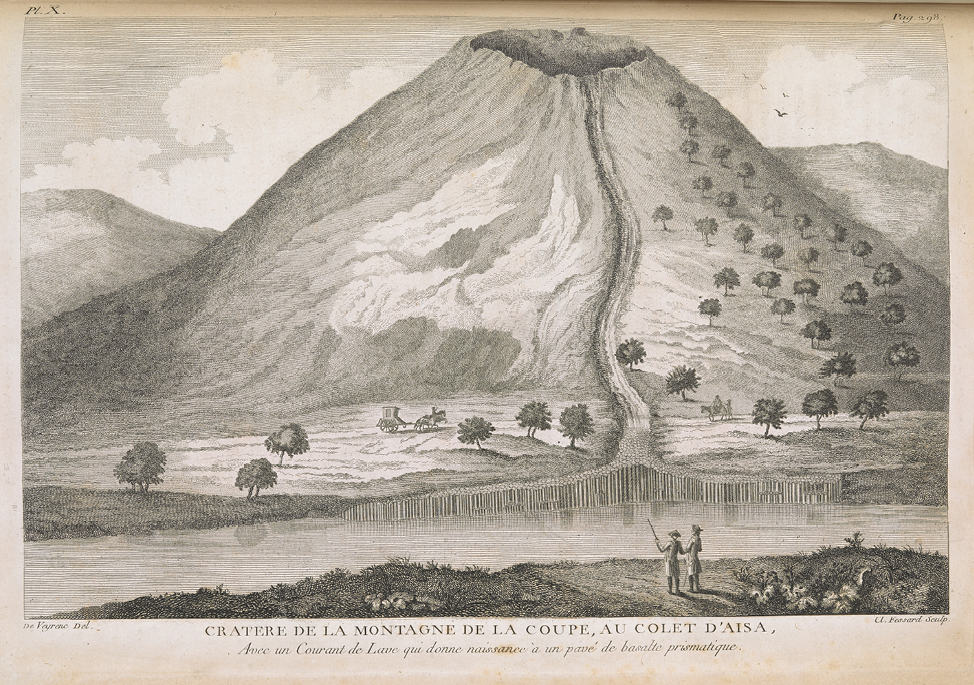
Yet it was Faujas’s Recherches sur les volcans éteints du Vivarais et du Velay (1778) that first established his reputation as a significant fieldworker and observer of volcanic terrain. It is also clear that this text aims primarily to support Desmarest’s claims about the volcanic origins of basalt, deeming the latter’s observations to be «plus méthodiques et mieux vues en général»13. To do so, his text adopts an inclusive and eclectic approach to its primary materials; all is grist to its author’s volcanic mill. For instance, when the Duc de Chaulnes, recently returned from Egypt with an ill-gotten haul of antiquities, presented some ancient Egyptian basalt statues to Faujas, the scientist thought nothing of chipping splinters of rock from the artwork for comparison with samples taken on site in Auvergne14. As we shall see, the geologist was also very aware of the use of complementary fields of enquiry in arriving at his scientific conclusions on the rocks he studied. Thus his writings make certain ethnographic assumptions in recording and relating his fieldwork. More significantly still for their knowledge production, they frequently base their arguments on both discursive and visual evidence, with pictorial exposition contributing as much as textual explanation to their conclusions on the volcanic nature of basalt in Auvergne15. The strikingly construed image of the ancient lava flows descending from the so-called Montagne de la Coupe, pooling into a neat bank of prismatic basalt columns in Plate 10 of the Recherches, offers prima facie diagrammatic proof of this claim. Faujas’s text has then only to draw the obvious conclusion:
On ne doutera plus, d’après l’inspection de cet objet [lava flow], que la lave qui a coulé des crateres ne soit absolument la même que celle des basaltes; on ne niera plus que les prismes ne soient une production volcanique & l’ouvrage du feu16 (see Fig. 1).
Whether visual or discursive in character, however, the processes of knowledge formation rely first and foremost on Faujas’s pioneering fieldwork, that is, the close observation and analysis of rock formations in situ in the hills and mountains of the Velay and Vivarais regions of south-eastern France. In his Recherches the author is forthright about the fundamental value of this work in the field:
C’est en suivant la nature pas à pas & avec méthode, qu’on peut quelquefois découvrir des sentiers qui mènent, sinon à des découvertes, du moins à la connaissance de plusieurs faits instructifs. C’est en m’efforçant de mettre constamment ces principes en pratique, que je me suis exercé à suivre & à étudier sur les lieux le basalte ou la lave compacte […]17.
This posits a certain vision of ‘nature’ itself as both a site of knowledge to be explored and an autonomous agency deploying its own practices of production which are to be imitated by the scientist. He writes that the scientist, specifically the chemist, should engage in «l’examen local des objets que la nature étale dans ses riches atteliers, où elle met en œuvre, d’une manière invariable, des procédés qu’elle nous invite à étudier & à suivre»18. Nature is both the craftsperson and the workshop she works in. As a result, Faujas frequently yokes together two verbs when describing fieldwork: nature is «à étudier & à suivre» or «à suivre & à étudier», to be both studied and imitated. In a sense, this is a paean to enlightened empiricism (studies in the field) which also conforms to the prevailing aesthetic of neo-classical emulation (imitate, not innovate). He is above all dismissive of those amateur scientists who neglect to apply this double principle, who prefer instead to speculate «du fond de leur cabinet, sans avoir examiné & suivi la nature sur place»19. This was to prove a constant refrain in Faujas’s writings. In his later Minéralogie des volcans (1784), he claims to have gleaned more from his visit to Etna, circumnavigating its entire base on foot with a geological hammer in his hand, than all previous visitors to the volcano. And he particularly urges the recently appointed Chair of Natural History in the University of Catania, Giuseppe Gioeni d’Angiò (1747-1822), to rise above the ridiculous local prejudice that prevented noblemen from exploring the mountain on foot, as «ce n’est sûrement pas de l’intérieur d’un carrosse ou d’une litière que l’on peut étudier la Nature»20.
What is more, Faujas was a strong advocate for chemical experiments to be conducted in the field and he often applied acid to his rock samples in situ21. Yet this practical chemistry was also a metaphor for the very knowledge it produces empirically, what Faujas calls «[c]ette espece (sic) de chymie des yeux & du tact», which, he claims, had been neglected hitherto22. Hence Faujas literally incorporates the chemist into his outdoor chemistry. As a result, the fieldwork engaged all his senses in its knowledge production: observing, touching, smelling, even licking rock samples – that is, organically and chemically interacting with his materials. One rock fragment that he licked, and which stuck to his tongue, was a pozzolana, a silicon-rich volcanic glass23. It often forms scoria round the crater of volcanoes and Faujas found himself, as he put it, sinking up to his knees in it, as he scrambled into the extinct crater of the Montagne de la Coupe24. Yet this physical immersion in volcanic materials was just the first part of a more concerted effort to sift, sort and class them. Thus, as far as the volcanic pozzolana of the Velay is concerned, Faujas’s chief preoccupation was to establish its volcanic origins in situ between strata of basalt and to distinguish it from some forms of non-volcanic clay which nonetheless share its celebrated cementing properties. This was, then, a particular fieldwork corrective to the armchair theorists in Paris who had wrongly identified pozzolana as a clay baked hard by volcanic heat, rather than an igneous rock similar in origin and composition to basalt itself25.
Having said that, Faujas is more tentative when it comes to deducing the processes of rock formation from the samples he analyses in the field. Discussing breccia and pudding lavas, seemingly formed by molten volcanic matter coming into contact with groundwater or seawater, he hazards some assumptions about the reactions at work but they are hedged with terms like «probable» and «probablement» and finally bracketed out as «une multitude de phénomenes qui nous sont encore inconnus, ou que nous voyons sans en soupçonner la cause»26. In similar fashion, confronted with gigantic slabs of tabular basalt near Mezinc, Faujas cautiously advances the hypothesis that they are formed underground before they are lifted wholesale out of the magma chamber in the course of a later eruption. But he prefaces this supposition with a frank avowal that «je suis bien éloigné de concevoir comment la chose s’est opérée, & je n’aurai pas la témérité de vouloir développer ici une théorie aussi épineuse»27. While he might occasionally then rehearse the cooling processes operative in creating amazingly regular prismatic basalt columns in the area, Faujas is consistently reluctant to speculate at length on rock formation. Consequently, knowledge production derives much more from a study of finished rock forms than from ongoing rock formation.
The study of rock forms in situ thus falls back on the classical epistemological tools of alphabetizing, cataloguing and classifying its objects of knowledge, as famously analysed by Michel Foucault in Les Mots et les choses28. Relations of similarity and equivalence, especially with other volcanic sites, are also in evidence, as is the so-called ‘ordering code’ of analogy. For instance, following Desmarest in his comparative topography, Faujas compares rounded prisms of basalt discovered in the Vivarais with those found on Vesuvius; or he explicitly calls the basalt prisms at the foot of the Montagne de la Coupe «un pavé des géans», in homage to the celebrated tourist site in Antrim, Northern Ireland29. Elsewhere in the text certain basalt excrescences are compared to a set of organ pipes or are said to imitate cables and petrified tree trunks30. Yet our contention here is that Faujas’s knowledge production is already moving beyond these classic Enlightenment practices to focus more on the forms in and of themselves, or to compare forms only with like forms. In other words, his Recherches realize a shift in producing an understanding of its volcanic objects from analogous thinking to a thinking based on discerning patterns in nature31. (This in turn could be seen as prefiguring the more widespread nineteenth-century preoccupation with morphologies and other recurrent natural motifs, as in Georges Cuvier’s comparative anatomy, Johann Wolfgang von Goethe’s Ur-Pflänze or Luke Howard’s modifications of clouds). In practical fieldwork terms, this means that Faujas favours the devices of «cassure» and «coupe», fracturing his rock samples to produce prisms and larger-scale projections of geological cross-sections. Rightly distrustful of the misleading weathering effects on the surface of the basalt in the Velay, Faujas thus insists: «On doit donc être attentif à rompre le basalte et à lire dans les cassures!»32. Knowledge is a matter of internal ‘truths’, of the purity of mineral and crystal forms inside the rock. This is evident in the very first of the illustrations in Faujas’s text: «Prismes de Basalte et de Schorls» (see fig. 2). What is more, these rock fragments can be visibly enhanced to uncover their secrets by sawing and polishing them. Dipped in clear water afterwards, the rock then reveals its authentic colour. For Faujas colour is a consistent means of literally ‘nuancing’ his understanding of rock-types without recourse to markers of external equivalence or analogy33. As for the practice of the «coupe», this is mostly provided diagrammatically. And as Martin Rudwick has shown, in an age when volcanological studies rarely used cross-sections, Faujas provides one to configure the shallow, blocked vent of the Montbrul crater as well as a series of oddly symmetrical box-like caverns34. The appropriately named Montagne de la Coupe is not presented in cross-section; and yet the solidified river of lava that runs from its summit appears almost as a sectioning of the volcano’s principal vent (see fig. 1).
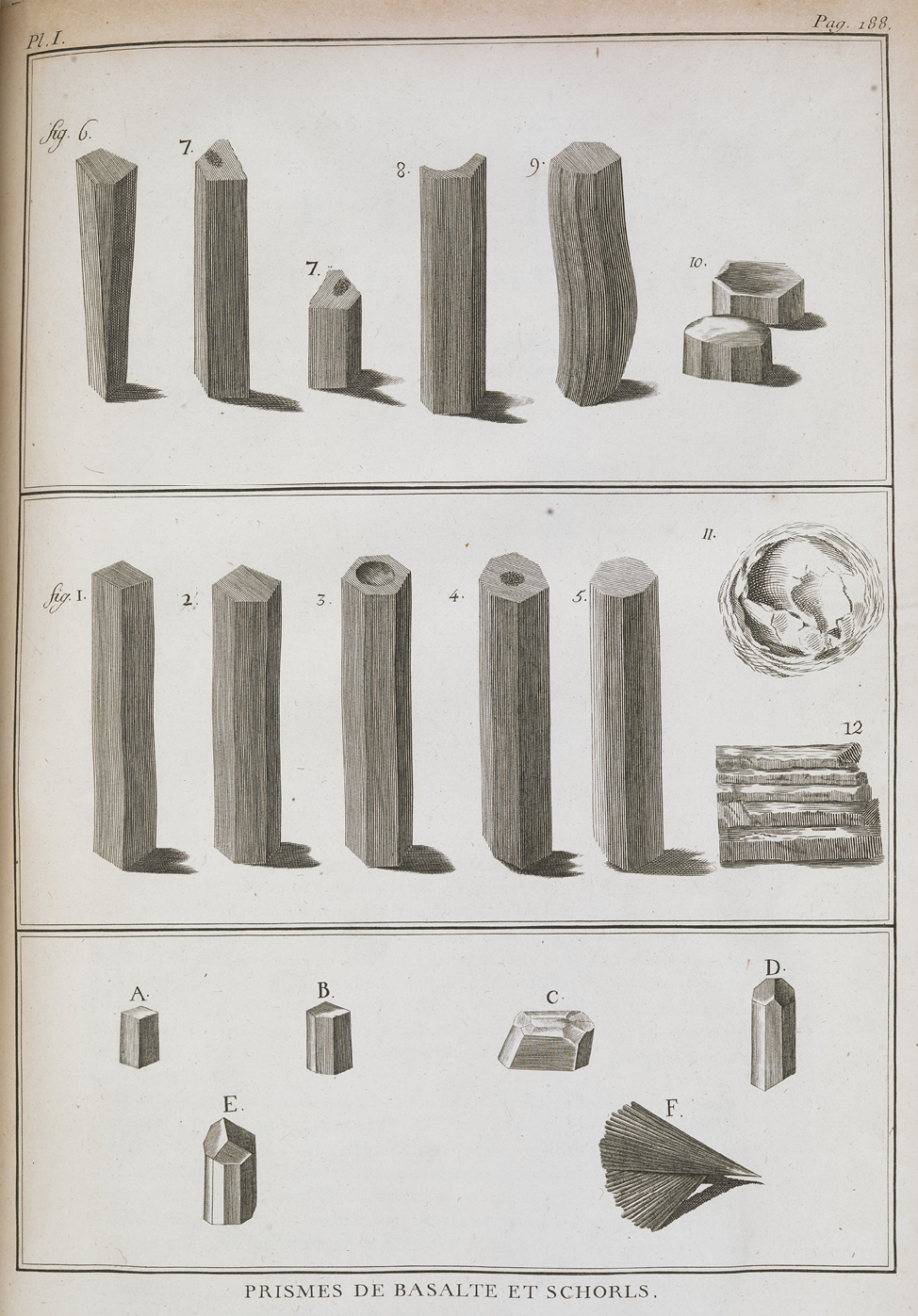
What ultimately unites the knowledge produced by the large-scale slicing-through the extinct volcano and the small-scale prisms fashioned from portable rock samples is crystalline form. The predominance of spectacular arrangements of unusually regular polyhedral basalt columns in the area quite possibly over-determines this methodology. It is certainly true that crystals are at the heart of Faujas’s quest for comprehension of the products – if not the processes – of volcanism. In this connection, he cites his correspondence with the pioneering French crystallographer Jean-Baptiste Louis Romé de l’Isle (1736-1790), author of Essai de cristallographie (1772) and Cristallographie, ou Description des formes propres à tous les corps du règne minéral (1782). As the latter title suggests, Romé de l’Isle’s innovative crystallography proposed a study of form as a primary feature of its object of study. It did so in the face of considerable scientific opposition from the likes of Buffon who held that form was essentially a secondary characteristic of rock crystals – alluring, certainly, but a distraction from grasping other revealing physical qualities of the rock such as density, hardness or combustibility35. Detecting everywhere around him in the Velay hills, the purer, cleaner forms of basalt columns and finding phenocrysts of quartz, tourmaline («schorl»), and feldspar in the rocks that he splits, Faujas follows Romé de l’Isle in his focus on form. If a further example of this methodological preference were needed, we could point here to the geologist’s repeated panning for garnets and sapphires in the mountain streams about a kilometre outside of Puy-en-Velay, the gemstones being identified by their prismatic form and distinctive colours and cross-referenced in each instance against Romé de l’Isle’s seminal 1772 text36.
What we appear to find in Faujas’s Recherches is a sort of epistemological extraction. Knowledge is mined in the same way that pozzolana deposits or semi-precious gemstones are mined: it is superficially sought among equivalences of rock-type and topography but is extracted according to situation in the field (pozzolana) or its prismatic purity of form (tourmaline, garnet). And just as mining supposes an exploitation of natural resources for social ends, so Faujas’s terminology for these basalt features suggests that he already conceives of them as subordinate to human purpose and design. They are configured as «boulevard», «rempart», «digue», «pavé», and «chaussée» – the language of an architect or engineer, not a disinterested geologist37. We will return to this point later when considering the aestheticization of the volcanic landscape in Faujas’s text.
It is also worth noting that the value of this knowledge production is further increased by depicting the extraction process as hampered by the backwardness, even the dangerous suspiciousness, of the local population. Indulging a classic late eighteenth-century ethnographic impulse, Faujas recounts how on his numerous excursions into the rural wildernesses of Auvergne, he was mistaken for a government tax-collector or the local seigneur’s spy. In an inn near Bastide – «misérable cabaret isolé, dont il est difficile de peindre le désordre, l’état de délabrement & de mal-propreté» – a group of increasingly drunk mule-drivers grew deeply suspicious of his fine clothes and his draughtsman’s bulging portfolio of local plans. But Faujas, who was born in near-by Montélimar and understood the local patois, was able to assuage the menacing muleteers by paying them in advance to transport his hundredweight of basalt columns back to town. The geologist also reassured his fellow-travellers that elsewhere in the Vivarais the murderous locals of the Cheyllard and Boutières cantons had recently been tamed by the local military governor, le chevalier de la Coste, who had successfully disciplined and disarmed them (although Faujas does not specify how)38. These might just seem like diverting sketches of local colour. But they also have the effect of raising the status of the knowledge extracted not just from isolated, craggy locales, but from among ignorant, hostile inhabitants of the region.
If such amateur ethnography complements Faujas’s geological and mineralogical knowledge production, the same is true of his aesthetics39. And it is true in at least two ways. Faujas does not hesitate to communicate his own sense of extreme aesthetic pleasure either in i.) unearthing exquisite basalt samples or in ii.) contemplating sweeping wild volcanic landscapes. Thus when Faujas methodically enumerates the location and size of prismatic basalts that he discovers, he clearly focusses on their crystal forms. But he does so as much as a collector of valuable rarities as a reasoning mineralogist, evaluating his finds not just for their geological significance but also for their aesthetic worth as prized curios. Triangular prisms of black tourmaline, or «schorl» as he calls it, occur only rarely in the area, hence Faujas was noticeably pleased to uncover a few samples near Rochemaure40. However, the real prize was octahedral or nonahedral rods of basalt, like those composing the steps of the Giant’s Causeway in Northern Ireland, as described in Romé de l’Isle’s Essai de cristallographie. To his patent delight, Faujas eventually found an eight-sided basalt column on mont Chenavari. «J’avoue», he writes, «qu’elle me fit un extrême plaisir; elle avait 1 pied ½ de diamètre, sur 5 pieds de hauteur»41. A two-hundred-pound (approximately ninety kilograms) section of this rock was thus leveraged away intact from the hillside and immediately transported back to the geologist’s study. As for the volcanic landscapes of the Velay and Vivarais, these are captured not just in Faujas’s prose but also in the high-quality drawings made by his hard-working draughtsman Julien-Victor Veyrenc (1756-1837), crucially produced in situ, and later engraved by Claude Fessard (1740-1803) for publication with the text. Faujas is clearly not immune to the beauties of the volcanic topographies in which he works; and is no doubt aware of the sublime and picturesque aesthetics that were then in vogue42. He qualifies the château of Rochemaure, perched on a range of striking basalt butts, as «le site le plus pittoresque»; and marvels at the imbrication over time of «les ruines de la nature parmi les ruines de l’art», that is, the basalt columns and medieval walls composing a single stone entity43. Indeed, in Veyrenc’s accompanying illustration, the basalt appears of more recent fabrication than the crumbling castle masonry (see fig. 3).
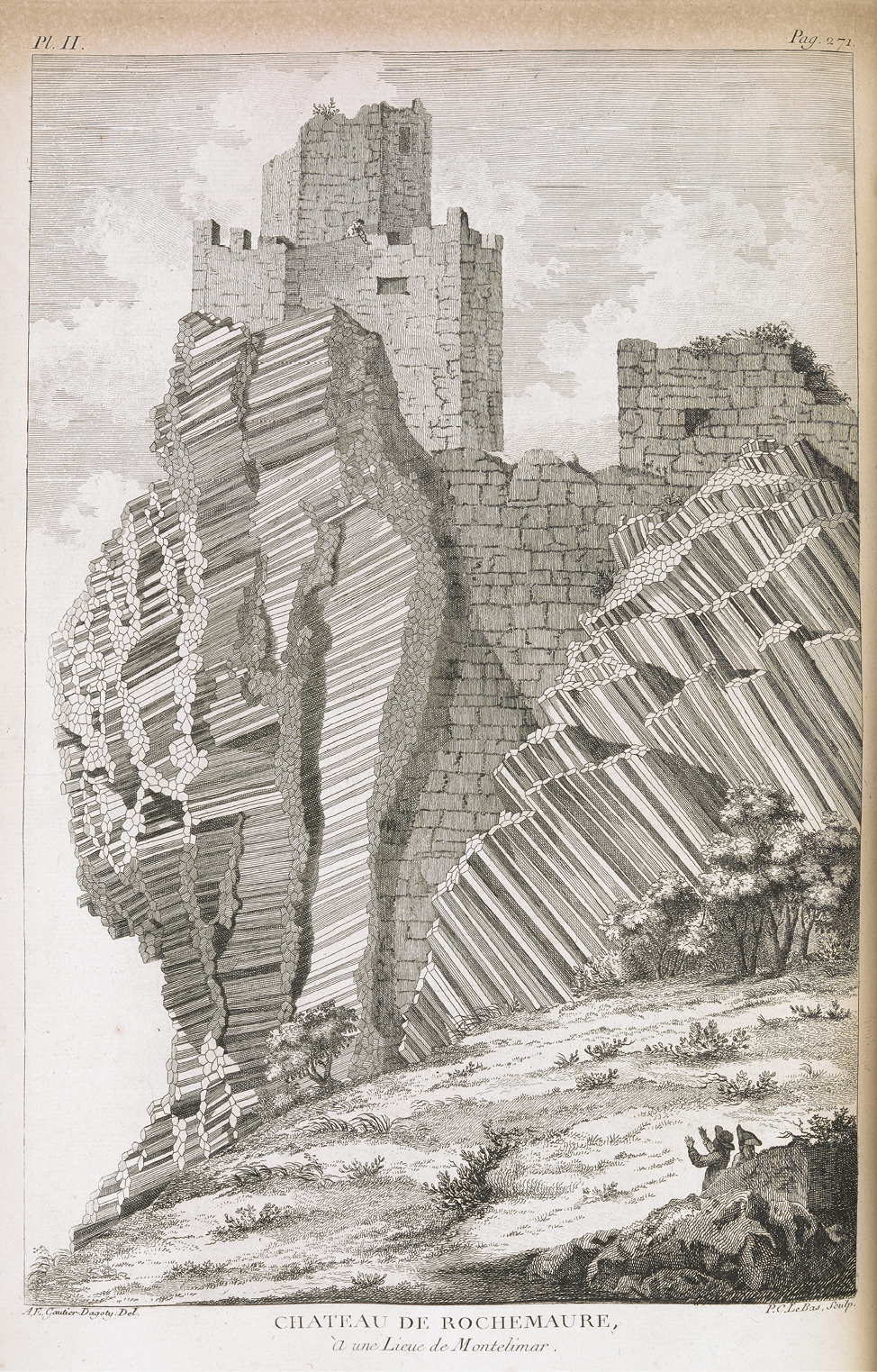
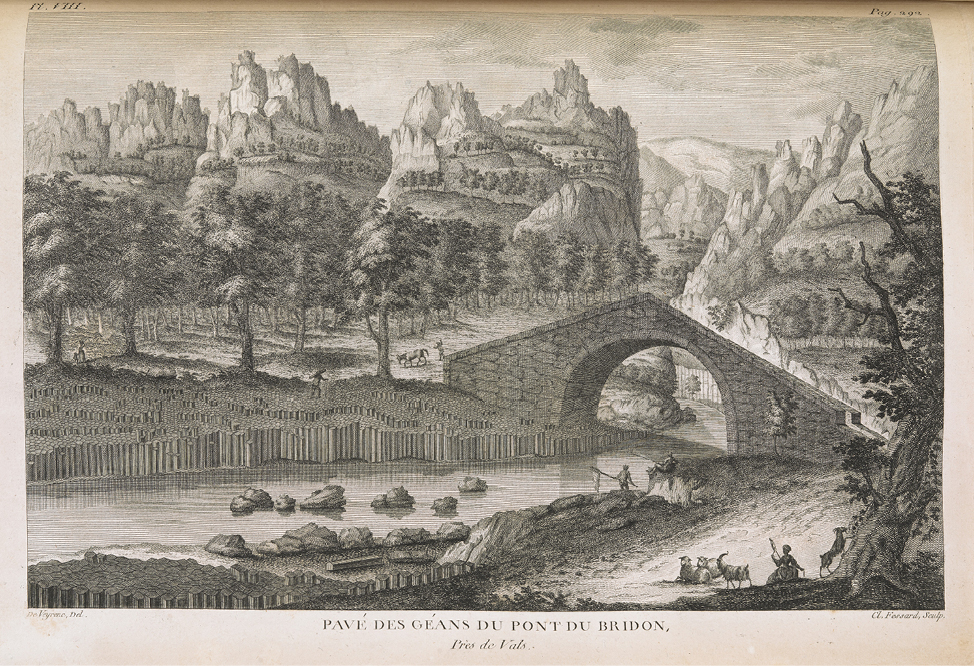
But in relation to knowledge production what seems important here is a further aesthetic promotion of form over formation. The artist, after all, is able to stylize, if not always idealize, the neat articulations and geometrical forms of the basalt to a degree that might go beyond their observation in situ. An example of this tendency would be Plate 8 in the Recherches, entitled «Pavé des géans du pont du Bridon»44 (see fig. 4). Here Veyrenc depicts a sort of Arcadian landscape in which the architectural forms of the bridge blend harmoniously and timelessly with the natural forms of its basalt support. Faujas then completes the fusion discursively by proposing an initial ‘reading’ of the landscape in which the basalt foundations appear at first sight to be the work of man not nature: «l’on croit d’abord en voyant [cette chaussée] de loin que c’est un ouvrage d’art fait pour contenir le torrent». However, on closer inspection, this interpretation is revised in recognizing that the bed of rock is clearly a natural geological phenomenon. The initial conception of the basalt outcrop as manmade has nonetheless been planted in the reader’s mind. This device, well known to rhetoricians, is called a paralipsis. Faujas’s presentation of the topography in this manner further facilitates its aestheticization in terms drawn from art and architecture: «mais à mesure qu’on approche, on voit les prismes se développer, former une belle mosaïque qui s’exhausse en talus, et marche comme par gradation jusqu’au pied d’un grand rocher de granit»45. The terms «mosaïque» (mosaic) and «talus» (embankment) imply human techniques of construction, the former also hinting at an aesthetically pleasing arrangement of its component parts.
Yet for all its focus on the finished character of forms in nature, Faujas’s own work is not presented as the final word on the volcanoes of the Vivarais and Velay. As an empiricist, Faujas presents the knowledge derived from his fieldwork as an incomplete, ongoing process of production, textually and materially embedded in what like-minded contemporaries are also producing. Hence his Recherches literally imbricate and circulate correspondence to and from his fellow geologists in their elaboration. Faujas thus publishes his replies relating to his findings, written to internationally known earth scientists such as Georges-Louis Leclerc de Buffon (1707-1788) in Paris, Horace Bénédict de Saussure (1740-1799) in Switzerland or Sir William Hamilton (1730-1803) in Naples as well as to local authorities on the volcanic topography of Auvergne like the marquis Jean-Baptiste de Geoffre de Chabrignac (1739-1781)46. In the same way that the chemist and his chemistry are constituted reciprocally in their material interactions in the field, so the textual constitution of Faujas’s thinking on the extinct volcanoes of the Velay and Vivarais is composed not only of his letters to other earth scientists but also includes their correspondence with him, in a sort of discursive imbrication of knowledge which is layered like a rock face. Thus the marquis de Geoffre de Chabrignac’s letter to Faujas contains within it another missive from «M. Pascal, prieur du Colombier», recounting his experiments on domestic animals placed in the so-called «Puits de la Poule» south of Loubeyrat47. What is significant in this last example is the socially levelling process of knowledge exchange around its volcanic objects in Auvergne. The empirical data produced by the humble cleric or the local seigneur are set on a par with the informed opinions of established figures in the European scientific community. Guettard had initiated this valorization of local knowledge as far as the volcanological exploration of Auvergne was concerned; for instance, he mentions in his work the samples of ancient lava sent to him by the local doctor M. de l’Arbre from the village of Pontgibaud, north-west of Clermont-Ferrand48. And as this last example makes clear, the letters exchanged in geological networks were not only paper documents; they frequently included rock samples, such as the basalt prisms accompanying Faujas’s letter to Sir William Hamilton for the latter to compare in situ with the lavas of Vesuvius49. In this way the rock sampling carried out on the mountainside extends to the sort of comparative mineralogy that Desmarest had practised in his notes in Encyclopédie when he assimilated the basalt columns of Auvergne to those of the Giant’s Causeway. By further extension, the letters in Faujas’s Recherches provide a sort of textual sampling modelled on the exchange of materials collected in the field. As recent research has also shown, Faujas’s web of geological correspondence intersected with other late eighteenth-century networks of knowledge exchange at local, national and European levels50.
In conclusion then, and for all of the reasons laid out above, Faujas’s Recherches sur les volcans éteints du Vivarais et du Velay constitute a substantial work of in situ eighteenth-century knowledge production. In seeking to prove beyond doubt the volcanic origins of the basalt topographies of Auvergne, he valorizes physical exploration, close observation and hands-on experimentation in the field. He suggests that the human body is just another instrument in the physical and chemical tool-kit of the intrepid geologist. And in the inert volcanic environment of the Vivarais and Velay hills, he is understandably more disposed to analyse the unusually geometrical forms of their rocks than to theorize their eruptive formation. Having said that, the privileging of form has specific implications for Faujas’s knowledge production, as it has been argued in this article. The knowledge produced in this manner ‘reads’ nature less by analogy than by patterning, less by surface appearance than by cutting through its materials, by «cassure» and by «coupe». As such, it draws closer in its epistemology to mineralogy and the new discipline of crystallography. Moreover, Faujas’s scientific and empirical forms of knowledge extraction from the volcanic hills of Auvergne are reinforced by significant ethnographic and aesthetic complements which increase the value of the knowledge brought home from the field and further stylize it in favour of form over formation. This knowledge is then recast further in its extensive relaying (not to say, relayering) via highly active networks of scientific correspondence. In sum, it is innovative fieldwork reworked through a number of specific contemporary intellectual and discursive practices.
1 P. Francis and C. Oppenheimer, Volcanoes (1976), Oxford University Press, Oxford 20042, p. 33. Touchstone is in fact another type of rock altogether, although it was frequently confused with basalt in the eighteenth century.
2 See G.-L. Leclerc, comte de Buffon, Histoire naturelle, générale et particulière, vol. I, Imprimerie royale, Paris 1749, pp. 99, 523-524; A. Lazzaro Moro, De’ Crostacei e degli altri marini corpi che si truovano su’ monti, Stefano Monti, Venezia 1740, especially «Libro Secondo», pp. 211-432. On the Neptunist/Plutonist debate more generally, see D.A. Young, Mind over Magma: The Story of Igneous Petrology, Princeton University Press, Princeton 2003, pp. 16-61.
3 J.-É. Guettard, Mémoire sur quelques montagnes de la France qui ont été des volcans, «Mémoires de l’Académie royale des sciences», Année MDCCLII, Imprimerie Royale, Paris 1756, pp. 27-59: 47. The original spelling is retained from all primary sources.
4 Idem, p. 46.
5 Idem, p. 55.
6 See Guettard’s references to the field knowledge of the Clermont chemist J.-F. Ozy (who would later claim to have preceded Guettard in having first perceived the volcanism of Auvergne hills), in Idem, pp. 37-39, 57. See also the excellent chapter by K.L. Taylor, Geological Travellers in Auvergne, 1751-1800, in Four Centuries of Geological Travel: The Search for Knowledge on Foot, Bicycle, Sledge and Camel, ed. by P.N. Wyse Jackson, Geological Society of London, London 2007, pp. 73-96, which contains an exhaustive chronological index of Guettard’s volcano-hunting successors in the region (pp. 82-88).
7 N. Desmarest, Histoire naturelle. Regne Minéral. Sixième Collection. Volcans, Solfatare, & Pavé des géans, in Encyclopédie ou Dictionnaire raisonné des sciences, des arts et des métiers, éd. par D. Diderot et J.-B. Le Rond D’Alembert, vol. XXIII, Briasson, Paris 1768, pp. 3-4. See the online edition ARTFL Encyclopédie (Autumn 2022 Edition), ed. by R. Morrissey and G. Roe, University of Chicago, <http://encyclopedie.uchicago.edu/> (08/10/2025). Desmarest’s key observations relate to the seventh plate in this collection, Basalte d’Auvergne.
8 Idem, p. 4.
9 N. Desmarest, Mémoire sur l’origine & la nature du basalte à grande colonnes polygones, déterminées par l’histoire naturelle de cette pierre, observée en Auvergne, «Mémoires de l’Académie royale des sciences», Année MDCCLXXI, Imprimerie Royale, Paris 1774, pp. 705-775. For more on Desmarest, see P. Richet, Nicolas Desmarest et l’origine volcanique du basalte, «Travaux du Comité français d’Histoire de la Géologie», 3, 2003, 17, pp. 81-97.
10 This initial contextualization of Faujas’s fieldwork in relation to the findings of Guettard and Desmarest is based on the more extensive considerations of the ‘empirical turn’ in volcanology in the mid- to late eighteenth-century Europe in D. McCallam, Volcanoes in Eighteenth-Century Europe: An Essay in Environmental Humanities, Oxford University Studies in the Enlightenment, Liverpool University Press, Liverpool 2019, pp. 70-77.
11 On Faujas de Saint-Fond more generally, see G. Comparato, Barthélemy Faujas de Saint-Fond, parcours d’un homme de sciences mondain au tournant des Lumières (1741-1819), Thèse de doctorat, Université Grenoble Alpes, 2016, and the excellent article drawn from it, De la pierre à la presse: pratiques du voyage, de l’analyse et de l’écriture chez Barthélemy Faujas de Saint-Fond 1741-1819, «Cahiers François Viète», 3, 2018, 5, pp. 11-31; see also H. Veil, Mitten im Umsturz Europas: Der Geologe und Revolutionär Faujas de Saint-Fond (1741 bis 1819), Humanities Online, Frankfurt am Main 2012.
12 See B. Faujas de Saint-Fond, Voyage en Angleterre, en Écosse et aux îles Hébrides, H.J. Jansen, Paris 1797.
13 B. Faujas de Saint-Fond, Recherches sur les volcans éteints du Vivarais et du Velay, J. Cuchet, Grenoble; Nyon aîné, Paris 1778, p. 136.
14 Idem, pp. 136-138.
15 On the diverse ‘codes’ determining word and image interaction, see R. Gualdo, Dialoghi tra parole e immagini, Carocci, Roma 2022.
16 Faujas de Saint-Fond, Recherches, cit., p. 298.
17 Idem, p. 135.
18 Ibidem.
19 Idem, p. 134.
20 B. Faujas de Saint-Fond, Minéralogie des volcans, ou Description de toutes les substances produites ou rejetées par les feux souterrains, J. Cuchet, Paris 1784, pp. 467-468.
21 For comparable field chemical experiments on the slopes of Vesuvius, see C. Guerra, If You Don’t Have a Good Laboratory, Find a Good Volcano: Mount Vesuvius as a Natural Chemical Laboratory in Eighteenth-Century Italy, «Ambix», 62, 2015, 3, pp. 245-265. And more generally, on the subject of chemistry and volcanism in eighteenth-century Italy, see the same author’s Lavoisier e Parthenope. Contributo ad una storia della chimica del regno di Napoli, Società Napoletana di Storia Patria, Napoli 2017.
22 Faujas de Saint-Fond, Recherches, cit., p. 135.
23 Idem, p. 181. Guettard also tasted minerals to determine their composition, as is clear from his Mémoire sur quelques montagnes, cit., p. 51.
24 Faujas de Saint-Fond, Recherches, cit., p. 298.
25 Idem, p. 181. On pozzolana as an ingredient in old and new cements, see V. Thiéry, Barthélémy Faujas de Saint-Fond (1741-1819) and His Work on Pozzolans and Lime: A Pioneer in Sustainable Building, «Proceedings of the Geologists’ Association», 135, 2024, 4, pp. 481-485; see also A. Guillerme, From Lime to Cement: The Industrial Revolution in French Civil Engineering (1770-1850), «History and Technology: An International Journal», 3, 1986, 1, pp. 25-85.
26 Faujas de Saint-Fond, Recherches, cit., p. 178.
27 Idem, p. 158.
28 M. Foucault, Les Mots et les choses: une archéologie des sciences humaines, Gallimard, Paris 1966, p. 16.
29 Faujas de Saint-Fond, Recherches, cit., pp. 155, 297.
30 Idem, pp. 292, 297.
31 See D. McCallam, From Analogies to Patterns: Images in French and British Geological Texts (1760-1800), in Visualizing the Text: From Manuscript Culture to the Age of Caricature, ed. by L. Beck and C. Ionescu, University of Delaware Press, Newark DE 2017, pp. 203-225.
32 Faujas de Saint-Fond, Recherches, cit., p. 140.
33 The term «nuance» in French is defined in its primary sense as the «degrés par lesquels peut passer une même couleur», and is derived from the verb «nuer», meaning to classify or match colours, originally applied to the palette of colours of clouds in the sky, as its root is «nue» from the Latin «nubes» meaning «cloud». See Le Petit Robert: Dictionnaire de la langue française, Dictionnaires Le Robert, Paris 1994, p. 1505.
34 Faujas de Saint-Fond, Recherches, cit., Coupe d’une partie intérieure du cratère de Montbrul, Plate 7, pp. 286-287. See M.J.S. Rudwick, The Emergence of a Visual Language for Geological Science (1760-1840), «History of Science», 14, 1976, pp. 149-195.
35 See D. Longeot, La genèse de la cristallographie et de la minéralogie scientifique, «Dix-Huitième Siècle», 3, 1971, pp. 253-264.
36 Faujas de Saint-Fond, Recherches, cit., pp. 185-186. On the importance of gemstones in the period, see Gems in the Early Modern World: Materials, Knowledge and Global Trade, 1450-1800, ed. by M. Bycroft and S. Dupré, Palgrave Macmillan, London 2018.
37 Faujas de Saint-Fond, Recherches, cit., pp. 271, 292, 297.
38 Idem, pp. 138-140.
39 A similarly empirically informed aesthetic of volcanic landscapes was developed in Naples where Sir William Hamilton employed the artist Pietro Fabris to provide quality illustrations for his study of Vesuvius and its environs, Campi Phlegraei: Observations on the Volcanos of the Two Sicilies, Naples 1776. See C. Knight, Sir William Hamilton’s Campi Phlegraei and the Artistic Contribution of Peter Fabris, in Oxford, China and Italy: Writings in Honour of Sir Harold Acton, ed. by E. Chaney and N. Ritchie, Thames & Hudson, London 1984, pp. 192-208.
40 Faujas de Saint-Fond, Recherches, cit., p. 148.
41 Idem, p. 152.
42 On the sublime, see B. Saint Girons, Fiat Lux: Une philosophie du sublime, Quai Voltaire, Paris 1993; and R. Doran, The Theory of the Sublime from Longinus to Kant, Cambridge University Press, Cambridge 2015; on the picturesque, see The Politics of the Picturesque: Literature, Landscape and Aesthetics since 1770, edited by S. Copley and P. Garside, Cambridge University Press, Cambridge 1994; and C. Chard, Pleasure and Guilt on the Grand Tour: Travel Writing and Imaginative Geography (1600-1830), Manchester University Press, Manchester 1999.
43 Faujas de Saint-Fond, Recherches, cit., pp. 269-272.
44 Idem, pp. 292-293.
45 Idem, p. 292.
46 Idem, pp. 327, 308, 189, 306.
47 Idem, pp. 303-305. Pascal’s experiments with animals in wells recall the much more famous «Grotta del Cane» near Pozzuoli outside Naples. The cave was so called because dogs were routinely thrust into its asphyxiating volcanic vapours for the edification and amusement of tourists. Once unconscious, the poor dogs were pulled out and revived by being thrown into a near-by lake. See, for example, C. Pinot Duclos, Voyage en Italie, ou Considérations sur l’Italie, Buisson, Paris 1791, p. 389.
48 Guettard, Mémoire sur quelques montagnes, cit., p. 57.
49 Faujas de Saint-Fond, Recherches, cit., pp. 195-196. Hamilton appears to be Faujas’s principal contact in Italy, although he is clearly aware of the work of Giovanni Maria Della Torre (1710-1782) and, indeed, critical of the latter’s chemical and mineralogical knowledge (Recherches, cit., p. 2). He is also acquainted with the works of other Italian volcanologists, such as Ignazio Sorrentino (1663-1738) and Andrea Pigonati (1734-1790), both cited in passing in the opening survey-like Discours of his Recherches. Yet his references to the Italian mineralogist abbé Gaetano de Bottis (1721-1790) seem to be based on a personal rather than a literary connection (e.g., Recherches, cit., pp. 27-28, 34).
50 The international networks are well-established; see, for example, McCallam, Volcanoes in Eighteenth-Century Europe, cit., pp. 77-85. What is interesting is the growth in research regarding Faujas’s important local networks of correspondence and readership. See, for instance, J. Mergoil and J. Mergoil-Daniel, L’abbé Gui de Mortessagnes (1714-1796), collaborateur de Faujas de Saint-Fond et pionnier de la volcanologie en Vivarais-Velay (France), «Comptes rendus – Géosciences», 343, 2011, 5, pp. 370-378; and A. Collomp, Un médecin des Lumières: Michel Darluc, naturaliste provençal, Presses Universitaires de Rennes, Rennes 2011, pp. 20-21, 119-123.